The snow came without warning on a Tuesday evening.
At first, it drifted down gently over Mill Haven, Pennsylvania, dusting the rooftops and parked cars like powdered sugar.
Then, just after four o’clock, the sky turned the color of old pewter, the wind shifted hard from the north, and winter stopped pretending to be pretty.
By five, the world outside Dorothy May Jenkins’s roadside diner had vanished behind a wall of white.
Dorothy had been running Jenkins Family Diner for thirty-one years. She had seen every kind of weather roll through that little stretch of highway: summer thunderstorms that flooded the ditches, autumn winds that stripped the maples bare overnight, and winter freezes that turned the parking lot into a sheet of glass.
But this storm felt different.
It had weight.
It pressed against the windows and rattled the glass. It threw snow sideways across the neon sign until the pink and yellow letters flickered like a tired heartbeat.
JENKINS FAMILY DINER
HOT COFFEE • HOMEMADE PIE
Dorothy stood behind the counter, wiping a clean spot that was already clean, listening to the radio.
“Travel is strongly discouraged,” the announcer said. “County Road 14 is closed past the bridge. Interstate ramps are being shut down one by one. If you are already home, stay home. If you are on the road, seek shelter immediately.”
Dorothy clicked the radio off.
She did not need a man in a studio telling her what the sky had already said.
The diner was nearly empty. Old Henry had finished his oatmeal early and left before the worst of the snow. The schoolteacher sisters, Mary and Louise, had canceled their usual coffee stop. Even the mail carrier, who normally came in at five-thirty for soup, had called to say the post office was closing early.
Dorothy looked toward the pie rack.
Apple.
Peach.
Sweet potato.
All unsold.
She sighed.
“Waste of good pie,” she muttered.
Her late husband Calvin’s picture sat on the shelf behind the register. He was smiling in the photo, one arm around Dorothy’s shoulders, the diner’s grand opening sign hanging behind them. They had been younger then, foolish enough to believe enthusiasm could pay bills and stubborn enough to make it true.
Calvin had been gone eight years.
Dorothy still spoke to him when the diner was quiet.
“Looks like it’s just you and me tonight,” she said to the photograph.
Then she heard the rumbling.
At first, she thought it was thunder.
Low.
Distant.
Rolling through the storm.
But thunder fades.
This sound did not.
It grew.
Deepened.
Spread through the floor beneath her shoes.
Dorothy set down her cloth and turned toward the windows.
Headlights appeared first.
One pair.
Then another.
Then another.
They cut through the snow in long, trembling beams, turning into her gravel parking lot one by one.
Motorcycles.
Fifteen of them.
They parked in a careful line, engines coughing off one after another.
The sudden silence after all that rumbling felt almost strange.
Dorothy stood behind the counter, watching.
The men who climbed off those bikes were large. That was the first thing anyone would have noticed. Broad shoulders. Heavy boots. Beards frosted with snow. Hands red from cold. Jackets worn hard by weather and miles.
They looked up at her diner sign.
Then at the storm.
Then at one another.
Dorothy could have locked the door.
She thought about it for exactly one second.
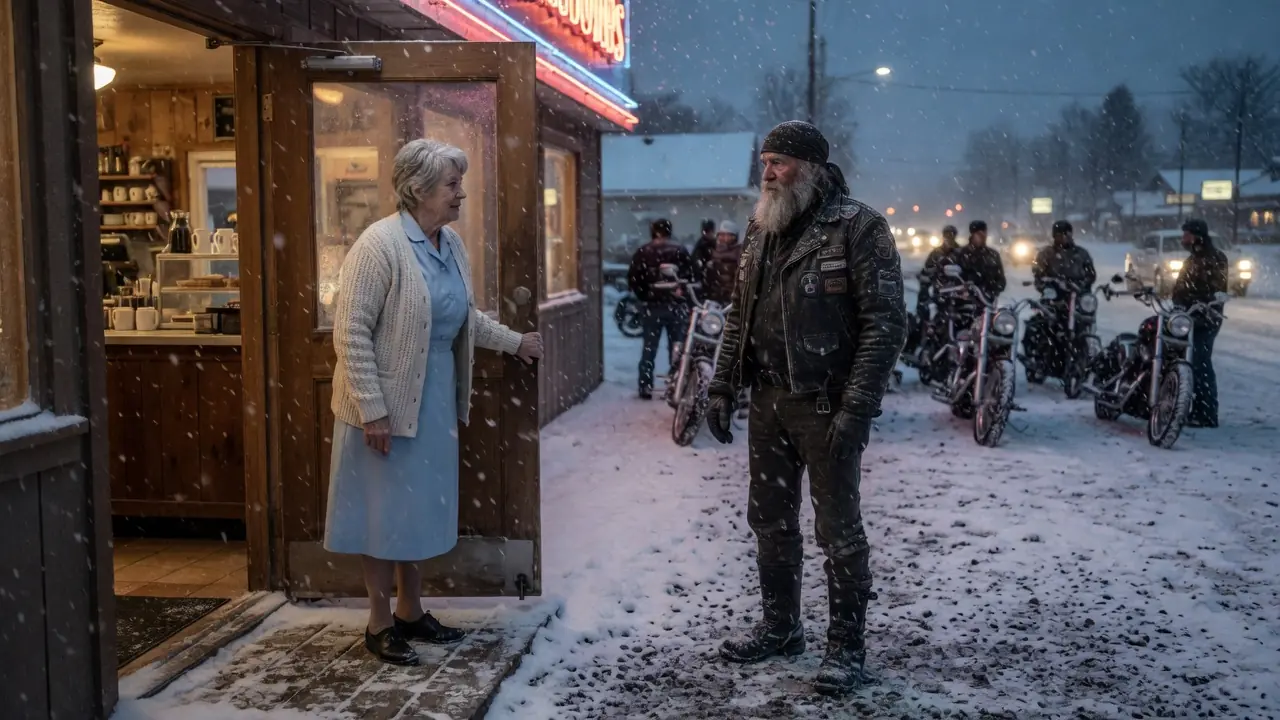
Then she walked across the diner, opened the front door, and pushed it wide.
Cold slammed into her face.
“You all better get in here before you freeze solid,” she called.
The man in front stopped.
He was the tallest of them, with a silver beard that reached his chest and eyes the pale blue-gray of winter sky. Snow had settled along the shoulders of his jacket like flour.
He looked at Dorothy for a long moment, as if trying to decide whether she was serious.
“Ma’am,” he said slowly, “there are fifteen of us.”
Dorothy lifted one eyebrow.
“I can count.”
A few of the riders exchanged glances.
The silver-bearded man almost smiled.
Dorothy stepped back from the doorway.
“Come on in. You’re letting the heat out.”
That did it.
One by one, the bikers filed through the door, stomping snow from their boots and filling the small diner with the smell of cold air, engine oil, wet leather, and highway wind.
They took up the booths along the windows, pulled chairs from empty tables, and stood awkwardly at first, as if they did not quite know how to be welcomed without suspicion.
Dorothy understood that look.
She had seen it in truckers, widowers, runaways, and lonely men who came in at midnight to order coffee they did not want simply because there was nowhere else lit.
The tall man removed his gloves and approached the counter.
“Russell Kowalski,” he said, offering his hand carefully.
Dorothy shook it.
His grip was strong, but gentle. The grip of a man who knew his strength and chose not to prove it.
“Dorothy May Jenkins,” she said.
“I figured the Jenkins part.”
She glanced at her name tag.
“Then you’re sharper than half the folks who come in here.”
That made one of the younger bikers laugh.
Russell looked toward the windows.
“We were trying to get to Clarksburg. Highway patrol closed the interstate behind us. We thought we could make the next motel.”
“How far?”
“About twelve miles.”
Dorothy looked out at the snow falling sideways.
“Twelve miles in this might as well be a hundred.”
A shorter man with a red beard stepped closer.
“We don’t want to trouble you, ma’am. We can wait a bit and see if the plows—”
“You’re staying here tonight,” Dorothy said.
The room went quiet.
Not suspicious quiet.
Surprised quiet.
The kind of silence that comes when generosity arrives in a shape no one expected.
Russell looked around the diner. The booths. The counter. The narrow hallway leading to the small apartment Dorothy had built onto the back after Calvin died. The storage room stacked with napkins, canned tomatoes, and old Christmas decorations.
Then he looked back at her.
“Dorothy May,” he said carefully, “you don’t know us.”
“I know you’re cold,” she said. “I know it’s snowing. And I know I’ve got soup going to waste if nobody eats it.”
He stared at her for another second.
She turned toward the kitchen.
“Who wants coffee?”
Every hand went up.
Dorothy snorted.
“That’s what I thought.”
She had chicken soup left from the lunch special, a deep pot of it thick with carrots, celery, noodles, and shredded meat. She had cornbread she had made that morning and not sold. She had pie waiting on the rack. She had coffee enough for a small army because Calvin had always said there was no such thing as too much coffee in bad weather.
Soon, the diner windows fogged from the heat inside.
Bikers wrapped their hands around mugs and leaned over steaming bowls. Their faces changed as they warmed. Hard lines softened. Shoulders lowered. Voices grew quieter, easier.
They were not loud the way Dorothy expected.
They were careful.
Polite.
One of them, a younger man with tattooed arms and a shy smile, stood before she could ask and said, “Ma’am, you want help carrying plates?”
“What’s your name?”
“Eli.”
“Eli, wash your hands and grab that tray.”
He grinned.
“Yes, ma’am.”
Another one mopped the slush near the door without being asked. The red-bearded man, Pete, fixed the wobbly leg on table six after noticing Dorothy had shoved a folded napkin under it. A woman rider named Marcy helped refill coffee cups and told Dorothy she had worked diners in her twenties and still remembered how to balance six plates on one arm.
By eight o’clock, the storm had made its decision.
No one was leaving.
County dispatch announced more closures. The motel twelve miles up the road lost power. The interstate was shut in both directions.
Dorothy stood at the counter, hands on her hips.
“All right,” she said. “You can spread out. Booths, floor, back hallway. I’ve got a small apartment in the back, but don’t get any ideas. I sleep there and I lock my door.”
Russell bowed his head.
“Yes, ma’am.”
“I’ve got some blankets. Not enough for all of you. You’ll have to share.”
Pete glanced around at the group.
“We’ve slept in worse.”
“I don’t doubt it,” Dorothy said. “But tonight, you’ll sleep warm.”
She brought out every spare blanket she owned.
Three from the hallway closet.
Two from her apartment.
One from her car.
A faded quilt Calvin’s mother had made years ago.
She handed them out without ceremony, the way she handed out coffee, as if warmth were not generosity but common sense.
As the night deepened, most of the riders settled into booths or stretched out on the floor between tables. Someone had a deck of cards. Someone else had a harmonica but wisely stopped after one look from Dorothy.
Russell stayed at the counter after the others quieted.
Dorothy poured him another cup of coffee and poured cream into her own.
For a while, they listened to the storm.
Then Russell said, “You really weren’t scared?”
Dorothy looked at him.
“Should I have been?”
“Most people see jackets like ours and decide what kind of men we are before we open our mouths.”
“I’ve run a diner for thirty-one years,” Dorothy said. “I learned a long time ago that the cleanest shirt in the room doesn’t always cover the cleanest heart.”
Russell looked down at his coffee.
“That’s a good lesson.”
“Expensive one.”
He nodded like he understood.
They talked the way people sometimes do when weather removes all the usual reasons to hurry.
Russell told her the club was called the Iron Shepherds. It had started fifteen years earlier with five friends who rode on weekends and helped fix houses after storms. Over time, it grew into something larger. They did charity rides for children’s hospitals, food banks, flood victims, and families who needed help after fires.
“People don’t always see that part,” he said.
“People don’t see most things,” Dorothy replied. “They look at the wrapping and decide the whole gift.”
Russell smiled.
“And you?”
Dorothy glanced at Calvin’s picture.
“I opened this place with my husband in 1993. We had twelve hundred dollars, a deep fryer that smoked when it got nervous, and a dream bigger than our sense.”
“What was his name?”
“Calvin.”
“Good man?”
“The best.”
She stirred her coffee though it needed no stirring.
“When he passed, everyone told me to sell. Said I was too old to keep running a diner alone. Maybe they were right.” She looked around the room. “But closing it felt like burying him twice.”
Russell said nothing.
Dorothy appreciated that.
Some people treated grief like a problem to solve. Russell let it sit where it belonged.
She continued.
“Some mornings, I unlock that door more from habit than hope. But then Henry comes in for oatmeal, or Mary and Louise split French toast, or some trucker sits down looking like the world just gave him a beating, and I remember why I stayed.”
“Why?”
Dorothy smiled faintly.
“Because folks need places where they’re not rushed out before they’ve warmed up.”
Russell looked around the diner, at his people asleep in booths and under tables, wrapped in her blankets.
“You’re a rare person, Dorothy May.”
She waved him off.
“I’m just a woman with too much soup and not enough sense to turn strangers away.”
His smile changed his whole face.
“No,” he said quietly. “That’s not all you are.”
Dorothy did not answer.
But she looked at Calvin’s picture and, for one second, imagined him smiling.
She woke before dawn.
The storm had passed in the night, leaving everything still and white. Outside, the motorcycles sat half-buried in snow, silent beneath the pale morning. The air had that sharp, clean brightness that comes after a storm has spent all its anger.
Dorothy started coffee.
Then she cracked eggs.
By seven, the bikers were awake and moving. They folded blankets. Stacked chairs. Cleaned the booths. Swept the floor. Pete washed every dish by hand while Marcy dried. Eli shoveled a path from the front door to the parking lot with an old snow shovel he found by the back entrance.
Dorothy stood in the kitchen doorway and blinked.
“You all do this everywhere you go?”
Russell pulled his jacket on.
“When someone gives us shelter, we don’t leave a mess behind.”
They ate breakfast.
Every egg Dorothy had.
A full pound of bacon.
Toast from four loaves of bread.
The last of the peach pie, because Eli claimed pie counted as breakfast in emergencies and Dorothy decided not to argue.
When they were ready to leave, Russell stood at the counter and reached into his jacket.
“What do we owe you?”
Dorothy dried her hands on her apron.
“Nothing.”
He frowned.
“Dorothy May.”
“I said nothing.”
“You fed fifteen people dinner and breakfast. You kept the heat running all night. You gave us blankets.”
“And you cleaned my diner better than my grandson ever did when I paid him.” She crossed her arms. “You were good company. That’s worth more than what you ate.”
Russell opened his mouth.
Dorothy lifted one finger.
“Don’t insult my hospitality by turning it into a bill.”
That closed his mouth.
He looked at her for a long moment, then slowly put his wallet back into his jacket.
“Thank you,” he said.
“You already said that.”
“I mean it again.”
She softened.
“I know.”
He shook her hand with the same careful grip.
“We won’t forget this.”
Dorothy smiled.
“People say that all the time.”
“We mean it.”
She stood in the doorway and watched them clear snow from their bikes. Engines started one by one, rumbling into the clean morning air. The riders pulled out slowly, careful on the plowed road, lifting gloved hands as they passed.
Dorothy watched until the last taillight disappeared over the hill.
Then she went inside, poured herself coffee, and sat alone at the counter.
The diner felt larger after they left.
Too quiet.
She looked at Calvin’s picture.
“Well,” she said, “that was different.”
Then she opened at eight like always.
Old Henry came in for oatmeal and complained about the weather as if Dorothy had personally ordered the storm. Mary and Louise split their French toast. The mail carrier stopped by for coffee before starting his delayed route.
Dorothy told no one much about the bikers.
Not because she was trying to keep it secret.
It simply did not occur to her to make a story out of it.
People had been cold.
She had let them in.
That was all.
The next morning, Thursday, Dorothy was unlocking the front door just before eight when she heard the sound.
Low.
Distant.
Growing.
She paused with the key still in the lock.
The rumble rolled across the highway like thunder, but the sky was clear.
Her hand fell from the door.
She stepped onto the porch.
At first, she saw only headlights coming over the hill.
Then motorcycles.
Not fifteen.
Not thirty.
Not fifty.
The highway was full of them.
They came in a long, steady line through the gray morning light, turning into her parking lot and then into the field beside it, parking in careful rows. Engines quieted one by one until the only sound was boots crunching over frozen gravel.
Dorothy stood frozen on the porch.
There were more than a hundred riders.
Men and women. Young and old. Leather jackets, denim vests, scarves, helmets tucked under arms. Some wore the same Iron Shepherds patch. Others wore different ones. All of them looked toward her diner as if they had come to pay respects.
Russell was at the front.
Pete stood beside him.
Eli was there too, grinning like he had been waiting all morning to see Dorothy’s face.
Russell walked toward the porch holding a large envelope.
It was thick.
Too thick.
Dorothy narrowed her eyes.
“Russell Kowalski, if that is a bill, I’m sending you all back out into the snow.”
Laughter moved through the crowd.
Russell stopped at the foot of the porch.
“Word travels fast in our community,” he said.
“I can see that.”
He held out the envelope.
“This is from everyone here. And from everyone who heard what you did and couldn’t make the ride.”
Dorothy looked at the envelope but did not take it.
“I told you. You don’t owe me anything.”
“You’re right,” Russell said. “We don’t owe you.”
Pete stepped forward, holding a card covered front and back with signatures.
“This isn’t about owing.”
Russell’s expression changed then. It settled into something solemn, something Dorothy recognized as sincerity before it spoke.
“You opened your door to strangers in a storm,” he said. “You fed us. You gave us blankets. You spoke to us like we were people worth speaking to.”
The riders behind him were quiet.
“A lot of folks see men like us and decide what we are before we say a word,” Russell continued. “You just saw people who were cold.”
Dorothy swallowed.
The cold morning air stung her eyes.
Or maybe it was not the air.
She took the card first.
The handwriting varied from neat to nearly unreadable.
Thank you for seeing us.
Best soup in Pennsylvania.
You made a bad night safe.
For Calvin too — because any man who built that diner with you must have been proud.
That last line blurred.
Dorothy pressed her lips together.
“Who wrote that?” she asked.
Eli raised a hand shyly.
She looked at him for a long second.
“You spell pretty good for a man who thinks peach pie is breakfast.”
He grinned.
“Yes, ma’am.”
Then she took the envelope.
It was heavier than she expected.
She opened it just enough to see cash, checks, and folded notes.
A lot of them.
“Russell,” she said softly.
“Before you argue,” he said, “there’s more.”
Dorothy stared at him.
“More?”
Marcy stepped forward, holding a clipboard.
“We’ve got electricians, roofers, painters, plumbers, carpenters, and one retired health inspector who is very excited to be useful.”
A man at the back lifted a hand.
“I heard that.”
Marcy smiled.
“We heard your roof leaks over the storage room. Your sign flickers. Your parking lot lights don’t work. Your walk-in cooler is making a sound no machine should make. And your front steps are one winter away from sending somebody to the hospital.”
Dorothy turned slowly and looked at her diner.
All of that was true.
Painfully true.
She had been patching things for years. Paying for the urgent repairs, postponing the ones that could wait, telling herself she would fix the sign next month, the roof after tax season, the cooler when business picked up.
Business never picked up enough.
“I didn’t ask for that,” she said.
“We know,” Russell replied. “That’s part of why we’re here.”
Her voice trembled despite her best efforts.
“I don’t take charity.”
Russell nodded.
“I figured.”
He looked up at the diner sign.
“So don’t take charity. Take repayment from the road.”
Dorothy frowned.
“What does that mean?”
“It means every rider out there has needed an open door at some point. A gas station that let them shelter from hail. A stranger who gave directions. A mechanic who stayed late. A diner that served coffee after closing. You gave us yours. Now we give back.”
Pete held up the clipboard.
“No strings.”
Marcy added, “Except breakfast. We are absolutely hoping for breakfast.”
Laughter rose again, warm in the winter air.
Dorothy looked across the parking lot at all those motorcycles, all those strangers who had become something else without her permission.
She thought of Calvin.
He had always said kindness was never wasted.
“Maybe it travels farther than you do,” he used to tell her. “Maybe it comes back by a road you never thought to watch.”
Dorothy blinked hard.
Then she straightened.
“Well,” she said, voice clearer now, “I suppose you all better come inside for breakfast.”
A cheer went up so loud it startled a flock of birds from the bare trees behind the diner.
Dorothy turned and pushed open the door.
“Coffee first,” she called. “Then somebody with strong hands can bring up the flour from the basement.”
That Thursday became a story Mill Haven told for years.
One hundred and twelve bikers filled Jenkins Family Diner and spilled into the parking lot. They ate in shifts because the diner could not hold them all at once. Dorothy made pancakes until her wrists hurt. Marcy took over the register. Pete washed dishes. Eli burned exactly one tray of bacon and was demoted to toast.
By noon, half the riders were working.
They repaired the front steps.
They replaced the broken parking lot lights.
They patched the roof over the storage room.
An electrician rewired the neon sign so it stopped flickering.
Someone painted the back hallway.
Someone fixed the cooler.
Someone else installed a new handrail by the entrance without asking and then pretended it had always been there.
Customers came by just to stare.
Old Henry stood outside with his oatmeal spoon still in his hand and declared, “I knew something was happening. Nobody fixes a diner this fast unless the Lord or bikers are involved.”
By evening, Jenkins Family Diner looked more alive than it had in years.
The neon sign glowed steady.
The steps were safe.
The roof no longer leaked.
The envelope, when Dorothy finally counted it after everyone left, held enough money to pay off six months of overdue supplier bills and replace the ancient stove that had been threatening to quit since Easter.
She sat at the counter long after closing, the card beside her, the envelope in her lap.
For the first time in years, she did not feel tired in her bones.
She felt held.
The riders did not disappear after that.
Not all at once.
They came back in smaller groups. Sometimes five. Sometimes twelve. Sometimes only Russell and Pete on a Sunday afternoon, ordering coffee and pie like regular men with nowhere better to be.
They added Jenkins Family Diner to their ride map.
A small patch appeared months later on some of their jackets.
A coffee cup with wings.
Under it, stitched in gold thread:
DOROTHY’S DOOR
The first time Dorothy saw it, she had to go into the kitchen and pretend to check the biscuits.
Russell followed only as far as the doorway.
“You all right?” he asked.
“No,” she said.
He waited.
Then she wiped her eyes with the corner of her apron and came back out.
“Yes,” she corrected. “I am.”
The diner changed too.
Not into something fancy.
Dorothy would not have tolerated fancy.
But it became steadier. Warmer. Safer. The kind of place people drove extra miles to visit because they had heard the story.
A waitress from the next town came after losing her job and Dorothy hired her on the spot.
A young man who had aged out of foster care started washing dishes and later learned to cook.
A retired carpenter came every Wednesday to fix whatever the bikers had not already fixed.
The bell above the door rang more often.
The pie rack emptied faster.
And Dorothy began opening each morning with a little more hope than habit.
One year later, almost to the day, snow began falling again over Mill Haven.
Not as hard as before.
Not dangerous yet.
Dorothy stood behind the counter, pouring coffee for Russell and Pete, while the neon sign glowed clear through the early evening.
The diner was full.
Truckers.
Teachers.
Regulars.
Three riders passing through from Ohio.
A young mother with two children coloring on napkins.
Dorothy looked around the room.
At the tables.
At the repaired steps.
At the steady lights.
At Calvin’s photograph on the shelf.
She could almost hear him.
Told you, Dot.
Kindness comes back.
Russell lifted his mug.
“What are you smiling at?”
Dorothy looked at him, then at the door as another customer stepped in from the snow.
“Nothing,” she said.
Then she filled another cup.
But it was not nothing.
It was soup given freely and breakfast returned by the hundreds.
It was a door opened in a storm.
It was strangers who became family because one woman had refused to be afraid before she had reason to be.
It was Calvin’s diner still standing.
Still warm.
Still needed.
And Dorothy May Jenkins, who had once thought she was simply a tired old woman with too much soup and not enough sense to turn people away, had learned something important late in life.
Sometimes the small mercy you offer on the worst night of the year does not vanish into the storm.
Sometimes it rides back to you two days later on one hundred and twelve motorcycles.
Sometimes it repairs the roof.
Sometimes it lights the sign.
Sometimes it fills every booth with laughter.
And sometimes it reminds you that the world is not as cold as the weather makes it seem.
Dorothy poured coffee until the pot ran empty.
Then she started another.
Because there was always someone coming in from the cold.
And Dorothy’s door was open.