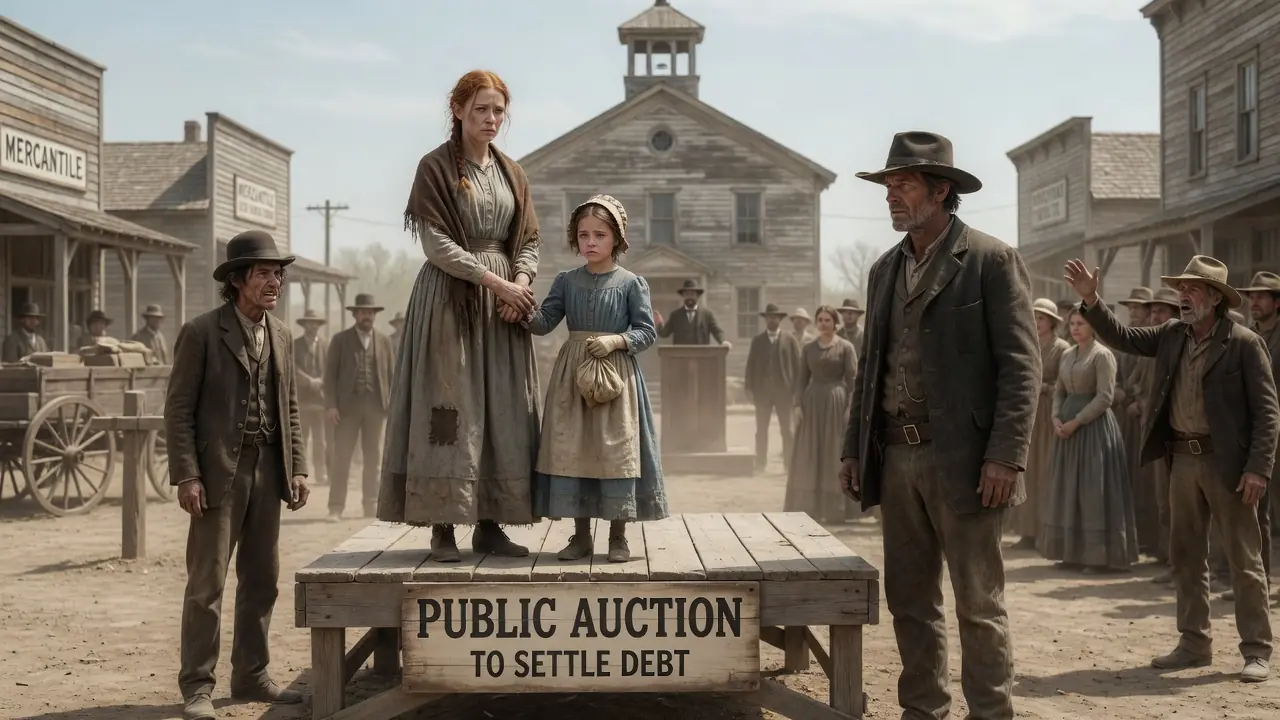
Two innocent sisters stood trembling on an auction block in Clearwater, Kansas, in the fall of 1887, about to be sold like cattle by the very man who should have protected them.
The older girl held her little sister’s hand so tightly that their knuckles turned white, but she did not let go, not even when the bidding began.
The town watched in shameful silence as their uncle smiled beside the platform, already counting money he had not yet touched.
Then a grief-hardened rancher in a dusty coat stepped out of the crowd, and the cruelest morning of their lives changed into the beginning of a fight no one in that town would ever forget.
The morning of September 14 dawned gray and heavy over Clearwater, as if the sky itself wanted to cover what men had gathered to witness. A crowd had formed in the town square, not for a celebration, not for a hanging, not for a cattle sale, but for something that made decent people stare at the dirt.
At the center of the square stood a rough wooden platform built beside the auctioneer’s barrel, with two girls standing on it in patched dresses and worn shoes. They looked too small for the cruelty placed upon them, but the law had a way of making wrong things sound orderly when men wanted profit.
Sarah Henderson was 15, thin from hunger, with copper hair braided down her back and green eyes that had learned to stay alert. She stood straight because pride was the last thing poverty had not taken from her, and because her little sister Lucy was watching.
Lucy was only seven, small enough to disappear behind Sarah’s skirt, with a carved wooden horse clutched against her chest. That horse was the last gift their father had made before the fever took him, and Lucy held it like a piece of home that no auctioneer could price.
Their parents, James and Margaret Henderson, had once been respected in Clearwater. James had taught in the schoolhouse, filling young minds with sums, scripture, poetry, and the belief that knowledge could make a person free.
Margaret had sewn dresses, quilts, gloves, and christening gowns for half the women in town, her stitches so fine that people said she could mend even sorrow if given the right thread. Their little house on Maple Street had never been rich, but it had been warm, filled with bread, books, music, and two girls who believed the world was mostly kind.
Then scarlet fever swept through Kansas the previous summer and left Clearwater with fresh graves and empty chairs. Margaret died first, her hand searching blindly for Sarah’s even after fever stole her words. James followed three days later, his voice no more than a breath as he pulled Sarah close and whispered the promise that became the shape of her life. “Keep Lucy with you, Sarah. No matter what comes, you stay together.”
Sarah had promised because she was 14 then and thought promises still had power. She had not yet learned how little promises meant to men like Silas Crane, her father’s younger brother.
Silas arrived after the funeral with whiskey on his breath, false sorrow in his eyes, and legal papers tucked in his coat. The will gave him guardianship of the girls, and by law, that meant he controlled where they lived, what they ate, how they worked, and whether they remained sisters in the same house.
For 11 months, Sarah and Lucy lived at Silas’s failing farm on the edge of town. He sold their mother’s sewing machine first, then their father’s books, then the good table their grandfather had built by hand.
He made Sarah cook, scrub, mend, haul water, and work the garden while Lucy gathered eggs and swept the porch with a broom nearly taller than she was. When Sarah asked for schoolbooks, Silas laughed and said education had not kept her parents out of the grave.
The final trouble came when three men from the Lucky Silver Saloon rode to the farm with papers showing that Silas owed $900 in gambling debts. They gave him one week to pay before they took the farm, his tools, and anything else with value.
Sarah listened from the pantry while Silas begged, cursed, and then suddenly fell quiet in the way he did when a wicked idea came to him. When the men left, he looked at the sisters as if seeing them not as children, but as two pieces of property he had forgotten to sell.
“You’re going to market,” he said that night, his voice flat and cold. “Both of you ought to fetch enough to clear my debts and leave me with something besides bad luck.”
Lucy did not understand at first, but Sarah did. She went to the sheriff the next morning, then to the judge, then to Reverend Miller at the Methodist church where her parents were buried. Each man gave her the same grave look, the same powerless shake of the head, the same answer wrapped in cowardice. Silas was their legal guardian, and if he chose to transfer their labor contracts by public bid, the law would not stop him.
Now she stood on the platform with Lucy pressed against her side while Marcus Blackwood, the auctioneer, cleared his throat. He was a round man with muttonchop whiskers and a voice trained to make misery sound profitable. “Lot 17,” he called, lifting one hand toward the sisters. “Two healthy orphan girls, capable of domestic work, sewing, field assistance, and general service. The eldest reads, writes, cooks, and keeps accounts. The little one is young, but trainable. Starting bid is $25 for the pair.”
Sarah felt Lucy flinch at the word trainable. She squeezed her sister’s hand and bent close enough to whisper. “Look at me, not them.” Lucy obeyed, tears shining in her eyes, wooden horse trapped between her arm and ribs. “Are they going to take me away from you?” she whispered back.
“No,” Sarah said, though she had no power to make it true. “I promised Papa.”
A man near the front lifted two fingers. Sarah recognized him as Dutch Harlan, a widowed farmer known for working hired help until they broke. “Twenty-five,” he said. “For the older one only. Don’t need the little one.”
Blackwood hesitated. “The lot is offered as a pair.”
“I said I don’t need the little one,” Dutch snapped. “The older girl can cook and keep house. That’s what I’m bidding on.”
Sarah’s stomach turned, but she forced herself not to look away. She had seen men assess horses, cattle, tools, and plow blades with more kindness than Dutch used on her. Lucy began to tremble, and Sarah pulled her closer, even though the auctioneer frowned at the movement. In the crowd, several women turned their faces aside, but none stepped forward.
“Twenty-five for the eldest,” Blackwood called, his voice thinner now. “Do I hear thirty?”
Silence spread through the square like spilled ink. Everyone knew this was wrong, but knowing and acting were different things. Silas Crane stood beside the platform, his mouth tight with frustration because a separated sale would bring less money than he wanted. He leaned toward Blackwood and hissed, “Sell them together if you can. I need more than that.”
The word carried across the square with enough force to turn every head. The crowd parted slowly, and Sarah saw a tall man in a dark ranch coat stepping forward. He looked to be in his late 30s, broad-shouldered, sun-browned, and hard-faced, with gray threaded through his dark hair and a scar running from his left ear toward his jaw. His eyes were the color of storm metal, and they were fixed not on the auctioneer, not on Silas, but on the two girls.
Blackwood straightened. “Fifty for the pair?”
“One hundred,” the man said. “For both sisters together.”
A murmur rippled through the crowd. One hundred dollars was more money than some families in Clearwater saw in months. Silas Crane’s eyes widened with greed, and even Dutch Harlan lowered his raised hand. Sarah had heard the stranger’s name whispered before the auctioneer asked it, because men like that carried stories with them.
“Name?” Blackwood asked.
“Grant Ashford,” the man replied. “Twin Pines Ranch.”
The crowd changed around those words. Everyone knew Twin Pines, 3,500 acres of cattle land five miles west of town. Everyone knew Grant Ashford, too, though few could claim to know him well. He was a widower who came to town once a month for supplies, spoke little, paid fairly, and left before anyone could ask about the wife he had buried three winters ago.
Silas scrambled closer. “You have that money with you, Mr. Ashford?”
Grant pulled a leather wallet from his coat and counted out the bills without hurry. “Cash. Right now. Both girls stay together.”
Dutch Harlan spat into the dirt. “This ain’t right. I bid first.”
“You bid for one,” Grant said without looking at him. “I bid for both. That is how auctions work.”
Blackwood lifted his gavel, visibly relieved that someone had offered enough money to end the shameful scene. “One hundred dollars for the pair. Do I hear more?”
No one answered.
“Going once,” Blackwood called.
Sarah’s heart pounded so hard she could barely hear the square.
“Going twice.”
Lucy buried her face against Sarah’s arm.
“Sold to Mr. Grant Ashford of Twin Pines Ranch.”
The gavel fell.
The sound cracked through Sarah like a gunshot.
Silas was already reaching for the money, his hands shaking. Grant counted the bills into his palm with cold precision, then stepped close enough that only those nearest the platform could hear him. He grabbed Silas by the collar and pulled him forward until the smaller man nearly rose onto his toes. “If I ever hear of you putting another child on a platform,” Grant said quietly, “I will find you before the law does. And you will spend the rest of your life wishing the law had been quicker.”
Silas’s face drained of color. He nodded so fast his chin nearly struck his chest. Grant released him with enough force to send him stumbling backward. Then the rancher turned toward the platform, his hard gaze landing on Sarah and Lucy.
“Come down,” he said. “Slowly.”
Sarah guided Lucy down the steps. Her legs felt strange beneath her, as if the earth had shifted while she stood above it. Lucy held the wooden horse in both hands now, her cheeks wet, her eyes fixed on Grant with fear and confusion. Sarah stepped slightly in front of her sister because habit was stronger than hope.
Grant looked them over, but not the way Dutch had looked at her. There was no hunger in his gaze, no cruel amusement, no sense that he enjoyed their helplessness. He looked like a man measuring the size of a burden he had chosen before knowing its full weight.
“Names,” he said.
“Sarah Henderson,” she answered, forcing her voice steady. “This is Lucy. I’m 15. She’s seven.”
“When did you last eat?”
Sarah hesitated.
Grant’s eyes narrowed. “That was not a hard question.”
“Yesterday morning,” Sarah admitted. “Silas said we had to look presentable but needy.”
For a moment, something dangerous moved across Grant’s face. He turned toward a woman standing near the general store, a kindly figure in a blue dress and gray bonnet. “Mrs. Hartwell,” he called. “I need help.”
The woman came forward at once. “Of course, Grant.”
“Take them to Morrison’s restaurant. Feed them properly. Then take them to Schultz’s store. Dresses, shoes, coats, underthings, stockings, whatever they need. Put it on my account.”
Mrs. Hartwell’s eyes softened. “I’ll see to them.”
Grant looked back at Sarah. “I have business at the land office. I will collect you in two hours. You will be safe with Mrs. Hartwell until then.”
Sarah stared at him. “Why?”
The question came out before she could stop it.
Grant’s jaw tightened, but he did not seem offended. “Because you are hungry, and hungry children need food before explanations.”
Then he walked away.
At Morrison’s restaurant, Mrs. Hartwell ordered fried chicken, potatoes, beans, fresh bread, and two slices of apple pie. Lucy stared at the cream on top of the pie as if it were something holy. Sarah tried to eat slowly, but hunger defeated manners, and Mrs. Hartwell pretended not to notice. After a few minutes, Lucy began eating with both hands, and Sarah had to turn her face away before the sight made her cry.
“Grant Ashford is a hard man,” Mrs. Hartwell said softly. “He will expect work and honesty from you. But he is not cruel, and he is not the sort of man who takes improper advantage of the helpless.”
“Then why did he buy us?” Sarah asked.
Mrs. Hartwell folded her hands on the table. “His wife, Mary, wanted children. The Lord never granted them any. Before she died, she made Grant promise that if he ever saw children in need, he would not turn away.”
Lucy looked up, her lips sticky with pie. “Did she die because she was sick?”
“Pneumonia,” Mrs. Hartwell answered gently. “Three winters ago. Grant loved her dearly, and after she died, part of him went quiet.”
Sarah looked down at her plate. “We are not children to him. We are a promise.”
“Maybe,” Mrs. Hartwell said. “Or maybe you are two girls who needed saving, and he was the only man angry enough to do it.”
At Schultz’s general store, Mr. Schultz greeted them with grave kindness and not one pitying word. He measured them for sturdy dresses, work aprons, wool stockings, leather shoes, coats, gloves, and bonnets. He added a slate and chalk for Lucy, a sewing kit for Sarah, and a small reader with lessons marked in the margins. When Mrs. Hartwell said Grant had not ordered those extras, Mr. Schultz waved one hand and said, “Then I order them. A new life should begin with proper tools.”
By the time Grant returned, the sisters stood beside a pile of bundles that looked impossible to own. He loaded everything into the wagon without comment. Sarah and Lucy climbed onto the bench beside him because Grant had already filled the wagon bed with supplies. For a while, they rode in silence as Clearwater fell behind them and the prairie opened wide beneath the lowering sun.
“You have questions,” Grant said at last.
Sarah kept her eyes on the horses. “Yes.”
“Ask.”
“What do you want from us?”
Grant did not answer quickly. That gave her more confidence than any smooth speech would have. “I acted faster than I thought,” he said. “That means I have not made a perfect plan. But this is what I can offer. You come to Twin Pines. You help in the house, garden, kitchen, and whatever work suits your abilities. In return, you get food, shelter, clothing, education, and protection. When you are old enough, you choose your own future.”
“We are not servants to be worked to death,” Sarah said.
“No.”
“And you will not separate us.”
“No.”
“You promise?”
This time, Grant looked at her. “I promise. Whatever else I may be, Sarah Henderson, I keep my word.”
Lucy shifted against Sarah’s side. “Do you have horses?”
Grant’s expression changed by the smallest measure. “Many.”
“Do they bite?”
“Some.”
“Do you bite?”
For the first time, Sarah saw his mouth almost curve. “Only men who sell children.”
Lucy considered this, then nodded as if satisfied. Sarah watched Grant’s profile in the dying light and wondered what sort of man could threaten their uncle like thunder, feed them like guests, and answer a frightened child without mockery. She did not trust him yet, but for the first time in nearly a year, she wanted to.
Twin Pines Ranch appeared at sunset, whitewashed and broad beneath two tall pine trees that gave the place its name. The house had two stories, a wide porch, and a barn large enough to hold half of Clearwater’s church congregation. Smoke rose from the chimney, and horses moved in the corral like dark shapes against the prairie. Lucy sat up straighter, her eyes wide with cautious wonder.
A small Chinese woman in her 50s stepped onto the porch before the wagon stopped. She wore a flour-dusted apron and carried herself like a queen disguised as a housekeeper. “Grant Ashford,” she called, planting both hands on her hips. “You bring children home and tell Mrs. Chen nothing?”
“I did not know I was bringing them until this morning,” Grant replied, climbing down.
Mrs. Chen looked at Sarah and Lucy, and anger softened into fierce tenderness. “Skin and bones,” she murmured. “Scared eyes. Bad men did this.”
“Mrs. Chen, this is Sarah and Lucy Henderson. They will be living here.”
“Of course they live here,” Mrs. Chen said. “You think Mrs. Chen let children sleep in barn? Silly man.”
Sarah helped Lucy down. Mrs. Chen took one look at the little girl’s wooden horse and nodded solemnly, as if introduced to an honored guest. “You come inside now. Food, warm water, clean beds. Questions later. Mrs. Chen does not answer important questions before supper.”
The house smelled of bread, wood smoke, dried herbs, and roasted meat. Sarah nearly staggered at the scent because hunger had made her body sharp and hollow for so long. Mrs. Chen led them upstairs to a room with two beds, a washstand, a small rug, and curtains at the window. After months in Silas’s freezing attic, it looked too fine to touch.
“This room yours,” Mrs. Chen announced. “No one comes in without knocking. Not ranch hands, not Grant, not Mrs. Chen unless emergency or laundry.”
Sarah swallowed hard. “Ours?”
“You think Mrs. Chen talks for decoration?”
Lucy moved toward one bed and pressed her hand against the quilt. “It’s soft.”
“Good,” Mrs. Chen said. “Children should sleep soft after hard days.”
Sarah turned toward the window before anyone could see the tears forming. She had spent so long preparing to endure that kindness felt more dangerous than cruelty. Cruelty made sense. Kindness asked her to believe in something that could be taken away.
At supper, Grant introduced them to the household. There was Tommy, a young ranch hand with sandy hair and nervous manners, Hector, an older Mexican horseman with weathered hands and kind eyes, and Red Donovan, an elderly cattleman who looked like he had been carved from fence posts and sun. Grant made one thing clear before anyone touched a fork.
“These girls are under my protection,” he said. “That means they are under yours. They will work and learn here, but they will be treated with respect. Anyone who cannot accept that can collect his wages tonight.”
No one moved.
Red cleared his throat. “Can either of them make biscuits?”
Mrs. Chen snapped her towel at him. “You old goat. They almost die of hunger today, and you ask about biscuits.”
“Just planning for the future,” Red said, grinning.
The tension broke. Lucy giggled, and Sarah nearly forgot how to breathe. It was the first light sound her sister had made since before Silas announced the auction. Grant looked down at his plate, but Sarah saw the brief flicker in his eyes. He had heard it, too.
After supper, Mrs. Chen bathed them in warm water scented with lavender soap. “Old clothes gone tomorrow,” she said. “Bad memories go with them.”
Lucy looked worried. “But Papa saw me in this dress.”
“Papa sees you in heart, not dress,” Mrs. Chen replied. “He wants clean child, warm child, safe child. Yes?”
Lucy nodded slowly.
That night, the sisters slept in separate beds for the first time in months, but Lucy dragged her blanket across the floor after five minutes and climbed in beside Sarah. Sarah did not send her back. The room was warm, the mattress soft, and the ranch quiet except for wind in the pines and horses moving beyond the yard. Before Lucy fell asleep, she whispered, “Sarah, is this home?”
Sarah stared into the dark. “I don’t know yet.”
“Can we pretend until we know?”
Sarah pulled her closer. “Yes. We can pretend.”
The next morning began before sunrise. Mrs. Chen rang a bell downstairs and called up that ranch life did not wait for sleepy bones. Sarah and Lucy dressed in their new work clothes and hurried down to learn that breakfast at Twin Pines was not one meal but a military campaign. Men needed coffee and bread before dawn, a proper breakfast at eight, dinner at noon, and supper after chores. Mrs. Chen commanded the kitchen like a battlefield and assigned tasks with terrifying speed.
Sarah learned how to fry bacon without burning it, stretch eggs for ten hungry people, knead dough, and keep coffee hot without turning it bitter. Lucy set the table carefully, her tongue caught between her teeth as she placed each fork and cup. Mrs. Chen watched without fussing too much, correcting with sharp words and gentle hands. By eight, the dining room was full, and no one went hungry.
After breakfast, Grant called Sarah to his office. The room was lined with maps, ledgers, invoices, receipts, and shelves of books that looked more used than decorative. He placed a ranch ledger in front of her and opened it to the month’s accounts. “You told me you can read, write, and do arithmetic. Show me.”
Sarah scanned the page, careful not to rush. “These are expenses, feed, wages, equipment, repairs, medicine for livestock. This side is income, cattle sales mostly, and some horse breeding.”
Grant nodded. “What is wrong?”
She leaned closer, adding the columns in her head the way her father had taught her. “The total is wrong. It says expenses are $418, but the column adds to $456.”
“Why might that matter?”
“It makes the profit look better than it is,” she said. “If it was a mistake, it can be corrected. If it was intentional, someone is hiding the truth.”
Grant’s eyes sharpened. “Your father taught you well.”
“He said a woman who cannot read money can be trapped by any man holding a pen.”
“Your father was right.”
For two hours, Grant taught her ranch bookkeeping. He explained profit margins, market prices, seasonal expenses, feed contracts, and how debt could become a rope around a man’s throat if he did not watch it. He did not speak down to her. He did not praise her falsely, either, but when she got something right, he said so plainly, and that felt better than flattery.
Meanwhile, Lucy met the horses. Hector took her to the corral after extracting three solemn promises that she would not run, shout, or put her hands near teeth. Lucy stood at the fence, staring at a gray stallion who moved alone near the far rail. The horse kept his head high, ears tense, body ready to flee or fight.
“That’s Thunder,” Hector said. “Fastest horse here, and the meanest. Only Grant rides him.”
“He isn’t mean,” Lucy said.
Hector chuckled. “That so?”
“He’s scared,” she said. “Someone hurt him. He watches hands too much.”
Hector stopped smiling. Thunder had been wild-caught and badly handled before Grant bought him. Most grown men never noticed the difference between fury and fear in a horse. Hector looked from the stallion to the little girl holding a wooden horse beneath one arm. “You may have eyes, niña,” he said softly. “Real eyes.”
By the end of the first week, a rhythm began to form. Sarah spent mornings in the kitchen and late mornings in Grant’s office, learning how a ranch survived. Lucy helped Mrs. Chen with simple chores, then followed Hector to the horses, where she learned feed, brushes, tack, and patience. In the afternoons, Grant made both girls read aloud from Mary’s books and practice writing letters. At night, Sarah fell into bed exhausted, but it was a clean exhaustion, the kind earned by work instead of fear.
Still, safety did not come easily. Sarah woke from dreams of the auction block, hands reaching for Lucy before remembering where they were. Lucy sometimes hid bread in her pillowcase until Mrs. Chen found it and said nothing, only placed a small covered tin by the bed so she could keep food without shame. Grant noticed everything but pressed little, which Sarah both appreciated and resented. It was difficult to hate a man who understood silence.
One evening, Sarah found him on the porch staring toward the dark pasture. She had come to return a ledger, but grief sat so plainly on him that she paused. Grant turned before she could retreat. “You walk quietly,” he said.
“I learned in Silas’s house not to be heard.”
His jaw tightened. “You should not have had to learn that.”
“No,” Sarah said. “But learning kept Lucy safe.”
Grant looked out over the land. “I had a brother named Thomas. When I was 14 and he was 11, men took us to work in a factory after our mother died. I survived. Thomas did not.”
Sarah held the ledger tighter. “That is why you bought us.”
“That is part of why.”
“And the rest?”
Grant’s voice dropped. “Because my wife made me promise not to turn away from children in need. Because your uncle’s face reminded me of men I should have fought sooner. Because I was angry enough that morning to act before fear could talk me out of it.”
Sarah studied him. “Were you afraid?”
“I still am.”
“Of us?”
“Of caring,” he admitted. “Everyone I have loved, I have buried.”
The honesty stunned her. Men like Silas used truth as a weapon only when it hurt someone else. Grant offered it like a burden he did not know where to place. Sarah looked through the window where Lucy sat beside Mrs. Chen, laughing over crooked stitches in a dishcloth. “Maybe loving someone is frightening because it matters,” she said.
Grant gave her a tired glance. “Your father taught you more than arithmetic.”
“He taught me words. Life taught me the rest.”
Three weeks after the auction, trouble arrived on horseback. Sarah saw them from the kitchen window while kneading dough with Mrs. Chen. One rider wore a sheriff’s badge, and the other wore a city suit, shiny boots, and the self-important expression of a man who believed papers made him righteous. Grant crossed the yard from the barn, with Hector and Tommy stopping behind him.
Mrs. Chen came to the window, saw the men, and wiped flour from her hands. “Government trouble,” she muttered. “Always smell like ink and foolishness.”
The conversation outside was brief and tense. The man in the suit waved documents while the sheriff looked uncomfortable. Grant stood still as stone, but Sarah knew stillness could hide fury. When he turned toward the house, his face told her the truth before his words did.
“They have come for us,” she whispered.
Mrs. Chen touched her arm. “Not if house has teeth.”
The front door opened. Grant entered with the two men behind him, and Sarah moved toward Lucy, who had come from the back room at the sound of strange voices. The suited man unfolded papers with the drama of an actor at a cheap theater. “Mr. Ashford, I am Inspector Lawrence Vale from the Kansas Bureau of Child Welfare. A formal complaint has been filed by Silas Crane.”
“Of course it has,” Grant said.
Vale’s mouth tightened. “Mr. Crane asserts that you coerced him into surrendering his wards under threat of violence. He further claims that the transfer was illegal and that the children are being held in an improper household. I am authorized to remove them to county care pending judicial review.”
Lucy clutched Sarah’s skirt.
Sarah felt the room narrow around her. “Silas is lying.”
Vale looked at her as if children were interruptions rather than witnesses. “You will have a chance to speak when appropriate.”
“It is appropriate now,” Sarah said. “We were the ones sold.”
The sheriff shifted, embarrassment darkening his face. “Grant, I’m sorry. Vale has authority to investigate. He says the girls have to be removed today.”
“No,” Grant said.
Vale blinked. “No?”
“No,” Grant repeated. “You may investigate. You may inspect. You may ask questions. But you are not taking these girls out of this house on Silas Crane’s word.”
“Careful, Mr. Ashford,” Vale said. “Interfering with a state officer is a serious matter.”
Grant stepped closer, and the temperature in the room seemed to drop. “Threatening children with removal based on a liar’s complaint should be a serious matter, too.”
The sheriff put a hand between them. “Grant, if you resist, he can have you arrested. Then the girls go anyway.”
That stopped him. Sarah saw the calculation in his face and hated that the sheriff was right. If Grant went to jail, they lost the only adult willing to fight for them. Vale knew it, too, and his small smile returned.
Grant’s voice became controlled. “How long?”
Vale checked his pocket watch. “I will return at noon with a wagon. That gives you three hours to prepare them.”
“Then get out of my house until noon.”
Vale stiffened. “Mr. Ashford—”
“You delivered your notice,” Grant said. “Now leave before I forget there is a sheriff standing beside you.”
After they left, silence filled the house. Lucy began to cry softly, and Sarah pulled her close. Grant stood in the entry hall, hands clenched, his face carrying a helplessness she had never expected to see there. Mrs. Chen looked from him to Sarah, her eyes fierce.
“What now?” she asked.
Grant exhaled. “I don’t know.”
Sarah wiped Lucy’s face with the edge of her apron. Fear was there, yes, but beneath it something harder rose. She had spent too long waiting for adults to decide her fate. “Then we make him listen,” she said.
Grant turned to her.
“Silas’s complaint is a lie,” Sarah continued. “There were witnesses at the auction. Mr. Schultz saw him take the money. Mrs. Hartwell helped us afterward. The sheriff was there. Dutch Harlan bid before you did. We need them to speak.”
“People avoid legal trouble,” Grant said.
“Then remind them that silence is how we got on that platform.”
Mrs. Chen nodded sharply. “Good. Girl has spine.”
Sarah looked toward Grant’s office. “You have records. Clothing, food, doctor’s visit, lessons, ledgers. We can prove we are not being mistreated. We can prove we are better here.”
Lucy lifted her head. “I can show him Thunder.”
Sarah blinked. “What?”
“Hector says I understand horses. I can show that I’m learning.”
Grant stared at the little girl as if seeing her anew. Then motion returned to him all at once. “Sarah, get the ledgers. Mrs. Chen, gather what you’ve taught them. Tommy!”
The young ranch hand appeared at the door. “Boss?”
“Ride to town. Bring Schultz, Mrs. Hartwell, Doc Henderson, Dutch Harlan if he has the backbone, and anyone else willing to tell the truth. Fast.”
Tommy did not ask questions. He ran.
For three hours, Twin Pines became a courtroom in preparation. Sarah organized Grant’s expense records, showing every dollar spent on food, clothing, books, and medical care. Mrs. Chen listed lessons in cooking, sewing, household management, reading, and hygiene. Doc Henderson arrived close to noon with a medical statement confirming that both girls had arrived malnourished and frightened, and both had improved significantly under Grant’s care. Hector brushed Thunder and quietly prepared Lucy to stand beside the corral without doing anything foolish.
Tommy returned just before noon, dust-covered and triumphant. Behind him came Mr. Schultz, Mrs. Hartwell, Doc Henderson, Dutch Harlan, Red Donovan, and two churchwomen who had stood in the square but said nothing that day. Dutch looked like he would rather be kicked by a mule than admit decency, but he came anyway. “I ain’t here for Ashford,” he grumbled. “I’m here because Silas Crane is lower than mud, and I won’t have my name twisted to help him.”
At noon, Inspector Vale returned with a wagon, two stern matrons, and the sheriff. Instead of two frightened girls waiting with packed bags, he found Grant, Mrs. Chen, the ranch hands, the doctor, six townspeople, and the sisters standing on the porch in clean dresses with their heads lifted. Sarah held the ledger against her chest. Lucy held her wooden horse, but her eyes were steady.
Vale’s expression soured. “What is this?”
“A defense,” Grant said. “You came to remove children without hearing the truth. Now you will hear it.”
“I am not conducting a trial on your porch.”
“No,” Grant said. “You are deciding whether to harm two children. That deserves at least as much care as buying a horse.”
The sheriff looked at Vale. “Lawrence, hear them. It will look better in your report.”
Vale’s jaw tightened, but he stepped down from the wagon. “You have 20 minutes.”
“We will take what truth requires,” Mrs. Chen snapped.
Sarah began with the ledgers. Her voice shook for the first sentence, then steadied as numbers gave her something firm to stand on. She showed what Grant had spent, what they had learned, how their meals had improved, and how their work was structured as training rather than exploitation. Doc Henderson read his medical statement. Mrs. Chen explained their daily routine with such authority that even Vale stopped interrupting.
Then the witnesses spoke. Mr. Schultz testified that Silas had taken the money eagerly and without fear. Mrs. Hartwell described the girls’ hunger and terror on auction day, then their condition after Grant’s intervention. Dutch Harlan admitted publicly that he had wanted Sarah as farm labor and had not cared what happened to Lucy. His face flushed as he said it, but he did not hide.
“I was there,” Dutch said, staring at Vale. “Ashford did not force Crane to sell. Crane wanted money, and he got it. The only threat Ashford made came after the sale, and if you ask me, it was gentler than Crane deserved.”
Vale looked annoyed, but the testimony had weight.
Finally, Lucy asked to show him Thunder. Grant stiffened, but Hector gave a small nod. The gray stallion stood at the corral fence, ears tense, body restless. Vale’s horse was tied nearby, shifting unevenly on one hoof.
Lucy walked slowly to the fence and did not reach out. She only stood still, speaking low. Thunder stopped tossing his head. After a moment, he stepped closer and lowered his nose toward her small palm.
“This horse was hurt before,” Lucy said. “If you rush him, he remembers pain. If you wait, he remembers he has a choice.”
No one spoke.
Lucy turned toward Vale. “Children remember, too.”
The inspector stared at her, then looked away. For the first time, uncertainty crossed his face.
Sarah stepped forward then, heart pounding. “Inspector Vale, I know the law gives adults many words for what happened to us. Guardianship transfer. Labor contract. Placement. But I was there. I stood on that block holding my sister’s hand while men decided how much we were worth. Grant Ashford did not make us property. He was the first person who looked at us and became angry that we were treated that way.”
Her voice rose, not loud, but clear enough for every person in the yard to hear.
“If you take us now, you are not correcting a wrong. You are finishing what Silas started. You are telling every child like us that it does not matter who loves us, teaches us, feeds us, or protects us, because paper matters more than truth. Is that the work you came here to do?”
Vale did not answer.
The sheriff removed his hat and rubbed one hand over his face. “Lawrence, I was at that auction. I should have stopped it, but I didn’t. Don’t make another mistake just because the first one was legal.”
Vale folded his papers slowly. “This matter will go before Judge Blackwell next week. Until then, I am suspending removal pending review.”
Lucy gasped.
Sarah nearly dropped the ledger.
Grant did not move, but his relief was visible in the way his shoulders lowered.
Vale pointed at him. “This is temporary. If the judge finds impropriety, the girls will be removed.”
Grant nodded once. “Then we will be ready for the judge.”
The hearing took place one week later in the Clearwater courthouse. By then, the story had spread beyond town, and the courtroom was crowded with people who wanted to witness what had begun as gossip and turned into a moral reckoning. Silas Crane appeared in a new coat purchased with the last of Grant’s money, his face arranged into injured innocence. Vale sat stiffly at one table, while Grant sat with Sarah and Lucy at the other.
Judge Thaddeus Blackwell was an older man with iron-gray hair and eyes that had little patience for performance. He listened as Silas claimed he had been frightened, coerced, and too impaired to understand the auction. He listened as Vale argued that two orphan girls belonged in state care rather than a ranch household. Then he listened as witness after witness dismantled those claims until Silas’s story stood bare and ugly in the room.
Sarah was called last. She walked to the front with her hands cold and her back straight. Lucy sat beside Grant, clutching his sleeve, and that gave Sarah courage. She placed her hand on the Bible and swore to tell the truth.
“Your honor,” she said, “Silas Crane is our uncle by blood, but he did not act like family. He sold our mother’s sewing machine, our father’s books, and then he sold us. He did not do it because he wanted better homes for us. He did it because he owed gambling debts.”
Silas shifted angrily, but the judge raised one hand.
Sarah continued. “Grant Ashford paid one hundred dollars for our guardianship. I hated that money at first. I hated that anyone could pay for us at all. But what Grant bought that day was not ownership. He bought time. Time for Lucy and me to eat, sleep safely, learn, and stand here now to speak for ourselves.”
She looked directly at the judge.
“If the law says children can be sold, then the law is wrong. If the law says a bad guardian can profit from two orphans but a good man can be punished for protecting them, then the law needs more than obedience. It needs courage.”
The courtroom was silent.
Judge Blackwell leaned back. “How old are you, Miss Henderson?”
“Fifteen, your honor.”
“And who taught you to speak like that?”
“My father taught me to think,” Sarah said. “Grant Ashford taught me not to be afraid of the answer.”
For a moment, the judge’s stern face softened.
He ruled before the hour ended. The transfer of guardianship was legal. Silas Crane’s complaint was dismissed. Grant Ashford would remain guardian of Sarah and Lucy Henderson, under formal court recognition and subject to periodic review. Then Judge Blackwell did something no one expected. He ordered an inquiry into the practice of public child auctions in Sedgwick County and requested testimony from citizens, clergy, doctors, and schoolteachers.
“This court will not pretend that legal means righteous,” he said. “Not after what we have heard today.”
Outside the courthouse, Lucy ran into Grant’s arms before remembering she was supposed to be dignified. Grant caught her without hesitation. Sarah stood beside them, trying not to cry, until Mrs. Chen arrived and pulled both girls against her apron. “Enough court,” she declared. “Now home. Mrs. Chen make feast.”
That night, Twin Pines glowed with lamplight and laughter. Red brought a fiddle, Mrs. Chen cooked enough food for three ranches, and even Dutch Harlan came by with a basket of apples and an apology so awkward it somehow felt honest. Lucy danced with Hector in the kitchen, her wooden horse tucked safely on a shelf where it could watch. Sarah sat on the porch later with Grant, the cold stars burning above the prairie.
“You fought like your father would have,” Grant said.
“You never knew him.”
“No,” Grant replied. “But I know what he left behind.”
Sarah looked through the window at Lucy laughing beside Mrs. Chen. “What happens now?”
“Now you grow,” Grant said. “You learn. You work. You live. And if you still want to fight the law when you are older, I suspect the law had better prepare itself.”
Sarah smiled then, the first easy smile she had felt in a long time. “I do want to fight it.”
“I know.”
“Will you help me?”
Grant looked toward the two pines that framed the house, their branches moving gently in the night wind. “I started this because I was angry,” he said. “But anger can only break a door open. Love is what builds the house behind it.”
Sarah leaned her shoulder lightly against his arm. “Is this our house now?”
Grant’s voice was rough when he answered. “If you want it to be.”
She looked at Lucy again, safe and full and laughing. “Then yes.”
In the years that followed, the case of the Henderson sisters became known across Kansas. Judge Blackwell’s inquiry led to county reforms, then state debate, then new protections requiring court approval before any child could be placed in labor or guardianship arrangements. Sarah helped Grant collect testimonies, write letters, and speak before committees when she was old enough. Lucy grew into the finest horsewoman in the county, able to gentle animals that grown men feared, and she never forgot the day she told a government man that children remembered pain just like horses did.
Twin Pines became more than a ranch. It became a refuge. Grant and Mrs. Chen took in other children over time, some for months, some forever, all of them given food, work, lessons, and the dignity of being asked what they could become. Sarah studied law and child welfare, eventually becoming one of Kansas’s fiercest advocates for orphan protection. Lucy became a veterinarian, the first woman many ranchers in the region trusted with their best horses because she listened before she touched.
Grant Ashford never claimed he had meant to change anything beyond one terrible morning. He always said he was only a widower who got angry at the right time and made one costly bid. But Sarah knew better. One act of courage had opened a door, and once opened, others walked through it.
Many years later, when the old auction platform in Clearwater was torn down, Sarah stood beside Lucy, both women grown, both still holding hands. A small memorial stone was placed where the platform had stood. It read, “For every child once treated as property, and for every soul brave enough to say no.”
Lucy brought the carved wooden horse and set it at the base of the stone. “Papa would like this,” she said softly.
“So would Grant,” Sarah replied.
The wind moved across the square, gentler than it had been that September morning in 1887. Sarah closed her eyes and remembered the gavel falling, the crowd watching, Lucy trembling beside her, and one man stepping forward with anger in his heart and mercy in his hands. They had been sold that day, but they had not been lost. They had been found by someone who refused to let the law be the only measure of right.
And that made all the difference.