At 4:00 in the morning, our bedroom looked too clean for the kind of ending happening inside it.
That was the first thing I noticed.
Not her dress.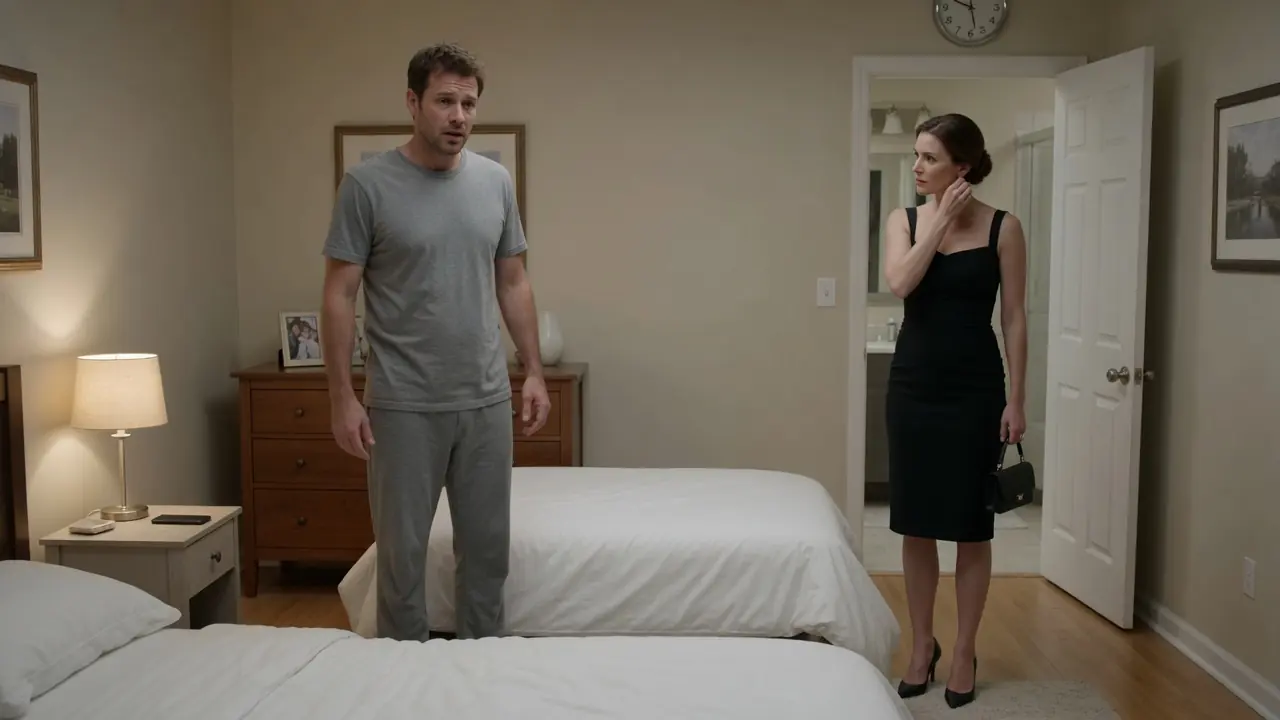
Not the smell of perfume that did not belong to our home.
Not the way she stood near the bathroom door like a woman prepared to defend herself before I had even spoken.
I noticed the room.
The white bedding was still smooth on her side because she had not been there all night. My side was wrinkled from the hours I had spent sitting up, lying down, getting up again, pacing, checking my phone, pretending I was not waiting like a fool. The small lamp on her nightstand gave the room a soft, steady light. It made everything look calm when nothing was.
Her phone lay face down near the lamp.
Silent now.
Charged enough to light up when she walked in, but somehow dead all night when I had called.
My wife, Vanessa, stood near the bathroom door in a black evening dress. Her hair was still neatly styled. Her makeup was not perfect anymore, but it was close enough to tell me she had cared about looking beautiful for someone that night. The lipstick had faded slightly at the center of her mouth. One curl had slipped loose near her cheek. Her heels were still on, which bothered me for some reason. She had not even come home tired enough to kick them off.
I stood near the foot of the bed in a gray T-shirt and lounge pants, barefoot on the hardwood floor, exhausted from waiting but too awake to pretend anything about this was normal.
My body felt heavy from hours of pacing.
My eyes burned.
My chest hurt with that particular pressure that comes when fear has had too much time to harden into certainty.
She had texted at 11:08 p.m.
Running late. Don’t wait up.
That was it.
No explanation.
No estimate.
No goodnight.
I had replied at 11:12.
Everything okay?
No answer.
At 12:03, I called once.
Straight to voicemail.
At 12:41, I called again.
Voicemail.
At 1:30, I texted.
Vanessa, please just tell me you’re safe.
Nothing.
By 2:00, I was angry.
By 3:00, I was scared.
By 3:45, something inside me had gone very still.
When she finally walked in at 3:57, calm and defensive at the same time, a part of me already knew the truth before I asked a single question.
“Where were you?” I asked.
I kept my voice low.
Not because I was calm, but because I was afraid of what would happen if I raised it. I did not want a fight. I did not want to scream. I did not want to become the version of myself she had been accusing me of being for months.
I wanted an answer.
A real one.
The kind a husband should not have to beg for.
Vanessa dropped her purse on the dresser and looked at me like I was the problem waiting at home.
“Out with the team,” she said. “I told you.”
Her tone was cold, polished, irritated. The tone she used when she had to explain something obvious to someone she considered beneath the conversation.
I looked at the clock.
Then back at her.
“You told me you would be late. You didn’t tell me you would disappear for almost five hours.”
She laughed.
There was no humor in it.
“Disappear? I was busy.”
“Too busy to text?”
She turned away and began removing one earring, slow and deliberate, as if the conversation bored her more than it hurt me.
“Apparently.”
“Too busy to answer one call?”
Her hand paused near her ear.
Then she pulled the earring free and set it on the dresser.
“My phone died.”
I stared at the phone sitting face down on the nightstand.
The same phone she had walked in holding.
She followed my eyes and her jaw tightened.
“Don’t start.”
Those two words said more than her excuse did.
For months, that had been our marriage.
I asked simple questions, and she treated them like accusations.
I said I worried when she stayed out late without answering, and she called me controlling.
Every concern I had became evidence of some flaw in me.
When her promotion first came, I was proud of her.
Genuinely proud.
Vanessa had worked hard at Brackett and Lowe, the marketing firm where she had started as a junior account coordinator and climbed faster than anyone expected. She stayed late. She took extra projects. She knew how to make clients feel listened to, how to sell an idea without making people feel sold to.
When she was promoted to senior campaign strategist, I cooked dinner.
Salmon because she liked it.
Roasted potatoes because I was trying to make the meal feel more grown-up than our usual weeknight pasta.
I bought flowers on the way home from the hospital. Not gas station flowers, either. Real ones from the small shop near the pharmacy, wrapped in brown paper with ribbon around the stems.
When she walked in that evening, glowing with pride and exhaustion, I kissed her and told her I knew she was going to do amazing things.
Back then, I believed her success would become something we shared.
I was a physician assistant at a large hospital, working long hours in emergency and internal medicine, but I had learned to build my life around unpredictable schedules. I knew what ambition cost. I knew what exhaustion did to people. I had no interest in punishing her for wanting more.
At first, the late nights made sense.
After-work drinks with the team.
Client dinners.
Networking events.
Industry panels.
Celebration dinners after successful pitches.
I understood all of it.
I had watched residents, surgeons, nurses, and administrators live the same way. The higher people climbed, the less their calendars belonged to them. So I adjusted. I made dinner and kept hers in the fridge. I texted goodnight when I went to bed before she came home. I did laundry on my days off. I walked Milo late because she was too tired.
But then the late nights changed.
After-work drinks became nights when she came home after midnight smelling like cocktails and someone else’s cologne hidden beneath her perfume.
Dinners became vague.
“Where did you go?”
“Downtown.”
“With who?”
“The team.”
“Who from the team?”
“Why does it matter?”
Her phone changed first.
That was the first real sign.
It was always face down.
Always locked.
Always in her hand.
If it rang, she took it into another room. If it buzzed while we were on the couch, she turned the screen toward her body before checking it. If I walked into the kitchen while she was typing, she would stop mid-sentence and set the phone down like I had caught her doing something private.
Then her answers changed.
“What are you working on?”
“Work stuff.”
“What kind of campaign?”
“You wouldn’t understand.”
That hurt more than she knew.
Maybe because she used to explain things to me. In college, when we first started dating, she would sit across from me in the library with a highlighter between her teeth, talking through campaign theories, communication models, and case studies I did not fully understand but loved hearing about because they mattered to her.
I was fighting my way through premed requirements then. Organic chemistry nearly destroyed me twice. Vanessa used to quiz me with flashcards until she fell asleep with them spread across her chest. I would carefully lift them away, cover her with my hoodie, and think there was no life I wanted unless she was in it.
We got married young by some people’s standards, but not recklessly.
At least, I did not think so.
We had been together for years. We had survived school, internships, long shifts, cheap apartments, car trouble, family emergencies, and the early grind of two careers being built at the same time.
We were not perfect, but we were a team.
Or I thought we were.
By the time her promotion came, we had been married four years. We had a decent apartment, a dog, a shared savings account, and a routine that felt stable if not always exciting. She teased me for leaving medical journals on the coffee table. I teased her for buying expensive notebooks she never finished.
We had Sunday breakfast rules.
No work talk until after the second cup of coffee.
That rule disappeared first.
Then Sunday breakfast disappeared completely.
She stopped asking about my day at the hospital.
She stopped laughing with me over dinner because we rarely ate together.
She stopped sitting beside me on the couch and started taking showers the moment she got home, locking the bathroom door behind her.
I told myself marriage went through seasons.
But deep down, I knew this was not a season.
It was distance that had learned to wear perfume and lipstick.
That night, in the clean bedroom at 4:00 a.m., I finally asked the question that had been living in my chest for months.
“Is there someone else?”
Vanessa froze.
It was not anger at first.
It was stillness.
So sudden, so complete, that my stomach dropped before she said anything.
I had touched the truth.
Then her face twisted.
“Unbelievable,” she said. “You’re actually accusing me of cheating.”
“I’m asking.”
“There is no difference.”
“There is.”
“No,” she snapped. “There isn’t. You’re accusing me because you can’t stand that I have a life outside of you.”
I stared at her.
Really stared.
The woman in front of me had once been my best friend. She had known every version of me from anxious college kid to overworked medical provider to husband who packed her lunch when she had early meetings.
Now she stood three feet away, looking at me like I was a cage.
“I waited up because you didn’t come home,” I said. “I called because I was worried.”
Her eyes narrowed.
“No. You waited up because you wanted to catch me doing something. You called because you don’t trust me.”
My voice cracked, but I kept it steady.
“Then give me a reason to trust you.”
She picked up her purse again, gripping the strap tightly.
“Stop interrogating me like I’m your prisoner. You don’t own me.”
The words filled the room and seemed to take all the air with them.
I had imagined many ways our marriage might break.
Maybe with crying.
Maybe with confession.
Maybe with one of us saying we had tried but could not find our way back.
Not like that.
Not with me standing barefoot at the foot of our bed, realizing my wife thought basic concern was ownership.
For a few seconds, I did not answer.
Something inside me snapped, but not loudly.
It felt more like a thread finally giving way after being stretched too long.
I was not angry anymore.
I was not desperate anymore.
I was simply done.
“You’re right,” I said quietly. “I don’t own you.”
She looked surprised by the calmness in my voice.
I took a breath.
“But I also don’t owe you the rest of my life while you lie to my face.”
Her expression changed then.
Just for a second.
I saw fear.
Or guilt.
Maybe both.
Then pride covered it again.
“Then leave if you’re so miserable,” she said, pointing toward the bedroom door. “I’m tired of coming home to your questions.”
I nodded slowly.
“I already did leave,” I said. “You just weren’t paying attention when you lost me.”
She stared at me.
For one brief moment, I thought she might finally stop performing.
I thought she might sit down on the edge of the bed, remove the mask, and tell me the truth.
Instead, she stepped toward the bathroom.
“I’m going to bed,” she said. “I have work in the morning.”
Then she walked past me and closed the bathroom door.
The lock clicked.
A second later, the shower turned on.
I stood in the bedroom, listening to water run behind the wall.
The sound felt final.
I moved before I could talk myself out of it.
I opened the closet and took down a duffel bag. My hands shook at first, but they steadied as I packed. Clothes. Toiletries. Laptop. Chargers. Work badge. Medical license card. Passport. The folder with important documents. A pair of running shoes.
I did not take wedding photos.
I did not take gifts.
I did not take anything with sentimental weight.
Sentiment had kept me standing still for too long.
That morning, I packed only what I needed to survive the next few days.
Milo lifted his gray-brown head from his bed in the corner and watched me.
He was younger then, still energetic, still confused whenever voices got sharp. His ears perked as I moved around the room.
I clipped on his leash and whispered, “Come on, buddy.”
He stood immediately.
No hesitation.
No questions.
No punishment for needing to leave.
He followed me through the apartment like it was the most natural thing in the world.
At the front door, I looked back once.
The hallway was dark.
The shower was still running.
My wife was twenty feet away, and it felt like there was an ocean between us.
I did not leave a note.
I did not knock on the bathroom door.
I did not send a dramatic text or make one final speech.
I simply walked out before sunrise with my dog, my bag, and the quiet knowledge that the marriage had ended before my body reached the parking lot.
The first night, I slept on my friend Aaron’s couch for maybe two hours.
Aaron lived fifteen minutes from the hospital in a small townhouse that always smelled faintly like coffee and cedarwood candles. He was an ER nurse, which meant he understood crisis without requiring long explanations.
When I called him from the parking lot, he answered on the second ring.
“Are you hurt?” he asked immediately.
“No.”
“Is Milo with you?”
“Yes.”
“Door’s unlocked.”
That was Aaron.
No performance.
No interrogation.
Just a door.
When I woke up on his couch later that morning, my phone had seventeen missed calls and more than thirty texts from Vanessa.
The first messages were angry.
Where did you go?
Are you serious right now?
You’re being ridiculous.
The middle ones softened.
Okay, you made your point.
Come home and we’ll talk.
You’re scaring me.
The last ones turned cold again.
Fine.
Be that way.
See if I care.
I sat on the edge of the couch, Milo’s head resting on my foot, and read every message twice.
I did not respond.
Aaron made coffee and sat across from me at his kitchen table. He did not say anything until I finished staring at the screen.
“What happened?” he asked.
I gave him the short version.
The late nights.
The locked phone.
The defensiveness.
The 4:00 a.m. fight.
The sentence that ended it.
He listened without interrupting.
Then he asked the question everyone eventually asks.
“Do you think she’s cheating?”
I looked into the coffee and felt nothing dramatic.
No movie-scene rage.
No sudden collapse.
Only exhaustion.
“Yes,” I said.
“Do you want to know for sure?”
I thought about it longer than I expected.
Part of me wanted proof. Screenshots. Receipts. Hotel records. A name. A timeline. Something concrete enough to hold up and say, “See? I wasn’t crazy.”
But another part of me was tired of needing evidence for pain I already understood.
Finally, I shook my head.
“No.”
Aaron leaned back.
“No?”
“Even if she isn’t,” I said, “she’s already gone.”
That was the truth I had been avoiding.
The betrayal might have had a name.
A hotel room.
A coworker.
A boss.
A timeline.
But the marriage had been dying long before any confession could confirm it.
A partner who loved me would not make me feel insane for noticing she had vanished.
A partner who respected me would not turn every request for honesty into a crime.
I stayed with Aaron for a week.
That week was humiliating in small ways.
Not because Aaron made me feel that way. He didn’t. He gave me blankets, a drawer for my clothes, and permission to let Milo sleep wherever he wanted.
But there is something deeply humbling about being thirty-three years old, married, professionally competent, trusted with patients in emergencies, and still sleeping on a friend’s couch because your home has stopped being safe.
I went to work.
I functioned.
That was the strange part.
I still checked vitals, updated charts, assisted physicians, explained medications, reassured families, and answered questions from patients who had no idea the man in front of them had walked out of his marriage before dawn.
Competence can survive heartbreak.
That is both useful and cruel.
During breaks, I looked for apartments.
I found a small studio six blocks from the hospital. It had old floors, a tiny kitchen, one large window, and enough space for a bed, a table, and Milo’s dog bed.
The landlord was a retired schoolteacher named Mrs. Kaplan who looked at Milo and said, “He seems polite.”
Milo wagged his tail.
“He’s more polite than I am right now,” I said.
She smiled.
“I’ve rented to worse.”
I moved in the next weekend.
A mattress.
A cheap table.
Two plates.
Two mugs.
A shower curtain.
A bag of dog food.
It was plain, quiet, and almost empty.
But it felt safer than the bedroom I had left behind.
Every night, I came home to silence.
For the first time in months, silence did not feel like punishment.
Two weeks after I left, I filed for divorce.
I did not file because I was certain I would never grieve again.
I filed because I knew grief was not a reason to remain available for disrespect.
Vanessa was served at work, which I did not plan. The process server simply found her there.
She called me immediately after.
Against my better judgment, I answered.
Her voice came through sharp and panicked.
“Are you kidding me right now? You’re divorcing me over one fight?”
“Not one fight,” I said. “Months of disappearing. Months of lying. Months of making me feel like I was wrong for caring.”
“I didn’t lie.”
I closed my eyes.
“Then where were you that night?”
Silence.
“Why couldn’t you answer your phone?”
More silence.
“Why did you come home at four in the morning dressed like you had been on a date and then tell me your phone died while it was sitting charged on the nightstand?”
“You don’t know what you’re talking about.”
“Then tell me.”
She inhaled sharply.
“I don’t have to defend myself to you.”
“No,” I said. “You don’t. That’s why I’m leaving.”
“If you do this, we’re done forever.”
I almost laughed.
I was too tired.
“That’s kind of the point of divorce.”
She told me I would regret it.
She said I would wake up alone and realize I had thrown away four years of marriage over insecurity.
I told her maybe.
But I would regret staying more.
The divorce finalized four months later.
She did not fight for much.
That surprised me at first. I expected war. I expected punishment. I expected her to take the furniture just to prove she could.
Instead, she seemed eager to make the paperwork disappear quickly.
We split the small amount of money we had. Divided furniture. Closed accounts. Untangled insurance. Signed documents with our legal names printed in formal black type, as if a marriage could be reduced to spacing, signatures, and notarized pages.
She kept the apartment.
I kept Milo because she had never really bonded with him anyway.
During one of the final exchanges, I went back to pick up a few remaining things. She was not home, but her perfume lingered in the hallway. The apartment looked almost unchanged, which made it worse somehow.
The same couch.
The same framed prints.
The same bowls in the kitchen.
Only my things were gone.
I stood in the bedroom doorway and looked at the spot near the bathroom where she had stood that night in the black dress.
For a moment, I expected to feel rage.
Instead, I felt tired.
That was when I knew the apartment had stopped being home long before I left.
The first year after leaving was ugly in quiet ways.
I worked too much.
I took extra shifts at the hospital, accepted terrible schedules, volunteered for anything that kept me busy. Overnight observation unit coverage. Weekend clinic overflow. Holiday shifts. Chart review projects no one else wanted.
Exhaustion became easier than grief.
Patients needed me to be competent.
Competence was simpler than heartbreak.
At home, the studio became functional.
Then livable.
Eventually, personal.
I bought a bookshelf. A real one, not the cheap kind that bowed in the middle. I hung one photograph of Milo at the park. I bought a blue rug because the floor felt too cold in winter. I learned which grocery store sold the bread I liked and which laundromat had machines that did not leave soap streaks.
Small things rebuilt me.
Morning coffee without dread.
Coming home without checking the emotional weather of another person.
Sleeping through the night.
Noticing that my shoulders no longer tightened when my phone buzzed.
Aaron came over once a week at first.
He would bring takeout, sit at my tiny table, and talk about hospital gossip until I forgot to be sad for a few minutes.
“You need a hobby,” he told me one night.
“I have a hobby.”
“Working extra shifts is not a hobby.”
“Reading medication interaction charts?”
“Also not a hobby.”
Milo sighed under the table as if agreeing.
Eventually, I started running again. Badly at first. A mile felt like punishment. Then two. Then three. By spring, I was running along the river after early shifts, breathing cold air until my lungs burned clean.
I avoided dating for a long time.
When I finally tried, I discovered how awkward it was to explain a failed marriage without sounding damaged.
“We grew apart,” I would say.
It was short.
Socially acceptable.
True, but not complete.
We had grown apart because she had moved away one lie at a time while I stood there trying to hold the door open.
Through mutual friends, I heard she started dating someone from her office soon after the divorce.
It did not surprise me.
His name was Gavin Pierce.
I knew the name from her stories before the stories stopped. He was her department director. Charming. Divorced. Expensive taste. The kind of man who said people were “brilliant” when he meant useful.
I remembered him vaguely from a company holiday party before everything went bad. He had shaken my hand with too much confidence and complimented Vanessa’s “instinct” in a way that made her glow.
When I heard they were together, I expected anger.
Mostly, I felt tired confirmation.
The story had a shape now, even without her admitting it.
Still, I did not ask questions.
I did not investigate.
I did not look her up.
I had given enough of my mind to that marriage already.
By the second year, I had moved from surviving to functioning.
By the third, from functioning to living.
By the fourth, my life had steadied.
I became a senior physician assistant, helped train new staff, and found meaning in work that demanded presence. I learned how to teach nervous new hires without making them feel stupid. I became the person residents called when a patient’s family needed plain language instead of medical fog.
Milo aged beside me.
His muzzle turned gray. His steps slowed. He stopped jumping onto the couch and began waiting for me to lift him. But his eyes still brightened every time I came through the door, as if I had returned from war instead of a twelve-hour shift.
Peace did not arrive all at once.
It came quietly.
Morning by morning.
Then, six years after I walked out, Vanessa appeared in an exam room at my hospital.
It was a Tuesday afternoon.
Ordinary clinic day.
Follow-ups, forms, blood pressure checks, medication adjustments, one teenager with strep throat, two elderly patients who brought handwritten lists of symptoms, and a construction worker who insisted his shoulder was “fine” while clearly unable to lift his arm.
A nurse named Priya asked if I could squeeze in a walk-in who needed a quick clearance form signed.
“Daycare enrollment,” she said. “Nothing serious. Vitals are normal. Dr. Han is backed up.”
I glanced at the name on the tablet.
Vanessa Cole.
My brain did not register it at first.
Cole was common enough.
Vanessa was common enough.
I walked into room three with the tablet in one hand and the form open on the screen.
She was sitting on the exam table.
For three seconds, my mind could not make sense of what my eyes were seeing.
She looked older, of course.
So did I.
But not drastically. There were fine lines around her mouth now. Her hair was shorter, cut just above her shoulders. She wore a cream sweater and dark jeans, and there was a diaper bag sitting on the chair beside her.
Her face went pale when she saw me.
She stared like I was the ghost.
My professional training saved me from reacting.
“Good afternoon,” I said. “Let’s get your vitals reviewed.”
Her voice came out small.
“I didn’t know you worked here.”
“Six years now,” I said.
Priya came in behind me, cheerful and unaware, wrapping the blood pressure cuff around Vanessa’s arm.
“You two know each other?”
I met Vanessa’s eyes.
The silence stretched just long enough to answer.
“We used to,” I said.
Priya picked up the tension immediately. Nurses always do. She finished quickly, entered the vitals, and left with the speed of someone suddenly remembering another task.
When the door clicked shut, the room felt smaller.
Vanessa held the daycare form in both hands.
“You look good,” she said.
“Thank you.”
“You too,” she added quickly, then winced as if she realized that was not the right thing either.
I kept my voice even.
“The form says this is for daycare enrollment. Is this for your child?”
She nodded.
“My son. Noah. He’s ten months.”
I looked at the form again.
“Any medical conditions?”
“No.”
“Any medications?”
“No.”
“Born full term?”
“Yes.”
“Up to date on vaccinations?”
“Yes.”
My tone remained professional, and I could tell it hurt her. Not because I was cruel, but because professionalism was a wall she had not expected.
She told me she was married now.
To someone named Daniel.
Not Gavin.
Gavin, I later learned, had lasted less than a year after our divorce. Office affairs, apparently, were more exciting when they were secret and less charming when they became grocery lists and rent.
“I’m happy for you,” I said.
And I meant it.
That surprised me more than seeing her did.
Whatever she had done to me, I did not wish misery on her child or her life.
Her eyes filled suddenly.
“I’m sorry,” she said.
I set the tablet down.
“Okay.”
She looked hurt by the simplicity of it, like she had expected something bigger. Maybe anger. Maybe forgiveness. Maybe a scene that would allow her to feel punished and therefore cleansed.
But what was I supposed to give her after six years?
She wiped beneath one eye quickly.
“I don’t mean just... seeing you now. I mean for everything. For how it ended. For how I treated you.”
I did not sit down.
That mattered to me.
Standing reminded me that I could leave any room I entered.
“I appreciate you saying that.”
She let out a shaky breath.
“There was someone else.”
The words landed softly.
Almost gently.
Not because they did not matter, but because they had arrived years too late to break anything.
“Gavin,” I said.
Her face changed.
“You knew?”
“I knew enough.”
She stared down at her hands.
“He was my boss. It started after the promotion. At first, it was just attention. He made me feel important. Like I was more than someone’s wife, more than someone trying to climb. He listened to my ideas. He said I had talent.”
“I made you feel seen,” I said quietly, “until you stopped letting me.”
She flinched.
I did not apologize for it.
She nodded slowly.
“You did.”
The room fell silent.
The fluorescent light hummed overhead.
Somewhere down the hall, a child laughed, then cried, then laughed again.
Vanessa pressed the daycare form flat against her knees.
“I need you to know something. Every time you asked where I was, I got angry because I was guilty. You weren’t crazy. You weren’t controlling. You were seeing it, and I hated that you could see it.”
I looked at her.
She continued, voice breaking.
“I called you needy because I wanted you to stop asking for closeness I was giving someone else. I called you insecure because I didn’t want to admit I was the one destroying your trust. I made you feel like your pain was the problem because my lying was easier if you doubted yourself.”
I had needed those words once.
Needed them so badly I had imagined them at night.
In my studio apartment.
On runs.
In the shower.
Driving home from work.
I had imagined her saying, “You were right. I lied. You weren’t crazy.”
I thought those words would set something free.
But sitting there in that exam room six years later, I realized something had already freed itself without them.
“I know,” I said.
She cried then.
Quietly at first, then harder.
I handed her a tissue box because I was not cruel.
But I did not move closer.
“I’m sorry,” she said again.
“I believe you.”
“Do you forgive me?”
That question felt larger than the room.
I took my time before answering.
“I don’t carry it the way I used to.”
“That’s not what I asked.”
“I know.”
She looked down.
“I guess I deserve that.”
I did not respond.
Deserve was no longer my department.
After I completed the form, she asked if we could talk somewhere that was not an exam room.
I should have said no.
But part of me understood that a few more minutes would not pull me back into anything. I was not that man anymore.
So we went to the hospital cafe.
It was between rushes, nearly empty except for a radiology tech eating soup and an older couple sharing a muffin. Vanessa bought coffee she did not drink. I bought tea I did not want.
We sat near the window.
She told me Gavin had ended things after our divorce finalized.
“He said it was getting too complicated,” she said bitterly. “Which was ironic.”
I did not comment.
She told me she left the marketing firm a year later. Started over at a smaller agency. Met Daniel through friends. Married him two years after that.
“He’s kind,” she said. “Stable. He knows I was divorced, but not the real reason.”
I looked at her.
“He deserves to know who he married.”
Her face tightened.
“I’m not that person anymore.”
“Maybe not. But honesty matters before it becomes convenient.”
She looked toward the cafe counter.
“I’m afraid if I tell him, he’ll look at me differently.”
“He might.”
“That’s not comforting.”
“It’s not meant to be.”
She gave a small, broken laugh.
“You really did change.”
“So did you.”
“Do you mean that kindly?”
“I mean it accurately.”
For a moment, she looked almost like the girl from college. Tired, uncertain, without the polished defensiveness that had ruled the end of our marriage.
“I hated you for leaving,” she admitted.
“I know.”
“I told people you abandoned me.”
“I heard.”
“You never defended yourself.”
“There was no point.”
She stared at me.
“I made you the villain because it was easier than admitting I was one.”
I shook my head.
“People aren’t usually one thing. You were cruel to me. That doesn’t mean you’re incapable of being good to someone else.”
She cried again.
This time, I looked out the window and let her.
At the end, she asked if I hated her.
I thought about it carefully.
“No,” I said.
Her lips parted slightly.
“I did for a while,” I added. “Mostly now, I feel nothing.”
That hurt her more than hate would have.
I could see it.
Her face crumpled as if I had slapped her.
“Nothing?”
I held her gaze.
“You’re a stranger who used to be important.”
For a second, I felt the old instinct rise.
Comfort her.
Soften it.
Make the truth easier to swallow.
Then I remembered standing barefoot at 4:00 a.m., being told my concern was ownership.
I let the truth remain exactly as heavy as it was.
I stood, threw away my untouched tea, and went back to work.
That evening, I went home to my quiet apartment.
Milo met me at the door, old and gray-faced, wagging his tail like I was still the best part of his day. He moved slower now, his hips stiff, but he still insisted on carrying one of my socks from the laundry basket whenever I came home.
I knelt and rubbed behind his ears.
“Hey, buddy.”
He leaned into my hand.
I fed him, made dinner, watched half an episode of a crime show, and slept without dreaming about Vanessa.
That was when I knew I was free.
Not because she apologized.
Not because she confessed.
Because her confession did not own me.
Eight months have passed since that day.
I have not seen her again, and I do not expect to.
Through Aaron, who somehow still hears everything despite claiming he hates gossip, I heard Vanessa told her husband the truth. I heard they entered counseling. I heard it was difficult.
I genuinely hope they make it.
Not because she deserves an easy ending.
Not because betrayal should have no cost.
But because everyone involved deserves honesty now, especially the child who did not ask to be born into adults’ unfinished damage.
I no longer need her life to fall apart for mine to make sense.
That took longer than I want to admit.
For a long time, I thought healing meant one day hearing that she regretted everything and suffered the way I had suffered. I thought some cosmic balance required her to hurt before I could stop hurting.
But peace does not come from another person’s pain.
It comes from no longer needing the past to pay you back.
I am dating someone now.
Slowly.
Carefully.
Her name is Claire. She teaches sixth grade science, drinks tea with too much honey, and knows how to be direct without being cruel. She is kind but not fragile, independent but not distant. She knows I am divorced. She knows trust takes time for me.
She does not push.
She does not punish me for needing patience.
She does not confuse love with possession.
When she is running late, she texts.
Not because I demand it.
Because she understands that consideration is not captivity.
The first time she did it, I stared at the message longer than necessary.
Running twenty minutes late. Traffic is awful. I’m okay. See you soon.
Such a simple thing.
A normal thing.
But sometimes normal feels miraculous after chaos.
For now, slow is enough.
Honest is enough.
Peaceful is enough.
Sometimes people think closure has to be loud.
They imagine a confrontation, a confession, a perfect apology, or some dramatic moment where the person who hurt you finally understands the damage.
But sometimes closure is quieter than that.
Sometimes it is standing in a clean bedroom at 4:00 a.m. and realizing you can leave.
Sometimes it is choosing not to answer thirty angry texts.
Sometimes it is signing divorce papers with a hand that shakes but does not stop.
Sometimes it is buying two plates for a studio apartment and discovering you only need one to feel whole.
Sometimes it is running beside a river until your lungs burn and your mind finally goes quiet.
Sometimes it is an old dog waiting at the door, reminding you that loyalty should feel simple.
And sometimes it is seeing the ghost of your marriage six years later in a hospital exam room, hearing the confession you once begged the universe for, and realizing it has arrived too late to control you.
I left with a duffel bag, a dog, and a broken heart.
At the time, I thought I was walking into loneliness.
I was really walking out of chaos.
Six years later, when the woman who broke me sat in front of me with a daycare form in her hands and the truth finally on her tongue, I understood the gift I had given myself before I knew how valuable it was.
I had chosen peace before I knew what peace would feel like.
That is the lesson I carry now.
Love should not make you beg for basic respect.
Marriage should not make you feel guilty for needing honesty.
Concern is not control.
Questions are not cages.
And when someone tells you that your pain is an inconvenience, when they turn every request for truth into evidence against you, when they make you feel insane for noticing the distance they created, sometimes the strongest answer is not another argument.
Sometimes the strongest answer is, “You’re right. I don’t own you.”
Then you pack your bag.
Clip the leash.
Open the door.
And give yourself back.