“I said check my balance, not my appearance.”
Eleanor Brooks’s voice carried through the marble lobby of Continental Heritage Bank without rising above a firm, measured tone.
The main branch occupied a century-old building in downtown Chicago, where crystal chandeliers hung beneath carved ceilings and brass lamps cast warm light over dark marble counters. The bank was designed to make wealth feel permanent. Everything from the columns to the silent elevators suggested that important people had been doing important business there for generations.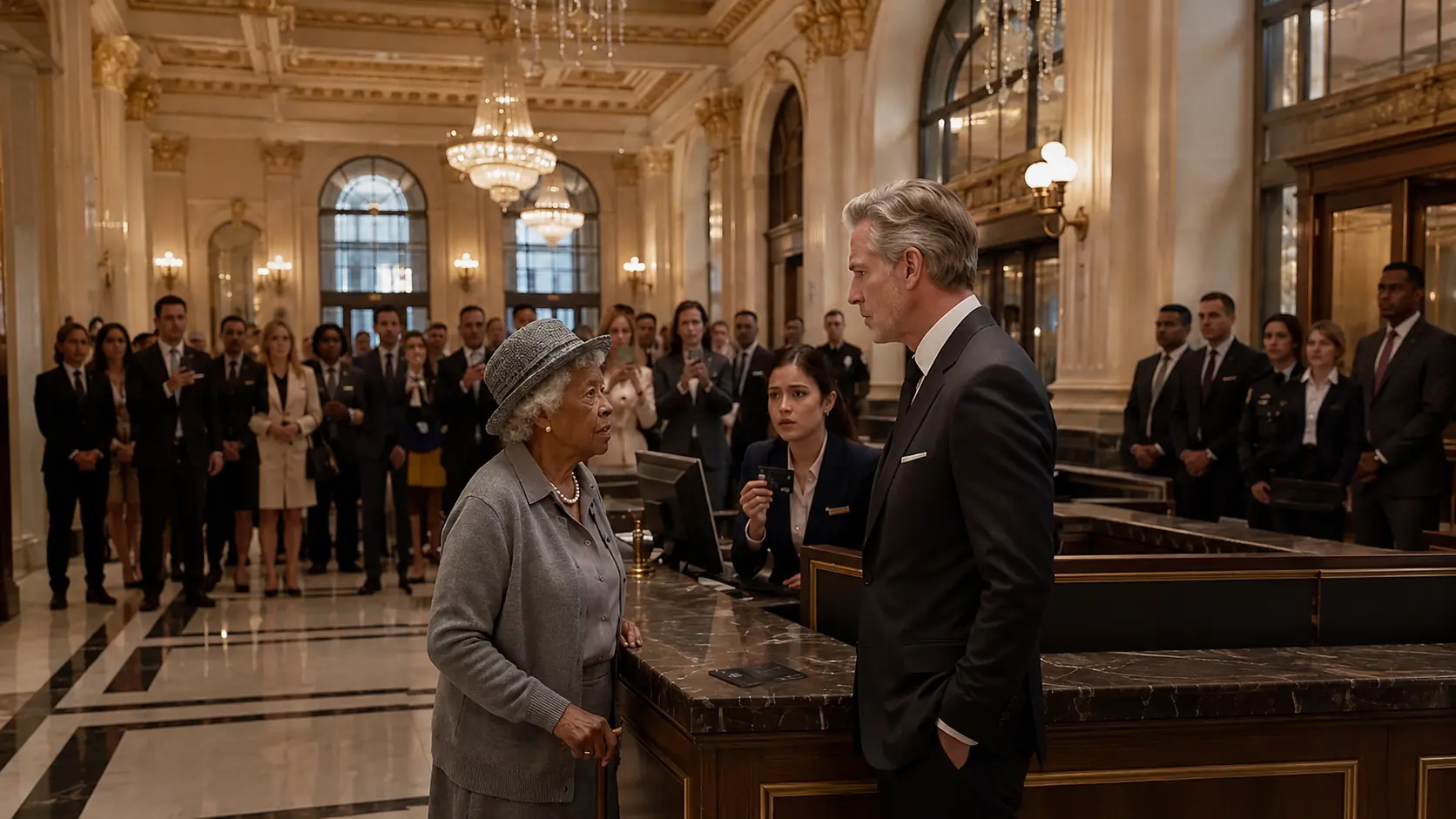
Eleanor stood at the private banking desk wearing a light-gray cardigan over a clean white blouse, a dark skirt, practical black shoes, and a gray knit hat covering her silver curls. At seventy-eight, she was short and slender, but nothing about her posture seemed fragile. Her deep-brown face carried the calm patience of someone who had spent decades watching impatient people reveal themselves.
Across the counter, junior banker Sofia Martinez held Eleanor’s black account card with both hands.
“I’m sorry, ma’am,” Sofia said. “The system is asking for executive verification.”
“Then verify it.”
“I’m trying.”
Sofia glanced toward the office behind the private banking area. She had already entered the card twice. Each attempt opened a red warning across her monitor:
RESTRICTED RELATIONSHIP. EXECUTIVE AUTHORIZATION REQUIRED.
The warning did not say the account was invalid.
It said the account was important.
Before Sofia could call her supervisor again, Victor Lang emerged from the executive corridor.
Victor was fifty-five, tall and lean, with silver hair brushed neatly away from a polished face. He wore a charcoal suit, crisp white shirt, black tie, and a pocket square folded with exact precision. He moved through the lobby with the confidence of someone who believed the building responded to him personally.
“What is the problem?” he asked.
Sofia lowered her voice.
“This customer’s card is triggering a restricted relationship notice.”
Victor looked at Eleanor.
His eyes traveled from her knit hat to her practical shoes before returning to her face.
“Where did you get that card?”
Eleanor’s expression remained unchanged.
“The bank mailed it to me.”
“To what address?”
“My address.”
Victor gave Sofia an irritated look.
“Run a standard identity review.”
“I already did. Her identification matches.”
“Then the card may have been issued incorrectly.”
Eleanor rested one hand on the marble counter.
“Check the account.”
Victor turned back to her.
“Private banking cards are issued to clients meeting substantial asset requirements.”
“I know.”
“People sometimes receive promotional materials and misunderstand what they are.”
“This is not promotional material.”
Victor took the card from Sofia and examined it. The black surface carried no printed account number, only a small silver crest and Eleanor’s name engraved along the lower edge.
He rubbed his thumb across it as though testing whether the lettering might come off.
Eleanor watched him.
“I said check my balance, not my appearance.”
Several customers near the teller line turned toward them.
Victor’s face tightened.
“You look like you need charity, not private banking.”
The lobby became still.
Sofia’s eyes widened.
A security guard near the revolving doors shifted his weight but did not approach.
Eleanor extended her hand.
“Run it before I remove you.”
Victor leaned closer across the counter.
“When it declines, security throws you outside.”
Eleanor did not take her eyes off him.
“Run it, then call your board before I decide who still works here tomorrow.”
A low murmur moved through the lobby.
Victor straightened.
“You are making threats inside a financial institution.”
“I am describing the next five minutes.”
“You have no authority over this bank.”
“Then checking the account should settle that.”
Victor placed the card on the counter but kept two fingers over it.
“You will first explain how you obtained access to restricted credentials.”
Eleanor looked at Sofia.
“Would you please call the number printed in the relationship file?”
Sofia glanced at her monitor.
“There are three numbers, ma’am.”
“Call the first.”
Victor turned sharply.
“Do not call anyone.”
Sofia froze.
Eleanor studied him.
“Why not?”
“Because I am handling this.”
“You are avoiding verification.”
“I do not need a stranger instructing my employees.”
“I have banked here longer than you have been employed.”
Victor gave a short laugh.
“This branch has served Chicago’s most established families for more than a century.”
“My husband’s family was one of them.”
“What was his name?”
“Arthur Brooks.”
For the first time, something changed in Victor’s expression.
It disappeared so quickly that most people missed it.
Eleanor did not.
Victor recovered.
“Arthur Brooks died many years ago.”
“Fourteen.”
“The Brooks relationship was restructured after his death.”
“Without my authorization.”
“That is not possible.”
“Then call the number.”
Victor looked at Sofia.
“Lock the screen.”
Sofia hesitated.
“Mr. Lang, the relationship notes say direct verification is mandatory when the card is presented.”
“I said lock it.”
She slowly moved the cursor toward the sign-out icon.
Eleanor reached into her handbag and removed an old flip phone.
Victor smiled.
“Planning to call the board from that?”
“Yes.”
“You expect us to believe you have the personal number of a bank director?”
“I expect nothing from you anymore.”
She opened the phone and pressed a saved contact.
Victor gestured toward the guard.
“Mr. Ramsey, please come over.”
The guard approached cautiously. He was a Black man in his early forties with a calm face and a name tag identifying him as Malcolm Ramsey.
Victor pointed toward Eleanor.
“This woman is refusing to leave after presenting questionable credentials.”
Malcolm looked at Eleanor’s identification resting on the counter.
“Has the card been confirmed as fraudulent?”
“It is inconsistent with her profile.”
Eleanor looked at him.
“Did you hear what he said to me?”
Malcolm’s jaw tightened.
“Yes, ma’am.”
Victor’s voice sharpened.
“Your task is security, not commentary.”
Malcolm remained where he was.
“I need a lawful reason before removing a customer.”
“She is disrupting operations.”
“She asked for an account balance.”
Victor’s cheeks reddened.
Eleanor’s call connected.
A woman answered.
“Eleanor?”
“Good morning, Helen.”
The ease in Eleanor’s voice unsettled Victor more than anger would have.
Helen Cross served as chairwoman of Continental Heritage Bank’s board. She had known Eleanor for thirty-two years and had sat beside Arthur Brooks during the merger that transformed a struggling local bank into a national institution.
“Are you at the branch?” Helen asked.
“Yes.”
“How did the review go?”
“It hasn’t begun.”
There was a pause.
“Why not?”
Eleanor looked directly at Victor.
“An executive believes my card cannot belong to someone dressed like me.”
Victor stepped closer.
“Give me that phone.”
Malcolm moved between them.
“Sir.”
Victor stopped.
Helen’s voice became colder through the speaker.
“Who is the executive?”
“Victor Lang.”
This time, Victor’s face lost all color.
Helen spoke clearly.
“Put him on.”
Eleanor held out the phone.
Victor did not take it.
“You know Chairwoman Cross?” he asked.
“She asked to speak with you.”
“This could be staged.”
Eleanor placed the phone on speaker and set it on the counter.
Helen’s voice filled the private banking area.
“Victor, answer me.”
Every employee nearby recognized her immediately.
Victor cleared his throat.
“Ms. Cross, we are dealing with a possible account-security issue.”
“The security issue is why Eleanor is there.”
“I was not informed.”
“You were personally copied on the review schedule.”
Victor looked toward Sofia.
“Perhaps the email was routed incorrectly.”
Helen continued.
“Eleanor Brooks is the sole surviving trustee of the Brooks Family Financial Trust, the largest private deposit relationship in Continental Heritage Bank.”
Several people in the lobby reacted quietly.
Victor looked at the black card again.
The Brooks trust held controlling interests in logistics companies, manufacturing properties, municipal bonds, and philanthropic endowments established by Arthur’s grandfather. The relationship had helped stabilize Continental Heritage during two financial crises.
Eleanor had spent years avoiding public attention, managing most matters through attorneys and trusted advisers.
Victor had mistaken privacy for insignificance.
Helen was not finished.
“She is also one of the three voting trustees empowered to review executive conduct under the bank’s founding agreement.”
Victor swallowed.
“I understand.”
“No, you don’t. Had you understood, you would have followed the verification protocol instead of judging the client.”
Eleanor picked up the card.
“Tell her what you called me.”
Victor looked around the crowded lobby.
“This is not an appropriate place.”
“It was appropriate when you said it.”
Helen’s voice hardened.
“What did you say?”
Sofia answered quietly.
“He told Mrs. Brooks she looked like she needed charity, not private banking.”
Silence followed.
Then Helen said, “Lock Victor’s administrative access immediately.”
Victor turned toward Sofia.
“Do not touch that system.”
Sofia stared at him, then at Eleanor.
Eleanor nodded once.
Sofia opened the employee control panel and selected Victor’s profile.
A confirmation prompt appeared.
Victor reached across the counter.
Malcolm caught his wrist before he touched the keyboard.
“Sir, step back.”
“Take your hand off me.”
“Step back from the employee.”
Victor pulled free, but he moved away.
Sofia disabled his access.
Victor’s phone vibrated almost instantly. He checked the screen and saw that his email, financial dashboards, and executive credentials had all been suspended.
“This is absurd,” he said. “One misunderstanding cannot justify shutting down the head of private banking.”
Eleanor looked at him.
“This is not about one sentence.”
“What else could it be about?”
“The account.”
Victor’s expression tightened again.
Helen heard her.
“Eleanor, did they show you the balance?”
“No.”
“Did the restriction appear?”
“Yes.”
Helen exhaled.
“Then do not leave the branch.”
Victor looked toward the executive elevators.
Eleanor noticed.
“What is upstairs?”
“Offices.”
“What is in my account?”
“I cannot discuss confidential balances in the lobby.”
“You were willing to discuss whether I looked wealthy enough.”
Victor said nothing.
Helen told Sofia to transfer the call to a secure conference line. Within ten minutes, three board members, the bank’s general counsel, and an outside forensic auditor joined remotely.
Eleanor was escorted into a private conference room overlooking the lobby.
Victor entered only after Malcolm confirmed he carried no removable drives or personal storage devices.
Sofia joined them as the employee who first accessed the account.
The black card rested on the table between Eleanor and Victor.
Helen appeared on the wall monitor.
“Eleanor, the Brooks trust was flagged after your attorney questioned several transfers from the community endowment.”
Victor leaned forward.
“The transfers were approved investments.”
“By whom?” Eleanor asked.
“The bank’s discretionary management team.”
“The endowment is not discretionary.”
Victor looked toward general counsel.
“The account structure changed after Arthur’s death.”
“I never signed a change.”
“There was a trustee authorization.”
“Show it.”
An auditor shared a scanned document on the screen.
The page appeared to contain Eleanor’s signature beneath language granting Continental Heritage authority to move charitable funds into bank-managed investment vehicles.
Eleanor leaned closer.
“That is not my signature.”
Victor spoke immediately.
“It was notarized.”
“By whom?”
The auditor zoomed in.
The notary name belonged to Martin Shaw, a former bank employee who had died six years earlier.
Eleanor examined the date.
“This says I signed it three years ago.”
No one spoke.
The dead notary could not have witnessed the signature.
Helen looked toward Victor.
“Explain.”
“I have never seen the original document.”
“You oversee the relationship.”
“The trust was administered before I took control.”
“How long have you controlled it?”
“Five years.”
The fraudulent document was three years old.
Victor realized the contradiction only after speaking.
Eleanor sat back.
“How much was moved?”
The auditor opened a preliminary report.
“Approximately forty-six million dollars across seven transactions.”
Sofia covered her mouth.
Victor’s voice rose.
“That figure includes internal reallocations, not losses.”
“Where did the money go?” Eleanor asked.
“Approved investment funds.”
“Which funds?”
The auditor displayed the names.
Four were legitimate Continental Heritage products.
Three were privately managed partnerships linked to Lang Meridian Capital.
Eleanor looked at Victor.
“Lang?”
He folded his hands.
“A distant family connection.”
General counsel answered.
“Lang Meridian Capital is controlled by Victor’s brother and two former Continental executives.”
Victor turned toward the monitor.
“That does not establish wrongdoing.”
Eleanor’s voice remained calm.
“Did you disclose the relationship?”
“The investment committee reviewed every transaction.”
Helen checked another document.
“The committee minutes show unanimous approval.”
“Exactly.”
“One member was traveling internationally on the meeting date. Another retired six months earlier.”
Victor stood.
“This meeting has become accusatory. I want counsel.”
“You should have counsel,” Eleanor said. “But first, sit down.”
“You do not order me.”
Malcolm opened the conference-room door.
Victor looked at him, then slowly returned to his chair.
The forensic auditor continued.
Money from the Brooks Community Endowment had been moved into speculative real-estate projects controlled by Lang Meridian. The projects paid high management fees before reporting losses.
The endowment supported housing grants, school meal programs, senior transportation, and emergency medical assistance across Chicago.
During the same period, several programs were told funding had been reduced because investment returns had fallen.
Eleanor remembered every letter.
A South Side food pantry had closed its evening program.
A senior shuttle serving three neighborhoods had reduced service to two days a week.
A scholarship fund named after Arthur had rejected more than sixty qualified students.
She had trusted the bank’s reports.
The losses were not market failures.
Someone had taken the money through fees, related-party contracts, and false approvals.
“How much did your family earn?” Eleanor asked.
Victor stared at the table.
“The fund managers received standard compensation.”
“How much?”
The auditor answered.
“Just over twelve million dollars.”
Eleanor looked at Victor.
“You called me a charity case while your family was taking money from charities.”
His face flushed again.
“I did not personally move those funds.”
“Your credentials approved four transfers.”
“Senior staff sometimes process transactions under executive authority.”
“Without your knowledge?”
“In a large institution, delegation is common.”
Helen interrupted.
“Victor, did you authorize anyone to use your credentials?”
“I would need to review the logs.”
“The logs show biometric confirmation.”
He went still.
The bank used fingerprint confirmation for trust transfers above five million dollars. The system had recorded Victor’s physical approval.
He could not blame an assistant.
General counsel muted the conference line for a private discussion with the board. Victor requested permission to leave.
Eleanor refused.
“You cannot detain me.”
“No,” she said. “But the officers entering the lobby may have that authority.”
Through the conference-room glass, two federal investigators and several state financial-crimes officers crossed the marble floor.
Victor stood again.
“You called law enforcement before reviewing the facts?”
Helen’s voice returned.
“The inquiry began two weeks ago.”
Eleanor looked toward the screen.
“You knew?”
“We suspected unauthorized transfers. We did not know how Victor would respond when you appeared in person.”
Eleanor understood.
Her branch visit had been part of the investigation.
The card was intentionally restricted. Proper protocol required the banker to call the trust’s designated board contact, verify Eleanor, and begin an independent review.
Victor had instead attempted to stop the call, lock the system, and remove her from the branch.
He had revealed more than prejudice.
He had revealed fear.
Special Agent Dana Mercer entered the conference room and presented a warrant covering Victor’s office, bank devices, personal phone, and records connected to Lang Meridian Capital.
Victor looked at Eleanor.
“You set me up.”
“I asked for my balance.”
“You came dressed like that deliberately.”
Eleanor looked down at her cardigan.
“Like what?”
“You knew people would misunderstand.”
“Honest people would have checked my identification.”
“That card represented billions in relationships.”
“And you decided my face could not belong beside it.”
Victor turned toward the agents.
“I will not answer questions without an attorney.”
Dana nodded.
“That is your right.”
Officers escorted him from the conference room.
As he crossed the lobby, the same customers and employees who heard him threaten Eleanor watched him pass between two investigators.
No one applauded.
Eleanor was glad.
This was not entertainment.
The investigation lasted eleven months.
Forensic teams uncovered altered signatures, false meeting minutes, undisclosed family relationships, and more than seventy million dollars in suspicious trust transactions across several client accounts.
The Brooks endowment suffered the largest losses, but it was not the only target.
Victor and two other executives had selected clients who were elderly, private, geographically distant, or unlikely to review complex reports personally.
Several were widows.
One was a retired physician living with dementia.
Another was a family trust supporting children with disabilities.
The scheme relied on the belief that no one important would ask the right questions.
Victor’s treatment of Eleanor in the lobby had followed the same logic.
He saw a woman in a cardigan and knit hat and decided she did not matter.
He had used that assumption for years.
This time, it ended him.
Victor was charged with bank fraud, conspiracy, forgery, breach of fiduciary duty, money laundering, and theft from charitable funds. His brother and two former executives were charged alongside him.
Sofia testified about the lobby confrontation and Victor’s order to stop verification.
Malcolm testified that Victor attempted to interfere with the computer after his access was challenged.
Digital records confirmed the rest.
Victor accepted a plea agreement only after prosecutors showed him biometric logs tied to every major transfer. He received eighteen years in federal prison and was ordered to surrender assets for restitution.
Continental Heritage recovered part of the stolen money through insurance, seized property, and civil claims.
The board covered the remaining endowment losses from executive reserves and shareholder funds.
Eleanor insisted that every affected community program receive not only restored funding but compensation for the years of disruption.
The senior transportation service returned to five days a week.
The food pantry reopened its evening program.
The Brooks scholarship fund accepted twice its previous number of students for the next four years.
Eleanor attended the first scholarship ceremony without a formal announcement.
She wore the same gray cardigan.
Sofia, now promoted to relationship manager under a new independent trust division, sat beside her.
“You could buy any clothing you want,” Sofia said quietly.
“I do.”
Sofia smiled.
“You know what I mean.”
Eleanor looked toward the students receiving their awards.
“Arthur used to say expensive clothing was useful when you wanted strangers to behave well before learning your name.”
“Did he dress expensively?”
“Always.”
“And you?”
“I prefer learning who people are.”
Months later, Eleanor returned to the bank’s main branch.
The chandeliers still glowed above the marble floor, but several policies had changed. Private banking employees could no longer stop identity verification based on a manager’s visual judgment. Restricted account alerts now contacted independent compliance officers automatically.
Customer-removal decisions required documented conduct, not vague discomfort.
A sign near the counter read:
Every client receives verification, privacy, and respect before account status is known.
Eleanor approached the same desk.
A new employee greeted her.
“Good morning, ma’am. How may I help you?”
“I would like to check my balance.”
“Of course. May I see your card and identification?”
Eleanor handed them over.
The employee examined the documents, entered the information, and followed the verification process without surprise, suspicion, or exaggerated politeness.
He did not know who she was.
That was the point.
After completing the request, he returned the card.
“Is there anything else I can help you with today, Mrs. Brooks?”
“No. You did exactly what I asked.”
She crossed the lobby toward the revolving doors.
Malcolm stood near the entrance and opened one side for her.
“Good to see you again.”
“You too.”
Outside, Chicago traffic moved beneath a gray morning sky.
Eleanor paused on the sidewalk and looked back at the building Arthur had once helped save.
Victor believed the black card was powerful because of the money behind it.
He never understood that the card had tested something more valuable.
Character.
The balance proved Eleanor controlled enormous wealth.
The five minutes before anyone checked it proved who deserved to remain near it.