“A dirt man like you doesn’t walk in with ten million dollars—tell me who you stole it from.”
Sarah Winters held Brandon Coleman’s cashier’s check above the marble counter so every customer in the private banking lobby could see it. Before he could answer, she tore it once down the center, folded the pieces together, and ripped them again. Four fragments of a valid ten-million-dollar check fluttered onto the polished floor between them.
Brandon looked down at the pieces without moving. “You just destroyed a valid check because my face offended your imagination.”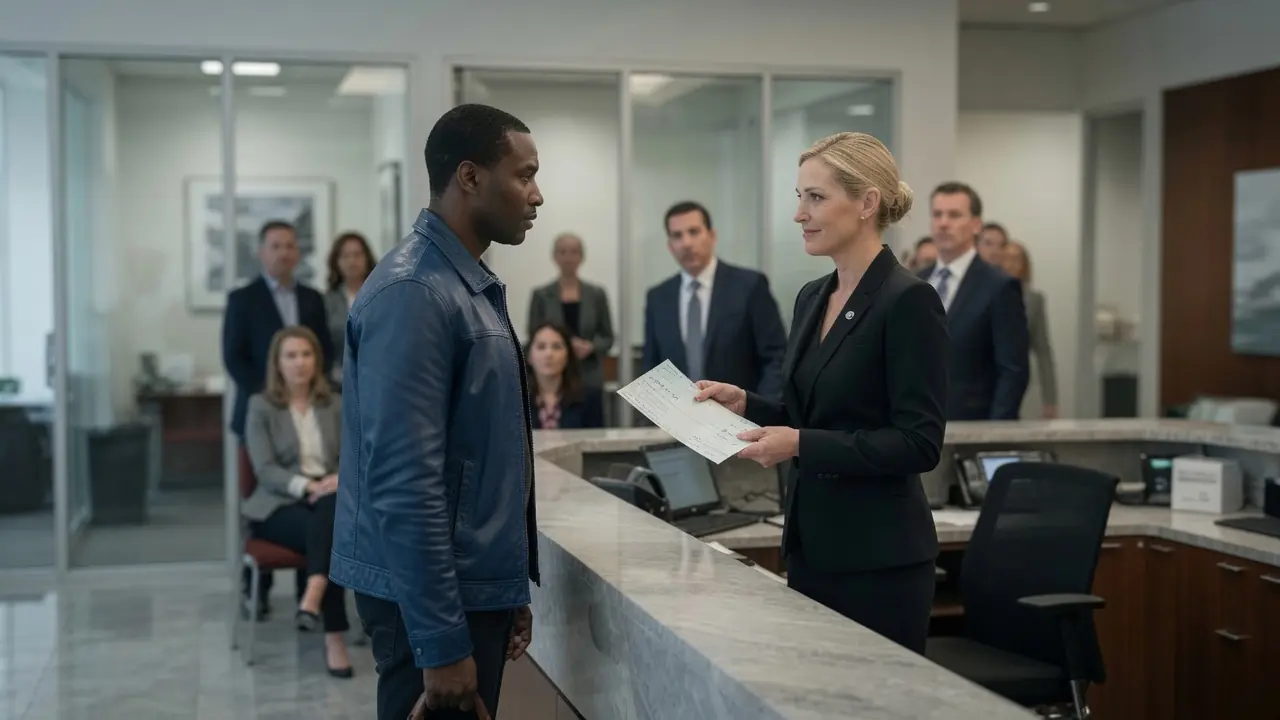
Sarah reached beneath the counter for the silent security button. “Keep talking, and I’ll have you dragged out in handcuffs.”
The glass doors opened behind Brandon before she could press it. Bank chairman Richard Hayes hurried into the lobby, saw the torn check on the floor, and stopped so suddenly that two executives nearly collided with him.
“Mr. Coleman, sir—the board is waiting upstairs,” Richard said. “What has my manager done to your check?”
Every sound inside Eastbridge Private Bank seemed to disappear.
Sarah’s hand remained beneath the counter. Her confident smile collapsed as she looked from Richard to Brandon and back again. The employees behind the service desks stared at their chairman, who had never rushed for anyone during Sarah’s seven years at the branch.
Brandon slowly picked up one piece of the check. “Your manager decided ten million dollars could not belong to a man dressed like me.”
Sarah found her voice. “Mr. Hayes, this customer entered without an appointment and presented a suspicious instrument. I was protecting the bank.”
Richard’s face hardened. “That customer is Brandon Coleman.”
“I know the name on the check.”
“No,” Richard said. “You clearly do not know the man.”
Forty-two-year-old Brandon Coleman had entered the bank thirty minutes earlier wearing a weathered brown leather jacket over a black shirt, dark jeans, and clean work boots. His appearance was deliberate. That morning, he had visited a construction site in Queens where one of his companies was converting an abandoned warehouse into affordable manufacturing space.
He had concrete dust on one sleeve and a small scratch across the back of his hand. His old leather briefcase contained contracts, tax documents, and the final cashier’s check required to complete the acquisition of Eastbridge Bank’s troubled commercial-loan division.
The ten-million-dollar check was not a deposit into Brandon’s personal account.
It was the final payment in a forty-eight-million-dollar transaction that could determine whether Eastbridge survived the next quarter.
Brandon had spent his childhood in a two-bedroom apartment in Newark with his mother, Denise, who worked nights cleaning office buildings. His father disappeared when Brandon was nine, leaving behind unpaid bills and a toolbox containing three wrenches, a hammer, and a rusted measuring tape.
At thirteen, Brandon began helping an elderly contractor named Arthur Bell repair porches during summer break. Arthur taught him how to frame walls, read blueprints, negotiate fair prices, and refuse clients who wanted good work for dishonest wages.
“You can tell what a man thinks of you by how quickly he assumes you are desperate,” Arthur once said.
Brandon remembered those words throughout college, where he studied engineering during the day and cleaned construction sites at night. After graduation, banks rejected his first six loan applications for a small renovation company, despite his contracts and detailed business plan.
The seventh lender approved him only after Arthur placed his own home as collateral.
Brandon never forgot it.
Coleman Urban Development began with three employees and one damaged pickup truck. Twenty years later, it employed more than eleven thousand people across construction, logistics, technology, and commercial property management.
Brandon owned buildings worth hundreds of millions of dollars, but he still carried Arthur’s rusted measuring tape inside his briefcase.
That morning, he had chosen to enter Eastbridge without assistants, attorneys, or security because he wanted to complete the transaction personally. The bank’s board had scheduled a final signing upstairs at eleven, but Brandon arrived early to verify the cashier’s check and review several account transfers.
He expected discretion and efficiency.
Sarah offered him neither.
The moment Brandon approached the marble counter, she looked past him toward the entrance as if waiting for the actual client to arrive. She did not greet him, ask his name, or offer assistance.
“This floor handles private clients,” she said.
“I’m aware.”
“Retail services are across the street.”
“I need to verify a cashier’s check before an eleven o’clock meeting.”
Sarah’s eyes moved over his leather jacket and work boots. “How much?”
“Ten million dollars.”
Her expression shifted immediately from annoyance to suspicion.
“Identification.”
Brandon placed his driver’s license and passport on the counter.
Sarah inspected both documents for nearly a minute, then held the license beneath the desk light. “These could be altered.”
“You may verify them electronically.”
“Where did you get the check?”
“Continental Reserve Bank issued it this morning.”
“That was not my question.”
Brandon met her eyes. “I earned the money.”
Several customers nearby turned toward them.
Sarah took the check with two fingers and examined its security marks. It was authentic, printed on protected paper, signed by two authorized officers, and linked to a verified account belonging to Coleman Urban Development Holdings.
The confirmation terminal displayed the company name clearly.
Sarah saw it.
Instead of acknowledging the verification, she stepped into the back office and called security. She told the officer that a suspicious man had presented a fraudulent ten-million-dollar instrument and might become aggressive.
The officer asked whether the check had failed authentication.
Sarah said she was still investigating.
When she returned, Brandon asked whether the check had been verified.
“You expect me to believe a man who walks in carrying an old bag owns ten million dollars?”
“My briefcase does not determine the balance.”
“People who handle money like this do not dress like construction workers.”
“I came from a construction site.”
Sarah smiled coldly. “Exactly.”
Brandon placed both hands on the counter. “Call the issuing bank.”
“I don’t need instructions from you.”
“You are holding my property.”
“I am preventing fraud.”
That was when Sarah raised her voice, delivered the insult in front of the entire lobby, and tore the check apart.
Now Richard Hayes stood beside Brandon, staring at the fragments.
The chairman bent down and collected two pieces himself. “This check was part of today’s acquisition.”
Sarah’s lips parted. “Acquisition?”
Richard turned toward the stunned employees. “Mr. Coleman’s company is purchasing our distressed commercial portfolio and providing the capital required to complete Eastbridge’s restructuring.”
One of the tellers covered her mouth.
Sarah attempted to recover. “Then why did he not identify himself properly?”
Brandon pointed toward the identification still resting on the counter. “I gave you two government documents, the verified check, the company account, and my full name.”
“You did not say you were the buyer.”
“You did not ask. You decided what I could not be before allowing me to explain what I was.”
Richard looked toward the lobby security officer who had just arrived. “Officer Bennett, did Mr. Coleman threaten anyone?”
“No, sir.”
“Did he behave aggressively?”
The officer glanced at Sarah. “I was told he might.”
“That is not what I asked.”
“No, sir. He appears calm.”
Sarah’s face reddened. “He accused me of discrimination.”
“You tore up ten million dollars after the system confirmed the check,” Brandon said. “What description would you prefer?”
The bank’s chief legal officer, Margaret Sloan, entered from the elevators with two board members. She had been waiting upstairs for Brandon and came searching when he failed to appear.
Her eyes fell on the torn check. “Please tell me that is a copy.”
Richard said nothing.
Margaret looked at Sarah. “Did you destroy the original?”
“I believed it was fraudulent.”
“The authentication system says verified,” one teller said quietly.
Sarah turned toward the young employee. “Nobody asked you, Melissa.”
Brandon noticed the teller flinch.
That small reaction told him Sarah’s behavior had not begun that morning.
Margaret requested that the lobby security footage be preserved immediately. She then asked the security officer to secure the check fragments as evidence and instructed Sarah not to touch the computer terminal.
Sarah folded her arms. “Am I being treated like a criminal because I protected this institution?”
“You are being investigated because you destroyed a verified financial instrument and made a discriminatory accusation against a client,” Margaret said.
“Because he is buying part of the bank?”
“Because your conduct would be unacceptable regardless of who he is.”
Brandon looked at her. That answer mattered.
He had no interest in watching Eastbridge pretend the problem existed only because Sarah had humiliated a wealthy man. If the bank responded differently only after learning his power, then the same behavior would continue against people without chairmen waiting upstairs.
Richard asked Brandon to continue the meeting in the boardroom while the incident was investigated.
Brandon shook his head. “Not yet.”
“Sir, we can replace the check and complete the paperwork.”
“The check is not the first issue.”
Richard lowered his voice. “What do you need?”
“I want to know how many people she treated this way when no board member was present.”
Sarah laughed nervously. “This is absurd. I have excellent performance reviews.”
Melissa, the teller Sarah had silenced, looked down at her desk.
Brandon saw it.
“Ms. Sloan,” he said, “ask the employees whether they can speak freely without their manager present.”
Sarah immediately objected. “You cannot interrogate my staff in front of customers.”
Margaret answered, “Your authority is temporarily suspended.”
Sarah’s expression went blank.
She had entered Eastbridge as an assistant manager twelve years earlier and advanced quickly because she attracted wealthy clients. Her quarterly reports showed strong deposits, high retention, and exceptional satisfaction scores from selected private-banking customers.
Those reports did not show what happened to people she considered unimportant.
Margaret asked Sarah to wait inside a conference room with a human-resources representative. Sarah refused at first, insisting she had done nothing wrong. When Richard reminded her that refusal would be documented as insubordination, she marched away in silence.
The moment the door closed, the atmosphere changed.
Melissa raised her hand cautiously. “She has done this before.”
Richard turned toward her. “Done what?”
“Questioned Black customers more aggressively. Latino customers too. Sometimes older people if their clothing doesn’t look expensive enough.”
Another employee named David spoke from the second counter. “She keeps a list of clients she calls high risk, but it isn’t based on account activity.”
“What is it based on?” Margaret asked.
David looked uncomfortable. “How they look. How they speak. Whether she thinks they belong here.”
Richard’s face tightened. “Why was this never reported?”
“It was,” Melissa said.
The answer surprised everyone except the employees.
She explained that three tellers had submitted complaints during the previous eighteen months. Each report was forwarded to regional management, then returned to Sarah for internal resolution. Sarah interviewed the employees who complained, changed their schedules, and lowered their performance scores.
One resigned.
Another requested a transfer.
Melissa remained because her mother depended on her health insurance.
Brandon felt his anger deepen, but he kept his voice controlled. “Did any customers complain?”
David nodded. “At least seven that I know of.”
“What happened to those reports?”
“Sarah marked them resolved.”
Richard asked the technology team to retrieve every complaint connected to the branch. Within forty minutes, they found eleven formal customer grievances and nine internal reports involving Sarah.
One Black physician had been asked to prove repeatedly that he owned a medical-practice account. A Hispanic businesswoman had been ordered to wait in the public lobby while her white assistant was invited into a private office.
An elderly widow had been told a large insurance payment was probably an error.
In each case, Sarah described the customer as confused, hostile, suspicious, or overly sensitive.
None of the complaints had received independent review.
Brandon entered the conference room where Sarah waited with an HR officer. Richard and Margaret accompanied him, while the security cameras continued recording.
Sarah looked at Brandon with open resentment. “Are you satisfied?”
“No.”
“You have already ruined my reputation.”
“I walked into your bank with a valid check. You did the rest.”
“You think because you are rich, you can destroy anyone who makes one mistake.”
Brandon sat across from her. “Was Dr. Marcus Hill a mistake?”
Sarah’s expression shifted.
“Was Elena Ramirez a mistake? Was Vivian Brooks a mistake? Were the tellers whose schedules you changed after they reported you all mistakes?”
“I handled difficult customers.”
“You created difficult situations, then used their reactions to justify what you had already decided about them.”
Sarah looked toward Richard. “I protected this bank from fraud for seven years.”
Richard placed the complaint files on the table. “You protected certain customers from having to share the lobby with people you judged beneath them.”
“That is not true.”
Margaret opened the first report. “You wrote that Dr. Hill displayed aggressive body language after being asked for additional identification.”
“He raised his voice.”
“He had already provided three forms of identification.”
“He could have remained calm.”
Brandon leaned forward. “That is how this works, isn’t it? You provoke people, disrespect them, and then demand perfect composure as proof they deserve to be heard.”
Sarah stared at him.
He continued, “I remained calm, and you still tore the check.”
For the first time, she had no answer.
Eastbridge immediately placed Sarah on administrative leave. The transaction meeting was postponed, and Richard offered to reimburse every expense caused by the delay.
Brandon declined to proceed until an independent firm reviewed the bank’s complaint system.
The board protested.
Without his capital, Eastbridge might violate regulatory requirements before the end of the month. The commercial-loan division contained several failing properties, and another buyer had already withdrawn after discovering undisclosed risks.
Brandon’s acquisition was their best remaining option.
Richard met him privately in the boardroom.
“If you walk away, hundreds of employees may lose their jobs.”
“I am not walking away.”
The chairman exhaled with relief.
“I am changing the conditions.”
Brandon placed a revised proposal on the table. Coleman Urban Development would still acquire the distressed loans and provide emergency capital, but Eastbridge had to accept independent oversight, rebuild its complaint process, protect employees who reported misconduct, and review every branch for discriminatory practices.
The bank would also fund a commercial-lending program for small businesses historically denied fair access to capital.
Richard read the proposal. “This will cost millions.”
“So did ignoring the problem.”
“The board may reject it.”
“Then they can find another buyer.”
The board approved every condition the following morning.
Continental Reserve Bank issued a replacement cashier’s check. This time, Brandon entered Eastbridge wearing the same leather jacket and carrying the same old briefcase.
Richard met him at the door.
No carpet was rolled out, and no photographers were invited. Brandon did not want the bank to transform accountability into a publicity event.
Melissa personally verified the new check.
She examined the security features, confirmed the issuing account, and asked Brandon to sign the receipt. She followed every required procedure without suspicion, condescension, or unnecessary delay.
“Everything is in order, Mr. Coleman,” she said.
“Thank you.”
He looked around the lobby. “That is all the first interaction needed to be.”
The investigation into Sarah lasted six weeks.
Security footage showed that she had intentionally ignored the terminal confirmation before tearing the check. Emails revealed jokes about customers’ clothing, names, and neighborhoods.
One message to another manager described the branch as “a private club that needs protection from people who discover money before discovering class.”
Sarah was terminated for discrimination, retaliation, destruction of property, falsification of reports, and violations of bank procedure.
She appealed, arguing that Eastbridge sacrificed her to satisfy a powerful buyer.
The independent investigator rejected the appeal after reviewing years of evidence that predated Brandon’s arrival.
Regional managers who returned complaints to Sarah without oversight were also removed or disciplined. The executive responsible for approving her promotions resigned after admitting he focused exclusively on revenue.
Melissa became assistant branch manager.
At first, she refused the promotion because she feared people would think she received it for speaking against Sarah. Brandon told her courage did not make her unqualified; it simply revealed qualities the old system had ignored.
She accepted after Eastbridge guaranteed that employee evaluations would include ethics, complaint handling, and fair treatment—not only deposit growth.
Dr. Marcus Hill received a personal apology and reimbursement for fees charged after he closed his accounts. Elena Ramirez returned to discuss financing for her logistics company under the new small-business program.
Vivian Brooks, the elderly widow once treated like a confused woman, was invited to review senior-client procedures.
Brandon attended several of those meetings but never dominated them.
He understood that reform designed only by executives often failed the people it claimed to protect.
Six months later, Coleman Urban Development transformed several distressed properties from Eastbridge’s portfolio. Empty warehouses became affordable commercial spaces. An abandoned shopping center became a medical clinic, daycare facility, and training center for skilled trades.
The investments generated profit, but they also created jobs in neighborhoods banks had spent decades describing only as risk.
One afternoon, Brandon visited the original branch after another construction inspection. Concrete dust covered one sleeve of his jacket again.
A new security officer greeted him politely without recognizing him.
“Good afternoon, sir. How may we help you?”
Brandon smiled. “I have a meeting upstairs.”
“May I see your identification?”
“Of course.”
The officer examined it, checked the appointment list, and returned it immediately. He treated the construction worker waiting behind Brandon with the same professionalism.
That ordinary fairness pleased Brandon more than any public apology.
Upstairs, Richard showed him the bank’s latest complaint data. Reports had increased during the first months because customers and employees finally trusted the system enough to use it.
Some board members considered the increase embarrassing.
Brandon considered it progress.
“Silence was never proof that nothing was wrong,” he said. “It was proof people believed speaking would change nothing.”
Richard nodded. “I should have known what was happening.”
“You should have built a system that did not depend on you personally knowing.”
The chairman looked toward the lobby below. “That may be the hardest lesson.”
“It is also the most important.”
A year after the incident, Brandon visited his mother’s apartment in Newark. Denise still lived in the same neighborhood because she refused every offer to move into one of his luxury buildings.
She said the women in her building knew when she was sick and brought soup without scheduling an appointment.
Brandon showed her the preserved pieces of the original check, now sealed inside a clear evidence sleeve.
Denise stared at them. “She tore up ten million dollars?”
“Yes.”
“You stayed calm?”
“Mostly.”
His mother shook her head. “I would not have stayed calm.”
“That is why I never take you to negotiations.”
She laughed, then became serious. “Did they believe you because you were right or because you were rich?”
Brandon considered the question.
“At first, because I was rich.”
“And after?”
“I made them face why that was a problem.”
Denise touched the evidence sleeve. “Good.”
She had cleaned bank offices for years after midnight. Employees who passed her during late meetings rarely asked her name. Some left trash beside full wastebaskets rather than placing it inside, as though her job erased the need for courtesy.
“You know what bothers me?” she said. “If that chairman had not known you, she might have had security take you away.”
“I know.”
“That means you did not win because the system worked.”
“No.”
“You won because you had enough power to stop it from failing quietly.”
Brandon looked at his mother. “That is why I changed the system.”
Denise nodded. “Then keep checking it.”
Eastbridge later displayed no plaque describing what happened. Brandon rejected the idea because he did not want the lobby turned into a monument to a wealthy man receiving justice.
Instead, the bank placed a short statement at every service desk:
Verify documents. Question transactions. Never judge ownership by appearance.
The words were simple, but employees discussed the event during training. They watched the security footage beginning with Brandon’s arrival and ending with Richard calling him “sir.”
Most trainees initially focused on the reversal.
The instructor always stopped the recording before Richard entered.
“At this point,” she asked, “does Mr. Coleman deserve respect?”
The answer was obvious.
He deserved it before anyone knew his wealth, title, or influence. He deserved it while wearing a dusty jacket, carrying an old briefcase, and standing alone before a manager who had already decided what a Black man could not own.
The chairman’s arrival exposed Sarah’s mistake.
The torn check exposed the bank’s deeper failure.
Years later, Brandon still carried the old leather briefcase. The corners grew softer, the handle required repair, and his assistants repeatedly offered to replace it with something more appropriate for a billionaire.
He refused.
Inside it remained Arthur Bell’s rusted measuring tape, the tool of a contractor who once placed his home at risk because a young Black engineer deserved a chance.
Beside it rested one fragment of the ten-million-dollar check.
The measuring tape reminded Brandon that someone had believed in him before he looked successful.
The torn check reminded him how quickly others could decide that success did not belong to him.
Sarah Winters believed wealth had a uniform, a skin color, and a particular way of entering a room. When Brandon failed to match that image, she preferred destroying evidence over questioning her prejudice.
She thought the torn paper would prove he was a fraud.
Instead, it proved the ten million dollars had never been the most valuable thing standing at her counter.
Brandon’s dignity existed before the check.
It remained after she tore it apart.
And by the time her chairman rushed across the lobby calling him “sir,” the entire bank had learned that respect arriving only after power is revealed is not respect at all.