The wind had been blowing across northern Wisconsin since before sunrise, pushing dry snow over County Road 17 in long white ribbons. By noon, the temperature had dropped low enough that even the pine trees seemed brittle. Most people had stayed home, fireplaces burning and curtains drawn against the gray afternoon.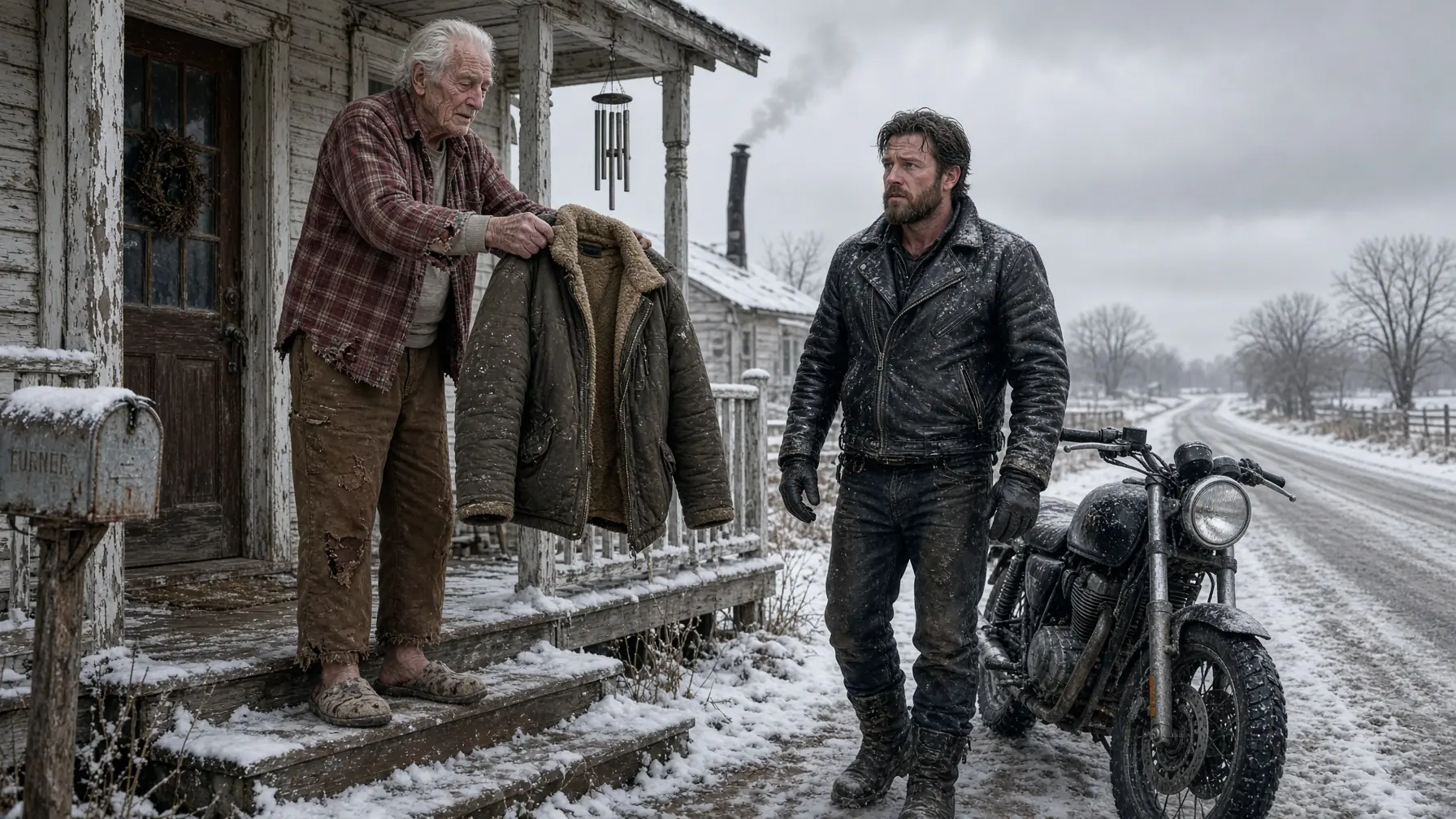
Seventy-nine-year-old Elias Turner had nowhere else to go anyway.
His small farmhouse stood alone beyond a narrow gravel lane, the last house before miles of frozen fields and forest. White paint had peeled from the siding years ago. Two porch boards had begun to sag, the gutter over the kitchen leaned slightly away from the roof, and the old mailbox beside the road carried more rust than paint.
Elias could no longer see any of it.
Glaucoma had taken most of his vision slowly, then cruelly. Shapes became shadows. Shadows became darkness. By the time his wife Margaret died three years earlier, Elias could distinguish little more than bright daylight from night.
He continued living in the house they had shared for forty-six years because he could still navigate it by memory.
Seven steps from the kitchen table to the sink.
Fourteen steps from his bed to the hallway.
Nine careful steps from the front door to the edge of the porch.
He knew every loose floorboard by sound.
What he did not know was how long he could keep doing it alone.
That afternoon Elias sat beside the kitchen radio wearing an old thermal shirt beneath a torn black-and-gray flannel. One elbow had been patched twice. The cuffs were frayed, and the collar had split along the seam. His brown work pants were older than some of the people who occasionally delivered groceries.
The furnace had stopped working properly two winters earlier.
Elias kept the thermostat low and relied on a small wood stove in the kitchen.
His only good winter coat hung beside the front door.
Heavy green wool.
Brass buttons.
A gift from Margaret during their twenty-fifth anniversary.
He had refused to replace it even when the lining started wearing thin.
At 2:17 that afternoon, Elias heard an engine.
It came from the county road.
Deep.
Mechanical.
Then uneven.
The sound sputtered several times before disappearing completely.
Silence returned.
Elias tilted his head.
He waited.
Seconds later, he heard something else.
Boots crunching through snow.
Slowly.
Unevenly.
Someone was walking toward his house.
Elias reached for the wooden cane leaning beside the table.
The stranger knocked three times.
“Hello?”
A man’s voice.
Young compared with Elias.
Tired.
Cold.
Elias opened the door.
Wind immediately pushed snow across his slippers.
“Can I help you?”
The stranger hesitated.
“Sorry to bother you, sir. My bike died about two hundred yards down the road.”
Elias listened to his breathing.
Too fast.
The man was trying not to shiver.
“What’s your name?”
“Dean. Dean Mercer.”
“Come inside, Dean Mercer.”
“I’m covered in snow.”
“So is half of Wisconsin.”
Dean almost laughed.
Elias stepped aside.
Thirty-eight-year-old Dean Mercer entered the kitchen looking nothing like the kind of person most strangers would immediately invite into their homes. He was broad-shouldered, heavily built, with a short brown beard, weathered face, and a black leather motorcycle jacket covered in road grime. Dark jeans disappeared into heavy riding boots, and tattoos ran along both forearms beneath his gloves.
But Elias could not see any of that.
He heard only a man whose teeth were beginning to chatter.
“You’re cold.”
“I’m fine.”
“That’s what cold men say right before they stop feeling their hands.”
Dean rubbed them together.
“My phone died. Bike did too. I thought maybe I could use yours.”
“Landline’s beside the refrigerator.”
Dean picked it up.
Nothing.
Elias sighed.
“Storm took the line yesterday.”
Dean stared toward him.
“You don’t have a cell?”
“I have one somewhere.”
Elias smiled.
“Never learned to like the thing.”
Dean walked toward the window.
Snow was coming harder.
“Closest town?”
“Eleven miles.”
Dean looked at the weather.
Walking was impossible.
Elias pointed toward the kitchen chair.
“Sit.”
“I don’t want to impose.”
“You’re already inside.”
Dean sat.
Elias poured him coffee.
It was weak and slightly burned from sitting in the pot too long.
Dean drank it like the finest thing he had tasted all year.
For twenty minutes, they talked.
Dean explained he had been riding home after visiting his younger sister near Eau Claire. He had checked the forecast that morning, but the storm arrived earlier than predicted. His motorcycle began losing power several miles before Elias’s house.
“You ride motorcycles in February?” Elias asked.
“Bad planning.”
“That’s one description.”
Dean laughed.
It was the first warm sound inside the house in days.
Elias asked about Dean’s family.
His sister had two daughters.
His parents had died years earlier.
Dean belonged to a motorcycle club called Iron Ridge Riders, though he quickly clarified they were more charity group than troublemakers.
“We mostly raise money for kids, veterans, hospitals, things like that.”
Elias smiled.
“You sound disappointed.”
Dean laughed again.
“Ruins the mysterious biker image.”
Elias reached toward the stove and added another piece of wood.
Dean noticed the stack beside it.
Only four logs remained.
“You got more firewood?”
“Some outside.”
“How much?”
“Enough.”
Dean could tell it was a lie.
Then he noticed Elias rubbing his hands.
The old man was cold too.
“Where’s your coat?”
“By the door.”
“Put it on.”
“I’m indoors.”
“So?”
“So people generally don’t wear coats in kitchens.”
Dean shook his head.
“You should.”
Elias ignored him.
They continued talking.
The temperature kept dropping.
Eventually Dean stood.
“I need to check the bike.”
“In this weather?”
“I can’t leave it sitting half on the shoulder.”
Elias reached for his cane.
“Wait.”
He crossed the kitchen slowly.
Dean watched him approach the front door.
Elias felt along the wall until his fingers found the heavy green coat hanging from the hook.
He removed it.
Then held it toward Dean.
“Take this.”
Dean stared.
“No.”
Elias extended it farther.
“Your bike quit, and your voice is shaking from the cold, son. Take this before winter makes the choice for you.”
Dean looked at Elias’s torn flannel.
“Sir, you need that coat more than I do.”
“I’m staying inside.”
“You barely have enough wood.”
“I’ve survived seventy-nine winters.”
“And that means you’re allowed to freeze on number eighty?”
Elias smiled faintly.
“Then help me keep my pride and accept it, because I’d sleep colder knowing I left you out there freezing.”
Dean looked toward the coat.
Then Elias.
His expression changed.
Something about receiving kindness from a man who clearly had almost nothing made refusal feel selfish.
Slowly, Dean took the coat.
It was too small across his shoulders.
He did not care.
“I won’t forget this, Mr. Turner.”
Elias nodded.
Dean pulled the coat around himself.
“And I promise this porch won’t stay lonely much longer.”
Elias chuckled.
“Just bring the coat back.”
Dean stepped outside.
He walked toward his motorcycle.
Twenty minutes later, an old pickup approached from the opposite direction. A county maintenance worker had seen the abandoned bike and stopped.
Dean explained what happened.
The worker loaded the motorcycle into the truck bed and offered Dean a ride into town.
Before leaving, Dean ran back toward Elias’s house.
He knocked.
Elias opened.
“You found help?”
“Yeah.”
“Good.”
Dean began removing the coat.
Elias stopped him.
“Keep it until you’re somewhere warm.”
“I’ll return it.”
“I know.”
Dean stared at the old man.
For the first time in years, Dean Mercer felt close to crying in front of another man.
“Thank you.”
Elias nodded.
“Go home, son.”
Dean did.
But he never forgot the farmhouse.
That night, he sat inside a roadside motel staring at Elias’s coat hanging over a chair.
The torn lining was visible now.
One brass button had been sewn back using black thread instead of green.
Inside the collar, someone had embroidered two initials by hand.
E + M
Dean ran his thumb across them.
Then he remembered Elias standing in that ripped flannel.
He called his sister.
“You still know that county social worker?”
“Why?”
“I met somebody.”
The next call went to Iron Ridge Riders president Tommy Graves.
Tommy answered loudly.
“What’d you break now?”
“Bike.”
“Again?”
“Not important.”
Dean described Elias.
The blind old man.
The furnace.
The firewood.
The torn shirt.
The coat.
Tommy became quiet.
Dean finished.
“He gave me the warmest thing he owned.”
A pause.
“What do you want to do?”
Dean looked at the green coat.
“Everything.”
The next morning, Dean returned.
He expected Elias to be surprised.
He did not expect the driveway to be almost completely buried.
Dean carried two grocery bags and the green coat.
Elias opened the door.
“You’re back.”
“You sound disappointed.”
“You said weeks.”
“I changed my mind.”
Dean returned the coat.
Then carried groceries inside.
Bread.
Soup.
Coffee.
Eggs.
Milk.
Fresh meat.
Elias immediately objected.
“I didn’t ask for this.”
“No.”
“You can take half back.”
“No.”
Elias crossed his arms.
“You’re stubborn.”
“Learned it yesterday.”
Dean spent three hours clearing snow.
Then he checked the furnace.
He knew almost nothing about heating systems, but he knew enough to recognize that it needed professional attention.
Before leaving, he measured the porch.
Elias heard the tape measure.
“What are you doing?”
“Nothing.”
“That sounds exactly like something.”
Dean smiled.
“You’ll find out.”
He called Tommy from the driveway.
“House needs more than firewood.”
“How much?”
“Roof. Furnace. Porch. Maybe windows.”
Tommy whistled.
“That’s not a weekend project.”
Dean looked toward the farmhouse.
“It is now.”
Tommy started making calls.
Iron Ridge Riders had approximately ninety regular members.
Those ninety knew other clubs.
And those clubs knew others.
Dean posted one photograph.
Not Elias.
The coat.
He wrote:
Yesterday, during a storm, a blind seventy-nine-year-old stranger gave me the last winter coat he owned because he thought I needed it more. His furnace barely works. His porch is failing. He lives alone. I’m going back. Anyone who wants to help, message Tommy.
The post spread.
By evening, Dean had 127 messages.
The next morning, 300.
Then contractors began offering materials.
A roofing company offered shingles.
A heating company volunteered a new furnace.
A lumberyard offered porch boards.
A local grocery store pledged food.
A window company called.
Then another motorcycle club asked whether they could participate.
Dean told Tommy:
“This is getting big.”
Tommy answered:
“Good.”
“But Elias hates charity.”
“Then don’t call it charity.”
“What do we call it?”
Tommy paused.
“Returning a coat.”
Dean smiled.
Elias knew something was happening.
He was blind, not oblivious.
More vehicles began stopping by.
A man named Rick inspected the furnace.
Another measured windows.
Two women from the county senior-services office visited and helped Elias review assistance programs he had never known existed.
When Elias demanded answers, Dean gave him the same response.
“Just maintenance.”
“Maintenance doesn’t need seven pickup trucks.”
“You have a complicated porch.”
Elias pointed his cane toward Dean’s voice.
“You’re lying.”
“Little bit.”
The biggest secret remained hidden.
The date.
Three weeks after the storm, Dean called Elias Friday evening.
“Don’t make plans tomorrow.”
Elias laughed.
“My social calendar is crowded.”
“Stay home.”
“Where would I go?”
“Good point.”
At 8:10 Saturday morning, Elias heard something far away.
At first, he thought it was thunder.
Then the sound continued.
Low.
Rolling.
Growing.
His kitchen window vibrated.
Elias stood.
He reached for his cane.
The sound became enormous.
Hundreds of engines.
One after another.
The road outside the farmhouse seemed to come alive.
Elias opened the front door.
Cold air touched his face.
“Dean?”
No answer.
Then one motorcycle stopped.
Another.
Another.
The engines continued arriving.
For almost fifteen minutes.
Elias stood frozen.
Finally, Dean’s voice came from below the porch.
“Morning, Mr. Turner.”
Elias gripped his cane.
“What have you done?”
Dean climbed the steps.
“Returned your coat.”
Elias frowned.
“I already have it.”
Dean smiled.
“Not exactly.”
Across the road, motorcycles stretched farther than Elias could have seen even before blindness.
Eight hundred ninety riders had come.
Men.
Women.
Young riders.
Retired riders.
Members from fifteen different clubs.
Some had traveled hundreds of miles.
Behind them came work trucks carrying lumber, roofing materials, tools, heaters, paint, groceries, and furniture.
Elias heard hundreds of boots on frozen gravel.
“What is happening?”
Dean stood beside him.
“Remember when you told me you’d sleep colder if you left me freezing?”
“Yes.”
Dean looked toward the crowd.
“Turns out none of us sleep very well knowing you’re freezing either.”
Elias’s face tightened.
“No.”
Dean waited.
“I don’t want money.”
“Nobody brought money.”
“I don’t want charity.”
“Good.”
Dean leaned closer.
“We didn’t bring charity.”
“What did you bring?”
“Friends.”
Elias tried to respond.
His voice failed.
Then someone in the crowd began clapping.
Another joined.
Within seconds, nearly nine hundred bikers were applauding the blind elderly man standing on a cracked porch in a worn flannel shirt.
Elias lowered his head.
He cried.
Not loudly.
Just enough that Dean saw his shoulders move.
Dean put one arm around him.
Elias whispered:
“All I did was give you a coat.”
Dean answered:
“Exactly.”
Work began immediately.
The riders divided into teams.
Professional contractors handled anything requiring expertise.
The furnace replacement went to licensed technicians.
Electricians inspected dangerous wiring.
Roofers repaired the worst sections.
Carpenters rebuilt the porch.
Everyone else carried materials, cleared snow, stacked firewood, painted, cleaned, cooked, or simply stayed out of the professionals’ way.
Elias spent most of the morning sitting in a chair near the kitchen doorway listening.
Hammers.
Laughter.
Boots.
Voices.
Music from someone’s portable speaker.
For years, the farmhouse had been silent enough that Elias could hear the refrigerator cycle on at night.
Now it sounded alive.
At noon, Dean sat beside him.
“Too much?”
Elias smiled.
“Way too much.”
“Want us to stop?”
“No.”
Dean laughed.
Elias reached for his arm.
“Where did they all come from?”
“Everywhere.”
“Why?”
Dean answered gently.
“Because people are tired of hearing stories where nobody shows up.”
Elias sat quietly.
Then asked:
“Are they really all bikers?”
“Mostly.”
“How many?”
Dean hesitated.
Elias immediately noticed.
“How many?”
“Eight hundred ninety.”
Elias turned his face toward him.
“You brought eight hundred ninety people to my house?”
“Technically Tommy invited some.”
Elias laughed so hard he started coughing.
Dean handed him water.
“You’re insane.”
“Probably.”
By sunset, the farmhouse looked different.
The porch was safe.
The furnace worked.
Firewood filled a newly repaired storage shed.
The roof would require two more days, but temporary repairs secured it.
The refrigerator was full.
Broken windows had been replaced.
A contractor installed railings along the porch steps so Elias could navigate them more safely.
One rider mounted raised tactile markers beside important doors.
Another installed a voice-controlled thermostat donated by an electronics store.
Nothing was luxurious.
That was not the goal.
The goal was dignity.
Dean refused every suggestion that would turn Elias’s house into something unrecognizable.
“This is his home,” he kept telling people.
“Repair it. Don’t replace his life.”
That mattered most.
Late that evening, most riders left.
The sound of motorcycles rolling away continued for almost half an hour.
Finally, silence returned.
But it felt different.
Not empty.
Elias sat beside his new furnace listening to the steady warmth moving through the vents.
Dean remained.
“You still here?”
“Yep.”
“Why?”
“Waiting for you to complain.”
Elias smiled.
“You replaced my porch.”
“It was dangerous.”
“My furnace.”
“Also dangerous.”
“My roof.”
“Roofers did that.”
“You brought nearly nine hundred strangers.”
Dean considered it.
“Okay, that part might have been excessive.”
Elias laughed.
Then became quiet.
“My wife would’ve liked you.”
Dean looked at him.
“Margaret?”
“You remembered.”
“The initials.”
Elias touched the green coat resting over his chair.
“She bought this for me.”
“I figured.”
“I thought giving it away would feel wrong.”
“Did it?”
Elias shook his head.
“No.”
He ran his fingers over the sleeve.
“Margaret used to say anything we owned became more valuable after helping somebody.”
Dean stared at the floor.
“She sounds smart.”
“She was.”
For several moments neither man spoke.
Then Elias asked:
“Why did you really come back?”
Dean thought carefully.
“Because when you handed me that coat, I realized something.”
“What?”
“I couldn’t remember the last time a stranger helped me without wanting anything.”
Elias nodded.
Dean continued.
“And I didn’t want the story to end with you being cold.”
Elias reached across and found Dean’s hand.
“It didn’t.”
The story spread throughout Wisconsin.
Then farther.
News crews wanted interviews.
Elias initially refused.
Eventually he agreed to one local reporter under a condition.
“Don’t call me a hero.”
The reporter asked why.
“I gave away an old coat.”
She smiled.
“Eight hundred ninety people disagree.”
Elias shook his head.
“Then eight hundred ninety people are wrong.”
“What should we call you?”
He considered.
“Neighbor.”
That word became attached to the story.
The Iron Ridge Riders created an annual winter program called The Neighbor Run.
Every December, members identified elderly residents living alone who needed home repairs, heating assistance, groceries, snow removal, or simply company.
They never used Elias’s name publicly without permission.
But everyone knew where the idea began.
A farmhouse.
A failed motorcycle.
A green wool coat.
Over the next five years, the program helped hundreds of people.
Dean eventually became its coordinator.
Whenever volunteers complained that a project seemed too small to matter, he repeated Elias’s words:
“You never know what somebody’s last coat looks like.”
Elias lived another seven years.
He never moved from the farmhouse.
Dean visited almost every week.
Sometimes they talked for hours.
Sometimes Dean repaired something.
Sometimes they simply drank terrible coffee.
Kayla, Dean’s niece, began calling Elias Grandpa E without anyone deciding when that happened.
The green coat remained beside the front door.
Elias never wore another one.
When he died peacefully at eighty-six, Dean found instructions in a drawer.
Only three sentences.
Dean gets Margaret’s coat.
Keep helping strangers.
And fix your motorcycle before winter.
Dean laughed through tears.
At Elias’s funeral, motorcycles again filled County Road 17.
Not eight hundred ninety.
More.
Nobody counted.
The farmhouse eventually passed to a small community foundation according to Elias’s will.
It became a temporary residence for elderly people whose homes were undergoing emergency repairs through the Neighbor Run.
The porch stayed.
The wind chime stayed.
Even the battered mailbox remained.
Dean insisted.
One winter afternoon years later, he stood on the same porch wearing Elias’s green coat.
It still barely fit his shoulders.
A young volunteer laughed.
“You’re going to tear that thing.”
Dean looked down.
“Probably.”
“Why keep wearing it?”
Dean ran his thumb across the old brass button sewn with black thread.
“Because this coat taught nearly nine hundred people how expensive kindness can become.”
The volunteer frowned.
“Expensive?”
Dean smiled.
“In the best way.”
He looked toward the frozen county road.
The night he first walked toward that farmhouse, he thought he needed warmth for an hour.
Elias gave him something that lasted decades.
People later told the story as if eight hundred ninety bikers surrounding the house was the miracle.
Dean never agreed.
That was merely the response.
The miracle happened three weeks earlier when a nearly blind seventy-nine-year-old man stood in a ripped shirt on a freezing porch and offered the last good coat he owned to someone he had known for less than an hour.
Elias had almost nothing.
He still found something to give.
And because one stranded biker refused to forget it, hundreds of engines eventually rolled down a frozen Wisconsin road to make certain the old man who had warmed a stranger would never spend another winter feeling forgotten.