Ten-year-old Carter James was not supposed to stop on the way home from school.
His mother had told him that every morning before he left their small rented house on the edge of Millbrook, Kansas.
“Straight home, Carter. No shortcuts through fields. No stopping at the creek. No wandering behind the grain silos. You hear me?”
“I hear you, Mom.”
“And if Mr. Dawson’s dog barks at you again, cross the street.”
“I know.”
“And keep your coat zipped.”
“I know, Mom.”
His mother always gave too many instructions, but Carter never complained. He understood why she worried. Ever since his father died in the accident at the feed mill, worry had become something that lived in the house with them. It sat at the kitchen table while his mother counted bills. It stood in the hallway when the furnace made strange noises. It followed Carter to school and waited for him outside the classroom door.
His mother, Elaine James, worked at the town grocery store in the mornings and cleaned offices at night. She was only thirty-four, but her tired eyes made her look older when she thought no one was watching. She did her best to keep their life steady, but some weeks steady meant peanut butter sandwiches for dinner and pretending the electricity bill was “just a little late.”
Carter tried to help in small ways.
He swept the porch without being asked. He carried laundry. He fixed the loose kitchen chair with a screwdriver that had belonged to his father. He learned how to patch his bicycle tires with an old kit from the garage. Whenever something broke, he tried to repair it before his mother had to worry.
Fixing things made him feel close to his father.
His dad, Daniel James, had not been a professional mechanic, but he had understood machines the way some people understood music. He could hear a problem in a motor before anyone else knew something was wrong. He could bring a stubborn lawn mower back to life with patience, wire, and a few quiet words under his breath.
When Carter was little, he used to sit beside him in the driveway while Daniel worked on engines.
“Don’t rush,” his father would say. “Machines don’t like panic.”
Carter remembered that.
He remembered everything.
The smell of grease on his father’s hands. The way Daniel wiped tools before putting them away. The way he let Carter hold a flashlight and made him feel important.
“Listen first,” Daniel always said. “You can’t fix what you haven’t understood.”
So Carter listened.
He listened to engines.
He listened to adults when they tried to hide fear behind normal voices.
He listened to silence.
And on a windy afternoon in late October, while walking home from school with his backpack bouncing against his shoulders, Carter heard something that made him stop.
It came from beyond the old fence line near Whitaker Farm.
A rough grinding noise.
Then a cough.
Then a loud metallic pop.
Then silence.
Carter turned his head.
Whitaker Farm sat half a mile outside town, past the empty baseball field and a narrow gravel road lined with cottonwood trees. Most kids avoided it. The barns were old, the fields looked lonely, and Mr. Samuel Whitaker had a reputation for being the kind of old man who shouted at anyone who got too close.
People said he had once owned half the farmland in the county.
People said he had not smiled since his wife died.
People said he kept everything locked.
Carter had only seen him twice before, both times in town, walking slowly with a cane and wearing a faded brown hat pulled low over his eyes. He looked like a man built out of weathered wood and stubbornness.
The sound came again.
A weak attempt at starting.
Then nothing.
Carter looked toward the road home.
His mother would expect him in twenty minutes.
He looked back toward the farm.
Another grinding sound rose from behind the barn, followed by a frustrated shout.
Carter swallowed.
Then he stepped off the sidewalk and started down the gravel road.
The wind pushed dry leaves across his shoes. The sky was pale gray, and the fields stretched wide and empty on both sides. Carter kept one hand on the strap of his backpack and told himself he would only check quickly. If Mr. Whitaker was fine, he would leave. If something was wrong, he would run for help.
When he reached the farm gate, he saw the tractor.
It sat in the middle of a muddy field behind the barn, an old green machine with chipped paint, huge rear tires, and a small trailer half-filled with sacks of feed. The hood was raised. Thin smoke drifted from the engine area.
Beside it stood Mr. Whitaker.
The old man was tall but bent at the shoulders, with a deeply lined face, white hair beneath his brown hat, and a gray beard trimmed short along his jaw. He wore a faded denim jacket over a plaid shirt, worn work pants, and muddy boots. One hand gripped a cane. The other rested against the tractor as if he needed it to stay upright.
Carter stopped near the fence.
“Mr. Whitaker?”
The old man turned sharply.
His eyes narrowed.
“Who’s there?”
“It’s Carter James.”
The old man frowned. “Daniel James’s boy?”
Carter was surprised he knew that.
“Yes, sir.”
“What are you doing on my land?”
Carter almost stepped back.
“I heard the tractor.”
Mr. Whitaker looked irritated, but also embarrassed.
“Tractor’s fine.”
As if answering him, the tractor gave a small hiss from beneath the hood.
Carter glanced at it.
Mr. Whitaker scowled.
“It’s being difficult.”
Carter carefully climbed through the gate opening and walked closer.
“You need help?”
“I need this old pile of bolts to remember it has a job.”
Carter looked at the engine.
“What happened?”
Mr. Whitaker exhaled heavily.
“Started losing power near the lower pasture. Thought I could get it back to the barn before it quit. Then it coughed, popped, and died right here.”
Carter stepped closer to the tractor, but not too close.
“Did it overheat?”
Mr. Whitaker’s expression changed.
“You know tractors?”
“A little.”
The old man gave him a doubtful look.
Carter was used to that.
He was small for ten. His coat sleeves were too short, his backpack had a broken zipper, and his shoes were scuffed white at the toes. Adults saw a little boy first, and only later did they notice he paid attention.
“My dad taught me,” Carter added.
The old man’s face shifted at the mention of Daniel.
For a moment, he looked less annoyed.
“He was good with engines,” Mr. Whitaker said.
Carter nodded.
“The best.”
The old man looked away toward the field.
Then he muttered, “Well, take a look if you’re so curious. But don’t touch anything hot.”
Carter nodded seriously.
“Yes, sir.”
He stepped onto the metal side platform and leaned over the engine. The smell reached him quickly.
Not just smoke.
Fuel.
Too much fuel.
He looked at the plugs, the wires, the air intake, the fuel line. The tractor was old but not neglected. Someone had maintained it for years, even if not perfectly. A loose wire near the ignition coil caught his eye, but that wasn’t the whole problem. He noticed the choke linkage stuck halfway closed.
Carter climbed down.
“I think it’s flooding.”
Mr. Whitaker frowned. “Flooding?”
“The choke is stuck. It’s getting too much fuel and not enough air. That might be why it coughed and popped. And this wire is loose too.”
The old man stared at him.
“You saw that from standing there?”
Carter shrugged.
“My dad used to make me find problems before he told me.”
Mr. Whitaker leaned in, squinting.
His hands trembled slightly when he reached toward the linkage. He stopped, grimacing as his fingers stiffened.
Carter noticed.
“Your hands hurt?”
The old man pulled them back quickly.
“They’re old.”
“That doesn’t answer the question.”
For a second, Mr. Whitaker looked offended.
Then, unexpectedly, he gave a rough little laugh.
“No. I suppose it doesn’t.”
Carter opened his backpack and pulled out a small pair of pliers wrapped in cloth. They had belonged to his father. He kept them with him the way some kids kept lucky cards or coins.
Mr. Whitaker looked at the tool.
“You carry pliers to school?”
“Sometimes things break.”
“That they do,” the old man said quietly.
Carter carefully freed the stuck linkage, then tightened the loose wire. He worked slowly, just the way his father had taught him. No rushing. No panic. The wind moved across the field, tugging at his hair. Mud clung to his shoes. Mr. Whitaker held the hood steady and watched without speaking.
When Carter finished, he stepped back.
“Try it now.”
Mr. Whitaker climbed onto the tractor with difficulty and turned the key.
The engine coughed once.
Carter winced, listening.
Then the tractor rumbled to life.
A deep, steady sound rolled across the field.
Mr. Whitaker sat frozen for a second, one hand still on the key.
Then he looked down at Carter.
“Well,” he said slowly. “I’ll be.”
Carter smiled.
“It needs cleaning. The linkage might stick again.”
Mr. Whitaker turned off the engine and climbed down.
“How much do I owe you?”
Carter immediately shook his head.
“Nothing.”
“You fixed my tractor.”
“It was small.”
“Small things stop big machines.”
Carter looked at the mud.
“My mom says we don’t charge neighbors for being decent.”
Mr. Whitaker studied him for a long moment.
Then his face softened in a way Carter had not expected.
“Your mother says that?”
“Yes, sir.”
“She’s raising you right.”
Carter looked back toward town and suddenly remembered the time.
“I have to go.”
Mr. Whitaker glanced at the sky.
“You walked here alone?”
“Yes, sir.”
“Your mother know?”
Carter hesitated.
That was enough.
The old man frowned deeply.
“She’ll worry.”
“I know. I just heard the tractor and thought maybe you needed help.”
Mr. Whitaker looked toward the tractor, then toward the road.
“I did,” he said quietly.
He reached into his jacket pocket and pulled out an apple wrapped in a napkin.
“Take this at least.”
Carter almost refused, but his stomach tightened at the sight of food. He had eaten lunch early, and dinner would probably be canned soup again.
“Thank you,” he said.
Mr. Whitaker nodded.
“And Carter?”
“Yes, sir?”
“Don’t come onto farms alone without telling someone. Machines can be dangerous. So can fields.”
Carter nodded.
“Yes, sir.”
He hurried back down the gravel road, biting into the apple only after the farm disappeared behind him.
When Carter reached home, his mother was standing on the porch.
Her arms were folded, her face pale with worry.
“Carter James.”
He stopped at the bottom step.
“I’m sorry.”
“Where were you?”
“Whitaker Farm.”
Her eyes widened.
“What?”
“Mr. Whitaker’s tractor broke down.”
Elaine closed her eyes and pressed one hand to her forehead.
“You went to Whitaker Farm alone?”
“I heard it from the road.”
“You are ten years old.”
“I helped fix it.”
“That is not the point.”
Carter looked down.
His mother came down the steps, knelt in front of him, and took his shoulders in both hands.
“Do you know how scared I was?”
“I’m sorry.”
Her face trembled.
“I thought something happened to you.”
Carter’s throat tightened.
“I didn’t mean to scare you.”
“I know.” She pulled him into a hug, holding him tightly. “I know you didn’t.”
Inside, over dinner, Carter told her what happened. He explained the stuck choke linkage, the loose wire, the way the tractor sounded, the smoke, the apple.
Elaine listened quietly.
When he mentioned his father’s pliers, she looked toward the small shelf where Daniel’s photograph sat in a wooden frame.
In the photo, Daniel smiled beside an old pickup, one hand resting on the hood, the other holding five-year-old Carter on his hip.
“He taught you too well,” Elaine whispered.
Carter looked at her.
“Is that bad?”
“No, sweetheart.” She reached across the table and squeezed his hand. “It just means I’m not the only one who misses him when you do something like that.”
The next afternoon, Mr. Whitaker came to their house.
Carter saw him through the window first. The old man stood on the porch wearing the same brown hat, holding a paper bag in one hand and leaning on his cane with the other.
Elaine opened the door cautiously.
“Mr. Whitaker?”
“Mrs. James,” he said, removing his hat. “I owe you an apology.”
“For what?”
“For letting your boy help me without making sure you knew where he was.”
Elaine blinked, surprised by the honesty.
“He made that choice himself.”
“He’s a good boy. But good boys still need adults to think clearly.”
Elaine’s guarded expression softened slightly.
Mr. Whitaker held out the paper bag.
“Brought some vegetables from the garden. Potatoes, carrots, onions. Too many for one old man.”
Elaine hesitated.
“We can’t pay for those.”
“Didn’t ask you to.”
She looked like she wanted to refuse, but Carter saw hunger win quietly behind her eyes. Not hunger for herself. For him.
“Thank you,” she said.
Mr. Whitaker nodded.
Then he glanced at Carter, who was standing behind his mother.
“Your son has a rare ear for machines.”
Elaine sighed. “His father did too.”
“I remember Daniel. Fixed my baler once after two grown mechanics gave up. Wouldn’t take full payment either.”
Carter looked at his mother.
She had never told him that.
Mr. Whitaker continued, “I came to ask permission. Not today. Not without you. But if Carter wants to come by the farm sometimes, I could teach him properly. Safe things. Small things. Nothing dangerous.”
Elaine stiffened.
“He’s ten.”
“I know.”
“He has school.”
“School first.”
“He has chores.”
“Chores matter.”
“And I don’t want him being used as free help.”
Mr. Whitaker’s eyes sharpened, but not with anger. With respect.
“Neither do I.”
Elaine studied him carefully.
The old man continued, “Truth is, Mrs. James, I’ve got more machines than my hands can manage and more silence than is good for me. I’m not asking for a worker. I’m asking whether your boy might sit in the barn sometimes and learn what his father would’ve kept teaching him.”
Carter held his breath.
Elaine glanced at him.
He tried not to look desperate.
He failed.
His mother looked back at Mr. Whitaker.
“I come with him the first time.”
“I expected that.”
“And if I don’t like anything I see, that’s the end.”
“Fair.”
“And no dangerous equipment.”
“Agreed.”
Carter nearly jumped.
Elaine pointed at him.
“No celebrating yet. Homework first. Always.”
“Yes, ma’am.”
That Saturday, Elaine walked with Carter to Whitaker Farm.
The place looked different when he was allowed to be there. Less like a forbidden old property. More like a world waiting to be understood.
The barn was huge and weathered red, with sliding doors that groaned when Mr. Whitaker pushed them open. Inside, shafts of daylight fell through gaps in the wooden walls. Dust floated in the air. Tools hung from nails. Old license plates decorated one beam. There were shelves of jars filled with bolts, screws, washers, and parts Carter could not yet name.
In the middle of the barn sat a machine covered by a tarp.
Carter noticed it immediately, but he did not ask.
Mr. Whitaker gave him a small tour.
“This is the workbench. Never touch sharp tools without asking. That cabinet is chemicals. You don’t open it. That corner is safe parts for cleaning and sorting. You can work there.”
Carter nodded seriously.
Elaine watched every word, every gesture.
Mr. Whitaker did not seem annoyed by her caution. If anything, he seemed grateful for it.
He gave Carter a small box of mixed bolts and washers.
“First lesson. Sorting.”
Carter looked surprised.
“That’s all?”
Mr. Whitaker raised an eyebrow.
“You think mechanics start by rebuilding engines?”
“No, sir.”
“Good. Sorting teaches patience. Patience saves fingers.”
Carter sat at the bench and began separating bolts by size.
For the first hour, nothing exciting happened.
And somehow, it was wonderful.
Mr. Whitaker worked nearby, cleaning a carburetor with slow, stiff hands. Elaine sat on an old wooden chair near the barn door, watching but gradually relaxing. The farm was quiet except for the soft clink of metal, the wind outside, and Mr. Whitaker’s occasional instruction.
“Not that pile. Look at the thread.”
“Yes, sir.”
“That one’s stripped. Toss it in the scrap tin.”
“Yes, sir.”
“Don’t just look. Feel it.”
Carter ran his thumb gently along the threads.
“Oh.”
Mr. Whitaker nodded.
“Hands can see things eyes miss.”
By lunchtime, Elaine stood to leave.
Carter looked up in alarm.
“I have a shift at the store,” she said. “You listen. You follow every rule. And Mr. Whitaker walks you home before dark.”
Mr. Whitaker nodded.
“Yes, ma’am.”
After she left, the barn felt larger.
Carter kept sorting.
Mr. Whitaker worked in silence for a while, then said, “Your mother is strong.”
Carter nodded.
“She works a lot.”
“She shouldn’t have to work that much alone.”
Carter did not answer.
He knew that already.
The old man glanced at him.
“Sorry. That was not your burden to carry.”
Carter looked at the bolts.
“I carry some of it anyway.”
Mr. Whitaker grew still.
Then he said quietly, “Children often do.”
That afternoon, Carter helped clean old spark plugs and learned the difference between a part that could be saved and one that had to be replaced. Mr. Whitaker explained things slowly. He never spoke down to him. He did not call him “little man” or “buddy” or “kiddo” the way adults sometimes did when they wanted to sound kind without really listening.
He called him Carter.
And Carter liked that.
Over the next few months, Saturdays at Whitaker Farm became part of life.
Carter’s grades stayed up because Elaine made sure of it. His chores stayed done because Carter understood the farm was a privilege, not an escape. Every Saturday after lunch, he walked to the farm, and every evening before dark, Mr. Whitaker walked him home or drove him in the old pickup if the weather turned bad.
Carter learned to clean tools properly. He learned to change oil in a lawn mower. He learned how to check belts, sharpen blades, label parts, and read old repair manuals. He learned that old machines carried histories in their dents and rust.
Mr. Whitaker changed too.
At first, he stayed gruff. He corrected more than he praised. He gave instructions in short sentences and frowned whenever Carter asked too many questions.
But slowly, his voice softened.
He started saving small jobs for Carter. He baked cornbread once and pretended it was “extra.” He sent Carter home with eggs, potatoes, jars of preserves, and once, an entire chicken wrapped carefully in butcher paper.
Elaine protested every time.
Mr. Whitaker always said the same thing.
“Too much for one old man.”
One cold afternoon in January, while snow dusted the barn roof, Carter finally asked about the tarp-covered machine in the center of the barn.
“What’s under there?”
Mr. Whitaker paused.
His hand tightened around the rag he was holding.
“Something old.”
“Can I see?”
The old man did not answer for a long time.
Carter thought he might say no.
Then Mr. Whitaker slowly walked to the tarp and pulled it back.
Beneath it sat an old tractor.
Not the green one Carter had fixed in the field. This one was smaller, older, painted a faded red that had chipped away in many places. Its tires were cracked, the seat was torn, and dust covered every surface.
But even through age and neglect, Carter could tell it had once been beautiful.
“Wow,” he whispered.
Mr. Whitaker stood beside it, staring as if the tractor were not a machine but a memory.
“This was my wife’s favorite.”
“Your wife drove tractors?”
The old man’s mouth twitched.
“Better than me, according to her.”
Carter smiled.
“What was her name?”
“Margaret.”
Mr. Whitaker said it carefully.
Like the name still hurt.
“She and I bought this tractor the first year we had the farm. Didn’t have much money. It was used even then. But she loved it. Said it sounded cheerful.”
Carter looked at the rusted machine.
“Does it run?”
“No.”
“Could it?”
Mr. Whitaker’s jaw shifted.
“With enough work.”
“Why didn’t you fix it?”
The old man looked toward the barn doors.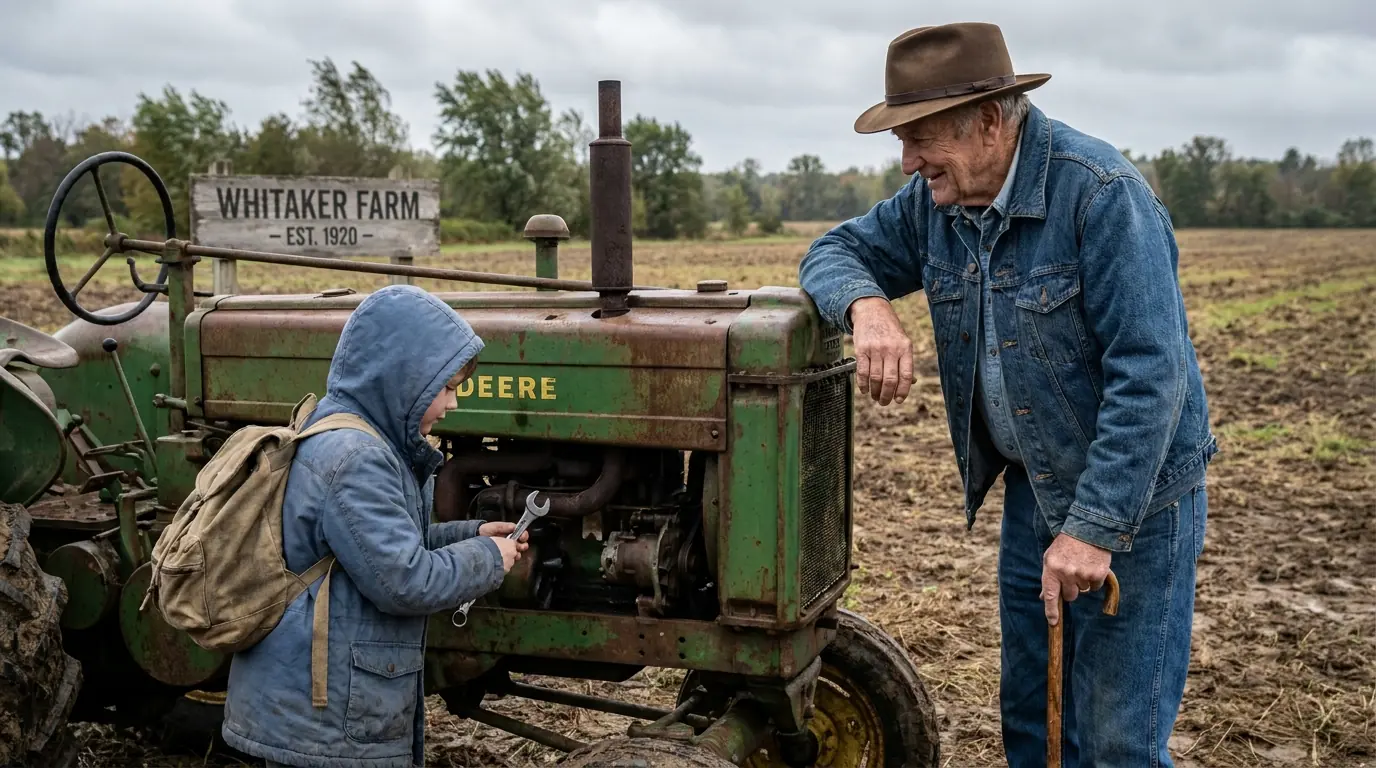
After a long silence, he said, “Because she died before we could restore it.”
Carter’s excitement faded.
“I’m sorry.”
Mr. Whitaker nodded once.
“She used to say we’d paint it together when we got old. Then she got sick. Cancer. Fast and cruel.”
Carter looked down.
“My dad had cancer too.”
The barn became very quiet.
Mr. Whitaker turned toward him slowly.
“How old were you?”
“Seven.”
The old man closed his eyes briefly.
“That’s too young.”
Carter nodded.
“Everyone says that.”
“It doesn’t help, does it?”
“No.”
Mr. Whitaker leaned against the workbench.
“When Margaret died, people told me time would heal it.”
“Did it?”
“No,” he said honestly. “But it changed the shape of the pain. Some days, that is enough.”
Carter looked back at the red tractor.
“Maybe fixing it would help.”
Mr. Whitaker’s eyes glistened.
“Maybe.”
They did not touch the tractor that day.
But the next Saturday, Mr. Whitaker had placed a notebook on the workbench.
On the front, in shaky handwriting, it said:
MARGARET’S TRACTOR
RESTORATION NOTES
Carter ran his fingers over the words.
“We’re really doing it?”
Mr. Whitaker nodded.
“Slowly.”
Carter grinned.
“Slow is still doing.”
The old man smiled for real then.
For the first time since Carter had known him, Samuel Whitaker smiled without hiding it.
Restoring Margaret’s tractor became their winter and spring project.
They began with photographs. Mr. Whitaker taught Carter to document every part before removing anything. They made labels. They drew diagrams. They cleaned pieces that had sat untouched for years. Carter learned the names of parts he had only seen in books. Magneto. Carburetor. Governor. Drawbar. Sediment bowl.
Some tasks were too advanced for him, and Mr. Whitaker handled those with help from a neighbor. But Carter was included in every explanation.
“Never pretend to know,” Mr. Whitaker told him. “Pride breaks more machines than ignorance.”
Carter wrote that in the notebook.
At home, his mother noticed the change in him.
He talked more.
He slept better.
He spent evenings reading old repair manuals instead of staring sadly at his father’s photograph. He still missed Daniel, but the ache had somewhere to go now. Into learning. Into tools. Into the red tractor waiting in the barn.
Elaine noticed something else too.
Their kitchen table had more food.
Not too much. Not enough to erase every struggle. But enough to breathe.
Eggs from Mr. Whitaker.
Vegetables.
A bag of flour.
A jar of honey.
Once, a winter coat for Carter appeared in a box by the door with a note that said:
Found this in town. Too small for me.
Elaine knew it was new.
She cried when Carter wasn’t looking.
One evening, she walked to the farm herself after work.
Mr. Whitaker was closing the barn doors.
“I need to talk to you,” she said.
He looked worried.
“Carter do something wrong?”
“No. That’s the problem.”
The old man frowned.
Elaine held up the note from the coat box.
“We can’t keep accepting things.”
Mr. Whitaker looked away.
“It was just a coat.”
“It was not just a coat.”
“He needed one.”
“I know.”
Her voice broke slightly.
“And I hate that you noticed before I could buy it.”
Mr. Whitaker’s face softened.
“Mrs. James—”
“No. Please let me say this. I am grateful. Truly. But I don’t want my son feeling like we’re someone’s charity case.”
Mr. Whitaker was silent for a moment.
Then he said, “Do you know why I let Carter into my barn?”
Elaine blinked.
“Because he helped you.”
“That was how it started.”
He looked toward the closed barn doors.
“But the truth is, before your boy came along, I was waiting to disappear.”
Elaine’s expression changed.
Mr. Whitaker continued quietly, “The farm was too quiet. The house was worse. I had stopped cooking real meals. Stopped going to church. Stopped fixing things unless I had to. Margaret’s tractor sat under that tarp like a coffin for everything I couldn’t face.”
He turned back to her.
“Your son didn’t just fix my tractor that first day. He made noise in a place that had gone silent.”
Elaine’s eyes filled.
“So when I send eggs or vegetables or a coat, that is not pity. That is an old man trying to remember how to be useful.”
She looked down, ashamed.
“I didn’t know.”
“Neither did I, at first.”
The wind moved softly between them.
Elaine wiped her cheek.
“I just don’t want him hurt.”
“I know.”
“He loves that barn.”
“I know.”
“He loved his father’s work. Losing that almost broke him.”
Mr. Whitaker nodded.
“Then we will not treat it carelessly.”
That was the moment Elaine truly began to trust him.
By late spring, Margaret’s tractor had been cleaned, repaired, and partially rebuilt. The first time they tried to start it, nothing happened.
Carter was disappointed, but Mr. Whitaker smiled.
“Good.”
“Good?”
“Now it gets to teach us something.”
They checked the fuel. The spark. The timing. The wires. The old battery. The starter.
For three Saturdays, the tractor refused to run.
Carter grew frustrated.
“I don’t understand what we’re missing.”
Mr. Whitaker handed him a rag.
“Then we listen again.”
Carter sat on an overturned bucket in front of the tractor and stared at it.
Listen first.
He closed his eyes and thought back through every sound it had made. The weak crank. The uneven catch. The almost-start.
“It’s trying,” he said slowly.
Mr. Whitaker watched him.
“But something stops it right when it should catch.”
He opened his eyes and looked at the fuel line again.
“Can we check the sediment bowl one more time?”
They did.
This time, Carter noticed a tiny blockage near the screen, something nearly invisible unless the light hit just right.
Mr. Whitaker leaned closer.
“Well,” he whispered. “There it is.”
They cleaned it carefully.
Then Mr. Whitaker climbed onto the tractor seat.
His hands trembled as he reached for the key.
“Wait,” Carter said.
The old man looked down.
“What?”
Carter stepped closer.
“You should say something.”
“To a tractor?”
“My dad used to.”
Mr. Whitaker stared at him.
Then he looked at the faded red hood.
For a long moment, he seemed unable to speak.
Finally, in a voice barely louder than the wind, he said, “Come on, Margaret. Let’s hear it.”
He turned the key.
The tractor coughed.
Once.
Twice.
Then the engine caught.
A rough, chugging rhythm filled the barn, deep and alive and impossible.
Mr. Whitaker froze on the seat.
Carter shouted, “It works!”
The old man covered his mouth with one shaking hand.
Tears spilled into the lines of his face.
Carter stopped cheering.
He had never seen Mr. Whitaker cry.
The old man looked down at the steering wheel, then toward the empty space beside him, as if someone unseen were standing there smiling.
“She would’ve laughed,” he whispered.
Carter climbed onto the step beside him.
“Because it sounds cheerful?”
Mr. Whitaker laughed through tears.
“Yes,” he said. “Because it sounds cheerful.”
That summer, they painted the tractor red again.
Not perfect.
Not like a showroom.
But bright, honest, and beautiful.
Carter helped sand safe parts. Mr. Whitaker handled the paint with a neighbor’s assistance. Elaine brought lemonade and sandwiches. For the first time in years, Whitaker Farm had people moving through it with purpose.
At the end of August, Millbrook held its annual Harvest Day parade.
Mr. Whitaker had not entered anything in nearly fifteen years.
This time, he entered Margaret’s tractor.
The whole town came out to watch.
Carter rode beside him on the tractor platform, wearing a clean shirt and the new coat Mr. Whitaker had “found.” Elaine stood along the sidewalk with tears in her eyes. People clapped as the restored red tractor rolled slowly down Main Street.
Someone shouted, “Looking good, Sam!”
Mr. Whitaker tipped his hat.
Carter looked up at him.
“You’re famous.”
The old man snorted.
“I’m old. People clap because they’re surprised I’m still moving.”
Carter laughed.
At the end of the parade, the mayor announced that Margaret’s tractor had won a special restoration award.
Mr. Whitaker tried to wave it off, but Carter saw his hands shaking when he accepted the plaque.
Later, back at the farm, they placed the award on the barn wall.
Mr. Whitaker stood looking at it for a long time.
“Thank you, Carter.”
The boy shrugged.
“You did most of it.”
“No,” the old man said. “I had the tools. You brought the reason.”
Carter didn’t know what to say.
So he looked at the tractor and smiled.
But life, even when it gets better, does not stop testing people.
In October, Elaine lost one of her cleaning jobs when the office company moved to another town. By November, the rent on their small house went up. By December, she was choosing between heating the house properly and paying the car insurance.
Carter noticed everything.
He noticed the thermostat stayed low.
He noticed his mother skipped breakfast.
He noticed the way she stared at envelopes before opening them.
One night, he heard her on the phone.
“Yes, I understand.”
A pause.
“I’m trying.”
Another pause.
“No, please don’t file anything yet. My son and I just need more time.”
Carter stood in the hallway, heart pounding.
The next Saturday at the farm, he was too quiet.
Mr. Whitaker noticed immediately.
“You put the same wrench in the wrong drawer twice.”
Carter looked down.
“Sorry.”
“What’s wrong?”
“Nothing.”
“Try again.”
Carter’s eyes filled before he could stop them.
“We might have to move.”
The old man went still.
“Why?”
“Mom lost one job. Rent went up. She says she’s figuring it out.”
Mr. Whitaker’s face tightened.
He knew that phrase.
A person said “figuring it out” when they were trying not to drown in front of a child.
“Does she know you told me?”
“No.”
“Then I won’t betray you. But I will speak to her.”
Carter wiped his face quickly.
“She won’t want help.”
“I know.”
“She hates feeling like she can’t do it.”
Mr. Whitaker nodded.
“Proud people often hate rescue even when the water is at their chin.”
That evening, he walked Carter home.
Elaine answered the door still wearing her grocery store uniform, exhaustion hanging from her shoulders.
“Mr. Whitaker?”
“May I speak with you?”
She glanced at Carter.
“Go wash up for dinner.”
Carter obeyed, but he stayed near the hallway where he could hear.
Mr. Whitaker did not begin gently.
“Mrs. James, I have a proposal.”
Elaine sighed.
“If Carter told you something—”
“He did not ask me for anything.”
“I didn’t say he did.”
“I know. But you were about to defend him from shame he hasn’t earned.”
Silence.
Then Elaine said quietly, “What proposal?”
“The farmhouse has three bedrooms. I use one. The other two are empty. The south room has been closed since Margaret died. The west room has boxes in it and nothing else.”
“No.”
“You haven’t heard the full offer.”
“I know where it’s going.”
“No, you don’t.”
Elaine went silent again.
Mr. Whitaker continued, “I’m not asking you to move in as charity. I need help with the farm records, supply orders, customer calls, tax papers, and the vegetable stand accounts. I’ve ignored too much for too long. You are organized, careful, and stubborn enough not to let me avoid paperwork.”
“That is not a job. That is you inventing one.”
“It is work I need done.”
“We can’t live in your house.”
“Why not?”
“Because people will talk.”
“People already talk. It gives them exercise.”
Despite herself, Elaine almost laughed.
Mr. Whitaker’s voice softened.
“Mrs. James, that house used to have laughter in it. Meals. Arguments. Music. Muddy boots by the door. Since Margaret died, it has become a place where one old man sleeps and avoids memories.”
Elaine said nothing.
“Your boy gave me back my barn. Maybe you and Carter could give the house back its life. And maybe I could give you both a safe place to breathe.”
Elaine’s voice trembled.
“I don’t want Carter attached to another person he might lose.”
The words struck the room hard.
Mr. Whitaker answered softly.
“He will lose people. So will you. So will I. That is not something we can prevent by staying lonely.”
Carter stood frozen in the hallway.
The old man continued, “The question is whether we let fear keep us from belonging anywhere.”
Elaine began to cry then.
Quietly at first.
Then harder.
“I’m so tired,” she whispered.
“I know,” Mr. Whitaker said. “You have carried too much alone.”
“I don’t know how to accept this.”
“Then don’t accept everything tonight. Accept dinner at the farm tomorrow. We’ll start there.”
The next evening, Elaine and Carter ate at Whitaker Farm.
The farmhouse was old but warm. The kitchen had yellow curtains, wooden cabinets, and a long table that looked built for a family. Framed photographs lined the hallway: Mr. Whitaker and Margaret young and laughing, harvest seasons, tractors, neighbors, Christmas dinners, and a younger Samuel holding a baby Carter did not recognize.
Mr. Whitaker saw him looking.
“Our son,” he said.
Carter turned.
“You have a son?”
“Had.”
The word felt heavy.
“His name was Peter. He died when he was twenty-eight. Farm accident.”
Carter’s face fell.
“I’m sorry.”
“So am I.”
The old man looked at the photograph.
“After Peter died, Margaret and I kept going because we had each other. After Margaret died, I stopped knowing how.”
Elaine stood quietly in the hallway, listening.
That night, they ate beef stew, cornbread, and apple pie. Carter had not eaten until truly full in weeks. Elaine noticed and looked away, ashamed, but Mr. Whitaker only pushed the bread basket closer and began telling a funny story about Margaret chasing a runaway chicken through church clothes.
By the end of the meal, even Elaine laughed.
A month later, they moved into the farmhouse.
Not all at once.
Not without hesitation.
But they moved.
Elaine took over the farm records and part-time administrative work. She also kept some shifts at the grocery store until the farm income became more organized. Carter had his own room for the first time since his father died. It had a window facing the barn and a wooden desk Mr. Whitaker said had belonged to Peter.
Carter placed his father’s photograph on the desk.
Then he placed the restoration notebook beside it.
At first, he worried the farmhouse would feel like borrowing someone else’s life.
But slowly, it became home.
Elaine cooked in the kitchen. Mr. Whitaker complained about her labeling every drawer, then secretly followed the labels. Carter fed chickens, helped in the garden, did homework at the long table, and spent Saturdays in the barn.
The farm changed.
The vegetable stand reopened in spring. Neighbors stopped by more often. Mr. Whitaker began attending church again. Elaine smiled more. Carter grew taller and stronger, though he still carried his father’s pliers in his backpack.
One evening, nearly a year after Carter first fixed the green tractor in the field, Mr. Whitaker called him into the barn.
Margaret’s red tractor stood near the open doors, polished and glowing in the late afternoon light.
Beside it was a wooden sign covered with cloth.
Elaine stood nearby, hands clasped tightly.
Carter looked from her to Mr. Whitaker.
“What’s going on?”
Mr. Whitaker cleared his throat.
“I’ve been working with a lawyer.”
Carter immediately looked worried.
“Are you sick?”
“No more than usual.”
“That’s not funny.”
“It was a little funny.”
Elaine wiped one eye.
Mr. Whitaker placed a hand on Carter’s shoulder.
“When you came through that gate last year, I thought you were just a boy who knew more about tractors than he should. I didn’t understand then that you were bringing something with you.”
“What?”
“Life.”
Carter swallowed.
The old man continued, “This farm was dying slowly because I was letting it. You and your mother changed that. Not by asking for anything. By showing up. By working. By caring.”
He nodded toward the covered sign.
“Pull that off.”
Carter stepped forward and removed the cloth.
The sign read:
JAMES-WHITAKER FARM LEARNING BARN
In Memory Of Daniel James, Margaret Whitaker, And Peter Whitaker
For Children Who Need A Place To Learn, Work, And Belong
Carter stared.
His father’s name was there.
Daniel James.
His chest tightened so sharply he could barely breathe.
“What is this?”
Elaine came beside him, crying now.
Mr. Whitaker smiled through wet eyes.
“The farm will start a weekend program. Kids from town can come learn basic repair, gardening, tool safety, and practical skills. Not dangerous work. Real learning. Your mother will help run the records. I’ll teach what these old hands still remember. And you, Carter, will be the first student.”
Carter touched his father’s name on the sign.
“You put Dad’s name here.”
“He belongs here,” Mr. Whitaker said. “He taught you. You brought his lessons to my field.”
Carter turned and hugged him hard.
Mr. Whitaker held him carefully, then tighter.
Elaine stood beside them, one hand over her mouth.
For a long moment, the three of them stayed there in the barn with the red tractor, the new sign, and the names of the people they loved watching over them.
Years passed.
The learning barn grew.
At first, only three children came. Then seven. Then fifteen. Some were farm kids. Some were town kids. Some were children like Carter had been, carrying worries too heavy for their age. They learned how to sort bolts, grow tomatoes, fix bicycle chains, change mower oil, read manuals, and ask for help without shame.
Carter grew into a tall, quiet young man with his father’s careful hands and Mr. Whitaker’s patience. He studied agricultural engineering after high school, helped modernize the farm, and returned every summer to teach younger kids in the barn.
Samuel Whitaker lived long enough to see the program become known across the county.
On Carter’s eighteenth birthday, the old man gave him a small wooden box. Inside were two things: the key to Margaret’s red tractor and a handwritten letter.
Carter read it later under the barn light.
Carter,
When you were ten years old, you walked onto my farm because you heard a broken machine. What you did not know was that the most broken thing here was not the tractor. It was me.
You listened first. You always did.
This farm has legal papers now, and your mother knows all of them because she is better at paperwork than I ever was. When my time comes, the farm will be protected as a learning place. You and your mother will always have a home here, and the barn will stay open for children who need what you once needed.
You fixed more than engines, son.
You reminded an old man that love can still grow in fields everyone else thinks are empty.
Samuel
Carter folded the letter with shaking hands.
He did not cry loudly.
He had never been that kind of person.
But he sat beside Margaret’s tractor for a long time, one hand resting on the red hood, feeling the warmth of everything that had been lost and everything that had somehow been given back.
Years later, when visitors came to James-Whitaker Farm Learning Barn, they often asked Carter how the program started.
He would smile and point toward the old red tractor near the entrance.
“It started with a broken tractor,” he would say.
Then he would point toward a photograph on the wall: a ten-year-old boy standing beside an elderly farmer, both covered in grease, both smiling like they had found something they did not know they were missing.
“But really,” Carter would add, “it started because my father taught me to listen. And one day, I heard an old man’s machine calling for help.”
He never told the story as if he had saved Mr. Whitaker.
That would not have been true enough.
The truth was deeper.
A boy had helped an old man fix a tractor.
An old man had helped a boy keep his father’s memory alive.
And together, in a barn that had once been silent, they built a place where broken things were never mistaken for worthless things.
Not machines.
Not dreams.
Not people.