“Walk away. This is none of your business.”
Brandon looked at the six young men surrounding the elderly biker.
“Six against one?” he asked. “You call that fair?”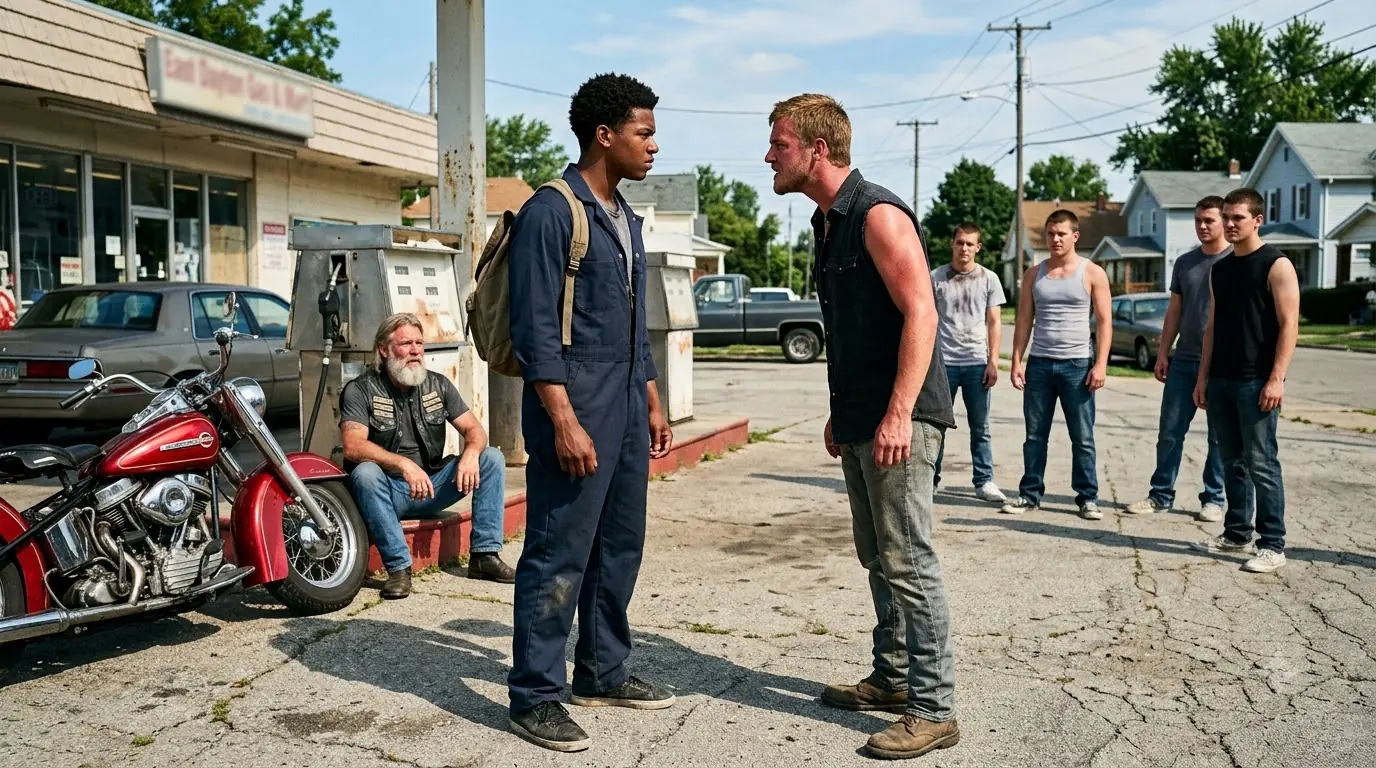
One of them stepped forward.
“Go back where you belong before we put you on the ground beside him.”
The old biker lying on the pavement slowly turned his head.
His voice cracked.
“Help me.”
He struggled to breathe.
“Please.”
Something broke open inside Brandon’s chest.
Trent stepped between them with a rusted pipe wrench in his fist and tapped it against the motorcycle’s engine.
“Stay out of this, or pay what he owes us. Then maybe I will leave the old man alone.”
“He asked for help,” Brandon said.
He reached toward the small adjustable wrench he always carried in his back pocket.
“I am helping him.”
Trent laughed sharply through his nose.
The five boys behind him spread into a wide line.
Six bullies.
One young Black man.
One elderly biker injured on the pavement.
By Monday, the story of the man begging for help would appear on news stations across the country.
The hardest part of Brandon Sullivan’s life had never been the work.
It was being watched as though he were always about to take something that did not belong to him.
At five in the morning, the kitchen light was already on.
Grandma Maylene sat at the counter checking her blood sugar with the same testing kit she had used for three years.
The reading was high.
She did not say anything.
She simply recorded the number in a small notebook.
Brandon kissed the top of her head as he walked toward the stove.
The oven door would not close properly.
He had been meaning to repair it.
Brandon removed a screwdriver from his back pocket, beside the adjustable wrench he carried everywhere, and tightened the loose hinge in less than a minute.
“There,” he said. “It should hold until payday.”
Maylene smiled without looking up.
“You do not have to repair everything around here, baby.”
“Somebody has to.”
On his way toward the door, Brandon counted the money inside his pocket.
Thirty-four dollars.
He stopped beside the rent jar on the counter.
After glancing over his shoulder, he slipped a folded twenty-dollar bill between the money already inside.
He was almost through the door when Maylene called his name.
“Brandon.”
He froze.
She stood in the kitchen doorway with her arms crossed.
She was not angry.
She looked worse than angry.
She looked sad.
“Bring that back.”
“Grandma.”
“Bring it back, baby.”
Brandon returned to the counter, removed the twenty from the jar, and held it in his palm.
Maylene lowered her voice.
She had never needed to shout to make herself understood.
“Listen to me this one time.”
She looked directly into his eyes.
“Our family, from your great-grandfather down, does not take what it did not earn.”
“And we do not take money from our children to pay for ourselves.”
Her voice remained gentle.
“Do you understand me?”
“Yes, ma’am.”
“That medical bill belongs to me, not you.”
“It is a lot of money.”
“It is still mine.”
Maylene placed one hand against his cheek.
“I do not need you to save me, Brandon.”
“I need you to become a man I will be proud of when I am gone.”
She smiled faintly.
“That is how you repay me.”
“Do you understand?”
Brandon nodded.
He placed the twenty-dollar bill back inside his wallet.
Then he kissed her again and walked outside.
The chain on his bicycle had snapped two weeks earlier.
He had not found time to repair his own transportation, so he walked twenty-two blocks to Hartman’s Auto.
The summer heat was already rising.
At a corner gas station, a woman watched him suspiciously while he purchased a soda.
“Do you work here, son?”
“No, ma’am. I am only a customer.”
She did not apologize.
Brandon did not expect her to.
Three blocks later, a patrol car slowed beside him.
The officer looked him up and down but never lowered the window.
Then the car continued down the street.
Brandon did not react.
His expression remained unchanged as he kept walking.
He had been experiencing moments like that since he was twelve.
Cole Hartman was already inside the garage with the hood raised on a Honda Civic, quietly arguing with its alternator.
He looked up when Brandon entered.
“You are early.”
“The bus did not come, so I started walking early.”
“The bus arrives at six fifteen.”
“I know.”
Cole grunted.
That was the closest thing to a compliment he usually offered.
Brandon pulled on his coveralls and went directly to a 1986 BMW R-series motorcycle parked near the rear of the shop.
The motorcycle was old and stubborn.
It was exactly the kind of machine nobody else wanted to touch.
Brandon worked on it the way some people prayed.
Quietly.
Patiently.
Without showing off.
He understood machines.
They made sense in ways people rarely did.
Around ten, a man wearing a polo shirt entered with the keys to a Lexus.
He looked past Brandon and asked Cole whether the mechanic was available.
Brandon kept his head lowered over the BMW.
He did not say anything.
Cole pointed toward him.
“He is the mechanic.”
The customer blinked.
He hesitated while trying to recover from the assumption he had made.
Brandon simply nodded politely and returned to work.
He had been experiencing that reaction since he was twelve too.
During lunch, he opened his backpack and removed a library book with a sticker on its spine.
Modern Custom Builders: A Visual History.
He had already borrowed it twice that year.
Brandon opened the book to a page softened by repeated use.
It showed a cherry-red 1959 Panhead with custom pinstriping across the fuel tank.
The caption read:
Henry “Iron Hank” Callaway, founder of Callaway Custom Cycles.
Brandon traced the lines of the motorcycle with one finger.
He whispered the names of famous builders the way other young men repeated the names of athletes.
“Callaway. Monroe. Roder. Foose.”
Cole walked past carrying a cup of coffee.
“You ever want to build something like that?”
“One day.”
Cole stopped.
“Yeah,” he said. “You will.”
It was the kindest thing he had said in months.
Brandon walked home that evening with aching arms and the adjustable wrench still inside his back pocket.
He passed a billboard advertising the West Coast Custom Bike Show.
The entrance fee for a builder was $350.
It was $350 Brandon did not have.
At the corner of Pine and Sixth, Mrs. Davies stood on her porch struggling with two grocery bags and a cane.
Brandon crossed the street without thinking.
“Let me carry those for you, ma’am.”
“Oh, Brandon, you do not have to.”
“It is nothing.”
He carried the bags up the steps.
He did not wait for thanks.
He waved and continued walking.
Mrs. Davies watched him leave and smiled as she shook her head.
“That boy.”
Brandon did not hear her.
He was already thinking about the following day’s shift.
He thought about the medical bill on the kitchen counter.
He thought about a cherry-red Panhead he had only seen in a library book.
He wondered whether he would ever see one in real life.
The following afternoon, Brandon almost did not take the shortcut behind the Sunoco station.
He almost remained on Main Street.
Almost.
It was four in the afternoon, and the summer heat had reached its peak.
His shift had run late.
His arms ached, and the library book felt heavier inside his backpack than it had that morning.
Brandon turned behind the Sunoco station on Fifth Street.
He had not yet seen the motorcycle.
Two blocks away, the man who built it was filling its tank with gasoline.
His name was Henry Callaway.
Most people called him Hank.
He was sixty years old.
His motorcycle was a cherry-red 1959 Panhead with a polished fuel tank and pinstriping Hank had painted with his own hands when he was thirty.
He was alone.
His phone had lost power an hour earlier.
Hank had ridden alone because he had always enjoyed riding alone.
He noticed the young men when they climbed out of the Chevrolet.
He noticed the way they looked at his motorcycle before they looked at him.
He had lived long enough to understand what that meant.
Hank did not move.
He continued filling the tank.
Trent Vaughn approached first.
He was twenty-two years old and possessed the dangerous confidence of someone with little to lose.
He whistled as though impressed.
“Look at this antique.”
Trent glanced at his friends.
“Grandpa rode his tricycle into the wrong part of town.”
Hank did not answer.
Cody spat onto the pavement two feet from Hank’s boot.
“Are you lost, old man? The retirement home is in the other direction.”
Hank remained silent.
Brett laughed.
The other three spread out behind them.
There were six now.
Six against one.
“What is wrong?” Cody asked. “Are you deaf, or too old to hear?”
Hank returned the fuel nozzle to the pump.
He still did not turn around.
Trent slowly circled the Panhead and pretended to admire it.
He whistled again.
“How much do you think this thing is worth?”
He looked at the others.
“Eight thousand? Ten?”
Trent grinned.
“Grandpa probably will not remember where he parked it tomorrow.”
A pickup truck passed the gas station.
The driver looked toward the six men and the elderly biker.
He counted the numbers.
Then he kept driving.
Cody kicked the rear tire.
Hank’s shoulders tightened for half a second before becoming still again.
That stillness should have warned them.
It did not.
Trent’s smile faded.
He walked toward the corner of the lot where an old air pump had once stood.
A metal toolbox lay on its side, abandoned and half filled with rainwater and rusted parts.
Trent reached inside and removed a long pipe wrench.
It was heavy enough to cause serious harm if swung carelessly.
He weighed it in one hand and tapped it against his palm.
“Keys, wallet, and watch.”
He stepped closer.
“Slowly, old man, or this will leave a mark.”
Hank turned around.
For the first time, the young men saw his face.
There was no fear in it.
There was not even surprise.
His voice was low and steady, the voice of someone who had survived more dangerous places than that parking lot.
“You do not want to do this.”
Hank looked directly at Trent.
“Walk away.”
Trent stared at him for half a second.
Then he laughed sharply and looked back toward his friends.
“Did you hear that? The old man thinks he is giving us advice.”
A young mother pushing a stroller approached the gas station.
She saw the six young men.
Then she saw Hank.
She turned the stroller around and walked in the opposite direction.
Inside the station, the clerk watched through the glass.
He saw the wrench and counted the number of men.
Then he locked the door from the inside.
He did not pick up the telephone.
The first attack did not come from Trent.
Cody stepped forward and smashed an empty bottle against the concrete several inches from Hank’s foot.
Glass scattered across the pavement.
It was intended as a warning.
Hank did not move.
Brett picked up a cheap plastic patio chair the station kept outside for smokers.
He swung it into Hank’s back.
The chair cracked.
Hank folded forward and dropped to one knee amid the scattered glass.
The impact forced a rough breath from his chest.
He did not cry out.
He did not beg.
Not yet.
He remained on one knee, head lowered, trying to steady himself.
His shoulder had already begun to stiffen.
His lip was sore where his teeth had struck the inside of his mouth.
He was sixty years old.
He was alone, without a working phone or anyone willing to intervene.
Decades earlier, he had found himself in a similar position in another parking lot and another life.
He had promised himself it would never happen again.
It was happening again.
Two miles away, Maylene Sullivan tested her blood sugar once more.
The number was wrong again.
She looked at the clock.
Brandon was late.
She did not know why.
Trent stood over Hank with the wrench in his hand.
He leaned down so the older man could hear him clearly.
“Are you ready to give us what we asked for?”
He tapped the wrench against the motorcycle.
“Or do we need to teach you some manners first?”
On the wall behind them was the faded remains of a mural nearly erased by twenty years of sunlight.
It showed a winged motorcycle wheel.
Beneath it were the weathered remains of a name.
Callaway Custom Cycles.
Nobody looked at it.
Eight seconds.
That was all it would take for two lives to change permanently.
Only one of them understood it yet.
Brandon turned the corner behind the Sunoco station and stopped.
He saw the elderly man on one knee.
He saw broken glass around his boots and the damaged chair lying nearby.
He saw the wrench inside Trent’s fist.
Then he counted six young men.
Brandon took one step backward.
His sneaker scraped the gravel.
The sound revealed him.
Jesse turned first.
He wore a lazy smile.
“Walk away, kid. This is not your street or your problem.”
Cody turned next.
“Looking for your father? He is not here.”
Brett separated from the group and approached Brandon with the broken chair still in one hand.
He stopped too close.
He positioned himself between Brandon and the elderly man.
“Are you deaf too?”
Brett leaned closer.
“Go home and tell your family you saw something. Tell them to keep you out of adult business.”
Trent did not even turn his head.
He spoke casually over his shoulder.
“Let him go.”
Then he laughed.
“He knows how things work around here, do you not?”
Brandon did not answer.
He looked past Brett.
Past the broken glass.
Past the cracked chair.
He looked at the elderly man still kneeling on the pavement.
Their eyes met.
Hank shook his head once.
It was a small and nearly invisible warning.
Go.
Please go.
Then Hank’s voice cracked.
“Please, son.”
He drew a painful breath.
“Keep walking.”
That was the moment.
Brandon stood there for two seconds.
He saw Hank.
He saw the wrench.
He saw three men laughing at him while the others watched.
Brandon looked down at his hands.
His left fist had already closed.
His right hand rested against the adjustable wrench in his back pocket.
They told me to walk away, he thought.
They told that old man to give up.
Those were two things I was never taught to do.
His eyes moved toward a dumpster six feet away.
A rusted length of bicycle chain lay coiled in the dirt where someone had abandoned it months earlier.
Brandon said nothing.
He moved.
First, he grabbed the chain with his left hand.
With his right, he pulled a water bottle from the strap of his backpack and threw it toward Trent.
The bottle struck the back of Trent’s head and startled him into turning around.
Brandon was already moving inside the circle.
He drove his shoulder into Cody’s chest.
Cody stumbled backward, dropping what remained of the broken bottle.
Brett swung the damaged chair toward Brandon’s head.
Brandon raised his left forearm in time.
The plastic chair split across his arm.
Pain traveled into his shoulder, and his hand briefly went numb.
No serious injury.
A bruise tomorrow.
Keep moving.
Brandon snapped the loose bicycle chain low across Jesse’s legs.
Jesse cried out and fell sideways, releasing the tree branch he had been carrying.
Behind Brandon, Hank moved.
The man who had remained on one knee for two minutes suddenly rose with the speed of a released spring.
He swept one attacker’s legs from beneath him with a clean and practiced movement.
The young man landed flat against the pavement, the breath leaving his lungs.
For the first time, the group saw something in Hank’s expression that was not pain or fear.
Trent recovered and rushed toward Brandon with the wrench.
Brandon turned sideways, but not quickly enough to avoid the entire swing.
The end of the wrench scraped across his right shoulder, sending pain through his body without causing a serious wound.
Brandon lowered himself beneath the next movement, looped the chain around Trent’s wrist, and twisted.
The wrench fell to the pavement.
Hank was standing beside him now.
The older man placed one heavy hand on Brandon’s shoulder and stepped in front of him.
He positioned himself between Brandon and the four young men still standing.
His voice was low and flat.
There was no anger in it.
“Boys, walk away.”
Hank’s gaze hardened.
“While you still can.”
Something in his face changed the air around them.
None of the young men could identify it.
They had no idea what kind of man they were looking at, but they felt the warning in their chests.
Trent stared at Hank for one full second.
Then he grabbed his wrist and turned away.
He ran.
The other five scattered behind him.
Their Chevrolet tore out of the parking lot seconds later.
The confrontation was over.
Brandon remained standing for one breath.
Then another.
His knees weakened.
He sat heavily on the curb and began trembling as the adrenaline left his body.
His left forearm had already started turning purple.
His shoulder burned, and his right knee was scraped beneath the torn fabric of his jeans.
There were no serious wounds.
Only pain that would become worse by the following morning.
Hank stood over him silently.
He did not look at Brandon’s face at first.
He studied Brandon’s hands.
Eighteen years old.
Shaking.
Grease beneath the fingernails.
A small adjustable wrench visible inside the back pocket.
A library card sticking from the wallet that had fallen onto the ground.
Hank crouched.
He reached into his vest and removed a folded blue bandana worn soft through years of use.
He opened it and carefully wrapped it around Brandon’s swelling forearm like a temporary brace.
His hands moved with the confidence of someone who had done similar work many times.
As Hank tied the knot, sunlight caught the steel ring on his right hand.
A compass face was set into the band.
Brandon’s eyes stopped on it for half a second.
Then he looked away.
Hank noticed.
“What is your name, son?”
“Brandon, sir.”
“Why did you do that, Brandon?”
Brandon was still trying to control his breathing.
He considered the question for a moment.
Then he shrugged.
“Nobody else was going to.”
Hank studied him for a long time.
Then he slowly stood.
His back cracked, and he briefly winced before ignoring it.
Hank looked toward his Panhead twenty feet away.
The young men had never reached it.
Then he looked back at Brandon sitting on the curb and holding his injured arm.
Hank almost smiled.
“Kid, you have no idea who you just helped.”
Behind them, the faded mural caught the late-afternoon sunlight.
The winged wheel.
The incomplete lettering of Callaway Custom Cycles.
Brandon did not look at it.
He was still thinking about the older man’s hands.
The compass ring.
The way the bandana had been tied.
Something in the back of his mind had begun whispering.
He did not yet understand what it was.
Hank reached into his vest.
Brandon assumed he was reaching for a phone.
He was not.
Hank removed a thick roll of money.
There were several thousand dollars in large bills.
He held it toward Brandon.
“Take it.”
He nodded toward the injured arm.
“For that and for your trouble.”
Brandon looked at the money and then at Hank.
He shook his head.
“I am not accepting money for helping you, sir.”
“You took a wrench across the shoulder for a man you did not know.”
Hank extended it again.
“Take it.”
“No, sir.”
Brandon kept his voice respectful.
“I appreciate the offer, but no.”
Hank pushed the money forward one more inch.
His voice softened.
“For your mother, then.”
Something flickered in Brandon’s eyes.
Hank did not know that Brandon’s mother had died when he was nine.
He did not know about the rent jar.
He did not know about the medical bill on the kitchen counter.
He did not know about the woman who had told Brandon that morning, “We do not take what we did not earn.”
Brandon heard Maylene’s voice as clearly as though she were standing beside him.
He shook his head once more.
“I did not do it for that.”
Hank kept the money extended for one more second.
Then he nodded slowly.
He returned the roll to his vest without arguing.
Hank studied Brandon the way a craftsman might examine a remarkable tool found unexpectedly in an ordinary place.
“All right,” he said.
“All right.”
Brandon slowly pushed himself up from the curb.
His left arm remained stiff against his side.
He began walking past Hank toward the road and home.
Then he passed the Panhead.
Brandon stopped.
His eyes moved across the fuel tank.
The hand-painted pinstriping surrounding the cap.
The polished cherry-red finish.
The small brass badge near the rear of the seat.
He had seen the motorcycle before.
It was on the dog-eared page of the library book beside his bed.
Cherry-red 1959 Panhead.
Henry “Iron Hank” Callaway.
Founder of Callaway Custom Cycles.
Brandon’s mouth opened slightly and closed.
He did not speak.
He looked at the motorcycle.
Then at Hank.
Then back toward the motorcycle.
Hank watched recognition form inside his expression.
He neither confirmed nor denied anything.
One corner of his mouth lifted into the closest thing to a smile he had shown that afternoon.
Brandon swallowed and continued walking.
Hank called quietly from behind him.
“Son.”
Brandon stopped.
“We do not forget.”
Brandon turned to ask what the words meant.
Hank was already placing the helmet over his head.
The Panhead started with a sound like distant thunder moving across hills.
Hank gave Brandon one small nod, lifted the stand, and rode from the gas station onto Fifth Street.
Brandon remained there with his bandaged arm.
He watched the cherry-red fuel tank disappear along the road.
Then he began walking home.
Inside the Sunoco station, the clerk waited until the motorcycle was gone.
He waited until Brandon turned the corner and the parking lot became empty.
Then he picked up the telephone and called a number he had not used in many years.
When someone answered, he kept his voice low.
“It was him.”
He looked through the glass.
“Yes, the builder from the magazine.”
The clerk paused.
“Some kid pulled him out. Young Black mechanic, skinny, maybe eighteen.”
“Hartman’s Auto, I think.”
He ended the call.
Brandon reached home at 6:40.
Maylene sat at the kitchen table with her notebook and a glass of water.
She looked up.
Her eyes moved toward the bandana on his arm.
Then she saw the dirt on his jeans and the way he favored his right leg.
She placed her pen on the table.
“Brandon.”
“I caught my arm on a fence on the way home.”
He tried to smile.
“It is fine.”
Maylene looked at him for a long and quiet moment.
She did not believe him.
Brandon could see that she did not believe him.
However, she was tired.
The numbers in her notebook were wrong again.
Her grandson was home.
“Sit down,” she said. “Let me see it.”
Brandon sat.
Maylene removed the bandana, examined the bruising, cleaned the skin gently, and rewrapped his arm with gauze from the medicine cabinet.
She carefully folded the blue bandana and placed it beside her notebook.
Maylene did not ask again.
Brandon did not volunteer the truth.
That night, he lay on his bed and stared at the water stain spreading across the ceiling.
His arm throbbed.
His shoulder throbbed.
Three words continued circling through his mind.
We do not forget.
We do not forget.
We do not forget.
By the following morning, three different things had already begun moving.
Brandon knew nothing about any of them.
The first was a black sport utility vehicle climbing a private road into the hills outside town.
Wyatt Donovan sat in the passenger seat.
Everyone called him Preacher.
He was speaking on the telephone.
He was not smiling.
“Yes, Hank is all right.”
Preacher listened.
“Two cracked ribs, perhaps. He refuses to say.”
He looked through the windshield.
“Some young man helped him. Black kid, eighteen, skinny, from the East Side.”
Preacher nodded.
“Yes, I understand.”
“Hank wants the entire table at the shop tomorrow.”
He paused.
“Bring the photographer.”
The call ended.
The vehicle passed through a gate and continued toward the house in the hills.
The second development was happening downtown.
Linda Brennan, a reporter at the local television station, frowned while listening to a voicemail at her desk.
She played it twice.
Then she walked into the records room and removed an old manila folder from a cabinet nobody had opened in years.
The label read:
CALLAWAY, HENRY. CUSTOM CYCLES. 1995 TO PRESENT.
Linda opened the folder.
The first photograph showed a man in his thirties standing outside a small motorcycle shop.
A cherry-red Panhead was parked behind him.
She picked up the telephone.
“Hello, it is Linda.”
She turned the photograph toward the light.
“I think I found something.”
The third development was happening inside the chapter clubhouse near the edge of town.
The room contained wooden walls, leather chairs, and a long oak table.
Behind Hank’s chair was a wall covered with framed photographs of motorcycles and the people who built them.
Hank sat at the head of the table.
Ten men occupied the remaining chairs.
Nobody touched the coffee in front of them.
Hank spoke quietly.
Like Maylene, he did not need to raise his voice.
“There is a young man working at Hartman’s Auto on the East Side.”
He looked down the table.
“I want to know about his family, school, medical bills, employment, difficulties, and friends.”
One of the older members leaned forward.
“What are we doing with this, Hank?”
Hank studied him.
“I have sat at this table for twenty-five years.”
“We have spent those years remembering what came before us.”
Hank’s hand rested on the wood.
“Now I want to know whether it is time to begin passing something forward.”
Nobody responded.
Hank tapped the table once with his compass ring.
Steel created a small, clean sound against oak.
“Find everything.”
His gaze moved across the men.
“Nobody approaches him.”
“Not yet.”
Across town, Brandon arrived early for work.
He had slept badly, and his arm ached with every movement.
Cole looked up from a tire iron.
“What happened to your arm?”
“I walked into a fence.”
Cole grunted and returned to work.
That afternoon, Brandon noticed a man standing across the street pretending to read a newspaper.
The performance was unconvincing.
Brandon paid little attention.
He was tired.
He had no idea that more than forty motorcycles were already preparing to ride toward his street.
Brandon was changing the oil in a Honda Civic when he heard the sound.
At first, he thought it was thunder.
He stood, wiped his hands against a rag, and listened.
Then he began counting engines.
Five.
Ten.
Fifteen.
Twenty.
He stopped counting because the sound continued growing.
Cole rolled from beneath the vehicle lift with a wrench still inside his hand.
He looked at Brandon.
Brandon looked back at him.
“What is that?” Cole asked.
“I do not know.”
They walked toward the open garage bay together.
The noise rolled along the street like an approaching storm.
Then the procession turned onto Maple Avenue.
The entire block became still.
There were forty-three motorcycles, possibly more.
They traveled two abreast in precise formation, filling the road from one curb to the other.
There were old custom builds, modern machines, chrome, dark paint, bright tanks, and riders with years written across their faces.
Every leather vest carried the markings of the Hells Angels chapter.
Traffic stopped in both directions.
A woman stepped onto her porch across the street with a dish towel in her hand.
Two children appeared from behind the laundromat.
Mrs. Davies walked onto her stoop with her cane.
The motorcycles parked along the curb in front of Hartman’s Auto.
Their engines continued idling together.
Then, one by one, they shut down.
Silence fell over the street like a heavy blanket.
One motorcycle rolled forward from the front of the procession.
A cherry-red 1959 Panhead.
Hank Callaway lowered the stand and climbed off.
He removed his helmet and tucked it beneath one arm.
Behind him, the rest of the chapter stood beside their motorcycles with helmets held against their bodies like an honor guard.
Cole attempted to speak.
The first sound caught inside his throat.
“Brandon.”
“Yes?”
“Brandon.”
“What?”
Cole’s voice fell to a whisper.
“That is Iron Hank Callaway.”
Brandon remained silent.
A part of him had already known.
He knew when he saw the motorcycle.
When he saw the bandana.
When he saw the compass ring.
He had simply refused to believe it.
A news van stopped near the end of the block.
Linda Brennan stepped out with a camera operator behind her.
She did not run.
She walked like a reporter who had been waiting her entire career for that moment.
Hank stopped six feet from Brandon.
He examined him from head to toe.
Then he looked toward Cole and offered a small nod.
“Cole Hartman?”
“Yes, sir.”
“I have heard good things about you.”
Hank gestured toward Brandon.
“You have helped raise a good employee.”
Cole tried to answer.
Nothing came out.
Hank turned back toward Brandon.
“Are you feeling all right today?”
“Yes, sir.”
“How is the arm?”
“Healing.”
Hank nodded once.
Then he raised his voice just enough for the entire street to hear.
It was also loud enough for Linda Brennan’s microphone to capture every word.
“I owe this young man an introduction.”
Hank turned slightly toward the crowd.
“My name is Henry Callaway.”
“Most people call me Hank.”
“Some people call me Iron Hank.”
He held his helmet against his side.
“I founded Callaway Custom Cycles in 1995.”
“We now operate shops in five states.”
Hank looked toward the motorcycle riders behind him.
“I have also served as president of this Hells Angels chapter for twenty-five years.”
He gestured toward Fifth Street.
“That is why the gas-station clerk locked his door instead of calling the police three days ago.”
“He knew who to call.”
A murmur moved through the people gathered on the sidewalks.
Hank continued.
“This chapter follows one rule above every other.”
“We do not forget.”
Hank’s gaze traveled across the crowd.
“We do not forget who stood up.”
“We do not forget who remained silent.”
“We do not forget who looked away.”
His attention returned to Brandon.
“And we do not forget who ran toward someone in trouble.”
Hank faced Brandon fully.
“Three days ago, an eighteen-year-old with a bruised arm and a wrench in his back pocket ran toward danger.”
“He did not ask who I was.”
“He did not ask what he would receive.”
“He did not even ask my name until the danger had passed.”
Hank looked toward the news camera.
“That is the kind of person I have spent my life looking for.”
He paused.
“And almost never found.”
Then Hank stopped speaking.
The silence stretched across the street.
A small Toyota Corolla stopped near the corner.
The passenger door opened.
Maylene Sullivan slowly stepped out, using the side of the vehicle for balance.
Mrs. Davies had called her.
Maylene did not know the men standing outside the garage.
She did not understand why motorcycles filled the street.
She knew only that her grandson stood in the center of it.
Maylene moved through the parted crowd with her chin raised.
She stopped beside Brandon and took his hand.
She squeezed once.
Brandon had not moved.
His expression remained controlled.
He did not smile or cry.
He stood beside his grandmother and looked at a man he had read about in library books.
Maylene’s eyes were wet.
Hank noticed her.
He removed the helmet from beneath his arm and held it against his chest.
It was a small and old-fashioned gesture of respect.
He gave her a deep nod.
“Ma’am.”
Maylene nodded in return.
She did not speak.
Hank faced Brandon again.
“I told you we do not forget.”
“I meant it.”
Hank looked toward Maylene.
“We have several things to discuss, you, your grandmother, and me.”
“But not here.”
He briefly glanced toward the cameras.
“Come to my shop tomorrow morning at ten.”
“Bring your grandmother.”
“We have business.”
Brandon finally found his voice.
“Yes, sir.”
Hank placed one hand on Brandon’s uninjured shoulder.
He squeezed once.
The compass ring caught the late-afternoon sunlight.
Then Hank returned to the Panhead and put on his helmet.
Forty-three engines started together.
The street shook beneath the sound.
Nobody standing on that block would ever forget it.
The following morning, Brandon and Maylene stepped from a rideshare vehicle outside the largest custom-motorcycle shop in the state.
Hank Callaway waited at the front entrance holding a folder.
He did not wait for them to climb the steps.
He walked down to meet them.
“Mrs. Sullivan.”
“Mr. Callaway?”
“Thank you both for coming.”
Hank held open the door.
The brass handle carried the same compass design as his ring.
Brandon noticed it.
Maylene noticed Brandon noticing it.
The building was a converted warehouse containing fifteen thousand square feet of polished concrete, exposed brick, tools, and motorcycles.
Brandon had seen many of the machines only in books.
Now they stood six feet away.
He did not reach out and touch them.
He kept his hands at his sides and followed Hank.
Hank led them beyond the showroom and through a heavy wooden door.
Inside was a long table surrounded by leather chairs.
The wall held framed photographs of motorcycles built throughout the chapter’s twenty-five-year history.
Hank pulled out a chair for Maylene.
Then he sat across from her and placed the folder on the table.
He looked at Brandon.
Then he looked at Maylene.
“I am going to say two things this morning.”
“Only two.”
“Then we can talk.”
Maylene nodded once.
“The first is for you, ma’am.”
Hank rested one hand on the folder.
“Yesterday, I asked my people to identify every medical bill in your name from the last eighteen months.”
Maylene’s expression tightened.
“We are paying every one of them in full today.”
“Before the end of business.”
Maylene gripped her purse.
“Mr. Callaway—”
“I am not finished.”
Hank’s voice remained respectful.
“From now on, your insulin, testing supplies, medical appointments, and related care will be covered by the chapter’s medical fund.”
“For as long as you require assistance.”
He leaned forward.
“We maintain that fund for our people.”
“As of today, you are one of our people.”
Maylene did not answer.
She stared at the tabletop.
Hank turned toward Brandon.
“The second matter is for you.”
“We are offering you a paid apprenticeship at this shop five days each week, beginning Monday.”
“You will work beside my lead builders.”
Hank’s voice became firm.
“You will begin at the bottom.”
“You will clean work areas, prepare parts, and handle errands.”
“The pay will be enough to live on.”
“The hours will be difficult.”
“You will learn this profession from the people who taught me.”
Hank sat back.
“That is the offer.”
Brandon waited.
He expected something more.
Nothing followed.
“That is the entire offer?” he asked.
“That is all.”
“No scholarship or motorcycle?”
Hank interrupted gently.
“Listen carefully, son.”
“This is not a reward for what you did three days ago.”
He nodded toward the arm that had been bandaged.
“The reward was the bandana.”
“You and I are even concerning that afternoon.”
Hank tapped the folder.
“This is an investment.”
“I invest in people, not dramatic stories.”
“I do not give anyone an entire life for free.”
“I give opportunity.”
Hank’s eyes remained on Brandon.
“Whatever comes later, trade school, your own motorcycle, or a shop carrying your name, will depend on you.”
“You will earn it the same way I earned mine.”
Brandon considered the words.
Then he nodded.
“Yes, sir.”
Maylene placed both hands flat against the table.
“Mr. Callaway, may I speak now?”
“Yes, ma’am.”
“I appreciate everything you have said.”
“I truly do.”
She glanced toward Brandon.
“But I need to explain something about our family.”
“We do not accept gifts we cannot repay.”
“We have never taken charity from a church, neighbor, or anyone else.”
Maylene looked directly at Hank.
“If you pay my medical expenses and give me no way to contribute, my grandson will not sleep at night.”
“Neither will I.”
She paused.
“If you want to help us, you must give me a way to earn it.”
“I can still work.”
“I can keep accounts and answer telephones.”
She lifted her chin.
“Find something.”
Hank studied her for several seconds.
Then he leaned back.
A small and genuine smile crossed his face.
“Ma’am, I suspected you might say something like that.”
“Did you?”
“I did.”
Hank tapped the compass ring against the table.
“All right.”
“Here is my counteroffer.”
He looked toward Brandon.
“When this young man opens a community garage in your neighborhood, and I believe he will, I want you working at the front counter every morning.”
“Full wages.”
“You greet every customer.”
“You manage the books.”
“You establish the character of the place.”
Hank returned his gaze to Maylene.
“That is the agreement.”
“Without you behind the counter, there is no shop.”
Maylene did not hesitate.
“Then we agree.”
She extended her hand.
Hank shook it.
Brandon watched the two of them make the agreement across the table.
He had remained silent for several minutes.
There was one question he still needed to ask.
“Mr. Callaway?”
“Hank.”
“Hank, why are you doing this for me?”
Hank’s expression did not change.
“Because that is the code.”
“You did the right thing when nobody was watching.”
He tapped the table again.
“The code says we do not forget.”
“I do not require a greater reason.”
“Neither should you.”
Someone knocked on the door.
Cole Hartman entered holding his cap between both hands.
He looked uncomfortable when offered one of the leather chairs.
Hank did not waste time.
“Cole, when we open a community shop on the East Side, I want you as a partner.”
“Senior mechanic.”
“Ownership stake.”
“You bring the teaching, and I bring the construction and capital.”
Hank leaned forward.
“Are you interested?”
Cole sat heavily in the chair.
“You are serious.”
“I do not make jokes about garages.”
Cole looked toward Brandon.
“Yes.”
He turned back to Hank.
“Yes, sir. I am interested.”
Hank pushed a second folder toward Brandon.
“Apprenticeship contract.”
“Read every line.”
“Sign it when you are ready.”
Brandon picked up a pen.
He read the contract carefully.
Then he signed at the bottom in deliberate handwriting.
Brandon Sullivan.
Maylene stood behind him with one hand on his shoulder and watched him complete every letter.
By Friday, the story had a name.
By Sunday, it had appeared on three national television networks.
By the end of the month, parts of the East Side had begun to change.
Linda Brennan called her report The Eight-Second Rescue.
Her segment aired repeatedly.
Video of forty-three motorcycles parked outside Hartman’s Auto became one of those images people sent to one another in group conversations.
Strangers from other cities mailed letters to the shop.
Brandon kept every one inside a shoebox beneath his bed.
Hells Angels chapters from across the country contributed money to a community fund created in Brandon’s name.
Brandon refused to use it.
He asked Hank to keep the money protected until a worthwhile community project appeared.
Hank smiled when Brandon told him.
After three months, Brandon had worked at Callaway Custom Cycles for ten weeks.
He arrived before sunrise and often remained after everyone else went home.
The lead builders stopped calling him “the kid.”
They began calling him Brandon.
One Thursday afternoon, Hank asked him to step aside.
“Trade school begins its fall semester soon.”
“We will cover tuition and books.”
“You continue working here on weekends.”
Hank crossed his arms.
“Yes or no?”
“Yes, sir.”
“Good answer.”
After six months, Maylene’s blood-sugar readings had remained stable for the first time in five years.
Her doctor asked what she had changed.
Maylene smiled.
That weekend, six chapter members arrived at the Sullivan house with a truck filled with lumber and a generator.
Cole came with them.
Preacher came too.
They worked every Saturday and Sunday for eight weeks.
They replaced the roof.
They installed insulation and built an accessibility ramp from the sidewalk to the porch.
They renovated the kitchen so Maylene could reach every cabinet without bending dangerously.
Maylene refused to leave during the construction.
She sat on a folding chair on the porch with a glass of sweet tea and supervised every nail.
By the end of summer, she could open every drawer in her kitchen comfortably.
After nine months, Brandon completed his first semester at the top of his class.
Hank called him into the back office at the flagship shop.
“It is time to write a business plan.”
Hank placed a notebook before him.
“Community garage, East Side.”
“You design it.”
“You choose the staff.”
“You present the plan to me before Christmas.”
“If it is good, I will finance it.”
“If it is not, we continue working until it is.”
Brandon spent eight weeks writing at the kitchen table.
Maylene sat beside him and checked spelling, numbers, and punctuation.
At the end of twelve months, Brandon presented the plan.
Hank read it twice.
Then he signed.
Sullivan and Callaway Community Garage opened on a Saturday in February.
Snow covered the ground beneath a bright and cloudless sky.
Brandon selected the name himself.
Mrs. Davies became the first customer through the door.
She arrived with her grandson and a vehicle containing an alternator she could not afford to replace.
Brandon did not charge her.
He completed the repair in two hours and gave her grandson a soda from the refrigerator.
Maylene sat behind the front counter wearing a clean apron.
She wrote inside a ledger using a pen Hank had given her.
She greeted every customer by name.
By the end of the first week, she remembered all of them.
On the wall behind the counter was a simple wooden frame.
Inside it rested the folded blue bandana Hank had tied around Brandon’s swollen forearm in the gas-station parking lot.
Beneath the frame was a strip of dark walnut.
Three words had been carved into it.
WE DO NOT FORGET.
When Hank attended the opening, he stood before the frame for a full minute.
He did not speak.
He did not explain what the words meant to him.
Hank touched the glass once with the tip of his finger.
He nodded.
Then he went to find Maylene at the front counter.
Eighteen months after the rescue, Trent Vaughn entered the garage on a Tuesday morning.
He was sober, forty pounds lighter, and his hands trembled.
He sat across from Brandon inside the small office.
Trent did not ask for forgiveness.
He asked for employment.
Brandon studied him for a long time.
Then he stood, walked toward the supply closet, and returned carrying a broom.
He handed it across the desk.
“Start there.”
Trent accepted the broom.
He did not say thank you.
He nodded and began sweeping the front of the garage.
A year later, he was still working there.
During the second year, Hank and Brandon began constructing a Panhead together.
It was not a gift.
It was a teaching project.
They spent eight months working at night and on Saturdays inside the flagship shop.
By then, two additional scholarships had been awarded through the Callaway-Sullivan fund.
One went to a young woman from the East Side who wanted to become a nurse.
A trade magazine described the partnership as a model for community investment.
Brandon continued carrying the adjustable wrench in his back pocket every day.
Two years after the gas-station rescue, Brandon was walking home from his own garage when he heard shouting.
The sound came from behind a building two blocks south of the shop.
He recognized it immediately.
Brandon was twenty now.
His clothes were different, but his posture was the same.
The same wrench remained inside the same back pocket.
There was no scar on his forearm.
The bandana associated with the injury was framed behind his grandmother’s counter.
Brandon was no longer afraid.
But he remembered.
He did not run.
He walked behind the building.
Three older boys had pinned a smaller child against a brick wall.
The child was twelve years old, Black, thin, and wore glasses that had been knocked crooked.
His backpack lay on the ground.
Library books were scattered across the gravel.
Brandon stepped into the space between them.
He said nothing.
He simply stood there and looked at the three older boys.
They looked back.
Then they noticed his shirt.
SULLIVAN AND CALLAWAY COMMUNITY GARAGE.
They knew the name.
Everyone on the East Side knew it.
The largest boy swallowed.
The three slowly stepped backward.
Then they turned and walked away quickly.
Brandon waited until they disappeared.
He crouched and began gathering the child’s books.
One was a library book about engines.
It carried the same style of sticker Brandon had once seen on every book he carried home.
“Is this yours?”
“Yes, sir.”
Brandon returned it.
The child stared at him.
His hands were trembling.
“Why did you help me?”
Brandon placed the books inside the backpack.
Then he knelt until they were at eye level.
He answered quietly.
Three words.
“We do not forget.”
The child did not understand yet.
Brandon could see him storing the words somewhere safe inside himself.
He would understand one day.
Brandon removed a business card from his back pocket and handed it over.
“Do you like engines?”
The boy nodded.
“Come to the garage Saturday at eight in the morning.”
“Bring the library book.”
“I will teach you.”
The child accepted the card with both hands as though it were made of glass.
“Yes, sir.”
“Brandon, not sir.”
“Yes.”
The boy corrected himself.
“Brandon.”
He lifted the backpack and began walking away.
After ten steps, he turned around.
Brandon was still standing there.
Brandon nodded once.
The child nodded back.
Then he ran.
Brandon took the longer route toward the garage.
Late-afternoon light spread across the rooftops.
He passed the old Sunoco station on Fifth Street.
It had a different owner now.
Fresh blue paint covered the wall.
Beneath the new layer, if someone knew where to look, there was still the faint outline of a winged motorcycle wheel and a name partly erased by sunlight.
Brandon did not look.
He no longer needed to.
Through the garage’s front window, Maylene sat at the counter with a customer and wrote inside her ledger.
She glanced up and saw him.
Maylene raised one hand.
Brandon raised his hand in return.
Then he continued walking home.
The story stayed with people because Brandon moved through a world that often watched him with suspicion.
There was the woman at the gas station who assumed he worked there.
The police officer who slowed beside him on the sidewalk.
The customer who walked past him to ask Cole whether the mechanic was available.
None of those experiences disappeared because Brandon saved one man.
What mattered was that he continued choosing kindness.
He chose it every day.
He chose it when he carried groceries for Mrs. Davies.
He chose it when he tried to place twenty dollars inside Maylene’s rent jar.
He chose it when he arrived early for work because the bus never came.
By the time Hank needed him, the person willing to step forward had already been formed.
The confrontation in the parking lot did not create Brandon.
It revealed him.
People often speak about courage as though it appears suddenly when a dramatic moment arrives.
It does not.
Courage is practiced quietly through hundreds of small decisions nobody notices.
It appears in the way a person treats a cashier.
In the way someone responds to an elderly neighbor carrying groceries.
In the decision to remain honest when nobody is watching.
Those daily choices become what a person carries inside when the real test arrives.
A single great moment does not transform someone into a brave person.
It discovers whether bravery was already there.
That is not fate.
It is the result of what someone chooses to do on ordinary days when nothing important seems to be at stake.