Ten-year-old Daniel Brooks noticed the old woman because she kept staring at the vending machine but never put money in.
It was a cold morning in Milwaukee, Wisconsin, the kind of morning when the sidewalks looked gray with frozen slush and every person walking past the bus station had their shoulders raised against the wind.
Inside the station, the air smelled like wet coats, old coffee, diesel smoke, and the faint sweetness of cinnamon rolls from the small snack counter near Gate 3.
Daniel sat on a metal bench with his backpack between his feet and a paper napkin on his lap.
On the napkin was his breakfast.
One boiled egg.
One slice of toast folded in half.
And a small orange his mother had tucked into his coat pocket before leaving for work.
“Eat all of it,” she had told him that morning.
“I will.”
“I mean it, Danny.”
“I know, Mom.”
His mother, Lisa Brooks, worked early mornings at a hotel kitchen and evenings cleaning offices downtown. On school days when her hotel shift started before the sun came up, Daniel waited at the bus station until the school bus came through the downtown route.
It was not ideal, but the station guard knew him, the snack counter lady knew him, and it was warmer than waiting outside.
Lisa hated it.
Every morning, she kissed the top of his head and said, “One day, baby, mornings won’t be this hard.”
Daniel always nodded.
He wanted to believe her.
But mornings had been hard for a long time.
His father had died three years earlier after a construction accident. Before that, they had lived in a small house with a yellow kitchen, a backyard, and a breakfast table where his father made pancakes every Sunday. After the funeral, the house became too expensive. The yellow kitchen disappeared. The backyard disappeared. Sunday pancakes became a memory Daniel carried carefully, like something breakable in his pocket.
Now he and his mother lived in a one-bedroom apartment above a closed laundromat. Lisa slept on the pullout couch so Daniel could have the bedroom. She said the couch was closer to the coffee maker.
Daniel knew that was not the real reason.
His father, Marcus Brooks, had loved feeding people.
Not in a fancy way.
He made scrambled eggs for neighbors. Toast for children who slept over. Soup for anyone sick. Chili for church fundraisers. If someone came to the door hungry, Marcus never asked many questions.
“Food first,” he used to say. “Questions after.”
Daniel remembered that.
So when he saw the old woman staring at the vending machine, he stopped chewing.
She stood near the corner by the pay phones, though nobody used pay phones anymore. She was small, with pale skin, silver hair tucked under a soft blue hat, and a beige coat buttoned unevenly. Her shoes were neat but worn, and her hands trembled slightly around a faded cloth purse.
She looked at the vending machine.
Then down at the coins in her palm.
Then back at the machine.
She counted the coins again.
A line of people moved around her. A man in a heavy coat reached past her to buy a candy bar. A teenager bumped her shoulder and muttered, “Sorry,” without looking up from his phone. The old woman stepped back, cheeks red with embarrassment.
Daniel watched her press a button without putting in money, as if hoping the machine might forgive her.
Nothing happened.
She lowered her hand.
Then she sat on the bench across from Daniel and looked down at her purse.
Daniel looked at his breakfast.
His mother had told him to eat all of it.
He was hungry.
But the old woman’s face looked like a person trying very hard not to need anything.
That was a look Daniel knew.
He had seen it on his mother at the grocery store.
He had seen it on himself when other kids talked about lunch money.
He picked up the toast, the egg, and the orange, then walked across the aisle.
“Ma’am?”
The old woman looked up quickly.
“Oh. Hello, dear.”
“Are you hungry?”
Her face changed.
Not because she was angry.
Because he had seen too much.
“I’m all right,” she said.
Daniel looked at the vending machine.
Then back at her.
“My mom packed extra.”
That was not true.
The old woman seemed to know that too.
“I can’t take a child’s breakfast.”
Daniel held out the napkin.
“You can take half.”
She stared at him.
“What is your name?”
“Daniel Brooks.”
“I’m Helen Carter.”
“Nice to meet you, Mrs. Carter.”
Her eyes softened.
“Nice to meet you too, Daniel Brooks.”
He sat beside her, leaving space, and divided the breakfast carefully. He gave her half the toast, the boiled egg, and three orange slices after peeling the fruit with his cold fingers.
She noticed what he had done.
“You kept only half the toast?”
“I like toast.”
“You gave me the egg.”
“You looked like you needed protein.”
Helen let out a surprised laugh.
“Protein?”
“My mom says that when she makes me eat eggs.”
Helen held the egg in both hands for a moment before taking a bite. Her eyes closed as if it were something far better than a boiled egg from a paper napkin.
Daniel looked away so she would not feel watched.
They ate quietly while buses came and went.
After a while, Helen said, “I missed my connection.”
Daniel looked up.
“Your bus?”
She nodded. “I was supposed to visit my sister in Green Bay. She fell last week. Nothing broken, thank goodness, but she’s frightened. I bought the ticket yesterday, but this morning I got confused about the platform. By the time I found it, the bus had gone.”
“Can you get another ticket?”
Helen looked down at her purse.
“I thought I had enough. But I counted wrong.”
Daniel looked toward the ticket counter.
“Maybe they can help.”
“I don’t want to bother them.”
“You’re not bothering.”
Helen smiled sadly.
“You say that like a boy who has not learned how often people make old women feel like bother.”
Daniel did not know what to say.
Then he said the only thing he knew was true.
“My dad said people should eat before questions.”
Helen looked at him.
“Was your father a cook?”
“No. But he cooked a lot.”
“Was?”
Daniel nodded.
“He died.”
Helen’s face became gentle.
“I’m sorry, dear.”
“Me too.”
She did not say anything else, and Daniel liked her for that.
Some grown-ups tried to patch the air too quickly when sadness appeared. Helen let it sit beside them without pushing it away.
A station worker announced a bus departure overhead.
Helen flinched, looking suddenly lost again.
Daniel stood.
“Come on. We can ask Mr. Alvarez.”
“Who is Mr. Alvarez?”
“The station guard. He helps people.”
Helen hesitated.
Daniel held out his hand, not touching her, just offering.
She took it lightly.
Mr. Alvarez stood near the information desk, a tall man with a gray mustache and a bright orange safety vest. He knew Daniel because Daniel waited there most mornings.
“Danny,” he said. “Everything okay?”
“Mrs. Carter missed her bus to Green Bay. She needs help with a ticket.”
Helen looked mortified.
“I’m sorry. I don’t want to cause trouble.”
Mr. Alvarez’s voice softened.
“No trouble, ma’am. Let’s see what we can do.”
He spoke to the ticket clerk, checked the schedule, and found a later bus. The fare difference was more than Helen had. Mr. Alvarez made a call. The ticket clerk typed something. A supervisor came over, looked at Helen, looked at Daniel, sighed, and said, “We can transfer it this once.”
Helen pressed one hand to her mouth.
“Thank you.”
Daniel smiled.
The bus would leave in forty minutes.
Helen sat back down with him.
“You helped me twice,” she said.
“I just asked Mr. Alvarez.”
“No. You saw me before I had to ask.”
That sentence stayed with him.
Before her bus came, Helen opened her purse and pulled out a small folded card. On the front was a drawing of a little blue bird. Inside, she wrote carefully with a pen that shook in her hand.
For Daniel, who shared breakfast and helped me find the right bus.
Never believe small kindness is small.
Helen Carter
She handed it to him.
Daniel touched the card gently.
“Thank you.”
“I wish I had more to give.”
He shook his head.
“My mom says notes are worth keeping.”
“Then your mother is right.”
When Helen boarded the bus, she turned back once and waved.
Daniel waved too.
Then he sat down and finished his half piece of toast.
It tasted colder now.
But somehow, he felt warmer.
That evening, Lisa noticed the card on the kitchen table.
“What’s this?”
Daniel froze.
He had meant to tell her.
He had also hoped maybe she would not ask.
“I helped an old lady at the bus station.”
Lisa closed her eyes.
“Daniel.”
“She missed her bus.”
“Were you alone with her?”
“No. Mr. Alvarez helped.”
“You gave her your breakfast?”
He looked down.
“Half.”
“Which half?”
He did not answer.
Lisa’s face softened with worry.
“You gave her the egg.”
“She was hungry.”
“You were hungry too.”
“I know.”
She sat down across from him, still wearing her hotel kitchen uniform. There was flour on her sleeve and exhaustion around her eyes.
“I’m not angry because you helped,” she said.
“You look angry.”
“I’m scared.”
“Because of the egg?”
“Because you keep giving from places that are already empty.”
Daniel looked at his hands.
“Dad would have fed her.”
Lisa’s eyes filled immediately.
“Yes,” she whispered. “He would have.”
“Then why does it make you sad?”
“Because your father had the same heart. And I loved it. And I worried about it.”
Daniel did not know what to do with that.
Lisa reached for the blue bird card and read it again.
Never believe small kindness is small.
She wiped one eye.
“She’s right about that.”
Two weeks passed.
Daniel thought he would never see Helen again.
Then one morning, as he sat at the bus station with a library book and another small breakfast, Mr. Alvarez came over.
“Danny, someone’s asking for you.”
Daniel looked up nervously.
“Am I in trouble?”
Mr. Alvarez smiled.
“Not today.”
Near the information desk stood Helen Carter.
Beside her was a woman in her forties wearing a dark green coat and carrying a paper bag. Helen smiled the moment she saw him.
“There he is.”
Daniel walked over.
“Hi, Mrs. Carter.”
The woman beside her crouched slightly.
“You must be Daniel. I’m Ruth Carter. Helen is my mother.”
“Hello, ma’am.”
Ruth’s eyes were wet.
“My mother told me what you did.”
Daniel shrugged.
“I just gave her breakfast.”
Helen shook her head.
“You also gave me courage.”
Ruth held out the paper bag.
“My mother insisted we bring this.”
Daniel stepped back.
“I can’t take money.”
Helen smiled.
“I knew you would say that. It is not money.”
Inside the bag were homemade muffins, two boiled eggs, a small container of fruit, and a thermos of hot cocoa.
Daniel stared.
“This is too much.”
Helen leaned closer.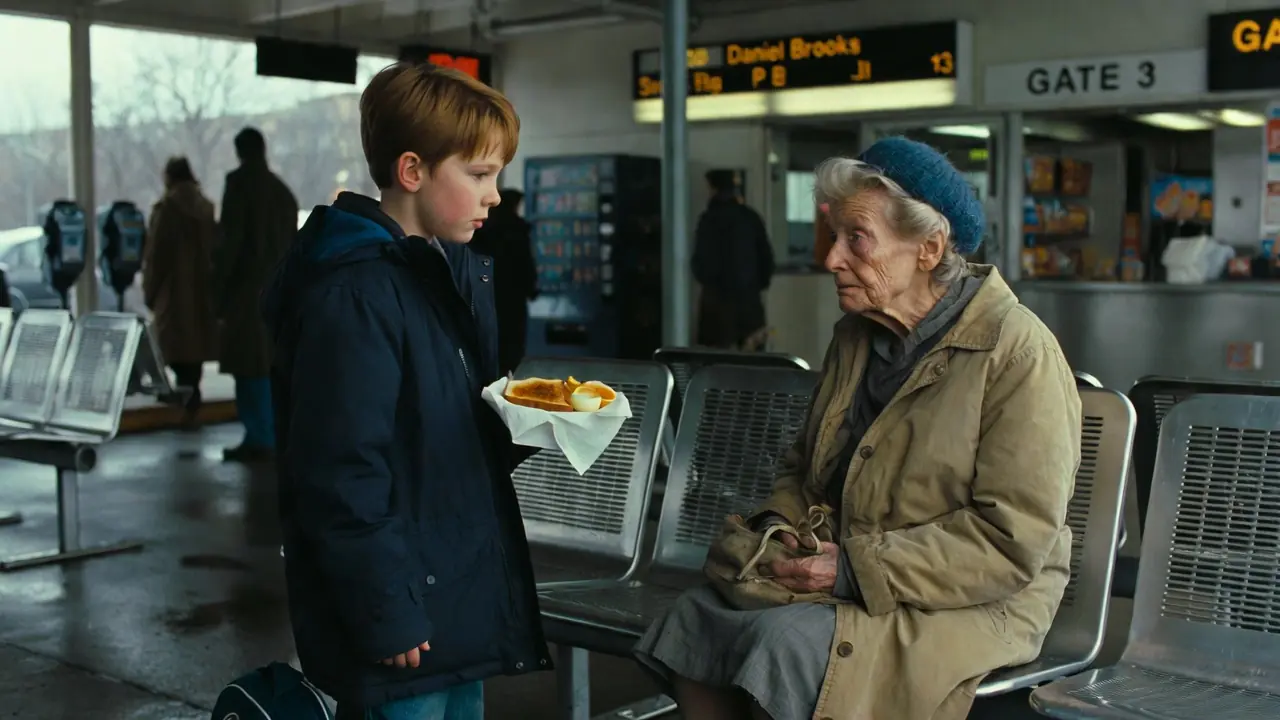
“It is breakfast. And I was told food comes before questions.”
Daniel smiled despite himself.
Ruth then said gently, “Could we meet your mother sometime?”
Daniel grew cautious.
“She works a lot.”
“I imagined she might.”
“She doesn’t like charity.”
Helen nodded.
“Then we will not bring charity. We will bring respect.”
That evening, Helen and Ruth came to the apartment above the closed laundromat.
Lisa had cleaned quickly, but there was no hiding the thin couch blanket, the rattling window, the tiny kitchen, or the way she had turned one bedroom into a child’s room and taken the living room for herself.
Helen noticed.
Ruth noticed.
Neither of them looked pitying.
That mattered.
Helen placed a small tin of muffins on the table.
“For sharing,” she said.
Lisa smiled politely.
“Thank you.”
Ruth looked at Daniel, then at Lisa.
“My mother told me Daniel said his father believed in feeding people.”
Lisa’s expression softened.
“Marcus did.”
“Was he in food service?”
“No,” Lisa said. “Construction. But he cooked like it was a second language.”
Helen smiled.
“My husband was the same way. He could make breakfast for ten people out of six eggs and confidence.”
Lisa laughed softly.
“That sounds familiar.”
Ruth opened a folder.
“My mother used to run a small breakfast program at St. Mark’s Community Hall. Years ago, after my father passed, she cooked there three mornings a week for seniors, schoolchildren, and anyone who needed a meal before the day began.”
Helen looked down at her hands.
“It kept me alive after Harold died. Feeding people gave me a reason to get out of bed.”
“What happened to it?” Daniel asked.
Helen’s voice trembled.
“I got older. My hands shook more. Funding changed. Volunteers moved away. One morning, I closed the kitchen and told myself it was temporary.”
Ruth touched her shoulder.
“That was six years ago.”
The room became quiet.
Lisa looked at the folder.
“Why are you telling us this?”
Ruth took a breath.
“Because Mom wants to reopen the breakfast program. Smaller at first. Two mornings a week. The community hall still has the kitchen. The church board is willing. I can help with paperwork and funding. But we need someone reliable to manage the mornings, organize supplies, coordinate volunteers, and make people feel welcome.”
Lisa’s face became guarded.
“No.”
Ruth blinked.
Helen smiled gently, as if she had expected it.
Lisa shook her head.
“I already work in a hotel kitchen. I clean offices. I don’t have time to run anything.”
“This would be paid,” Ruth said. “Part-time first. Morning hours.”
“I’m not qualified.”
Helen looked at her with surprising firmness.
“You feed your son with almost nothing and still teach him to share. You are more qualified than you know.”
Lisa looked away.
“I don’t want pity.”
“This is not pity,” Helen said. “This is an old woman admitting she cannot reopen a kitchen alone.”
Daniel watched his mother’s face.
Hope appeared there, quick and frightened.
Then she pushed it down.
Ruth slid the folder across the table.
“No answer tonight. Read it. Ask questions. Say no if it’s wrong.”
Lisa did ask questions.
For two weeks, she asked many.
She visited St. Mark’s Community Hall. The kitchen was dusty but functional, with old metal counters, a wide stove, a refrigerator, shelves, and a long serving window opening into a fellowship room. The place smelled faintly of old coffee and floor cleaner.
Helen stood in the doorway, looking smaller than usual.
“I used to know where everything was,” she whispered.
Lisa walked inside and touched the counter.
“This needs cleaning.”
Ruth smiled.
“Yes.”
“And better storage.”
“Yes.”
“And a sign-in sheet.”
Helen’s eyes brightened.
“You see it.”
Lisa gave a small, nervous laugh.
“I see work.”
“Good things often begin that way,” Helen said.
The program reopened in January.
They called it The Morning Table.
The first day, only nine people came.
Three seniors.
Two mothers with young children.
One man from the shelter.
Two middle school students.
And Daniel.
Lisa arrived before sunrise, nervous and quiet. Helen came with recipes. Ruth brought clipboards. A retired church volunteer named Mrs. Bell made coffee badly and admitted it.
Lisa cooked oatmeal, scrambled eggs, toast, and apples with cinnamon.
Nothing fancy.
But the room changed when people began eating.
Shoulders lowered.
Hands warmed around mugs.
Children stopped looking so tired.
The old man from the shelter ate slowly, like he had forgotten meals could happen at tables.
Helen watched from a chair near the kitchen door.
Tears ran down her face.
Daniel sat beside her.
“Are you sad?”
“No, dear,” she whispered. “I think I am returning.”
By March, The Morning Table served breakfast three days a week.
By April, the church received a community grant.
By May, Lisa left the evening office-cleaning job.
The first night she did not have to go downtown to clean, Daniel found her standing in the apartment kitchen at six o’clock, still wearing her Morning Table apron.
“You’re home,” he said.
“I am.”
“For the whole night?”
She smiled, and her eyes filled.
“For the whole night.”
“What do we do?”
Lisa looked around like she had forgotten what evenings could be.
Then she said, “We make pancakes.”
They did not have syrup.
They used apples and cinnamon instead.
Daniel said they tasted like Sunday before everything changed.
Lisa cried into the stove towel.
The Morning Table grew into more than breakfast.
People came for food, yes, but also for warmth, conversation, job flyers, school supplies, and a place where nobody was asked to prove they were hungry enough. Lisa made sure of that.
“No shame at the door,” she told volunteers.
Helen loved that.
She said it sounded like something Harold would have carved into the wall.
In summer, Ruth helped secure funding to open a small pantry shelf beside the kitchen. Daniel helped write labels. Big letters. Clear words. Oatmeal. Rice. Soup. Fruit Cups. Tea. Take What You Need.
Helen brought in her old recipe cards and taught Lisa how to make Harold’s skillet potatoes and church hall biscuits. Lisa adapted recipes for large batches. Daniel helped measure flour when school was out.
One morning, Helen watched him press biscuit dough carefully with floured hands.
“Your father would be proud,” she said.
Daniel swallowed.
“I wish he could eat one.”
Helen touched his shoulder.
“Maybe love eats through memory.”
He did not fully understand.
But he liked the sentence.
In September, the hotel cut Lisa’s hours.
For a few days, old fear returned to the apartment. Bills appeared on the table. Lisa stayed quiet after phone calls. Daniel heard her whisper numbers at night again.
Then Ruth came with news.
The community grant had expanded. The Morning Table could become a full weekday program, with Lisa as paid coordinator.
Not temporary.
Not just a few mornings.
A real position.
Lisa sat at the kitchen table holding the offer letter.
“I don’t know how to believe this,” she whispered.
Daniel stood beside her.
“Maybe believe it slowly.”
She looked at him.
“That sounds like something Helen would say.”
“It does.”
Lisa accepted.
By winter, The Morning Table served breakfast five days a week. Local bakeries donated bread. Grocery stores donated fruit. Volunteers came from nearby schools and offices. Seniors helped fold napkins. Children helped wipe tables. Nobody was treated like a problem.
Helen came every morning, even when she could no longer stand long in the kitchen. She sat near the serving window and greeted people by name.
Daniel called her the keeper of the table.
She liked that.
One year after Daniel shared his breakfast at the bus station, St. Mark’s held a holiday breakfast celebration.
The fellowship room was full. Paper snowflakes hung from the windows. The smell of pancakes, eggs, coffee, and cinnamon filled the air. Families sat beside seniors. Workers in uniforms sat beside children in school coats. Volunteers moved between tables with pitchers of orange juice.
Daniel thought it was just a Christmas meal.
Then Ruth stood near the front with Helen.
A cloth covered a wooden sign on the wall.
Helen motioned for Daniel and Lisa to come forward.
Daniel’s stomach fluttered.
“What’s happening?” he whispered.
Lisa shook her head, already crying.
Helen took Daniel’s hand.
“One year ago,” she said to the room, “I sat hungry in a bus station, too proud and too ashamed to ask for help. A boy saw me. He shared his breakfast. Then he helped me find the bus I had missed.”
Daniel’s face burned as people turned toward him.
Helen continued, “That boy reminded me that The Morning Table was never supposed to stay closed. Hunger did not disappear just because I grew tired. Loneliness did not disappear just because I locked the kitchen.”
Ruth pulled the cloth away.
The sign read:
THE MARCUS BROOKS BREAKFAST KITCHEN
Food First. Questions After.
Daniel stared at the letters.
His father’s name.
Marcus Brooks.
His mother covered her mouth and sobbed.
Helen’s voice trembled.
“Your father gave you words that fed me before I took a bite. Now those words will welcome everyone who enters this kitchen.”
Daniel touched the wooden sign with shaking fingers.
For years, his father had lived in memory, in a photograph, in the ache of Sunday mornings without pancakes.
Now his name was above a kitchen.
A kitchen where people would be fed.
“He would love this,” Daniel whispered.
Lisa wrapped her arms around him.
“He would be standing at that stove already,” she said through tears.
Everyone laughed softly.
Then they ate.
That morning, Daniel served the first plate from the kitchen bearing his father’s name.
Pancakes.
Eggs.
Apples with cinnamon.
He handed it to an elderly man sitting alone near the door.
The man said, “Thank you.”
Daniel smiled.
“Food first.”
Years passed.
The Marcus Brooks Breakfast Kitchen became one of the most beloved places in the neighborhood. It served children before school, seniors on fixed incomes, workers between shifts, families going through hard months, and anyone who needed a meal without shame.
Lisa became the full-time director of The Morning Table.
She no longer worked at the hotel or cleaned offices at night. She still woke before dawn, but now she woke to a kitchen filled with purpose instead of panic. She smiled more. She ate breakfast every morning. She came home before dinner and sometimes made pancakes just because.
Daniel grew up inside that kitchen.
At twelve, he helped set tables.
At fourteen, he organized the pantry shelf.
At sixteen, he started a school breakfast club that packed morning bags for students who arrived hungry.
At eighteen, he received a scholarship to study nutrition and community service.
Helen lived long enough to see him graduate high school.
After the ceremony, Daniel came straight to St. Mark’s in his cap and gown. Helen sat at her usual table near the serving window, wrapped in a blue shawl.
He handed her a small framed card.
It was the blue bird card she had given him years before, now preserved under glass.
Never believe small kindness is small.
Helen touched it.
“You kept it.”
“My mom says notes are worth keeping.”
Helen smiled.
“She was right.”
Daniel sat beside her.
“Thank you for helping my mom.”
Helen looked toward the kitchen, where Lisa was laughing with volunteers.
“You helped me first.”
“I just shared breakfast.”
“And I just reopened a kitchen,” she said. “We can both pretend small things are small, but we know better.”
Helen passed away two winters later.
Her memorial was held at The Morning Table because Ruth said her mother would haunt them if people gathered without food. Everyone brought breakfast dishes instead of flowers. Biscuits. Muffins. fruit. casseroles. pancakes. even boiled eggs.
Daniel spoke last.
He stood beneath the sign with his father’s name.
“When I was ten,” he said, “I thought I was giving half my breakfast to a hungry old woman. I didn’t know she had once fed a whole neighborhood. I didn’t know my mother needed a door out of exhaustion. I didn’t know one egg, half a piece of toast, and a few orange slices could reopen a kitchen.”
Lisa wiped her eyes.
Daniel continued.
“My father taught me food comes first. Mrs. Carter taught me small kindness can become a table. My mother taught me that feeding people with dignity can turn survival into purpose.”
Years later, Daniel Brooks returned to Milwaukee after college and expanded The Morning Table into a citywide breakfast program. Churches, schools, shelters, diners, and community halls joined together to make sure children, seniors, and working families could begin the day with food and dignity.
The original kitchen at St. Mark’s stayed his favorite.
The serving window.
The old stove.
Helen’s chair.
His mother’s apron hanging by the door.
The wooden sign with his father’s name.
And beside it, framed under glass, the blue bird card from the bus station.
Whenever children asked about it, Daniel told them the story.
About a cold morning.
A bus station vending machine.
A hungry old woman counting coins.
A boy with one boiled egg, one slice of toast, and an orange.
A tired mother who needed hope.
A closed kitchen waiting to open.
And a kindness that began before questions.
He always ended the story the same way.
“I thought I was sharing my breakfast,” Daniel would say. “But really, Mrs. Carter helped my mother and me find our way back to the table.”