James Walker had been waiting outside Savannah Market Grocery for twelve quiet minutes when Officer Daniel Reynolds walked into the accessible parking space and decided something about him looked wrong. At seventy-two, James had learned to recognize suspicion before anyone bothered turning it into words, and the look on Reynolds’s face was unmistakable. James sat beside his gray SUV in a black wheelchair, wearing a faded torn gray work shirt, worn blue jeans, an old baseball cap, and brown boots that had not touched the ground with his full weight in nearly nine years. His wife, Margaret, was still inside buying groceries when the officer stopped directly in front of him and demanded identification.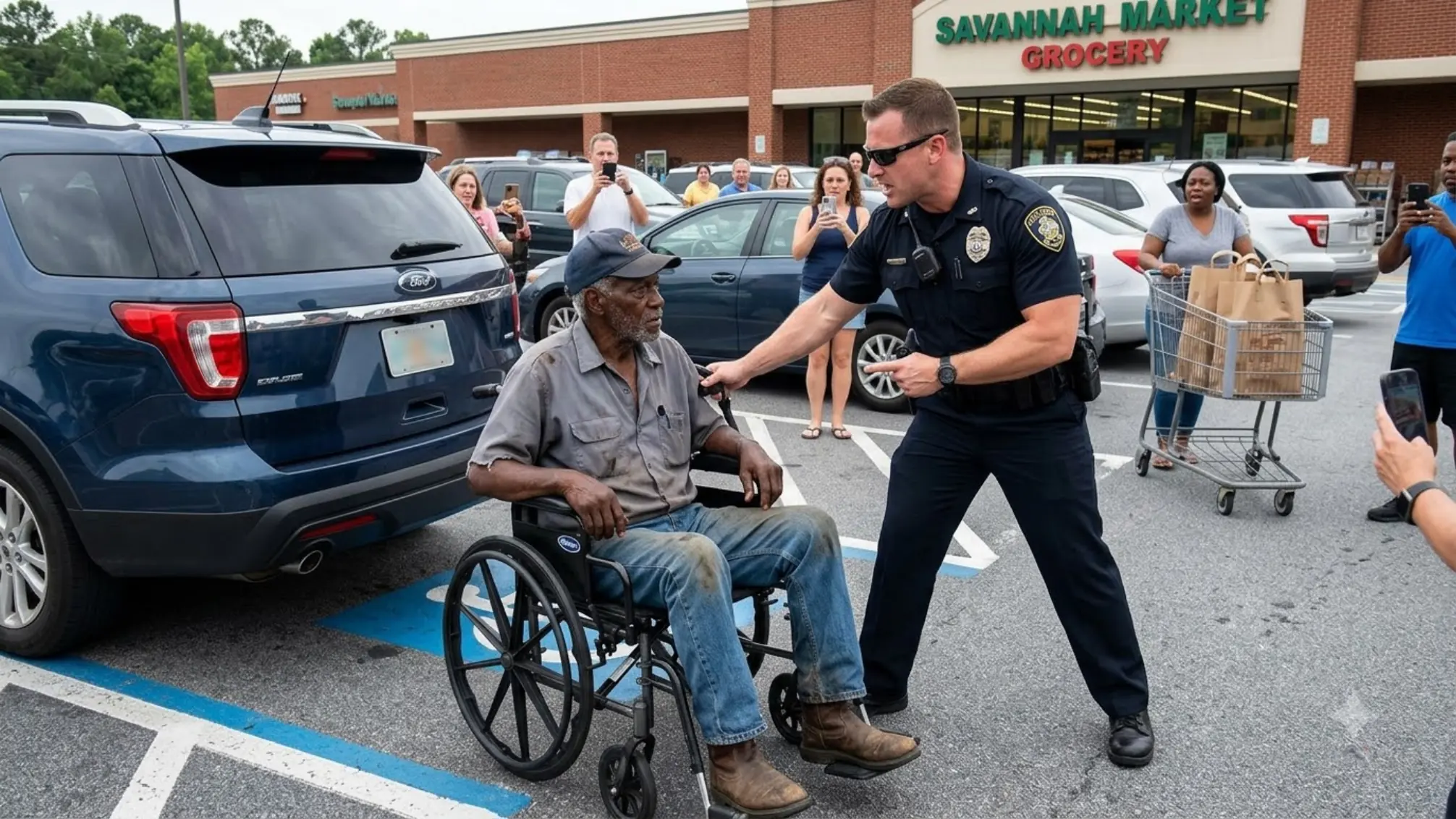
James looked up calmly. “For what?” Reynolds glanced toward the accessible parking sign, then toward the placard hanging inside James’s windshield, as if both were merely decorations rather than answers. “Someone reported a man using a disabled space who doesn’t look disabled enough,” he said, putting special emphasis on the final two words. James stared at him for a moment before answering, “Then whoever called you doesn’t understand disability.”
Reynolds was thirty-eight, muscular, broad through the shoulders, and wore dark sunglasses even though clouds had begun gathering above the shopping center. His body camera sat squarely in the center of his navy patrol uniform, its small indicator light showing that the encounter was being recorded. Instead of checking the placard number or speaking to the store manager, Reynolds stepped closer to James and looked down at his legs. “Stand up.”
James thought he had misheard him. “Excuse me?” Reynolds pointed toward the pavement. “Stand up and show me you actually need that chair.” James’s expression changed from confusion to controlled disbelief. “Officer, I cannot stand safely.”
Reynolds gave a short laugh. “Convenient.” James placed both hands on the wheelchair armrests and forced himself not to respond emotionally. Years earlier, an injury followed by multiple surgeries had left severe permanent damage affecting his lower-body mobility, and walking even a few unsupported steps carried serious risk. He had medical documentation, a properly issued accessible parking placard, and vehicle registration connected to his home address, but none of that seemed to interest Reynolds yet.
“I already told you I can’t stand,” James said. “Take whatever information you legally need from the placard and leave my chair alone.” Reynolds leaned closer until James could smell coffee on his breath. “You don’t tell me how to investigate fraud.” James looked straight at the body camera. “Then investigate it instead of trying to perform it.”
A woman loading groceries into a minivan stopped and turned toward them. Another shopper pushed a cart more slowly, watching Reynolds position himself directly beside James’s wheelchair. Reynolds noticed the attention gathering and apparently decided retreat would make him look weak. He grabbed one of the wheelchair handles.
James’s voice hardened instantly. “Take your hand off my chair.” Reynolds held it tighter. “Stand up right now—or admit you’re a fraud stealing this parking space.” James did not move. “I already told you I can’t stand.”
Reynolds bent toward him. “Then prove it before I drag you out of that thing myself.” Several shoppers audibly reacted, and phones began appearing from pockets. James looked once more at the active body camera and said, “Go ahead—let that camera record the moment you turn a disability check into an assault.” Reynolds’s jaw tightened.
The officer pulled the chair backward several inches. James grabbed the wheels instinctively, locking his arms to keep from being tipped or dragged toward the lane of moving vehicles. Pain shot through his lower back, but he refused to give Reynolds the sudden movement the officer seemed to be expecting. A younger officer walking from the patrol cruiser noticed what was happening and immediately quickened his pace.
“Reynolds,” Officer Ethan Clark called. “What are you doing?” Reynolds did not release the chair. “Checking a fake disability claim.” Clark looked through the SUV windshield and saw the placard immediately. “Did you run it?”
Reynolds turned slightly. “He won’t identify himself.” James answered before Clark could respond. “Nobody asked me for the placard number. He asked me to stand.” Clark’s eyes moved toward Reynolds’s body camera, then toward the growing crowd. “Let go of the wheelchair.”
Reynolds looked offended. “Stay out of this.” Clark lowered his voice. “Daniel, release the chair.” That was the first moment James saw uncertainty cross Reynolds’s face. Instead of listening, the older officer pulled again.
James’s wheelchair rolled backward unexpectedly, and one wheel struck the painted curb stop. The sudden jolt drove pain through James’s spine hard enough that he gasped and grabbed the armrest. A woman filming nearby shouted, “He told you he can’t stand!” Reynolds immediately released the chair, but the damage to the encounter had already been done.
Clark moved between them. “Sir, are you hurt?” James breathed slowly until the sharpest pain subsided. “I’m not sure yet.” Reynolds pointed toward him. “Don’t start acting injured now.”
Every phone in the parking lot captured that sentence. Clark stared at his partner. “Stop talking.”
Reynolds looked around and finally seemed to understand how bad the scene appeared. An elderly man in worn clothing sat beside a properly marked vehicle while an officer towered over him, and multiple witnesses had recorded the chair being moved after James repeatedly stated that he could not stand. Reynolds reached toward his radio as though procedure might rescue him. “Dispatch, run the accessible placard displayed on a gray Ford Explorer.”
The response took less than a minute. The placard was valid and issued to James Edward Walker, age seventy-two, at the same address listed on the vehicle registration. Reynolds looked toward James. “You James Walker?”
James’s eyes narrowed. “You could have discovered that ten minutes ago.” Clark lowered his head slightly.
Then Margaret emerged through the grocery store doors carrying two paper bags. She saw the officers first, then the shoppers surrounding her husband, then James sitting unusually stiff in his wheelchair. The bags slipped from her hands. “James?”
He turned. “I’m okay.” Margaret rushed toward him and touched his shoulder. “What happened?”
Reynolds spoke first. “Ma’am, we were responding to a concern about improper use of accessible parking.” Margaret stared at him. “Improper use?” She pointed toward James. “He hasn’t walked without assistance in nine years.”
James reached for her hand. “Margaret.” She looked down at him and saw how tightly he was gripping the armrest. “Are you hurting?”
“My back got jolted.” Her expression changed. “How?”
Nobody answered immediately. Then the woman with the minivan stepped forward. “That officer grabbed his chair and pulled him.” Margaret slowly turned toward Reynolds.
“You touched his wheelchair?” Reynolds shifted his weight. “He refused to cooperate.” Clark stepped in immediately. “Mrs. Walker, we’re going to get a supervisor here.”
Margaret looked at Clark. “Is his camera recording?” Clark nodded. “Yes, ma’am.” She pointed toward Reynolds. “Then make sure nobody touches that footage.”
Sergeant Laura Mitchell arrived fourteen minutes later. Unlike Reynolds, she did not begin by demanding explanations from James. She first requested medical assistance, separated the officers, identified witnesses, and instructed dispatch to preserve both body-camera recordings. Then she walked toward James and crouched slightly so she could speak to him at eye level.
“Mr. Walker, I’m Sergeant Mitchell. I’d like to understand exactly what happened, but first I need to know whether you want an ambulance.” James looked toward Margaret. The pain had decreased but had not disappeared. “I’ll get checked.”
Paramedics arrived and evaluated him beside the SUV. They found no immediate evidence of a new catastrophic injury, but because of his medical history and the sudden jolt, they recommended further evaluation. Margaret insisted on going with him. Before leaving, James pointed toward Reynolds’s camera and told Mitchell, “Whatever happens next, don’t let this turn into his word against mine.”
Mitchell answered, “It won’t.” Reynolds stood near the patrol car, arms crossed, anger replacing the confidence he had displayed earlier. As the ambulance pulled away, he told Clark, “This whole thing got blown out of proportion because he wanted to argue.” Clark stared at him. “He was sitting in a wheelchair.”
The hospital discharged James several hours later with muscle strain and instructions to monitor worsening symptoms. Nothing was broken, and no new neurological damage was detected, which relieved both him and Margaret. But when they returned home, James barely touched dinner. The physical pain bothered him less than the memory of Reynolds gripping the chair.
Margaret found him sitting in the living room staring at the television without watching it. “You’re going to file a complaint.” James rubbed one wrist. “I know.” She sat beside him. “No, I mean a real complaint. Names, footage, witnesses, all of it.”
James nodded. “I know.” He had spent most of his life avoiding unnecessary battles because experience taught him how expensive they could become. But there had been a moment in the parking lot when Reynolds pulled the wheelchair backward and James understood exactly how easily things could have become much worse. Someone frailer might have fallen.
The complaint was filed the following morning. James described everything chronologically, including what he said, what Reynolds said, when the second officer intervened, and when the placard was finally checked. He did not speculate about Reynolds’s motivations. He simply requested that the body-camera footage be preserved and compared with the report.
Sergeant Mitchell had already done that. Reynolds’s preliminary report described James as “evasive and verbally confrontational” and claimed the wheelchair moved when Reynolds attempted to inspect it. The video showed something different. James remained seated throughout the encounter, answered direct questions, repeatedly stated that he could not stand safely, and explicitly told Reynolds not to touch the chair.
More damaging was the language. Stand up right now—or admit you’re a fraud. Then prove it before I drag you out of that thing myself. Finally, after James was jolted: Don’t start acting injured now. Those sentences were not reconstructed from memory; Reynolds’s own camera preserved them clearly.
Internal Affairs investigator Monica Hayes watched the footage twice. Then she requested Reynolds’s previous complaint history. Four incidents appeared over six years, two involving accusations that he dismissed medical limitations during encounters. Neither had been sustained because there had been insufficient independent evidence.
One involved a diabetic driver who said Reynolds refused to let him retrieve glucose tablets during a prolonged traffic stop. Another involved a woman with an invisible neurological condition whom Reynolds allegedly accused of exaggerating symptoms after she asked to sit down. Neither case alone had established misconduct. Together with the parking-lot footage, they raised questions about judgment.
Hayes interviewed Clark first. “Did Mr. Walker threaten either officer?” “No.” “Did you see evidence he was fraudulently using the accessible parking space?” “No.”
“Why did you tell Officer Reynolds to release the wheelchair?” Clark hesitated. “Because there was no reason to touch it.” Hayes waited. Clark continued, “And because Mr. Walker had already said he couldn’t stand.”
Reynolds entered his own interview certain that he could explain everything. He said he responded to a fraud complaint and believed James was being evasive. Hayes asked what evidence of fraud existed beyond the caller’s suspicion. Reynolds admitted there had been none.
“Then why order him to stand?” Hayes asked. “To verify mobility.” “Are patrol officers trained to verify disability by ordering wheelchair users to stand?” Reynolds went silent.
Hayes played the footage. Reynolds watched himself gripping the wheelchair. He watched James clearly tell him to stop. Then he watched himself pull.
“That looks worse from this angle,” Reynolds said. Hayes paused the recording. “Which angle makes it appropriate?”
Reynolds stared at the screen.
He tried another explanation. “I didn’t know his disability was real.” Hayes answered, “That is exactly why documentation exists. The placard was visible, and dispatch verified it in under sixty seconds once someone actually requested verification.”
Reynolds leaned back. “People abuse accessible parking all the time.” Hayes nodded. “Sometimes they do.” Then she asked the question that ended most of his defense. “How does pulling a wheelchair prove fraud?”
He had no answer.
The department sustained several findings against Reynolds, including improper physical interference, failure to de-escalate, unprofessional conduct, and conduct creating unnecessary risk to a disabled citizen. He was placed on administrative leave pending a disciplinary hearing. But James remained uneasy about the investigation focusing only on Reynolds.
He requested a meeting with Police Chief Angela Warren. Margaret accompanied him. James placed one question on the table before the conversation began. “What is your department teaching officers about disabilities they cannot see?”
Warren did not answer immediately. That told James more than a prepared statement would have. She eventually admitted the department’s academy included general disability awareness but offered little practical training about mobility devices, hidden disabilities, accessible parking verification, or how officers should respond when a person said a physical command was medically impossible.
“That’s the problem,” James said. “He thought my body had to perform for him.” Warren looked down.
James continued. “I had a wheelchair. I had the placard. I had the plates. And somehow the final test was whether I could stand because he said so.” Margaret added quietly, “What happens to someone with epilepsy when an officer orders something dangerous? What happens to someone with a heart condition who doesn’t look sick?”
The department announced revised disability-response training before Reynolds’s hearing concluded. Officers would be instructed to verify documentation through available records rather than demanding physical demonstrations of disability. Mobility devices would be treated as extensions of personal autonomy and not moved without necessity or consent except in genuine emergencies. Supervisors would review complaints involving alleged disregard of documented medical limitations.
Reynolds’s disciplinary hearing occurred seven weeks after the parking-lot incident. The panel watched the body-camera footage from beginning to end. James attended but did not testify until afterward. He did not enjoy seeing himself on screen.
The moment Reynolds grabbed the wheelchair made Margaret squeeze James’s hand. Then came the sentence about dragging him out. Several panel members visibly shifted in their seats. Reynolds looked down.
When asked why he continued after the placard was visible, Reynolds answered, “I thought he was challenging me.” One panel member replied, “Was he challenging your authority, or challenging your assumption?” Reynolds did not answer.
James eventually testified. “I don’t need him fired because he embarrassed me.” He looked toward the board. “I need you to decide whether somebody who reacts to disagreement by grabbing a disabled person’s wheelchair should be working alone with authority over strangers.”
Reynolds received a lengthy suspension, mandatory remedial training, and removal from independent patrol pending successful evaluation. The decision stopped short of termination because the board considered his record, the absence of serious new physical injury, and the possibility of retraining. Some residents criticized the outcome as too lenient.
James did not. “Consequences aren’t measured by how angry the crowd is,” he told Margaret. “They’re measured by whether the problem changes.” Still, he insisted Reynolds return only if supervisors could demonstrate actual improvement rather than paperwork completion.
Months later, Reynolds requested a meeting with James. The request surprised him. James almost declined, but Margaret told him, “You don’t have to forgive him. Listening isn’t forgiveness.”
They met in a community conference room with an Internal Affairs representative present. Reynolds arrived without his uniform. He looked smaller without the badge, sunglasses, duty belt, and body camera.
“I’m sorry,” he began. James waited. Reynolds continued, “I’ve watched the video more times than I want to admit.”
“What did you see?” James asked.
Reynolds looked toward his hands. “Someone trying to prove he was right after there was nothing left to prove.” James nodded once.
“I thought if I backed down, everyone watching would think I had lost control.” Reynolds took a breath. “So I kept escalating because stopping felt like losing.” James studied him.
“There was nothing to win.” Reynolds nodded. “I understand that now.”
James leaned forward. “Do you?” Reynolds met his eyes. “I treated your disability like something you owed me a demonstration of. I was wrong.”
That was the first sentence James believed completely.
He did not tell Reynolds everything was fine. It was not. He did not offer friendship or erase the complaint.
Instead he said, “Then make sure the next person benefits from what happened to me.” Reynolds nodded. “I will.”
A year later, James returned to Savannah Market Grocery with Margaret. He parked in the same accessible space. His wheelchair came down the ramp beside the SUV, and he waited outside while Margaret went inside because she had forgotten coffee.
A patrol cruiser passed slowly. James looked up automatically. The officer behind the wheel was Ethan Clark, the younger officer who had intervened that day.
Clark parked several spaces away and approached.
“How are you doing, Mr. Walker?”
“Still causing trouble by sitting down.”
Clark laughed.
“I heard.”
They talked briefly. Clark had recently become a field-training officer responsible for mentoring new recruits. The department now used portions of Reynolds’s body-camera footage in disability-awareness training.
James raised an eyebrow. “My worst grocery trip became homework?” “Pretty much.”
“What do you tell them?”
Clark considered the question.
“That a command doesn’t become reasonable just because an officer says it louder.” James smiled slightly.
Clark continued. “And that if the facts keep proving your assumption wrong, your job is to change the assumption, not keep searching for another reason to defend it.” James nodded.
“That’ll do.”
Margaret returned carrying coffee and bread. She saw Clark and smiled.
“Everything okay?”
James looked toward the grocery store, the wheelchair, and the painted accessible symbol beneath him.
“Perfectly boring.”
Margaret laughed. “My favorite kind.”
They loaded the groceries into the SUV.
James remained beside the vehicle for another moment, remembering the crowd, the grabbing hand, the body camera, and the helpless anger of being told to perform an ability his body no longer possessed. The experience had changed something inside him, but it had also changed something beyond him.
New recruits now learned that accessible parking investigations began with documentation, not humiliation. Officers were taught not to move mobility devices casually. Complaints involving medical limitations were reviewed more carefully.
None of those changes made headlines for long.
James preferred it that way.
The story people repeated was simpler: an officer ordered an old disabled man to stand, grabbed his wheelchair, and forgot his camera was recording. That version had tension and a clear villain.
James remembered something more complicated.
He remembered Officer Clark stepping forward.
Sergeant Mitchell preserving evidence.
Investigator Hayes asking the right questions.
Chief Warren admitting training was inadequate.
And eventually Reynolds watching his own behavior closely enough to understand what he had done.
Accountability was not one dramatic punishment.
It was evidence forcing people and institutions to stop lying to themselves.
James rolled toward the passenger side of his SUV. Before climbing inside, he looked once toward the parking space where the confrontation had happened.
The painted wheelchair symbol was bright blue beneath the afternoon sun.
No one asked him to prove he belonged there.
No one demanded that he stand.
No one touched his chair.
That ordinary silence was the outcome he had wanted from the beginning.
Because dignity should never depend on whether a disability is visible enough to satisfy a stranger.
And no person should have to perform their pain before someone with authority decides to believe them.