“I do not believe you’re authorized to use this government vehicle,” Officer Daniel Mercer said, tightening his grip around the Black man’s wrist.
Rear Admiral Isaiah Grant stood beside the unmarked government SUV without resisting. Cold rain had turned to sleet along the harbor road outside Naval Station Everett, and red police lights flashed against his formal black Navy uniform. Gold rank stripes circled his sleeves, decorated ribbons covered his chest, and a silver warfare insignia rested above them. “Release me,” Isaiah said evenly, “and verify the credentials already in your hand.”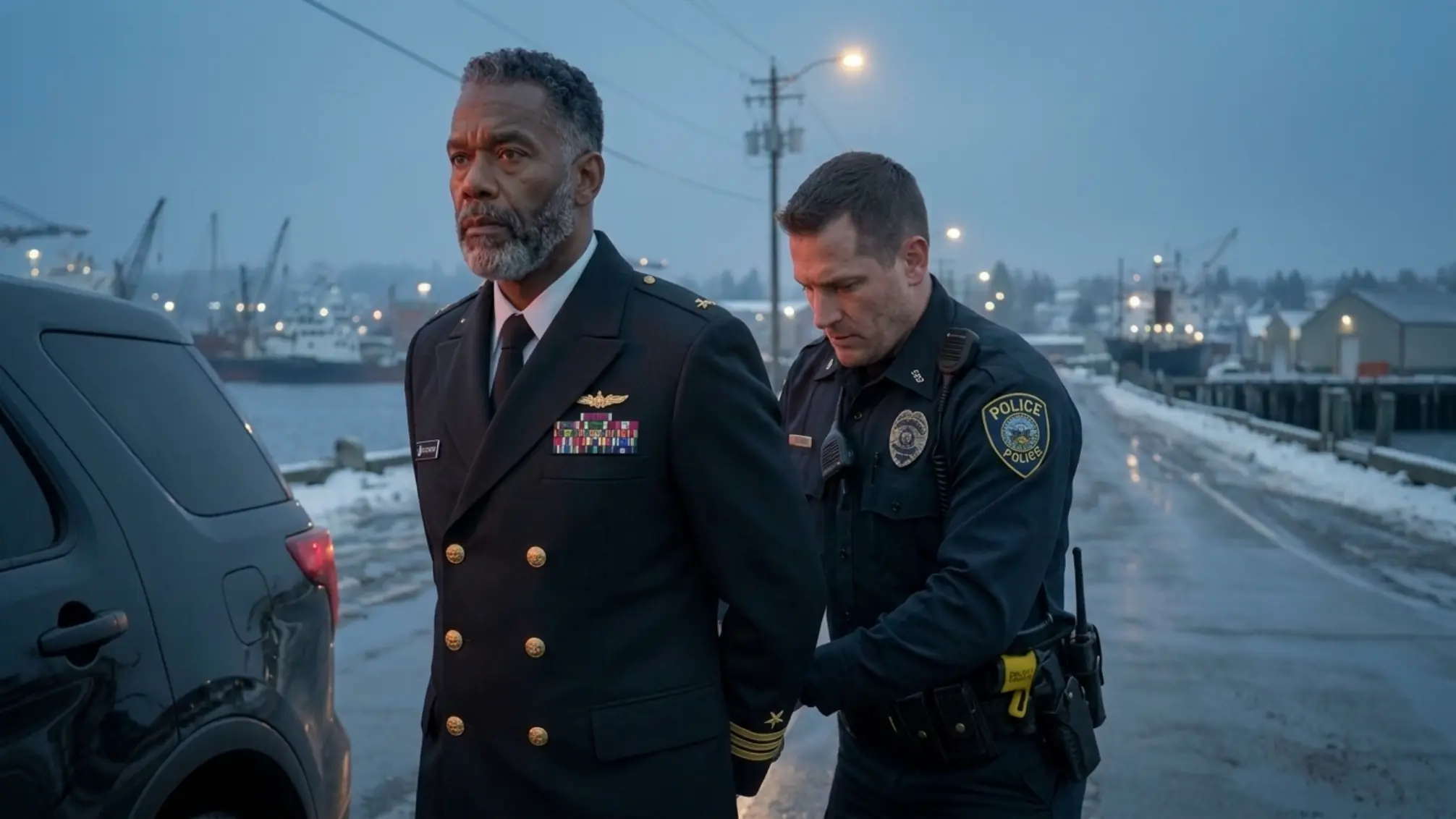
Mercer glanced at the authenticated military identification card but did not read it. Instead, he pushed Isaiah’s arm higher behind his back and reached toward the yellow Taser on his duty belt. “Move again, and I’ll drop you before you reach that door.”
Isaiah slowly turned his head. His dark eyes remained controlled, but the warning in them was unmistakable. “Fire it,” he said. “Then explain yourself when the entire base surrounds you.”
The police officer drew the Taser.
Two barbed probes struck Isaiah through the back of his long military overcoat. Electricity locked his muscles, tore the breath from his lungs, and drove him onto one knee beside the SUV. His shoulder struck the wet pavement before he could catch himself.
Mercer kept the trigger depressed.
“Stop resisting!”
Isaiah could not move enough to resist. His jaw tightened as the current ran through him, but he refused to cry out. Thirty years of military training did not lessen the pain; it merely taught him not to surrender his mind to it.
When the cycle ended, Isaiah remained on the ground, breathing slowly through clenched teeth.
Mercer stepped behind him and pulled both arms back. “Hands where I can see them.”
“They are beneath your knees,” Isaiah said.
The officer pressed harder.
A second patrol officer, Lena Watkins, arrived in another vehicle and hurried toward them. She was thirty-one, recently transferred to the harbor district, and immediately noticed details Mercer had ignored: the admiral’s uniform, the government plates, the encrypted antenna system on the SUV, and the credentials lying faceup in a puddle.
“What happened?” she asked.
“He tried to access a restricted government vehicle.”
Isaiah looked toward her. “The vehicle is assigned to me.”
Mercer scoffed. “He expects us to believe he’s some kind of admiral.”
Watkins picked up the identification card. Rainwater ran across the sealed surface without damaging it. She read the name, rank, photograph, and Department of Defense verification code.
Her face changed.
“Daniel,” she said quietly, “get off him.”
Mercer did not move. “The card could be fake.”
“It has a live verification chip.”
“Anyone can buy military costumes online.”
Watkins looked at Isaiah’s decorations. The uniform was not a costume assembled from random pieces. His rank, warfare insignia, ribbons, and command identification were positioned precisely.
She activated her radio. “Dispatch, verify Department of Defense credential for Rear Admiral Isaiah Grant.”
Mercer stood and pulled Isaiah upright by the arm.
Isaiah staggered once but remained standing.
The police officer shoved him against the rear quarter panel of the SUV. “You’re still detained.”
Isaiah’s voice lowered. “You have already crossed detention.”
“Is that a threat?”
“It is an observation.”
Dispatch responded less than thirty seconds later.
“Unit Twelve, hold traffic. Credential number returns active. Rear Admiral Isaiah Marcus Grant, United States Navy. Commander, Naval Special Operations Readiness Directorate. Vehicle registration confirmed as federal property.”
Watkins closed her eyes briefly.
Mercer stared at the radio.
Then he reached for Isaiah again.
“Active credentials do not explain why he’s outside the base before sunrise.”
Isaiah turned to face him. “Because I was ordered here.”
“By whom?”
“That information is classified.”
Mercer seized the front of Isaiah’s coat. “You don’t decide what I’m allowed to know.”
Isaiah looked down at the officer’s fist gripping his uniform. “Take your hand off me.”
Mercer stepped closer. “Or what?”
A low mechanical siren sounded from the direction of the base.
The heavy security barriers at the installation entrance rose simultaneously. Three matte-black military vehicles emerged through the gate, followed by two marked Navy security trucks. Their emergency lights flashed blue and white across the icy road.
Watkins moved away from Isaiah.
Mercer released his coat but kept one hand near his weapon.
The military convoy stopped in a controlled formation around the roadside scene. Doors opened at once, and twelve armed security personnel stepped out wearing tactical gear marked NAVAL SECURITY FORCES.
Their rifles remained pointed toward the ground.
The message was still unmistakable.
Captain Elena Ward exited the lead vehicle. She was forty-six, composed, and carried the authority of someone accustomed to giving orders that were obeyed immediately. Her gaze moved first to Isaiah’s injured shoulder, then to the Taser wires hanging from his overcoat.
“Admiral Grant,” she said, “are you able to stand?”
“I am standing.”
“Were you struck with a conducted-energy weapon?”
“Yes.”
Ward looked at Mercer. “Step away from him.”
“This is a municipal police matter.”
“No,” she replied. “You discharged a weapon against a flag officer transporting classified federal material within the installation’s protective security perimeter.”
Mercer gestured toward the road. “We’re outside the gate.”
“By seventy-four yards.”
“That is city jurisdiction.”
“It is shared federal-security jurisdiction under the harbor defense agreement your department signed.”
Mercer looked toward Watkins for support.
She said nothing.
Captain Ward raised one hand. Two Navy security officers moved toward the government SUV while another pair began photographing the scene. A military medic approached Isaiah and cut the Taser wires from his coat.
Mercer blocked the medic. “Nobody touches evidence until my supervisor arrives.”
Ward looked at him. “Your body camera is the primary evidence. Is it active?”
His eyes shifted.
Watkins glanced at the small device on his chest.
No indicator light was visible.
“Daniel,” she said, “you turned it off?”
“I activated it during the stop.”
“No, you didn’t.”
He looked at her sharply.
Watkins touched her own camera. “Mine recorded the credential verification, the second threat, and you grabbing his uniform after dispatch confirmed his identity.”
Mercer’s expression hardened. “Stay out of this.”
“You involved me when you lied about the stop.”
Isaiah watched the exchange quietly.
He had not been traveling to the base for an ordinary meeting. Inside the SUV rested an encrypted case containing evidence connected to a months-long investigation of stolen military equipment, forged access credentials, and unauthorized movement of restricted weapons components.
Someone knew he would be driving that road.
Someone had arranged for him to be stopped before he reached the secure facility.
The timing was too precise to dismiss.
Captain Ward appeared to reach the same conclusion. She turned toward one of her officers. “Secure the vehicle. Full electronic sweep. Nobody opens the rear compartment without the admiral’s authorization.”
Mercer pointed toward the SUV. “I need to search it.”
“No.”
“I have probable cause.”
“For what crime?”
“Unauthorized use of federal property.”
“Dispatch confirmed his authorization.”
“He refused to explain what he was doing.”
“A citizen is not required to reveal classified military operations to a patrol officer.”
Mercer stepped toward Ward. “You military people don’t control this road.”
Ward did not retreat. “At this moment, I control the protection of that admiral and everything inside his vehicle.”
The two stood inches apart.
Isaiah’s medic finished examining him and recommended immediate transportation to the base clinic. Isaiah refused for the moment.
“Captain,” he said, “check the officer’s radio history.”
Mercer’s head snapped toward him.
Ward noticed.
“So did Isaiah.
“Why?” she asked.
“I was stopped less than ninety seconds after leaving the secondary gate. Officer Mercer was already positioned ahead of my route with his lights off.”
Watkins looked toward Mercer’s patrol SUV.
“Daniel, you told dispatch you observed a suspicious vehicle leaving the industrial district.”
“I did.”
“The industrial district is four miles south.”
Mercer folded his arms. “Maybe I misspoke.”
Isaiah faced him. “Who gave you my plate number?”
“No one.”
“Then why did you call it in before you could see the rear plate?”
Mercer’s mouth tightened.
Watkins accessed the preliminary dispatch log on her vehicle terminal. The first record showed Mercer requesting a stop authorization at 5:41 a.m. His message included the exact federal plate number and described the driver as a potentially armed Black male impersonating military personnel.
At 5:41, Isaiah had not yet left the secured gate.
The log timestamp was undeniable.
Captain Ward ordered Mercer’s radio and department-issued phone preserved.
“You have no authority to take my property.”
Ward looked toward the city police vehicles approaching from the highway. “Your own internal-affairs commander can decide who takes it.”
A black sedan pulled behind the patrol units. Deputy Chief Raymond Collins stepped out wearing a heavy coat over his uniform. He was in his late fifties and appeared irritated rather than concerned.
“What is the meaning of this military deployment?” he demanded.
Mercer immediately moved toward him. “Chief, the suspect refused lawful orders and attempted to access restricted property.”
Watkins held up the verified identification card. “He is Rear Admiral Grant. The SUV is assigned to him.”
Collins barely looked at the card.
“That does not prevent an officer from conducting an investigation.”
Isaiah studied him. “You arrived quickly.”
Collins looked at him for the first time. “Excuse me?”
“No one called for a deputy chief over the public channel.”
The older officer’s face remained still.
Captain Ward turned toward her communications specialist. “Confirm whether Deputy Chief Collins received an official dispatch.”
The specialist checked.
“No official notification.”
Collins stepped forward. “I will not be interrogated on a roadside by military police.”
Isaiah’s voice became colder. “Then perhaps you would prefer the secure room already prepared for this morning’s briefing.”
Collins stared at him.
That reaction gave Isaiah his answer.
The deputy chief knew about the briefing.
He should not have.
Inside the encrypted case were procurement records and surveillance photographs linked to a stolen guidance-system shipment. One photograph showed a warehouse owned by a private security company called Northline Tactical.
Another showed Deputy Chief Collins meeting the company’s director after midnight.
Mercer was not a reckless officer who happened to stop the wrong man.
He was part of an attempt to delay or seize the evidence before Isaiah delivered it.
Collins turned toward Mercer. “Place the admiral in your vehicle. We’re moving this to headquarters.”
Captain Ward stepped between them.
“No one is moving him.”
Collins reached toward his coat.
Every military security officer raised a weapon into a ready position without pointing directly at him.
The deputy chief froze.
Ward’s tone remained calm. “Keep your hands visible.”
“This is insanity.”
Isaiah looked at Watkins. “Officer, did your camera record his order to place me in custody after my credentials were verified?”
“Yes, Admiral.”
“Preserve it.”
Collins turned on her. “You work for me.”
“I work for the department.”
“You will surrender that camera immediately.”
Watkins took one step backward. “No, sir.”
He moved toward her.
A Navy security officer blocked him.
Captain Ward received a message through her earpiece, listened, and looked at Isaiah. “Admiral, the sweep found an unauthorized magnetic tracker beneath your rear bumper.”
Mercer’s face changed.
The device transmitted through a civilian police frequency.
It had been programmed to alert the receiver when Isaiah’s SUV left the base.
Ward looked at Collins. “The receiving account is registered to a municipal law-enforcement terminal.”
Collins said nothing.
“Which terminal?” Isaiah asked.
“Harbor District Command Three.”
Everyone looked toward the deputy chief.
That terminal sat inside his private office.
The road fell silent except for sleet striking metal roofs and the distant movement of harbor cranes.
Collins finally spoke. “This can be explained.”
Isaiah stepped closer despite the pain running through his shoulder. “Then begin.”
The deputy chief looked at Mercer.
Mercer understood that he had been abandoned.
“You told me he was transporting stolen property,” the officer said.
Collins’ eyes flashed. “Be quiet.”
“You said he was impersonating an admiral.”
“I said be quiet.”
Mercer’s voice rose. “You gave me the plate number and told me to keep him from reaching the base.”
Watkins watched in disbelief.
Collins moved toward Mercer, but naval security personnel separated them.
“You idiot,” Collins hissed.
Mercer laughed bitterly. “I’m the idiot? You said the vehicle would be taken to evidence and the case inside would disappear.”
Collins stopped struggling.
That sentence transformed the roadside incident into a federal conspiracy confession.
Captain Ward ordered both men detained pending transfer to federal authorities. Naval personnel did not immediately handcuff them because city officers still held formal arrest authority on that section of road.
Watkins made the decision.
She removed Mercer’s service weapon first.
Then she faced her deputy chief.
“Sir, place your hands behind your back.”
“You will never wear that badge again.”
“Maybe not,” she said. “But you won’t use yours to bury this.”
She arrested him.
The military base then took complete control of the protective operation.
The road was closed in both directions. Federal investigators arrived by helicopter. The SUV was moved inside a shielded inspection bay, where technicians documented the tracker and confirmed no one had breached the encrypted rear compartment.
Isaiah entered the base clinic only after the evidence was secure.
The Taser probes had caused deep puncture wounds, and his fall had strained his shoulder. Doctors recommended observation, but he insisted on attending the emergency command briefing remotely.
By eight o’clock, the meeting no longer concerned only stolen military equipment.
It concerned corruption inside the harbor police department.
The encrypted case revealed that Northline Tactical had diverted guidance assemblies, encrypted radio modules, and aircraft-navigation components through falsified disposal contracts. The company then sold them to foreign intermediaries through shell corporations.
Collins used police systems to protect shipments and identify federal investigators.
Mercer performed traffic stops whenever vehicles carrying auditors or witnesses approached the harbor. Most stops ended without violence because the targets became intimidated and turned back.
Isaiah had not.
The investigation uncovered seventeen suspicious stops over eight months. Three drivers reported threats. Two had property temporarily seized without documentation. One civilian contractor disappeared after agreeing to provide procurement records.
His abandoned car had been found near the harbor.
The conspiracy was larger than anyone expected.
Federal agents arrested four Northline executives, three port employees, two military contractors, and six police officers. Search warrants recovered stolen equipment from warehouses in Washington and Oregon.
The missing contractor was found alive in a remote storage facility where Northline employees had held him to force access codes from him.
Mercer requested a plea agreement.
He admitted Collins instructed him to stop Isaiah and provoke a confrontation. If Isaiah complied, Mercer would search the SUV under a fabricated safety claim. If he resisted, force would justify removing him and impounding the vehicle.
The Taser had not been an emotional mistake.
It had been part of the plan.
Mercer believed prejudice would make the lie believable. He assumed witnesses would accept that a Black man near a government SUV was suspicious, even while wearing the uniform of a decorated admiral.
He also assumed Isaiah’s military title would not matter once the official police report described him as aggressive.
Officer Watkins’ body-camera footage destroyed that strategy.
It showed Isaiah complying, offering credentials, warning Mercer to verify them, and remaining controlled after being shocked. It also captured Mercer’s refusal to accept dispatch confirmation and Collins’ attempt to seize the SUV.
The footage became central evidence in federal court.
Deputy Chief Collins was charged with conspiracy, obstruction, theft of federal property, unlawful surveillance, kidnapping connected to the missing contractor, and multiple corruption offenses. Mercer faced assault, evidence tampering, conspiracy, and civil-rights charges.
Several officers who cooperated received reduced sentences.
Those who had knowingly helped target innocent drivers were dismissed and prosecuted.
The city offered Isaiah a private settlement before the case reached trial.
He refused confidentiality.
“I will not accept money in exchange for helping an institution hide what happened,” he told the city council. “Accountability conducted in secret is reputation management, not reform.”
The case went public.
Images from the roadside spread across national television: Isaiah standing in his decorated uniform beside the SUV, Mercer behind him with the Taser, and naval security vehicles surrounding the scene minutes later.
Some commentators described the incident as a misunderstanding.
The body-camera footage ended that discussion.
The city council removed the police chief after investigators proved he had ignored earlier complaints against Collins. A federal consent agreement imposed outside oversight, mandatory camera activation, independent stop audits, and automatic review whenever officers challenged federal or military credentials.
Watkins testified against both men.
She was transferred out of the harbor district for her protection and later promoted to detective. During the ceremony, she looked uncomfortable when reporters called her heroic.
“I verified an identification card and refused an illegal order,” she said. “That should be ordinary.”
Isaiah attended quietly in the back of the room.
Afterward, she approached him.
“I should have stopped Mercer sooner.”
“You arrived after the weapon was fired.”
“I saw the way he was treating you before dispatch confirmed your identity.”
Isaiah studied her. “Would you have intervened if I had not been an admiral?”
The question struck her.
“I hope so.”
“That is not an answer.”
She looked down. “I don’t know.”
Isaiah nodded once. “Honesty is where reform begins.”
Collins went to trial the following year. Prosecutors played Mercer’s roadside confession, displayed the tracking device, and presented communications connecting the deputy chief to Northline Tactical.
The defense argued that the military had overreacted and contaminated a local police investigation.
Captain Ward testified for six hours.
She explained that naval forces had not seized control of city government. They had secured a federal officer, classified material, and military property during an active attempt to steal evidence.
When the defense attorney asked whether surrounding the road with armed personnel had been excessive, Ward answered without hesitation.
“An officer had already discharged a weapon at a rear admiral and attempted to open a vehicle carrying evidence of stolen defense technology. The danger was not hypothetical.”
Collins was convicted on every major count.
Mercer pleaded guilty and testified against him. He lost his badge, pension eligibility, and freedom. During sentencing, he apologized to Isaiah but described himself as manipulated by a superior.
Isaiah stood before the court.
“You were manipulated,” he said. “But you were also willing. You saw my skin before you saw my credentials, and that made the order easy for you to believe.”
Mercer lowered his head.
“You shocked me because someone promised the report would protect you. The law cannot survive when officers believe paperwork can erase what people endured.”
The judge imposed a substantial prison sentence.
Isaiah returned to active command after recovering from his injuries. He declined offers to move into a ceremonial role and continued overseeing special-operations readiness.
The uniform damaged by the Taser was preserved as evidence for nearly two years.
When it was finally returned, two small punctures remained in the back of the overcoat.
His staff offered to replace it.
Isaiah refused.
He wore it during his final retirement ceremony.
Captain Ward stood beside him as sailors, officers, and members of his family filled the base auditorium. Officer Watkins attended in plain clothes near the rear.
During his speech, Isaiah did not describe himself as a victim.
He spoke about authority.
“A uniform can represent service,” he said. “A badge can represent protection. Rank can represent responsibility. None of those symbols guarantee character.”
The room remained silent.
“Authority reveals the person carrying it. Some use it to protect people they may never meet. Others use it to make fear look like law.”
After the ceremony, Isaiah walked outside toward the harbor road. Snow covered the shoulder where Mercer had forced him to the ground years earlier.
The old tracker had been removed. The corrupted officers were gone. The base and city had created a joint review team that required both agencies to document stops involving military vehicles near the installation.
The changes could not erase what happened.
They could make repetition more difficult.
Watkins joined him near the gate.
“Do you still think about that morning?” she asked.
“Every time I pass this road.”
“You told Mercer the base would surround him.”
Isaiah looked toward the installation, where security lights glowed through the falling snow.
“I hoped he would understand the warning.”
“He thought you were bluffing.”
“So do most people who confuse restraint with weakness.”
A military SUV waited nearby to take him home. This time, the driver stepped out and opened the rear door.
Isaiah paused before entering.
The officer who stopped him had believed a Black man could not possibly possess the authority displayed openly on his uniform. He ignored the identification, the government plate, and the dispatch confirmation because accepting them required surrendering the story he had already invented.
Then he fired the Taser.
Minutes later, the base barriers rose.
Naval security surrounded the road. The hidden tracker exposed the conspiracy, one officer’s camera preserved the truth, and a corrupt deputy chief discovered that neither his badge nor his department could protect him from the evidence.
Mercer had ordered Isaiah away from a government vehicle.
By sunrise, the military had secured the SUV, the road, the classified files, and every person involved in the illegal stop.
The officer thought he was arresting an impostor.
Instead, he triggered the operation that dismantled the entire conspiracy.