The midday sun beat down on an Atlanta park while two men sat quietly on a green iron bench, watching a courier carrying access to millions of dollars in cartel money.
They were federal agents, minutes away from completing the biggest operation of their careers. The man about to ruin everything was not a cartel gunman or an undercover criminal.
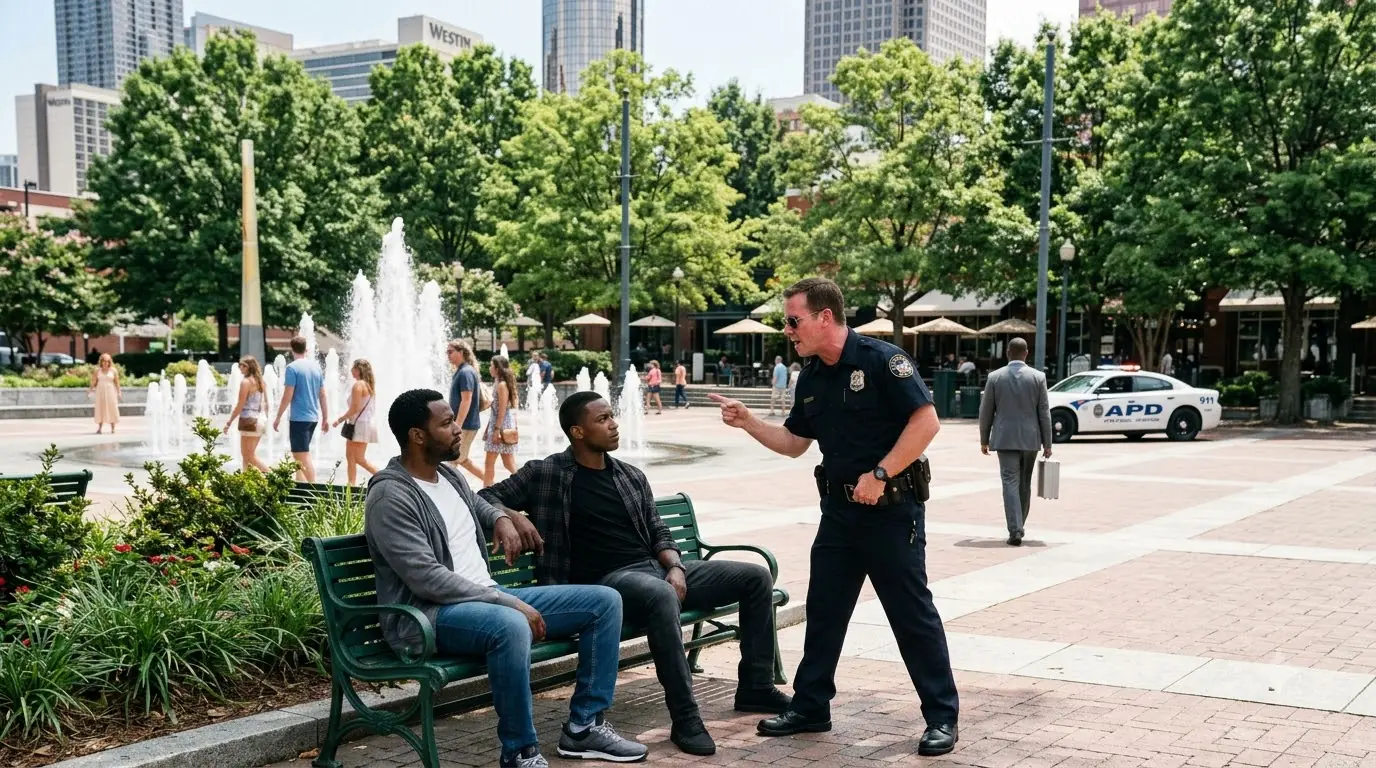
He was a local patrol officer.
A man with a badge, a fragile ego, a history of complaints, and absolutely no idea that he was stepping directly into the middle of a federal operation.
Heat radiated from the concrete of Centennial Olympic Park in downtown Atlanta. It was a blistering Tuesday afternoon in mid-August, the kind of Southern heat that seemed to press against the lungs the moment anyone stepped out of air conditioning. Tourists clustered beneath scattered trees while office workers hurried toward nearby high-rises with cold drinks in their hands.
On a weathered green bench near the fountains sat two men who looked entirely ordinary.
Special Agent Jonathan Paul leaned forward with his elbows on his knees. At forty-two, Jonathan was a veteran investigator assigned to the FBI’s Organized Crime Task Force. His faded gray hoodie, white T-shirt, worn jeans, and scuffed shoes were deliberate choices meant to make him disappear into the park.
Beside him sat Special Agent Samuel Hayes.
Sam was thirty-one, a former Army Ranger whose analytical skills had carried him quickly through federal training. He wore an open flannel shirt over a plain T-shirt, dark jeans, and construction boots. Both men were Black Americans, and to anyone glancing casually in their direction, they looked like two working-class friends taking a break from the heat.
In reality, they were critical pieces of Operation Glass House.
The investigation had consumed almost two years.
Its target was the Navarro Syndicate, an organized criminal network using businesses across the Southeast to move illegal proceeds through legitimate accounts. Months of surveillance, undercover work, financial tracing, and intercepted communications had led the FBI to one specific afternoon in Centennial Olympic Park.
Jonathan barely moved his lips.
“Comm check.”
A voice answered immediately through the small earpiece hidden in his right ear.
“Loud and clear.”
Supervisory Special Agent Richard Cole was sitting inside a disguised mobile command vehicle several blocks away, surrounded by screens displaying live feeds from surveillance teams across the park.
“Target is three blocks north,” Cole said. “Approaching on foot. He has the briefcase.”
Sam adjusted his sunglasses.
“Copy. We have eyes on the exchange location.”
The target was Arthur Penhaligan, a notoriously careful money launderer investigators had nicknamed the Ghost. Penhaligan was expected to meet a mid-level distributor and transfer a physical ledger, digital-access information, and control of roughly three million dollars in laundered funds.
If Jonathan and Sam captured the exchange correctly, prosecutors believed they could build cases against more than twenty senior members of the criminal network.
Everything depended on patience.
Everything depended on allowing the handoff to happen before anyone moved.
While the FBI watched Penhaligan approach from the north side of the park, another vehicle entered the area.
A marked Atlanta Police Department cruiser rolled slowly along Andrew Young International Boulevard.
Officer Brian Jenkins sat behind the wheel.
Jenkins had been with the department for ten years. His personnel history contained repeated complaints involving unnecessary force, selective enforcement, and aggressive stops. Internal investigators had reviewed him more than once, yet technical failures, reluctant witnesses, and institutional protection had allowed him to remain on the job.
Recently, department leadership had moved him to low-priority daytime patrol assignments.
Jenkins considered it an insult.
He hated the assignment.
He hated the heat.
He hated being treated as though supervisors no longer trusted him.
Most of all, he hated feeling ignored.
As he passed the edge of Centennial Olympic Park, he scanned the people scattered across the open space.
Then his attention locked onto Jonathan and Sam.
Two Black men.
Casual clothing.
Sitting unusually still.
Watching the pedestrian entrances.
Jenkins did not see undercover federal agents.
He created his own explanation almost immediately.
Maybe drugs.
Maybe robbery.
Maybe two men looking for a tourist who appeared vulnerable.
He did not radio dispatch before acting.
He simply turned toward the park and stopped his cruiser near the pedestrian area.
Back on the bench, Sam caught the movement through his peripheral vision.
“Dave,” he whispered, using Jonathan’s operational nickname. “Local officer at three o’clock. He’s coming straight toward us.”
Jonathan did not turn his head.
“Cole, you seeing this?”
“I have him on traffic cameras.”
There was a brief pause.
“Our liaison can’t raise him. He didn’t call the stop.”
Jonathan’s jaw tightened.
Cole continued quickly.
“Do not break cover. Penhaligan is less than a minute away. Handle the officer without exposing yourselves if you can.”
“Easy for you to say,” Jonathan muttered.
Officer Jenkins walked toward them with one hand resting near his duty belt.
He stopped roughly ten feet from the bench.
“Park section’s closed for maintenance.”
Jonathan glanced toward a family standing fifty yards away.
A jogger passed behind them.
The park was obviously open.
Still, Jonathan leaned back and deliberately kept his posture relaxed.
“Just taking a break, Officer.”
His tone was polite.
“It’s hot. We’ll be gone in a few minutes.”
Sam continued looking toward the fountain.
In reality, he was watching the northern walkway.
Then he saw him.
Arthur Penhaligan.
Tall.
Thin.
Gray suit.
Steel-colored briefcase.
“Target on site,” Cole said in their ears. “He’s approaching the exchange.”
Jenkins stepped closer.
“I didn’t ask what you were doing for the next five minutes.”
Jonathan looked up.
“What are you doing here dressed like that?”
Jenkins continued.
“You buying something? Waiting on somebody?”
“No, sir,” Sam answered. “We’re just waiting for a friend.”
Jenkins looked between them.
“Stand up.”
Jonathan’s jaw tightened.
Across the park, Penhaligan had reached a café table.
The distributor was approaching from the opposite direction.
The operation was seconds from its critical moment.
“Officer,” Jonathan said, keeping his voice controlled, “we are sitting on a public bench and causing no disturbance. I strongly suggest you continue your patrol.”
That sentence changed everything.
Jenkins’s expression hardened.
“You strongly suggest?”
Jonathan immediately knew he had touched the officer’s ego.
Jenkins grabbed his radio.
“Dispatch, Unit 41. Need another unit near the Olympic Park fountains. Two noncompliant subjects. Possible narcotics activity.”
The dispatcher acknowledged him.
In Jonathan’s earpiece, Cole’s voice became urgent.
“Paul. Hayes. The handoff is happening.”
Jonathan and Sam looked toward the café.
The distributor sat.
A manila envelope moved across the table.
Penhaligan reached toward the briefcase.
Jenkins pulled out a notepad.
“Identification. Both of you.”
Jonathan and Sam were carrying alias identification intended for the operation.
Producing it would prolong the encounter.
Producing real federal credentials would expose the operation instantly.
Sam made the decision.
“Left our wallets in the truck.”
Jenkins smiled.
“No ID.”
He looked almost pleased.
“Refusing instructions. Acting suspicious.”
He stepped closer.
“You two are making this very easy.”
Jonathan looked directly at him.
“Officer Jenkins.”
He read the nameplate.
“You are interfering with something much larger than you understand.”
For the first time, Jenkins hesitated.
Jonathan’s tone no longer sounded casual.
It carried command.
“Walk back to your cruiser.”
Jenkins stared.
Then his pride took over.
“Are you threatening me?”
His hand moved toward a less-lethal device on his belt.
Cole’s voice exploded in their earpieces.
“The exchange is happening now. You have to move.”
Jonathan looked toward Sam.
“We’re moving.”
Both agents stood.
Jenkins interpreted the simultaneous movement as resistance.
“Hands behind your backs!”
Jonathan ignored him and turned toward Penhaligan.
Jenkins grabbed the shoulder of Jonathan’s hoodie and pulled him backward.
Jonathan stumbled against the iron bench.
“Back off!” Sam shouted, turning with both hands visible. “You’re making a mistake.”
Jenkins escalated immediately.
“Resisting!”
He shoved Sam against the bench and ordered him down.
At the café table, the distributor heard the shouting.
He looked toward the police officer struggling with the two men who had been watching the area.
Whatever instincts had kept him alive in the criminal world took over.
He grabbed the briefcase.
Penhaligan stood at the same moment.
The exchange collapsed.
The distributor ran toward the street.
Penhaligan moved in the opposite direction.
“No!”
Jonathan watched two years of preparation disappear in seconds.
“Cole! They’re running.”
“We see them.”
Jonathan heard movement and shouting through the command channel.
“Units are too far out.”
A pause.
“Penhaligan is getting into a cab.”
Jonathan closed his eyes for half a second.
The operation was blown.
The money was leaving.
The ledger was gone.
And all of it had happened because one patrol officer decided two men on a bench looked like people he could push around.
Jenkins forced Sam’s hands behind him and applied handcuffs far tighter than necessary.
Sam remained still.
He knew fighting would make the situation worse.
The truth was coming.
Jonathan stood with his hands raised.
Jenkins turned toward him.
“Your turn.”
Jonathan’s voice became dangerously calm.
“You just cost the United States government three million dollars.”
Jenkins stared.
“My name is Special Agent Jonathan Paul.”
He nodded toward Sam.
“That is Special Agent Samuel Hayes.”
“We are with the Federal Bureau of Investigation.”
Jenkins paused.
Then laughed.
“FBI.”
His disbelief was immediate.
“Sure you are.”
He turned Jonathan toward the bench and secured his wrists.
“You two are pathetic.”
Jenkins began searching Jonathan.
“Now you’re impersonating federal agents too?”
His hand moved beneath the hoodie.
Then stopped.
He found Jonathan’s secured duty sidearm.
Beside it was a heavy leather credential case.
Jenkins removed the case.
Opened it.
The Atlanta sunlight reflected from the federal badge inside.
Next to it was Jonathan’s identification.
SPECIAL AGENT.
FEDERAL BUREAU OF INVESTIGATION.
Jenkins stared.
His breathing changed.
He looked at Jonathan.
Then back at the badge.
“Fake.”
The word came out weakly.
“This is fake.”
Sam turned his head as far as he could.
“Left breast pocket.”
Jenkins looked toward him.
“Go ahead.”
Sam’s voice was cold.
“See how many fake federal credentials you can find today.”
With visibly shaking hands, Jenkins reached into Sam’s shirt.
Another credential case.
Another federal badge.
Another government identification card.
The color drained from Jenkins’s face.
Sirens rose in the distance.
Then several dark federal vehicles entered the park.
Doors opened.
Agents poured out wearing clearly marked FBI tactical equipment.
Supervisory Special Agent Richard Cole stepped from the lead vehicle.
He moved directly toward the bench.
“Agent Paul. Agent Hayes.”
His eyes dropped to the cuffs.
“Are you injured?”
Jonathan looked over his shoulder.
“Our wrists hurt.”
Sam added, “And our operation is gone.”
Cole slowly turned toward Jenkins.
The patrol officer was still holding Jonathan’s FBI credentials.
“The keys,” Cole said.
Jenkins fumbled at his belt.
“The keys. Now.”
He finally handed them over.