The safety click on a service pistol is a sound you never forget.
For Zeke Washington, a man who had survived the horrors of Kandahar, that sound did not trigger fear.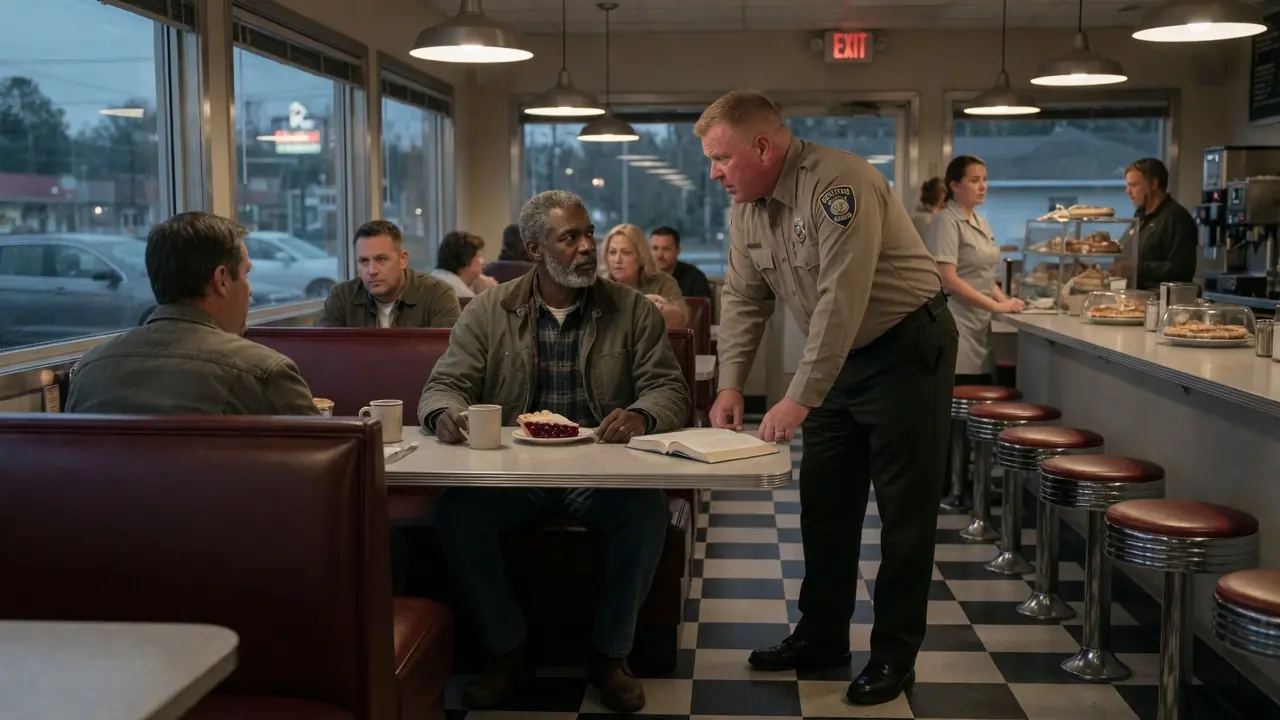
It triggered a cold, calculated rage.
He was just trying to eat a slice of cherry pie in a dusty roadside diner. But when two corrupt deputies decided he looked like trouble, they made the biggest mistake of their careers.
They thought they had a drifter in cuffs.
They did not know they were holding a ghost, a man with a clearance level higher than their sheriff’s pay grade.
And they certainly did not expect the one phone call that would freeze the entire county in its tracks.
The neon sign above Sal’s Stop & Go flickered with a dying buzz, casting an intermittent, sickly red glow over the wet asphalt of Route 66.
Inside, the air smelled of stale coffee, bacon grease, and floor wax. It was a sanctuary for the weary.
Right now, the only patron that mattered was the man sitting alone in booth four.
Zeke Washington did not look like a threat.
At fifty-two, his hair was dusted with the gray of hard years, close-cropped in a style he had not abandoned since discharge. He wore a faded Carhartt jacket that had seen better decades, flannel underneath, and work boots that were scuffed but meticulously laced.
To the casual observer in Oak Haven, he looked like a mechanic, or maybe a truck driver passing through on a long haul to nowhere.
He was not.
Zeke stared at the black coffee in his mug, watching the steam rise in curling ribbons. His hands, resting on the Formica table, were steady.
There was a small scar running from his left eyebrow to his temple, a souvenir from a shrapnel burst in Helmand Province.
But the people of Oak Haven did not know about Helmand.
They did not know about the Distinguished Service Cross tucked away in a drawer in D.C., or the consulting work Zeke now did for the Defense Intelligence Agency.
To them, he was just an outsider in a town that decided quickly who belonged and who did not.
“More coffee, hon?”
The waitress, a woman named Beverly with hair teased high enough to brush the doorframe, hovered over him with a pot. She had a kind face worn down by double shifts and cigarette breaks.
Zeke looked up and offered a soft, genuine smile.
“Please, ma’am. And if that cherry pie is still fresh, I’ll take a slice.”
“Fresh out of the oven, sugar,” Beverly said, pouring the dark liquid. “You’re not from around here, are you?”
“Just passing through,” Zeke said, his voice a low baritone. “Heading up to visit my daughter in Chicago. The radiator on my Ford started hissing about ten miles back. Figured I’d let it cool down and get some sugar in my system.”
“Well, you picked the right spot.”
Then Beverly lowered her voice, her eyes darting toward the front window.
“Don’t linger too long after dark. Sheriff’s boys, they get bored on weeknights. And when they get bored, they get mean.”
Zeke nodded slowly.
He knew the type.
Every small town had them. The high school bullies who peaked at eighteen and were handed a badge and a gun to validate their insecurities.
“I appreciate the warning, Beverly. I’ll eat and run.”
She scurried off to the kitchen, leaving Zeke to the silence.
He took a sip of the coffee. It was bitter, but hot.
He pulled a worn paperback book from his jacket pocket, intending to read a few chapters.
The peace lasted only minutes.
The bells above the front door jingled violently, announcing an entrance that was less about arriving and more about invading.
A gust of cold wind swept through the diner, killing the warmth.
Two uniformed officers stepped inside.
The first was a towering slab of meat named Sergeant Royce Dalton. He was thick in the waist, his uniform straining against a gut built on donuts and entitlement.
His buzz cut was severe. His eyes were hidden behind mirrored aviators, despite the fact that the sun had set.
He walked with a swagger that demanded space.
Trailing him was Officer Lane Carver.
Younger, leaner, with a nervous energy that made his hand hover constantly near his belt. He looked like the kind of kid who joined the force to impress a father who never loved him.
The diner went silent.
The couple in the corner booth stopped chewing.
The old man at the counter buried his face in his newspaper.
The air pressure in the room seemed to drop.
Zeke did not look up.
He turned the page of his book, his demeanor calm, almost bored.
“Coffee, Bev,” Dalton barked, sliding onto a stool at the counter without looking at her. “And tell Sal to put some fries on. I’m starving.”
“Coming right up, Royce.”
Beverly’s voice trembled slightly.
Dalton spun on his stool, his eyes scanning the room like a predator looking for a limping gazelle.
He passed over the old man.
Ignored the couple.
Then his gaze landed on booth four.
He paused.
Zeke felt the eyes on him. It was a sensation he had honed in the field, the feeling of being watched through a scope.
He took another sip of coffee, refusing to engage.
“Well, look at this,” Dalton said, his voice loud enough to carry to the back of the kitchen. “Since when do we have tourists stopping in Oak Haven on a weeknight?”
Carver chuckled, a nervous, tiny sound.
“Maybe he’s lost, Sarge.”
“You lost, pal?” Dalton called out.
Zeke slowly closed his book.
He placed it on the table and turned his head, meeting Dalton’s mirrored gaze with a neutral expression.
“Not lost, officer. Just hungry.”
Dalton stood up.
The leather of his gun belt creaked.
“Hungry?” Dalton repeated, stopping right at the edge of Zeke’s table.
He loomed over him, using his height as a weapon.
“That your black F-150 out front? The one with the D.C. plates?”
“It is,” Zeke said.
“Nice truck,” Dalton sneered. “Expensive truck. A lot of truck for a guy wearing, what is that, flannel?”
“It gets me from A to B,” Zeke said evenly.
“See, that’s the thing.”
Dalton leaned down, placing both hands on the table, invading Zeke’s personal space. His breath smelled of peppermint and stale tobacco.
“We’ve had some reports lately. Runners moving product up from the coast, using trucks just like that. D.C. plates are a favorite. Harder to track.”
Zeke did not blink.
“I’m a retired landscape architect, Sergeant. The only thing I’m running is a high cholesterol count.”
It was a lie, of course.
Zeke had never planted a rose bush in his life, but it was the cover story on his current civilian file.
“Landscape architect,” Dalton scoffed.
He looked back at Carver.
“You hear that, Lane? We got a gardener.”
“I hear him, Sarge.”
Dalton turned back to Zeke, the smile vanishing from his face.
“Stand up.”
Zeke paused.
“Is there a problem, officer?”
“I said stand up,” Dalton snapped, his hand dropping to rest near his belt. “I want to see some ID. Then I want to know why your truck is parked six inches over the white line.”
Zeke sighed.
He looked at the cherry pie Beverly had just set down on the counter, steaming and untouched.
He knew how this went.
He could quote the statutes. He could assert his Fourth Amendment rights. But right now, in this diner, the law was whatever Royce Dalton said it was.
“I’m reaching for my wallet,” Zeke narrated calmly, moving his hand slowly toward his back pocket.
“Easy,” Carver shouted, his hand flying to his holster. “Watch his hands, Sarge.”
Zeke froze.
He looked at the young officer and saw the panic in his eyes.
That was dangerous.
A bully like Dalton was predictable.
A scared kid like Carver was a trigger waiting to be pulled.
“My hands are plain to see,” Zeke said, his voice dropping an octave, taking on the command tone he had used to lead platoons. “I am going to slowly remove my wallet and place it on the table. Nobody needs to get excited.”
Dalton glared at him, annoyed that his attempt to provoke fear had failed.
“Do it slowly.”
Zeke pulled out the slim leather wallet and set it down.
Dalton snatched it up, flipping it open. He pulled out the driver’s license, squinting at it.
“Isaiah Washington. Washington, D.C. address. You a politician, Isaiah?”
“No.”
“You got a record?”
“No.”
Dalton tossed the license onto the table, but it slid off the edge and landed on the dirty floor.
He did not apologize.
He grinned.
“Pick it up.”
The diner was dead silent.
Beverly was clutching a dish rag to her chest, her eyes wide with fear.
Zeke looked at the license on the floor, then back at Dalton.
This was the test.
The humiliation ritual.
If he picked it up, he submitted.
If he refused, he escalated.
“I think you dropped that, Sergeant,” Zeke said softly.
Dalton’s face went red.
The vein in his neck pulsed.
“I gave you a lawful order. Pick it up.”
“I don’t see how that’s a lawful order related to a traffic investigation,” Zeke said. “But if it makes you feel like a big man, sure.”
Zeke bent down slowly.
As he did, Dalton kicked the license across the room under the counter.
“Oops,” Dalton laughed. “Clumsy me. Go get it.”
Zeke straightened up.
The air in the booth changed.
The tired gardener facade evaporated.
Zeke stood up, unfolding to his full height of six foot two. He was leaner than Dalton, but he held himself with a density, a coiled power that the sergeant lacked.
“I’m done eating,” Zeke said. “I’m going to pay my bill, and I’m going to leave.”
“You’re not going anywhere until I say you are.”
Dalton stepped into Zeke’s path, chest bumping him.
“We’re going to search that truck. I smell narcotics on you.”
“You smell cherry pie and Old Spice,” Zeke said. “You don’t have probable cause.”
“I have a K-9 unit coming that says I do,” Dalton hissed. “And until that dog gets here, you’re detained. Put your hands behind your back.”
The handcuffs ratcheted tight.
Too tight.
Sergeant Dalton made sure of that, wrenching Zeke’s arms up at an unnatural angle as he shoved him against the counter. The cold laminate bit into Zeke’s cheek.
“Stop resisting,” Dalton shouted for the benefit of the imaginary jury, though Zeke had not moved a muscle to fight back.
“I am compliant,” Zeke stated clearly, his voice muffled against the counter. “I’m not resisting. You are applying excessive force.”
“Shut up,” Carver barked, grabbing Zeke’s other arm. “He’s got a knife, Sarge. He’s got a clip on his pocket.”
Dalton ripped the object from Zeke’s pocket.
It was a Leatherman multi-tool, standard issue for anyone who worked with their hands.
But in Dalton’s narrative, it was a deadly weapon.
“Carrying a concealed weapon,” Dalton announced triumphantly. “Assaulting an officer. Resisting arrest. You’re looking at a long vacation in the county jail, Isaiah.”
They hauled him up and dragged him toward the door.
Zeke did not stumble.
He walked with dignity even as they shoved him.
As they passed Beverly, Zeke caught her eye.
She was crying.
“Put the pie on my tab, Beverly,” he said.
“Move.”
Dalton shoved him through the door and out into the biting wind.
They slammed him against the hood of the patrol car, the heat from the engine radiating through the metal.
The flashing blue and red lights painted the scene in a chaotic strobe.
“Empty his pockets,” Dalton ordered Carver. “Let’s see what Mr. D.C. is hiding.”
Carver patted him down with trembling hands.
He pulled out a phone, a sleek black smartphone with no brand markings on the case.
He pulled out a pack of gum.
He pulled out a folded piece of paper.
“Phone’s locked,” Carver said, tapping the screen. “Biometric.”
“Well, get a warrant for it,” Dalton said, spitting on the ground. “Or maybe he’ll unlock it for us if he wants to make things easier.”
He leaned into Zeke’s ear.
“What’s on the phone, Isaiah? Your supplier’s number? Something worse?”
Zeke turned his head, staring straight into the cruiser’s dash camera.
He wanted this recorded.
“That is a government-issued device,” Zeke said. “Accessing it is a federal felony.”
Dalton threw his head back and laughed, a harsh barking sound.
“Government-issued? Who do you work for? The post office? You think I’m scared of a mailman?”
“I’m asking you one time,” Zeke said, his voice cutting through Dalton’s laughter like a razor blade. “Let me make a call. One call. It will clear this whole thing up.”
“You get your phone call at the station,” Dalton sneered.
“If you take me to the station, Sergeant, you end your career. If you let me make a call now, you might just get away with a suspension.”
Dalton’s eyes narrowed.
He was a bully, but he possessed a rat’s cunning.
There was something in Zeke’s voice, a total lack of fear, that unnerved him. Most guys, even the tough ones, started bargaining or begging by now.
Zeke sounded like he was the one in charge.
“Give him the phone,” Dalton said suddenly.
Carver looked shocked.
“Sarge, procedure says—”
“I said give him the damn phone, Lane. Let’s see who his big bad friend is. Probably his parole officer.”
Dalton smirked.
“Speakerphone. I want to hear this.”
Carver held the phone up to Zeke’s face. Zeke leaned in.
The scanner flashed, and the phone unlocked.
Carver held it, his thumb hovering over the end-call button.
Zeke did not scroll through contacts. He did not look for “Mom” or “Lawyer.”
He opened a secure government application, authenticated it, and waited as the screen shifted to a restricted dialer.
He pressed a single emergency contact.
It rang once.
“This is Washington,” Zeke said. “Status code black. Location: Oak Haven, Alabama. I’m being detained by local law enforcement. Badge numbers?”
He glanced at the metal on Dalton’s chest.
“492. And him?”
He looked at Carver.
“510. Hostile extraction required. Authorize override.”
There was a pause on the other end.
Then a voice that sounded like gravel crunching under tires spoke.
It was not a secretary.
It was General Colton Sterling, vice chairman of the Joint Chiefs of Staff.
“Zeke, are you compromised?”
“Negative, physically. But I’m in cuffs, General. They’re seizing my device.”
“Put them on,” the general said.
The voice was so loud and commanding it distorted the tiny speaker.
Zeke looked at Dalton.
“He wants to talk to you.”
Dalton rolled his eyes.
“Who is this? Your friend from the post office?”
He leaned toward the phone Carver was holding.
“Listen here, whoever this is. This is Sergeant Royce Dalton of the Oak Haven Sheriff’s Department. Your boy here is in deep.”
“Sergeant Dalton,” the voice cut him off.
It was not a shout.
It was the terrifying calm of a man who commanded more power than Dalton could imagine.
“This is General Colton Sterling, United States Marine Corps. You are currently holding a Tier One asset of the United States government. If you do not remove those handcuffs immediately, I will have federal marshals at your location. And if they have to come get him, they will not be knocking.”
Dalton froze.
He blinked.
“General who?”
“Sterling. Look it up. You have a computer in that car, don’t you, son? Search the name. I’ll wait.”
Dalton looked at Zeke.
He looked at the phone.
A bead of sweat trickled down his temple, cutting through the grease on his face.
He snatched the phone from Carver.
“Hold on,” Dalton muttered.
He leaned into the cruiser, typing furiously on the laptop mounted to the dash.
The screen loaded.
The first image was a man in a dress uniform, chest heavy with ribbons, shaking hands with the president.
The face on the screen belonged to the same voice on the phone.
Dalton’s stomach dropped through the floor.
He looked back at Zeke.
Zeke was just watching him, an eyebrow slightly raised.
“You know this guy?” Dalton stammered into the phone.
“Know him?” Sterling’s voice crackled. “I served with him. Now, Sergeant, I am tracking your GPS. I see you are on Route 66. I am going to stay on this line. You are going to unlock Mr. Washington. You are going to return his property, and then you are going to stand at attention until I tell you to breathe. Do you copy?”
Dalton’s hand shook.
He looked at Carver, whose face had gone sheet white.
“Key,” Dalton croaked. “Lane. Give me the key.”
“Sarge—”
“The key now,” Dalton screamed, his voice cracking.
Carver fumbled for his keys, dropping them on the asphalt.
He scrambled to pick them up.
Dalton grabbed Zeke’s arm, much gentler this time, and spun him around. He jammed the key into the cuffs.
The metal clicked open.
Zeke rubbed his wrists, grimacing as the circulation returned.
“Phone,” Zeke said, holding out his hand.
Dalton placed the phone in Zeke’s palm like it was made of nitroglycerin.
Zeke put the phone to his ear.
“I’m loose, General.”
“Good,” Sterling said. “Don’t hang up, Zeke. I’m patching in the governor of Alabama. Apparently, he needs to have a chat with the sheriff of Oak Haven about who he’s hiring.”
Zeke looked at Dalton.
The sergeant was no longer the apex predator. He was a deflated balloon staring at the ground, realizing that the gardener he had just harassed had the governor on speed dial.
“Sergeant Dalton,” Zeke said, his voice dangerously low. “The general says you can breathe now.”
But the nightmare for Royce Dalton was just beginning.
Because in the distance, over the hum of the highway, a new sound was emerging.
The deep, rhythmic thumping of rotors.
Unmarked helicopters.
The sound was not just a noise.
It was a physical pressure.
The rhythmic thup-thup-thup of rotor blades beat against the chest, vibrating the glass of the diner windows until the neon open sign rattled against the pane.
Sergeant Royce Dalton looked up, his mouth slightly open, the color draining from his face until he looked like wet dough.
“What is that?” Officer Carver shouted over the roar, clutching his hat to his head as the wind picked up, swirling grit and dead leaves into a mini cyclone around the patrol car.
Zeke did not look up.
He adjusted his cuffs, smoothing the flannel over his wrists where the metal had dug in.
He looked at Dalton with a calm that was far more terrifying than any threat.
“That, Sergeant, is what happens when you detain a man whose schedule is classified.”
A spotlight, blindingly white and brighter than the sun, cut through the darkness from above. It pinned Dalton and Carver against their cruiser like insects under a magnifying glass.
A voice boomed from above, drowning out the highway traffic.
“All personnel on the ground will holster their weapons and step away from the civilian. Repeat, step away from the asset.”
Dalton’s hand twitched toward his belt.
Pure muscle memory.
“Don’t,” Zeke said, his voice cutting through the din. “If you touch that gun, you won’t live to see your pension.”
Dalton froze.
He slowly raised his hands, palms open, and stepped back.
Carver was already cowering near the trunk, looking like he wanted to crawl inside the wheel well.
From the darkness above, a sleek unmarked helicopter descended. It did not land. It did not need to.
It hovered above the asphalt of the parking lot, kicking up a storm of dust that coated Dalton’s freshly polished boots.
Two operators sat on the external benches of the helicopter.
They were not wearing police uniforms.
They wore tactical gray with night-vision equipment flipped up on their helmets, and their weapons rested easily across their chests.
They did not look like cops.
They looked like reapers.
One of the operators hopped down and walked through the wind toward Zeke, ignoring Dalton entirely.
The operator stopped in front of Zeke and snapped a crisp salute.
“Colonel Washington. Secure.”
Zeke returned the salute, a sharp, precise motion that shed the tired old man persona instantly.
“Secure, Lieutenant. Though my dinner was interrupted.”
“Apologies, sir. General Sterling has the DOJ on the line. He wants to know if you require immediate extraction or if you want to play this out.”
Zeke looked at Dalton.
The bully sergeant was trembling.
The arrogance was gone, replaced by the primal fear of a small animal realizing it had walked into a lion’s den.
“I’m not going anywhere,” Zeke said, his eyes locking onto Dalton’s mirrored sunglasses. “We’re going to wait right here. The sheriff is on his way, isn’t he, Sergeant?”
Dalton nodded mutely.
“Good,” Zeke said. “I’d hate for him to miss the show.”
The operator nodded and spoke into his headset.
“Asset is secure. Holding position. Ground unit ETA two minutes.”
The helicopter pulled up and away, circling overhead like a vulture, its spotlight never leaving the two deputies.
Inside the diner, the patrons were pressed against the glass.
Beverly was filming on her phone, her hand shaking.
She had seen Royce Dalton terrorize drifters, teenagers, and single mothers for years.
She had never seen him look small.
“You’re a colonel?” Dalton stammered, his voice barely audible.
“Retired,” Zeke corrected. “But the clearance doesn’t retire.”
He stepped closer.
“You see, Sergeant, you made an assumption. You saw a man in a truck and assumed trouble. You didn’t bother to run the plates properly. If you had, you would have seen a federal block on the registration. That means do not detain without authorization.”
“I— The system was down.”
Dalton lied, desperation creeping in.
“The system works fine,” Zeke said. “Your judgment is what’s broken.”
Suddenly, sirens wailed from the north.
Three SUVs tore into the parking lot, drifting sideways and blocking the exit.
But these were not sheriff’s deputies.
They were black Tahoes with government plates.
Doors flew open.
Men in suits, sharp, tailored, and very serious, spilled out.
Leading them was a woman with a stride that could crack pavement. She held a briefcase in one hand and a badge on a lanyard in the other.
She walked straight past Dalton, brushing his shoulder hard enough to spin him around, and stopped in front of Zeke.
“Mr. Washington,” she said, offering a hand. “I’m Special Agent Nora Jenkins, FBI Civil Rights Division. General Sterling briefed me. Are you injured?”
“Just my pride, Agent. And my wrists are a little sore.”
Jenkins turned slowly to face Dalton.
Her expression was pure, unadulterated disgust.
“Sergeant Dalton?”
“Yeah.”
Dalton tried to puff his chest out, trying to find some scrap of his authority.
“Who are you?”
“I’m the person who is going to ruin your life,” Jenkins said calmly. “I need your badge, your gun, and your keys. Now.”
“You can’t do that,” Dalton shouted, pointing a finger at her. “This is Oak Haven. I answer to Sheriff Maddox. You feds think you can just waltz in here?”
“Royce!”
The shout came from a new vehicle screeching into the lot, a white sheriff’s cruiser emblazoned with sheriff in gold letters.
The door swung open, and a man the size of a vending machine climbed out.
Sheriff Vance “Bull” Maddox had arrived.
He adjusted his Stetson hat, hitched up his gun belt, and marched toward the group. He had a face like a bulldog chewing a wasp, and right now he was furious.
“What in the hell is going on in my town?” Maddox bellowed. “Royce, why is there a chopper buzzing my diner? And who are these people?”
Dalton looked at his boss like a drowning man seeing a life raft.
“Sheriff, thank God. This guy—”
He pointed at Zeke.
“He resisted arrest, and now these feds are interfering with a local investigation.”
Maddox glared at Agent Jenkins.
“Now you listen here, little lady. I don’t care what alphabet agency you work for. You are in Oak Haven County. That man is a suspect in a narcotics investigation. I’m taking him into custody, and if you interfere, I’ll arrest you for obstruction.”
Zeke watched, a small smile playing on his lips.
This was the moment.
The trap was not just for Dalton.
It was for the whole rotten machine.
“Sheriff Maddox?” Zeke said, stepping forward.
Maddox sneered at him.
“Shut your mouth. I’ll deal with you in a minute.”
Zeke did not flinch.
He just nodded to Agent Jenkins.
“Agent, I think he just made your case easier.”
“I think you’re right, Colonel,” Jenkins said.
She reached into her jacket.
“You’re not arresting anyone,” Maddox snarled, his hand resting on his pistol.
The silence that followed was deafening.
The tactical operators in the shadows raised their weapons into ready positions.
The FBI agents reached for their waistbands.
“Sheriff,” Agent Jenkins said, her voice dropping to a deadly whisper, “look at the roof of the diner.”
Maddox frowned and looked up.
Perched on the edge of the roof, silhouetted against the moon, was an overwatch operator.
A small red point rested silently on the gold star pinned to Maddox’s chest.
“We have a federal warrant for the seizure of all files, body-camera footage, and electronic devices associated with the Oak Haven Sheriff’s Department,” Jenkins announced, holding up a paper signed by a federal judge. “We’ve been watching your department for months, Maddox. We just needed a trigger. Tonight, you pulled it.”
Maddox’s face went purple.
“This is entrapment.”
“No,” Zeke said, stepping closer until he was nose-to-nose with the sheriff. “This is consequences.”
The diner parking lot had transformed into a command post.
The flashing blue lights of the local police were now drowned out by federal strobes and the harsh glare of tactical floodlights.
Sheriff Maddox stood frozen, the red point still fixed on his chest.
The bluster, the good-old-boy intimidation, the decades of unchecked power, it all evaporated in the face of a force he could not bully.
“You’re making a mistake,” Maddox grunted, though his voice lacked conviction. “I know the governor.”
“The governor is currently on a conference call with the attorney general explaining why he should not be indicted as a co-conspirator for ignoring the complaints against your office,” Agent Jenkins said, checking her watch. “I wouldn’t count on him answering your calls tonight.”
She snapped her fingers.
“Disarm them. All of them.”
Dalton looked down at his belt.
Being disarmed was the ultimate humiliation for a man like him.
His gun was his identity.
Without it, he was just a bully with high blood pressure.
“Lane,” Dalton whispered to Carver. “Don’t give it up.”
Carver, however, had reached his breaking point.
He looked at the rooftop, then at the grim-faced FBI agents.
He slowly unbuckled his belt.
“I’m sorry, Sarge,” Carver said, his voice cracking. “I just wanted a job. I didn’t want this.”
He handed his belt to an agent.
“Traitor,” Dalton hissed.
An agent approached Dalton.
“Sir. The weapon.”
Dalton hesitated.
For a split second, Zeke saw the madness in Dalton’s eyes, the urge to draw, to go out in a blaze of stupid glory.
But Dalton was a coward at heart.
He slumped, unholstered his weapon with two fingers, and dropped it into the evidence bag.
“Badge, too,” the agent said.
Dalton unpinned the silver shield.
His hands shook so badly he pricked his finger. A drop of blood smeared on the metal as he handed it over.
“And you, Sheriff,” Jenkins said.
Maddox stared at Zeke.
“You set us up? You came here looking for this?”
“I came here for pie,” Zeke said simply. “But I carry my eyes open. I saw how you looked at the couple in the corner. I saw how your deputy treated the waitress. I saw a town held hostage by the people paid to protect it.”
“You’re a nobody,” Maddox spat, handing over his gun. “A washed-up soldier playing hero.”
“I’m a citizen,” Zeke replied. “And that should have been enough.”
“Agent Jenkins,” a voice called out from one of the SUVs.
A tech specialist waved a laptop.
“We accessed the cruiser’s dashcam cloud storage. You’re going to want to see this.”
Jenkins walked over, motioning for Zeke to follow.
Maddox and Dalton were corralled by agents, forced to watch.
The laptop screen glowed.
It showed the footage from minutes ago.
It showed Dalton mocking Zeke.
It showed the license plate clearly visible.
“Audio’s crisp,” the tech said.
He hit a key.
Dalton’s recorded voice sneered from the speakers.
“Who do you work for? The post office?”
Then another clip played.
“We’re going to search that truck. I smell narcotics on you.”
Jenkins paused the video.
“Probable cause based on smell in a windy parking lot before he even approached the vehicle.”
“There’s more,” the tech said. “We recovered the deleted files from the last few months. It looks like Sergeant Dalton has a habit of smelling narcotics on out-of-state drivers, confiscating cash under civil forfeiture laws, and then losing the paperwork.”
Jenkins turned to Maddox.
“Civil forfeiture fraud. Wire fraud. Deprivation of rights. Unlawful detention.”
She smiled.
A cold, predatory smile.
“Sheriff, we’re going to need a bigger van.”
Maddox turned on Dalton.
“You idiot. I told you to keep the audio off on the stops.”
“You told me to get the cash,” Dalton screamed back, his loyalty vanishing instantly. “You said you needed ten grand for the reelection fund. I was just doing what you said.”
“Shut up,” Maddox roared, lunging at Dalton.
Two FBI agents tackled Maddox before he could reach his deputy.
They slammed him onto the hood of his own car, the same way Dalton had slammed Zeke earlier.
The irony was heavy in the air.
Royce Dalton.
Vance Maddox.
Jenkins recited the Miranda rights, her voice bored, like she was reading a grocery list.
“You have the right to remain silent.”
Zeke turned away from the spectacle.
He walked back toward the diner entrance.
The wind had died down, leaving a heavy silence in its wake.
He pushed the door open.
The bell jingled.
The diner was quiet.
Every eye was on him.
The fear that had been in the room earlier was gone, replaced by awe.
Zeke walked to the counter.
Beverly was standing there, the pot of coffee still in her hand.
Stone cold now.
“I believe,” Zeke said gently, “I ordered a slice of cherry pie.”
Beverly blinked.
Tears welled up in her eyes again.
She laughed, a nervous, relieved sound.
“You sure did, sugar. You sure did.”
She reached for a plate, her hands shaking.
“I can’t believe you did that. Nobody stands up to Maddox. Nobody.”
“Bullies are like paper tigers, Beverly,” Zeke said, sitting down on a stool. “They look scary until you strike a match.”
“Is it true?” she asked, sliding the pie across the counter. “Are you really a spy?”
Zeke took a forkful of the pie.
It was sweet, tart, and perfect.
“I’m just a guy who hates bad service.”
Outside, the sound of handcuffs clicking shut echoed through the night.
But Zeke was focused on his pie.
He knew the work was not done.
The arrest was just the beginning.
The trial.
The media circus.
The cleanup that would take months.
Then the door opened again.
It was not a cop.
It was a man in a bespoke navy suit carrying a leather briefcase. He looked out of place in a diner, more suited for a Senate hearing.
He scanned the room, spotted Zeke, and walked over.
“Colonel Washington,” the man said.
Zeke did not look up.
“Mr. Calloway. I assume the Pentagon sent you.”
“White House counsel, actually,” Calloway said, sitting on the stool next to Zeke. “The president saw the preliminary report. He’s not happy about a Medal of Honor nominee being handcuffed in a parking lot.”
Zeke paused, his fork hovering.
“I told them to withdraw that nomination. I don’t want the attention.”
“Well,” Calloway said, glancing outside where Maddox was being shoved into the back of a Tahoe, “I think it’s a little late for that. You just became the face of a national cleanup operation, Zeke. We need you to do one more thing.”
“I just want to eat my pie.”
“We need you to testify,” Calloway said. “Not just against Dalton and Maddox, but against the judge who signed their warrants, the district attorney who buried the complaints. We’re taking the whole county down, and we need a star witness.”
Zeke looked at Beverly.
She was watching him, hope written all over her face.
He looked at the old man in the corner, who gave him a slow, respectful nod.
Zeke put his fork down.
The quiet life he wanted, the gardening, the road trips, was fading away.
But he had sworn an oath.
Foreign and domestic.
“One condition,” Zeke said.
“Name it,” Calloway replied.
“This diner.”
Zeke tapped the counter.
“It gets protected status. No harassment. No surprise health inspections from friends of the sheriff. And you fix Beverly’s roof. It leaks when it rains.”
Calloway smiled.
“Done. I’ll have a crew here tomorrow.”
Zeke nodded and took another bite of pie.
“Then sign me up.”
The weeks following the arrest at Sal’s Stop & Go were not quiet.
They were a different kind of war.
If the parking lot had been a kinetic engagement, the legal aftermath was asymmetric warfare.
Oak Haven was not just a town with a few bad apples.
It was a rotting orchard, and the roots ran deep into the county courthouse.
Quentin McKee was the kind of lawyer who chased ambulances, but only if he was driving the car that hit them.
He was Sheriff Maddox’s brother-in-law, a man with a smile like a cracked windshield and a suit that cost more than Beverly made in a year.
He sat in the interrogation room of the county jail, staring at Royce Dalton.
“Royce, you need to listen to me,” McKee hissed, tapping a gold pen on the metal table. “The feds have the video. They have the audio. They have the text messages where Maddox told you to shake the trees for cash. But we can still win this.”
Dalton looked like a ghost.
Prison orange did not suit his complexion.
“They have me dead to rights, Quentin. That guy, Washington, he’s a ghost.”
“He’s a man,” McKee spat, “and every man has a skeleton in his closet. We’re going to dig up Isaiah Washington’s past. We’re going to paint him as an unstable veteran with a history of insubordination. We’ll say you felt threatened. We’ll say his compliance was actually a pre-assault indicator. We’ll make the jury scared of him, not you.”
McKee’s strategy was brutal and classic.
Destroy the victim’s character.
He leaked stories to the local press.
Mysterious stranger agitates local law enforcement.
Was the veteran really a threat?
The town was divided.
The old power network rallied.
Pickup trucks started sporting Free Maddox bumper stickers.
Then the intimidation started.
It began weeks after the incident.
Beverly found her tires slashed in the diner parking lot. A note was tucked under her windshield wiper.
Keep your mouth shut at the trial.
She called Zeke.
Zeke was staying at a motel two towns over, preparing for the deposition.
He arrived at the diner in minutes.
He looked at the slashed tires, then at the trembling waitress.
“I can’t do this, Zeke,” Beverly sobbed. “I have two kids. If they come for me—”
Zeke placed a hand on her shoulder.
It was heavy, reassuring.
“They aren’t coming for you, Beverly. They’re lashing out because they’re drowning. It’s the death throes of a predator that knows it’s been caught.”
“But my car.”
“I’ll handle the car,” Zeke said. “And I’ll handle the security.”
That night, Quentin McKee was sitting in his home office pouring a scotch, congratulating himself on the fear he was spreading.
His phone rang.
Unknown number.
“McKee.”
He answered.
“Mr. McKee,” a digitally altered voice spoke. “This is a courtesy call.”
“Who is this?” McKee demanded, sitting up straighter.
“You have a safe in your office behind the painting of the hunting dogs. The combination is familiar to us.”
McKee froze.
The blood drained from his face.
“How? Who are you?”
“Inside that safe,” the voice continued, “is a ledger. A handwritten ledger detailing the kickbacks you’ve received from the sheriff’s seizures over the last ten years. You also have a burner phone taped to the underside of your desk drawer.”
McKee scrambled to his desk, feeling underneath.
His fingers brushed plastic.
He ripped the phone off the tape, staring at it in horror.
“We have the audio from that room, Quentin,” the voice said. “We heard you tell Dalton to lie on the stand. That’s subornation of perjury. That’s a felony. And since you discussed it with a federal detainee, it is also a federal problem.”
“What do you want?” McKee whispered, his throat dry.
“We want you to step down as counsel,” the voice said. “And we want you to turn that ledger over to the FBI by tomorrow morning. If you don’t, the IRS will be auditing you back to your first paper route. And Quentin, we know about the offshore account.”
The line went dead.
Zeke sat in his motel room, placing the phone on the nightstand.
He was not technically allowed to use national surveillance assets for personal vendettas, but General Colton Sterling had been very clear.
“Zeke, if they threaten the witnesses, you take the gloves off. I’ll sign the paperwork later.”
The next morning, Quentin McKee walked into the FBI field office, pale and shaking, carrying a heavy ledger.
He did not just resign.
He flipped.
He offered up Maddox, Dalton, the district attorney, and two judges in exchange for immunity.
The snake pit was collapsing on itself.
The trial of United States versus Royce Dalton and Sheriff Vance Maddox was moved to the federal courthouse in Birmingham to avoid jury tampering.
The courtroom was packed.
National media had descended.
The headline was irresistible.
The veteran versus the sheriff.
But despite McKee’s defection, Dalton refused to plead guilty.
He was convinced that a jury of law-and-order citizens would never convict a cop for being tough on crime.
He had a new lawyer, a public defender who looked like he had not slept in a week.
The prosecution was led by a relentless assistant U.S. attorney named Sarah Wallace.
She called her first witness.
Officer Lane Carver.
Carver looked young and small in the witness chair.
He refused to look at Dalton.
“Officer Carver,” Wallace asked, “did Mr. Washington provoke the encounter?”
“No, ma’am,” Carver said quietly.
“Did Sergeant Dalton explicitly state his intention to find a reason to arrest Mr. Washington before approaching the vehicle?”
“Objection,” Dalton’s lawyer shouted. “Hearsay.”
“It’s not hearsay if he was part of the conspiracy,” the judge ruled. “Overruled. Answer the question.”
Carver took a deep breath.
“Yes. Sergeant Dalton said he didn’t like the way the suspect looked. He said he wanted to teach him a lesson about whose town this is.”
A murmur went through the gallery.
Dalton glared at Carver, mouthing the word traitor.
Then it was Dalton’s turn.
He took the stand with a swagger that felt forced.
He lied smoothly at first.
He talked about officer safety, about furtive movements, about the stress of the job.
“I felt my life was in danger,” Dalton told the jury, squeezing out a fake tear. “He reached for his pocket. I didn’t know it was a multi-tool. In that split second, I had to make a choice.”
“So you were scared?” Wallace asked on cross-examination. “Terrified?”
“Yes.”
“And that fear justified you falsifying the police report?”
“I didn’t falsify anything. I wrote what I saw.”
“Interesting,” Wallace said. “Because we have a new piece of evidence, Sergeant. One that wasn’t on the dashcam.”
She turned to the judge.
“Your Honor, the prosecution would like to introduce Exhibit G. This is audio recovered from the internal microphone of the defendant’s own body camera. The camera he claimed was malfunctioning and turned off.”
Dalton’s eyes went wide.
“I turned it off.”
“You switched the video feed off,” Wallace corrected. “But the Model X2 body camera has a fail-safe audio recording feature that continues briefly after deactivation to prevent evidence tampering. It seems you didn’t read the manual.”
She played the tape.
The courtroom went silent.
There was a click.
The sound of the camera being switched off.
Dalton’s voice filled the courtroom.
“Stupid piece of junk. All right, it’s off.”
Carver’s voice came next.
“Sarge, maybe we should just let him go. He hasn’t done anything.”
Dalton’s voice answered.
“Shut up, Lane. I don’t care if he’s innocent. I need that truck impounded. If we find cash, we keep it. If we don’t, we make sure the report gives us what we need.”
Carver again.
“Sarge, that’s crazy.”
Dalton answered.
“That’s police work. Now get the cuffs.”
The audio ended.
The silence in the courtroom was absolute.
You could hear the hum of the air conditioning.
The jury stared at Dalton with open revulsion.
Dalton slumped in his chair, his face gray.
He looked at his lawyer, who was busy organizing his notes, clearly realizing the case was unwinnable.
“I was joking,” Dalton whispered weakly. “Locker room talk.”
“You were on duty,” Wallace said, her voice like ice. “Planning to frame a decorated war hero. No further questions.”
But the final nail in the coffin was not the audio.
It was the victim.
Zeke took the stand last.
He wore a simple suit, not his uniform.
He did not need the medals to command respect.
“Mr. Washington,” Wallace asked, “why didn’t you fight back? You are a trained combat operative. You could have disarmed Sergeant Dalton.”
Zeke looked at the jury.
He looked at the families in the back of the room.
“Because,” Zeke said, his voice deep and resonant, “if I had fought back, I would have become the story they wanted to tell. I would have been dead, and the report would have said I attacked a police officer. I had to let him take my freedom so that I could take his power.”
He paused, looking directly at Dalton.
“I fought for this country. I fought for the Constitution. And that Constitution protects everyone, even from men with badges who think they are gods. I didn’t fight back with my fists. I fought back with the truth.”
He let the words settle.
“And the truth is the only weapon that never jams.”
The jury deliberated quickly.
The verdict was read on a rainy day, much like the night everything started.
Guilty.
Royce Dalton was found guilty on fourteen counts, including deprivation of rights under color of law, conspiracy, and perjury.
Sheriff Vance Maddox was found guilty on twenty-two counts, including racketeering, wire fraud, and money laundering.
The judge, a no-nonsense woman named Judge Sterling, no relation to the general, though the irony was noted, threw the book at them.
“You have disgraced your uniform,” she told Dalton during sentencing. “You have betrayed the public trust.”
Dalton was sentenced to twenty-five years in federal prison.
He screamed as the marshals dragged him away.
Maddox took his sentence, thirty years, in sullen silence, knowing he would likely die behind bars.
But Zeke was not done.
The hard karma was not just for the men in the diner.
Using the evidence from McKee’s ledger and the seized computers, the Department of Justice launched Operation Clean Sweep.
The district attorney was indicted for accepting bribes to drop charges against wealthy donors’ children.
He was disbarred and sentenced to ten years.
The tow truck company owner who split the impound fees with Maddox lost his business and his home to asset forfeiture.
The local judge who signed the fake warrants was forced into early retirement and stripped of his pension.
Oak Haven was gutted.
The sheriff’s department was disbanded entirely, temporarily replaced by state troopers until a new vetted force could be hired.
Months later, Zeke returned to Sal’s Stop & Go.
The old sign was gone.
Beverly was now the manager, thanks to a mysterious angel investor who had bought the place from Sal and given her a controlling stake.
The roof was fixed.
The coffee was fresh.
Zeke sat in booth four.
It was sunny this time.
Beverly walked over, placing a slice of cherry pie in front of him before he even ordered.
She looked younger, lighter.
The fear was gone from her eyes.
“On the house,” she said, smiling. “For the man who saved the town.”
“I didn’t save the town, Bev,” Zeke said, picking up his fork. “I just took out the trash.”
He ate his pie in peace.
No sirens.
No bullies.
Just the sound of the highway and the murmur of happy customers.
When he walked out to his truck, he saw a new police cruiser parked near the entrance.
A young trooper was standing there, adjusting his hat.
He saw Zeke and stiffened.
Zeke stopped.
He waited for the harassment.
He waited for the suspicious-person check.
The trooper walked over, extended his hand, and said, “Colonel Washington, it’s an honor, sir. If you need an escort to the county line, just let us know.”
Zeke shook the hand.
“I’m good, Trooper. Just keep your eyes open and treat the lady inside with respect.”
“Yes, sir.”
Zeke climbed into his F-150.
He started the engine, the rumble familiar and grounding.
He checked his phone.
A message from General Colton Sterling.
Mission accomplished, Zeke. Take a vacation. We have a situation in Berlin next month, but for now, enjoy the pie.
Zeke smiled, tossing the phone onto the passenger seat.
He put the truck in gear and pulled out onto Route 66, heading north.
The road was open.
The rearview mirror was clear.
He was not a ghost anymore.
He was just a man driving a truck.
But in Oak Haven, the legend of the quiet veteran who took down an empire with a single phone call would be told for generations.
Karma had not just hit back.
It had struck with precision, leaving nothing but the truth in its wake.
Royce Dalton thought he was the predator.
But he picked a fight with the apex of the food chain.
True strength is not about being the loudest voice in the room or having the biggest gun.
It is about knowing exactly who you are and standing your ground when the world tries to move you.
Justice was served cold, with a side of cherry pie.