The burlap sack over Mercy Caldwell’s head smelled of grain, dust, and damp rope.
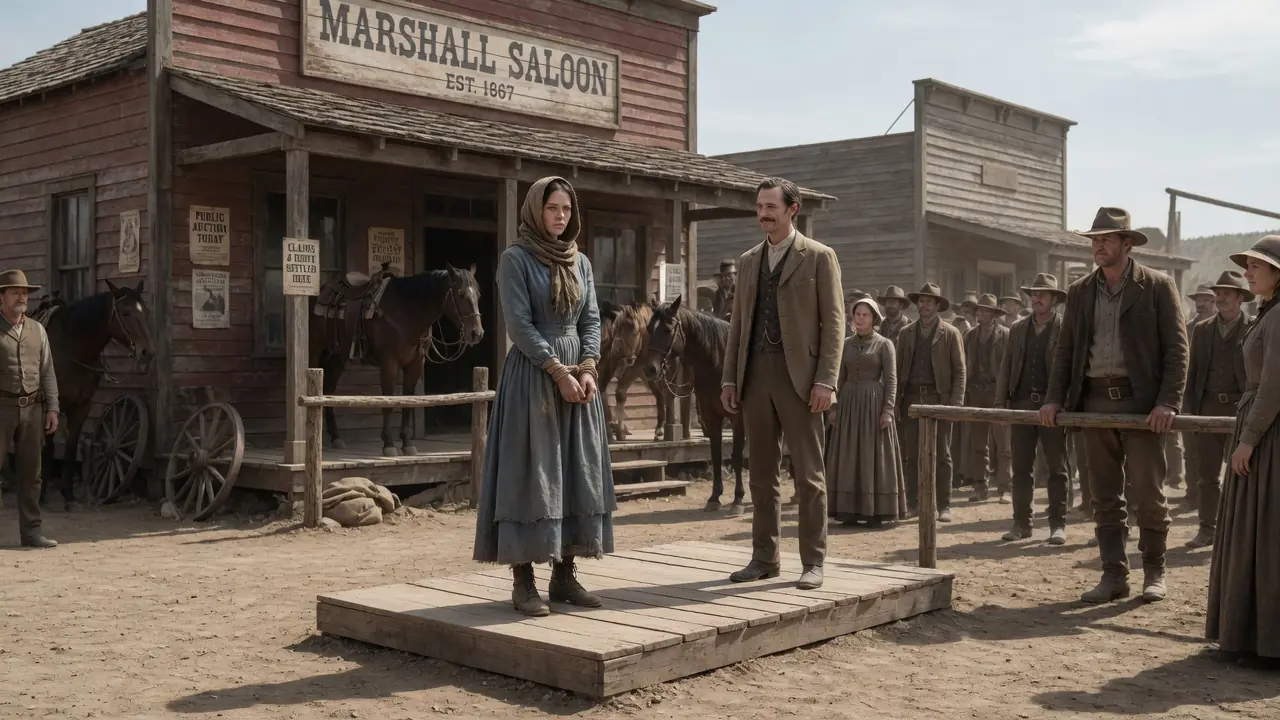
She stood on a narrow wooden platform inside the Red Lantern Saloon in Bitter Creek, Wyoming Territory, with her wrists tied in front of her and her heart beating so hard she could hear it over the room.
Men crowded around the tables. Boots scraped. Glasses clinked. Someone laughed too loudly near the piano, then stopped when the auctioneer raised his hand.
Mercy could not see their faces, but she could feel their eyes.
That was the worst part.
She had already been hungry. She had already been afraid. She had already watched Silas Keene take her mother’s sewing table, her father’s mule, and the little house where her sister still slept under a quilt their grandmother had made.
But this was different.
This was meant to erase her.
Silas Keene stood somewhere to her left. She knew because she could smell the bay rum he wore and hear the soft scrape of his cane against the floor. He was a creditor by trade and a gentleman by costume, the kind of man who smiled with polished teeth while taking the last blanket off a widow’s bed.
“This is not cruelty,” Silas had told the room before the sack went over Mercy’s head. “This is settlement of a lawful debt.”
Nobody argued.
In Bitter Creek, people argued over fences, poker hands, whiskey prices, and stray cattle. They did not argue with Silas Keene. He owned notes on half the town and secrets on the rest.
The auctioneer cleared his throat.
“We begin at one dollar.”
A few men chuckled.
Mercy pressed her bound hands together. She had decided she would not shake. Fear was all they had left her, and even that she refused to hand over willingly.
“One dollar,” the auctioneer repeated. “For the labor contract of Miss Mercy Caldwell, transferred under debt settlement witnessed by Justice Abel Prout.”
A chair creaked. Someone coughed.
“One dollar,” a drunk voice called from the back, not because he wanted her, but because he wanted the room to laugh.
The room did.
Mercy closed her eyes beneath the sack.
The auctioneer pushed higher.
“Two dollars.”
Silence.
“Three?”
No one answered.
The silence grew thick and ugly. Mercy understood then that the sale itself was not the sport. Her humiliation was. The waiting was what they enjoyed, the slow stretch of her standing there as if she were worth less than a saddle blanket.
Then a voice came from the back of the saloon.
“Six dollars.”
It was not loud. It did not shake. It cut through the room cleanly, like a blade through rope.
Every boot, chair, and breath seemed to turn.
Mercy could not see the man, but she heard him walk forward. His steps were steady. Unhurried. The kind of steps made by someone who had already decided what he was going to do before he entered the room.
The auctioneer hesitated.
Silas Keene’s cane tapped once.
“Six dollars,” the voice repeated. “Paid now.”
Coins struck the bar.
The auctioneer looked toward Silas.
Mercy waited for Silas to object. He liked control too much to enjoy being surprised. But the room had heard the bid, and the money had been laid down. Keene had made a public ceremony of legality. Now he was trapped inside it.
“Sold,” the auctioneer muttered.
The stranger climbed onto the platform.
Mercy held herself still as his hands reached for the rope around her wrists. He did not grab. He did not linger. He worked the knot loose with rough fingers, then stepped back half a pace.
He did not remove the sack.
Instead, he said quietly, “Come with me.”
But she walked.
The room watched them leave. Nobody spoke. The stranger’s hand hovered near her elbow without taking hold unless she stumbled. He guided her through the saloon doors and down the steps into the evening air.
Only when the noise of the Red Lantern fell behind them did he remove the sack.
Mercy blinked into the last pale light of sunset.
The man standing in front of her was perhaps forty, lean and sun-browned, with tired gray eyes and a face that looked more used to weather than conversation. His coat was plain. His hat was dusty. His beard was trimmed short, but not carefully. There was no hunger in his gaze. No amusement. No claim.
He looked at her the way a person looks at another person.
“My name is Caleb Rusk,” he said. “My wagon is across the street.”
Mercy studied him, still breathing too fast.
“What happens now?”
He glanced at the saloon behind her.
“Now we get you away from here.”
“And after that?”
“After that, you decide what you want to say. Or not say.”
Mercy waited for the bargain, the condition, the hidden hook.
None came.
Caleb turned and crossed the street toward a weathered wagon hitched to a brown mare. Mercy followed because she had nowhere else to go and because, for the first time that day, no one was laughing.
The wagon rolled out of Bitter Creek under a wide violet sky.
Mercy sat beside Caleb with her hands in her lap, the marks from the rope still red around her wrists. The town disappeared behind them. The saloon lights became small and then vanished. The trail ahead stretched through open grass toward low hills, where the wind moved in waves across the land.
Caleb did not ask her questions.
That unsettled Mercy more than if he had.
Men always asked questions. They asked where she was going, what she owed, who owned the house, why her sister was not married, why her mother had signed a note she could not read properly, why Mercy thought she had the right to refuse anything when debt had already done the answering.
Caleb asked nothing.
He drove with one hand on the reins and the other resting loosely on his knee. Once, when the wagon wheel hit a rut and Mercy reached for the seat edge, he slowed the mare without looking at her.
His ranch sat two miles beyond the creek, tucked near a line of cottonwoods. It was not large, but it was solid. A small cabin. A barn with repaired doors. A smokehouse. A fenced garden. A well with a clean bucket and a rope in good condition.
Mercy noticed the rope first.
Not frayed. Not careless.
Caleb stopped the wagon, climbed down, and tied the mare.
Then he opened the cabin door and stepped aside.
Mercy remained outside.
He looked back.
“You can sleep in the room at the rear. It has a door that closes from the inside.”
That was the first thing he said about the room.
Not that it was his. Not that she should be grateful. Not that he had paid for her.
Only that the door closed from the inside.
Mercy walked in.
The cabin smelled of pine smoke, coffee, and leather. It was spare but clean. The rear room held a narrow bed, a chair, a washstand, and a window facing the cottonwoods. On the bed was a folded quilt.
Caleb set her small satchel near the door.
“I will leave food outside,” he said. “You do not have to come out tonight.”
Then he closed the door and left her alone.
Mercy stood in the middle of the room until her knees gave way and she sat on the bed.
She did not cry.
Not then.
She took off her boots, lay down fully dressed, and stared at the door. For a long time, she expected footsteps. A knock. A demand. A reminder of what six dollars had purchased.
None came.
Later, she heard something soft outside the door.
In the morning, she found a plate on the floor. Biscuits, beans, and a tin cup of water.
He had not knocked.
He had not waited to be thanked.
He had simply left it there.
Mercy stared at the food for a long time before picking it up.
That first week passed in silence.
Caleb left before sunrise and worked until dusk. Mercy heard him moving outside: chopping wood, mending fence, speaking softly to the mare, hammering something in the barn. He came inside only for meals and never entered the rear room. When Mercy stayed hidden, food appeared outside her door. When she ventured into the kitchen, Caleb made room without comment.
On the third morning, she found a faded green shawl folded over the chair in her room.
It had not been there the night before.
She touched it carefully. It was soft from age, patched near one corner, and smelled faintly of cedar. Mercy wrapped it around her shoulders before stepping into the kitchen.
Caleb was at the stove, turning flapjacks in an iron pan.
He did not look at the shawl.
“Coffee’s strong,” he said.
Mercy sat at the table.
“That a warning?”
“An apology.”
The answer surprised her.
A tiny sound escaped her, not quite a laugh, but close enough that Caleb looked at her for half a second before returning to the pan.
The flapjacks were uneven. One was nearly burned. Mercy ate all of them.
After breakfast, she washed the plates without asking. Caleb did not stop her. The next morning, there was a new bar of soap beside the basin.
No thank you.
No praise.
Just soap.
Mercy began to understand his language.
A split seam in the kitchen curtain was mended one afternoon. The next day, a small tin of needles appeared on the shelf. She swept the floor. Later, Caleb repaired the loose broom handle. She folded the quilt at the end of the bed. He found a better pillow and left it on the chair.
Everything between them was quiet.
But quiet, Mercy learned, could be gentle.
On the eighth day, Caleb saw her without the shawl.
She had been washing her face at the basin in the rear room, sleeves rolled up, hair loose over her shoulders. The door had not latched properly. A gust of wind pushed it inward just as Caleb passed carrying a stack of folded linens.
Mercy froze.
For one breath, they looked at each other.
She waited for that familiar feeling to rise: shame, heat, the need to cover herself, the memory of the sack and the saloon and every stare that had stripped her smaller than nakedness.
Caleb only lifted the folded linens slightly.
“Clean sheets,” he said.
Then he looked away and set them on the chair by the door.
“I’ll fix the latch.”
He left.
Mercy stood at the basin, water dripping from her chin.
The shame did not come.
That frightened her more than shame would have.
That evening, she came to the table without the shawl.
Caleb noticed. She knew he noticed because he set her cup exactly where she liked it, slightly to the right of the plate, and did not say a word.
They ate stew with cornbread. Outside, wind moved through the cottonwoods. The lamp burned low.
Mercy finished first.
“My sister’s name is Eliza,” she said.
Caleb’s spoon paused.
He did not look up too quickly. He did not pounce on the first piece of truth she offered.
“Eliza,” he repeated.
“She is twenty-two. Small. Brown hair. She hums when she is afraid.”
Caleb set his spoon down.
Mercy kept her eyes on the table.
“Our mother borrowed money from Silas Keene when fever came through two winters ago. At first it was ten dollars. Then twenty. Then there were charges for the note, charges for waiting, charges for mercy.”
Her mouth twisted around the word.
“When Mother died, Silas said the debt belonged to us. Eliza signed a paper because he told her if she did not, we would both go to jail. She can read, but not legal writing. Neither can I.”
Caleb waited.
Mercy’s voice thinned.
“He took Eliza first. Said she could work it off at his trading post near Stone Ridge. I tried to challenge him. That is why he put me on the platform.”
Caleb’s face changed then.
Only a little.
His jaw tightened, and the stillness around him sharpened.
“Where is the trading post?”
“Stone Ridge Road. North of town.”
“How long since you saw her?”
“Seven weeks.”
The words nearly broke Mercy, but she held them together.
Caleb rose from the table and walked to the window. He stood there looking into the dark.
For a long time, he said nothing.
Mercy’s heart sank.
She had told too much. She had mistaken decency for willingness. A man could give shelter and still not choose war.
Then Caleb turned.
“I leave at first light.”
Mercy stared at him.
“For what?”
“To see if your sister is still there.”
Her throat closed.
“You do not have to do that.”
“I know.”
“Silas owns men in town.”
“I know.”
“He has papers.”
Caleb’s eyes were steady.
“Then I will need better papers.”
At sunrise, he rode out with a rifle, a bedroll, and the same plain expression he wore while mending fence.
Mercy stood on the porch until he disappeared.
The day stretched long.
She cleaned already clean surfaces. She baked bread and burned the first loaf. She mended a shirt with hands that shook too much for even stitches. By late afternoon, clouds moved over the hills, and fear sat in her chest like a stone.
Caleb returned after dark.
He came back alone.
Mercy saw that before he reached the porch, and all the breath left her body.
“She is alive,” he said before dismounting.
Mercy gripped the doorframe.
“Alive?”
“Yes.”
“Did you see her?”
“I spoke with her.”
Mercy covered her mouth.
Caleb tied the horse and climbed the steps.
“She is thin. Tired. But alive. Silas has her washing, cooking, and keeping ledgers she is not allowed to read.”
“Can we get her?”
“Not by riding in and taking her. Not yet.”
Mercy flinched.
Caleb saw it and added, “If I take her tonight, Silas will come with the law tomorrow. He has Justice Prout’s signature on the debt paper. If we want her free, we cut the paper out from under him.”
“How?”
He removed a folded sheet from his coat and placed it on the table.
“I found two men he cheated the same way. A freighter named Amos Vail and a widow named Judith Pike. Both kept copies of notes Silas altered after signing.”
Mercy looked at the paper as if it were a weapon.
“And Eliza?”
“She told me where Silas keeps the original ledger.”
Mercy’s eyes lifted.
Caleb looked tired, dust on his coat and a bruise forming near his cheekbone.
“He likes paper,” he said. “Men like him always do. They think ink makes sin respectable.”
The next two days were filled with movement.
Caleb rode into Bitter Creek and spoke to Sheriff Daniel Rowe, a young lawman with a cautious face and a reputation for being honest but slow. He spoke to Amos Vail at the freight yard, Judith Pike behind the church, and a retired clerk named Mr. Barlow who had once worked in Justice Prout’s office before being dismissed for asking too many questions.
Mercy went with him on the third day.
It was the first time she returned to town since the saloon.
People looked.
She felt the looks touch her skin, but she did not lower her head. She wore the green shawl around her shoulders and walked beside Caleb through the main street. At the mercantile, two women stopped whispering when she passed.
Mercy stopped too.
She turned and looked directly at them.
Neither woman spoke.
Mercy walked on.
Caleb said nothing, but when they reached the sheriff’s office, he opened the door and stepped aside, allowing her to enter first.
Sheriff Rowe listened to everything.
So did Mr. Barlow.
The retired clerk studied the copies of the notes with trembling hands.
“Prout witnessed these?”
“Yes,” Caleb said.
Barlow’s face hardened.
“He has used the county seal on private contracts. If you can get Silas’s ledger, we may have more than debt fraud. We may have conspiracy.”
Sheriff Rowe leaned back in his chair.
“Getting that ledger is the problem.”
Mercy spoke before anyone else could.
“Eliza can get it.”
Caleb turned to her.
Mercy met his eyes.
“She knows where it is. And Silas does not think frightened women are dangerous.”
That night, Mercy wrote the first letter she had ever sent to her sister.
Not a long one.
Only three lines.
Eliza, if you can reach the red ledger, hide it beneath the flour bin by the west wall.
A friend will come before dawn.
Hum the river song if it is safe.
Caleb delivered the letter through a boy who swept the trading post floors and owed Judith Pike a kindness.
Before dawn, Caleb rode to Stone Ridge with Sheriff Rowe and Amos Vail.
Mercy waited at the ranch with Judith Pike, who had insisted on coming.
“You should not be alone,” Judith said, settling at the kitchen table with a shotgun across her lap.
Mercy almost smiled.
“You know how to use that?”
Judith gave her a cool look.
“My husband taught me three things before he died. How to load a shotgun, how to spot a liar, and how to make biscuits that do not crumble.”
Mercy sat beside her.
“Useful man.”
“Only when he listened.”
They waited until the sun rose.
Then until it stood high.
By noon, Mercy thought she would go mad.
At last, horses sounded outside.
She ran to the porch.
Caleb rode in first.
Behind him came Sheriff Rowe.
And behind the sheriff, on Amos Vail’s wagon seat, sat Eliza.
Mercy made a sound that was not a word.
Eliza climbed down, stumbled, and then both sisters were running.
They met in the yard and held each other so tightly Judith Pike turned her face away.
Eliza was thinner than Mercy remembered. Her wrists were narrow. Her dress hung loose. But when she pressed her face against Mercy’s shoulder, she began to hum.
The river song.
Their mother’s song.
Mercy broke then. Quietly. Completely.
Caleb walked past them into the barn and gave them the yard.
By evening, the whole truth sat on the kitchen table.
Silas Keene’s red ledger listed names, debts, false charges, rewritten terms, and payments never credited. Justice Abel Prout had signed as witness on seventeen contracts. Six families had lost land. Four women had been forced into labor. Two men had been jailed for debts they had already paid.
There was also a page marked Caldwell.
Mercy saw her mother’s name.
Then Eliza’s.
Then her own.
Beside Mercy’s name, Silas had written one word.
Defiant.
Mercy stared at it.
Caleb stood behind her, silent.
She touched the page with one finger.
“He thought that was a flaw.”
Eliza whispered, “It saved us.”
The reckoning came three days later in the county hall.
Not the saloon.
Mercy refused the saloon.
“If this began as entertainment,” she told Sheriff Rowe, “it will end as law.”
The county hall filled before noon. Bitter Creek loved spectacle, even when it pretended to love justice. Men who had laughed in the Red Lantern now stood along the back wall with their hats in their hands. Women crowded near the windows. Amos Vail, Judith Pike, Mr. Barlow, and three other injured families sat near the front.
Silas Keene arrived in a tan coat, holding his cane and smiling as if the whole thing amused him.
Justice Prout arrived late.
That was his first mistake.
His second was looking afraid.
Sheriff Rowe placed the red ledger on the table.
Silas’s smile faded.
For two hours, the truth was read aloud.
Not shouted.
Not dramatized.
Read.
Names. Dates. Amounts. False charges. Payments stolen. Contracts changed. Witness signatures. County seal misuse. The room listened as Silas Keene’s respectable cruelty became plain arithmetic.
Mercy stood when Sheriff Rowe called her.
Her legs shook, but her voice did not.
She told them about the platform. About the sack. About the six-dollar bid. About Eliza. About the paper her sister had signed in fear.
When Silas’s lawyer asked if Caleb had purchased her labor contract, Mercy looked straight at Silas.
“No,” she said. “He purchased the room’s silence and broke it.”
A murmur moved through the hall.
Caleb sat still.
Silas finally lost patience.
“This is sentiment,” he snapped. “The law is ink, not tears.”
Mr. Barlow rose then, old and stooped, but steady.
“The law is not whatever you can trick frightened people into signing.”
He placed three county records beside the ledger.
“And that is not ink. That is fraud.”
Justice Prout tried to leave before the sheriff finished reading.
Amos Vail blocked the door.
Not with violence. Just his body.
Sheriff Rowe arrested Prout first.
Then Silas.
The room was silent as the iron cuffs closed around Silas Keene’s wrists.
Mercy watched him look around for help and find none.
Not because the town had become brave all at once, but because power changes shape when witnesses finally decide to stand together.
As Silas was led past Mercy, he leaned close enough to whisper.
“You still sold for six dollars.”
Caleb moved before Mercy could answer, but she lifted one hand and stopped him.
Then she stepped toward Silas.
“No,” she said softly. “Six dollars was the price of your mistake.”
For the first time since Mercy had known him, Silas Keene had nothing to say.
After the arrests, Bitter Creek tried to become kind.
It did so awkwardly.
People nodded too much. Some apologized badly. The auctioneer avoided Mercy’s eyes for a month, then left town entirely. The Red Lantern Saloon lost customers after Judith Pike stood outside its doors every Friday and asked entering men whether they had come to drink or buy another woman’s shame.
Eliza stayed at Caleb’s ranch through the autumn.
She slept heavily for weeks. She woke at times afraid she had missed a bell, an order, a command. Mercy would sit beside her bed and hum the river song until Eliza slept again.
Caleb built a second room onto the cabin without announcement.
Mercy found him one morning measuring boards.
“What is that?”
“Wall.”
“I see that.”
“Room needs a wall.”
“For whom?”
He looked at her, then back at the boards.
“Whoever needs a door that closes from the inside.”
Mercy had to turn away.
By winter, the ranch was no longer Caleb’s quiet refuge from the world. It held three lives, then four when Judith Pike began coming every Sunday after church. Amos Vail brought flour when he passed. Sheriff Rowe stopped by to discuss repairs that did not need discussing. Even Mr. Barlow came once with books for Eliza.
Mercy began sewing again. Not because she had to survive, but because her hands wanted work that made things whole.
She mended shirts, curtains, blankets, and once, Sheriff Rowe’s pride after his sleeve tore climbing over a fence.
Eliza laughed more by spring.
The first time Caleb heard it, he was in the barn sharpening a tool. He stopped and stood very still, listening to the sound travel through the open door.
Mercy found him there.
“You look startled,” she said.
“I had forgotten this place could hold laughter.”
“So had I.”
They stood side by side in the barn’s doorway.
The cottonwoods had gone green. The creek moved bright over stones. Eliza was near the garden with Judith, both of them arguing about beans.
Mercy looked at Caleb.
“Why did you bid?”
He knew what she meant.
He had never answered fully.
For a while, he watched the creek.
“My wife died eight years ago,” he said.
Mercy stilled. He had never spoken of a wife before.
“Her name was Clara. Fever took her in three days. After that, I learned how easy it is for a person to disappear while still breathing.”
He turned his hat slowly in his hands.
“That night in the saloon, everyone was watching you disappear. I had six dollars. So I used it.”
Mercy’s eyes burned.
“You saved my life.”
“No,” Caleb said. “I opened a door. You walked through it.”
She reached for his hand.
He let her take it.
Neither spoke of love that day. Some things needed time. But from then on, Mercy’s place at the table was not temporary, and Caleb no longer looked surprised when she stood beside him at the fence in the evening.
A year after the saloon auction, Mercy returned to Bitter Creek by choice.
She entered the county hall wearing a green dress she had sewn herself and stood beside Eliza, Judith Pike, Amos Vail, and Sheriff Rowe. The stolen properties recovered from Silas Keene’s fraud were being settled. Some land returned to families. Some money was paid from assets seized by the court.
The Caldwell sisters received enough to reclaim their mother’s house.
Eliza wept when she heard it.
Mercy did not.
She only reached for her sister’s hand.
After the hearing, Eliza asked, “Will you come back with me?”
Mercy looked toward the open doors where Caleb waited outside beside the wagon, giving them privacy as always.
“No,” she said gently. “But I will visit.”
Eliza followed her gaze and smiled.
“You love him.”
Mercy watched Caleb adjust the mare’s harness, patient and steady as sunrise.
“Yes,” she said. “I do.”
That evening, back at the ranch, Mercy told him.
Not with drama. Not with trembling speeches. They were washing supper dishes, and Caleb was drying a plate badly.
“You are leaving streaks,” Mercy said.
“I am drying a plate, not entering it in a fair.”
She took the towel from him.
“You need practice.”
“I have survived this long.”
“Barely.”
He looked at her, and there it was again, the almost-smile that had become more common over the year.
Mercy set the plate down.
“I love you, Caleb Rusk.”
The room went still.
Outside, the cottonwoods moved in the wind.
Caleb’s face changed slowly, as if the words had reached a place in him that had been locked for years.
“You do not have to say anything,” Mercy added quickly.
“Yes,” he said.
She blinked.
“Yes?”
“Yes, I have to say something.”
He stepped closer.
“I love you, Mercy Caldwell.”
Her breath caught.
He reached for her hand, careful as always, leaving room for her to choose.
She chose.
The wedding happened in June, not because anyone required it, but because Mercy wanted a day that belonged fully to her.
No sack.
No platform.
No auctioneer.
She stood beneath the cottonwoods in a cream dress of her own making, with Eliza beside her and Judith Pike crying openly into a handkerchief. Sheriff Rowe performed the ceremony because he had become a judge by then after Prout’s disgrace left a vacancy. Amos Vail brought fiddle music. Mr. Barlow brought flowers.
Caleb wore a clean shirt and looked more nervous than he had facing Silas Keene.
When Rowe asked if he took Mercy as his wife, Caleb’s voice was low but steady.
“I do.”
Mercy smiled.
This time, when everyone watched her, she did not feel stripped or shamed.
She felt witnessed.
Years later, people still told the story of the woman sold for six dollars at the Red Lantern Saloon. Most told it wrong. They made Caleb louder than he was. They made Mercy weaker than she had ever been. They liked to say he rescued her, because simple stories were easier to carry.
But those who knew the truth told it differently.
Caleb had not bought a woman.
He had bought a moment before cruelty finished its work.
Mercy had not been saved like a helpless thing.
She had survived long enough to meet someone who understood that healing does not begin with a speech. Sometimes it begins with a door that closes from the inside, food left without demand, thread placed quietly on a shelf, and one person refusing to look away when everyone else does.
On quiet evenings, Mercy and Caleb sat on the porch while the sun went down behind the hills. Eliza’s letters arrived every month from the restored Caldwell house. Judith still came on Sundays. The ranch grew slowly, room by room, fence by fence, season by season.
One night, Mercy found the old green shawl folded at the foot of the bed.
She held it for a long moment.
Then she carried it outside and draped it over the porch rail, where the evening wind lifted it gently like a flag.
Caleb watched her.
“You done needing it?”
Mercy looked out over the land.
“No,” she said. “I am done hiding behind it.”
He nodded.
She sat beside him and took his hand.
The last light touched the cottonwoods. The house behind them glowed with lamplight. The world was still dangerous in places, still unfair in ways no ledger could fully correct. But here, on this stretch of land, two people had made a room for dignity to return.
And dignity, once returned, does not kneel easily again.