“That rotten bridge was blocking my resort, so I tore it down while you buried the old man who built it.”
Vanessa Cross stood on the muddy shoreline of Clearwater Lake in a vivid pink business suit, holding a demolition permit as excavators crushed the final section of the Mercer family bridge behind her. Splintered beams floated beneath the broken pilings, carried toward the center of the lake by a slow current that had passed under the structure for more than seventy years. Daniel Mercer still wore the charcoal work shirt and black trousers he had put on for his great-grandfather’s funeral that morning.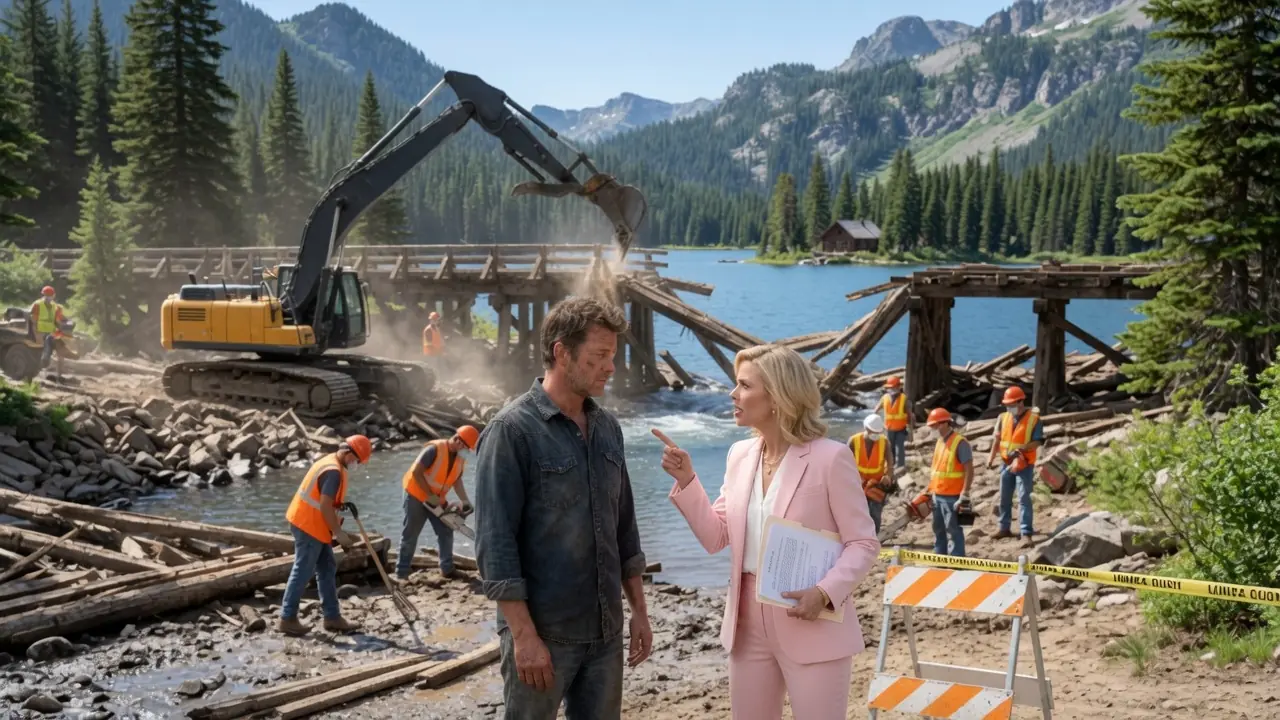
“You destroyed fifty years of my family because you thought grief made me weak,” Daniel said.
Vanessa pushed the permit toward his chest. “The resort owns this shoreline now. Fight me, and I’ll take the rest of your land too.”
Daniel looked past her toward the excavator bucket crushing a hand-carved railing his great-grandfather had shaped in 1952. Then he reached into his pocket and closed his fingers around an old brass key. “Watch carefully, Vanessa. Your four-million-dollar lakefront is about to become a field of mud.”
The confidence in her face flickered, but only briefly.
“You think threats will rebuild that bridge?”
“No,” Daniel replied. “But the deed will.”
Vanessa laughed and turned away as though the conversation had already ended. She ordered the equipment operators to continue clearing debris, then walked toward the temporary sales pavilion where banners advertised luxury cabins, private docks, and permanent lake access. Daniel remained beside the water, watching pieces of his family’s history drift beneath the machinery.
Only three hours earlier, he had placed a handful of soil on Samuel Mercer’s coffin.
Samuel had been one hundred and one years old when he died. He had outlived two wives, one son, five brothers, and nearly every man who helped him build the bridge after returning from military service in 1951. His hands had remained broad and heavily scarred until the end, though age eventually made them too weak to hold the carpenter’s plane stored above Daniel’s workbench.
Samuel built the bridge because the original road stopped at the eastern edge of the lake. The Mercer farm stood on the western side, separated from the nearest town whenever spring floods covered the low crossing. With salvaged timber, borrowed tools, and the help of neighboring families, Samuel raised a narrow wooden bridge that allowed cattle wagons, school buses, and emergency vehicles to pass safely over the outlet channel.
For decades, everyone used it.
Families crossed the bridge to reach fishing spots. Children carved initials into the railing, and newly married couples stopped at its center to take photographs. Daniel’s grandfather proposed there, Daniel’s parents scattered wildflowers there after their wedding, and Daniel learned to drive across it in an old farm truck while Samuel sat beside him pretending not to be terrified.
Samuel inspected the bridge every spring.
Even after the county built a paved road around the lake, he replaced damaged boards, tightened bolts, and treated the supporting beams against moisture. The bridge no longer carried heavy vehicles, but it remained a pedestrian route connecting the Mercer property with the northern shoreline.
More importantly, the bridge concealed the entrance to something few people understood.
Beneath the western abutment sat the Mercer headgate, a steel control valve connected to an underground diversion channel built before Clearwater Lake existed. The channel carried water from Pine Creek into a low basin that eventually became the lake’s northern cove. When the county expanded the reservoir in the 1960s, Samuel granted a permanent flow easement on one condition: the bridge, headgate, and Mercer maintenance access had to remain undisturbed.
The main body of Clearwater Lake was natural.
The northern cove was not.
Without the diversion channel, the cove gradually returned to the shallow marshland shown on maps from before 1963. The state water authority renewed the arrangement every twenty years because the channel also helped control spring flooding. Daniel inherited both the land and the water-control rights after his grandfather died.
Samuel retained a life interest in the bridge.
Vanessa Cross either never discovered that fact or believed it no longer mattered.
She arrived in Clearwater County eighteen months earlier as managing director of Cross Summit Development. Her company had purchased an abandoned summer camp beside the northern cove for one million two hundred thousand dollars. Vanessa announced plans to transform it into an exclusive mountain resort with twenty glass-front cabins, a private marina, a restaurant, and luxury wedding facilities.
The project promised jobs and tax revenue.
Most residents initially supported it.
Daniel attended the first public meeting and listened while Vanessa displayed architectural drawings of cabins overlooking the water. The resort itself did not concern him, but one rendering showed the Mercer bridge replaced by a concrete access road and decorative archway.
“That bridge is not on your property,” Daniel said.
Vanessa smiled from the stage. “It sits inside the resort’s visual corridor.”
“That is not ownership.”
“We intend to negotiate.”
“I am not selling it.”
Her smile remained, but her eyes changed. “Everything has a price.”
“Not everything belongs to you.”
From that evening forward, Vanessa treated Daniel as an obstacle rather than a neighbor.
She sent surveyors onto Mercer land without permission. Her attorneys claimed the bridge had become an abandoned public structure, despite maintenance records proving otherwise. When Daniel installed a gate to stop construction vehicles from crossing his pasture, Vanessa accused him of interfering with regional development.
Her company offered him twenty thousand dollars for the bridge easement.
Daniel refused.
The offer increased to fifty thousand, then one hundred thousand. Each proposal required him to surrender the headgate, shoreline access, and all future objections to the resort. Daniel returned every contract unsigned.
Vanessa began applying pressure elsewhere.
A county inspector suddenly questioned the permits for Daniel’s equipment shed. His farm insurance carrier received an anonymous complaint about unsafe visitor access. A local bank delayed renewing a modest operating line because Cross Summit’s attorney suggested the Mercer property might soon face an eminent-domain proceeding.
None of the threats succeeded.
Daniel owned the farm without a mortgage and kept complete records. His attorney, Margaret Bell, responded to every notice with documents Vanessa’s people had apparently hoped no one would find. Still, defending the land consumed time and money while Samuel’s health declined.
During Samuel’s final month, Daniel spent most nights beside him.
The old man understood what Vanessa wanted.
“She thinks the bridge is old,” Samuel said from his bed. “Old is not the same as useless.”
“I won’t let her take it.”
Samuel’s faded blue eyes remained fixed on him. “Don’t promise what anger cannot protect.”
“I have the deed.”
“Then know every word in it.”
Daniel brought the original property documents from the county archive. Together, they read the easement, reservoir agreement, and maintenance covenant. Samuel’s finger stopped beneath one paragraph written in legal language from another generation.
If any party destroyed, obstructed, or removed the Mercer bridge without written consent, the diversion license could be suspended immediately. The cove’s continued water supply depended upon preservation of Mercer access.
Samuel smiled weakly. “Your great-great-grandmother insisted on that.”
“She wrote this?”
“She trusted developers less than I did.”
Daniel copied every page and sent them to Margaret.
Samuel died four days later.
The funeral began at eight in the morning because Samuel had requested burial beneath the cottonwood trees before the afternoon heat. Nearly two hundred people attended, including farmers, retired teachers, former soldiers, and families whose grandparents once crossed his bridge during floods.
Vanessa did not attend.
At 6:03 that same morning, two excavators entered the northern shoreline through the resort construction road. Security footage later showed workers cutting the Mercer gate chain and driving directly toward the bridge. By the time Daniel placed the first soil on Samuel’s coffin, the central span had already collapsed into the water.
Vanessa timed the demolition deliberately.
She knew Daniel, Margaret, and most Mercer neighbors would be at the cemetery. She believed the completed destruction would become a fact too expensive to reverse. Her attorney had obtained an emergency safety order by submitting photographs that made the bridge appear structurally unstable.
The photographs were misleading.
They showed two temporary boards Samuel removed during repairs, not failing support beams. Vanessa also failed to tell the county that the bridge was privately owned and protected by a reservoir covenant.
Daniel received the first call during the funeral reception.
His neighbor, Luis Ortega, sent a photograph of an excavator bucket tearing through the eastern railing. Daniel stared at the image until the voices around him disappeared. Samuel’s initials were visible on one beam seconds before the machinery crushed it.
Margaret drove him to the lake.
When Daniel arrived, the central structure was already gone. Vanessa stood beside the shoreline with the demolition permit, prepared for confrontation and surrounded by contractors who assumed official paperwork protected them.
Daniel wanted to shout.
He wanted to drag the operators from their machines and throw Vanessa’s permit into the water. Instead, he remembered Samuel’s warning that anger could not protect a promise.
He photographed everything.
He recorded Vanessa admitting she had ordered the demolition. He asked the workers to identify their employer and requested copies of the permit. Then he called the state water authority and reported unauthorized destruction of a protected maintenance structure.
Vanessa watched with amusement.
“You can call every agency in the state,” she said. “The bridge is already gone.”
Daniel held up the brass key. “So is your cove.”
He walked past the demolished western abutment toward a steel access panel half buried beneath wet soil. The excavator had broken the wooden housing but had not reached the valve assembly below it. Daniel inserted the key, unlocked the cover, and revealed a large manual control wheel.
Vanessa followed him. “What are you doing?”
“Suspending the diversion.”
“You cannot interfere with the lake.”
“It is my licensed channel.”
“The resort purchased waterfront property.”
“You purchased property beside water my family allowed into this cove.”
Her expression tightened. “You are bluffing.”
Margaret arrived with the copied easement documents. “He is acting under Section Twelve of the 1963 diversion agreement. Your unauthorized demolition automatically suspended your right to receive water through the Mercer channel.”
Vanessa grabbed the papers and scanned the highlighted paragraph.
“This agreement is ancient.”
“It was renewed six years ago,” Margaret said.
“My company was never informed.”
“The covenant is recorded against your parcel. Your title attorney signed acknowledgment of it.”
Vanessa looked toward Daniel. “If you touch that valve, I’ll sue you for every dollar this resort loses.”
Daniel placed both hands on the wheel. “Get in line behind the family whose bridge you destroyed during a funeral.”
He turned it.
The mechanism resisted at first, then moved with a deep metallic groan. Beneath the water, the diversion gate began closing across the Pine Creek channel. The flow entering the northern cove slowed immediately.
Vanessa laughed again, though less convincingly. “The lake will not disappear because you turned one wheel.”
“Not today.”
Daniel closed the gate completely and secured the lock.
The effect began overnight.
Clearwater’s main lake level remained unchanged, but the northern cove depended on constant diverted flow to replace water lost through seepage and the natural outlet. By the following afternoon, the resort’s floating dock rested several inches lower.
Three days later, mud appeared along the shore.
Within a week, the water receded thirty feet from the first row of luxury cabins.
Cross Summit’s advertisements promised guests private lake access directly from every deck. The photographs showed blue water touching the retaining walls and small boats tied beneath pine trees. Now the cove resembled a broad basin of exposed stones, wet clay, and reeds.
Construction stopped.
Vanessa called the state water authority and demanded that officials reopen the diversion. The authority refused after confirming that her demolition violated the recorded covenant. Inspectors also discovered that the resort’s marina permit depended on minimum water depth supplied through the Mercer channel.
The county suspended the marina approval.
Investors panicked.
Vanessa had financed construction using advance reservations and a commercial loan tied to the property’s projected waterfront value. Without the cove, several completed cabins no longer met the descriptions used in sales materials.
Customers requested refunds.
The lender sent inspectors.
Still, Vanessa refused to apologize.
She held a press conference beside the retreating shoreline and accused Daniel of environmental sabotage. She described him as an angry farmer using outdated water rights to destroy local jobs.
Daniel attended from the back.
When reporters asked for his response, he handed them copies of the easement, demolition footage, and Vanessa’s recorded statement admitting she destroyed the bridge while he attended Samuel’s funeral.
The story changed by evening.
Local news stations showed images of the broken bridge beside photographs from its history. Former residents sent wedding pictures, family portraits, and childhood memories taken on the wooden span. Veterans who knew Samuel described the demolition as calculated cruelty.
Vanessa’s claim that the bridge was dangerous also collapsed.
An independent engineer had inspected it only five months earlier and found the structure safe for pedestrian use. The report recommended replacing twelve deck boards, work Daniel had scheduled for autumn.
The emergency safety order had been obtained using incomplete information.
The county prosecutor opened an investigation into whether Cross Summit knowingly submitted false documents. The historic preservation board issued a separate violation because the bridge qualified as a protected cultural structure under a designation Vanessa’s attorneys overlooked.
Her four-million-dollar resort became a legal trap.
The most damaging discovery came from inside Cross Summit.
A junior project manager named Claire Donovan contacted Margaret and provided copies of internal emails. Vanessa had known about the diversion covenant before purchasing the property. Her title attorney warned her that destroying the bridge could terminate water access.
Vanessa replied with one sentence:
Once the bridge is gone, the old farmer will negotiate.
Daniel was not an old farmer, but the intention was clear.
She planned to create irreversible damage, then force him to sell the water rights cheaply to prevent the resort from failing. Samuel’s funeral offered the perfect opportunity because Vanessa assumed grief would make Daniel disorganized and vulnerable.
The emails reached Cross Summit’s investors.
They removed Vanessa as managing director within forty-eight hours.
She arrived at Daniel’s farm the following morning without her bright suit, attorneys, or contractors. She wore dark trousers and a gray coat, and for the first time since they met, she appeared uncertain.
Daniel found her beside Samuel’s workshop.
“I want to resolve this,” she said.
“You wanted to resolve it with an excavator.”
“The board has authorized a settlement.”
“I am not interested in money.”
“You have significant damages.”
“I know.”
“We will rebuild the bridge.”
Daniel looked toward the lake. “You cannot rebuild the mornings my great-grandfather spent there. You cannot replace the original beams or the names carved into them.”
“No, but we can create a replica.”
“I don’t want a resort replica.”
Vanessa’s restraint broke. “What do you want from me?”
“The truth in court.”
Her face hardened. “If you continue this, hundreds of workers could lose jobs.”
“The workers did not hide the covenant.”
“The resort can still help this county.”
“Then it will survive without rewarding what you did.”
Vanessa lowered her voice. “Reopen the channel, and I will sign any apology you want.”
Daniel shook his head. “An apology purchased with water is another contract, not remorse.”
She stared at him. “You would destroy four million dollars over an old bridge?”
“You destroyed the bridge over four million dollars.”
Vanessa left without another word.
Cross Summit eventually filed for restructuring. The original investors negotiated directly with Daniel, the county, and the state water authority. Unlike Vanessa, they did not begin with demands.
They began with the bridge.
The company agreed to fund a historically accurate reconstruction using salvaged original timber wherever possible. A preservation architect documented every remaining beam, joint, carving, and foundation stone. Local craftsmen volunteered labor, while Samuel’s old plans were found inside a metal tube beneath the workshop floor.
Daniel insisted on several conditions.
The reconstructed bridge would remain Mercer property. Public access would continue permanently, and the resort could not use its image in advertising without contributing to a maintenance trust.
Most importantly, the diversion channel would remain under independent oversight rather than resort control.
The investors agreed.
Only after construction began did Daniel partially reopen the headgate. Water slowly returned to the northern cove, but not to the artificially high level Cross Summit originally demanded. The resort redesigned its marina as a smaller public dock and transferred several shoreline acres into a conservation easement.
The luxury project changed too.
Instead of a private enclave, it included public trails, local vendor spaces, and a small museum telling the history of Clearwater Lake and the Mercer bridge. Some investors complained that the changes reduced exclusivity.
Reservations increased.
Visitors preferred a resort connected to the valley rather than one attempting to erase it.
Vanessa faced charges for property destruction, fraudulent permitting, and interference with protected water infrastructure. She avoided prison through a plea agreement but paid restitution, lost her development license, and was barred from managing projects involving public permits for five years.
Her most difficult consequence was not financial.
During sentencing, the judge ordered her to attend the reconstructed bridge’s dedication and hear testimony from the families affected by its destruction.
Daniel spoke last.
He carried Samuel’s carpenter’s plane in one hand and the brass headgate key in the other. Behind him stood the restored bridge, built with new supports and sections of original railing recovered from the lake.
“My great-grandfather never believed this bridge belonged only to our family,” Daniel said. “That is why he allowed everyone to cross it.”
Vanessa sat silently in the front row.
“He did believe that using something created responsibility. The bridge carried people. The channel carried water. The covenant carried trust between generations.”
Daniel looked toward the clear cove beyond the trees.
“You saw old wood blocking a profitable view. You never asked what held the water beneath that view or what promises made your project possible.”
After the dedication, Daniel walked alone to the center of the bridge.
The reconstructed railing still showed slight differences between old and new timber. He could identify every recovered piece because the original wood had darkened with age and carried marks no craftsman could reproduce.
Near the western end, one beam bore Samuel’s initials.
Daniel rested his hand over them.
The bridge was not untouched. It never would be. Its destruction had become part of its history, just as rebuilding became part of what the next generation would inherit.
Luis Ortega joined him carrying two cups of coffee.
“Cove looks good,” Luis said.
Daniel nodded.
“You ever regret closing the gate?”
“No.”
“Even when everyone said you were destroying the resort?”
Daniel looked across the water at the completed cabins reflecting beneath the mountain sky. “I didn’t destroy it. I showed them what their waterfront depended on.”
Luis handed him a cup. “Samuel would have enjoyed that.”
“He would have told me I turned the wheel too fast.”
“He probably would have turned it faster.”
Daniel laughed.
One year later, the resort opened under a new name: Mercer Crossing Lodge. Daniel initially refused the use of his family name, but the community persuaded him after the company agreed that a portion of every booking would fund bridge maintenance and lake conservation.
A small plaque stood beside the entrance.
It did not mention Vanessa or the lawsuit.
It read:
Built first by Samuel Mercer in 1952. Rebuilt by the Clearwater community after those who valued profit more than memory learned that neither land nor water survives without respect.
Guests crossed the bridge each morning.
Children leaned over the railing to watch trout below. Couples stopped at the center for photographs, and older residents pointed toward the recovered beams while telling stories of Samuel.
Daniel sometimes watched from the shoreline.
He never told visitors that the brass key remained in his pocket whenever he inspected the headgate. He did not carry it as a threat.
He carried it as Samuel carried his tools: proof that responsibility belonged in the hands of people who understood what a thing was built to protect.
Vanessa had believed the bridge was only wood.
She believed the lake was only scenery.
She believed Daniel’s grief was only weakness.
By the time the cove emptied beneath her unfinished cabins, she finally understood that the oldest structure on the shoreline had never been the obstacle to her resort.
It was the reason the resort had waterfront at all.