He stepped inside, moving slowly and deliberately.
His shoes, scuffed from years of wear, tapped against the polished marble floor, a quiet defiance against the gleaming perfection surrounding him.
The air carried a crisp artificial chill and the unmistakable scent of wealth, the kind of wealth that was not merely possessed but intentionally displayed.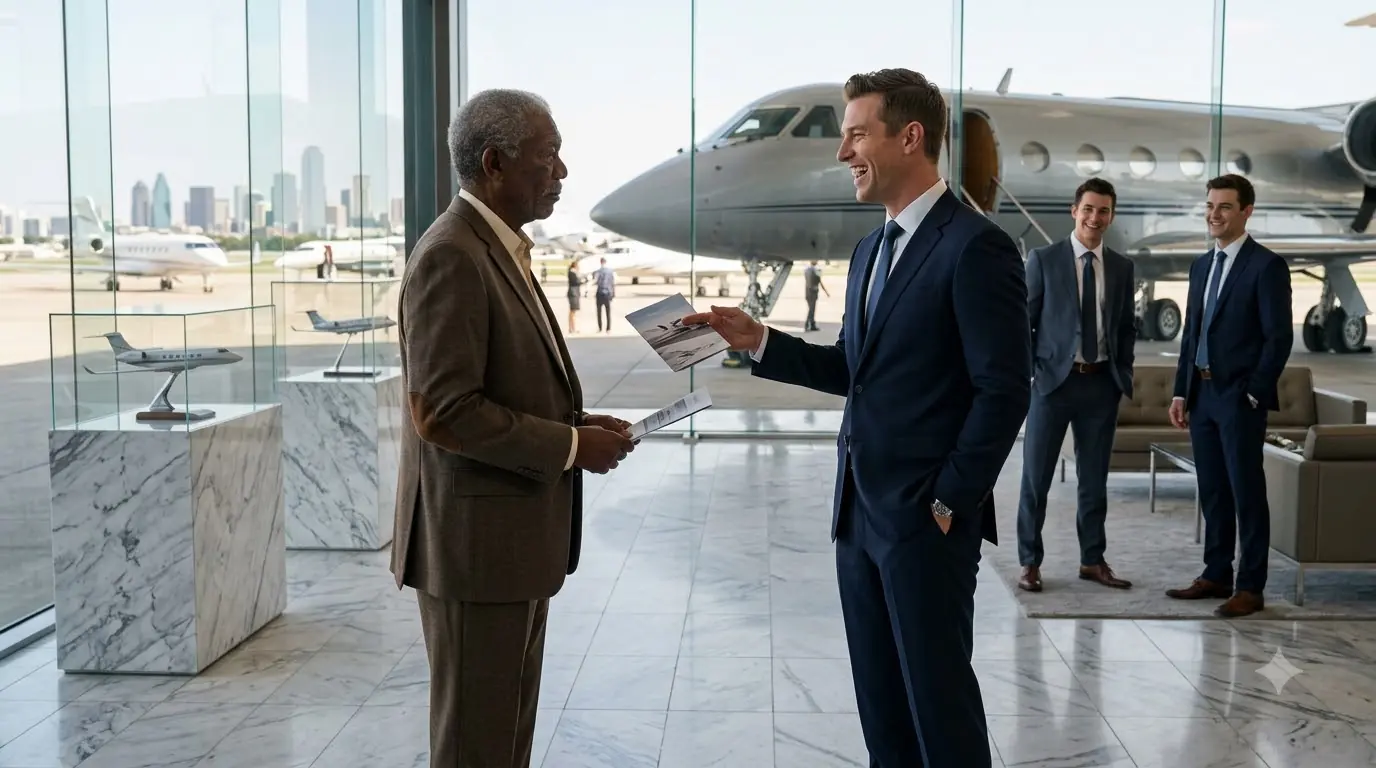
Every inch of the showroom seemed designed to remind visitors that ordinary people were not expected to walk through its doors.
Towering floor-to-ceiling windows framed the tarmac outside, where sleek private jets glistened beneath the Texas sun.
In the center of the showroom stood a massive silver Gulfstream model, its wings stretching outward like the arms of a giant. It was a silent proclamation of power, status, and money.
This was a place for the elite.
For the untouchable.
For people who did not ask to see price tags.
And James Carter knew the moment he entered that the staff had already decided he did not belong.
The first look came from the receptionist. Her painted smile faltered for half a second before she regained her professional expression.
The second came from a young salesman adjusting the cuff of an expensive suit. His eyes flicked up from his phone and widened with barely concealed amusement.
The third came from deeper inside the showroom, where two men in tailored jackets stood beside an aircraft display. They exchanged a glance before one of them released a low chuckle.
The laughter was subtle at first.
Hidden behind smirks.
Behind polite disinterest.
But James had spent a lifetime reading rooms.
He felt the shift immediately.
The hum of condescension moving through the space like a slow current.
James continued walking.
Each step was measured.
Each movement carried the quiet patience of a man who had survived far more difficult rooms than this one.
Then a voice cut through the showroom.
“Sir, are you lost?”
It was not a genuine question.
It was a performance.
The young salesman James had noticed earlier was now standing directly in his path, an easy grin spreading across his face.
James met his eyes.
There was no anger in his expression.
No indignation.
Only patience.
“I’d like to inquire about purchasing a jet,” James said.
His voice was calm and steady.
For a moment, the salesman hesitated.
It seemed to take his mind a second to process what he had heard.
Then came the exhale.
The barely noticeable scoff.
Amusement flickered across his face.
He rested one hand on his hip and gestured vaguely toward the showroom with the other.
“I’m sorry, sir, but these jets aren’t for window shoppers.”
His tone was light, almost playful, as though he were indulging a child in a fantasy.
“Maybe we can find something more suitable for you.”
Laughter followed.
Louder this time.
Less restrained.
Someone farther back let out a whistle. Another employee muttered something James could not quite hear, but whatever it was sent another wave of amusement through the sales staff.
James did not react.
He allowed them to speak.
Allowed them to look at him and see only what they wanted to see.
An elderly man in an old suit.
A curiosity.
A brief joke in the middle of an otherwise polished workday.
They did not see the decades of sacrifice written into his hands.
They did not see the experience behind his steady posture.
They did not see him at all.
And James Carter had never been the kind of man who demanded recognition.
He had spent most of his life building things quietly.
Companies.
Opportunities.
Scholarships.
Churches.
Communities.
He had known men who wore power like a weapon and others who carried it with grace.
James understood both types.
He nodded slowly, committing the moment to memory.
Then, with the same calm resolve that had carried him through every major challenge of his life, he turned toward the exit.
The laughter followed him.
The glass doors closed behind him with a soft mechanical sound.
To the employees inside, it felt final.
They thought that was the end.
They thought they had seen the last of the old man who had wandered into the wrong world.
They were wrong.
Because the following morning, James Carter would return.
Not merely as a customer.
As their boss.
James had always believed in humility, hard work, faith, and quiet generosity.
At seventy-six years old, he had lived a life most people could only imagine.
But no one would have guessed that by looking at him.
He did not wear flashy suits.
He did not collect expensive watches merely to display them.
James had built his fortune the same way a patient man builds a house.
One brick at a time.
One sacrifice after another.
His story was not one of overnight success.
It was not inherited privilege.
James had been born in Birmingham, Alabama, during the segregated South, a place where dreams for boys like him were often limited before they had a chance to form.
His father worked as a janitor in a textile factory.
His mother worked long hours cleaning homes and doing whatever she could to help keep food on the table.
James remembered his father leaving before sunrise and returning after dark.
His hands were always rough.
His back was always tired.
But his spirit never seemed defeated.
One evening, when James was still young, his father told him something he would carry for the rest of his life.
“Son, life may never hand you anything. You take what you need with work and with faith.”
His mother gave him a different version of the same lesson.
She was deeply religious and often read the Bible by candlelight after everyone else had gone to bed.
“God has a plan for you, James,” she would tell him. “Never let this world tell you what you’re worth. Let God decide that.”
Faith mattered.
But faith did not automatically put food on the table.
By the time James was ten years old, he was shining shoes on Birmingham sidewalks, earning pennies to help his mother buy bread and milk.
He faced rejection almost every day.
Some men walked past him as though he were invisible.
Others tossed coins toward him with the casual indifference of people who believed they were doing him a favor simply by noticing him.
James did not pity himself.
He watched.
He listened.
And he learned.
He studied the businessmen who moved through the city with confidence.
Their pressed suits.
Their controlled voices.
The way people stopped talking when they entered a room.
The way they carried themselves as though they had a right to be wherever they stood.
Somewhere inside himself, James made a promise.
One day, he would not merely work for men like that.
He would become one of them.
At eighteen, James left Birmingham for Houston, Texas.
He carried fifteen dollars and an unshakable belief that he could build a different future.
Houston was not kind to him at first.
He slept in inexpensive boarding houses.
Took whatever work was available.
Loaded cargo at shipping docks during the day.
Attended classes at night.
He survived on very little sleep and even less money.
But he continued.
At twenty-four, James saw an opportunity everyone else viewed as failure.
A small freight company was nearing collapse.
Its owner was older, exhausted, and buried under debt.
The company had few functioning assets and even fewer prospects.
Most people saw a business already dying.
James saw something that could still be saved.
He did not have enough money to purchase it outright.
So he negotiated.
James offered to take over operations and assume responsibility for the debt, promising the owner that he would pay what was owed within two years.
The agreement was simple.
Mostly built on trust.
A handshake.
Then James went to work.
He drove trucks himself.
Made deliveries.
Repaired equipment.
Visited small businesses in person and asked for contracts.
When a customer complained, James listened.
When an employee struggled, he learned why.
When money was short, he paid other people before paying himself.
Other men his age were settling into regular jobs and predictable lives.
James was building.
One truck became several.
Several became twenty.
Within five years, the company expanded beyond Houston.
Within ten, it had become one of the leading logistics operations in Texas.
Over the following decades, James expanded into other industries.
Real estate.
Technology.
Transportation.
Investment.
By the time most people first heard his name, James Carter was already worth millions.
Later, much more.
But wealth changed his circumstances more than it changed his habits.
He still preferred old suits he considered comfortable.
He still disliked unnecessary attention.
He still remembered what it felt like to count coins.
And he believed money carried responsibility.
James funded scholarships for students from low-income families.
He supported churches.
Helped single mothers.
Funded orphanages.
When small community ministries were close to shutting down because they could not pay rent or transportation costs, James frequently stepped in.
Usually without attaching his name.
Recognition had never interested him as much as usefulness.
But there was one dream James had never pursued.
A private jet.
Not because he wanted luxury.
Not because he wanted to impress anyone.
James had spent years watching pastors, missionaries, and community leaders decline opportunities simply because travel was too expensive or too complicated.
He watched people with important work to do lose days in airports, miss events, and sometimes abandon trips entirely.
Eventually James made himself a promise.
One day, when the time was right, he would create a way for some of those people to travel without constantly worrying about whether they could afford to get where they needed to go.
That was part of what brought him to Wellington Jets in Dallas.
He wore the simple brown suit he had owned for years.
The elbows were worn.
The cuffs slightly frayed.
The fabric softened by time.
James was not seeking a favor.
He was not asking permission.
He was there to evaluate aircraft.
And the people inside Wellington Jets judged him almost instantly.
The receptionist barely looked up.
The sales team noticed his worn shoes.
Then his suit.
Then his age.
James saw their eyes.
He understood what they were thinking.
He does not belong here.
He is wasting our time.
Another old man with big dreams and an empty wallet.
One salesman in particular seemed determined to turn James into entertainment.
His name was Brandon Walker.
Brandon wore a sharp suit, polished shoes, and the expression of someone who had spent years being rewarded for confidence.
His name tag gleamed beneath the showroom lights.
He approached James with a smirk already forming.
“Sir, are you lost?”
James looked at him calmly.
“I’d like to inquire about purchasing a jet.”
The amusement in Brandon’s eyes flickered.
Then came the small scoff.
“I see.”
He glanced toward the display aircraft.
“Well, these jets start around fifty million dollars. Maybe we can find something smaller for you.”
A few salesmen laughed behind him.
James did not.
He had experienced this feeling before.
Not in that showroom.
Not in that exact form.
But the feeling was familiar.
Being underestimated.
Dismissed.
Judged before speaking.
James had spent much of his life proving people wrong without needing to argue with them.
So he simply nodded.
Then he turned toward the door.
The laughter followed.
What Brandon and the others did not know was that, before James ever entered Wellington Jets, he had already changed the company’s future.
Wellington Jets was connected to a much larger aviation company, Falcon Aeronautics.
Falcon had been struggling.
Mismanagement had damaged confidence.
Investors were becoming nervous.
Executives had spent months trying to find a path forward.
Richard Langston, Falcon’s CEO, eventually approached James Carter.
Not merely because James had money.
Because James had built a reputation for rescuing troubled companies without destroying the people inside them.
He was known for examining operations carefully.
For thinking in decades instead of quarters.
For valuing integrity as much as revenue.
Langston had asked James for advice.
The conversations gradually became negotiations.
James did not rush.
He prayed.
He studied the company.
Reviewed its debt.
Its subsidiaries.
Its leadership.
Its customers.
Its long-term potential.
Eventually, he agreed to acquire a controlling stake.
Wellington Jets was part of the transaction.
James had not entered the showroom to reveal himself.
He wanted to observe.
To see how employees behaved when they believed the person in front of them had no influence.
And they showed him.
That evening, while Brandon and the salesmen were still joking about the old man in the worn brown suit, a very different conversation unfolded in the corporate offices.
Richard Langston sat at the head of a long glass conference table.
Senior executives surrounded him.
The mood was tense.
Documents were stacked in front of each person.
Langston spoke quietly.
“The board has made its decision. We’re finalizing the ownership transfer by morning.”
Murmurs moved through the room.
One executive asked the question everyone wanted answered.
“Who is the buyer?”
Langston looked down at the documents.
Then back at the room.
“James Carter.”
Silence.
The name meant little to a few people.
But others knew immediately.
James Carter.
A businessman who rarely announced his moves before they were complete.
A man who had quietly reshaped logistics companies, real-estate operations, and technology investments.
A man who did not need headlines before buying influence.
Langston closed the folder.
Downstairs, faint laughter still drifted from the showroom.
His employees had no idea that the man they were mocking was about to become the most powerful person in their corporate structure.
James Carter had not been window shopping.
By the following morning, they would be working for him.
Back in the showroom, Brandon’s laughter had grown bolder before James left.
The old man stood with his hands resting lightly at his sides, the faded brown of his suit blending with the muted showroom tones.
Brandon adjusted his silk tie and looked James over again.
“Sir, these jets aren’t for window shoppers.”
His colleagues laughed.
James took one step forward.
“I’d like to see your financing options.”
The room became quiet for half a second.
Then another round of laughter erupted.
Brandon tilted his head.
“You want to finance a jet?”
“That’s right.”
Brandon pressed his lips together as though trying not to smile.
Then he gestured toward the luxury seating area.
“Well, sir, let me explain. These jets begin at around fifty million dollars. Of course, there are financing arrangements, but—”
Another salesman interrupted.
A lanky man in a navy suit.
“Maybe he can afford a paper plane.”
The laughter came harder.
One employee covered his mouth.
Even the receptionist struggled to hide a smile.
James stood silently.
Then he released a slow breath.
His gaze returned to Brandon.
“I may not look like much to you,” James said.
His voice remained calm.
“But God knows my worth.”
The laughter stopped.
Only for a second.
But something in James’s certainty shifted the room.
He did not sound defensive.
He sounded settled.
James turned.
He walked toward the exit with his back straight.
No raised voice.
No argument.
That bothered Brandon more than anger would have.
People who were humiliated normally defended themselves.
They shouted.
Threatened to complain.
Demanded managers.
James did none of those things.
He simply left.
And the lack of reaction created an uneasiness the salesmen could not explain.
While they laughed, the ownership documents were already being prepared.
By the time the employees arrived at work the following morning, rumors were moving through Wellington Jets.
The place normally ran on confidence.
Salespeople crossed the marble floor in designer suits, focused on commissions and wealthy clients.
But that morning the atmosphere felt different.
Phones buzzed constantly.
Assistants whispered behind desks.
People who normally spent twenty minutes drinking coffee were refreshing their inboxes.
In the break room, Jason, one of the junior salesmen, leaned over his laptop.
His eyes moved quickly across an internal memo.
His hand trembled slightly when he reached for his coffee.
“Something’s up.”
Brandon sat across from him, casually throwing a stress ball into the air.
“What now?”
“I heard from accounting that the company changed hands overnight.”
Brandon caught the ball.
He smirked.
“Relax. Probably corporate restructuring.”
Jason shook his head.
“No. Full buyout. New ownership. New leadership.”
Brandon rolled his eyes.
“So what? Some rich guy bought the company. We sell jets to rich guys every day.”
A few others nearby chuckled.
One salesman nodded.
“Whoever he is, he’ll love us. We’re the people making the company money.”
That was how they thought.
They had spent years dealing with CEOs.
Oil executives.
Celebrities.
Investors.
People with private security and enormous bank accounts.
They believed they understood wealth.
They believed wealth always looked like wealth.
Brandon stood and adjusted his tie.
“Mark my words, fellas. Whoever this guy is, he’ll be like all the others. Easy to impress. Easy to sell to. Easy to get on our side.”
The men laughed.
The tension eased.
Why should they be afraid?
Across town, James Carter was preparing differently.
He sat in a quiet study lined with old books and framed scripture.
Morning sunlight entered through the window.
An open Bible rested before him.
James had spent part of the morning praying.
The events of the previous day remained fresh in his mind.
The laughter.
The comments.
The smirks.
For a moment, he felt the natural human desire to return and watch those men discover their mistake.
To see embarrassment replace arrogance.
But James understood the danger in that desire.
He had spent decades learning that possessing power did not justify using it carelessly.
His eyes returned to Proverbs 16:18.
“Pride goes before destruction, and a haughty spirit before a fall.”
James closed his eyes.
He breathed slowly.
This was not supposed to be revenge.
If he returned simply to humiliate them, then their arrogance would have changed him too.
James closed the Bible.
He stood.
Today, he would return to Wellington Jets.
Not to prove that he was richer than they imagined.
Not to destroy people because they embarrassed him.
He would return to reveal what they had become.
And perhaps give them the opportunity to become something better.
The moment James stepped through the Wellington Jets doors, the atmosphere changed.
This time, he was not alone.
Walking behind him was Richard Langston.
Two senior executives followed, carrying folders marked CORPORATE TRANSITION.
The receptionist looked up.
She recognized James instantly.
Her hands froze above the keyboard.
“Mr. Carter…”
Her voice was barely audible.
James gave her a polite nod.
Then continued forward.
Employees on the sales floor stopped talking.
Coffee cups paused halfway to mouths.
Brandon stood near the luxury aircraft display.
His stomach tightened.
He recognized James.
But why was Richard Langston walking beside him?
Why were senior executives following?
Why did everyone seem to be deferring to the old man they had laughed at yesterday?
Brandon forced a smile.
“Good morning, gentlemen.”
Nobody answered.
Brandon swallowed.
“Can we help you?”
Langston stepped slightly to one side.
All eyes settled on James.
The same man they had mocked.
The same faded brown suit.
The same worn shoes.
The same calm expression.
But the room saw him differently now.
James walked to the center of the sales floor.
His posture remained relaxed.
He did not need to perform authority.
Brandon stepped forward.
He was not ready to accept what his instincts were already telling him.
“Can we help you, sir?”
The condescension in his voice was weaker now.
Uncertain.
He looked toward his colleagues.
No one laughed.
Desperate to recover control of the moment, Brandon said the worst possible thing.
“Back to look at jets you can’t afford?”
The words left his mouth.
Immediately, he knew.
The room changed.
His own sentence seemed to hang in the air like evidence.
James looked at him.
Not angrily.
Almost sadly.
Then he said:
“No, son.”
His voice was steady.
“I’m here to discuss my company’s future.”
Brandon’s smile disappeared.
“Your company?”
He gave a nervous laugh.
His eyes searched the room for reassurance.
None came.
James did not explain.
Richard Langston did.
“That’s right.”
Everyone turned toward him.
Langston stepped forward.
His expression was controlled.
Final.
“Ladies and gentlemen, allow me to formally introduce the new majority owner.”
He looked toward James.
“Mr. James Carter.”
The showroom froze.
No one moved.
No one spoke.
Brandon’s breathing caught.
The words did not seem capable of belonging to reality.
The old man.
The worn suit.
The shoes.
The man they had laughed at.
James Carter owned the company.
The realization moved across the staff in waves.
Shock.
Disbelief.
Fear.
Then shame.
James watched quietly.
He looked down briefly at his brown suit.
It was almost funny in a painful way.
Yesterday, the suit had been enough for them to decide he was beneath them.
Today, the suit had not changed.
Only their information had.
James stepped forward.
“God has a funny way of humbling the proud.”
His voice carried no anger.
That made the words heavier.
Brandon lowered his eyes.
He had spent years building an identity around charm, sales numbers, polished clothing, expensive restaurants, and wealthy clients.
He was accustomed to controlling rooms.
Now he could barely look at the person standing in front of him.
James could have fired Brandon immediately.
No one would have questioned it.
He could have dismissed the entire sales team.
Instead, James looked toward the receptionist.
“Call everyone in.”
She blinked.
“The entire staff.”
“Yes.”
Her hands shook as she reached for the intercom.
Within minutes, employees from every department gathered on the main floor.
Executives.
Salespeople.
Assistants.
Receptionists.
Maintenance workers.
Administrative staff.
People who had participated in the laughter.
People who had merely watched.
And people who had known nothing about the incident.
James stood before them.
He did not look furious.
He looked thoughtful.
“I wasn’t born into wealth,” he began.
The room became silent.
“I didn’t grow up with privilege or easy opportunities.”
James let his eyes move across the crowd.
“I was born in Birmingham, Alabama, at a time when a young Black boy like me was often told very clearly what the world expected him to become.”
No one interrupted.
“My family was poor.”
He paused.
“My father worked from sunrise until long after sunset just to keep food on our table.”
James’s expression softened.
“My mother taught me one of the most important lessons I ever learned.”
He seemed to hear her voice again.
“She said, ‘Son, the world may judge you by what you wear, where you live, and how much money you have. But God judges the heart.’”
Several employees looked down.
James continued.
“I didn’t have expensive shoes.”
He looked briefly toward his own.
“I didn’t have money for the best schools.”
Another pause.
“But I had faith.”
He spoke about leaving Birmingham.
Houston.
The docks.
Night school.
The struggling freight company.
The first truck.
Driving deliveries himself.
The years of building.
“I worked.”
His voice remained simple.
“I worked long nights. I prayed. I made mistakes. I learned.”
James gave a small laugh.
“And little by little, doors opened.”
He looked around the showroom.
“Now I own companies.”
He continued.
“I support churches. I help ministries. I fund programs.”
James held up one hand slightly.
“I am not saying that to boast.”
His expression became more serious.
“Everything I have came with responsibility.”
Then his voice lowered.
“And yesterday, I walked into a building I was about to own.”
The silence became heavier.
“I was treated as though I were a nuisance.”
Several salesmen stared at the floor.
“As though I were a beggar.”
James looked directly toward Brandon.
“As though I did not belong.”
Brandon felt something tightening in his chest.
For the first time, he saw the previous afternoon from outside himself.
The laughter.
The smirk.
The paper-plane joke.
The assumptions.
He saw himself.
Arrogant.
Proud.
Blind.
Brandon’s hands began trembling.
He tried to swallow.
His mouth had gone dry.
Then something broke.
“Mr. Carter.”
James stopped.
Brandon stepped out from the group.
His voice shook.
“I was wrong.”
Several employees looked at him.
Brandon Walker almost never admitted weakness.
Now tears had filled his eyes.
“I judged you.”
He struggled to continue.
“I mocked you.”
His head lowered.
“I let my pride decide who you were before I knew anything about you.”
He took another breath.
“I was a fool.”
His voice cracked.
“And I’m sorry.”
The room became completely still.
Brandon waited for the consequence.
He expected termination.
Perhaps humiliation.
Perhaps James would repeat his own words back to him in front of everyone.
James walked toward him.
Brandon braced himself.
Instead, James said:
“I was given chances in life.”
Brandon looked up.
James’s voice was firm but gentle.
“Now I’m giving you one.”
Brandon stared.
“You have a choice.”
James continued.
“You may stay here.”
A pause.
“But if you stay, things will change.”
Brandon nodded slowly.
“You will change.”
James looked toward the rest of the staff.
“You will treat people with dignity regardless of what they wear.”
Another pause.
“Regardless of where they come from.”
James’s eyes returned to Brandon.
“Regardless of what you think they can afford.”
He let that settle.
“Or you can walk away and continue living as you have.”
Brandon breathed heavily.
He did not deserve the mercy being offered.
He knew that.
Perhaps that was why it affected him so deeply.
“I want to change.”
The words came quietly.
Then stronger.
“I want to change.”
For the first time, James believed him.
The atmosphere inside Wellington Jets did change after the ownership transfer, but not in the way most employees expected.
Corporate acquisitions usually created fear.
People worried about layoffs.
Salaries.
Management reshuffles.
Benefits.
James did not enter swinging a hammer.
He listened.
He met executives.
Salespeople.
Administrative assistants.
Mechanics.
Cleaning staff.
Everyone.
He asked what worked.
What did not.
What customers complained about.
What employees feared.
Then he began rebuilding the culture.
Wellington Jets would continue selling luxury aircraft.
The company would continue serving wealthy clients.
It would remain a premium aviation business.
But James changed the values underneath the sales process.
No employee would decide whether a customer deserved respect based on clothing, age, accent, profession, appearance, or assumed wealth.
Customer-service policies were rewritten.
Ethics training became mandatory.
James insisted that employees be trained not merely to close sales but to recognize the dignity of the person standing in front of them.
Then came the decision connected to the dream James had carried for years.
Wellington Jets would create partnerships with Christian ministries and community organizations.
The company would provide lower-cost transportation arrangements for qualifying pastors, missionaries, and church leaders whose work required travel they could not easily afford.
Some executives thought it was financially reckless.
Financial commentators questioned the strategy.
Critics said faith and aviation did not belong in the same corporate mission.
James listened.
Then kept going.
He believed a business could make money and still possess purpose.
And over time, something unexpected happened.
Customer loyalty increased.
New clients approached Wellington Jets specifically because they respected the company’s values.
Employees began speaking differently about their work.
The company’s reputation changed.
Rather than collapsing under James’s unusual strategy, Wellington Jets grew stronger.
But the most important transformation was not visible in quarterly reports.
It happened inside Brandon Walker.
Brandon had always been considered the golden salesman.
Smooth.
Fast.
Persuasive.
The kind of employee coworkers joked could sell ice in winter.
After James took over, people noticed Brandon becoming quieter.
He listened more.
He mocked less.
Eventually, he stopped mocking altogether.
He no longer laughed at customers after they left.
He stopped looking at shoes and watches before deciding how much attention to give someone.
Months earlier, an older man in a worn brown suit would have been an easy target.
Then one afternoon, another elderly gentleman entered Wellington Jets wearing exactly that kind of suit.
Simple.
Old.
Worn at the elbows.
Brandon noticed him.
For a brief second, the old instinct appeared.
Then he remembered.
Brandon stood.
He walked toward the man.
Extended his hand.
“Good afternoon, sir. Welcome to Wellington Jets.”
The man smiled.
“I have a few questions.”
“I’d be happy to help.”
Brandon spent nearly an hour with him.
He answered every question.
Explained aircraft differences.
Discussed financing options.
Never once assumed the man could not afford anything.
James happened to be watching from a distance.
He smiled.
Not because Brandon had become perfect.
Because he was changing.
The biggest moment came one morning when Brandon knocked on James Carter’s office door.
James looked up from a stack of papers.
Brandon stood in the doorway holding something.
A Bible.
“Sir?”
“Yes, son?”
“I want to learn.”
James leaned back.
“Learn what?”
Brandon stepped inside.
“About faith.”
He looked down at the Bible.
“About Jesus.”
Then back at James.
“About what made you different.”
James studied him carefully.
This did not feel like an employee trying to impress the new owner.
Brandon’s face carried too much vulnerability for that.
He looked like a man who had discovered that the identity he built for himself was not enough.
James gestured toward a chair.
“Pull it up.”
Brandon sat.
James closed the folder on his desk.
“Let’s talk.”
Brandon started reading the Bible.
At first, much of it felt unfamiliar.
Some passages confused him.
Others challenged him.
But he continued.
He began attending church.
He sat quietly toward the back.
Week after week, he listened.
For years, Brandon had believed success meant being the smartest person in the room.
The most persuasive.
The best dressed.
The one with the highest sales numbers.
Now he was learning a different definition.
One Sunday, the pastor preached about humility, grace, and the choice to answer wrongdoing without becoming consumed by it.
Then he read Romans 12:21.
“Do not be overcome by evil, but overcome evil with good.”
Something inside Brandon gave way.
Years of pride.
Years of arrogance.
Years of believing that strength meant never admitting weakness.
When the congregation was invited forward for prayer, Brandon stood.
His legs felt unsteady.
He walked toward the front.
Then he knelt.
Tears moved down his face.
“Lord,” he whispered, “I need you.”
James was nearby.
His own eyes filled.
For him, the moment reframed everything that had happened at Wellington Jets.
The humiliation in the showroom.
The laughter.
The acquisition.
The revelation.
None of it needed to end with revenge.
James could have returned the following morning, fired Brandon, embarrassed the sales staff, and left everyone terrified of the new owner.
He had possessed the authority to do exactly that.
Instead, he gave them the opportunity to see themselves.
And Brandon had chosen to change.
James understood that his arrival at Wellington Jets had never been only about buying an aircraft.
It had never been only about acquiring Falcon Aeronautics.
It had never been only about proving that an elderly man in worn shoes might have more money than the salesmen laughing at him.
For James, it became a lesson about what people do with power once they finally possess it.
He had been underestimated throughout his life.
In Birmingham.
At the shipping docks.
In business meetings.
And again inside Wellington Jets.
He knew how easy it would have been to let those years turn into bitterness.
Instead, he chose something else.
Humility over ego.
Mercy over humiliation.
Purpose over revenge.
The company became stronger because of it.
Brandon became different because of it.
And James Carter never forgot the old brown suit.
He kept wearing it sometimes.
Not because he lacked better clothes.
His closet held suits that cost more than some people’s cars.
He wore the brown one because it reminded him of something his mother had taught him decades earlier.
The world would always be tempted to judge a person by what it could see.
Their clothes.
Their age.
Their money.
Their status.
Their address.
But character was usually revealed in the moments when people believed none of those things mattered.
The salesmen at Wellington Jets had thought they were evaluating James Carter.
In reality, without realizing it, they had been revealing themselves.
And when James finally held all the power, he revealed himself too.
Not by how many people he could punish.
But by what he chose to do when punishment would have been easy.
That was the lesson he carried forward.
And for James Carter, it had never really been about the jet.
It was about what kind of man he would remain after the world finally gave him enough power to become anything he wanted.