The summer Della Pruitt turned eleven, the fields of Calloway County, Kentucky, began to crack open like old clay bowls left too long in the sun. Every morning, her father Harlan stood on the porch with a coffee cup in his hand, looking toward the soybean rows as if staring hard enough might bring rain. The lower fields still held a little green because the pond sat nearby, but the upper field looked tired, pale, and thirsty. Della watched all of it from the porch steps, not saying much, because children learned early that adults did not always hear quiet things.
Harlan Pruitt was not a careless farmer. He was slow in speech, careful with tools, and respectful toward land that had fed his family for three generations. He knew when to plant by the smell of the soil, knew which clouds lied, and knew which neighbors would lend a tractor without needing to be asked twice. But drought had a way of making even wise men feel small. By July, Harlan’s shoulders looked heavier every time he came in from the fields.
Della’s mother, June, kept a kitchen garden near the back fence, where tomatoes climbed handmade stakes and pole beans twisted toward the sky. She watered each plant with a careful hand, saving old dishwater for flowers and placing straw around the roots to keep moisture from escaping. Della loved that garden because it felt like proof that patience could still win against heat. But even June’s garden had begun to droop by the time the county entered its third dry summer.
Grandma Opal was the only person who noticed Della watching water more than crops. Opal lived in the little back room off the farmhouse, with a narrow bed, a shelf of old seed catalogs, and a stack of agricultural pamphlets she had saved since the 1960s. She read those pamphlets the way other people read love letters. When Della sat beside her at the kitchen table, Opal would tap a page and say, “Land talks, child, but water tells the truth.”
Della remembered that sentence more than anything. She began watching where rainwater went after storms, where puddles formed, where mud stayed dark, and where the soil dried first. She noticed that the upper soybean field suffered not because there was no water anywhere, but because the water they had was not reaching the roots that needed it. The pump could push water only so far before pressure weakened, and the top rows always seemed to be left waiting. Adults called it bad luck, but Della began to wonder if it was only bad design.
One May afternoon, the county extension agent, Clifton Barr, came to inspect the farm. He walked beside Harlan through the fields, pushed his fingers into the dry soil, and explained what everyone already feared. “You need more efficient irrigation,” he said. “Less spray, less runoff, more water at the root.” Harlan rubbed his neck and looked toward the old pump. “That costs money I don’t have.”
Della stood nearby with her hands behind her back, listening hard. “If the pressure drops going uphill,” she asked, “what happens to the water that never reaches the top?” Clifton looked surprised, then answered kindly. “It slows down or sits in the line.” Della nodded slowly. That answer settled inside her like the last missing piece of a puzzle.
By the next Saturday, Della had tied a wooden trailer to the back of her bicycle. Her father had built the trailer years earlier so she and her younger sister Wren could haul pumpkins from the garden. Now Della filled it with rope, gloves, a small wrench, and a notebook. June watched from the porch. “Where are you headed, baby?”
“Down the road,” Della said.
“For what?”
“Pipes.”
June blinked. “Pipes?”
Della only nodded and pedaled away before her mother could ask more.
The first farm belonged to Mr. Harris, who had a pile of broken aluminum irrigation pipe lying near an equipment shed. Della knocked on his door, stood straight, and asked if she could have the pieces he was throwing away. Mr. Harris stared at her for a moment, then laughed softly. “You planning to build a spaceship, honey?” Della shook her head. “No, sir. Just something for the field.”
He let her take what she wanted. Then he stood on the porch with his hands in his pockets, chuckling while she wrestled a pipe longer than herself into the trailer. She thanked him politely, tied it down, and pedaled away with the metal clanking behind her. By noon, she had stopped at three farms and collected enough discarded pipe to make her bicycle wobble.
The laughter followed her all summer. Some farmers laughed kindly, some laughed loudly, and some laughed in the way grown men laugh when they think a child is too young to be offended. “There goes Harlan’s girl with more junk,” one neighbor called from a fence line. Another said, “Better save some scrap for the rest of us.” Della kept pedaling.
Her older brother Cass thought the whole thing was embarrassing. He was fourteen, tall for his age, and deeply concerned with not looking foolish in front of anybody. “You know they’re laughing at you, right?” he said one evening as Della unloaded pipes near the barn. Della wiped sweat from her forehead. “I know.”
“Doesn’t that bother you?”
“Not as much as dry soybeans.”
Cass stared at her, then shook his head. “You’re weird.”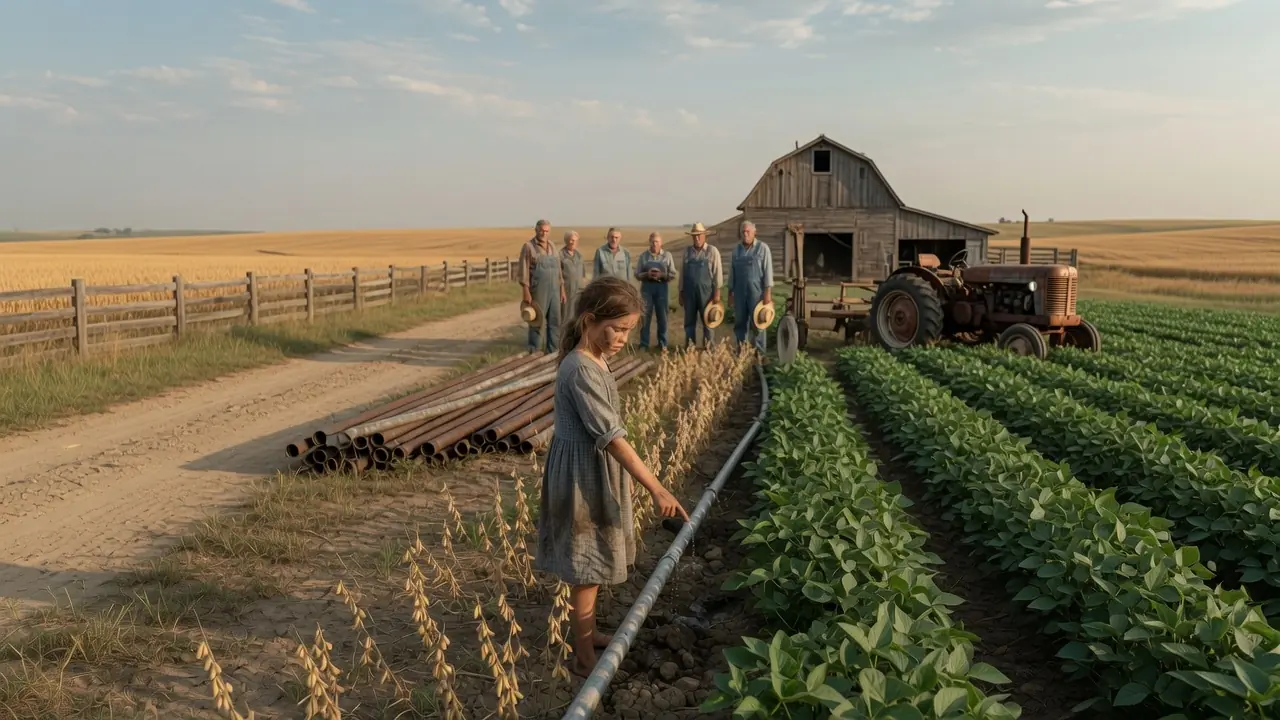
Wren, who was eight and believed her sister could probably invent rain if given enough string, followed Della everywhere. She handed over tools Della did not always need and asked questions Della sometimes answered. “What are you building?” Wren whispered one afternoon. Della looked toward the upper field. “A way for water to go where it wants to go.” Wren accepted that as if it made perfect sense.
At night, Della sat with Grandma Opal and read old pamphlets about drip irrigation and gravity-fed water systems. The words were not always easy, but Opal helped her sound them out and explained what the drawings meant. Della learned that sprinklers wasted water in heat, because some of it evaporated before reaching the ground. Drip systems worked slower, but they carried water directly to roots, where plants could drink without fighting the sun.
The problem was pressure. The pond sat lower than the upper field, which meant gravity could not pull water uphill. But Della had noticed a shallow draw on the north side of the property where rainwater pooled after storms. The draw sat higher than the struggling soybean rows. If she could collect water there and run it downhill through salvaged pipe, she might not need the pump at all.
When Della explained the idea to Harlan, he did not laugh. That was one of the reasons she loved him. He leaned against the barn door, listened until she finished, then looked across the fields for a long time. “It might leak,” he said. Della nodded. “Probably.”
“It might not make enough pressure.”
“I know.”
“It’ll be hard digging.”
“I know.”
Harlan looked down at his daughter’s dirty hands and serious face. Then he went into the barn and came back with a shovel. “Well,” he said, “hard digging goes faster with two people.”
The first version failed before it reached the first row. Water spilled from three joints, ran into the dirt, and made a muddy patch that looked almost insulting. Cass watched from the fence and laughed. “Great invention, Della.” Wren threw a clod of dirt at him and missed. Della did not cry, though her throat tightened.
That evening, she sat at the kitchen table with Opal’s pamphlets open and studied pipe fittings until the words blurred. Opal poured coffee for herself and milk for Della. “First failure tells you where the truth leaks,” Opal said. Della looked up. “Did you just make that up?” Opal smiled. “Most wisdom starts that way.”
The second attempt worked better, but not enough. Water reached the first few plants in thin, uneven drips, while the rest of the line stayed dry. Della lay flat in the dirt, staring at the emitters, trying to understand why some roots received water and others did not. She thought about Clifton’s explanation of pressure. Then she went back to the pamphlets and discovered that pipe diameter mattered more than she had realized.
She needed a wider main line to carry enough water from the collector basin, then narrower lines to feed the rows evenly. The smaller pipe she had collected was useful, but not for the place she had used it. That meant more searching, more asking, and more laughter. Della tied the trailer back to her bicycle the next morning.
This time she rode to Wendell Coe’s farm, where old vegetable equipment filled a barn like history nobody had the heart to throw out. Wendell was retired, with a beard like dry grass and a limp from a tractor accident years earlier. He listened while Della explained what she needed. Unlike the others, he did not laugh.
“You understand flow rate?” he asked.
“Some,” Della said.
“Enough to know you need bigger pipe?”
“Yes, sir.”
Wendell studied her, then opened the barn door wider. “Then let’s see what I’ve got.”
For two weeks, Della traded smaller pipe sections for larger ones, helped Wendell sort fittings, and learned more about irrigation than most children learned about anything during summer break. Wendell taught her how to check for cracks, how to angle a line, and how to think of water as lazy but obedient. “It won’t work harder than it has to,” he told her. “So give it the easiest useful path.”
By mid-August, the third version was ready. Harlan helped fit the main line while Della checked the drip tape, and June brought jars of cold water to the field. Cass pretended not to care, but he stayed close enough to watch. Wren crouched beside the first row like she was waiting for magic.
Della opened the collector gate.
For a moment, nothing happened.
Then water moved.
It slipped through the main line, down the slope, into the smaller runs, and finally began to drip slowly and steadily near the roots of the soybean plants. Not spray. Not waste. Just quiet drops disappearing into thirsty soil. Wren gasped like she had seen a miracle.
Harlan knelt and pressed his fingers into the ground after several minutes. His face changed. The soil was darkening exactly where it needed to. He looked at Della, but for once he had no words. Della smiled only a little, because the system still needed watching, adjusting, and proving.
Over the next three weeks, proof arrived leaf by leaf. The rows fed by Della’s pipe system stood greener than the rest of the upper field. Their leaves opened wider, their stems strengthened, and their pods began to fill while neighboring plants curled under the heat. Harlan walked those rows every morning, first quietly, then with a kind of disbelief he could no longer hide. June stood beside him one evening and whispered, “Our girl did that.”
Word spread slowly at first. Mr. Harris heard from Cass, who had stopped laughing and started bragging. Wendell told a man at the feed store that Harlan’s little girl had built a drip system from junk and stubbornness. Clifton Barr returned in September and walked the field with his notebook, asking Della questions with the serious respect adults usually reserved for other adults. He measured the soil moisture, checked the pipe layout, and shook his head in wonder.
“This is using less than half the water,” Clifton said.
Della corrected him softly. “About forty percent, depending on how long I let it run.”
Harlan looked at her then, pride rising in his face like sunrise. “You hear that?” he said to Clifton. “She’s got numbers now.”
By October, the farmers who had laughed began arriving at the Pruitt farm. They came in pickup trucks, old farm caps, and boots dusty from their own failing fields. Some came pretending they were only curious. Some came smiling too broadly, hoping nobody remembered what they had said from their porches. Della remembered, but she did not mention it.
They stood at the edge of the upper field and stared.
The difference was impossible to dismiss. On one side, the untreated rows looked pale and tired, surviving but barely. On the other, Della’s soybeans stood deep green and full, their leaves thick enough to shade the soil beneath them. Pods hung heavy from the plants. The old pipes ran between the rows like proof.
Mr. Harris removed his hat. “Well, I’ll be.”
Della stood beside her father with mud on her boots and a smudge on her cheek. She looked smaller than the system she had built, but not smaller than the moment. Clifton stood nearby, smiling into his notebook. Wendell leaned on his cane, looking proud enough to burst.
Harlan knelt beside the green rows, touched the damp soil, and asked what he already knew. “Della, how much water is this thing using?”
Della wiped dirt from her hands. “Less than half, Daddy. The roots get every drop.”
Mr. Harris looked down at the old pipes, then back at Della. Shame reddened his face. “We laughed when you took those old pipes, little girl.”
Della’s eyes lifted to his. “I know. But the plants didn’t laugh.”
Another farmer swallowed hard. “We thought you were just playing with broken things.”
Della pointed toward the dying rows beyond her system. Her voice stayed quiet, but every man heard it. “No, sir. You were the ones playing farmer while water ran past your roots.”
Silence settled over the field.
Harlan stood slowly, emotion tightening his face. “From now on,” he said, looking at the men around him, “anyone who laughs at my daughter can come learn from her first.”
No one laughed then.
The first farmer to ask for help was not Mr. Harris, but a younger man named Luke Bell who had inherited land too dry for the methods his father used. He stepped forward, twisting his cap in his hands. “Could you show me how to lay one of these before spring?” Della looked at him carefully. “Do you have a high draw or only low water?” Luke blinked, surprised. “A high draw, I think.”
“Then maybe,” Della said. “But first, stop calling broken things useless.”
By the next planting season, Della had become the busiest eleven-year-old in the county. Farmers brought her pipe sections, old fittings, cracked valves, and questions. Wendell helped her with measurements, Clifton brought an agricultural engineering student from Murray State, and Harlan made sure no one treated her like a novelty instead of a person with knowledge. June packed sandwiches for field visits, and Wren proudly called herself “assistant chief of tools.”
Cass changed too. He began hauling pipe without being asked and once snapped at a boy who called Della’s system a kid project. “That kid project saved our upper field,” he said. Della heard him and said nothing, but later she left an extra biscuit on his plate at supper. Siblings had their own language of apology.
The county paper printed a story about her beneath the fold. The headline called her a young innovator, which made Della hide behind the kitchen door while June read it aloud. Harlan bought three copies and mailed one to a cousin in Tennessee. Opal clipped the article and tucked it inside her favorite irrigation pamphlet. “Now you’re part of the research,” she told Della.
But Della did not feel famous. She still woke early, still checked emitters, still worried about leaks, clogs, and whether the system would hold through another dry summer. She understood better than anyone that one good field did not mean the work was finished. Water always found weakness if you stopped paying attention.
Over time, the fields around Calloway County began to change. Salvaged pipes disappeared from weeds and fence lines, reappearing in careful networks across farms that had once depended only on pumps and luck. Draws that used to hold rainwater until it vanished were shaped into catchments. Farmers who once laughed from porches now asked their children what they noticed about water after storms.
Harlan’s east field became Della’s next project. It was larger, harder, and less forgiving, with uneven slope and soil that changed halfway through. The first layout failed, and the second clogged badly after one muddy rain. Della stood in the field that day with wet shoes and frustration burning behind her eyes.
Harlan came beside her. “Still worth doing?”
Della looked across the messy lines, the standing water, and the plants waiting for a better answer. Then she nodded. “Especially now.”
He smiled. “That’s what I thought.”
By the time Della turned twelve, she no longer collected pipes alone. Farmers called before throwing anything away. Wendell taught her formulas she wrote carefully in a notebook. Clifton invited her to speak at a county demonstration day, though she made him promise she could stand beside Harlan while talking. She did not like attention, but she liked showing people that paying attention mattered.
At the demonstration, Mr. Harris stood in the front row. When someone asked whether children should really be advising grown farmers, he cleared his throat and said, “I gave that child trash, and she grew better beans than I did. I figure that earns her the floor.” Della smiled at the dirt, but Harlan saw.
Years later, people would tell the story as if it happened all at once. They would say everyone laughed, then Della built her system, then the crops turned green, and then the whole county changed. But Della knew better. Nothing changed all at once. It changed one pipe, one leak, one question, one failure, and one stubborn morning at a time.
The real miracle was not that an eleven-year-old girl collected old irrigation pipes. The real miracle was that she looked at what everyone else had thrown away and saw a path for water. She looked at dry plants and understood they did not need pity. They needed someone willing to study the problem without pride.
One evening after harvest, Della stood with Harlan at the edge of the upper field. The soybeans had been cut, the rows lay quiet, and the old pipes rested under a thin layer of dust. The sun lowered over Calloway County, turning everything copper and gold. Harlan put one hand on her shoulder.
“You changed this farm,” he said.
Della looked at the field, then at the draw, then at the pipe line that still followed the slope. “No,” she said softly. “The water did. I just stopped wasting it.”
Harlan’s eyes shone. “That’s wisdom, girl.”
Della leaned against him, tired and proud in a way she did not have words for yet. Around them, the county settled into evening. Somewhere down the road, old pipes still lay in weeds, waiting for someone to understand they were not finished.
And in Calloway County, no one laughed at that anymore.