“Ma’am, you’ll need to order something or give the table to a paying customer.”
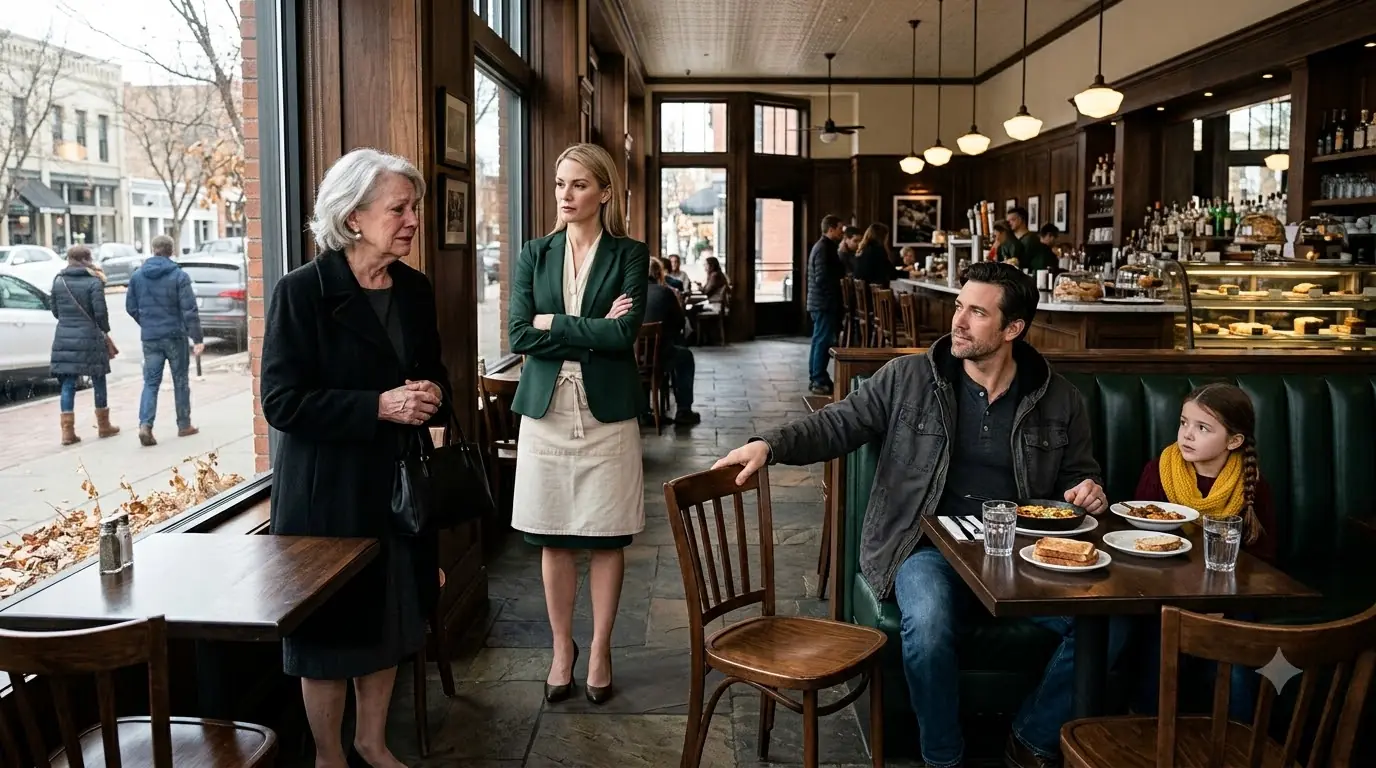
The elderly woman looked up from the laminated menu, but her eyes did not seem to focus on Tessa Monroe, the manager standing over her.
For several seconds, she simply stared.
Then she blinked.
“I only need another minute.”
Her voice was soft.
Not weak exactly.
Just tired.
Tessa folded her arms.
The Copper Lantern Cafe would be crowded within half an hour.
It was the Tuesday before Thanksgiving, temperatures had fallen overnight, and the breakfast rush always arrived early when the wind turned cold.
Table seven sat beside the front window.
Good table.
Two chairs.
Easy access to the aisle.
The woman had been sitting there almost twenty minutes.
No coffee.
No food.
No order.
Just a menu held between trembling fingers.
Her black wool coat hung loosely around her shoulders.
Her gray hair looked as though it had been brushed once and then forgotten.
Her face was pale.
Her eyes were swollen.
And one hand shook every time she tried to turn the menu page.
To Tessa, she looked like someone who had come in from the cold because she had nowhere else to go.
That happened occasionally.
The cafe sat near a bus stop and two blocks from the older section of downtown Fort Collins.
People came inside to warm themselves.
Some bought coffee.
Some tried not to buy anything.
Tessa had been instructed to manage seating during peak hours.
She took that responsibility seriously.
Perhaps too seriously.
“This isn’t a warming shelter,” she said quietly. “I’m asking you to leave.”
At the booth across the aisle, Owen Bishop stopped cutting a piece of toast in half.
He looked up.
Across from him sat his eight-year-old daughter, Ruby.
Yellow knitted scarf.
Purple sweater.
Hair tied into two uneven braids because Owen still had not mastered braids despite three years of practice.
Ruby had already heard the manager.
Her fork was suspended halfway to her mouth.
“Dad,” she whispered.
Owen glanced at her.
“She’s shaking.”
He knew.
He had noticed the woman when she came in.
Everyone probably had.
Not because she looked unusual enough to draw attention.
Because she looked invisible.
There was a particular way exhausted people moved when they were trying not to inconvenience the world.
Owen recognized it.
He had spent eight months learning it himself.
Owen was forty.
A widower.
Single father.
Former commercial refrigeration technician.
Current delivery driver, appliance-repair handyman, occasional warehouse temp, and whatever else paid enough to make rent.
Eight months earlier, he had held the same steady job he had worked for thirteen years.
Silver Pine Foods.
Cold Storage Operations.
Senior Systems Technician.
Health insurance.
Retirement account.
Company truck.
Predictable schedule.
Not glamorous.
Owen had never needed glamorous.
Then one commissioning dispute changed everything.
He lost the job.
After that, the losses came slowly.
First the truck.
Then the better apartment.
Then the savings.
Then the confidence that another company would surely hire someone with thirteen years of experience.
Employers read the same sentence on background checks.
Terminated for cause.
Failure to support management direction.
Professional insubordination.
No matter how Owen explained it, the language did damage.
He began delivering parcels before dawn.
Repairing dryers at night.
Replacing garbage disposals on Saturdays.
He accepted anything legal that did not interfere with Ruby’s school schedule.
That morning, after buying gas, he had $18.60 available until Friday.
The breakfast skillet between him and Ruby cost $12.95 before tax.
He had told himself the cafe outing was necessary.
Ruby had aced a spelling test and asked if they could get breakfast before school because her mother used to take her to the Copper Lantern every November.
Owen had almost said no.
Then he remembered how many times he had already said maybe later.
So they went.
One skillet.
Two plates.
Water for Owen.
Hot chocolate for Ruby.
He told Ruby he had eaten earlier.
She pretended to believe him.
Owen had become good at pretending not to be hungry.
Ruby had become good at pretending not to notice.
Across the aisle, the elderly woman pushed back her chair.
The legs scraped against the tile.
“I understand,” she told Tessa.
No anger.
No argument.
That somehow made the scene worse.
She began buttoning her coat.
The first button missed the hole.
She tried again.