Steam hissed around the lonely depot as Harriet Doyle dragged her battered wooden trunk onto the half-frozen platform. Snowmelt had turned the ground into black mud, and every step buried her worn boots deeper in the slush. She was twenty-nine, heavyset, pale from the long journey, and already breathing hard beneath a faded charcoal shawl. Across the platform stood Gideon Black, the mountain trapper whose name had frightened four previous brides back onto eastbound trains.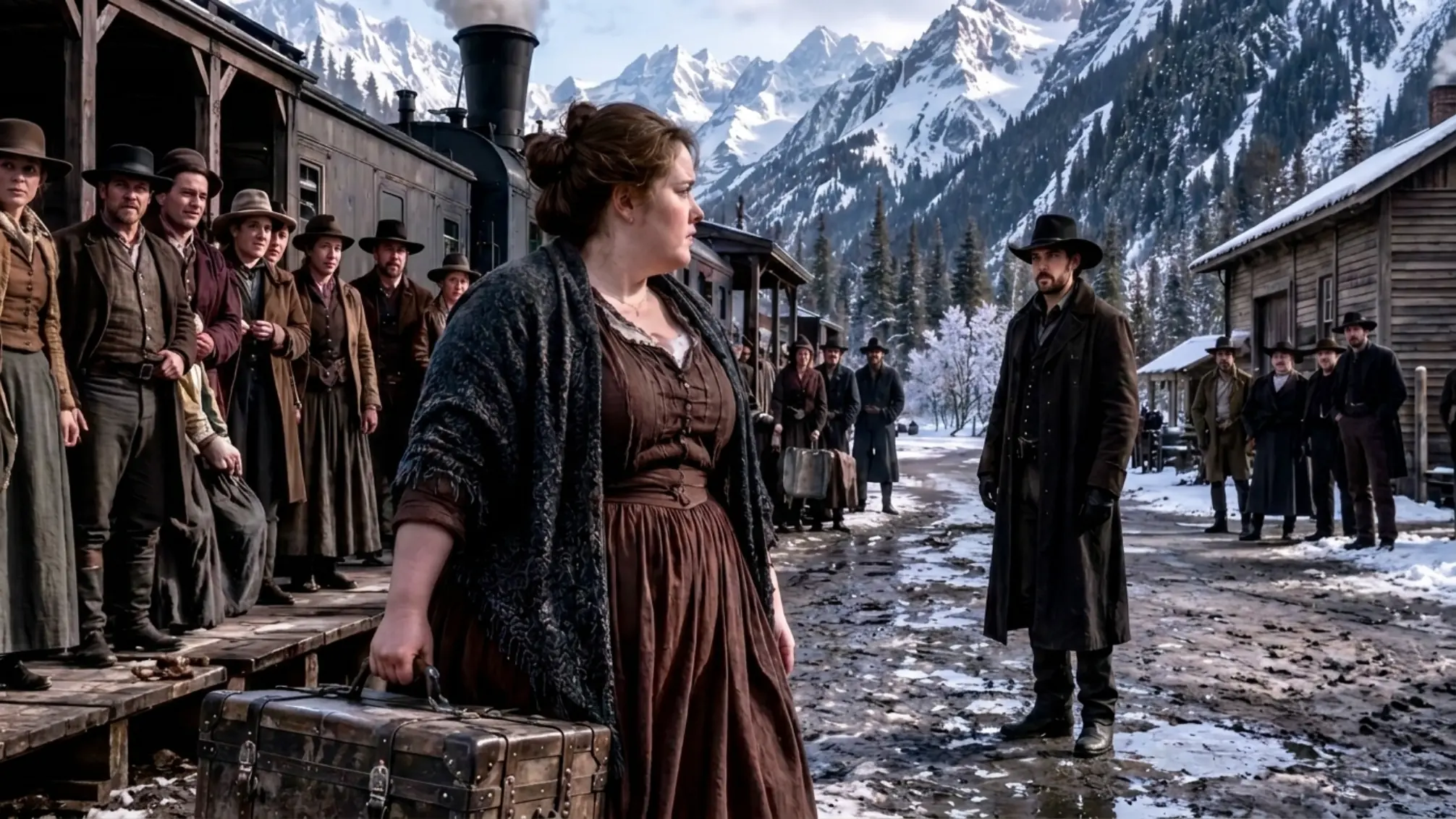
The townspeople crowded beneath the depot awning, pretending to wait for parcels while watching Harriet’s reaction. Gideon was thirty-eight, broad-shouldered and severe, with weathered skin, a thick black beard, and eyes as dark as the pine forest climbing the mountains behind him. His long trail coat moved in the wind, and one gloved hand rested near the gun belt beneath it. He did not offer to carry Harriet’s trunk.
“The wagon is a mile north,” he said. “The creek washed out the road.”
Harriet looked toward the narrow trail vanishing into the trees. “How far is your cabin?”
“Eight miles after the wagon.”
One woman near the depot whispered a prayer.
Harriet tightened her grip on the trunk. “Lead the way.”
Gideon turned without another word.
The first bride had lasted three days on his mountain. She returned to town with bleeding feet and begged strangers for train fare before Gideon reached the station. The second fought through twelve miles of snow after accusing him of trying to frighten her into obedience. The third disappeared before sunrise, leaving behind her wedding dress and a note saying no decent woman could live in a place that smelled of death.
The fourth bride remained nearly two weeks. She believed patience might soften Gideon, but his silence became heavier each day. When she finally left, she told the postmistress that he did not want a wife. He wanted another object inside his cabin that would make no demands and ask no questions.
Harriet knew those stories.
The conductor had repeated them during the final hour of her journey, perhaps hoping she would remain aboard. A traveling salesman advised her to continue west and find work in Denver. Even the depot clerk quietly offered to hide her until Gideon left.
Harriet had refused them all.
There was nothing waiting in Chicago except two brothers who had divided their dead parents’ home and decided their unmarried sister was an inconvenience. They had called her slow, clumsy, and too large for any respectable man to desire. When Gideon’s advertisement arrived through a matrimonial agency, they bought her ticket with enthusiasm usually reserved for funerals.
Harriet understood why.
If Gideon rejected her, she had nowhere to return.
The trail rose sharply beyond the depot. Harriet’s trunk struck roots, rocks, and frozen ridges while Gideon walked several yards ahead without looking back. Within twenty minutes, sweat covered her face despite the cold. Her lungs burned, and each breath felt smaller than the one before.
Gideon finally stopped beside a fallen pine.
“The train leaves tomorrow at three.”
Harriet lowered the trunk and bent forward, gasping.
“I’ll pay your fare,” he continued. “You can wait at the boardinghouse tonight.”
She slowly raised her head. “Is that what you told the others?”
“I told them the truth.”
“That they were too weak?”
“That the mountain does not care what anyone hoped to find here.”
Harriet’s eyes filled, but she did not allow the tears to fall. “I have no family, no money, and no home behind me. So unless you intend to throw me down this mountain yourself, stop offering me a road I cannot take.”
Gideon’s jaw tightened.
She dragged the trunk forward until one iron corner struck his boot.
“Now show me where the wagon is.”
For the first time, he picked up one handle.
They carried it together without discussing the change.
The wagon waited beneath a stand of fir trees, one rear wheel sunk into frozen mud. Gideon loaded the trunk, harnessed the horses, and guided them onto a narrow road climbing toward the higher peaks. The settlement disappeared behind folds of timber and stone until the only sounds were leather harnesses, turning wheels, and distant avalanches rumbling somewhere beyond sight.
Harriet studied the man beside her.
His silence did not feel peaceful. It felt guarded, like a locked door reinforced from the other side. He answered direct questions with as few words as possible and never volunteered anything about himself.
“How long have you lived here?” she asked.
“Fourteen years.”
“Alone?”
“Mostly.”
“What happened to your parents?”
“Dead.”
“Brothers?”
“One. Dead.”
Harriet looked forward. “You make conversation feel like pulling nails from a board.”
“Then stop pulling.”
She almost laughed.
The cabin appeared at sunset, crouched beneath a dark cliff where the forest opened onto a snow-covered valley. It was larger than Harriet expected but looked less like a home than a trapper’s storage shed. Animal skins hung beneath the eaves. Antlers covered one wall, and smoke leaking from the chimney carried the sour odor of burning fat.
Inside was worse.
A bucket of congealed blood sat near the hearth. Unwashed pans covered the table. Greasy hides hung from beams overhead, and the blankets on the narrow bed smelled of smoke, sweat, and old animals. A row of rifles occupied the cleanest wall in the room.
Gideon watched Harriet’s face.
“The creek is east. Woodpile is behind the shed. Don’t cross the marked trees after dark. Bears are waking hungry.”
He dropped his coat onto a chair.
Harriet looked at the blood bucket. “Where do you sleep?”
“There.”
He pointed toward the bed.
“And where am I expected to sleep?”
Gideon gestured toward a small room behind a curtain. “There is another cot.”
Harriet pulled the curtain aside. Dust covered the blanket, and mouse droppings lay beneath the window.
“The previous brides used it?”
“Some did.”
“Before or after they decided death outside was preferable?”
His eyes narrowed.
Harriet removed her shawl. “I need hot water.”
“There is a kettle.”
“And soap?”
“On the shelf.”
Gideon seemed disappointed that she had not recoiled. He collected two empty traps, muttered that he would return before dark, and left her alone.
Harriet sat at the table for ten minutes.
Her hands shook from exhaustion. Pain pulsed across her shoulders, and the cabin’s odor seemed to settle inside her throat. She imagined the Chicago kitchen where she once cooked beside her mother, sunlight warming the yellow curtains while bread rose near the stove.
That life no longer existed.
She looked at the blood bucket again.
Then she stood.
By the time Gideon returned, smoke rose cleanly from the chimney. Harriet had dragged every hide into the storage shed, thrown open the windows despite the cold, scrubbed the floor with boiling water, and burned the foulest bedding outside. The blood bucket had been emptied and scoured.
She stood at the stove cleaning a blackened skillet when Gideon entered carrying two rabbits.
He looked slowly around the room.
Without a word, he dropped the animals onto the newly scrubbed table. Fresh blood spread across the wood.
Harriet placed the skillet down.
“Skin them outside.”
Gideon looked at her.
“I just cleaned that table.”
“They freeze outside.”
“Then use the shed.”
“This is where I have always done it.”
“And four women ran away.”
His expression darkened. “You think moving a few hides makes this your cabin?”
“No. Marrying me will make it ours.”
“We are not married yet.”
“Then you have until the preacher arrives to learn manners.”
Gideon stared at her for a long moment. Harriet’s knees trembled beneath her skirt, but she held his gaze.
Finally, he picked up the rabbits.
He skinned them in the shed.
The preacher could not reach the cabin for nine days because the storm arrived before morning. Snow struck the roof like thrown stones, and wind screamed through the trees. By noon, the trail had vanished beneath several feet of white.
Harriet woke to find Gideon feeding the stove. He had left a cup of coffee near her cot.
“Storm may last three days,” he said.
“Then we have time to speak.”
“No need.”
Harriet wrapped both hands around the warm cup. “A man orders five wives from the east, frightens four away, and still believes speaking is unnecessary.”
“I ordered no one.”
“You placed advertisements.”
“They answered.”
“Why?”
Gideon looked toward the fire. “The ranch needs work.”
“You wanted unpaid labor?”
“I wanted someone who understood isolation.”
“How could a woman in Chicago understand your mountain before seeing it?”
“She could decide after arriving.”
“You made certain they decided quickly.”
His eyes shifted toward her.
Harriet continued. “You left filth everywhere. You watched them struggle with their trunks. You offered tickets home before they had eaten a meal.”
“The weak should leave before winter.”
“You wanted them gone.”
Gideon stood abruptly. “You do not know what I wanted.”
“No. Because you speak three words at a time and expect women to build a marriage from scraps.”
He crossed the room. “You ain’t going to last.”
Harriet rose despite the fear tightening her chest. She moved close enough to press one finger firmly against his coat.
“I survived brothers who called me worthless every day for ten years. I survived burying both parents, losing my home, and crossing half this country alone. So do not mistake softness for weakness, Gideon Black.”
His face remained hard, but something flickered behind it.
Harriet’s voice lowered. “If you want me gone, say it plainly. But stop asking this mountain to reject me because you are too frightened to do it yourself.”
The storm raged around them.
Gideon looked down at her finger resting against his chest. Then he stepped away.
“My first wife died here.”
Harriet’s hand fell.
He moved toward the window, where snow had begun sealing the lower glass.
“Her name was Sarah. We came from Missouri. She believed the mountain was beautiful.” His voice became rougher with every sentence. “First winter, fever came through the mining camp. Trail was closed. I tried carrying her toward town.”
Harriet said nothing.
“She died four miles from the station.”
Gideon looked toward the dark outline of the forest. “I buried her beneath the pines. After that, the cabin became whatever it became.”
“Why seek another wife?”
“Because fourteen years is a long time to hear only your own breathing.”
“And why drive them away?”
His jaw worked before the answer came. “Because each time one arrived, I saw Sarah walking through that door. Then I saw the grave.”
Harriet’s anger softened, though it did not vanish. “You decided losing someone again would hurt more than remaining alone.”
“I decided the mountain kills gentle things.”
Harriet approached him more carefully. “Then perhaps it needs something stubborn.”
He almost smiled.
That night, Gideon gave Harriet the clean bed and slept beside the hearth.
The storm continued for four days. During that time, Harriet discovered that beneath Gideon’s cruelty lived habits shaped more by grief than malice. He cut wood before she woke, left the warmest blankets near her cot, and always placed himself between her and the door when wolves howled outside.
He also argued about everything.
He claimed vegetables were food for rabbits. Harriet hid them inside stew. He insisted curtains served no purpose, so she made them from a torn flour sack. When he complained they blocked his view, she tied them back and informed him he now possessed both sunlight and civility.
On the third evening, Harriet prepared rabbit stew with dried onions and barley. Gideon ate three bowls before noticing her amusement.
“What?”
“You dislike my cooking?”
“Never said that.”
“You have barely looked up.”
“Eating.”
“Like a starving bear.”
He lowered the spoon. “Sarah could not cook.”
Harriet waited.
“She burned water once.”
“That sounds difficult.”
“She forgot it until the pot cracked.”
A laugh escaped him unexpectedly. The sound was deep, brief, and so unfamiliar that Gideon seemed startled by it.
Harriet smiled. “There you are.”
His laughter disappeared. “Who?”
“The man hiding beneath all that misery.”
He studied her across the table. “You always speak this boldly?”
“Only when silence becomes foolish.”
When the storm cleared, Gideon showed her the mountain.
He led her past the marked trees to a high meadow overlooking a frozen lake. Sunlight struck the peaks until the entire range glowed silver and blue. Harriet stood speechless while wind lifted loose strands of hair around her face.
“Sarah is buried there,” Gideon said.
A simple wooden cross stood beneath two pines.
Harriet approached it alone. She cleared snow from the name and placed one gloved hand against the weathered wood.
“I am not here to replace you,” she whispered. “But I will try to bring him back from wherever grief took him.”
Gideon heard her.
He said nothing until they reached the cabin.
“Thank you,” he murmured.
It was the gentlest thing he had given her.
The preacher arrived three days later with two witnesses from town. Harriet wore her brown dress because she owned nothing finer. Gideon shaved, trimmed his beard, and appeared in a clean black coat that made him look almost unfamiliar.
When the preacher asked whether anyone objected, the older witness coughed and stared at the floor.
Gideon took Harriet’s hand.
“I have little to offer,” he said before repeating the vows. “A hard mountain, a rough cabin, and a man who has forgotten much of what a husband should be.”
Harriet squeezed his fingers. “Then we will teach each other.”
They married beside the hearth.
News reached town quickly. Some residents expected Harriet to descend the mountain within a week. Others placed small wagers on whether she would last until spring.
She did more than last.
Harriet reorganized the smokehouse, preserved meat properly, and discovered that Gideon had been selling his finest pelts to a trader named Silas Crowe for half their value. Gideon accepted low prices because traveling farther required leaving the mountain for days.
Harriet demanded to see the account book.
“You cannot read Crowe’s marks,” Gideon said.
“I managed my father’s dry-goods accounts.”
“This is trapping.”
“Numbers do not grow fur.”
She recalculated three years of sales and found that Crowe owed Gideon nearly six hundred dollars under the written terms of their agreement. When the trader arrived, Harriet placed the ledger before him and refused to serve coffee until he explained every missing payment.
Crowe laughed.
Then Gideon stepped behind his wife.
The laughter ended.
They received four hundred dollars in cash, a new stove, and better terms for every future sale.
Harriet used part of the money to repair the cabin roof and purchase hens, seed, and medicine. She turned the lower meadow into a kitchen garden and taught Gideon to eat fresh greens without complaining loudly enough for the entire valley to hear.
Spring softened the mountain.
So did marriage.
Gideon still spoke little, but his silence changed. It no longer felt like punishment. Sometimes he sat beside Harriet on the porch while she sewed, their shoulders touching without words.
One evening, he returned from checking traps and found her kneading bread. Flour covered her hands and one pale streak crossed her cheek.
He watched from the doorway.
“Why are you staring?” she asked.
“Still expecting you to run.”
Harriet wiped her hands and approached him. “Disappointed?”
“No.”
“Afraid?”
“Every day.”
She touched his beard. “So am I.”
He leaned his forehead against hers. “What if this mountain takes you?”
“Then love me while I am still standing on it.”
Gideon kissed her slowly.
By summer, travelers began stopping at the cabin because word spread about Harriet’s bread and rabbit stew. Prospectors paid for meals, trappers traded supplies, and families crossing the pass rested beneath the porch roof. The lonely cabin became known as Black’s Mountain Table.
Gideon pretended to dislike the visitors.
Harriet noticed he always cut extra wood before they arrived.
In October, a landslide blocked the main pass and trapped seventeen travelers near the cabin. Gideon guided them through the storm while Harriet turned the house into a shelter. She fed children, treated a broken wrist, and organized sleeping spaces across every available floorboard.
For six days, the cabin that had once driven women away kept an entire group alive.
When the pass reopened, the townspeople came to help. Several stood inside the clean, warm house and stared at the curtains, shelves, polished table, and pots of food.
Mrs. Talbot from the depot approached Harriet.
“We did not think you would survive.”
Harriet smiled. “I noticed.”
“What did you do differently?”
Gideon answered from the doorway.
“She stayed.”
Harriet looked at him. “He changed.”
The townspeople glanced between them.
Gideon walked across the room and took his wife’s hand without embarrassment. “She refused to let me use grief as an excuse for cruelty.”
Harriet’s eyes filled.
“And she was right,” he added.
That winter, Gideon built a larger room onto the cabin. He claimed it was for travelers, but Harriet found a small cradle hidden beneath a blanket before the roof was finished.
She held it up when he returned from the forest.
“Expecting a very small traveler?”
His weathered face reddened. “Maybe someday.”
Harriet placed the cradle near the bedroom wall.
“Someday,” she agreed.
Months later, she stood beside Sarah’s grave while Gideon replaced the old cross with a stronger one. They did not erase the first wife’s place in his life. Harriet understood that love did not require destroying what existed before it.
Gideon carved a final line beneath Sarah’s name.
She taught me love could survive death.
Then he looked at Harriet.
“And you taught me the living still need it.”
She rested her head against his shoulder.
Far below, smoke rose from the town where four women had once returned with stories of Gideon Black’s terrible mountain. Those stories remained true. He had been cold, cruel, and determined to make every bride prove his worst beliefs.
The fifth bride had simply refused to obey the ending he expected.
Harriet had crossed the country believing she was unwanted. Gideon had spent fourteen years believing everyone he loved would be taken from him. Neither arrived on that train platform whole.
They did not save each other in a single grand moment.
They did it through scrubbed floors, honest words, shared meals, repaired ledgers, quiet apologies, and the daily courage to remain when fear demanded distance.
Years later, travelers still repeated the story of the five brides who climbed Gideon Black’s mountain. They remembered the four who fled and the stubborn woman who dragged a trunk through frozen mud rather than surrender.
But Gideon remembered something different.
He remembered the moment Harriet pressed one finger against his chest and told him she would break his silence before the mountain broke her.
She kept that promise.
And once the silence finally shattered, the mountain no longer felt like a grave.
It became their home.