The night the blizzard hit Ridgemont, Ohio, the windchill dropped to thirty-eight below zero.
Roads closed.
Power went out.
The whole town went dark.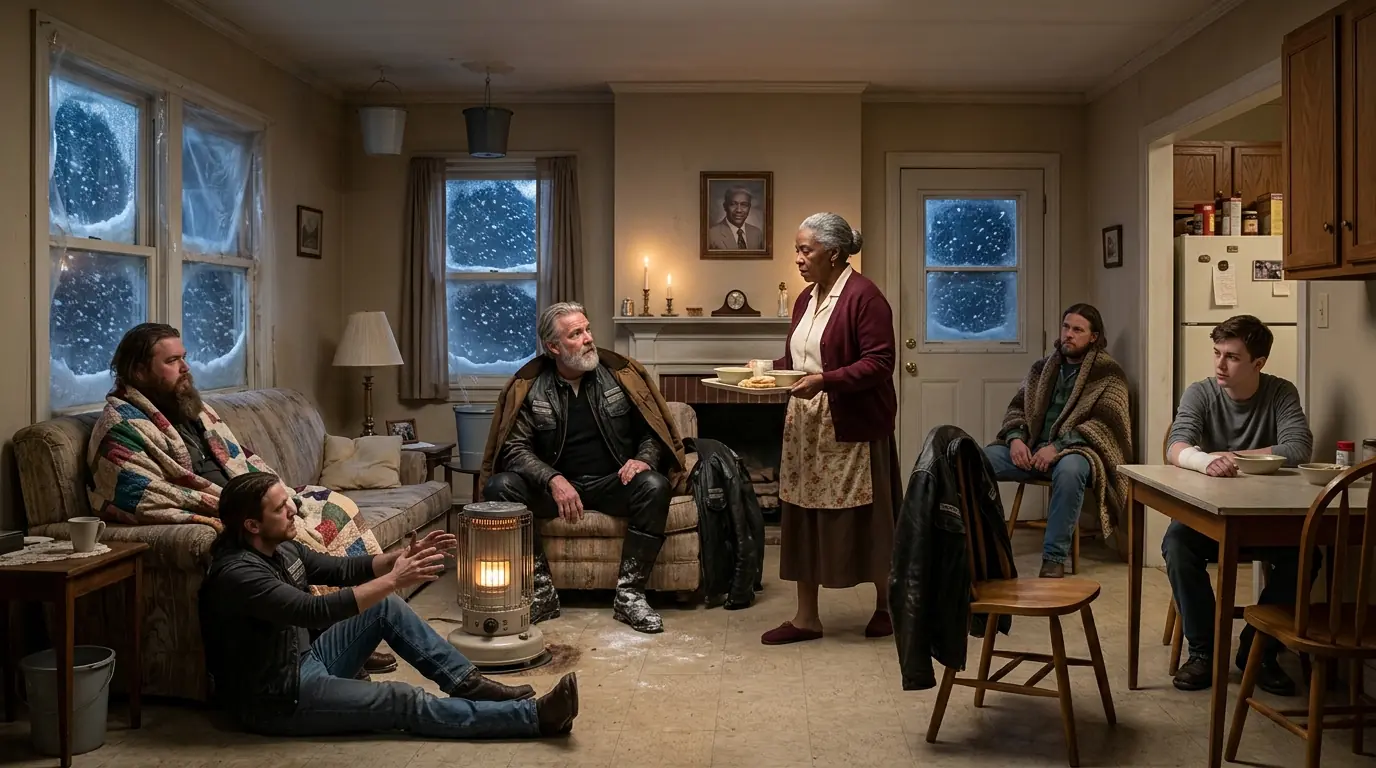
And on a dead-end street called Maple Terrace, a seventy-two-year-old grandmother heard three heavy knocks on her front door.
She opened it.
Standing on her porch were five Hells Angels bikers, leather cuts, tattoos up their necks, snow caked on every inch of them.
One was bleeding.
Most people would have called the police.
Irene Wilson invited them inside and made them soup.
She gave them her blankets, her dead husband’s coat, and her last bit of food.
She had no idea that the man standing at the front of that group was worth more than her entire zip code.
And what happened the next morning was the part that changed everything.
But before we get to that night, you need to understand something first.
You need to know who Irene Wilson really was, and why she had every reason in the world to keep that door shut.
Ridgemont, Ohio.
A small town about two hours southeast of Cleveland.
The kind of place that used to mean something.
Back in the seventies and eighties, Ridgemont was a steel town. Good jobs. Full churches. Families on every porch in the summer.
You could raise kids there and feel proud about it.
But then the plant closed.
Then another one closed.
Slowly, year after year, people started leaving.
By the time this story takes place, Ridgemont had lost nearly half its population. Main Street was mostly boarded-up storefronts and dollar stores, the kind of town people drive through without stopping.
And right in the middle of it, on a quiet dead-end street called Maple Terrace, lived Irene Wilson.
Seventy-two years old.
Retired school cafeteria worker.
Widowed.
Her husband Earl had passed away eleven years ago from complications tied to a factory injury. The plant had already shut down by then. His disability checks barely covered his medications.
At the end, Irene held his hand in that hospital room and promised him she would be okay.
She kept that promise.
Mostly.
Irene lived alone in the same small two-bedroom house Earl bought in 1979. He built the back porch himself, his hands, his lumber, his weekends.
She never changed a thing about it.
Every morning, Irene was up by 5:15.
Not because she had to be.
Just because that was who she was.
She made coffee in the same percolator she had owned since 1989. She fed the two stray cats who had shown up on her porch years ago.
She named them Bishop and Deacon.
Then she sat at the kitchen table, read her devotional, and talked to Earl’s photo on the mantel.
“Storm’s coming, baby,” she told him that week. “Big one this time.”
Now, let me tell you about Irene’s situation, because it matters.
She lived on a Social Security check.
One thousand one hundred forty-three dollars a month.
That was it.
That was everything.
Her roof had been leaking since last spring. She had three buckets lined up in the attic to catch the drips. Every time it rained, she emptied them and put them back.
She owed twenty-two hundred dollars on a medical bill from a fall last October. She had slipped on the front steps, bruised her hip badly, and gone to the emergency room because she could not stand up.
The bill came three weeks later.
She put it in a drawer because looking at it made her chest tight.
Her furnace broke in November. The repair estimate was more than she could afford, so she heated the house with a kerosene space heater and the oven door cracked open.
Low heat running all night.
Two sweaters.
A quilt to bed.
Most nights, that was how she made it through.
She taped plastic sheeting over every window to keep the drafts out. The tape was peeling in the kitchen, and she kept pressing it back down.
But here is what you need to understand about Irene.
She never complained.
Not once.
Not to her neighbor Patrice, not to the Fletcher family down the street, not to anyone.
It was not denial.
It was something deeper than that.
Irene believed, truly, all the way down to her bones, that you make do with what you have.
And while you are making do, you find a way to help somebody else.
That was her code.
That was her religion, really.
She watched the Fletcher kids after school three days a week so their mother could pick up a second shift at the warehouse. She did not charge a dime.
She left foil-wrapped plates of food on porches when she knew someone was going through a hard time. She did not knock. She did not wait for a thank you.
She just left the plate and walked home.
Last summer, she organized the only neighborhood cleanup Maple Terrace had seen in years. She printed flyers at the library.
Six people showed up.
She thanked every single one of them like they had given her a gift.
That was Irene.
Invisible to the town council.
Invisible to the system.
Forgotten by the church she had attended for forty years after it merged with a parish twenty-five minutes away, a drive she could not make in winter.
She did not have the internet. She did not have a cell phone plan with data. She had a landline, a radio, and a TV with three channels.
But she had something most people do not.
She had a kind of grace that did not ask for anything back.
She meant every word.
The afternoon of February 14, the sky went dark at 3:00.
Snow started falling by 4:00.
Heavy.
Fast.
The radio said the interstate was closing. Blizzard warning through the night. Windchill dropping below minus twenty.
Irene moved through the house with quiet purpose. She filled every pot and pan with water just in case the pipes froze. She checked the kerosene. She stacked extra blankets on the couch.
Then she did something small, something she could not explain later.
She walked to the hallway closet, pulled out Earl’s old hunting coat, brown canvas, wool-lined, still smelling faintly like him after all these years.
She laid it across the arm of the couch.
“Just in case somebody needs it,” she whispered.
She did not know why she said it.
She would understand by morning.
By 7:00, Ridgemont was buried.
Snow came down so thick you could not see the house across the street. Wind screamed through the power lines. Trees cracked under the weight of ice.
Then the power went out.
The whole east side of town went dark just like that.
No streetlights.
No porch lights.
Nothing.
Irene’s block went silent.
She lit two candles, set one in the kitchen window, and set one on the mantel next to Earl’s photo.
Then she turned the kerosene heater up as high as it would go.
The temperature outside was twenty-two below zero, with windchill pushing it even further down. The kind of cold that hurts your lungs when you breathe.
Irene pulled her quilt tighter around her shoulders and sat in the recliner.
The house creaked and groaned against the wind like it was trying to hold itself together.
She was alone.
And it was going to be a long night.
But five miles north of Ridgemont, on Highway 44, five men were fighting for their lives.
They were Hells Angels, a chapter from upstate New York.
Five riders on five Harleys heading south for a memorial ride. They were honoring a fallen brother, a man who had ridden with them for over twenty years and died of cancer the previous spring.
Every year since, they made this ride.
Same route.
Same weekend.
It was sacred to them.
The leader of the group was a big man, fifty-six years old, with a silver beard, broad shoulders, wraparound glasses, and hands like catcher’s mitts.
His name was Garrett.
Riding behind him were Colton, Danny, and two others.
Five men.
Five machines.
Miles of empty highway.
The storm came in faster than anyone expected. The forecast said snow after midnight, but by 6:30, visibility was already down to almost nothing.
The road turned into a sheet of ice.
Garrett’s bike went down first.
The front tire caught a patch of ice, and the Harley slid sideways. Eight hundred pounds of metal skidded across frozen asphalt.
He went down hard, rolled twice, and got up slowly.
The others stopped. Two of the bikes would not restart in the cold. Engines flooded. Batteries drained.
Colton, the youngest in the group, mid-twenties, had caught road rash through his jacket. A deep gash ran from his elbow to his wrist, blood soaking through the leather.
His arm was going numb.
They were stranded.
No cell signal.
Towers were down from the ice.
The GPS showed one town nearby.
Ridgemont.
Four point eight miles south.
Garrett made the call.
“We walk. Push what we can. Leave the rest.”
They buried three bikes in snowdrifts on the shoulder, pushed two, and started south into the wind.
Five men in leather jackets and boots, walking through a blizzard in the dark.
Hypothermia in conditions like that sets in fast. Thirty minutes, maybe less, for exposed skin. These men were wet. Colton was bleeding. The wind cut straight through the leather like it was not even there.
Every step was a fight.
Garrett kept them moving.
He walked at the front and kept turning around, counting heads.
“Nobody sits down,” he told them. “Nobody stops. You stop, you die.”
It took them almost two hours to reach the edge of Maple Terrace.
When they got there, every house was dark, either empty or locked up tight. People hiding from the storm behind closed doors.
They knocked on the first house.
No answer.
They knocked on the second.
A curtain moved.
Then nothing.
One of the men cursed under his breath.
Colton was shaking so badly he could barely stand. Danny’s feet were going white.
They were running out of time.
Then Garrett saw it.
At the end of the block, one small flickering light.
A candle in a window.
The only light on the entire street.
Irene’s house.
He walked up the porch steps. His boots were caked in two inches of ice. Every joint in his body was screaming.
He knocked.
Three heavy knocks.
The screen door rattled.
Inside, Irene heard it.
She froze, set down her coffee cup, looked at the door, then looked at Earl’s photo.
She picked up the flashlight from the kitchen counter, walked slowly to the front door, put her hand on the knob, took a breath, and opened it.
What she saw stopped her.
Five enormous men.
Leather vests.
Hells Angels patches on their backs.
Beards.
Tattoos.
Snow crusted on every surface of their bodies.
One of them was bleeding through his sleeve.
Five white bikers on a grandmother’s porch in the middle of the night.
Everything in Irene’s life, every story she had heard, every warning, every reason the world had given her to be afraid, stood right there in front of her.
Garrett looked at her.
His voice was barely above a whisper.
“Ma’am, I’m real sorry to bother you. We got caught out in the storm. One of my guys is hurt. We just need to get out of the cold.”
The wind howled behind them.
Silence.
Irene looked at his face.
Then at the bleeding young man behind him.
Then back at Garrett.
She opened the door wider.
“Well, get in here before you freeze to death. All of you.”
What happened inside that house over the next five hours was where this story really began.
Five men filed through Irene’s front door one by one. They filled her small living room completely, shoulders touching walls, heads nearly brushing the ceiling.
Snow melted off their boots onto the linoleum. Water pooled around their feet. The whole room smelled like wet leather and frozen road.
Irene did not flinch.
Not once.
She looked at them the way a woman looks at a problem she has already decided to solve.
“Sit down wherever you can,” she said. “And somebody get that boy to my kitchen table.”
Colton, the young one with the gash on his arm, was guided to a chair by Danny.
His face was pale. His lips had a blue tint. The cut on his forearm was ugly, deep, and still bleeding through the torn leather of his jacket.
Irene went straight to the bathroom and came back with Earl’s old first aid kit from under the sink, a white metal box with a red cross on the front.
She had kept it stocked for eleven years.
Just in case.
She sat down across from Colton, took his arm gently, and rolled back the sleeve.
He winced.
“Hold still, baby,” she said. “I’ve patched up worse.”
She cleaned the wound with peroxide.
Steady hands.
No hesitation.
The young man hissed through his teeth. She did not rush. She did not apologize.
She just worked.
She tore strips from a clean bed sheet without thinking twice and bandaged his arm tight, neat, careful, like she had been doing this her whole life.
“There,” she said. “That’ll hold until you see a real doctor.”
Then she stood up and went to work on the next problem.
Food.
She had a pot of chicken soup on the stove, made that afternoon, enough for maybe two servings. Her dinner tonight and lunch tomorrow.
She looked at the pot.
Then she looked at the five men in her living room.
She did the math in her head.
Then she added water, opened a can of kidney beans from the pantry, poured in a cup of rice, stirred it all together, and turned the flame up.
She pulled out a sleeve of saltine crackers, half a loaf of bread, and a jar of pickles she had canned last summer.
She served them first.
Every one of them.
Bowls of soup.
Crackers on the side.
Bread torn into pieces.
She did not make a bowl for herself.
Garrett noticed.
“Ma’am, aren’t you going to eat?”
“I had a big lunch,” she said.
She had not.
Then came the cold.
These men were soaked through, shivering down to their bones. Colton’s teeth were chattering so hard you could hear it across the room.
Irene moved through the house, pulling every warm thing she could find.
Quilts from both beds.
A wool blanket from the hallway closet.
An old afghan her mother had crocheted forty years ago.
Then she went to the couch and picked up Earl’s hunting coat, the one she had laid out that afternoon without knowing why.
She walked over to Garrett.
He was the biggest, the coldest, standing by the wall because there was not room for him to sit.
She held out the coat.
“Put this on,” she said. “It was my husband’s.”
Garrett looked at her.
Then at the coat.
Something passed across his face, an emotion he was not used to showing.
He took it and put it on.
It fit almost perfectly.
“Thank you, ma’am,” he said quietly.
Then Irene turned to Danny.
His boots were off. His feet were white.
Early frostbite.
She knelt down on the floor, a seventy-two-year-old woman on her knees on cold linoleum, and took his feet between her palms.
She rubbed them slow and firm, working the blood back in.
Danny stared at her.
He did not say a word.
His eyes were red.
She rubbed until the color started coming back. Then she pulled off her own wool socks, the ones she was wearing, and put them on his feet.
“Those are my good socks,” she said. “Don’t you go running off with them.”
Danny laughed.
It was the first time any of them had laughed in hours.
While all of this was happening, Garrett was watching.
He did not say much.
He just watched.
He noticed the three buckets in the hallway lined up under brown water stains on the ceiling.
The roof was leaking.
He noticed the plastic sheeting taped over the windows, peeling at the edges.
He noticed there was no furnace running, just a kerosene heater in the corner doing its best.
He noticed the framed photos on the wall.
Irene and Earl on their wedding day.
A group shot from the school cafeteria.
Irene in a hairnet, smiling, surrounded by children.
And he noticed something on the floor under the kitchen table.
A magazine, old and dog-eared, being used to prop up a wobbly table leg. He could not read the cover from where he was sitting, but the corner of a face was visible, along with a headline in bold letters.
He did not think about it.
Not yet.
Irene hung the men’s vests near the kerosene heater to dry. As she draped Garrett’s vest over a chair, she noticed the back, the big patch, the Hells Angels death head.
She knew what that was.
Everybody did.
But below it, there was a smaller patch, harder to see, a letter that looked like a T inside some kind of gear shape.
She did not ask about it.
Garrett did not explain it.
A silence settled over the room.
Not awkward.
Just honest.
Garrett looked at Irene and nodded.
Something connected between them in that moment, two people who understood what it meant to keep going after losing someone who made the world make sense.
Danny showed her a photo on his phone.
His daughter, five years old, blonde curls, missing a front tooth.
Colton talked about his mother, who lived alone in Pennsylvania. He called her every Sunday.
Irene listened to every word like it mattered.
Because to her, it did.
That was who she was.
The kind of person who made you feel like what you said was important.
By 1:00 in the morning, the men were asleep, stretched out on her floor, her couch, and her recliner.
Five massive men crammed into a tiny living room, wrapped in quilts and afghans.
Irene did not sleep.
She sat at the kitchen table, kept the kerosene heater going, watched the candle, listened to the wind, and made sure the house stayed warm.
She kept watch over five strangers like they were her own family.
At 3:00 in the morning, she stood up quietly and went to the kitchen.
She took the last of her flour, the last of her sugar, a little bit of buttermilk, and made biscuits from scratch on the gas stove in the middle of a blizzard.
She set them on a plate, covered them with a clean towel, and put them on the counter for morning.
Then she sat back down and waited for the sun.
When the sun came up, the storm was over.
Morning light came through the plastic-covered windows.
Soft.
Golden.
The wind had stopped.
Two feet of snow covered the ground, but the sky was clear for the first time in fourteen hours.
The men woke up one by one, stiff, sore, blinking in the light.
Then they smelled it.
Coffee.
Irene’s last can of Folgers.
And biscuits, warm and golden, sitting on a plate with strawberry preserves she had canned last summer.
Five massive bikers crammed around a kitchen table built for two.
Elbows bumping.
Knees against the wall.
Eating biscuits with homemade jam like it was the best meal of their lives.
Because right then, it was.
Colton ate three.
Danny closed his eyes on the first bite.
One of the other men just shook his head and whispered, “Man.”
Irene stood by the stove watching them eat, sipping her coffee, a small smile on her face.
This was her gift.
Not the food itself.
But knowing she had kept them alive through the night.
When they finished, Garrett pushed back from the table. He reached into his vest, dry now from hanging near the heater, and pulled out a thick fold of cash.
Hundreds.
At least fifteen hundred dollars.
He set it on the table.
“Ma’am, this is for everything you did last night. Please take it.”
Irene looked at the money.
She did not touch it.
She pushed it back across the table.
Slow.
Steady.
No hesitation.
“Put that away,” she said.
Firm.
Not angry.
Just clear.
“I didn’t help you for money. I helped you because you needed help. That’s the beginning and the end of it.”
The room went quiet.
Garrett stared at her.
His eyes got wet just for a second.
He blinked it away, the kind of man who had not cried in front of anyone in decades.
He nodded.
Then he put the money back.
After that, he did something none of his men expected.
He pulled out a small notebook from his inside pocket.
Not a napkin.
A leather-bound notebook, dark brown, with gold-edged pages.
The kind of thing you would see in a boardroom, not on a biker.
“Can I have your name, ma’am?”
“Irene Wilson.”
He wrote it down, careful and deliberate.
Then he asked for her address.
Irene laughed.
“Honey, you don’t owe me a thing.”
“Just in case I want to send a thank you,” he said.
She gave it to him.
He wrote it down, closed the notebook, and slipped it back inside his jacket.
Before they left, the men did something that surprised her.
They helped.
Two of them cleared the snow off her porch steps. Garrett salted the walkway with rock salt from a bag by the house.
Danny noticed the broken hinge on her screen door, the one that had been sticking for months, and fixed it with a multi-tool from his pocket.
He did not ask.
He just did it.
Colton was the last one out.
He stopped, turned around, and squeezed Irene’s hand, his bandaged arm still wrapped in her bed sheet strips.
“You remind me of my grandma,” he said, his voice cracking.
Irene patted his arm.
“You call your mama when you get home. You hear me?”
He nodded.
He could not speak.
Then he walked out.
She stood in the doorway and watched them go.
Five figures in leather walking through white snow, getting smaller until the road curved and they disappeared.
Irene went back inside, closed the door, sat at the kitchen table, and finished her coffee alone.
For about two weeks, nothing happened.
And Irene figured that was the end of the story.
She was wrong.
Life went back to normal.
The pipes survived.
The roof still leaked.
The buckets went back in the attic.
Same routine.
Same quiet days.
Irene told the Fletcher kids about the bikers over after-school snacks. Their eyes went wide.
She laughed about it.
“Five big old boys sleeping on my floor,” she said. “Earl would have had a fit.”
The kids asked if she was scared.
She thought about it for a second.
“No,” she said. “They were just cold.”
That was that.
A good story for the kitchen table.
Nothing more.
Then strange things started happening.
First, a delivery from the hardware store downtown.
Two kerosene heater refills dropped off right on her porch.
Already paid for.
Irene did not order them.
She called the store. The clerk said someone phoned it in and paid with a credit card over the phone.
They would not leave a name.
“Must be a mistake,” Irene said.
“No, ma’am,” the clerk said. “They gave your exact address.”
She let it go.
She figured maybe someone from church was being generous.
Then, a week later, a truck pulled up on Maple Terrace.
A white truck with a roofing company logo on the side. Two-man crew.
They knocked on Irene’s door and told her they had been contracted to do a courtesy inspection on her roof.
Irene stood in the doorway with her arms crossed.
“Contracted by who?”
The foreman checked his paperwork, flipped a page, and ran his finger along a line.
“Client is listed as Trident Holdings.”
Irene frowned.
“Never heard of them.”
“That’s all I got, ma’am. They just want us to take a look. No charge to you.”
She was suspicious, but the roof was leaking and had been for months.
So she let them up.
They took photos, measured, made notes, thanked her, and left.
That evening, Irene mentioned it to her neighbor Patrice over the fence.
“Trident Holdings,” Patrice said. “That sounds like one of those big investment companies.”
Irene waved it off.
“Probably some kind of scam.”
But something nagged at her that night.
She went to the kitchen, looked at the wobbly table, bent down, and pulled out the old magazine she had been using to prop up the leg.
She held it up and looked at the cover for the first time in months.
America’s Most Unconventional CEOs.
A row of small photos ran along the bottom, faces she did not recognize, names she had never heard.
She stared at it for a moment.
Something flickered at the edge of her mind.
Something she could not quite reach.
Then she shook her head, put the magazine back under the table leg, and went to bed.
Then one morning, three weeks after the blizzard, a SUV pulled up on Maple Terrace, and everything Irene thought she knew about that night changed.
It was a Tuesday, just after 10:00 in the morning.
Irene was washing dishes at the kitchen sink when she heard it.
An engine.
Low and heavy.
Not the kind of car you usually heard on this street.
She looked out the window.
A Cadillac Escalade with tinted windows was parked in front of her house, brand new, chrome wheels still shining like it had just rolled off a lot.
Neighbors noticed.
Patrice came out to her front porch. The woman across the street pulled back her curtain.
A car like that on Maple Terrace meant something.
And it was never ordinary.
Two men in dark suits stepped out of the back seat. They stood by the car, hands folded, sunglasses on like Secret Service agents.
Then the front passenger door opened, and a man stepped out.
Tall.
Broad shoulders.
Clean-shaven.
Silver hair cut short.
Wearing a tailored charcoal overcoat and polished shoes.
Irene did not recognize him.
Not at first.
He looked like he had just walked off the cover of a business magazine.
And in a way, he had.
He walked up her porch steps, the same steps he had climbed three weeks ago, caked in ice and half frozen to death.
This time, his shoes were dry.
His back was straight.
His face was calm.
He knocked.
Two knocks.
Gentle this time.
Irene opened the door, looked at him, looked at the Escalade, looked at the men in suits standing by the car.
Then she looked back at his face.
Something clicked.
The eyes.
She recognized the eyes.
“Well, I’ll be,” she said slowly. “The biker.”
Garrett smiled.
“Yes, ma’am.”
He stood there in her doorway, the same doorway where he had stood shaking and half dead three weeks earlier, and introduced himself properly.
His full name was Garrett Sullivan.
He was the founder and CEO of Trident Holdings, a logistics and infrastructure conglomerate based out of Columbus, Ohio.
He started the company at twenty-nine years old in a rented warehouse with two employees and a used truck.
Twenty-six years later, that company was worth 2.8 billion dollars, with four thousand employees across six states.
Garrett Sullivan was one of the most powerful businessmen in Ohio.
And three weeks ago, he had been freezing to death on Irene Wilson’s porch.
Irene’s eyes went wide.
She looked at the Escalade again.
Then the suits.
Then back at Garrett.
“You’re telling me you’re some kind of CEO?”
“Yes, ma’am,” he said simply.
No flash.
No ego.
“But that night, I was just a man freezing to death. And you saved my life.”
Irene put her hand on the doorframe to steady herself.
Her mind was racing.
The memorial ride. His brother. The fallen one they were honoring.
That man had been a lifelong Hells Angels member, and he had died of cancer last spring. Every year since, Garrett rode with the chapter, same route, same weekend.
No bodyguards.
No Escalade.
Just leather and the road.
That was who he was that night.
Not a CEO.
Just a brother honoring a brother.
But now, standing in her doorway in a charcoal overcoat, the other side of him was showing.
Suddenly, the pieces started falling into place.
The patch on his vest, the small T inside a gear shape.
That had not been a biker patch.
That was the Trident Holdings logo.
Irene had looked right at it and hung it by the heater to dry.
The leather notebook, dark brown, with gold-edged pages.
That had not been a journal.
That was his daily planner.
The kind a man carries when his schedule runs a four-thousand-person company.
The way he said, “Yes, ma’am.”
The way he took his boots off at the door.
The way he folded the quilt she gave him.
The way he silenced one of his men with a look when feet went on the couch.
That was not just politeness.
That was discipline.
The habits of a man who ran boardrooms for a living.
And the magazine, the one under her kitchen table, propping up the wobbly leg.
America’s Most Unconventional CEOs.
His face was on that cover.
She had been using it to level her table for six months.
Irene stared at Garrett.
Then she started to laugh.
Not a polite laugh.
A deep, full, surprised laugh.
The kind that shakes your whole body.
“I used your face to keep my kitchen table from wobbling,” she said.
Garrett laughed, too.
The men in suits by the car looked at each other, confused.
The ice broke completely.
Then Garrett got serious.
He stepped inside and sat down at her kitchen table, the same table, the same chair, the same spot where he had eaten her biscuits three weeks ago.
He looked around the room.
At the buckets.
At the plastic windows.
At the kerosene heater doing the work of a furnace that did not run.
Then he looked at Irene.
“Miss Wilson,” he said, “I’ve sat in boardrooms with people who had every advantage in the world. Money, power, resources. And most of them wouldn’t have opened that door.”
He paused.
“You had every reason not to. Every single one. And you didn’t just open it. You gave us everything you had.”
His voice was steady, but his eyes were not.
“I’ve been thinking about that night every single day since.”
He leaned forward.
“I want to do something. Not as payment, because you made it very clear how you feel about that.”
Irene almost smiled.
“As an investment,” he said. “In you and in this neighborhood.”
The room was quiet.
The heater hummed.
The candle on the mantel, still there from that night, flickered once.
Irene looked at Earl’s photo.
Then back at Garrett.
She did not say yes.
She did not say no.
She said, “I’m listening.”
What Garrett offered Irene that morning was not just generous.
It was the kind of thing that changes a whole community’s story.
He reached into his coat and pulled out a folder, then set it on the kitchen table between them.
He did not open it yet.
“I’m going to walk you through this one piece at a time,” he said. “And I need you to hear the whole thing before you say a word. Can you do that for me?”
Irene folded her hands in her lap and nodded once.
Garrett opened the folder.
“First, this house.”
He looked around the room.
The water stains on the ceiling.
The plastic on the windows.
The buckets in the hallway.
“Trident Holdings is going to renovate your home top to bottom. New roof, new furnace, updated electrical, plumbing, insulation. Every window replaced.”
Irene opened her mouth.
Garrett held up a hand.
“I’m not finished.”
He looked at her carefully.
“We’re not tearing anything down. Earl built that back porch. We’re not touching it. We’re fixing everything around it.”
Irene’s eyes filled.
She pressed her lips together.
She did not speak, but her chin trembled just slightly.
Garrett turned to the second page.
“Now, I noticed something about you that night, Miss Wilson, and I’ve been thinking about it ever since.”
He paused.
“You feed people. That’s who you are. You made soup for five strangers out of almost nothing. You leave plates on your neighbors’ porches. You feed those kids after school. Feeding people, that’s your thing.”
Irene said nothing, but her hands tightened in her lap.
“Two blocks from here, there’s a vacant storefront. Used to be Ridgemont Hardware. Been sitting empty for three years.”
Irene knew the building.
She passed it every time she walked to the corner store.
Dusty windows.
Faded sign.
Weeds growing through the sidewalk cracks out front.
“Trident’s charitable foundation is going to convert that building into a community kitchen and meal program. Full commercial kitchen, tables for forty, open five days a week.”
He looked at her.
“And you’re going to run it.”
Irene blinked.
“Me?”
“You. Head of operations. Paid position. You’ll have a staff of five, all hired from this neighborhood. We’ll cover everything, rent, utilities, equipment, food supply, for the first three years. After that, we transition to a sustainable model with local partnerships.”
Irene stared at him.
Her mouth was slightly open.
No words came out.
Garrett turned another page.
“Third, this street.”
He gestured toward the window.
“Maple Terrace. Cracked sidewalks. No streetlights on the south end. Kids playing in the road because there’s nowhere else.”
He continued.
“Trident Foundation is putting up a five-hundred-thousand-dollar block grant for Maple Terrace, specifically sidewalk repair, new streetlights, and a playground on that empty lot at the end of the block.”
He let that sit for a moment.
“The grant will be managed by a community board, local residents making local decisions, and I’d like you to chair it.”
Irene’s hands were shaking now.
She pressed them flat against her knees.
Garrett turned to the last page.
“One more thing.”
He set down his pen.
This one was personal. She could see it in his face.
“Trident is establishing two annual college scholarships, fifteen thousand dollars each, awarded to Ridgemont High School seniors who demonstrate community service.”
He looked at her.
“They’ll be called the Earl and Irene Wilson Scholarships.”
That was when Irene broke.
Not dramatically.
Not the way people break in movies.
She did not scream.
She did not fall out of her chair.
She just went very, very still.
Then the tears came.
Slow.
Quiet.
Rolling down her cheeks, one after another.
The kind of tears that come from a place so deep you did not even know it was there.
The tears of a woman who had held everything together, every bill, every leak, every cold night, every empty chair at the table, for eleven years alone, without asking anyone for anything.
And someone finally saw her.
The room was silent except for the hum of the kerosene heater.
Garrett did not speak.
He just sat there and gave her space.
After a long moment, Irene wiped her face with the back of her hand, took a breath, steadied herself, and spoke quietly, almost in a whisper.
“You’re telling me those kids on this street are going to have a place to play.”
Garrett nodded.
“And somebody’s going to help them go to college.”
“Yes, ma’am.”
“Because I made soup.”
Garrett leaned forward. His voice was steady, but his eyes were full.
“Because you opened the door, Miss Wilson.”
Another silence followed.
Longer this time.
Irene looked at Earl’s photo on the mantel.
She looked at it for a long time, like she was telling him something, like she was asking permission.
Then she looked back at Garrett.
“Can I name the kitchen after Earl, too?”
Garrett did not hesitate.
“You can name it whatever you want.”
Irene reached across the table, her small hand half the size of his.
They shook on it.
“Then we’ve got a deal,” she said.
And for the first time in that conversation, Irene Wilson smiled.
Really smiled.
The kind of smile that changes the whole shape of a face.
The kind that comes from somewhere so real it almost hurts to look at.
Garrett smiled back.
Outside, the sun hit the snow on Maple Terrace, and the whole street lit up white.
But this story does not end with Irene.
It ripples.
Three months after that morning at the kitchen table, construction crews showed up on Maple Terrace.
Trucks.
Scaffolding.
Workers in hard hats carrying lumber up Irene’s front steps.
The roof came off first.
The old one, patched, leaking, held together with prayers and buckets, was gone.
In its place came new shingles, new flashing, and new gutters.
Then the furnace.
A real one, installed in the basement.
For the first time in over a year, Irene turned a thermostat dial and felt warm air come through the vents.
She stood over the vent in the hallway for five minutes.
She did not move.
She just stood there with her eyes closed.
New windows went in.
Double-paned.
No more plastic sheeting.
No more tape peeling off in the middle of the night.
Electrical.
Plumbing.
Insulation in the walls.
And the back porch, Earl’s porch, stayed exactly where it was.
They worked around it, just like Garrett promised.
Irene sat on that porch the morning after the renovation finished, coffee in hand, no coat needed inside anymore.
She looked out at the street and whispered, “We got a new roof, baby.”
Six months later, the Earl and Irene Wilson Community Kitchen opened its doors.
The old Ridgemont Hardware storefront, dusty windows, faded sign, weeds in the cracks, was gone.
In its place stood something alive.
Fresh paint.
Warm lighting.
Tables for forty.
A commercial kitchen with steel counters and a six-burner stove that made Irene’s eyes go wide the first time she saw it.
A sign hung above the front door, hand-painted and simple.
The Earl and Irene Wilson Community Kitchen.
Irene was there at 6:00 a.m. on opening day, wearing an apron that said Head Chef, even though she told everyone she was just warming things up.
Two hundred people came through that first day.
Single mothers from the east side who had not sat down for a meal in weeks.
Elderly folks who had not eaten with company in months.
Teenagers who came in after school because it was warm and somebody actually asked how their day was.
Local news showed up.
Camera crew.
Reporter.
They asked Irene how it felt.
She said, “It feels like Tuesday. We’re just feeding people.”
The story aired that night.
Phones started ringing.
Two blocks away, the empty lot at the end of Maple Terrace became a playground.
Small, but perfect.
A swing set.
A climbing wall.
Rubber surfacing so the kids would not scrape their knees.
The Fletcher kids were the first ones on it, running, screaming, laughing so loudly you could hear them from Irene’s porch.
Patrice, Irene’s neighbor, organized a Saturday morning porch-and-play.
Parents sat on their stoops, watched the kids, and talked to each other, something that had not happened on that block in years.
New streetlights went up on the south end.
Sidewalks got repaired.
For the first time in a long time, Maple Terrace looked like a place where people wanted to be.
Spring came.
The first two Earl and Irene Wilson Scholarships were announced at the Ridgemont High Senior Assembly.
One went to a girl named Tamara Davis, who wanted to study nursing and would be the first person in her family to go to college.
The other went to Wesley Moore, who planned to study civil engineering and wanted to come back and build things in towns like Ridgemont.
Irene presented the awards.
She stood at the podium, tiny, silver-haired, hands shaking just a little, and looked at those two kids.
“Your job isn’t to pay this back,” she said. “Your job is to pass it on.”
The auditorium was silent.
Then it was not.
The bikers came back, too.
Garrett, Danny, Colton, all of them, leather cuts on, riding in on a clear Saturday morning for the kitchen’s opening weekend.
They sat at a table and ate Irene’s soup.
The same recipe from that night.
Colton took a spoonful and grinned.
“Still better than my mom’s.”
Danny brought his daughter this time, five years old with blonde curls.
Irene hugged that little girl like she had known her all her life.
A Columbus TV station picked up the story.
Then a regional newspaper.
Then it went wider, shared online, reposted again and again.
Garrett’s company launched an annual initiative called Open Door Day.
Every year, Trident employees volunteered at community kitchens and shelters across Ohio, inspired by one woman, one night, one open door.
Irene hated the attention.
“I didn’t do it for cameras,” she told Patrice one evening on the porch.
Patrice smiled.
“I know. That’s exactly why they’re here.”
But there was one more moment in this story.
One year later.
February 14.
Same date.
Same street.
Another snowstorm rolled through Ridgemont.
Not as bad as the year before, but still bitter cold, heavy snow, the kind of night that empties the streets and locks the doors.
But one door stayed open.
The Earl and Irene Wilson Community Kitchen.
Lights on.
Heat running.
Soup on the stove.
Irene kept it open late that night.
She did not have to.
Nobody asked her to.
She just looked at the weather report that afternoon and said, “Somebody might need a warm place tonight.”
So she stayed.
She made a double batch of soup, stacked blankets by the door, put coffee on, wiped down the tables, and turned every light on so the building glowed from the street.
It was quiet.
A few regulars came through early, ate, thanked her, and went home before the snow got worse.
By 9:00, Irene was alone.
She stood at the counter wiping a bowl that was already clean, listening to the wind outside.
Then, at 9:15 p.m., came a knock on the door.
Almost the exact same time.
Almost the exact same sound.
One year to the night.
Irene set down the bowl, walked to the door, and opened it.
A young woman stood outside, mid-twenties, white, shivering so hard she could barely stand, holding a toddler wrapped in a blanket against her chest.
The child’s face was red from the cold.
“My car broke down,” the woman said.
Her voice was barely there.
“On the highway. We walked. I don’t know how far. I saw the light.”
She was crying, not from sadness, but from relief.
From being so cold and so scared, and finally finding a door that was open.
Irene did not hesitate.
Not for one second.
Same voice.
Same words.
One year later.
“Well, get in here before you freeze to death.”
She took the child, wrapped him in a warm blanket, and set him in a chair by the heater.
She heated soup.
Poured coffee.
Called a tow truck.
Then she sat across from the young woman and let her cry, let her breathe, let her get warm.
The woman looked at Irene through wet eyes.
“Why are you being so kind to me?”
Irene smiled.
Soft.
Steady.
“Somebody knocked on my door once, too,” she said. “This is just what we do here.”
Outside, the snow kept falling.
The wind pushed against the windows.
But inside the kitchen, there was warm light, warm soup, and two people at a table.
The sign above the door glowed in the storm.
The Earl and Irene Wilson Community Kitchen.
Irene picked up the ladle, poured two more bowls, and they ate together.