After a fourteen-hour hospital shift, I still bought dinner because I thought love was supposed to show up tired.
My name is Nathan Cole, and that night I left St. Catherine Medical Center in Cleveland, Ohio, with sore feet, a wrinkled scrub jacket, and two containers of hot pasta from a little Italian place on Euclid Avenue.
My hands still smelled faintly of sanitizer.
My shoulders ached from lifting patients, pulling carts, changing beds, and moving through emergency rooms where people arrived at the worst moments of their lives and expected strangers in scrubs to hold the world together.
Outside the hospital entrance, an American flag snapped hard in the cold wind. It was late October, the kind of cold that did not feel dramatic yet, only sharp enough to remind you winter was waiting nearby.
My car had frost along the edge of the windshield, and when I started the engine, I sat there for a few seconds with the takeout bag warming my lap and thought about going straight home.
I should have gone home.
I was exhausted enough that my eyelids hurt. I had not eaten since a stale granola bar around three in the afternoon. A man had died in trauma bay two just before shift change, and I could still hear his wife saying his name like she was trying to pull him back with her voice.
But Lydia had texted me at 7:12 that evening.
Long day. Wish you were here.
That was all.
Four words.
Enough to make me stop for dinner after fourteen hours on my feet.
My fiancée, Lydia Monroe, lived at The Monroe Flats on West 25th Street, a brick apartment building with black railings, warm lobby lights, and a doorman named Sam who always called me “the fiancé who brings food.” She liked the nickname. She used to smile and say, “See? Even Sam knows you’re useful.”
At the time, I thought it was teasing.
A man in love can mistake warning signs for affection if the voice is sweet enough.
I had a key to Lydia’s apartment.
She had given it to me six months earlier after we got engaged in Chicago. I proposed near the river, under lights reflecting on the water, with a ring I had spent three months paying off by taking extra shifts in the emergency department. Lydia cried when she saw it, or at least I thought she did. She threw her arms around my neck, said yes before I finished asking, and posted the picture online before dessert arrived.
The caption read, “Forever with my best friend.”
I believed her.
That night, standing outside her apartment door with pasta in my hand, I did not use the key.
I wanted to knock because I wanted to surprise her.
That was the first kindness I regretted.
I shifted the takeout bag to my left hand and knocked twice.
For a few seconds, nothing happened.
Then I heard movement inside.
Not Lydia’s light footsteps.
Heavier.
Slower.
Comfortable.
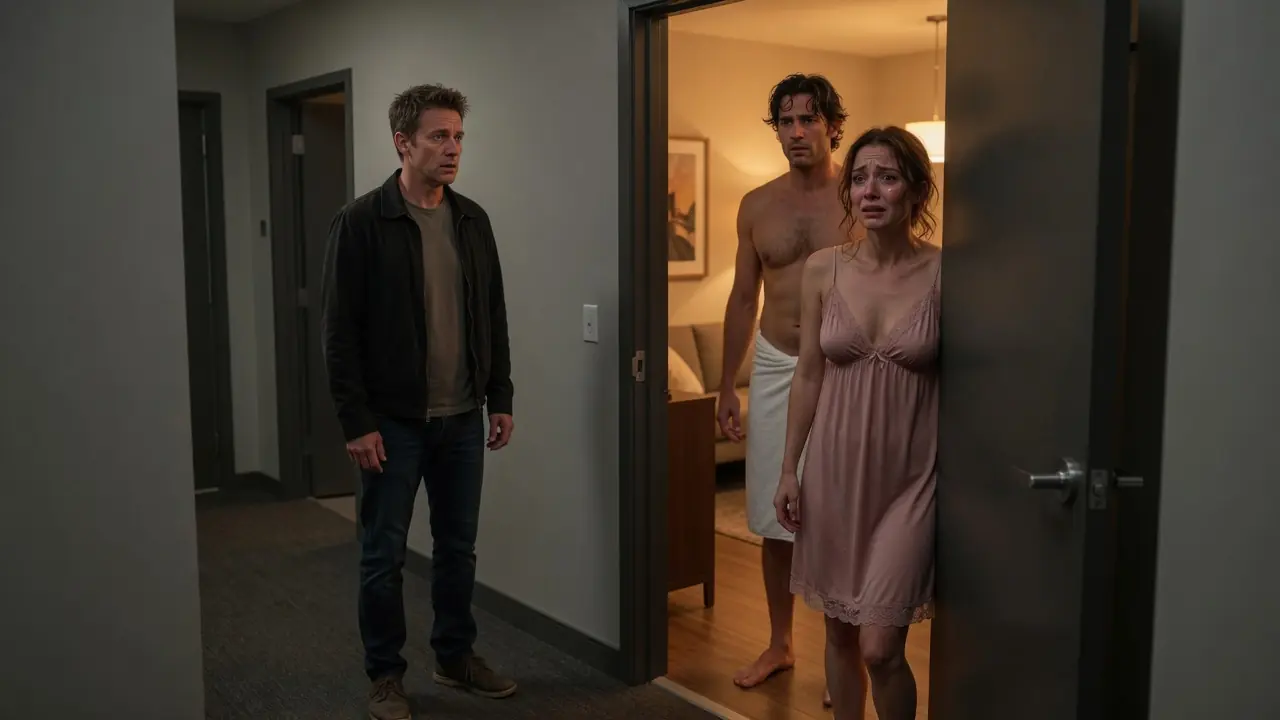
The door opened.
The man standing there was barefoot.
Not in socks. Not wearing shoes he had kicked off near the entrance. Barefoot, comfortable, planted on the hardwood floor like a man who knew where the bathroom was, where the glasses were, and which side of the couch dipped when you sat too long.
I had never seen him before.
He was taller than me by a couple of inches, broad through the shoulders, with dark hair pushed back carelessly and a gray T-shirt that looked like it had been worn for hours, not thrown on in panic. He had the kind of calm expression men wear when they already know they have taken something and are waiting to see if you are brave enough to name it.
His eyes moved from the takeout bag in my hand to my hospital badge, then to my face.
“Do you want me to tell her you came by?” he asked.
Not who are you?
Not Lydia is changing.
Not this is not what it looks like.
He spoke like I was a delivery driver who had interrupted the wrong evening.
For one second, I could not move.
There are moments when the mind refuses to accept what the eyes have already understood. My first thought was ridiculous. Maybe this was a cousin. Maybe this was an old friend. Maybe there was an explanation so obvious that later I would feel ashamed for the sudden coldness spreading through my chest.
Then Lydia appeared behind him.
Her hair was loose. Her cheeks were flushed. She wore the soft cream sweater I had bought her the previous Christmas because she said it made her feel “expensive without trying.” Her engagement ring caught the hallway light when she lifted one hand to her throat.
“Nathan,” she whispered. “Please, it’s not what you think.”
That sentence is a strange thing to hear when a barefoot man is standing in your fiancée’s doorway at 10:47 p.m.
I looked at him.
Then at her.
Then at the ring on her finger.
That ring had cost me more than money. It had cost sleep. It had cost double shifts. It had cost birthdays I missed, dinners I canceled, and weekends I spent in scrubs instead of beside her because Lydia said she wanted a wedding that felt secure.
I thought secure meant flowers, deposits, a venue, and a future.
Now I understood that to Lydia, secure meant I worked enough hours to fund a life she could enjoy while someone else kept her warm on the nights I was too tired to notice.
The man leaned one shoulder against the doorframe.
He did not step aside.
That was the second thing I understood.
He was not embarrassed.
He was measuring me.
Lydia stepped around him, trying to push past the narrow opening.
“Nathan, wait. Let me explain.”
I looked at her hand again.
The diamond on her finger looked too bright.
I had been so proud when I bought it. I remember sitting in my car outside the jewelry store afterward, holding the small box, feeling scared and hopeful. My mother had cried when I showed her. She said, “If she loves you, she will see the sacrifice, not the size.”
My mother had always believed the best in people.
That was one of the things I loved and feared about her.
Lydia reached toward my arm.
I stepped back before she touched me.
“Nathan,” she said, voice breaking.
I wanted to ask who he was.
I wanted to ask how long.
I wanted to ask whether she had been laughing at me on the nights I texted, Sorry, emergency came in, I’ll be late.
But the barefoot man was still standing in her doorway, and I knew if I asked questions, I would be giving them both the dignity of pretending this needed interpretation.
So I did not ask.
I held out the takeout bag.
Lydia stared at it.
“What?”
“Dinner,” I said.
She looked confused, as if my calmness had frightened her more than shouting would have.
“I brought dinner.”
The man smirked faintly.
I placed the bag on the small table beside her door.
“Enjoy it.”
Then I turned and walked away.
“Nathan!”
Lydia came after me into the hallway.
Her voice echoed against the polished walls. Somewhere down the corridor, a door opened a crack. Someone was listening. People always pretend they hate drama until it appears close enough to hear through drywall.
I pressed the elevator button.
Lydia reached me, barefoot too now, which somehow hurt more.
She had been barefoot in front of him.
Comfortable.
At home.
“Nathan, please,” she said. “You have to let me explain.”
The elevator doors did not open.
I stared at the numbers above them.
“What is his name?”
The question came out quietly.
She hesitated.
That hesitation answered more than the name would have.
“Evan,” she said finally.
“Evan what?”
“Nathan, it’s complicated.”
I looked at her then.
Her eyes were wet, but panic is not the same as remorse. Panic fears consequences. Remorse understands harm. Lydia looked terrified that her life was about to become inconvenient, not devastated that she had broken mine.
“Evan what?” I repeated.
“Evan Rhodes.”
The elevator dinged.
The doors opened.
She grabbed my sleeve.
“He’s an old friend.”
I looked down at her hand on my scrub jacket.
I had worn that jacket while holding pressure on a chest wound two hours earlier. I had worn it while calming a frightened child whose father had collapsed in the waiting room. I had worn it while trying to save people whose families would have given anything for one more night together.
Now Lydia held it like she had the right to keep me from leaving.
“Old friends don’t answer your door barefoot at eleven at night,” I said.
Her face crumpled.
“I was lonely.”
That was when I felt something inside me harden.
Not explode.
Harden.
“You were lonely?”
“I never see you anymore.”
“I was working.”
“You’re always working.”
“For our wedding.”
She closed her eyes.
“I know.”
“No,” I said. “You don’t. Because if you knew, you would have either loved me enough to wait or respected me enough to leave.”
The elevator doors began to close.
Lydia put her hand against them to stop them.
“Nathan, I made a mistake.”
I almost laughed.
A mistake is putting salt in coffee.
A mistake is forgetting to call.
A mistake is taking the wrong exit during a storm.
A barefoot man in your apartment at 10:47 p.m. while your fiancé is bringing dinner after a hospital shift is not a mistake.
It is a decision with skin on it.
“How long?” I asked.
She looked away.
That was the first time she truly looked ashamed.
“How long, Lydia?”
“A few months.”
The hallway became very quiet.
A few months.
I thought of all the nights I had left work and texted, Wish I could come over, too tired.
I thought of all the times she answered, It’s fine, babe, sleep.
I thought of her telling me she understood.
I thought of her saying she admired my work ethic.
I thought of her showing me wedding venues while sitting on my couch with her feet in my lap, letting me massage them after my own legs ached from standing all day.
A few months.
I stepped into the elevator.
This time, when the doors began closing, I looked at her and said, “Take off the ring before you touch him again.”
The doors closed on her face.
Downstairs, Sam the doorman looked up from his desk and smiled automatically.
“Leaving so soon, Doc?”
I was not a doctor, but he always called me that no matter how many times I corrected him.
I walked past him.
“Nathan?” he called, hearing something in the silence.
I stopped at the lobby door.
“Goodnight, Sam.”
Outside, the cold wind hit my face.
I made it to my car before my hands started shaking.
For ten minutes, I sat in the driver’s seat without turning the engine on. The hospital badge still hung from my jacket. My phone buzzed again and again.
Lydia calling.
Lydia texting.
Nathan please.
Please come back.
You don’t understand.
I love you.
I made a mistake.
Don’t do this.
That last one almost made me smile.
Don’t do this.
As if I had been the one who opened the door barefoot.
I drove home through Cleveland streets glazed with cold rain. The city looked washed out and indifferent. Red lights blurred on the windshield. Sirens wailed somewhere in the distance, and my body reacted automatically, glancing toward the sound even though I was off duty.
That is the thing about working in a hospital.
You train yourself to run toward emergencies.
But no one trains you for the emergency of realizing the person you were building a life with had already been living another one behind your back.
My apartment was small, quiet, and too clean because I was rarely home long enough to make a mess. There were boxes of wedding invitations stacked near the bookshelf, still waiting for addresses. A folder labeled VENUE DEPOSIT sat on the kitchen counter. A sample menu from the caterer was pinned to the fridge with a magnet from Chicago.
Lydia had circled the chicken piccata.
I pulled the paper down and threw it in the trash.
Then I sat at the kitchen table until sunrise.
I did not sleep.
By 6:30 a.m., my mother called.
Her name was Elaine Cole. She lived forty minutes away in Parma, in the same small house where I grew up. She had raised me alone after my father died of a heart attack when I was thirteen. She worked twenty-seven years in a school cafeteria and still believed every problem could be made smaller with coffee and something warm to eat.
I almost did not answer.
But mothers know when not answering means worse than words.
“Nathan?” she said.
I closed my eyes.
“Hi, Mom.”
Her voice changed immediately.
“What happened?”
I stared at the wedding invitations.
“She cheated.”
There was a silence so deep I heard her breathe.
Then she said, “I’m coming.”
“No. You don’t have to.”
“I didn’t ask.”
She arrived at 7:18 with a thermos of coffee, a plastic container of breakfast casserole, and a face full of pain she was trying to hide because she knew mine was bigger.
She did not ask for details at first.
She took one look at me and wrapped her arms around my shoulders. I was thirty-six years old, but for a moment I was thirteen again, standing beside my father’s grave, trying not to collapse because I thought being a man meant staying upright.
“You don’t have to be strong in front of me,” she said.
That was when I finally cried.
Not loudly.
Not dramatically.
Just enough that the pressure in my chest cracked.
My mother sat with me at the kitchen table while the sun came up behind gray clouds. I told her everything. The shift. The pasta. The knock. The barefoot man. Lydia’s face. A few months.
Elaine listened without interrupting.
When I finished, she reached across the table and touched my hand.
“Did you get the ring back?”
I looked up.
That was my mother.
Soft heart.
Practical bones.
“No.”
“You will.”
“I don’t care about the money.”
“Yes, you do,” she said. “And you should. That ring was not just romance. It was work. It was time from your life. She doesn’t get to keep it like a souvenir.”
My phone buzzed again.
Lydia.
Elaine looked at it.
“Do you want me to answer?”
“No.”
“Good. I wanted to, but it would not be Christlike.”
Despite everything, I laughed once.
It hurt.
At 8:04, I called the venue.
The woman on the phone sounded cheerful until I told her I needed to cancel.
“Our policy states the deposit is nonrefundable,” she said gently.
“I understand.”
“May I ask the reason?”
I looked at the ring sample photo Lydia had left on my counter months ago.
“The wedding is no longer happening.”
The woman’s voice softened.
“I’m very sorry.”
“So am I.”
I called the photographer.
The florist.
The caterer.
The hotel block.
With each call, the future became less scheduled.
By noon, Lydia showed up at my apartment.
I knew because the buzzer rang three times, then my phone lit up again.
Nathan, I’m downstairs.
Please.
I need to talk to you.
Elaine stood by the window and looked down.
“She looks awful,” she said.
“Good.”
My mother turned.
“Nathan.”
“I’m sorry.”
“No, you’re not.”
I wasn’t.
Not yet.
I buzzed Lydia in because avoiding her would only delay the inevitable. When she knocked, I opened the door but did not step aside.
She looked different in daylight.
Less polished.
Her eyes were swollen, her hair pulled into a messy bun, her face pale. She wore the engagement ring.
I looked at it first.
She noticed and curled her hand slightly.
“Nathan,” she said. “Can I come in?”
“No.”
Her face fell.
“Your mother is here?”
“Yes.”
Elaine appeared behind me, arms folded.
Lydia’s mouth trembled.
“Mrs. Cole.”
Elaine said nothing.
Lydia looked back at me.
“I ended it.”
“With Evan?”
“Yes. I told him it was over.”
I nodded.
“Congratulations.”
She flinched.
“I deserve that.”
“No,” I said. “You deserve worse. I’m trying not to become someone I hate.”
Tears filled her eyes.
“Nathan, I was lonely. You were always gone. I kept asking for time, and you kept picking up shifts.”
“I picked up shifts because you wanted the ballroom at Lakeside. Because you wanted the photographer from Chicago. Because you wanted the four-tier cake. Because you cried when I suggested a smaller wedding and said I didn’t value you.”
Her tears spilled.
“I know.”
“Do you?”
“Yes.”
I looked at her ring.
“Take it off.”
She froze.
“Nathan.”
“Take it off.”
Her voice broke.
“Please don’t ask me to do that right now.”
“I’m not asking.”
She looked past me to my mother, perhaps hoping for softness.
Elaine’s face was stone.
“That ring belongs to my son,” she said. “You don’t wear the proof of his sacrifice while asking him to forgive your betrayal.”
Lydia looked down.
For a moment, I thought she might refuse.
Then she slowly pulled the ring from her finger.
She held it in her palm, crying hard now.
When she handed it to me, her hand shook.
I took it without touching her skin.
“I love you,” she whispered.
I looked at the ring.
“I believe you love what I gave you.”
She sobbed.
“That’s not fair.”
“No. But it’s honest.”
She wiped her face.
“I made a terrible mistake.”
I felt tired again.
Not hospital tired.
Soul tired.
“Lydia, stop calling it a mistake. You had a relationship with him for months. You let him into your apartment. You let him answer your door. You looked at me while he stood there barefoot and said it was not what I thought.”
She covered her mouth.
“You trained me to doubt myself,” I continued. “Every time I felt something was wrong, you called me insecure. Every time I asked for honesty, you said I was controlling. Do you understand what that does to a person?”
Her eyes lowered.
“I was scared.”
“Of getting caught?”
“Of losing you.”
I stared at her.
“You lost me when keeping me became less important than deceiving me.”
She had no answer.
After she left, my mother stayed another hour.
Then she washed the two coffee mugs in the sink, kissed my forehead, and said, “Do not go back because grief makes loneliness loud.”
I tried to smile.
“I won’t.”
But the truth was, I did not know.
Love does not die just because respect does.
For weeks, I moved like a man recovering from surgery without pain medication. I went to work. I came home. I answered necessary texts. I ignored unnecessary ones. Lydia sent apologies, memories, long messages about regret. Some nights I read them. Some nights I deleted them unread.
I returned the ring to the jeweler.
They could not refund the full amount, but they bought it back for enough that I paid off the remaining balance and donated part of what was left to the hospital’s patient assistance fund. I do not know why I did that. Maybe because I needed something about that ring to end up helping someone.
At work, people noticed.
Nurses notice everything.
Dr. Patel asked if I was sleeping. I lied and said yes. Marissa, one of the night shift nurses, placed a protein bar in my locker every day for a week without saying anything. My supervisor quietly adjusted my schedule so I had two consecutive days off after I nearly charted the wrong room number from exhaustion.
One afternoon, I ran into a little boy named Owen in the pediatric wing.
He had been in and out of St. Catherine for leukemia treatments, and I had fixed his TV remote twice even though that was not technically my job. He was seven, bald from treatment, and fiercely opinionated about cartoons.
“Mr. Nathan,” he said from his bed, “you look sad.”
His mother apologized immediately.
“Owen.”
“It’s okay,” I said.
Owen narrowed his eyes at me.
“Did someone die?”
“No.”
“Then maybe it can get better.”
I stood there with a broken remote in my hand and felt my throat tighten.
“Maybe,” I said.
Children in hospitals have a way of saying things adults are too polite to risk.
A month after the breakup, Evan Rhodes came to the hospital.
Not as a patient.
As a visitor.
I saw him in the main lobby near the coffee stand, wearing a navy coat and leather shoes this time. Shoes. That seemed important in the most irrational way. He was laughing with a woman I did not recognize, one hand resting lightly on her back.
He saw me.
His smile faded, then returned with a casual arrogance that made my hands curl.
He walked over.
“Nathan, right?”
I said nothing.
He glanced at my badge.
“Look, man, I know things got messy.”
Messy.
As if betrayal were spilled coffee.
“I didn’t come to talk to you,” I said.
He lowered his voice.
“You should know Lydia wasn’t happy.”
There it was.
The line men like him use to turn theft into rescue.
I looked at him carefully.
“You answered her door barefoot.”
His jaw tightened.
“Things happen.”
“No,” I said. “People do things. Then cowards rename them.”
His face hardened.
“You don’t know anything about me.”
“I know enough.”
I turned to leave.
He said, “She came to me because you were never there.”
That stopped me.
For one second, the old wound opened.
Then I thought of fourteen-hour shifts, wedding deposits, cold pasta, and a woman who had wanted me to work until I was useful but not absent enough to inconvenience her conscience.
I turned back.
“Maybe I wasn’t there enough,” I said. “But you were there because she invited you into something that belonged to someone else. Don’t pretend that makes you profound.”
Evan laughed once, but there was no confidence in it.
“You always this dramatic?”
“No. Mostly I’m tired.”
Then I walked away.
That was the last time I saw him.
Three months later, Lydia sent a letter.
Not a text.
A real letter in a cream envelope, written in her careful handwriting.
I almost threw it away.
Instead, I opened it at my kitchen table.
Nathan,
I have written this letter many times and hated every version because every apology sounds too small for what I did.
You were right. I did not make a mistake. I made choices. I made them repeatedly. I lied to you. I made you feel insecure for noticing what I was hiding. I let you work yourself exhausted for a wedding I was betraying. I do not know how to face that, but I am trying.
I could tell you I was lonely, and I was. I could tell you I felt neglected, and sometimes I did. But none of that explains what I did unless I am trying to excuse it, and I am done excusing it.
Evan did not love me. I think part of me knew that. I think I liked the attention because it did not require responsibility. With you, love came with a future, with bills, with choices, with growing up. With him, I could pretend I was wanted without having to be worthy.
I am sorry for making your goodness feel foolish.
I am sorry for the door.
I am sorry for the ring.
I am sorry for every time I made you doubt yourself.
I will not ask you to come back. I do not deserve that. I only wanted to say the truth without making you fight for it.
Lydia
I read it twice.
Then I folded it and placed it back in the envelope.
For the first time, her apology sounded like it belonged to reality.
That did not mean I wanted her back.
It meant I could stop arguing with an imaginary version of her who still refused to understand.
I kept the letter for one week.
Then I burned it in a small metal bowl on my balcony.
Not out of hatred.
Out of release.
A year passed.
Life did not become suddenly beautiful. Healing rarely respects dramatic timing. It was slow, uneven, and sometimes embarrassingly ordinary. I learned to cook for one again. I took fewer extra shifts. I started running in the mornings, badly at first, then less badly. I visited my mother every Sunday and let her send leftovers home without pretending I did not want them.
I moved the wedding invitations from the bookshelf to the trash.
I took the Chicago magnet off the fridge and put it in a drawer.
Then one day, months later, I found it while looking for batteries and realized it no longer hurt to hold.
That was how I knew I was getting better.
Not because I had forgotten.
Because memory had stopped behaving like a knife.
On the anniversary of the night I found Evan at Lydia’s door, I worked another fourteen-hour hospital shift.
It was not planned.
A flu outbreak had filled the emergency department, and two people called off. I stayed late because someone had to. By the time I left, my feet ached, my scrub jacket was wrinkled, and the city outside was cold again.
I drove past the Italian place on Euclid Avenue.
For a moment, I considered stopping.
Then I did.
I ordered one container of pasta this time.
Just one.
When the cashier handed me the bag, she smiled.
“Long shift?”
“Very.”
“Hope someone’s waiting with a glass of wine.”
I smiled back.
“Just me tonight.”
Her face softened like she felt sorry for me.
But I did not feel sorry for myself.
I took the pasta home, changed into sweatpants, sat at my kitchen table, and ate slowly while the city hummed outside my window. No one lied to me. No one made me feel foolish. No one waited behind a door with bare feet and a smirk.
The apartment was quiet.
But quiet was not the same as empty anymore.
It was honest.
People say betrayal teaches you not to trust others.
Maybe that happens to some people.
For me, it taught me to trust myself again.
To trust the tightening in my chest when something felt wrong. To trust the part of me that noticed disrespect before my heart tried to explain it away. To trust that love should not require me to become smaller, quieter, or easier to deceive.
I had shown up tired because I believed love did that.
I still believe it.
Love shows up tired.
Love brings dinner after long shifts.
Love pays attention.
Love sacrifices.
But love does not stand barefoot in another man’s doorway and ask whether he should tell your fiancée you came by.
That is not love.
That is the moment love ends and self-respect has to begin.
I did not ask who he was that night because I already knew enough.
I looked at the ring.
I looked at his bare feet.
I looked at Lydia’s face.
And I understood that I was not the man she had been waiting for.
So I stopped waiting too.