“Mind your own, or we put you on the ground next to him.”
The words came from Trent Vaughn’s mouth with the kind of easy cruelty that only worked when six men stood behind it. He was twenty-two, lean, hard-eyed, and proud in the way broke young men sometimes became proud when they had nothing useful to be proud of.
The old biker on the pavement turned his head.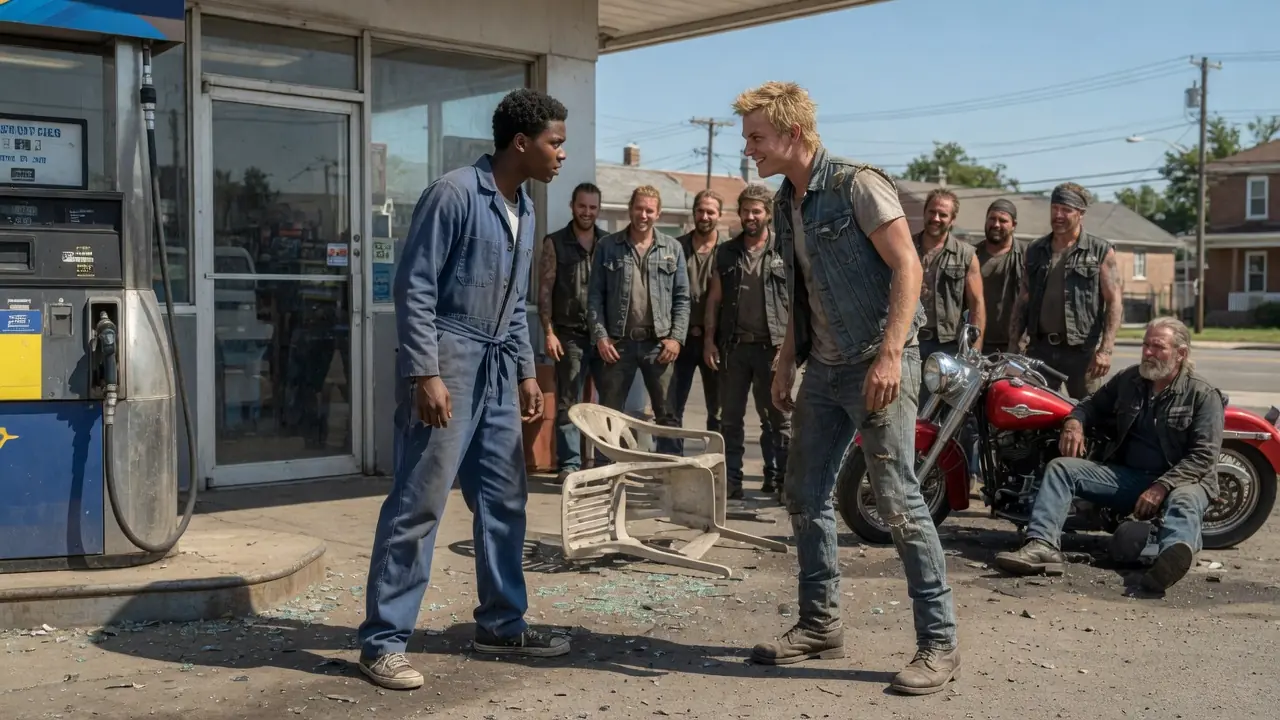
His lip was split. His breathing was rough. His leather vest was smeared with dust from the gas station concrete, and one hand was pressed against his ribs as if he was trying to hold himself together through will alone.
He looked at Brandon Sullivan.
His voice cracked.
“Help me. Please.”
That broke something in Brandon’s chest.
Trent stepped between them, a rusted pipe wrench in his fist. He tapped the wrench against the old motorcycle’s engine cover, smiling when the metal rang.
“Get back to your kennel,” Trent said, “or cough up the money. I’ll spare this old man.”
Brandon’s right hand moved toward the small adjustable wrench in his back pocket.
“He asked for help,” Brandon said. “I’m helping him.”
Trent laughed, sharp through his nose.
The five behind him spread out wide.
Six bullies.
One Black young man.
One old biker on the ground beside a cherry-red Panhead.
None of them knew yet that the man begging for help would be on every news channel by Monday.
None of them knew the name Henry “Iron Hank” Callaway would make half the state sit up straight.
And none of them knew that Brandon Sullivan, eighteen years old, underpaid, overworked, with thirty-four dollars in his pocket and a medical bill on his grandmother’s kitchen counter, was about to step into a story much larger than himself.
The hardest part of Brandon’s life was not the work.
Work made sense.
A stripped bolt needed patience. A bad gasket needed replacing. A carburetor needed cleaning, not excuses. Engines had problems, but they did not lie about them. Machines did not look at Brandon like he was about to take something.
People did.
That was the hardest part.
Being watched in stores. Being followed by security guards who pretended to straighten shelves. Being asked if he worked somewhere when he was only buying a soda. Being called “son” by strangers who were not being kind. Being treated like a threat before he had opened his mouth.
He had been carrying that weight since he was twelve.
By eighteen, he knew how to keep his face still.
He knew how to make his voice polite.
He knew when to lower his eyes and when not to.
His grandmother called it survival.
Brandon called it Tuesday.
At five o’clock that morning, the kitchen light was already on.
Their house sat on Beaumont Avenue on the East Side, a narrow two-bedroom place with peeling white paint, a porch that leaned slightly left, and a front step Brandon had repaired twice with salvaged wood. The rent was too high for what it was, but it was theirs for now.
Grandma Maylene sat at the counter in her faded blue robe, checking her blood sugar with the same kit she had been using for three years. She handled the needle with practiced irritation, as if even illness should know better than to waste her time.
The strip read high.
She looked at the number.
Then she wrote it in a small notebook with a yellow cover.
She did not sigh.
That was how Brandon knew she was worried.
He came into the kitchen tying his work boots, his Hartman’s Auto shirt folded over one arm.
“You eat yet?” Maylene asked without looking up.
“I will.”
“That means no.”
“It means I’m thinking about it.”
“Thinking doesn’t keep ribs from touching.”
He smiled faintly and crossed the small kitchen to kiss the top of her head.
Her hair smelled like coconut oil and the lavender scarf she wore to bed. She reached up and patted his cheek, the way she had done since he was small enough to stand between her knees while she braided his hair.
The oven door hung slightly open.
Heat leaked from it in waves, warming the already sticky kitchen.
Brandon crouched and frowned.
“You told me this was fixed.”
“I told you it was fixed enough.”
He pulled the small screwdriver from his back pocket, right next to the adjustable wrench he always carried, and tightened the loose hinge in under a minute.
“There,” he said. “It’ll hold till payday.”
Maylene watched him with soft, tired eyes.
“You don’t have to fix everything around here, baby.”
“Somebody’s got to.”
He regretted it the second he said it.
Not because it was untrue.
Because it was too true.
The electric bill sat under a magnet shaped like a peach. The rent jar sat on the counter beside an old sugar canister. The medical bill from County Health was folded under Maylene’s notebook, but Brandon knew the number by heart.
Nine hundred eighty-six dollars.
For bloodwork, medication adjustments, and a doctor who had told Maylene what they already knew.
She needed consistency.
Consistent food.
Consistent medicine.
Consistent sleep.
Consistent money.
Their life had almost none of those things.
Brandon counted what was in his pocket on the way out.
Thirty-four dollars.
He paused by the rent jar.
Maylene had turned back to her notebook.
He looked over his shoulder, slid a folded twenty between the bills already inside, and tried to leave before she noticed.
“Brandon.”
He froze.
His hand was already on the doorknob.
Maylene stood in the kitchen doorway with her arms crossed. She was not angry. She was something worse than angry.
She was sad.
“Bring that back.”
“Grandma.”
“Bring it back, baby.”
He walked back slowly, opened the jar, and took out the twenty. He held it in his palm like evidence.
Maylene came closer.
She lowered her voice.
She did not need to be loud. Maylene Sullivan had never needed to be loud.
“Listen to me one time.”
“Yes, ma’am.”
“Our family, from your great-grandfather down, we don’t take what we didn’t earn. And we don’t take from our own children to pay for ourselves. You hear me?”
“I earned it.”
“You earned it for your lunch and your bus and whatever else you need today.”
“I don’t need much.”
“That is not the point.”
Her voice trembled just enough to hurt him.
“That medical bill is mine, not yours.”
“It’s a lot.”
“It’s still mine.”
She placed her hand on his cheek.
Her fingers were thin, but steady.
“I don’t need you to save me, Brandon. I need you to become a man I’m proud of when I’m gone. That’s how you pay me back. You understand?”
He swallowed.
“Yes, ma’am.”
“Look at me when you say it.”
He lifted his eyes.
“Yes, ma’am.”
She nodded.
“Put that twenty back in your wallet.”
He did.
His bike chain had snapped two weeks earlier.
He had parts for three other people’s vehicles in his backpack, but had not found time to fix his own bicycle. That was how life worked lately. Brandon could keep half the neighborhood moving, but his own wheels sat upside down behind the house waiting for attention.
So he walked twenty-two blocks to Hartman’s Auto.
The summer heat was already climbing. The sidewalks held yesterday’s warmth. The air smelled like cut grass, exhaust, and the fryer oil from the chicken place that opened before dawn for the breakfast crowd.
At the corner gas station, Brandon bought a soda because he had skipped breakfast and needed sugar.
The woman behind the counter eyed his work shirt, then his face, then the soda.
“You work here, son?”
“No, ma’am,” Brandon said. “Just a customer.”
She did not apologize.
He did not expect her to.
Three blocks later, a patrol car slowed beside him.
The officer looked him up and down.
Did not roll the window down.
Did not say anything.
Just looked.
Then drove on.
Brandon did not react.
His face did not move.
He just kept walking.
He had been doing this since he was twelve.
Cole Hartman was already at the shop when Brandon arrived, hood up on a Honda Civic, cussing at the alternator like it had insulted his mother.
Hartman’s Auto had been open for thirty-one years, though the sign out front looked as if it had survived all thirty-one without being repainted. The shop had three bays, two working lifts, one bathroom with a door that stuck, and a coffee pot nobody had cleaned since winter.
Cole Hartman was fifty-seven, white, broad, bald, and allergic to sentimental conversation. He had hired Brandon two years earlier after Brandon came in asking if he could sweep floors for cash. By the end of the first week, Brandon had fixed a lawn mower Cole had been using as a doorstop.
By the end of the first month, Cole stopped calling him kid.
Most days.
“You’re early,” Cole said without looking up.
“Bus didn’t come, so I started early.”
“Bus comes at six-fifteen.”
“I know.”
Cole grunted.
That was the closest thing to a compliment he gave.
Brandon pulled on coveralls and went straight to the back bay, where a 1986 BMW R series motorcycle sat waiting. Old, stubborn, the kind of bike nobody else wanted to touch because parts were annoying and owners were worse.
Brandon loved it.
He worked on the BMW the way other people prayed.
Quietly.
Carefully.
Without showing off.
He understood machines. They made sense in a way people did not. A machine did not pretend respect while planning to cheat you. It did not smile in your face and call the police when you stood too close to a display case. It did not ask whether you belonged in a room after you had already fixed the thing everyone else gave up on.
Around ten, a man in a polo shirt walked in holding keys to a Lexus.
He looked past Brandon, directly at Cole.
“Is the mechanic in?”
Brandon kept his head down inside the BMW.
He did not say a word.
Cole jerked his thumb toward him.
“He is the mechanic.”
The man blinked, tried to recover, and looked at Brandon as if the word mechanic had changed shape.
“Oh. I just meant...”
“I can take a look,” Brandon said politely.
The man hesitated half a second too long.
Brandon saw it.
Cole saw it.
Nobody said anything.
Brandon had been doing this since he was twelve too.
On his lunch break, he sat on an overturned tire near the back door and opened his backpack.
Inside was a library book with a worn sticker on the spine.
Modern Custom Builders, A Visual History.
He had already checked it out twice that year. The librarian had stopped reminding him about late fees because he always brought it back carefully, corners protected, pages clean.
He flipped to the dog-eared page.
A cherry-red 1959 Panhead filled the page, all polished tank, sweeping lines, and custom pinstripe work so perfect it looked alive. The caption underneath read:
Henry “Iron Hank” Callaway, Callaway Custom Cycles, founder.
Brandon traced the lines with one finger.
He whispered the names the way other guys whispered the names of athletes.
“Callaway. Monroe. Roder. Foose.”
Cole walked past with coffee.
“You ever gonna build one of those?”
Brandon looked up.
“One day.”
Cole sipped his coffee.
“Yeah. You will.”
It was the kindest thing Cole had said in months.
Brandon lowered his eyes to the book because he did not trust his face.
He walked home that night with his arms aching and the wrench still in his back pocket.
He passed a billboard for the West Coast Custom Bike Show.
$350 To Enter Your Build.
Three hundred and fifty dollars he did not have.
Three hundred and fifty dollars that might as well have been the moon.
He stopped at the corner of Pine and 6th when he saw Mrs. Davies on her stoop struggling with two grocery bags and her cane. She was seventy-nine, thin, stubborn, and always dressed like church might break out unexpectedly.
Brandon crossed the street without thinking.
“Let me get those, ma’am.”
“Oh, Brandon. You don’t have to.”
“It’s nothing.”
He carried the bags up the steps and set them inside her doorway.
She tried to give him a dollar.
He shook his head.
“Save it for church plate.”
“You and that mouth.”
He smiled, waved, and kept walking.
Behind him on her stoop, Mrs. Davies watched him go and shook her head.
“That boy.”
Brandon did not hear her.
He was already thinking about tomorrow’s shift.
About the medical bill on the counter.
About a cherry-red Panhead he had never seen in real life.
And how he might never get to.
Three days later, Brandon almost did not take the shortcut.
He almost stayed on Main Street.
Almost.
It was four in the afternoon.
The summer heat had peaked and begun to press down on everything instead of rising. Brandon’s shift had run long because a delivery truck came in with brake trouble and Cole needed help before the driver took it back on the road. His arms ached. His shoulder was stiff. The library book in his backpack felt heavier than it had that morning.
The shortcut behind the Sunoco on 5th Street shaved seven minutes off the walk home.
Seven minutes mattered when Maylene was waiting and he still had to make dinner.
So he turned.
Two blocks away, the man who built the motorcycle from the library page was pumping fuel into its tank.
His name was Henry Callaway.
He was sixty years old.
The world knew him as Iron Hank.
Brandon knew him from captions, magazine profiles, grainy documentaries, and library books he could not afford to own.
Hank rode alone that day because he liked riding alone. He always had. The cherry-red 1959 Panhead beneath him had a polished tank, hand-laid pinstripe work, and a brass badge on the seat hump that caught the sunlight like a secret.
His phone had died an hour earlier.
He had not cared.
A dead phone meant no calls, no messages, no responsibilities for a little while. Just road, wind, heat, engine, and the old machine’s rhythm under him.
He noticed the boys when they got out of the Chevy.
He noticed the way they looked at his bike before they looked at him.
He had been around long enough to know what that meant.
He did not move quickly.
He did not act afraid.
He kept pumping fuel.
Trent Vaughn walked up first.
Twenty-two years old. Cocky in the way only boys with nothing to lose are cocky.
He whistled like he was impressed.
“Look at this antique, boys. Grandpa rode his tricycle to the wrong side of town.”
Hank did not answer.
Cody spat on the pavement two feet from Hank’s boot.
“Old man, you lost? Nursing home’s the other way.”
Hank did not answer.
Brett laughed.
The other three spread out behind.
Six of them now.
Six on one.
“What, you deaf, old-timer?” Trent asked. “Or just too old to hear?”
Hank set the pump back in the cradle.
He still did not turn around.
Trent walked a slow circle around the Panhead, stopped at the front, and pretended to admire it.
“How much you think this thing’s worth, boys? Eight grand? Ten?”
“Grandpa won’t even remember where he parked it tomorrow,” Cody said.
A pickup truck rolled past the gas station.
The driver slowed.
He looked.
Counted the numbers.
Kept driving.
Cody kicked the back tire.
Hank’s shoulders tensed for half a second.
Then went still again.
That stillness should have told them something.
It did not.
Trent’s smile dropped.
He walked over to the corner of the lot where the old air pump used to be. There was a metal toolbox lying on its side, abandoned, half full of rust water and forgotten parts.
Trent reached in and pulled out a long, rusted pipe wrench.
Heavy.
The kind of tool that could do real damage in the hands of someone foolish enough to think cruelty made him powerful.
He hefted it in his hand and tapped it against his palm.
“Keys, wallet, watch,” Trent said. “Slow, old man, or this is going to leave a mark.”
Hank turned around.
For the first time, the boys saw his face.
There was no fear in it.
Not even surprise.
His voice was low and steady, the voice of a man who had been in worse places than this.
“You don’t want to do this, son. Walk away.”
Trent stared at him for half a second.
Then he laughed sharply through his nose.
“You hear that, boys? Old man thinks he’s giving us advice.”
A young mother pushed a stroller toward the gas station entrance. She saw the six of them. She saw Hank. Her hand tightened around the stroller handle.
Then she turned around and walked the other way.
Inside the station, the clerk watched through the glass.
His name was Marvin Lee, and he had worked there twenty years. He saw the wrench. He counted the numbers. He saw Hank’s face.
Recognition struck him so hard he forgot to breathe.
He slid the deadbolt across the door from inside.
But he did not pick up the phone.
Not yet.
The first blow did not come from Trent.
Cody stepped forward and smashed an empty beer bottle down on the concrete six inches from Hank’s foot.
Glass exploded across the pavement.
A warning shot.
Hank did not move.
Behind him, Brett picked up a plastic patio chair, the cheap red kind the station kept for smokers, and swung it into Hank’s back.
The chair cracked.
Hank’s body folded.
He dropped to one knee on the broken glass.
His breath left him in a single rough exhale.
He did not cry out.
He did not beg yet.
He just knelt there, head bowed, gathering himself.
His shoulder was already stiffening. His lip was split where his teeth had cut the inside. Sixty years old, alone, no phone, no backup, nobody watching who was willing to help.
He had been in this exact position before, decades ago, in another parking lot, in another life.
He had promised himself then he would never let it happen again.
It was happening again.
Two miles away, Maylene Sullivan tested her blood sugar again.
The number was wrong again.
She looked at the clock on the wall.
Brandon was late.
She did not know why.
Back at the Sunoco, Trent stood over Hank, wrench in his fist.
He bent down so the old man could hear him clearly.
“Now you want to give us what we asked for, Grandpa? Or do we have to teach you manners first?”
On the wall behind them, faded under twenty years of sun, was the ghost of a painted mural.
A winged motorcycle wheel.
A name half eaten by weather.
Callaway Custom Cycles.
Nobody looked at it.
Eight seconds.
That was all it took.
In those eight seconds, two lives changed forever.
But only one of them knew it yet.
Brandon turned the corner behind the Sunoco and stopped cold.
He saw the old man on his knees.
He saw the broken glass around his boots.
He saw the cracked plastic chair on its side.
He saw the wrench in the lead boy’s fist.
He saw six of them.
He took one step back.
His sneaker scuffed the gravel.
That was the sound that gave him away.
Jesse turned first, lazy, already smiling.
“Yo, walk away, kid. This ain’t your block.”
Cody turned next.
“This ain’t your business.”
Brett peeled off from the group and walked toward Brandon with the cracked chair still in his hand. He stopped close. Too close. He stood between Brandon and the old man like a wall.
“You deaf too?” Brett asked. “Same problem as grandpa? Run home. Tell your mommy you saw something. Tell her keep her boy out of grown folks’ business.”
Trent did not even turn his head.
He spoke over his shoulder, casual.
“Let him go. He knows how it works around here. Don’t you, boy?”
Brandon did not answer.
He looked past Brett.
Past the broken glass.
Past the cracked chair.
He looked at the old man on his knees.
Their eyes met.
Hank shook his head once.
Small.
Almost invisible.
A warning.
Go.
Please, go.
Then his voice cracked, low and rough.
“Help me. Please.”
That was the moment.
Two seconds.
That was how long Brandon stood there.
He saw Hank.
He saw the wrench.
He saw three men laughing at him.
He saw the gas station clerk behind locked glass.
He saw the mother with the stroller disappearing down the sidewalk.
He looked down at his own hands.
His left fist was already closed.
His right hand was already on the wrench in his back pocket.
They told me to walk, he thought. They told that old man to give up.
Two things I was never taught to do.
His eyes flicked to the dumpster six feet from him.
A length of rusted bicycle chain lay coiled in the dirt where some kid had dumped it last summer.
He did not say anything.
He moved.
One.
He grabbed the chain with his left hand.
He grabbed the water bottle from his backpack strap with his right.
He threw the bottle hard at the back of Trent’s head.
It bounced off.
Trent spun, wrench still raised.
Two.
Brandon was already inside the circle.
He drove his shoulder into Cody’s chest. Cody staggered backward, the broken bottle neck clattering out of his hand onto the pavement.
Three.
Brett swung the cracked chair sideways toward Brandon’s head.
Brandon got his left forearm up just in time.
The plastic split clean through.
Pain shot up to his shoulder.
His arm went numb.
No blood, he told himself. Bruise tomorrow. Keep going.
Four.
Brandon snapped the chain low across Jesse’s shins.
Jesse shouted and went down sideways, the tree branch in his hand spinning into the gutter.
Five.
Behind him, Hank moved.
The old man who had been on his knees for two minutes, quiet, breathing slow, watching everything, exploded up from the pavement like a coiled spring.
He swept the legs out from under one of the two boys still standing behind him.
Clean.
Practiced.
The kid hit the concrete flat on his back, all the air leaving him in one wet sound.
For the first time, the boys saw something on the old man’s face that was not fear.
Six.
Trent recovered and charged Brandon with the wrench.
Brandon twisted sideways, but not fast enough.
The end of the wrench scraped down his right shoulder, burning, dragging, but not cutting deep.
Brandon dropped under the swing, looped the chain around Trent’s wrist, and twisted hard.
The wrench fell.
Seven.
Hank was on his feet beside him now.
He put one heavy hand on Brandon’s shoulder, stepped in front of him, and set himself between Brandon and the four boys still standing.
His voice was low.
Flat.
No anger.
“Boys, walk away while you still can.”
Eight.
Something in his face changed the air around them.
The boys had no way to know what they were looking at, but they felt it in their chests.
They felt it in the way the old man stood.
They felt it in the sudden cold stillness around him.
Trent stared at Hank for one full second.
Then he turned.
He grabbed his wrist and ran.
The other five scattered behind him.
The Chevy peeled out of the parking lot two seconds later.
The whole thing was over.
Brandon stood there for one breath.
Two.
Then his knees gave out.
He sat down hard on the curb and started shaking.
Adrenaline crash.
His left forearm was already turning purple. His shoulder burned. His right knee was scraped through his jeans. No blood worth mentioning, just pain that would settle in by morning and make every movement remind him of the choice he had made.
Hank stood over him for a long moment.
He did not look at Brandon’s face first.
He looked at Brandon’s hands.
Eighteen years old.
Shaking.
Grease under the fingernails.
A small adjustable wrench sticking out of his back pocket.
A library card poking out of his wallet on the ground.
Hank crouched slowly.
He reached into his vest and pulled out a folded blue bandana, clean but worn soft from years of use.
He shook it open, then wrapped it carefully around Brandon’s swelling forearm and tied it like a brace.
His hands moved like a man who had done this a hundred times.
As he tied the knot, the sun caught the steel ring on his right hand.
A compass face set into the band.
Brandon’s eyes flicked to it and held there for half a second.
Then dropped.
Hank noticed.
“What’s your name, son?”
“Brandon, sir.”
“Why’d you do that, Brandon?”
Brandon was still catching his breath.
He had to think about the answer for a moment.
Then he shrugged.
“Nobody else was going to.”
Hank looked at him for a long time.
Then he stood slowly. His back cracked. He winced once and shook it off.
He looked at his Panhead twenty feet away.
Untouched.
The boys had never even gotten to it.
He looked back at Brandon, still sitting on the curb holding his swollen arm.
Hank shook his head and almost smiled.
“Kid,” he said, “you have no idea who you just helped.”
Behind them, the faded mural on the gas station wall caught the late afternoon sun.
The winged wheel.
The half-eaten letters.
Callaway Custom Cycles.
Brandon did not look at it.
He was watching the old man’s hands.
The compass ring.
The way the bandana was tied.
Something at the back of his mind had started to whisper, but he did not know what it was yet.
Hank reached into his vest.
Brandon thought he was reaching for a phone.
He was not.
Hank pulled out a thick roll of cash.
Hundreds.
Easily three or four grand.
He held it out.
“Take it. For the arm. For your trouble.”
Brandon looked at the roll.
Then back at Hank’s face.
He shook his head once.
“I’m not going to take money for that, sir.”
“Kid, you took a wrench to the shoulder for a man you don’t know. Take it.”
“No, sir. I appreciate it, but no.”
Hank pushed it forward an inch.
His voice softened.
“For your mother, then.”
Something flickered behind Brandon’s eyes.
Hank did not know Brandon’s mother had died when he was nine.
He did not know about the rent jar.
He did not know about the medical bill on the kitchen counter.
He did not know about the woman who that morning had said, “We don’t take what we didn’t earn.”
Brandon heard Maylene now, clear as if she stood beside him.
He shook his head again.
“I didn’t do it for that.”
Hank held the cash out one more second.
Then he nodded slowly.
He folded the roll back into his vest.
He did not push again.
He just looked at Brandon the way a man studies a tool he did not expect to find in his hand.
“All right,” Hank said. “All right.”
Brandon pushed himself off the curb slowly.
His left arm hung stiff at his side.
He started walking past Hank toward the road, toward home.
Then he passed the Panhead.
He stopped.
His eyes went to the tank.
The pinstripe work.
The hand-laid pattern around the gas cap.
The little brass badge on the seat hump.
He had seen this bike in a library book on his bedside table.
Cherry-red 1959 Panhead.
Henry “Iron Hank” Callaway.
Callaway Custom Cycles founder.
Brandon’s mouth opened slightly.
Then closed.
He did not say a word.
He just looked at the bike, then at Hank, then at the bike again.
Hank watched him put it together.
He did not confirm.
Did not deny.
Just lifted one corner of his mouth, the closest thing to a smile he had shown all afternoon.
Brandon swallowed, turned, and started walking again.
Behind him, Hank’s voice was quiet.
“Son.”
Brandon stopped.
“We don’t forget.”
Brandon turned back to ask what that meant, but Hank was already pulling his helmet down.
The Panhead started with a sound like distant thunder rolling over hills.
Hank gave Brandon one small nod, kicked the stand, and rolled out of the gas station onto Fifth Street.
Brandon stood there alone, holding his bandaged arm, watching the cherry-red tank disappear down the road.
Then he started walking home.
Inside the Sunoco, Marvin Lee waited until the bike was gone, until Brandon had turned the corner, until the parking lot was empty.
Then he picked up the phone and dialed a number he had not dialed in many years.
When someone answered, Marvin kept his voice low.
“It was him,” he said. “Yeah. Iron Hank. Some kid pulled him out.”
He looked through the glass toward the street where Brandon had disappeared.
“Black kid. Skinny. Works at Hartman’s Auto, I think.”
He listened.
Then nodded though no one could see.
“Yeah,” he said. “I’m sure.”
He hung up.
Brandon got home at 6:40.
Maylene was at the kitchen table with her notebook and a glass of water.
She looked up.
She saw the bandana on his arm, the dirt on his jeans, the way he was favoring his right leg.
Her pen stopped moving.
“Brandon.”
“Caught on a fence on the way home, Grandma. It’s fine.”
She looked at him for a long, slow moment.
She did not believe him.
He could see her not believing him.
But she was tired.
The numbers in her notebook were wrong again.
And he was home.
“Sit down,” she said. “Let me see it.”
He sat.
She unwrapped the bandana, looked at the bruise, cleaned it gently, and rewrapped it with gauze from the medicine cabinet.
The blue bandana she folded carefully and set on the table beside her notebook.
She did not ask again.
He did not offer.
That night, Brandon lay in his bed staring at the water stain on the ceiling.
His arm throbbed.
His shoulder throbbed.
Three words kept circling through his head over and over.
We don’t forget.
We don’t forget.
We don’t forget.
By the next morning, three things had already started moving.
Brandon knew nothing about any of them.
The first was a black SUV winding up a private road into the hills outside town.
Wyatt Donovan sat in the passenger seat. Everyone called him Preacher, not because he preached in any church, but because when he spoke, even men who hated advice accidentally listened.
He was on the phone.
He was not smiling.
“Yeah, he’s fine. Two cracked ribs, maybe. Won’t say. You know him.”
He listened.
“No, some kid pulled him out. Black kid. Eighteen. Skinny. From the East Side.”
Another pause.
“Yeah, I know. I know.”
The SUV climbed past a private gate and up toward a long, low building surrounded by bikes, old dogs, and men who did not startle easily.
Preacher looked at the driver.
“Hank wants the whole table at the shop tomorrow. Whole table. And bring the photographer.”
The second thing was happening downtown.
Linda Brennan, a reporter at Channel 8, frowned at the voicemail on her desk phone. She listened to it twice, then a third time.
Then she walked to the records room and pulled an old manila folder from a low cabinet nobody had opened in years.
The tab read:
Callaway, Henry. Custom Cycles. 1995 to present.
She opened it.
The first photo was a man in his thirties standing in front of a small shop. A cherry-red Panhead stood behind him.
Linda picked up her phone.
“Hey, it’s Linda,” she said. “I think I have something.”
The third thing was inside the chapter clubhouse on the edge of town.
Wood walls.
Leather chairs.
A long oak table polished by decades of elbows, coffee mugs, and arguments.
The wall behind Hank’s seat was covered floor to ceiling in framed photographs of bikes and the men who had built them.
Hank sat at the head.
Ten other men sat down the table.
Nobody touched their coffee.
He spoke quietly.
He did not need to be loud.
“There’s a kid. Hartman’s Auto on the East Side. I want to know everything about him. Family, school, medical, bills, trouble, friends, everything.”
One of the older men spoke up.
“What are we doing with this, Hank?”
Hank looked at him for a long moment.
“Twenty-five years I’ve sat at this table,” he said. “We’ve spent twenty-five years remembering. Now I want to know if it’s time to start passing it on.”
Nobody said anything to that.
Hank tapped the table once with his ring.
The steel compass made a small, clean sound on the oak.
“Find me everything. Nobody approaches him. Not yet.”
Across town, Brandon got to work early.
He had slept badly.
His arm ached.
Cole looked up from a tire iron and raised one eyebrow.
“What happened to your arm?”
“Walked into a fence.”
Cole stared at him.
“That fence owe you money?”
“No.”
“Then don’t hit it again.”
Cole went back to the tire iron.
But Brandon noticed him watching more closely all morning.
On the way home that afternoon, Brandon noticed a man across the street pretending to read a newspaper.
Not doing a great job of it.
Brandon did not think much of it.
He was tired.
He had no idea forty-three motorcycles were already pointed at his street.
Brandon was changing the oil on a Honda Civic the next afternoon when he heard it.
He thought it was thunder at first.
He stood up, wiped his hands on a rag, and listened harder.
Then he started counting engines.
Five.
Ten.
Fifteen.
Twenty.
He stopped counting at twenty because the sound was not slowing down.
It was getting bigger.
Cole came out from under the lift, wrench still in his hand.
He looked at Brandon.
Brandon looked at Cole.
“What is that?” Brandon asked.
“I don’t know,” Cole said.
But his face said he knew enough to be nervous.
They walked to the open bay door together.
The sound rolled down Maple Street like an oncoming storm.
Then it turned the corner, and the entire block went still.
Forty-three motorcycles.
Maybe more.
Two abreast.
Perfect formation.
Filling the street curb to curb.
Old custom builds. New machines. Cherry paint. Chrome. Black leather. White hair under helmets. Hells Angels patches on every back.
Traffic stopped in both directions.
A woman across the street walked out onto her porch holding a dish towel.
Two kids came out from behind the laundromat.
Mrs. Davies stepped onto her stoop with her cane.
The motorcycles pulled up along the curb in front of Hartman’s Auto and idled in unison.
Then, one by one, the engines cut.
Silence dropped on the street like a heavy blanket.
A single bike rolled forward from the front.
Cherry-red 1959 Panhead.
Hank Callaway swung his leg over the seat and dismounted. He pulled off his helmet and tucked it under his arm.
Behind him, the rest of the chapter stayed standing by their bikes, helmets in their hands like an honor guard at a funeral.
Cole made a sound in his throat.
Half a word.
He could not finish it.
“Brandon.”
“Yeah?”
“Brandon.”
“What?”
Cole’s voice dropped.
“That’s Iron Hank Callaway.”
Brandon did not say anything because some part of him had already known yesterday when he saw the bike, when he saw the bandana, when he saw the ring.
He just had not let himself believe it.
A news van pulled up at the end of the block.
Linda Brennan stepped out with a camera operator behind her. She did not run. She walked like she had been waiting for this moment her entire career.
Hank stopped six feet in front of Brandon.
He looked Brandon up and down.
Then he looked over at Cole and gave a small nod.
“Cole Hartman?”
“Yes, sir.”
“Heard a lot about you. You raised a good employee here.”
Cole tried to answer.
Nothing came out.
Hank turned back to Brandon.
“You feeling all right today, son?”
“Yes, sir.”
“Arm?”
“Healing.”
Hank nodded once.
Then he raised his voice.
Not loud, but enough so the whole street could hear him.
Enough so Linda Brennan’s microphone could catch every word.
“I owe this young man an introduction,” Hank said. “My name is Henry Callaway. Most people call me Hank. Some people call me Iron Hank. I founded Callaway Custom Cycles in 1995. We have shops in five states.”
A murmur moved through the block.
Hank continued.
“I have also served as president of this chapter for twenty-five years. That is the reason the gas station clerk on Fifth Street locked the door instead of calling police three days ago. He did not need the police. He knew who to call.”
People looked at one another.
Hank’s face did not change.
“In this chapter, we have one rule above all the others.”
He turned, looking at the men behind him, then back to Brandon.
“We don’t forget.”
The words landed heavy.
“We don’t forget who stood up. We don’t forget who stayed quiet. We don’t forget who turned the other way. And we do not forget who ran in.”
He faced Brandon directly.
“Three days ago, a kid with a bruised arm and a wrench in his back pocket ran in. He did not ask who I was. He did not ask what was in it for him. He did not even ask my name until after.”
Hank looked back at the camera.
“That is the kind of person I have spent my entire life looking for and almost never found.”
Then he stopped talking.
The silence stretched.
A small Toyota Corolla pulled up at the corner.
The door opened.
Maylene Sullivan stepped out, leaning on the car for balance. Mrs. Davies had called her the moment the bikes arrived.
Maylene did not know any of these men.
She did not know what was happening.
She only knew her grandson was standing in the middle of it.
She walked through the parted crowd slowly, chin up.
She stopped beside Brandon, took his hand, and squeezed once.
Brandon still had not moved.
His face had not changed.
He was not crying.
He was not smiling.
He just stood there, holding his grandmother’s hand, looking at the man he had grown up reading about in library books.
Maylene was the one whose eyes were wet.
Hank saw her.
He took his helmet from under his arm and held it against his chest.
A small gesture.
An old one.
He gave her a single, deep nod.
“Ma’am.”
She nodded back.
She did not say anything yet.
Hank turned back to Brandon.
“I told you, son. We don’t forget. I meant it.”
He glanced toward the news camera, then back at Brandon.
“We have a few things to talk about, you and me. And your grandmother. But not here. Not in front of all this.”
He reached into his vest and pulled out a business card.
“Come to the shop tomorrow morning. Ten o’clock. Bring her with you. We’ve got business.”
Brandon found his voice.
“Yes, sir.”
Hank put one hand on Brandon’s good shoulder and squeezed once.
The compass ring caught the late afternoon sun.
Then he turned, swung his leg over the Panhead, and pulled his helmet down.
Forty-three engines started at once.
The street shook with it.
Nobody on that block forgot the sound for the rest of their lives.
The next morning, Brandon and Maylene stepped out of an Uber in front of the biggest custom motorcycle shop in the state.
Callaway Custom Cycles sat inside a converted warehouse on the west side of the city, fifteen thousand square feet of polished concrete, exposed brick, steel beams, and glass. Motorcycles gleamed under the lights like art that could outrun you.
Brandon stopped outside the front doors.
His throat went tight.
He had seen photographs of this place in magazines.
He had watched grainy interviews filmed here on library computers.
He had once drawn the Callaway logo in the margin of a math worksheet and gotten in trouble for not paying attention.
Now he stood in front of the actual brass door handle, shaped like the same compass design on Hank’s ring.
Maylene noticed him noticing.
“Breathe, baby,” she said.
“I am.”
“No, you’re standing there forgetting.”
He took a breath.
Hank was waiting at the front door with a folder in his hand.
He did not wait for them to walk up.
He came down the steps to meet them.
“Mrs. Sullivan.”
“Mr. Callaway?”
“Thank you for coming. Both of you.”
He held the door open.
Inside, Brandon did not reach out to touch anything.
He kept his hands at his sides.
He kept walking.
That alone made Hank’s mouth twitch with approval.
He led them past the showroom and through a heavy wooden door into a back room.
A long table.
Leather chairs.
A wall of framed photographs of motorcycles and the men who had built them.
Hank pulled out a chair for Maylene, sat across from her, and set the folder on the table between them.
He looked at Brandon, then at Maylene.
Then he folded his hands.
“I’m going to say two things this morning,” Hank said. “Just two. Then we talk.”
Maylene nodded once.
“The first one is for you, ma’am, not for him.”
Maylene’s eyes narrowed.
“Yesterday, I had my people pull every medical bill in your name from the last eighteen months. We are paying every single one of them in full today. By end of business.”
Maylene’s hand tightened around her purse.
“Mr. Callaway.”
“I’m not done.”
Her mouth closed.
“Going forward, your insulin, your testing supplies, your doctor visits, all of it covered by the chapter’s medical fund for as long as you need it. We have a fund for this. We use it for our own people.”
He paused.
“As of today, you are one of our own.”
Maylene stared at the table.
Brandon looked at her.
He saw her pride rise first.
Then fear.
Then exhaustion.
Then pride again.
Hank turned to Brandon.
“The second one is for you. We are offering you a paid apprenticeship at this shop, five days a week, starting Monday. You will work alongside my lead builders. You start at the bottom. Cleaning bays, prepping parts, running errands, learning tools properly, learning safety properly, learning how to shut up and watch before touching expensive machines.”
Brandon swallowed.
“The pay is enough to live on. The hours will be brutal. You will learn this trade from the men who taught me.”
Hank leaned back.
“That’s it.”
Brandon waited.
He thought there was more.
There was not.
“That’s the whole offer?” he asked.
“That’s it.”
“No scholarship? No bike? No...”
Hank cut him off, but gently.
“Listen carefully, son. This is not a reward for what you did three days ago. The reward was the bandana I tied on your arm. We’re square on that.”
Brandon blinked.
“This is an investment,” Hank continued. “I invest in people, not in stories. I don’t give anything for free. I give opportunity. Whatever comes after this, school, a build, a shop of your own, that’s up to you. You earn it the same way I had to earn mine.”
Brandon let that sink in.
Then he nodded.
“Yes, sir.”
Maylene set her hands flat on the table.
“Mr. Callaway, may I speak now?”
“Yes, ma’am.”
“I appreciate everything you’ve said this morning. I do. But I have to tell you something about this family. We don’t take gifts we can’t repay. We’ve never taken charity. Not from the church, not from neighbors, not from anybody.”
Her voice remained calm.
“If you pay my medical bills and I have no way to give back, my grandson will not sleep at night. Neither will I.”
Hank watched her closely.
Maylene continued.
“So if you want to help us, you will have to give me a way to earn it. I can still work. I can still count. I can still answer a phone. Find something.”
Hank looked at her for a long moment.
Then he leaned back.
Something close to a smile crossed his face.
Small.
Real.
Surprised.
“Ma’am,” he said, “I had a feeling you were going to say something like that.”
“Did you now?”
“I did.”
He tapped his compass ring against the table once.
“All right. Here is my counter. When this young man opens a community garage in your neighborhood, and he will, I want you at the front counter every morning. Full wages. You greet every customer who walks in. You handle the books. You set the tone of the place.”
Maylene’s lips parted slightly.
Hank pointed gently toward her.
“That’s the deal. Without you sitting there, there is no shop.”
Maylene did not even pause.
“Then we agree.”
She put out her hand.
Hank shook it.
Brandon watched the two of them shake hands across the table.
He had not said anything for a while.
He had one question left.
“Mr. Callaway.”
“Hank.”
Brandon corrected himself.
“Hank. Why are you doing this for me?”
Hank looked at him across the table.
His face did not change.
“Because that’s the code, son. You did the right thing when nobody was watching. The code says we don’t forget. I don’t need a bigger reason than that. Neither should you.”
There was a knock on the door.
Cole Hartman stepped inside holding his cap in his hands, looking uncomfortable in the leather chair he was offered.
Hank did not waste time.
“Cole, when we open that community shop on the East Side, I want you as a partner. Senior mechanic. Equity stake. You bring the teaching. I bring the build. You in?”
Cole sat down hard.
“You’re serious.”
“I don’t joke about shops.”
Cole looked at Brandon.
Then at Maylene.
Then back at Hank.
“Yes,” he said. “Yes, sir. I’m in.”
Hank slid a folder of paperwork across the table to Brandon.
“Apprenticeship contract. Read it. Sign it when you’re ready.”
Brandon picked up the pen.
He read every line.
Every word.
Maylene stood behind him with one hand on his shoulder watching every letter.
Then Brandon signed his name at the bottom in careful, deliberate handwriting.
Brandon Sullivan.
By Friday, the story had a name.
By Sunday, it was on three national networks.
The segment was called The Eight-Second Rescue.
Linda Brennan’s footage of forty-three motorcycles parked outside Hartman’s Auto played on repeat. The clip of Hank saying, “We don’t forget,” became the line people shared in texts, online posts, and church parking lots.
Strangers wrote letters to Hartman’s Auto.
Some sent cash.
Some sent photos of old bikes.
Some sent notes that simply said, Tell Brandon thank you for reminding me good people still exist.
Brandon kept every letter in a shoebox under his bed.
The Hells Angels chapters from across the country sent money to a community fund set up in his name.
Brandon refused to touch it.
“Keep it for later,” he told Hank.
Hank smiled when he said it.
Month three.
Brandon had been at the Callaway shop ten weeks.
He showed up before sunrise.
He stayed after the others left.
He swept floors, cleaned tools, organized fasteners, labeled parts bins, and learned to hear the difference between a builder explaining and a builder testing whether he had been listening.
The lead builders stopped calling him the kid.
They started calling him by name.
One Thursday afternoon, Hank pulled him aside.
“Trade school. Fall semester. We’ll pay tuition and books. You keep working here weekends. Yes or no?”
“Yes, sir.”
“Good answer.”
Month six.
Maylene’s blood sugar had been steady for the first time in five years. Her doctor wanted to know what she had changed.
She smiled.
“Support system.”
That weekend, six members of the chapter showed up at her house with a truck full of lumber, new insulation, and a generator.
Cole came too.
So did Preacher.
They worked Saturdays and Sundays for eight straight weeks.
New roof.
New insulation.
Accessibility ramp from the sidewalk to the porch.
A real kitchen with drawers that did not stick and cabinet shelves Maylene could reach without bending.
Maylene refused to leave during the work.
She sat on a folding chair on the porch with a glass of sweet tea and supervised every nail.
“Not crooked,” she called once.
A biker named Moose looked at the nail he had just driven.
“It’s straight, ma’am.”
“It is thinking about being crooked.”
Moose pulled it and did it again.
By the end of summer, Maylene could open every drawer in her own kitchen without pain.
She cried once.
In private.
Brandon pretended not to see.
Month nine.
Brandon finished his first semester at the top of his class.
Hank called him into the back office at the flagship shop.
“Time to write a business plan.”
Brandon stood straighter.
“For what?”
“Community garage. East Side. You design it, staff it, pitch it to me by Christmas. If it’s good, I fund it. If it’s not, we keep working until you learn better.”
Brandon spent the next eight weeks at the kitchen table with Maylene helping him spell-check.
She wore reading glasses on the tip of her nose and corrected his commas with the seriousness of a judge reviewing evidence.
“No, baby, you cannot write ‘people deserve not to be robbed blind by bad mechanics’ in a business proposal.”
“But it’s true.”
“Truth still needs shoes before it walks into a bank.”
Month twelve.
He pitched it.
Not in a fancy conference room.
At Hank’s long oak table.
In front of Hank, Cole, Preacher, two accountants, three builders, and Maylene, who sat at the end with her notebook open.
Brandon explained the mission.
Affordable repairs.
Youth apprenticeships.
Evening classes.
Women’s car care workshops.
Sliding-scale labor hours for elders.
Partnership with trade schools.
A small emergency repair fund.
No predatory pricing.
No humiliation.
No customer talked down to because they were poor, young, old, Black, female, or unfamiliar with engines.
Hank read the proposal twice.
Then he signed.
The opening day of Sullivan and Callaway Community Garage was a Saturday in February.
Snow sat in gray piles along the curbs, but the sky was bright and clear.
The building used to be a tire warehouse near Pine and 6th, three blocks from where Brandon had carried Mrs. Davies’s groceries. Now it had fresh paint, two bays, a classroom, a small office, a waiting area with coffee, and a front counter Maylene had already declared too low and then approved after someone raised it two inches.
Mrs. Davies was the first customer through the door.
She arrived with her grandson and a broken alternator she could not afford to replace.
Brandon did not charge her.
He fixed it in two hours and gave her grandson a soda from the fridge.
Maylene sat behind the front counter in a clean apron, writing in a ledger with a pen Hank had given her as a gift.
She greeted every customer by name.
By the end of the first week, she remembered all of them.
On the wall behind the counter, in a simple wooden frame, was the folded blue bandana Hank had tied around Brandon’s swollen forearm in the gas station parking lot.
Underneath the frame, carved into a strip of dark walnut wood, were three words.
We Don’t Forget.
When Hank came to the opening, he stood in front of the frame for a long minute.
He did not speak.
He did not tell anyone what it meant to him.
He touched the glass once with the tip of his finger.
Then he nodded and turned to find Maylene at the counter.
Year one and a half.
Trent Vaughn walked into the shop on a Tuesday morning.
Sober.
Forty pounds lighter.
Hands shaking.
Brandon saw him through the office window and recognized him before the bell above the front door stopped ringing.
Maylene recognized him too.
Her face hardened.
Trent took off his cap.
He did not look at her first.
He looked at Brandon.
“I’m not here to start trouble.”
Brandon came out of the office.
The whole shop seemed to quiet around them.
Trent swallowed.
“I got out of county last month. Been trying to get clean. My aunt said maybe you hire people who need a chance.”
Brandon said nothing.
Trent stared at the floor.
“I’m not asking forgiveness.”
“Good,” Brandon said.
Trent flinched.
“I’m asking for work.”
Brandon looked at him for a long time.
He thought of Hank on the pavement.
The chair.
The wrench.
The old fear in the gas station air.
Then he thought of the boy he had once been, always one missed chance away from something worse.
He walked to the supply closet, came back with a broom, and handed it across the counter.
“Start there.”
Trent took the broom.
He did not say thank you.
He just nodded and went to sweep the front of the shop.
He was still there a year later.
Year two.
Hank and Brandon began building a Panhead together.
Not as a gift.
As a teaching project.
Eight months of nights and Saturdays at the flagship. Brandon learned what the library books could not teach. The smell of proper paint curing. The patience of hand-laid pinstripes. The way a machine became personal only after it had fought you and you had chosen not to rush.
By then, two scholarships had gone out under the Callaway-Sullivan name.
One went to a girl from the East Side who wanted to become a nurse.
One went to a quiet boy who loved electrical systems more than conversation.
A trade magazine wrote about the partnership as a model program.
Brandon kept the wrench in his back pocket every day.
Not because he expected trouble.
Because he remembered where he started.
Two years after the gas station, Brandon was walking home from his own shop when he heard shouting behind a building two blocks south of the garage.
He knew that sound.
He was twenty now.
Different clothes.
Same posture.
Same wrench in the same back pocket.
He was not afraid anymore.
But he remembered.
He did not run.
He walked behind the building.
Three older boys had a smaller kid pinned against the brick. The kid was twelve, Black, skinny, with glasses crooked on his face and his backpack on the ground. Library books had spilled across the gravel.
Brandon stepped into the gap.
He did not say anything.
He just stood there and looked at the three boys.
They looked back.
Then they looked at his shirt.
Sullivan and Callaway Community Garage.
They had heard the name.
Everybody on the East Side had.
The biggest boy swallowed.
They began backing away.
Then they turned and walked off fast.
Brandon waited until they were gone.
Then he crouched and started picking up the kid’s books.
One of them was a library book on engines.
Same sticker on the spine Brandon used to carry himself.
“Yours?” Brandon asked.
“Yes, sir.”
Brandon handed it back.
The kid stared at him, hands shaking.
His voice was barely a whisper.
“Why’d you help me?”
Brandon set the books carefully into the backpack.
Then he knelt so they were eye level.
He said it quietly.
Three words.
“We don’t forget.”
The kid did not understand yet.
But Brandon could see him filing the words away somewhere safe.
He would understand one day.
Brandon reached into his back pocket, pulled out a business card from the shop, and handed it over.
“You like engines?”
The kid nodded.
“Come by Saturday. Eight in the morning. Bring that library book. I’ll teach you.”
The kid took the card with both hands like it was made of glass.
“Yes, sir.”
“Brandon,” he said. “Not sir.”
“Yes. Brandon.”
The kid hoisted his backpack and started walking the other way.
After ten steps, he looked back.
Brandon was still there.
Brandon nodded once.
The kid nodded back.
Then he ran.
Brandon walked the long way back to the shop.
Late afternoon light stretched across rooftops.
He passed the old Sunoco station on 5th Street.
Different owner now.
Fresh blue paint covered the wall.
But underneath the new coat, if you knew where to look, you could still see the faint outline of a winged motorcycle wheel and a name half eaten by sun.
Brandon did not look.
He did not need to.
Through the front window of the garage, Maylene sat at the counter with a customer, writing in her ledger. Her silver hair was pinned back. Her glasses sat low on her nose. The blue bandana frame hung on the wall behind her, catching the light.
She glanced up, saw him, and lifted her hand.
He lifted his back.
Inside one of the bays, Trent swept the floor carefully around a toolbox, making sure not to leave dust beneath the wheels.
Cole argued with a customer about a brake job.
A teenage apprentice laughed near the coffee machine.
A kid with a library book would show up Saturday.
And somewhere across town, Hank Callaway was probably sitting at his oak table, compass ring tapping once against the wood, remembering.
Brandon stepped through the open garage door and felt the warmth of engines, coffee, and people building something honest.
He had once thought help was a thing you gave and then walked away from.
Now he understood it differently.
Help was a chain.
One hand reaching down.
One person standing up.
One door opening.
One story becoming strong enough to carry the next person.
Brandon had run into a gas station parking lot because nobody else was going to.
He had refused the money because Maylene had taught him not to sell his conscience.
Hank had remembered because that was the code.
And now, every time the bell above the garage door rang, every time a frightened kid walked in holding a broken part, every time Maylene greeted a customer by name, every time a young apprentice learned the right way to hold a wrench, the code lived again.
We don’t forget.
Not the pain.
Not the people who helped.
Not the ones who looked away.
Not the moment that changed everything.
And most of all, not the responsibility to become for someone else what someone once became for you.