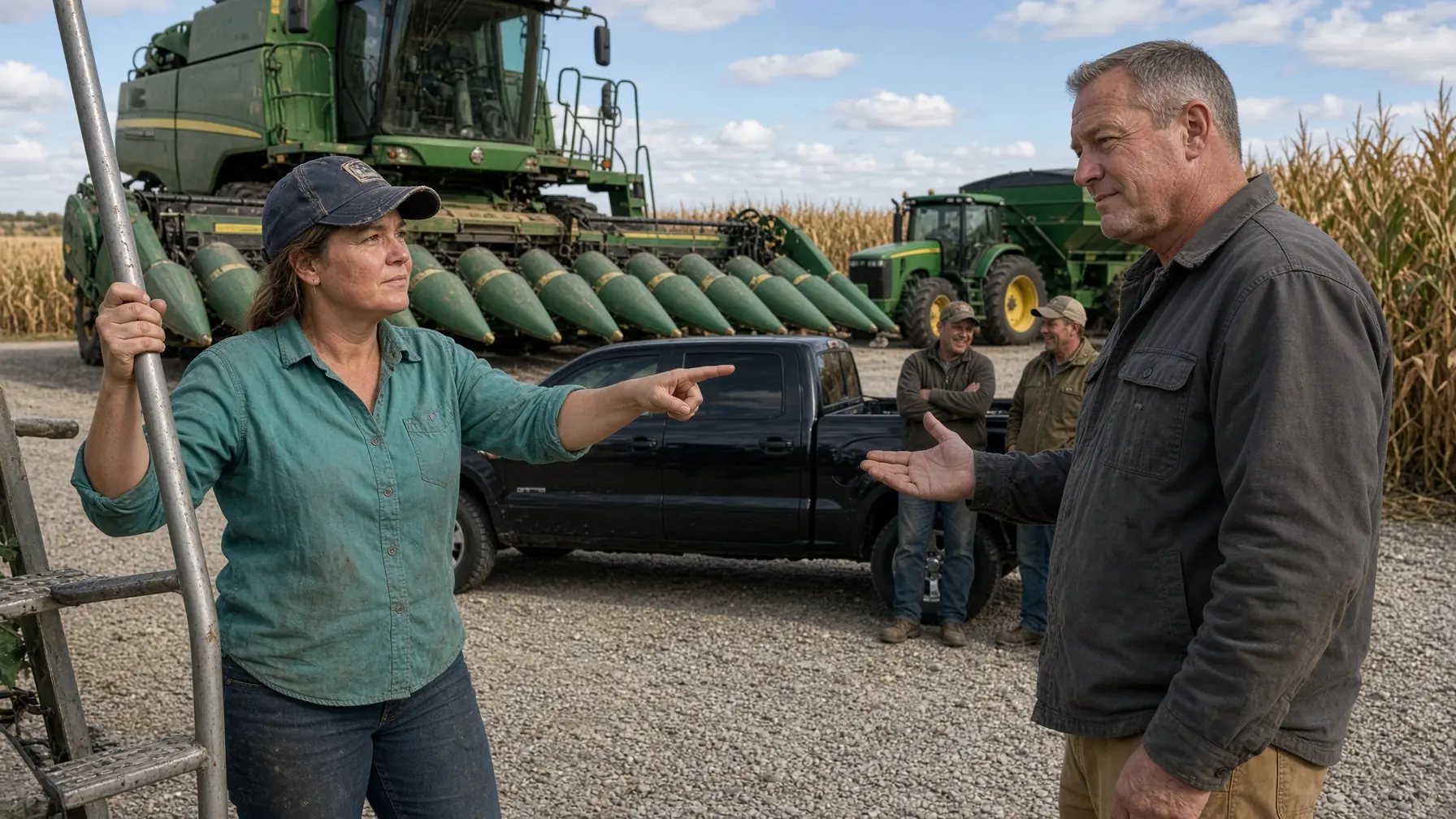
By the time Wade Mercer laughed in my face at the edge of the access lane, I had already been awake for twenty-nine hours.
That part never made it into the story people repeated later. The version that traveled around Bell Creek and across the coffee counters in three counties always started with Wade standing in front of his shiny black pickup, mocking me in front of two other farmers, and me telling him to move his truck. That was the clean version, the version with a beginning people could point to. It sounded sharper that way, more cinematic, more satisfying. But real humiliation never starts in the clean place. It starts a little earlier, usually after exhaustion has thinned your skin, after fear has already made a home in your chest, after you have spent a night in a hospital room listening to your father try and fail to say your name with the right side of his mouth.
The morning before that afternoon in the yard, my father had suffered a stroke.
He had been standing in the machine shed, one hand resting on the fender of an old planter we no longer used, the other pointing toward the air compressor because he wanted me to remind Tyler to check one of the combine tires before we rolled after lunch. I remember that he was annoyed because the compressor hose had a slow leak. I remember that he had my coffee thermos in his hand because he always stole a swallow when he thought I wasn’t looking. I remember that he said, “If the dew burns off by eleven, we can start on the east hundred first,” and then the next thing I knew, his voice slid sideways in the middle of the sentence. The thermos slipped from his fingers. Coffee hit the concrete. And then he tried to take a step and his right leg forgot how.
There are sounds a farm teaches you to categorize without thinking. Engines healthy. Engines tired. Belts too loose. Bearings too hot. Rain on a machine shed roof when you’re grateful, and rain on drying corn when you’re not. But there is another category no one prepares for: the sound your own father makes when his body stops obeying him.
I was the one who caught him before his head hit the shop bench. Tyler called 911. I knelt on the concrete in my work boots and held my father upright while he blinked at me with one eye wider than the other, furious at his own mouth because it wouldn’t do what he told it to do. He had spent forty-three years building Bennett Farms into something solid enough that people in our part of Iowa referred to the place as if it were a direction. Go past the church, turn left at the co-op, keep driving until you hit the Bennett place. He knew every culvert, every drowned-out patch, every fence line where deer liked to come through. He had opinions on weather, markets, diesel storage, and everybody’s tires. He also had an old farmer’s conviction that if he kept moving, his body would keep making the necessary arrangements to move with him.