The spreadsheet sat on Evelyn Hadley’s kitchen counter like a verdict. She had come home from Kroger with two paper bags of groceries, a carton of eggs, and a discount package of chicken thighs, still thinking about whether she could stretch the meat into three dinners. The envelope had no stamp, no return address, only her name written in Christine’s neat, hard handwriting. Evelyn knew before she opened it that whatever waited inside had not come from love.
She set the groceries down beside the sink and slid one finger under the flap. Inside were three printed pages, clipped together, with yellow highlights running down every line. Tuition payments, baseball fees, riding lessons, tutoring invoices, emergency loans, car repairs, mortgage assistance, summer camps, dental bills, and even birthday checks were listed with dates and exact amounts. At the bottom, written in red ink, were the words that made Evelyn’s hands go cold: Total owed to the family: $487,000. We need to discuss repayment.
For a long moment, Evelyn only stared. She had spent that money willingly, or at least she had told herself it was willing, because every payment had been connected to someone she loved. Her grandson Tyler needed travel baseball because Daniel said scouts noticed boys early now. Her granddaughter Lily needed riding lessons because Christine said horses taught confidence, discipline, and social standing.
But seeing every gift turned into a debt changed the shape of the past. The tuition checks were no longer sacrifice; they had become evidence. The birthday gifts were no longer affection; they had become numbers in a claim against her own life. Evelyn lowered herself slowly into the kitchen chair Walter had repaired twenty years earlier and pressed one trembling hand against the table.
Her husband, Walter, had built their home on Maple Drive with patience and pride. He had worked as an electrician for thirty-nine years, coming home with tired hands and sawdust on his boots, but he had always stopped to kiss Evelyn behind the ear before washing up for dinner. Together they had paid off the mortgage, raised two children, and filled the backyard with a swing set, a vegetable garden, and later a treehouse. After he passed, the house had become more than property; it was the last place where Evelyn could still feel his presence.
Daniel arrived at three o’clock with Christine beside him. He did not knock, because he still had the habit of entering his mother’s house as if it were an extension of his own. Christine walked in first, her blonde bob perfect, her navy blouse pressed, her eyes sweeping the kitchen like she was already imagining it empty. Daniel followed with the expression of a man preparing to deliver difficult news and pretending it hurt him more than anyone else.
“Mom,” he said, setting his phone on the counter, “we need to talk like adults.” Evelyn looked at the spreadsheet still lying open beside her grocery bags. “I assumed that was why you left me a bill for loving my grandchildren.” Christine’s mouth tightened immediately. Daniel sighed, as if Evelyn had already become unreasonable.
“This is not about love,” Daniel said. “This is about accountability.” Evelyn turned her eyes to her son, the boy she had once rocked through ear infections and school nightmares. His face was older now, sharper, and tired in a way that had nothing to do with work. “Accountability for what?” she asked quietly.
Christine crossed her arms. “For the way you have inserted yourself into our family finances and created dependency.” Evelyn blinked once, slowly. “You called me every time you needed help.” Christine lifted her chin. “Yes, and you chose to give it. Now we need to clean up the structure.”
Daniel picked up the spreadsheet and pushed it toward Evelyn. “Mom, this is every dollar you spent, and the family deserves repayment.” Evelyn stared at him, waiting for shame to appear on his face. It did not. He truly believed the sentence could stand in her kitchen without collapsing under its own cruelty.
“Repayment?” Evelyn asked, her fingers gripping the counter. “I thought I was helping my grandchildren, not signing a loan.” Daniel looked away first, but Christine did not. She leaned forward slightly, the way she did when negotiating with contractors, school administrators, and anyone she considered useful but beneath her.
“You have to understand,” Christine said, “your spending created expectations we now have to manage.” Evelyn nearly laughed, but the sound broke before it reached her mouth. “My spending kept Tyler in school when your commissions fell. My spending kept Lily in lessons when Daniel’s bonus disappeared. My spending fixed your roof, your transmission, and the kitchen you said embarrassed you in front of your book club.”
Christine’s cheeks flushed. “That kitchen added value to our home.” Evelyn turned to Daniel. “And you stood there while she said it was my debt?” Daniel rubbed his forehead, irritated now. “Mom, nobody is attacking you. We are trying to plan responsibly.”
Then he said the sentence that changed everything. “At your age, staying alone in this house may not be realistic anymore.” Evelyn grew very still. Christine’s eyes moved toward the windows, the cabinets, the hallway, and the staircase, already measuring the value of the home Walter had built.
“What does my house have to do with your spreadsheet?” Evelyn asked. Daniel looked uncomfortable, but Christine answered for him. “The house can cover what you owe us if you stop being emotional and start being practical.” Evelyn heard Walter’s old clock ticking in the dining room. She heard the refrigerator hum, the maple leaves brush the window, and her own heart beating with a calm that frightened her.
Daniel tapped the red total. “The house can cover what you owe us, if you stop being selfish.” There it was, spoken plainly at last. The son she had fed, clothed, defended, and rescued was standing in her kitchen asking her to sell the roof over her head because generosity had not been enough. He wanted repayment for gifts he had begged for through silence, guilt, and carefully timed phone calls.
Evelyn did not cry. That surprised all three of them. Christine had clearly expected tears, and Daniel seemed prepared to soften his voice once Evelyn broke. But Evelyn only folded the spreadsheet neatly, lined the corners, and placed it beside the salt shaker.
“I need time to think,” she said. Daniel exhaled with relief, mistaking restraint for surrender. “That is fair.” Christine’s eyes narrowed, perhaps sensing something colder beneath Evelyn’s calm. “We should meet with a realtor this week,” she said.
Evelyn looked at her daughter-in-law. “No.” Christine stiffened. Evelyn stood slowly, her knees aching, but her posture straight. “You have given me your proposal. Now leave my house.”
Daniel’s face hardened. “Mom, don’t make this ugly.” Evelyn’s eyes moved to him, and something in them made him step back. “Daniel, ugly walked in with that envelope.” Christine grabbed her purse and marched toward the door, but Daniel lingered a moment longer, as if expecting his mother to apologize for defending herself.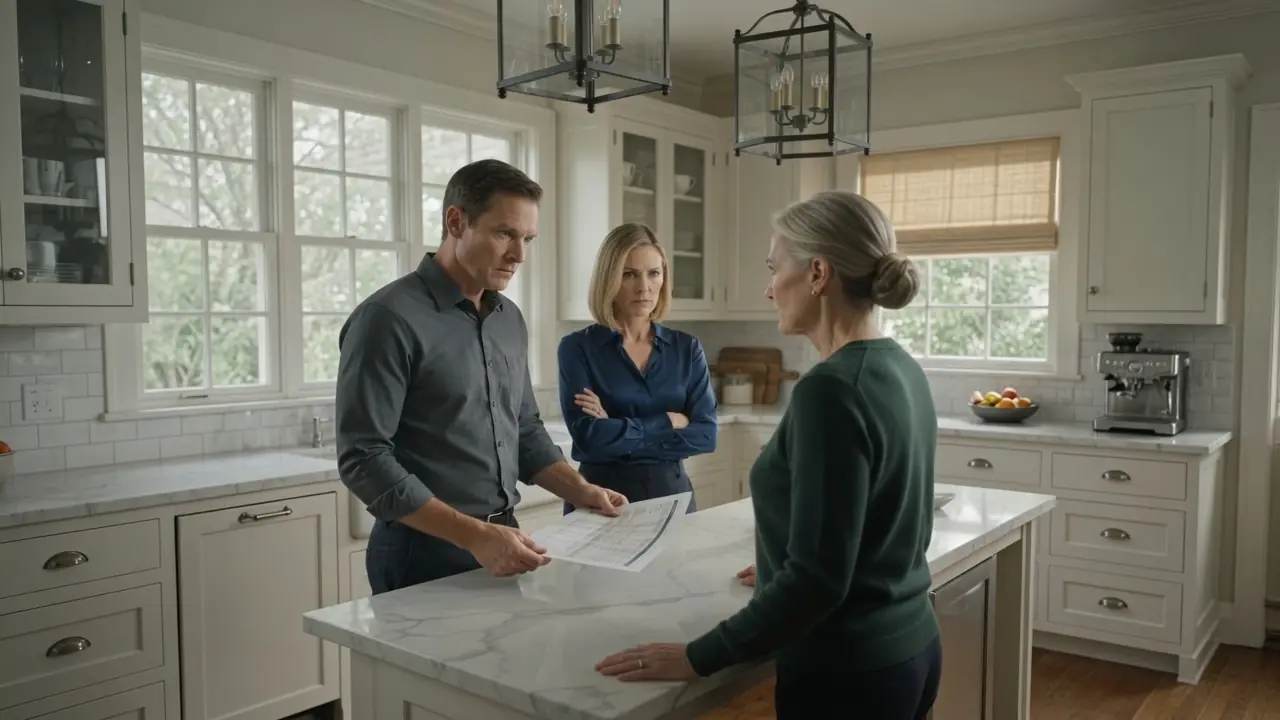
When they left, Evelyn locked the door behind them. Then she stood in the foyer beneath the family photos and let herself breathe. She did not weep until she saw the picture of Daniel at seven years old, missing both front teeth, holding a chess trophy Walter had helped him practice for. The boy in that picture had once believed his father was a genius because Walter could beat him in six moves.
Evelyn wiped her tears and went to Walter’s desk in the den. It had remained almost untouched since his death, except for the bills she paid and the birthday cards she stored in the top drawer. She opened the bottom drawer and removed a small black notebook, the one Walter had used for household finances. Behind it, wrapped in a soft cloth, was his hand-carved chess set.
Walter had made the set the winter Daniel turned sixteen. The pieces were walnut and maple, each one carved slowly over months at the dining room table. Daniel had loved it then, before ambition hardened him, before Christine taught him that sentiment was clutter unless it could be appraised. Walter used to say chess taught a man to see consequences before pride moved his hand.
Evelyn held the black queen in her palm and remembered Walter’s voice. “Never chase every threat, Evie,” he had told her once after a school board argument left her shaken. “Make one quiet move that changes the board.” She closed her fingers around the piece and finally understood what she needed to do.
The next morning, Evelyn called Grace first. Grace was her younger child, a nurse in Asheville, and the only person in the family who still asked Evelyn how she slept before asking for anything else. Evelyn told her everything, starting with the envelope and ending with Daniel’s suggestion that the house should cover what she owed. Grace went silent for so long that Evelyn thought the call had dropped.
Then Grace said, “Mom, tell me you did not agree to anything.” Evelyn looked toward Walter’s desk. “I did not.” Grace’s voice shook with anger. “Good. I am coming this weekend.” Evelyn almost told her not to bother, but the old habit of minimizing her own pain suddenly felt exhausting.
After that, Evelyn called her bank. Then the school. Then the riding academy. Then the baseball travel program, the tutoring company, the insurance office, the car lender, the private music coach, and every service tied to Daniel’s household that had quietly begun billing her accounts. Some payments were automatic. Some were recurring checks. Some were “temporary assistance” arrangements that had lasted for years.
By noon, Evelyn had a yellow legal pad filled with confirmations. She had canceled tuition support for the next semester, removed herself from Tyler’s travel expenses, stopped Lily’s riding payments, ended tutor billing, closed the emergency transfer line, and revoked the card Daniel kept “only for family emergencies.” She canceled subscriptions Christine had added to Evelyn’s account without asking, including a meal delivery service and a home organization consultant. By the time the bank manager read back the final list, Evelyn had canceled sixty-three payments.
“Mrs. Hadley,” the manager said carefully, “are you certain you want all of these stopped immediately?” Evelyn looked at Walter’s chess set arranged on the desk. “Yes,” she said. “Every one.” Her voice did not tremble.
That afternoon, Evelyn packed the chess set in a wooden box. She added a note written on Walter’s old stationery, then placed the folded spreadsheet beneath the board. The note was short because Walter had always believed the strongest truths needed fewer words. Daniel, you taught me love was a loan. Your father taught me chess. The sixty-three payments are canceled. Learn the board before you move again. Mom.
She drove to Daniel’s house before dinner. It was a large brick home with a trimmed lawn, bright shutters, and a remodeled kitchen Evelyn had paid for with money she once planned to use for a trip to Savannah. Christine’s white SUV sat in the driveway, and Daniel’s sedan was parked beside it. Evelyn left the chess set on the front porch, rang the bell, and walked away before anyone answered.
The first call came fifteen minutes later. Evelyn let it ring. The second came from Christine. Then Daniel again. Then a text from Daniel saying, “Mom, what did you do?” Evelyn sat at her kitchen table, poured herself a cup of tea, and watched the phone light up beside the black queen she had kept from the set.
At seven-thirty, Daniel used his key to enter, forgetting Evelyn had changed the deadbolt that afternoon. He knocked hard instead, then rang the bell twice. Evelyn opened the door but did not invite him in. His face was pale, furious, and frightened.
“Mom,” he said, holding up his phone, “the school says tuition support was canceled.” Evelyn folded her hands in front of her. “Yes.” Christine appeared behind him, breathless with anger. “The riding academy called me. Tyler’s tournament hotel was declined. The tutors said our payment authorization was revoked.”
Daniel stared at his mother as if seeing a stranger. “What did you do?” Evelyn stepped onto the porch and closed the door behind her. “I canceled all sixty-three payments that were keeping your perfect life standing.” Christine’s eyes widened. Daniel lowered his voice. “You can’t just do that.”
“I can,” Evelyn said. “They were my payments.” Christine’s voice became sharp and panicked. “The tuition, the insurance, the mortgage support, everything is due this week.” Evelyn looked at her calmly. “Then handle it yourself, because the woman you called too old just put you in checkmate.”
Daniel flinched at the word. He looked down at the wooden chess box tucked under his arm, suddenly understanding only the surface of what it meant. “Mom, this is insane. You’re punishing the kids.” Evelyn’s face tightened with pain, but she did not retreat. “No, Daniel. I am refusing to let you hide behind them while you punish me.”
Christine stepped closer. “You are being vindictive.” Evelyn’s eyes moved to her. “Vindictive would be sending your spreadsheet to every person you brag to at St. Andrew’s.” Christine went silent. “Merciful is canceling what belongs to me and letting you explain your own life.”
Daniel’s anger cracked into fear. “We can’t cover all of this at once.” Evelyn nodded. “I know.” He stared at her. “Then why would you do this?” Her voice softened, and that softness made the words hurt more. “Because you knew I couldn’t cover $487,000 when you put that bill in my hands.”
For the first time, Daniel looked ashamed. Not enough, perhaps, but enough for Evelyn to see the boy under the man. He glanced toward the street, then back at her. “We were trying to make you understand the burden.” Evelyn let out a quiet breath. “I carried the burden for four years. You only noticed it when I stopped.”
A long silence passed between them. Inside the house, Walter’s clock chimed eight. Evelyn suddenly remembered Daniel as a child, sitting cross-legged on the floor with the chess set, trying to beat his father by copying moves he did not understand. He had always hated losing more than he loved learning.
“Mom,” Daniel said, his voice lower now, “can we come inside and talk?” Evelyn shook her head. “Not tonight.” Christine scoffed, but Daniel did not move. Evelyn looked at both of them. “When you can speak to me without treating my home as your asset, my savings as your account, and my love as your entitlement, then we can talk.”
She stepped back into the house and closed the door.
The next week was chaos for Daniel’s family. Evelyn did not need to see it; the voicemails told her enough. The private school demanded a payment plan. Christine’s car payment bounced because Evelyn’s emergency account was no longer attached. Tyler’s travel baseball fees needed immediate confirmation, and Lily’s riding lessons were paused until the account was settled.
Daniel called again and again. Sometimes angry, sometimes pleading, sometimes rehearsed and gentle. Christine sent one message calling Evelyn selfish and another, three hours later, asking if they could all “reset with love.” Evelyn saved every message but answered none until Grace arrived on Saturday.
Grace came through the door and hugged her mother so tightly Evelyn finally cried. She cried for the spreadsheet, for the years of giving, for the house that had almost become a prize to be divided by people who had never paid for it. Grace made tea, sat beside her at the kitchen table, and went through every account with the careful patience of a nurse reading medication labels. By evening, Grace had helped Evelyn schedule appointments with a financial planner and an elder law attorney.
“You are not helpless,” Grace said. Evelyn smiled sadly. “They almost made me feel like I was.” Grace reached across the table. “That is what people do when they want control. They make independence look dangerous.” Evelyn looked around the kitchen Walter had painted twice, the cabinets he had installed, the window where he used to watch cardinals at the feeder. “This is still my house,” she whispered.
“Yes,” Grace said firmly. “And it stays that way.”
Two weeks later, Daniel agreed to meet at Evelyn’s attorney’s office. Christine came with him, though her face showed she did not want to be there. Evelyn wore a deep green sweater, her silver hair pinned neatly, and Walter’s wedding ring on a chain beneath her blouse. She looked smaller than the conference table, but she did not feel small anymore.
The attorney, Mr. Albright, reviewed the facts without emotion. The payments had been voluntary support, not loans to Daniel’s family and certainly not debts owed by Evelyn. The house belonged solely to Evelyn, fully paid and protected under her updated estate plan. Any attempt to pressure her into selling it could be documented as financial coercion.
Christine’s face tightened at that phrase. Daniel looked at his mother, wounded. “You think I was coercing you?” Evelyn met his eyes. “You brought a spreadsheet to my kitchen and told me my house could cover what I owed.” He swallowed. “I was angry.” She nodded. “So was I. I canceled payments. I did not try to take your home.”
Mr. Albright slid a document across the table. It revoked all prior informal financial assistance and established that any future gifts from Evelyn would be at her sole discretion. Daniel stared at it, then at his mother. “So that’s it? You’re cutting us off?”
Evelyn folded her hands. “I am cutting off the account. I am not cutting off my grandchildren.” Christine laughed bitterly. “How generous.” Evelyn turned to her. “Generosity is not what you called it when you wrote repayment in red ink.” Christine’s mouth closed.
Daniel looked exhausted. “What am I supposed to tell Tyler and Lily?” Evelyn’s face softened, but her voice stayed steady. “Tell them the truth in a way children can bear. Tell them their parents made financial choices they now have to manage.” He looked down. “They’ll be angry.”
“Yes,” Evelyn said. “And you will survive their anger the way I survived yours.” Daniel flinched again. For once, Evelyn did not comfort him.
Months passed, and the family changed because it had no choice. Tyler transferred from St. Andrew’s to a public high school with a strong baseball program and discovered he liked being around boys who did not measure each other by vacation photos. Lily stopped riding at the expensive academy but found a volunteer program at a rescue barn where she learned to care for horses instead of only sit on them. Evelyn continued seeing them, but she met them for lunch, library trips, and backyard afternoons, not as the woman paying for everything.
One Sunday, Tyler came over alone. He was taller than Evelyn now, awkward and serious, with Walter’s quiet eyes. “Grandma,” he said while helping her carry groceries, “Dad said you stopped helping because we were ungrateful.” Evelyn paused by the pantry. “Is that what you think?”
Tyler looked at the floor. “I don’t know. I just know everyone was yelling.” Evelyn put the soup cans away slowly. “I stopped paying because your parents forgot help is a gift, not a right.” Tyler absorbed that in silence. Then he whispered, “Thank you for baseball, even if I don’t play travel anymore.”
Evelyn turned, and tears filled her eyes before she could stop them. “You are welcome, sweetheart.” Tyler hugged her, clumsy and tight. In that moment, Evelyn understood that canceling the payments had not cost her the grandchildren. It had only removed the price tag from the relationship.
Daniel took longer. Pride made him stubborn, and Christine made him harder. But pressure has a way of teaching lessons comfort hides. He sold the white SUV, moved the children to more reasonable activities, refinanced what he could, and took a second consulting project at night. For the first time in years, Daniel had to tell his children no without blaming Evelyn’s wallet.
One evening in early spring, he came to Maple Drive alone. Evelyn found him on the porch holding Walter’s chess set. He looked thinner, humbler, and embarrassed by both. “Can I come in?” he asked.
Evelyn studied him for a moment, then opened the door. They sat at the kitchen table where the spreadsheet had once landed like a weapon. Daniel placed the chess set between them and unfolded the note she had left him months earlier. The paper had been read so many times the crease was soft.
“I understand more now,” he said quietly. Evelyn waited. Daniel touched the carved black king. “Dad used to let me lose until I learned why. I hated him for it sometimes.” Evelyn smiled faintly. “He knew.” Daniel’s eyes filled. “You did the same thing.”
Evelyn did not answer right away. The clock ticked in the dining room, slow and familiar. Daniel wiped one hand over his face. “I am sorry for the spreadsheet. I am sorry for the house. I am sorry I made you feel like your love was something I could invoice.”
The apology did not erase the wound. Evelyn knew better than that. But it landed somewhere real, and after months of anger, real was enough to begin with. “I accept the apology,” she said. “But I will not go back to being your emergency fund.”
Daniel nodded. “I know.” His voice broke slightly. “I don’t want that anymore.” Evelyn looked at him carefully, searching for performance and finding exhaustion instead. “Then learn how to be my son again.”
They played one game of chess that night. Daniel lost in eleven moves, because grief and guilt made him reckless. Evelyn moved Walter’s black queen with a steady hand and watched Daniel study the board after the final move. He gave a sad laugh. “Checkmate.”
“Yes,” Evelyn said. “But not the end of the game.” Daniel looked up, and for the first time in a long while, he looked like someone willing to learn.
Evelyn still lived in the house on Maple Drive. She returned to the community center, visited Grace in Asheville, took the long-delayed trip to Savannah to see her sister Ruth, and bought decent coffee again without guilt. She kept the spreadsheet in a folder in Walter’s desk, not because she wanted to remember the cruelty, but because she wanted to remember the day she stopped mistaking exhaustion for love. Sometimes she opened the drawer and saw the folder there beside Walter’s notebook, and she felt no shame at all.
The sixty-three canceled payments became family legend, though no one spoke of them loudly. Tyler called it “Grandma’s checkmate” once, and Evelyn laughed so hard she had to sit down. Lily painted her a small picture of a black queen standing in front of a house with green shutters. Evelyn framed it and placed it on the mantel.
In the end, Evelyn Hadley did not lose her family by closing her wallet. She found out which parts of the family had been buried beneath expectation, fear, and entitlement. Her son had left a spreadsheet on her kitchen counter thinking numbers could turn sacrifice into debt. But Evelyn made one quiet move, canceled sixty-three payments, and proved that a woman they called too old still knew exactly how to protect her house, her dignity, and her final years.