“Get this broke garage rat off my jet before I have him dragged out.”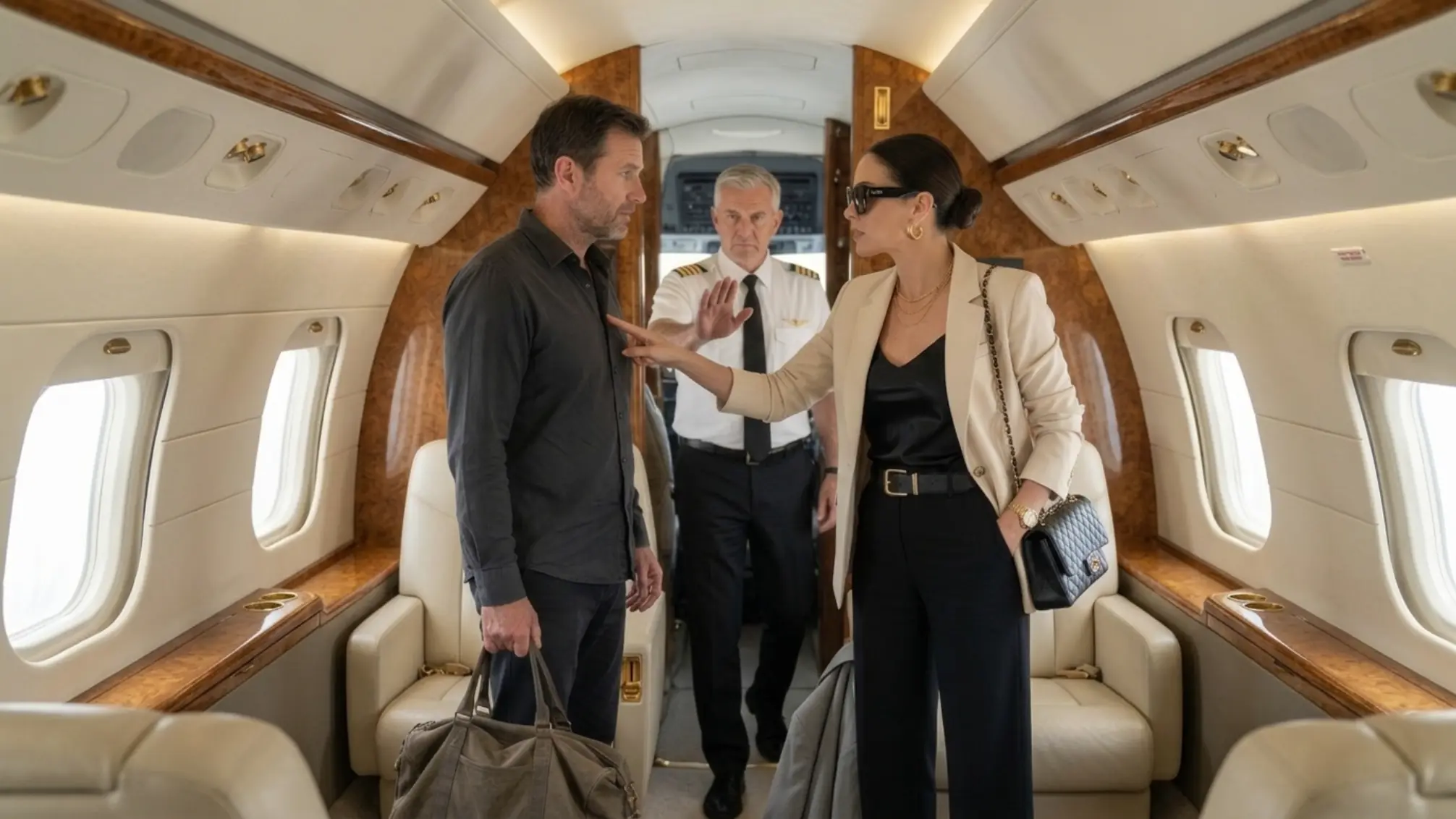
Sloan Harrington ripped the plain gray jacket from Grant Holloway’s hand and threw it onto the cream-colored carpet of the private jet. She stood in the forward cabin wearing a tailored beige blazer over a black satin camisole, high-waisted black trousers, a gold designer belt, layered necklaces, and oversized black sunglasses that made her expression look even colder. Behind her, six Blackthorn Global executives smiled as though humiliating her former husband was merely the morning’s entertainment.
Grant glanced down at the jacket, then back at the woman who had once promised to stand beside him through poverty, failure, and every impossible dream. “Are you sure you want to do this in front of the crew?”
Sloan pressed one manicured finger against his chest. “You’re still the failure I abandoned. Touch me, and security will bury you.”
The cockpit door opened.
Captain Reese Callahan stepped into the cabin, took one look at Grant’s jacket on the floor, and raised his hand before the flight attendant could close the main door. “Ma’am, step away from Mr. Holloway.”
Sloan turned toward him impatiently. “Captain, remove this man. Blackthorn chartered this aircraft for an executive meeting, and he has no business being here.”
Reese’s expression did not change. “Blackthorn chartered nothing.”
The laughter behind Sloan stopped.
The captain looked directly at her. “The man you just threatened owns this aircraft. He also decides whether you remain on it.”
For several seconds, the cabin was so quiet that the faint clicking of the coffee machine near the galley became impossible to ignore.
Sloan removed her sunglasses.
“No,” she said.
Grant bent down, picked up his jacket, and brushed a small piece of lint from the sleeve. He did not smile, insult her, or enjoy the sudden fear in her eyes. That calmness frightened her more than anger would have.
The flight was scheduled to leave Northridge Airfield at eight fifteen that morning. Sloan believed it had been arranged by Conrad Blackthorn, founder of Blackthorn Global and the man she had served for more than a decade. The company was preparing for a crucial meeting in Seattle, where a mysterious investment group was considering a four-hundred-million-dollar rescue package.
Without that money, Blackthorn Global would collapse.
Banks had stopped extending credit. Vendors were demanding advance payment. Two maintenance divisions had delayed payroll, and the company’s pension fund was quietly approaching a crisis Sloan had helped hide from employees. The Seattle presentation was supposed to convince the investor that Blackthorn remained strong, efficient, and worthy of saving.
Sloan had spent six months preparing every line.
She simply had not researched the man she was supposed to impress.
Grant arrived at the airfield before sunrise in an old pickup with more than two hundred thousand miles on the odometer. He carried a single worn duffel bag and wore a charcoal shirt beneath the jacket Sloan later threw onto the floor. Nothing about him announced that his aviation company owned fourteen private aircraft, three maintenance centers, and engine-monitoring technology used across several international fleets.
Before boarding, Grant stopped beside the front landing gear.
A young technician named Owen had been completing the final inspection. Grant crouched near the strut, studied a faint line beneath the mounting assembly, and asked for a light. The mark was no wider than a strand of hair, but Grant recognized the beginning of material fatigue.
Owen stared at it. “The earlier inspection missed that.”
“That’s why inspections happen more than once,” Grant replied. “Flag it, photograph it, and have engineering confirm the tolerance before departure.”
“You’re with the maintenance team?”
Grant smiled slightly. “Something like that.”
The executives walking toward the stairs barely noticed him. Men in work jackets had always been invisible to people who believed aircraft existed only to carry them from one important room to another.
Sloan noticed him immediately.
Her first expression was not surprise.
It was disgust.
She had not seen Grant in nearly three years, though they shared a twenty-one-year-old daughter named Piper. Sloan missed most family events, explaining that global strategy did not pause for birthdays, graduations, or ordinary weekends. Grant stopped arguing long ago because Piper had grown old enough to understand which parent consistently appeared and which one sent expensive gifts after forgetting the date.
Sloan approached the stairs carrying a quilted black handbag and a coffee she never drank.
“How did you get past security?” she demanded.
“My name is on the manifest.”
She laughed. “You used our old connection to beg your way onto this flight?”
“No.”
“Then perhaps you’re here to repair something.”
“I already did.”
Her colleagues began watching.
Sloan enjoyed audiences. She had built much of her career by controlling how rooms perceived people before they were given a chance to speak. During the final years of their marriage, she described Grant as stubborn, impractical, and incapable of understanding the world beyond a rented hangar.
Now she used the same story in front of executives.
“My ex-husband used to fix other people’s engines,” she announced. “Apparently, he now thinks that qualifies him for private aviation.”
One executive chuckled.
Grant looked toward the jet. “Are you certain this is your flight?”
Sloan mistook the question for jealousy.
She ordered the flight attendant to remove him.
That brought them to the cabin, the discarded jacket, the threat of security, and Captain Reese’s revelation.
Sloan recovered first.
“Perhaps he owns a small share,” she said. “That doesn’t make this his personal aircraft.”
Reese remained near the cockpit. “This Gulfstream is registered to Holloway Meridian Aviation.”
She looked at Grant. “A coincidence of names.”
“No coincidence,” the captain replied. “Mr. Grant Holloway is the registered owner.”
A senior Blackthorn executive named Miles Keaton slowly bent down, picked up Grant’s duffel bag, and placed it beside the nearest seat. He had laughed only minutes earlier. Now his face had become carefully blank.
Sloan stared at Grant as though wealth should have altered his features.
He still had the same steady blue eyes. The same light beard. The same scar near his right eyebrow from an accident in the old hangar. Twelve years earlier, she had looked at that face across an unpaid electricity bill and told him dreams did not feed children.
Then she left.
“Why didn’t you tell me?” she asked.
“You didn’t ask who I became,” Grant answered. “You only reminded everyone who you thought I was.”
Captain Reese checked the time. “Mr. Holloway, we need a decision. Are all passengers remaining aboard?”
Grant looked at Sloan.
For one hopeful second, she believed he would throw her off the aircraft and allow her to become the public victim of a bitter ex-husband. She could have used that. She understood scandal, outrage, and reputational warfare.
Grant denied her the opportunity.
“You may stay,” he said. “But if you insult another crew member or passenger, you leave.”
“This meeting affects thousands of employees.”
“That is why you’re still standing here.”
Sloan took her seat.
Grant did not choose the largest chair in the cabin. He sat beside the window, opened his laptop, and began reviewing maintenance data. His indifference forced Sloan to confront something worse than anger.
He had not built his life to punish her.
She quietly messaged her assistant.
Find everything on Holloway Meridian immediately.
The response arrived before takeoff.
Holloway Meridian owned predictive engine-failure patents licensed by major aviation operators. It controlled aircraft-leasing assets, cargo technology, maintenance facilities, and a private investment division. Analysts valued the business at more than two billion dollars, though ownership had been hidden behind a family trust.
The trust beneficiary was Grant Holloway.
Sloan reread the message until the letters blurred.
When the aircraft reached cruising altitude, she unfastened her seat belt and moved across the aisle.
“You hid all of this.”
Grant continued reading his screen. “When you left, I was three months behind on the hangar rent.”
“You could have told me later.”
“Why?”
“We were married.”
“We were divorced before the first major contract.”
Sloan lowered her voice. “You made me believe you failed.”
“No. You decided I would fail before the evidence arrived.”
Her jaw tightened. “I left because Piper needed stability.”
“Piper stayed with me.”
“That was temporary.”
“It has been fourteen years.”
Several executives looked away.
Sloan realized Grant was not merely defending himself. He was correcting the story she had repeated at corporate dinners, charity events, and private gatherings for years. She had portrayed herself as the ambitious woman forced to escape an unmotivated husband.
The truth was less flattering.
Grant had worked nights in the rented hangar and mornings from their kitchen table while raising Piper alone. His early system monitored vibration, heat, pressure, and fatigue patterns to identify engine failures before traditional inspections could detect them. Investors rejected the technology because implementation was expensive and airlines preferred familiar methods.
Then one cargo operator tested it.
Grant’s software detected a developing turbine fault that would likely have caused catastrophic engine damage within weeks. The operator adopted the system across its fleet. Other contracts followed, slowly at first and then rapidly.
Grant paid his debts.
He bought the hangar.
He hired the mechanics who had believed in him when he could barely pay them.
He never called Sloan.
The jet leveled at thirty-five thousand feet. A flight attendant served breakfast, but Sloan touched nothing. On the table before her rested the Blackthorn investment proposal.
Grant glanced at the cover.
Prepared for Holloway Meridian Strategic Holdings.
“You were presenting to my company,” he said.
Sloan swallowed. “The final decision belongs to the board.”
“I chair the board.”
“One person cannot decide an investment this large.”
“No vote moves without my approval.”
The room changed again.
Miles Keaton closed his tablet. Two executives exchanged quick looks. Sloan had entered the aircraft believing she controlled the delegation. Now everyone understood that the man she had tried to remove was the only person capable of saving their company.
Grant placed one hand on the proposal. “Present it.”
“Now?”
“You planned to ask for four hundred million dollars. Convince me.”
Sloan began with confidence because presentations were the one battlefield she understood. She described an eighteen-percent reduction in operating costs, the sale of two maintenance centers, and a strategic workforce adjustment affecting twenty-four hundred employees.
“Adjustment?” Grant asked.
“Positions eliminated through restructuring.”
“Mechanics, inspectors, and maintenance planners.”
“Personnel are replaceable.”
Grant’s expression cooled.
Sloan had once used similar words during their marriage. She told him Piper would adapt to her absence because children adjusted and mothers were replaceable in practical ways through schools, caregivers, and money.
Grant turned one page. “Who accepts responsibility when safety knowledge disappears with those workers?”
“Our remaining teams will manage.”
“Your remaining teams are already missing inspection anomalies.”
Sloan frowned.
Grant displayed the photograph of the stress line beneath the landing-gear assembly. Owen’s report had entered the system minutes before takeoff.
“Blackthorn technical staff reviewed this aircraft yesterday,” he said. “Your team marked the assembly clear.”
“That could be an isolated oversight.”
“It could also be evidence of what happens after years of cutting experienced staff.”
Miles leaned forward. “He’s right about the staffing levels.”
Sloan looked at him sharply.
He continued anyway. “We delayed recurrent training and reduced second-shift inspection coverage. I raised concerns last quarter.”
“Not in the executive review.”
“Because Conrad removed them.”
Grant turned to the financial appendix.
“What is this eighty-six-million-dollar consulting transfer?”
Sloan answered too quickly. “A strategic advisory allocation.”
“To whom?”
“An outside partner.”
“Name it.”
She hesitated. “Blackthorn Advisory Services.”
“Who owns it?”
“That falls outside this presentation.”
“No,” Grant said. “It sits inside the company asking me for four hundred million dollars.”
He identified three inflated revenue projections and a pension liability hidden behind a restructuring footnote. Within eighteen months, the proposed plan would leave the retirement fund unable to meet obligations if investment returns fell below Sloan’s unrealistic assumptions.
She stared at him.
“You’re an engineer.”
“I learned finance when banks tried to take everything I owned.”
A secure message appeared on Grant’s phone.
Dana Whitlock, his chief counsel, had been reviewing Blackthorn’s internal maintenance records. Her message contained a scanned approval page bearing Sloan’s signature.
Grant rotated the screen toward her.
“Did you authorize these altered safety reports?”
Sloan’s face tightened. “Conrad instructed me to sign.”
“That was not my question.”
“The numbers were revised for consistency.”
“False numbers are not consistency.”
“You don’t understand the pressure inside a company this size.”
“I understand that people fly on aircraft maintained under those reports.”
She lowered her voice. “We were a family once.”
“Do not use Piper.”
“I am her mother.”
“You missed twelve birthdays.”
Sloan’s mouth opened, but Grant’s phone rang before she could respond.
Piper’s name appeared on the screen.
He answered immediately.
“Hey, kiddo.”
His voice changed.
Warmth replaced the cold control that had filled the cabin. Piper was calling from college about an engine-design assignment involving torque tolerance. Grant took a notebook, worked through the calculation with her, and reminded her to eat lunch before the laboratory session.
Sloan listened in silence.
Piper did not know her mother was sitting across the aisle.
The call lasted four minutes.
It revealed more about Grant than the aircraft, company valuation, or investment authority. He had built wealth, but fatherhood remained the center of his life. Sloan heard the closeness she had never earned and could not purchase.
After he ended the call, Grant looked at her. “You have until we land to decide whether you tell the truth.”
“About what?”
“The reports, the consulting transfer, and Conrad’s plan.”
“You’re assuming he committed wrongdoing.”
“I’m assuming your signature appears where his does not.”
Sloan still believed Conrad would protect her.
She had served him through restructurings, acquisitions, scandals, and internal rebellions. He called her indispensable. He said loyalty created power.
Minutes later, Conrad called the aircraft’s secure conference system.
Sloan answered while Grant signaled everyone to remain quiet.
Conrad’s face did not appear, only his voice.
“Secure Holloway Meridian’s signature before landing.”
Sloan glanced toward Grant. “There are complications.”
“Then solve them.”
“He discovered the consulting transfer.”
A pause followed.
Conrad’s tone became colder. “You signed those documents. If this becomes an investigation, the evidence points to you.”
Sloan’s breathing stopped.
Conrad continued, unaware Grant was listening. “Erase the files connecting Blackthorn Advisory to the family trust. Once the investment clears, we move the valuable assets into the replacement entity and let the old company enter bankruptcy.”
“What about the employees?”
“They will become the court’s problem.”
“And me?”
“You remain useful as long as you secure the money.”
The aircraft’s recording system captured every word.
Grant leaned toward the microphone. “Good morning, Conrad.”
Silence.
Then forced laughter. “Grant Holloway. I didn’t realize you were aboard.”
“You didn’t realize I owned the plane either.”
Conrad attempted to describe the conversation as hypothetical planning language. Grant asked directly about the eighty-six million dollars, the shell company, pension exposure, and manipulated safety data.
Conrad became insulting.
“You built software in a garage. Do not confuse luck with the experience required to run a global corporation.”
Grant’s voice remained even. “We’ll discuss that in Seattle.”
He ended the call.
Sloan sat motionless.
The man she had sacrificed her marriage, daughter, and conscience to serve had already chosen her as the person who would absorb every consequence. She had believed proximity to power made her powerful.
It had only made her convenient.
“Help me,” she whispered.
Grant looked at her. “Tell the truth.”
“I can transfer my shares.”
“I don’t want them.”
“I’ll resign quietly.”
“That protects Conrad.”
“I can give you private information.”
“You should give investigators accurate information because it is accurate, not because you are bargaining for rescue.”
Miles spoke from across the cabin. “I kept copies of the original reports.”
Sloan stared at him.
“I knew the revisions were false,” he continued. “I was afraid.”
Grant nodded. “Anyone who comes forward honestly will receive legal protection.”
That promise unsettled Sloan. Grant used power to shield people below him rather than crush them. It was the opposite of everything Conrad had taught her.
She finally handed Dana remote access to Blackthorn’s internal data vault.
The evidence was worse than expected.
Conrad planned to receive Holloway Meridian’s investment, transfer valuable patents and aircraft contracts into a shell company, declare bankruptcy, abandon pension liabilities, and reacquire the assets for himself. Thousands of employees would lose jobs and retirement benefits while his family trust preserved the profitable pieces.
Grant revealed one final fact.
Holloway Meridian had quietly purchased most of Blackthorn Global’s distressed debt during the previous six months.
Conrad was not merely asking Grant for money.
He already answered to him as the company’s controlling creditor.
The jet descended through gray clouds toward Seattle.
At the private terminal, Conrad waited with lawyers, public-relations advisers, and a line of black vehicles. Grant exited first in his plain jacket.
Conrad did not recognize him.
“Security,” he called. “Remove that technician from the executive area.”
Sloan stepped onto the stairs behind Grant and stopped.
The scene mirrored the morning.
Grant did not react. Captain Reese handed a ground supervisor the ownership confirmation, and security immediately withdrew.
Conrad looked annoyed but not yet frightened.
Inside the hotel conference hall, he announced that Holloway Meridian had effectively approved the four-hundred-million-dollar deal. Shareholders applauded before any agreement existed.
Sloan began the presentation.
She reached the slide describing the elimination of twenty-four hundred jobs. Her voice weakened. Conrad signaled impatiently for her to continue.
Instead, she looked toward Grant seated in the back row.
“The financial statements behind this proposal were manipulated,” she said.
The room went silent.
Conrad stood. “Cut her microphone.”
Sloan continued before the audio disappeared. “The consulting transfer benefited a Blackthorn family trust. Safety data was altered, and the pension fund is at risk.”
Conrad called her unstable and claimed stress from her divorce had damaged her judgment. He ordered staff to remove her.
Grant rose.
Conrad pointed at him. “You have no authority in this meeting.”
The conference chair stood beside the stage.
“Mr. Blackthorn,” she said, “that is Grant Holloway, chairman of Holloway Meridian and the controlling creditor of this corporation.”
Phones appeared throughout the room.
Reporters began typing.
Grant walked to the front without haste. He presented the recorded aircraft call, original maintenance reports, banking records, pension analysis, and documents describing the planned bankruptcy.
Conrad denied everything until his own voice filled the speakers.
You signed those documents. If this becomes an investigation, the evidence points to you.
The board suspended him before the meeting ended.
Grant rejected the original rescue proposal. Instead, Holloway Meridian offered a restructuring that protected the pension fund, retained essential maintenance workers, eliminated executive bonuses, and placed safety oversight under an independent board.
Shareholders accepted.
They had no better option.
After the hall emptied, Sloan found Grant near the terminal windows.
“Was this revenge?” she asked. “Did you build all of this to prove I was wrong?”
“No.”
“You never wanted me to see what you became?”
“I stopped living for your judgment years ago.”
Tears formed in her eyes. “I am sorry.”
“I believe you’re sorry for several things.”
“Could we begin again?”
Grant shook his head without cruelty. “Forgiveness does not restore trust.”
“What about Piper?”
“That decision belongs to her.”
Sloan lost her executive position, returned bonuses obtained through false reports, and cooperated with the investigation. Her testimony reduced her legal exposure, but it did not erase her choices.
Conrad faced federal inquiry.
Blackthorn Global was renamed and rebuilt. Thousands of jobs survived, and the maintenance divisions received greater authority than they had held under his leadership.
Several weeks later, Grant returned to Northridge Airfield with Piper. She was beginning an internship at a Holloway Meridian technical center and had insisted on applying under the same standards as everyone else.
Captain Reese met them beside the aircraft.
“You still driving that ancient pickup?” he asked.
“It starts every morning.”
“You own fourteen jets.”
“None of them carry lumber.”
Piper laughed.
A new ground employee approached without recognizing Grant. “Sir, do you need assistance finding your aircraft?”
Grant thanked him sincerely and showed the boarding pass.
He remembered Sloan’s first mistake that morning. It was not failing to recognize his wealth. It was believing a man in an old jacket deserved less respect than the mysterious billionaire she intended to impress.
The jet had never been the real lesson.
Neither was the money, the company, or the four-hundred-million-dollar decision.
Character appeared before recognition.
Sloan threw Grant’s jacket onto the floor because she believed he had nothing she needed. Minutes later, she learned he owned the cabin around her and controlled the future of the company she had sacrificed everything to serve.
Yet Grant’s greatest victory was not watching her lose power.
It was refusing to become like her once he possessed it.
He protected workers she considered replaceable, preserved pensions Conrad planned to abandon, and gave frightened employees room to tell the truth. He allowed consequences to follow Sloan without using his influence to make them crueler.
As the aircraft rose above the clouds, Piper opened a battered notebook filled with engineering calculations. Grant sat beside her, listening as she explained a design problem she had been trying to solve.
Below them, the airfield disappeared.
The expensive cabin became quiet.
Grant did not look like a billionaire celebrating revenge against the woman who once called him a failure. He looked like what he had always been during the hardest years: a father who stayed, an engineer who refused to trade safety for speed, and a man who understood that power was measured by what it protected.
Sloan Harrington had tried to throw a broke mechanic off her private jet.
The aircraft belonged to him.
But long before the captain revealed that truth, Grant Holloway had already become the one person in the cabin she could no longer afford to underestimate.