Walter Hayes recognized the tractor before he saw it.
Its engine reached him from behind the machinery shed, a deep uneven rhythm followed by the faint metallic rattle that had lived in his memory for twenty-nine years. Conversations continued across the crowded Iowa estate auction, boots shifted on gravel, and the auctioneer tested his microphone beside a line of combines. Walter stopped walking so suddenly that the farmer behind him nearly collided with his shoulder.
“That sound,” Walter whispered.
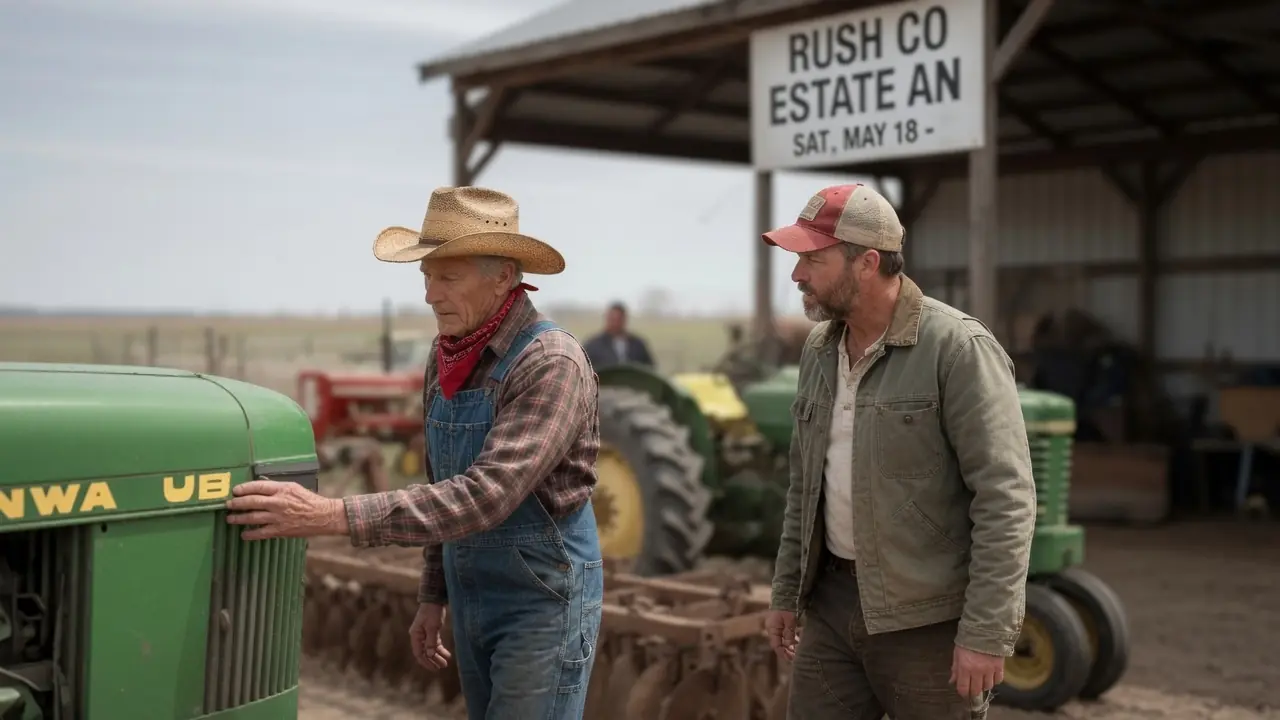
At sixty-one, Walter remained broad-shouldered and strong from a lifetime of repairing fences, lifting feed sacks, and wrestling stubborn equipment through difficult seasons. Gray now marked his short dark hair and trimmed beard, but his face still carried the rugged handsomeness of the younger farmer he had once been. He wore a cream cowboy hat, a fitted navy work shirt, faded jeans, and brown boots worn pale around the toes. In his right hand, he carried a pair of fencing pliers because he had planned to bid on nothing more important than a box of old tools.
A green John Deere 4020 rolled from behind the shed.
Fresh paint gleamed beneath the cloudy sky, and polished yellow wheels turned slowly across the auction yard. A younger employee drove it toward the equipment line while bidders moved closer, admiring the restored tractor. Walter did not notice the paint, the new seat, or the clean decals first.
He noticed the engine’s hesitation between the third and fourth beat.
His father had spent an entire winter trying to correct that irregular rhythm after replacing the fuel pump in 1986. The tractor ran perfectly under load, but at low idle it always produced one slight pause that no mechanic ever eliminated. Walter had listened to it from his bedroom as a boy, from the barn as a young man, and from the driver’s seat during the first years he managed the Hayes farm.
He crossed the yard without hearing anyone call after him.
The John Deere stopped beside an older red tractor. Walter moved toward the rear axle, his pulse pounding harder with every step. The restoration had hidden many familiar details, but not all of them.
A shallow bend remained in the left fender.
Two uneven holes marked the place where Walter’s father had once mounted a homemade toolbox. Near the hydraulic housing, a repaired crack curved upward like a crooked smile beneath several layers of green paint.
Walter touched it with two fingers.
His father, Arthur Hayes, had made that weld in 1978 after the tractor slipped into a frozen drainage ditch. Arthur refused to replace the housing, insisting that a good weld should outlive the man who made it. The scar remained rough because Arthur had ground down only the sharpest edges before returning the tractor to work.
Walter closed his eyes.
For one moment, the auction disappeared.
He was thirty-two again, standing beside an empty equipment shed on a September morning in 1995. The chain on the gate had been cut, tire tracks crossed the damp yard, and the John Deere his father helped him buy had vanished during the night. Walter searched roads, dealerships, repair shops, and county sales for months.
Nothing surfaced.
The sheriff filed a stolen-property report using the serial number Walter copied from his insurance papers. Photographs appeared at feed stores and machinery dealers throughout southern Iowa. Walter called farms after hearing rumors and drove hundreds of miles to inspect tractors that turned out to be wrong.
The insurance company paid only part of the value because the machine was old. Walter used the settlement to purchase a smaller tractor that never matched the 4020’s power. Two difficult harvests followed, and the farm nearly failed after Arthur suffered a stroke.
Walter eventually stopped searching.
He never stopped listening.
“Sir, step away from the machinery.”
The voice brought him back.
A polished man in his early fifties approached from beside the auction office. Grant Mercer wore a tan jacket, pressed trousers, expensive boots, and a plastic identification badge naming him as the estate-sale coordinator. His neatly trimmed beard and confident posture suggested someone accustomed to giving instructions without expecting resistance.
Walter kept one hand near the axle.
“Where did this tractor come from?”
Grant glanced at the machine. “It belongs to the Rush estate.”
“How long did they own it?”
“That information isn’t relevant to the sale.”
“It is to me.”
Grant’s expression tightened. “Are you registered to bid?”
Walter pulled the bidder card from his shirt pocket.
“Then you’ll hear the same description as everyone else when the tractor comes up.”
Walter pointed toward the curved welding scar. “This machine was stolen from my farm in 1995.”
Several nearby bidders turned toward him.
Grant gave a short laugh, perhaps expecting Walter to join him. When he did not, Grant folded his arms.
“This tractor has been stored on the Rush property for more than twenty years.”
“That doesn’t make it theirs.”
“You recognized a green tractor at a farm auction and decided it belongs to you?”
“I recognized the idle before it came around the shed.”
A few men smiled, but Walter saw uncertainty in others. Older farmers understood that machinery developed voices as distinctive as people. A tractor operated for thousands of hours could carry sounds its owner knew immediately.
Grant did not care.
“We have clear estate documents,” he said. “Unless you intend to bid, stop interfering with the preview.”
Walter crouched beside the rear axle.
Grant stepped closer. “What are you doing?”
“Checking the serial plate.”
“The plate was painted during restoration.”
“I can see that.”
Walter removed a small folding knife from his pocket and carefully scraped the edge of the thick green paint covering the metal tag. Grant grabbed his wrist before he completed the first stroke.
“Touch it again and you’ll be removed from the property.”
Walter rose slowly.
“My father welded that scar by hand in 1978.”
Grant released him. “Thousands of tractors have welding repairs.”
“Not shaped like that one.”
“You are embarrassing yourself.”
Walter looked past him at the restored John Deere. “Then let me read the number and prove I’m wrong.”
“No.”
The refusal came too quickly.
Walter studied Grant’s face. “Why not?”
“Because you have no right to damage property consigned to this auction.”
“I’m asking to uncover a factory plate.”
“You’re scraping paint from a tractor you don’t own.”
“I did own it.”
Grant stepped closer, lowering his voice. “Listen carefully. This estate includes valuable equipment, and we have hundreds of registered bidders. I will not allow some sentimental farmer to disrupt the sale with an old theft story.”
Walter’s anger became cold.
“Call the sheriff.”
Grant smiled. “You think law enforcement has time to investigate every man who recognizes a dent?”
“The county still has the stolen-property report.”
“After twenty-nine years?”
“The report doesn’t disappear because the thief waited.”
Grant signaled toward two security workers near the auction tent. “Walk away from the tractor.”
Walter did not move.
One of the men approached reluctantly. He knew Walter from cattle sales and church fundraisers, and his discomfort showed clearly. The other was younger and less hesitant.
“Walter,” the older man said quietly, “let’s not make this worse.”
“I’m asking for the serial number to be checked.”
“Grant says the machine belongs to the estate.”
“Grant isn’t the sheriff.”
The younger security worker reached for Walter’s elbow. Walter stepped back before the hand touched him.
Grant raised his voice so the growing crowd could hear. “This man is making an unsupported ownership claim and attempting to damage auction property. Remove him.”
A murmur spread through the yard.
Walter saw farmers he had known for decades watching in silence. Some appeared curious, others skeptical, and a few looked embarrassed for him. He understood the scene Grant had created: an aging man clinging to an old memory while professionals tried to conduct legitimate business.
Walter had no intention of giving them that ending.
He pulled out his phone and called his daughter.
Emily answered on the second ring. “Dad?”
“I need you to go into the metal file cabinet in the farm office.”
“Which drawer?”
“Bottom drawer. There’s a blue folder marked equipment insurance, 1995.”
A pause followed. “Did you find it?”
Walter looked at the John Deere.
“I think it found me.”
Emily did not question him. She had grown up hearing about the missing tractor, though Walter stopped mentioning it after her mother told him grief could attach itself to objects. Emily went directly to the file cabinet while Walter remained several yards from the machine under Grant’s supervision.
“What am I looking for?” she asked.
“The sheriff’s report and the insurance schedule.”
Papers moved through the phone.
“I found a copy of the report.”
“Read the serial number.”
Emily began with the model designation, then slowly read seven numbers.
Walter repeated them once.
He had remembered every digit correctly.
Grant shook his head. “A number over the phone proves nothing.”
“It proves the report exists.”
“It proves your daughter read something.”
Walter turned toward the older security worker. “Call Deputy Mills.”
The man hesitated.
Grant interrupted. “There will be no police involvement unless a crime occurs.”
“A stolen tractor is a crime.”
“The estate purchased this machine legally.”
“Show me the purchase record.”
Grant’s face hardened. “You have no authority to demand private documents.”
A gray pickup entered the auction grounds before Walter could respond. Deputy Nathan Mills stepped out wearing his county uniform and walked toward the crowd. Someone had already called him, though Walter never learned whether it was a bidder, an employee, or the older security worker.
Grant’s confidence shifted slightly.
Nathan had grown up two farms from the Hayes property. He had been a child when the tractor disappeared, but his father joined the original search. He listened without interrupting as Walter described the engine sound, the welding scar, and the covered serial plate.
Then he turned toward Grant.
“Pause the sale of this tractor.”
Grant stared at him. “On what basis?”
“A documented ownership dispute.”
“We have a schedule to maintain.”
“You can maintain it around this item.”
“The estate’s attorney approved every consignment.”
“Then the attorney can explain the records.”
Grant lowered his voice. “Deputy, this man has scraped the paint.”
“One small section near the serial tag.”
“That is property damage.”
Nathan looked at Walter. “Did you damage anything besides paint covering the plate?”
“No.”
Nathan crouched beside the machine and examined the tag. “Mr. Mercer, do you have a problem with me uncovering the serial number?”
Grant hesitated too long.
“It may affect the tractor’s restored finish,” he finally said.
Nathan removed a small evidence tool from his vehicle. He worked carefully, lifting flakes of paint from the raised metal digits without touching the surrounding bodywork. The crowd moved closer, forming a silent half-circle behind him.
One number appeared.
Then another.
Walter repeated the sequence before Nathan exposed each digit.
When the seventh number emerged, Nathan remained crouched for several seconds. He photographed the plate, then stood.
“It matches the number Walter gave me.”
The auction yard erupted in whispers.
Grant held out one hand. “Matching a report does not establish present ownership. The estate may have acquired it through a lawful sale after recovery.”
“Then we’ll check the title history and original investigation.”
“Farm tractors didn’t always carry formal titles in 1995.”
“That makes your sales documents more important, not less.”
Grant glanced toward the auction office. “I’ll contact the estate attorney.”
“You do that. The tractor isn’t moving until I finish.”
Nathan called the sheriff’s department and asked the records clerk to locate the original theft file. The report remained in archived county records, along with photographs Walter had submitted nearly three decades earlier. One picture clearly showed the crooked weld beside the hydraulic housing and the bent left fender.
The John Deere in the auction yard matched both.
Grant stopped arguing that Walter had mistaken the tractor.
Instead, he changed his argument.
“The Rush estate bought equipment from multiple farms over the years,” he said. “Even if the tractor was stolen before they acquired it, the current estate may be an innocent purchaser.”
“That may affect criminal responsibility,” Nathan replied. “It doesn’t automatically transfer ownership of stolen property.”
Walter kept his eyes on Grant. “Who consigned it?”
“The estate.”
“Who gave you the paperwork?”
“The executor.”
“Which executor?”
Grant’s jaw tightened. “That information will be provided through counsel.”
Nathan entered the auction office with Grant while Walter waited outside. The crowd slowly returned to other machinery, though attention remained fixed on the disputed tractor. Several men approached Walter to ask questions.
One remembered the theft.
Another recalled seeing the tractor advertised in a regional paper during the late 1990s, though he could not remember the seller. An elderly farmer named Paul Dwyer walked around the John Deere twice before stopping near the front weight bracket.
“Arthur made that bracket too,” Paul said.
Walter touched the metal. “You remember it?”
“I helped hold the torch.”
Paul pointed toward a small triangular reinforcement beneath the mount. “He cut that from an old cultivator frame. Said factory steel was too thin.”
The auction company had described the bracket as a custom period accessory.
Paul laughed bitterly when Walter told him.
“That’s Arthur Hayes’s work. Ugly enough to last forever.”
After nearly an hour, Nathan emerged carrying photocopied receipts. Grant followed with none of his earlier confidence.
The estate file showed that Harold Rush had purchased the tractor in 2001 from a man named Leonard Voss. The handwritten bill of sale listed the model but not the serial number. Leonard operated a small machinery brokerage that closed after a federal tax investigation in 2004.
Walter recognized the name.
Leonard had worked briefly for a repair shop fifteen miles from the Hayes farm during the year the tractor disappeared. The original sheriff’s file included a note stating that Leonard had been interviewed because he knew which farms kept equipment in unlocked sheds.
He denied involvement.
No evidence tied him to the theft at the time.
Nathan contacted state investigators. Although the statute of limitations likely prevented prosecution for the original theft, the machinery’s history still had to be resolved. The tractor was removed from the auction list and transported to a secure county storage building.
Grant objected until Nathan informed him that attempting to sell disputed stolen property after receiving official notice could create a new offense.
The auction continued without the John Deere.
Walter returned home with only the fencing pliers.
That evening, he sat at the oak kitchen table studying the original insurance papers Emily had placed before him. His wife, Clara, had died six years earlier, but he could hear what she would have said.
“Don’t make the tractor carry everything you lost.”
Walter understood that now.
The John Deere was connected to his father, his early farming years, and the difficult season when theft nearly cost them their livelihood. But recovering it would not restore Arthur, Clara, or the twenty-nine years between its disappearance and return.
Still, truth mattered even when time had reduced its practical value.
Three days later, state investigator Marisol Vega arrived at the Hayes farm. She brought photographs taken during the inspection of the tractor. Beneath the seat platform, officers found faded white paint from the original Hayes farm inventory number. Someone had ground most of it away, but chemical imaging recovered enough to match an equipment list in Walter’s records.
They also discovered alterations near the serial plate.
The tag itself was original, but thick layers of paint had been deliberately applied over it during multiple restorations. The engine number corresponded with John Deere service records from a 1989 repair ordered by Arthur Hayes.
The evidence left little doubt.
“It is your tractor,” Marisol said.
Walter exhaled slowly.
“What happens now?”
“The Rush estate claims innocent purchase. Their attorney agrees the property should be returned once the court signs the release, but they may seek reimbursement from Leonard Voss’s remaining assets.”
“Is Leonard alive?”
“Yes. He lives in Missouri.”
“Can you prove he stole it?”
“Not yet.”
Leonard was seventy-four and initially refused to speak. When investigators showed him the photographs, archived report, and bill of sale, he claimed he had purchased the tractor from an unknown man at a roadside equipment sale.
There was no receipt.
Then another document surfaced.
A former repair-shop owner had kept payroll records and customer notes in his basement. One page from September 1995 stated that Leonard missed two days of work and returned with “green 4020 for repaint—no tag showing.” The shop owner questioned the machine’s origin, but Leonard moved it before repairs began.
The record did not prove every detail, but it weakened his story.
Faced with possible charges related to later possession and fraudulent sale records, Leonard admitted he helped transport the stolen tractor. He insisted another man planned the theft, a farmhand who had died years earlier. According to Leonard, they watched the Hayes farm during county-fair week, cut the gate chain after midnight, and loaded the John Deere onto a trailer.
They repainted it in Missouri and sold it twice before Leonard bought it back cheaply. He later sold it to Harold Rush.
“Why that tractor?” Walter asked when Marisol explained the confession.
“Leonard said your father kept it in excellent condition and rarely locked the outer equipment gate.”
Walter looked toward the old shed.
Arthur had blamed himself for years.
He believed his trust in the community had invited the theft. Walter wished he could tell him that the machine had returned, though he knew Arthur would have cared less about the tractor than about clearing the family name from its long failure to protect it.
The court signed the release two weeks later.
Walter drove to the county storage yard with Emily and his twelve-year-old grandson, Noah. The restored John Deere waited beneath an open shelter, cleaner than it had ever looked during its working years.
Noah walked around it slowly. “This is the one Great-Grandpa fixed?”
“Many times.”
“Does it still run?”
Walter smiled. “There’s one way to find out.”
He climbed into the seat.
The controls felt both familiar and strangely small beneath his hands. He turned the key, and the engine caught after two rotations. That uneven idle returned immediately—the slight hesitation between beats that had pulled him across the auction yard.
Walter closed his eyes.
For several seconds, he allowed himself to remember his father riding beside him during corn planting, Clara bringing lunch to the field, and Emily standing on the platform as a child while he drove slowly toward the barn.
Then Noah climbed onto the step.
“Can I ride?”
Walter moved over enough to make room.
They drove the tractor home along county roads while Emily followed with her hazard lights flashing. Farmers emerged from driveways after hearing what had happened, waving as the green machine passed. Paul Dwyer stood beside his mailbox and removed his cap.
Walter brought the John Deere into the same yard from which it vanished in 1995.
He parked beside the equipment shed and shut down the engine.
Silence settled across the farm.
Noah touched the welding scar near the axle. “Are you going to repaint this part?”
“No.”
“It’s rough.”
“That’s why it stays.”
The auction company later issued a public statement claiming it had acted appropriately after law enforcement confirmed the ownership dispute. Walter read the statement once and threw it away.
Grant Mercer called him personally.
“I want to apologize,” Grant said. “I handled your claim badly.”
“You threatened to throw me out.”
“I believed you were disrupting the sale.”
“You believed a polished document more than the man standing beside his stolen tractor.”
Grant remained silent.
Walter continued. “You didn’t have to believe me immediately. You only had to stop long enough to check.”
“I understand.”
“You understand now.”
Grant offered to waive the buyer’s premium if Walter ever attended another Mercer auction. Walter almost laughed at the absurdity of the gesture.
“I don’t need a discount,” he said. “I need you to remember what happened the next time an old farmer tells you a machine has a history your papers missed.”
Grant promised he would.
Walter did not know whether the promise lasted.
The restored John Deere returned to work gradually. Walter could have sold it for a strong price because the story increased public interest, but he refused every offer. He also resisted turning it into a museum piece.
Machines were built to work.
He replaced worn hydraulic lines, changed fluids, and repaired a leaking rear seal. He left the fresh green paint untouched except around the exposed serial plate and Arthur’s welding scar. During hay season, Walter used the tractor to pull a small rake across the north pasture.
Noah rode beside him.
The boy asked question after question about gear ranges, engine speed, and the homemade front bracket. Walter answered patiently, repeating many of the lessons Arthur once gave him.
“Why didn’t Grandpa buy a newer bracket?” Noah asked.
“He trusted his own work.”
“Was he always right?”
Walter smiled. “Absolutely not.”
“But this lasted.”
“Good work can outlive a mistake.”
The tractor became part of the farm again, but not in the way Walter expected. Its return did not erase the anger he carried for twenty-nine years. Instead, it made the anger feel smaller.
The machine had passed through other hands, worked unfamiliar fields, and spent years beneath different roofs. Harold Rush may never have known it was stolen. His family had maintained it well enough that the engine still ran strongly.
Walter decided not to treat every person in the tractor’s history as an enemy.
Leonard Voss faced charges related to falsified sales records and possession of stolen equipment. Because of his age, the passage of time, and his cooperation, he received probation, restitution, and a substantial fine rather than prison.
Walter attended the sentencing.
Leonard turned toward him afterward.
“I was twenty years old and stupid,” he said.
“You were forty-five.”
Leonard lowered his eyes.
“You knew exactly what that tractor meant to my farm.”
“I needed money.”
“So did we.”
Walter did not forgive him that day.
He also did not spend another year carrying Leonard’s choices.
“I hope every time you hear a Deere engine,” Walter said, “you remember the family you nearly broke.”
Then he walked away.
The following spring, Walter entered the John Deere in the county agricultural heritage display. He did not polish away every imperfection. The bent fender remained visible, along with Arthur’s weld and the uncovered serial plate.
A small card beside the tractor told the story.
It described the 1995 theft, the estate auction, and the evidence that returned the machine to its original owner. At the bottom, Walter added one sentence himself:
Paperwork records possession. Scars remember ownership.
Visitors gathered around it throughout the fair.
Some came for the theft story. Others wanted to hear the famous uneven idle. Older farmers studied the homemade bracket and debated whether Arthur’s repair method had been sensible.
Noah stood proudly beside the tractor, explaining every detail as though he had witnessed the entire twenty-nine-year journey.
Walter watched from a bench near the livestock barn.
Emily sat beside him. “Dad would have loved this.”
“Your grandfather hated crowds.”
“He would have loved being proven right.”
Walter smiled. “That part is true.”
She rested one hand on his arm. “Did you ever really believe it would come back?”
“No.”
“But you remembered the sound.”
“Every day.”
Across the fairgrounds, Noah climbed into the driver’s seat under supervision. He placed both hands on the wheel and looked toward Walter for permission.
Walter nodded.
The engine started.
Its deep rhythm rolled between the barns, followed by the unmistakable pause between the third and fourth beat. For twenty-nine years, that sound had belonged to a loss Walter could not resolve.
Now it belonged to his grandson’s smile.
The John Deere had disappeared from the Hayes farm in darkness, carried away by men who assumed paint, distance, and time could erase its past. It returned in broad daylight at a stranger’s auction, surrounded by people prepared to sell it again.
Grant had trusted documents.
The crowd had trusted appearances.
Walter trusted the sound, the crooked weld, and the work his father’s hands left behind.
The serial number proved the theft.
But Walter had known the truth before anyone scraped away the paint.