The HOA president called the police on me for moving out, as though leaving the neighborhood were somehow a crime.
I was loading the final box into my moving truck when Vivian Blackwood came storming down the sidewalk in a two-hundred-dollar yoga set, waving her phone like a weapon.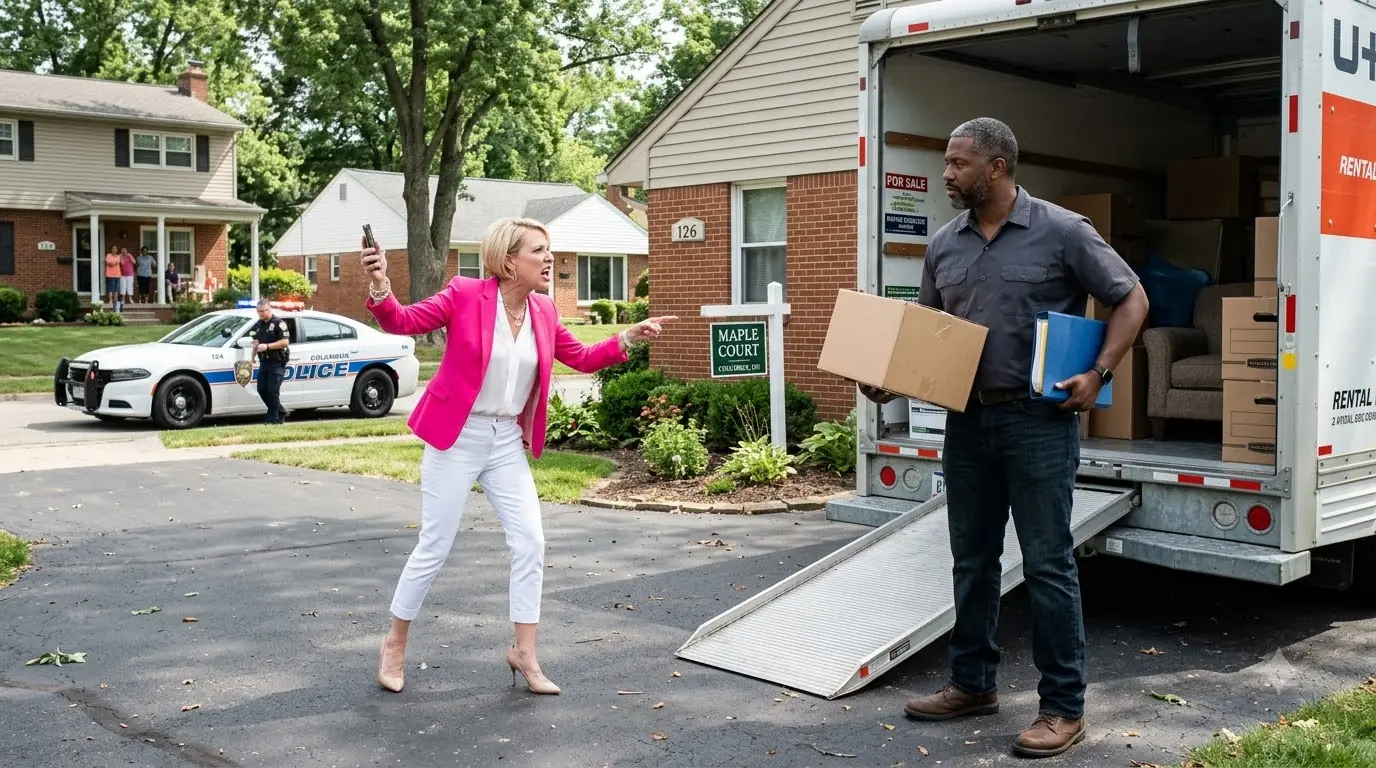
“Officer, he is abandoning community assets,” she shouted. “He is destroying our property values.”
Gravel cracked beneath her designer sneakers as she marched toward me. Diesel exhaust from the moving truck drifted across the cul-de-sac and mixed with her expensive perfume.
I had to bite the inside of my cheek to keep from laughing.
While Vivian screamed about community standards, I had something in my back pocket that was about to turn her entire world upside down. It was something she never imagined a person like me could accomplish.
I did not argue. I did not defend myself.
I simply looked her in the eye.
“Vivian, you might want to sit down for this.”
To understand how we reached that moment, I need to explain how the war began.
My name is Marcus Fletcher. Six months earlier, I had been a man trying to rebuild his life after the kind of divorce that allowed lawyers to purchase vacation homes.
I worked as a construction project manager and owned Fletcher Contracting. Before entering private business, I had spent twenty years working in large-scale engineering and infrastructure projects.
I believed in rules, but I also believed those rules should apply equally to everyone.
Willowbrook Estates appeared perfect when I first visited. It was a quiet American suburb with decent neighbors and cookie-cutter ranch houses built during the 1990s.
Children still played outside. Lawns were tidy, traffic was light, and every house looked like a place where someone could begin again.
The real estate agent mentioned an HOA but described it as a simple organization responsible for lawn care and snow removal.
She forgot to mention the dictator.
Vivian Blackwood ruled Willowbrook like a personal kingdom.
She had served as HOA president for eight years. During the day, she worked as a real estate agent, and during every other waking hour, she acted like the neighborhood belonged to her.
Vivian always wore perfectly coordinated workout sets and drove a spotless white BMW X5 that looked as though it were detailed twice every week.
Three weeks after I moved in, I walked outside and found a crisp envelope tucked beneath my windshield wiper.
The paper crackled as I unfolded it.
Violation Notice: Unapproved Commercial Vehicle in Driveway.
The vehicle in question was my work truck, a clean and professionally maintained Ford F-250 with small company lettering on the doors. It was parked inside my own driveway.
The morning coffee turned bitter in my mouth when I read the penalty.
Seventy-five dollars, payable within ten days.
Failure to comply could result in a property lien.
Three houses away, Bob Martinez had a boat trailer that had been sitting in his driveway since Memorial Day. It was coated in pollen, one tire was flat, and the trailer occupied twice as much space as my work truck.
Bob had received no violation notice.
I soon learned that Bob’s wife worked at Vivian’s real estate office.
Convenient.
That evening, I opened the HOA handbook.
It contained eighty-two pages of bureaucratic torture, but inside Section 4.3, I discovered something beautiful.
Board members were subject to enhanced penalties for violations because they were expected to model community standards. Any board member who broke the rules could receive double fines.
The game had changed.
For the next two weeks, I used my professional camera to document Vivian’s violations. Every photograph included timestamps, location data, and complete metadata.
Old habits from years of project management were difficult to lose.
Her violations were everywhere.
Vivian’s BMW blocked the public sidewalk for twelve minutes almost every morning. That created a one-hundred-fifty-dollar municipal violation.
She had six ceramic garden gnomes despite the HOA’s prohibition on lawn ornaments. Each one carried a seventy-five-dollar penalty.
Four security cameras pointed toward public areas without board approval. Each camera created another two-hundred-dollar violation.
While Vivian harassed me about a professionally maintained work truck, she had accumulated roughly eight hundred dollars in penalties.
What truly angered me came later.
I began knocking on doors and speaking with neighbors.
Vivian had been terrorizing Willowbrook for years.
Mrs. Stella, the kind elderly woman living beside me, had been fined two hundred dollars because her rose bushes were two inches taller than Vivian’s preferred limit.
A young family across the street nearly moved after Vivian repeatedly cited them for their children’s sidewalk chalk.
Everyone paid.
Everyone lowered their heads.
The neighborhood constantly smelled of fresh paint because residents were scrambling to satisfy arbitrary exterior-color requirements. Measuring tapes had practically become the soundtrack of Willowbrook as homeowners checked grass height, mailbox placement, and decorative trim.
The rules seemed to change whenever Vivian needed another excuse to control someone.
Then I discovered the real problem.
Property ownership records are public, and something about Vivian’s address did not make sense.
According to the county assessor, the house at 47 Maple Court, Vivian’s premium corner-lot palace, belonged to Clearwater Investment Holdings LLC.
Vivian did not own it.
She was a tenant.
The HOA bylaws were clear. The board president had to be a property owner inside the community.
A renter could not legally hold the position.
Vivian’s entire eight-year reign was invalid.
I sat in my kitchen that night staring at the property records.
While she had spent years acting like the queen of Willowbrook, Vivian had violated the organization’s most fundamental rule.
It was time for a reality check.
The following morning, I walked to her front door.
The scents of expensive coffee and vanilla candles drifted outside when she opened it. Her expression shifted immediately from a professional smile to concealed irritation.
“Mr. Fletcher,” she said. “What can I do for you?”
I held up my phone.
“I wanted to discuss the violation notices I will be submitting.”
Her perfectly shaped eyebrows rose.
“Excuse me?”
“Section 12.7 prohibits lawn ornaments. You have six garden gnomes at seventy-five dollars each.”
I moved to the next photograph.
“Section 15.4 prohibits unauthorized surveillance equipment. That is two hundred dollars per camera.”
I showed her another image.
“Then there is the daily sidewalk obstruction caused by your BMW.”
The scent from the candle could not cover the sudden nervousness in the doorway.
“That is different,” Vivian said. “Those are decorative elements that enhance property values.”
“According to whom?”
I scrolled through the handbook on my phone.
“The rules contain no exception for decorations you personally approve.”
I held up the penalty calculation.
“Section 4.3 doubles fines for board members, so your current total is approximately sixteen hundred dollars.”
Vivian’s face lost color beneath her professional spray tan.
HOA bullies rarely retreat when they are cornered.
They escalate.
Within twenty-four hours, four new violation notices had been forced into my mailbox like passive-aggressive love letters.
Grass Height Exceeds Maximum of 2.5 Inches.
Someone had measured my lawn at 2.7 inches with a ruler.
Improper Garbage Container Placement.
The wheels on my container faced the street rather than the house.
Unauthorized Door Color Variation.
My forest-green front door was apparently two shades darker than the approved color called Sage Mist.
Vehicle Maintenance Activity in Driveway.
I had checked the oil in my truck.
The paper crackled across my kitchen table as I spread out the notices.
Vivian had apparently crawled through the neighborhood at dawn with a measuring tape, searching for reasons to punish me.
That was when I remembered something an old supervisor used to say.
When an opponent becomes desperate, mistakes follow.
Document the mistakes.
I spent the next week systematically photographing Willowbrook.
Twenty years of construction management had taught me that patterns did not lie. Selective enforcement always left a trail.
Every image contained GPS coordinates, timestamps, and measurement references.
The soft mechanical click of the camera became part of my morning routine.
The results were extraordinary.
Bob Martinez’s boat trailer remained inside his driveway, now with weeds growing around the flat tire.
Violation notices received: zero.
The Henderson family’s basketball hoop clearly violated the prohibition on visible sports equipment.
Violation notices received: zero.
Three different lawns measured more than three inches high.
Combined violations: zero.
Mrs. Patterson’s decorative flagpole directly violated Section 8.2.
Violations received: zero.
Every favored homeowner had either donated to one of Vivian’s real estate charity events or used Vivian as an agent when purchasing a house.
Another convenient coincidence.
Meanwhile, Vivian’s documented violations became more serious.
Her BMW blocked the sidewalk at exactly 6:47 every morning while she sat behind the wheel scrolling through her phone.
The garden-gnome collection grew from six to eight. She also added a decorative welcome sign that violated two separate rules.
Her four surveillance cameras remained pointed toward streets and neighboring properties without written approval.
From my construction work, I had learned that code cases followed a simple principle.
Document every condition with photographs, timestamps, and measurements.
HOA violations were no different.
The next board meeting was going to be memorable.
I arrived with a complete professional presentation.
It did not contain a random collection of photographs. Every violation was cross-referenced with a specific rule, penalty calculation, date, and documented pattern of selective enforcement.
Twenty neighbors filled the folding chairs inside the community room.
The chairs squeaked like old hinges, and the fluorescent lights buzzed above us while the projector displayed slide after slide of documented hypocrisy.
“Based on my two-week survey,” I said, “HOA President Vivian Blackwood currently owes approximately twenty-four hundred dollars in accumulated violation fees.”
The room became silent except for the projector’s mechanical hum.
Vivian’s voice cracked.
“This is harassment. Board members have enforcement discretion.”
“Section 4.3 says board members face enhanced penalties,” I replied. “It does not provide exemptions.”
I advanced to the final slide.
“But here is the most interesting issue.”
The county property record appeared on the wall.
“Public records show that you do not own the house at 47 Maple Court.”
Mrs. Stella gasped.
“Clearwater Investment Holdings owns the property,” I continued. “You are a tenant.”
I displayed the relevant HOA bylaw beside the assessor record.
“The president must be a property owner. A renter is not eligible.”
Vivian’s face changed from spray-tanned bronze to nearly white.
“That is a meaningless technicality.”
“No,” I said. “It means your entire eight-year presidency may have been invalid.”
The room erupted.
Nervous laughter mixed with excited whispers, and someone in the back began clapping slowly.
I could see the calculation behind Vivian’s panicked eyes.
She was not surrendering.
She was planning a counterattack.
It arrived with the subtlety of a sledgehammer.
Three days after the board meeting, I found an official-looking notice inside my mailbox.
Emergency HOA Session: Problem Resident Requiring Immediate Action.
Vivian had created a private tribunal to deal with me.
That was not the real surprise.
On Thursday morning, I was checking email over coffee when my largest client called.
The commercial renovation contract was worth fifty thousand dollars.
“Marcus,” the client said, “we received a call yesterday about your company.”
“What kind of call?”
“A woman claimed to be calling through a consumer-protection organization. She said there were multiple safety complaints and allegations of unprofessional conduct against Fletcher Contracting.”
The coffee turned to ash in my mouth.
“We have worked together for three years,” the client continued, “but our insurance company is asking questions.”
I knew exactly who had placed the call.
The sweet vanilla scent from Vivian’s house suddenly felt poisonous inside my memory.
That afternoon, while I scrambled to protect the contract, Vivian spread a different type of poison through the neighborhood.
Mrs. Patterson approached me at the mailbox.
“Marcus, Vivian mentioned that you may be experiencing some difficulties.”
Concern dripped from every word.
“She called it post-service stress. She said she is worried about everyone’s safety.”
A metallic taste filled my mouth.
Vivian was using a part of my professional background, something I was proud of, as evidence that I was dangerous.
“She said you have been stalking residents,” Mrs. Patterson continued. “Taking photographs of their houses at all hours and following Vivian around town.”
I had documented visible HOA violations from public areas during reasonable hours.
Vivian had transformed that work into a story about an unstable resident experiencing a breakdown.
By evening, three neighbors had asked whether I was doing all right and casually mentioned installing new security cameras.
The smells of backyard barbecues filled the air while quiet conversations stopped whenever I walked past.
The emergency meeting was pure theater.
Vivian had rearranged the community center to resemble a courtroom. She sat behind a folding table elevated on the small stage while the other board members flanked her like nervous supporting actors.
“We are here tonight to address a serious threat to our peaceful community,” she announced.
Her voice carried manufactured authority.
“Mr. Fletcher’s obsessive surveillance and harassment of law-abiding residents have created an atmosphere of fear.”
Then she revealed what she believed was her strongest weapon.
“I have consulted legal counsel. His behavior meets the definition of stalking under state law.”
She looked directly toward me.
“Combined with his background and obvious anger-management issues, I believe the HOA must take protective action.”
The room became completely silent.
Even Vivian’s supporters appeared uncomfortable.
Using a person’s service history as evidence that he was dangerous represented a new low.
What Vivian did not know was that I had continued investigating her background.
“Before we discuss my dangerous behavior,” I said, rising slowly, “perhaps we should discuss why you are three months behind on your rent.”
Her face went white.
“That is private.”
“Eviction filings are public records.”
I raised the documents.
“Clearwater Investment Holdings filed the first notice in March and another last month.”
I looked around the room.
“She is not only operating the HOA while legally ineligible. She is a renter who has not paid her landlord.”
Mrs. Stella gasped.
“Her lease expires in six weeks,” I continued. “It is a month-to-month agreement, which means the landlord may terminate it with proper notice.”
Vivian gripped the table so tightly that her knuckles turned white.
“Those are confidential financial matters.”
“So are the liens and unpaid settlements connected to your real estate business.”
I held up another set of public documents.
“There are three of them.”
The room filled with whispers.
Someone in the rear laughed, not cruelly, but with amazement at the size of Vivian’s deception.
“You are destroying everything!” Vivian shouted.
She slammed both hands against the table.
“I built this community. I maintained standards. I protected property values.”
“Property values you do not contribute to,” I said calmly, “because you do not own property here.”
That broke the barrier.
Mrs. Stella stood.
Her voice shook with eight years of suppressed anger.
“You fined me two hundred dollars because my roses were too tall while you were facing eviction.”
A young mother from Oak Street rose next.
“You forced us to repaint our entire house while you could not pay the rent on yours.”
One neighbor after another began sharing stories.
Arbitrary fines.
Threatening letters.
Selective enforcement.
Warnings about liens.
Eight years of Vivian’s control poured from the room like water through a broken dam.
While the anger surrounded her, I watched Vivian’s expression change.
The panic became something colder and more calculated.
She was not broken.
She was planning something more destructive.
“This meeting is adjourned,” she announced.
Vivian collected her papers with hands that had stopped shaking.
As residents filed outside, still discussing the revelations, she met my eyes across the room.
Her smile contained pure venom.
“Enjoy your victory, Marcus.”
She leaned closer.
“It will not last.”
I should have taken the warning more seriously.
Vivian’s next move arrived at six on Friday morning with the sound of government boots crossing gravel.
Two city code-enforcement officers stepped from a truck, followed by a police cruiser.
The morning coffee turned to battery acid in my mouth as they approached the front door.
“Mr. Fletcher,” the lead inspector said, “we received an anonymous complaint concerning hazardous material storage and unlicensed electrical work.”
It was every contractor’s nightmare.
Even a false complaint could delay projects, trigger inspections, create fees, and damage a business while the owner fought to prove compliance.
“What specific violations were reported?” I asked.
The inspector, Rodriguez, was already moving toward my tool-storage shed.
“Improper chemical storage, unauthorized structural modifications, possible fire hazards, and reports of unpermitted electrical work.”
He read from the clipboard as casually as though he were ordering lunch.
I watched the inspectors photograph everything while neighbors looked through their curtains.
The sharp scent of adhesive filled the air as temporary review notices were placed on my legally permitted workshop, properly stored equipment, and an electrical panel that had passed inspection three months earlier.
“These permits appear valid,” Rodriguez admitted after reviewing my paperwork. “However, we will need a complete structural review to verify current compliance.”
The translation was simple.
Weeks of delays, thousands of dollars in possible costs, and serious damage to my professional reputation while officials investigated imaginary violations.
The real consequences began before the inspection ended.
My telephone rang.
My second-largest client called.
Then my third.
Then my insurance company.
Information traveled quickly inside the construction industry, and allegations of safety violations could destroy a contractor.
“Marcus,” the insurance representative said, “our underwriters are concerned about these reports.”
“We may need to suspend coverage while the investigation is active.”
Twenty years of building my company appeared ready to disappear because Vivian made several calls.
That afternoon, she delivered what she believed was the killing blow.
A sheriff’s deputy knocked on my door.
His boots sounded against the porch like a countdown.
“Mr. Fletcher, this is a temporary restraining order.”
He handed me the papers.
“You must remain five hundred feet away from Ms. Blackwood and her residence for fourteen days.”
The documents rustled like dry leaves as I read Vivian’s petition.
She described me as an unstable former infrastructure engineer who had been stalking her with cameras and threatening her safety through obsessive surveillance.
Inside a neighborhood as compact as Willowbrook, a five-hundred-foot restriction meant I could barely leave my property without risking a violation.
Every photograph documenting her HOA misconduct had been transformed into supposed evidence of fixation.
Vivian had weaponized the system nearly perfectly.
But I had learned one important rule during difficult construction projects.
When people believe they have already won, they become careless.
That evening, Mrs. Stella appeared beside my rear fence.
Her face was red with anger.
“Marcus, you need to see something,” she said. “Stay on your side of the property line.”
She pointed toward Vivian’s driveway.
A premium real estate sign stood beside the sidewalk.
Blackwood and Associates. Luxury Corner Lot. $485,000.
“She is selling the house,” Mrs. Stella whispered.
I stared at the sign.
“How can she sell property she does not own?”
The answer arrived like pieces locking into place.
Vivian was not simply behind on rent.
She was attempting to sell her landlord’s property while eviction proceedings were active.
“The mail carrier mentioned that she has been intercepting letters from Clearwater Holdings,” Mrs. Stella continued. “She takes them directly before they reach the house.”
Possible mail interference.
Possible real estate fraud.
A restraining order designed to prevent me from documenting either one.
Then Mrs. Stella said something that changed the entire situation.
“I called Clearwater Holdings this morning and pretended I was interested in buying inside the neighborhood.”
She lowered her voice.
“They said they are not selling individual properties.”
“What are they selling?”
“The entire block.”
My body went cold.
“All twelve houses on Maple Court,” she said. “They need a buyer who can close quickly because of tax problems.”
“The representative said they have tried reaching their tenant about access and showings, but she will not return their calls.”
I gripped the top of the fence.
Across the street, prospective buyers were touring a house Vivian did not own.
While she played a small confidence game with one property, Clearwater Holdings was attempting to liquidate the entire street.
Quick sale.
Below market value.
Buyer with immediate financing.
That evening, I covered my kitchen table with divorce-settlement papers, business statements, and loan documents.
My veteran home-loan eligibility remained available. Fletcher Contracting had recently received approval for a business credit line.
My former wife, Sarah, worked at the bank handling several of Clearwater Holdings’ commercial accounts.
The numbers barely worked.
But they worked.
Vivian believed the inspections and restraining order were destroying me.
She did not know she had placed the keys to her kingdom directly in front of me.
The restraining order would expire in fourteen days.
By then, I might not only be Vivian’s neighbor.
I could become her landlord.
Unlike her, I would own the property.
The sweet smell of cookies from Vivian’s real estate showing drifted through my kitchen window.
For the first time in several days, I smiled.
She was attempting to sell one house she did not own.
I was preparing to purchase the whole street.
The following morning, I did something I had promised myself I would never do again.
I called my former wife.
“Marcus,” Sarah said.
Her voice carried a familiar combination of surprise and suspicion.
“This had better not involve the divorce settlement.”
“I need a favor.”
I took a breath.
“A large one.”
Silence.
“It involves stopping the woman who has been trying to destroy my life.”
Sarah had always been drawn to stories about accountability. That quality had led her into banking law and had been one of the things that attracted me to her before our marriage collapsed.
“Now you have my attention.”
“You still manage commercial accounts at First National?”
“Yes.”
“I need an introduction to the person handling Clearwater Investment Holdings.”
The silence lasted long enough for me to hear the coffee maker finishing behind me.
“The real estate investment company?” Sarah asked. “Marcus, what are you planning?”
“Something that will make Vivian Blackwood’s restraining order look harmless.”
Three hours later, I sat across from Janet Morrison inside a downtown coffee shop.
My hands shook slightly as she slid a manila folder across the scratched wooden table.
“Your former wife vouched for you personally, Mr. Fletcher.”
Janet had the focused expression of someone who worked with distressed assets every day.
“That carries weight in my business.”
She opened the folder.
“She said you may be interested in our Maple Court portfolio.”
“The entire block?”
“All twelve properties.”
Janet folded her hands.
“We need to sell them within sixty days to resolve an outstanding federal tax matter.”
The folder opened with a sharp snap.
“Cash-oriented buyers only. Two million eight hundred thousand dollars for the full package.”
My throat went dry as I studied the property list.
Halfway down the page, I found it.
47 Maple Court. Monthly Rent: $4,200. Tenant: Vivian Blackwood. Status: Eviction Pending.
“What happens to the existing tenants?” I asked.
“Most are reliable.”
Janet’s professional expression changed when she reached Vivian’s name.
“The tenant at 47 Maple Court is three months behind, has ignored eviction notices, and is advertising the property for sale.”
The noise of the coffee shop faded.
“She is doing what?”
“Our property manager reports that she is showing the house to prospective buyers, intercepting correspondence, and possibly collecting deposits.”
Janet leaned forward.
“We are considering referring the matter for criminal investigation.”
While Vivian was playing neighborhood dictator and filing a false restraining order against me, she had also begun defrauding her landlord and prospective buyers.
“The asking price seems aggressive for the timeline,” I said.
“Tax deadlines do not negotiate.”
Janet removed another document.
“Your loan eligibility and business credit line could cover the structure required for the transaction.”
Sarah had completed her research before making the introduction.
My former wife was helping me purchase a neighborhood to defeat my HOA nemesis.
The irony was almost painful.
“What happens specifically to Ms. Blackwood?”
Janet’s smile became cold and professional.
“New owner, new management.”
“She is a month-to-month tenant with an active eviction history.”
“With proper notice, the new owner may require compliance or terminate the tenancy.”
The taste of victory combined bitter coffee with the possibility of consequences.
“When can we begin?”
“Monday morning.”
Janet studied my face.
“Whatever this woman did to you, she is about to discover what accountability looks like.”
We shook hands across the table.
Fourteen days of humiliation under Vivian’s restraining order began transforming into something far more powerful.
Vivian believed she had trapped me.
She had no idea I was preparing to become her landlord.
On Monday morning, I entered First National carrying a folder that could either make me a successful real estate investor or bankrupt me.
The loan officer, Rebecca, had prepared everything like a large construction operation.
Residential financing documents were arranged across her desk. Business credit applications were stacked in exact order beside closing schedules and appraisal timelines.
“Mr. Fletcher, your credit history, income, and eligibility triggered an expedited review.”
Rebecca clicked her pen.
“The residential portion can be structured through your available home-loan program. The investment units will be supported through your company credit line.”
She slid the preliminary schedule toward me.
“Forty-five days to closing.”
One thing I had learned during the divorce was that banks became highly cooperative when they saw steady income, strong credit, and valuable collateral.
The larger the transaction, the more people appeared to help.
“The full package is approved pending appraisal and final review,” Rebecca continued.
“You are purchasing these properties at approximately seventy cents on the dollar.”
She pushed the signature pages toward me.
“Honestly, this may be the strongest distressed-property opportunity I have seen in years.”
Every signature felt like another part of the plan locking into place.
Vivian had no idea the machinery was moving.
After leaving the bank, I visited the banner company I used for construction projects.
If the final announcement was going to happen, it needed to look professional and be visible from every house on the street.
I designed a custom banner using heavy weather-resistant vinyl.
WELCOME HOME TO WILLOWBROOK’S NEW PROPERTY MANAGEMENT
The letters would be large enough to read from Vivian’s front window. The banner would stretch between two oak trees on Mrs. Stella’s property.
The owner of the sign company, Pete, understood immediately.
“You want this to look completely official.”
He smiled while measuring the design.
“It is a rush order, but after hearing what you are planning, I am donating the banner.”
My next stop was my attorney’s office.
Mike had the expression lawyers developed when a complicated case became unusually satisfying.
“Marcus, this compliance agreement is either brilliant or excessive.”
He leaned back.
“Possibly both.”
We created new standard lease terms that required every tenant to follow the same written community rules.
For Vivian, that meant every regulation she had spent eight years forcing onto others would now apply to her as a tenant.
Grass-height requirements.
Vehicle restrictions.
Decorative limitations.
Surveillance rules.
“The language is completely standard,” Mike explained.
“Every requirement comes directly from the HOA handbook she helped enforce.”
“She cannot reasonably claim the conditions are unacceptable after spending years demanding that everyone else obey them.”
The public announcement required coordination from the neighborhood.
Mrs. Stella had become my unofficial intelligence officer.
Her evening briefing was thorough.
“Vivian has been showing the house twice every day.”
Mrs. Stella’s eyes sparkled.
“She told the Hendersons she is moving to Florida with nearly half a million dollars from the sale.”
“She has no idea her next landlord is standing across the street.”
Timing mattered.
I coordinated with every neighbor who had suffered beneath Vivian’s rule.
We planned a potluck dinner for the day the restraining order expired.
Children would play outside. Families would bring chairs and food.
It would look like the wholesome neighborhood gathering Vivian always claimed to represent.
The banner would be revealed at six in the evening, when most residents had returned from work.
For documentation, I hired Jake Morrison, a videographer who handled corporate events.
“It is a community-improvement project,” I told him. “I need professional footage of speeches and reactions.”
I did not explain that we would be recording the moment a neighborhood dictator learned that she had lost her kingdom.
The technical planning resembled one of my construction projects.
I calculated sight lines from every property, tested the sound system, confirmed the banner mounting points, and coordinated still photography with Mrs. Stella’s grandson.
Successful operations depended on preparation.
Every variable needed to be controlled, every contingency considered, and every piece of equipment tested twice.
While preparing the public announcement, I also planned the improvements the properties would need.
Years of weak landlord oversight had created maintenance problems across Maple Court.
Several roofs required work.
Electrical systems needed updates.
Exterior paint and drainage issues had been neglected.
I intended to turn Maple Court into the model neighborhood Vivian had always claimed it was, but under management that protected residents instead of controlling them.
I also prepared an individualized compliance report for each violation I had documented at Vivian’s house.
The garden gnomes.
The BMW blocking the sidewalk.
The unauthorized cameras.
Every item would appear in her first official lease-compliance notice.
The restraining order expired in four days.
Closing was scheduled two days later.
Vivian was about to learn what authority looked like when used by someone who understood accountability and mercy.
Mercy could come later.
First, she needed to experience the standards she had imposed on everyone else.
During the final week of the restraining order, Vivian became increasingly desperate.
She must have sensed something changing. Neighbors had stopped answering her calls, and Clearwater Holdings had finally confronted her about the unauthorized property showings.
On Tuesday morning, I watched from my kitchen window as she paced across her driveway with the telephone pressed against her ear.
Her voice carried through the neighborhood.
“No, you do not understand. The eviction notices are false.”
“I have lived here for eight years.”
“Someone is trying to frame me.”
She appeared to be speaking with an attorney, although the conversation was not going well.
By Wednesday, Mrs. Stella reported that Vivian had attempted to persuade the mail carrier to hold all correspondence from Clearwater Holdings.
“She gave him money,” Mrs. Stella said, barely containing her disbelief. “She is trying to prevent the eviction notices from reaching the house.”
Vivian’s collection of possible offenses continued growing.
The situation became more visible on Thursday when a truck from the banner company parked outside Mrs. Stella’s house.
I remained inside my backyard, carefully respecting the restraining-order boundary, when Vivian stormed across the street.
Her car door slammed hard enough to echo across Willowbrook.
“What is that?” she demanded.
Pete calmly continued measuring the distance between the oak trees.
“Banner installation, ma’am.”
“It has been approved.”
“I am the homeowners association,” Vivian snapped. “Nobody authorized this.”
Pete examined his clipboard with the patience of a man who had spent thirty years dealing with difficult clients.
“According to my paperwork, it was authorized by the incoming property-management company.”
Vivian froze.
“What company?”
“Fletcher Property Services.”
The silence was extraordinary.
I could almost hear Vivian trying to understand what those words meant.
She spent the rest of Thursday calling every neighbor, demanding information about the banner and the new management company.
Her voicemails became increasingly frantic.
“This is Vivian Blackwood, your HOA president.”
“Someone is attempting to undermine community standards through unauthorized signage.”
“Call me immediately.”
By Friday, her desperation became destructive.
I woke and discovered that all four tires on my work truck had been damaged.
The smell of rubber mixed with the morning air while I photographed everything.
Vivian had made a critical mistake.
After the earlier harassment, I had installed security cameras.
The footage clearly showed her white BMW arriving during the night. It captured a person matching Vivian’s appearance entering my property and damaging the tires.
The police became very interested.
“Ma’am, this recording appears to show you entering Mr. Fletcher’s property despite the restraining order you requested,” Officer Rodriguez explained later that afternoon.
“It also documents significant property damage.”
“That is not me,” Vivian insisted.
The video showed her face clearly enough for the denial to sound irrational.
“Someone is framing me. The entire neighborhood is conspiring against me.”
Years of unchecked authority followed by several days of losing control appeared to have broken something inside her.
The following night, Vivian attempted to destroy the oak trees where the banner was scheduled to hang.
I woke to sirens and the sharp smell of smoke.
Firefighters, officers, and paramedics filled the street with flashing lights.
Vivian had poured fuel around the base of Mrs. Stella’s trees and attempted to ignite the area. The damage remained limited because the grass and wood were damp, but part of the lawn was scorched and the neighborhood filled with heavy smoke.
“She was standing outside with a fuel container,” Mrs. Stella told the fire chief.
Her voice shook.
“She was shouting about stopping the banner and taking back the neighborhood.”
Officers found Vivian unconscious in her backyard after she inhaled too much smoke.
Paramedics transported her to the hospital while investigators photographed the scene.
As the ambulance left Willowbrook, I realized something uncomfortable.
I had wanted justice.
What I was witnessing looked more like a complete emotional collapse.
The restraining order would expire the following day, and the property closing was scheduled for Monday.
Standing near the scorched grass and lingering smoke, I wondered whether there would be enough of the old Vivian left to understand the consequences.
The war was almost over.
Victory had begun tasting like ashes.
Vivian was discharged from the hospital on Sunday morning, twelve hours before the restraining order expired.
I watched her step from a taxi.
Her carefully styled hair hung loosely around her face, and her expensive outfit had been replaced by hospital clothing.
The woman who had terrorized Willowbrook for eight years appeared to have aged a decade overnight.
The dangerous look in her eyes remained.
She was not finished.
The banner installation was scheduled for four in the afternoon. The neighborhood gathering would begin at six.
Mrs. Stella had organized everything with impressive precision.
Residents prepared potluck dishes, arranged lawn chairs, and installed a small speaker system for announcements.
At noon, Vivian made her final move.
A white van marked Emergency Property Services stopped outside her house.
Three workers unloaded generators, floodlights, and large sound equipment.
Mrs. Stella called me immediately.
“Marcus, she is building something in the backyard.”
“It looks like she is planning a competing event.”
From my property, I watched Vivian direct the workers.
She positioned speakers toward the street, aimed floodlights at Mrs. Stella’s oak trees, and arranged enough generators to power a small concert.
By two o’clock, her backyard looked like an outdoor venue.
Her amplified voice suddenly boomed across Willowbrook.
“Attention, residents.”
“An unauthorized gathering has been planned for this evening.”
“As your HOA president, I am implementing emergency noise restrictions.”
The feedback from the speakers rattled nearby windows.
Dogs began barking as Vivian continued her amplified announcement.
“Unauthorized signage will be removed.”
“Illegal assemblies will be dispersed.”
“Order will be maintained.”
She had made another serious mistake.
The equipment violated the city’s noise regulations, and her broadcasts continued for nearly two hours.
At three thirty, three police cruisers arrived after receiving complaints from homes across several blocks.
“Ma’am, shut down the equipment immediately,” Sergeant Williams announced through his patrol-car speaker.
“I have authority here,” Vivian screamed into her microphone. “This is my neighborhood.”
“Step away from the microphone.”
Vivian gripped it tighter.
She began shouting about conspiracies, false accusations, and people attempting to steal her kingdom.
“They are all working together.”
“The neighbors, the mail carrier, even the police.”
“I built this community, and they are trying to destroy it.”
Her breakdown was being broadcast through her own sound system.
Several officers eventually removed her from the equipment.
The generators shut down with a mechanical wheeze.
Sudden silence fell over Willowbrook.
As Vivian was placed inside a patrol car, I realized that the property closing was the following morning.
She still had no idea what was coming.
At four o’clock, Pete arrived with the banner.
Installation required fifteen minutes.
He used professional mounting hardware and stretched the folded vinyl between Mrs. Stella’s oak trees.
The message remained hidden until six.
Residents began gathering at five thirty with chairs and covered dishes.
The smell of barbecued chicken mixed with the faint scent of the scorched lawn.
Children drew on the pavement with sidewalk chalk, finally free to create without fear of receiving HOA violations.
At exactly six, Mrs. Stella’s grandson pulled the release cord.
The banner opened like a sail.
WELCOME HOME TO WILLOWBROOK’S NEW PROPERTY MANAGEMENT
Twenty neighbors applauded.
Most did not yet understand the complete meaning of the message.
They only knew that anything opposing Vivian felt like freedom.
I stepped forward and accepted the microphone from Jake.
“Neighbors and friends, thank you for coming.”
“I have an announcement that will change Willowbrook.”
Vivian watched from behind the divider inside the patrol car. Her face was pressed close to the window as she stared at the celebration, banner, and professional cameras.
She did not know the final revelation.
“This morning,” I said, “the purchase of every property on Maple Court was completed.”
The street became silent.
“Fletcher Property Services now owns all twelve houses.”
I looked toward the corner lot.
“That includes the house Vivian Blackwood has rented for eight years.”
Gasps, laughter, and applause exploded across the street.
Vivian’s shouting could be heard from inside the patrol car.
The door opened as an officer attempted to calm her, but she rushed toward the gathering before anyone could stop her.
“That is impossible!” she screamed.
She charged across the lawn with two officers following.
“You cannot buy houses.”
She pointed at me.
“You are nobody. I am the president.”
The crowd separated as she moved forward, still wearing hospital clothing, her face twisted by eight years of authority colliding with reality.
“Ms. Blackwood, return to the vehicle,” Sergeant Martinez called.
Vivian ignored him.
She grabbed the microphone from my hand.
“Do not listen to him.”
Her voice cracked through the speakers.
“He is lying.”
“I have lived here for eight years.”
“This is my neighborhood.”
Twenty neighbors watched in stunned silence while the former HOA ruler collapsed in front of professional cameras.
“Vivian,” I said calmly, taking the purchase agreement from my jacket, “you have rented the house for eight years from Clearwater Holdings.”
I held up the document.
“Clearwater sold the full Maple Court portfolio to my company.”
The papers moved in the evening breeze.
“All twelve properties transferred this morning, including 47 Maple Court.”
“Show me those papers,” she shouted.
She lunged toward the documents.
“They are fake.”
Officer Rodriguez stepped between us.
His voice carried the patience of someone responding to a person in crisis.
“Ma’am, ownership records are public. We can verify the transfer.”
He opened the county assessor’s database on his phone.
“Property at 47 Maple Court.”
He read the updated record.
“Owner of record: Fletcher Property Services LLC.”
Mrs. Stella’s gasp could be heard from several houses away.
“That is not possible,” Vivian whispered.
Her voice became small.
“I have buyers.”
“I have accepted deposits.”
“You have been attempting to sell property you do not own,” I said quietly.
“You accepted money for a house belonging to Clearwater Holdings.”
I folded the purchase agreement.
“Clearwater has now sold that house to me.”
The weight of Vivian’s actions finally reached her.
Unauthorized real estate transactions.
Interference with correspondence.
Property destruction.
Violation of her own restraining order.
The fire at Mrs. Stella’s trees.
Eight years of neighborhood intimidation had expanded into serious legal trouble.
Mrs. Stella looked toward me.
“What happens now?”
I removed a thick manila folder prepared by Mike.
“As the new property owner, I have lease agreements and management policies to discuss.”
Vivian’s face turned white.
“The standard terms for Maple Court include fair rent, transparent procedures, proper maintenance, and uniform enforcement of written rules.”
I looked directly at her.
“That includes compliance with the HOA standards residents have been following for years.”
“You cannot evict me,” Vivian shouted. “I have rights.”
“You have the same rights as every other month-to-month tenant.”
I handed her a white envelope.
“This is formal notice.”
“You have thirty days to comply with the lease or thirty days to vacate.”
Her hands shook as she opened it.
Her eyes moved across the violation report Mike had prepared.
Unauthorized lawn ornaments.
Eight garden gnomes at seventy-five dollars each.
Repeated sidewalk obstruction by her BMW.
Unauthorized surveillance cameras pointed toward public areas.
Each item reflected the same rules she had enforced against neighbors.
“Your unpaid rent and documented fees total approximately four thousand dollars,” I said.
I allowed myself a small smile.
“I am willing to discuss a payment plan.”
The crowd began laughing.
It was not cruelty.
It was the sound of people releasing years of fear after justice finally arrived.
“This is harassment!” Vivian shouted toward the officers.
“Arrest him. He is the one breaking laws.”
Sergeant Martinez examined the cameras, purchase documents, and neighbors surrounding us.
“Ma’am, Mr. Fletcher appears to be following ordinary landlord-tenant procedures.”
“If you dispute the notice, you may speak with an attorney.”
“But I am the HOA president.”
“You are a tenant,” Martinez replied.
“The property owners elect the HOA president.”
Mrs. Stella raised her hand as though she were inside a classroom.
“I nominate Marcus Fletcher.”
Twenty hands rose.
The vote was unanimous.
“All in favor of transparent management, fair standards, and equal treatment?” Mrs. Stella asked.
Every hand remained raised.
Vivian lowered herself onto the edge of Mrs. Stella’s lawn.
The fight finally left her as reality settled around her.
She was no longer the queen of Willowbrook.
She was a tenant.
I was her landlord.
“Welcome to the new Willowbrook, Vivian,” I said.
“A community for everyone who actually lives here.”
Six months later, Maple Court had become the neighborhood people wanted to join.
Vivian moved out quietly after two weeks. She could not pay the overdue rent and refused to follow the same requirements she had imposed on others.
On her final day, she loaded a rental truck without speaking.
Across the street, Mrs. Stella’s roses bloomed freely at their natural height.
The real estate case was resolved after Vivian returned the deposits she had collected from prospective buyers. She avoided a more severe outcome by paying restitution and cooperating with the investigation.
Her corner house became the home of the Martinez family.
They were good people who had been unable to afford a traditional purchase until I offered a rent-to-own arrangement below the market rate.
Bob Martinez repaired the basketball hoop his children had been forbidden from using.
The HOA transformation became everything I had hoped it would be.
Monthly dues dropped from two hundred dollars to seventy-five.
Every dollar was included inside quarterly reports available to all residents.
Mysterious consulting fees stopped disappearing into the accounts of board members.
Mrs. Stella became the HOA secretary.
Her rose garden became the centerpiece of Willowbrook’s relaxed landscaping standards.
The Henderson children’s sidewalk drawings were officially classified as community beautification.
Someone always left fresh chalk outside for any child who wanted to contribute.
We held monthly potluck dinners inside the former HOA office.
It became a real community space rather than a headquarters for threats and fines.
The best part was watching children play outside again.
The sound of laughter and bicycle tires replaced the tense silence that had covered Willowbrook for years.
The investment also performed better than my accountant predicted.
Property values increased eighteen percent within six months as people learned about the neighborhood’s transformation.
The waiting list for available homes extended three months.
I learned something important about authority.
It produced better results when shared instead of hoarded.
The other Maple Court properties became homes for families struggling with rising rent elsewhere.
We prioritized veterans, teachers, firefighters, and other community workers through transparent applications.
Most importantly, we created the Willowbrook Community Fund.
Part of the rental profit supported scholarships and emergency assistance for local families.
Mrs. Stella worked with the school district to identify students needing help with supplies, tutoring, and college applications.
At our six-month celebration, we announced the first scholarship recipients.
Five students received two thousand dollars each toward their education.
The money came from rental income that once disappeared into Clearwater Holdings’ financial problems.
Jake Morrison edited the footage from the announcement into a documentary about HOA reform.
Three local stations broadcast it.
Soon, residents from other neighborhoods contacted us for guidance about dealing with unaccountable boards and selective enforcement.
Fletcher Contracting doubled in size as Willowbrook residents recommended my company throughout the city.
People trusted a contractor who used his skills to improve communities rather than only increase profits.
The legal case also helped support new city ordinances requiring financial transparency from HOAs and limiting how long one person could control a board.
Sometimes winning one battle helps other people fight their own.
Sarah and I met for coffee several months later.
It was the first conversation since the divorce in which we sounded like old friends rather than former spouses.
She stirred her latte.
“Helping you buy the neighborhood was the most entertaining project I have handled in years.”
She smiled.
“Watching Vivian lose that little kingdom was better than therapy.”
Sarah and I were not getting back together.
We were no longer enemies either.
Sometimes accountability healed more than the obvious wounds.
I still wake inside the house where the story began.
Everything else has changed.
My coffee tastes better.
My neighbors wave rather than lowering their eyes.
Children draw rainbows across the sidewalk outside my home.
Vivian taught me an important lesson.
Power without accountability eventually destroys itself.
I only helped the process move faster.