The HOA president stormed into my garage with her phone already connected to 911, screaming that she was finally shutting down my “illegal operation” in front of nearly fifty neighbors.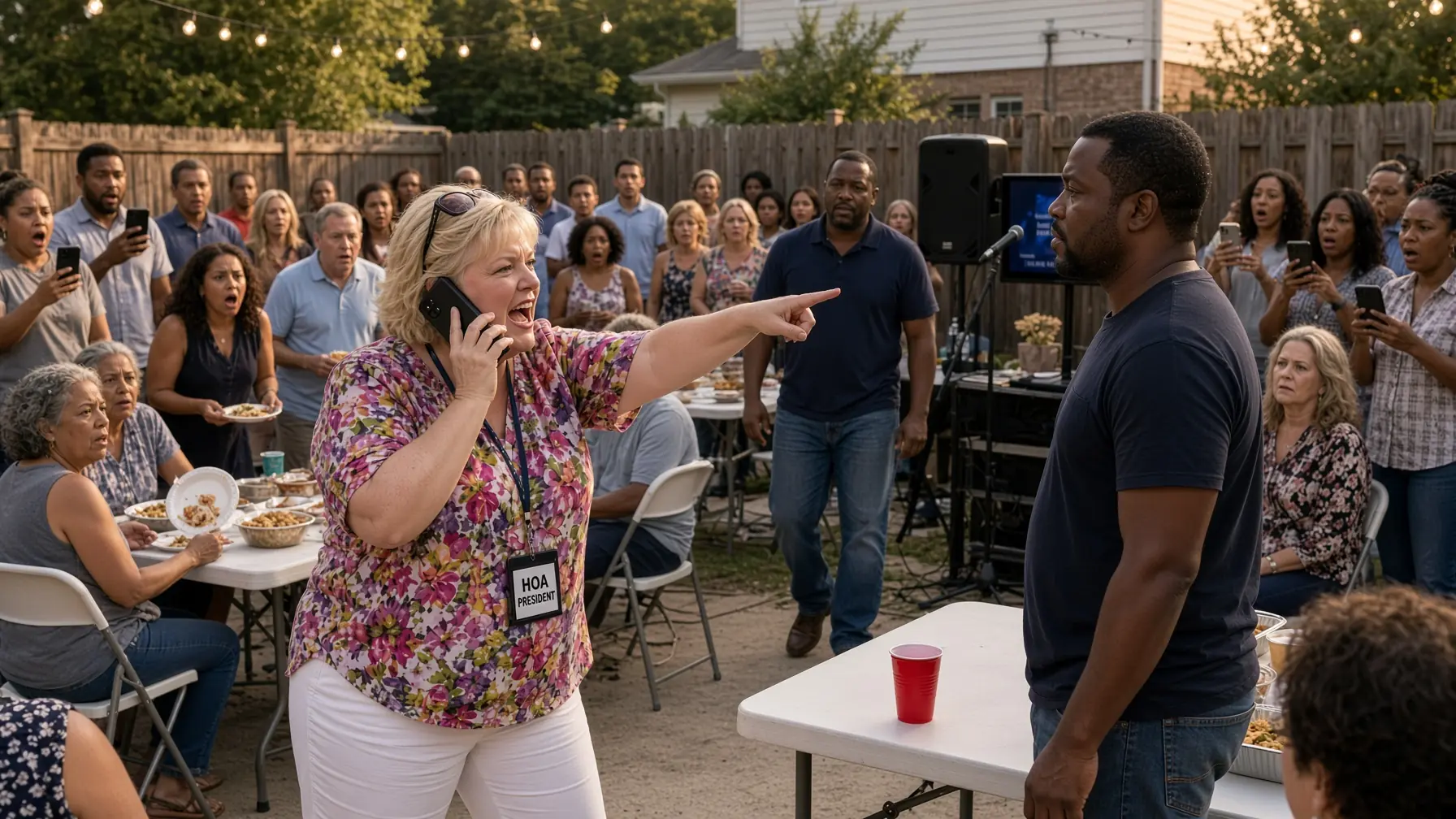
Every conversation stopped.
Every engine went quiet.
And Delilah Thornfield smiled like eight years of intimidation had finally delivered the victory she wanted.
What she did not know was that the quiet man in jeans standing beside my restored 1967 Mustang was the police chief she was demanding dispatch send to arrest me.
My name is Miles Juliet.
I was forty-five when this happened.
Twenty years in the Navy had taught me a lot about pressure, patience, and people who confuse authority with competence.
After two Gulf deployments and enough time working around machinery to know almost anything mechanical can be saved if you are stubborn enough, I retired and became something simpler.
A dad.
A mechanic.
And the owner of a house with the biggest garage I could afford.
That garage was the reason I bought the place.
It sat on the corner of Oak Street in Willowbrook, a clean suburban neighborhood where most homes had two-car garages designed to store bicycles, Christmas decorations, and cars nobody actually worked on.
Mine was different.
The previous owner had expanded it years earlier.
I had the conversion inspected.
Updated the wiring.
Installed proper ventilation.
Added fire suppression equipment.
Upgraded the electrical system for welders and compressors.
Obtained every permit the city required.
Then I turned it into a restoration workshop.
Classic American muscle was my weakness.
Mustangs.
Cudas.
Chevelles.
Chargers.
Camaros.
Old machines built in an era when designers seemed personally offended by subtlety.
I loved bringing them back.
There was something satisfying about taking an engine that had sat dead for thirty years, opening it piece by piece, cleaning away decades of neglect, replacing what could not be saved, and hearing it fire again.
The garage smelled like motor oil, WD-40, coffee, leather, and old metal.
To me, it smelled like home.
My sixteen-year-old daughter Zoe practically grew up inside it.
She could identify a carburetor before half her classmates could identify a spark plug.
Her dream was automotive engineering.
She wanted to study at Cal Poly and design electric vehicles that still had the attitude of American muscle.
“Silent cars are depressing,” she told me once.
“They don’t have to be silent.”
“That’s not how electric motors work.”
“Then I’ll fix that.”
I believed her.
The garage also became something neither of us originally planned.
A community center.
Not officially.
Nobody elected it.
Nobody issued rules.
It simply happened.
Veterans stopped by.
Neighbors brought projects.
Kids watched me work.
Retired mechanics wandered over and started conversations that lasted three hours.
And once a month, I opened the garage and driveway for a small charity car show.
The idea started after a friend from my veteran support group told me his daughter had been accepted to college but was struggling to cover tuition.
We raised a little money.
Then another military family needed help.
Then another.
Eventually, I created a scholarship fund for children of veterans.
Nothing huge.
Twenty dollars here.
Fifty there.
A local shop donated.
A restaurant helped with food.
Classic-car owners volunteered to display their cars.
The first Saturday of every month became something people looked forward to.
Kids chased each other between parked classics while their parents talked.
Veterans told stories.
People dropped cash or checks into the scholarship jar.
Sometimes we raised two thousand dollars.
Sometimes five.
Every dollar mattered.
The event that started this whole disaster was supposed to fund three scholarships.
One applicant was the son of a Marine who had died after leaving the service.
Another was the daughter of an Army medic.
The third was the grandson of a retired Navy chief who had raised him since infancy.
We had already raised almost seven thousand dollars by five in the afternoon.
Then Delilah arrived.
Delilah Thornfield had been HOA president for six years.
Nobody remembered electing her the last two.
She just kept appearing at meetings with a binder thick enough to stop small-caliber ammunition and announcing that nobody else had filed paperwork before the deadline.
Delilah believed the neighborhood existed to satisfy her sense of order.
Trash cans visible too early?
Warning.
Grass half an inch too tall?
Photo.
Basketball hoop facing the “wrong” direction?
Violation notice.
A family once received a letter because their children left sidewalk chalk drawings in front of the house overnight.
Delilah called them “visual clutter.”
Zoe called her “the unpaid dictator of shrubbery.”
I told Zoe to be respectful.
Then Delilah fined me for leaving my garage door open while changing a transmission.
Zoe asked whether respect still applied.
I said we would revisit the issue.
My conflict with Delilah began within three months of moving in.
She came over while I was installing a lift.
“You cannot operate a commercial garage in Willowbrook.”
“I don’t.”
“You have professional equipment.”
“I own professional equipment.”
“That means you are operating a business.”
“No.”
She stared at me.
“What do you charge?”