“Stop moving.”
Karen tightened her fist around Lily Bennett’s hair.
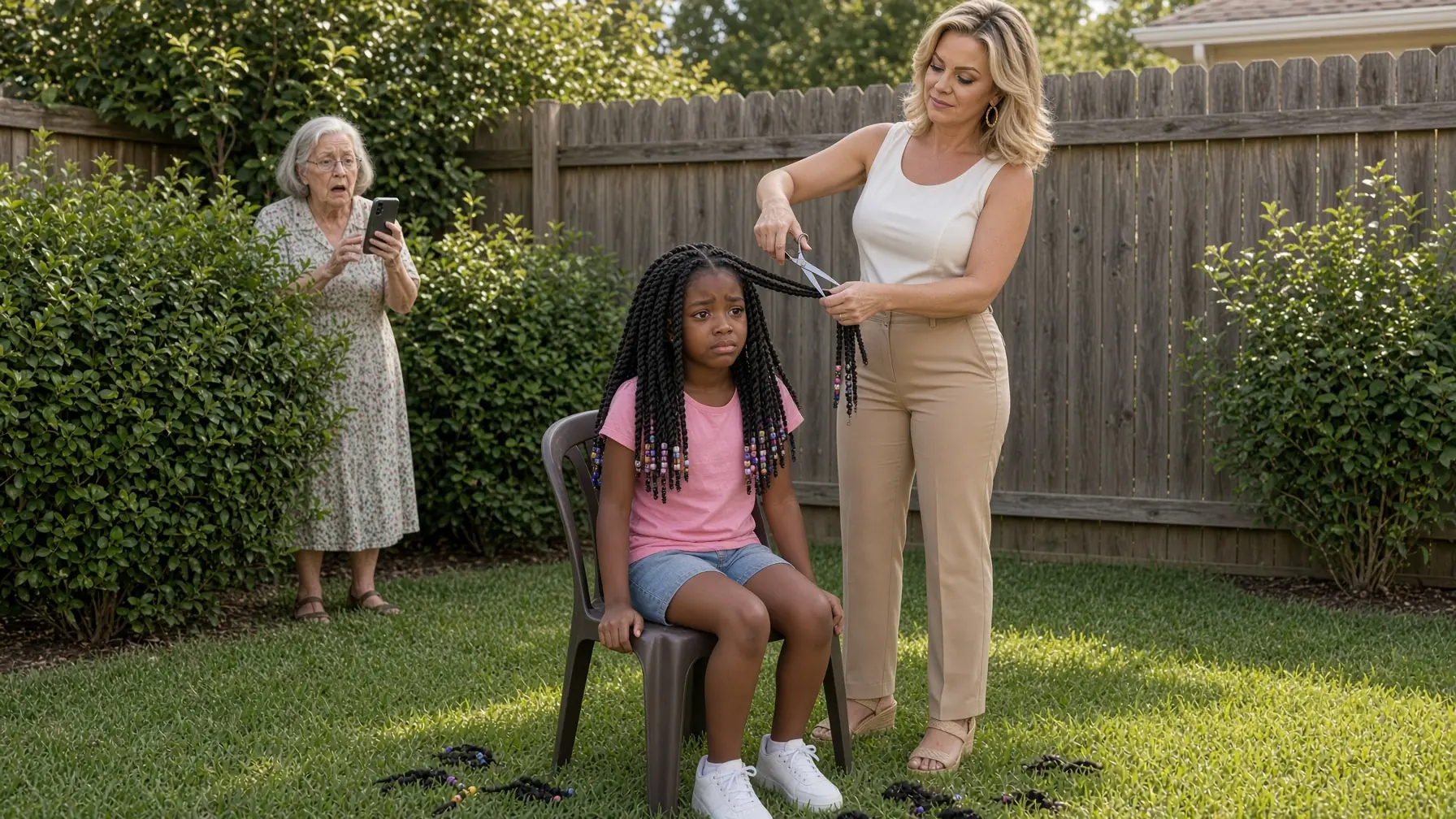
The eight-year-old girl went completely still.
“Maybe now your mother will finally learn to keep you under control.”
Late-afternoon sunlight stretched across the suburban backyard.
Fresh grass.
Wooden privacy fence.
Small patio.
A yellow plastic cup sitting untouched on the table.
Everything looked ordinary.
Except for the long strands of light-brown hair scattered beside Lily’s white sneakers.
Lily sat stiffly in the patio chair.
Her eyes were wet.
Her chin trembled.
Karen stood behind her.
White sleeveless blouse.
Beige pants.
Gold earrings.
Household scissors in one hand.
A thick section of Lily’s hair in the other.
Lily whispered:
“Please…”
Karen lifted the scissors.
“She said nobody can cut my hair.”
Karen gave a small, irritated laugh.
“Your mother isn't here.”
Lily looked desperately toward the house.
Empty sliding door.
No one.
Karen leaned closer.
“Maybe if you listened the first time, I wouldn't have to teach you.”
Then—
CLICK.
A phone camera shutter.
Karen froze.
The scissors stopped inches from Lily’s hair.
For several seconds, nobody moved.
Then a voice came from behind the hedge.
“No.”
Karen slowly turned.
Mrs. Miller stood at the far side of the yard.
Sixty-eight years old.
Gray bob.
Floral house dress.
Reading glasses halfway down her nose.
Her phone was raised.
Camera pointed directly at Karen.
Mrs. Miller continued:
“But I am.”
Karen’s smile disappeared.
Her eyes moved toward the phone.
Then downward.
Scissors.
Lily’s hair still clutched in her fist.
Cut strands across the grass.
Then back toward Mrs. Miller.
“Put that phone down.”
Mrs. Miller did not move.
Karen released Lily’s hair.
“I said put it down.”
Mrs. Miller’s thumb remained near the screen.
“I heard you.”
Karen took one step toward her.
Mrs. Miller raised the phone slightly higher.
“And I’m still recording.”
Karen stopped.
For the first time that afternoon—
she looked afraid.
Twenty-seven minutes earlier, Rachel Bennett had left the house.
Not for work.
Not for the afternoon.
For twenty minutes.
Maybe thirty.
Her younger son had developed a fever.
The pharmacy had called to say his prescription was ready.
Rachel’s sister was supposed to arrive before she left.
Traffic delayed her.
Lily was eight.
The neighborhood was quiet.
Mrs. Miller was outside gardening next door.
Rachel made the decision thousands of parents make in ordinary life.
She told Lily:
“Stay inside or in the backyard.”
“No front yard.”
“No answering the door.”
“I’ll be right back.”
Lily had nodded.
She had been drawing at the patio table when Rachel drove away.
Mrs. Miller noticed the car leave.
She did not think anything of it.
Then she saw Karen.
Karen Thompson lived four houses down.
Everybody knew Karen.
Not because she was particularly important.
Because Karen behaved as though importance was something she could generate by speaking loudly enough.
She attended HOA meetings.
Ran the neighborhood social-media page.
Organized yard-sale weekends.
Reported trash cans left near curbs.
Asked neighbors why their guests parked where they did.
Once measured another homeowner’s hedge with a tape measure.
She introduced herself to new residents before moving trucks were fully unloaded.
Karen called that:
“Keeping standards.”
Most people called it:
Karen.
Rachel Bennett had made the mistake of challenging her three weeks earlier.
The argument had started with sidewalk chalk.
Lily and two other children had drawn flowers, rainbows, stars, and an enormous purple dinosaur across the sidewalk in front of Rachel’s house.
Washable chalk.
Private frontage.
Gone after the next rain.
Karen appeared before dinner.
Hands on hips.
“This looks terrible.”
Rachel looked at the dinosaur.
“I kind of like him.”
Karen did not smile.
“This is a neighborhood, Rachel.”
“Yes.”
“People have standards.”