“Your daughter was just sitting there. My son needed the chair more.”
Monica Prescott clutched the thick black HOA handbook beneath one arm as if the gold lettering granted her authority over every family in Cedar Grove, Ohio. Her healthy eleven-year-old son stood beside the custom wheelchair she had taken, still wearing his black soccer uniform and staring at the ground in humiliation. Twelve-year-old Nia Bennett remained seated on a wooden bench several feet away, unable to move without assistance, while tears ran silently down her face. Her father, Marcus Bennett, stared at the platinum-blonde woman in the crimson suit and felt every muscle in his body tighten.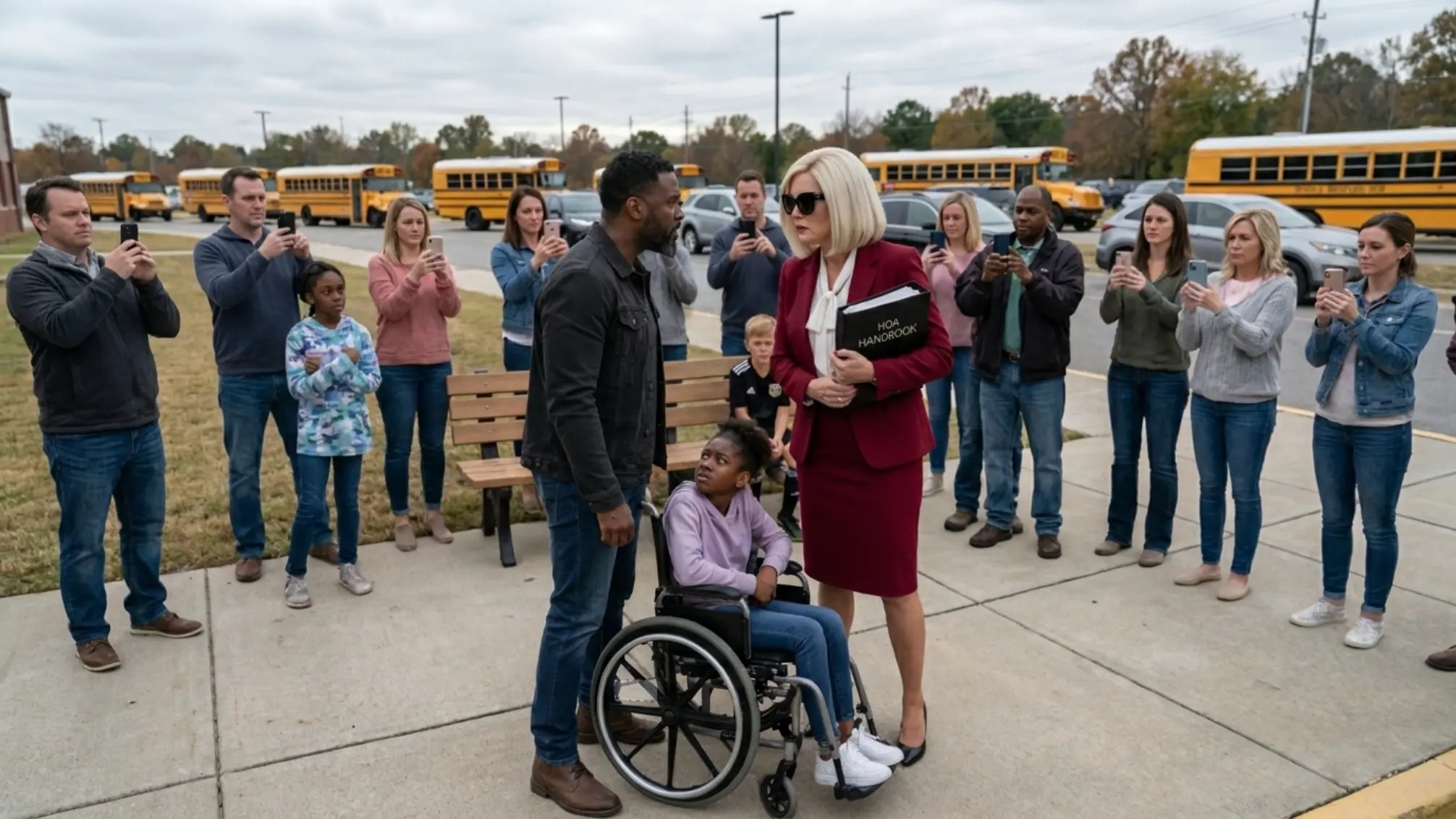
“Touch her chair again,” Marcus said, stepping between Monica and his daughter, “and the police will remove you from this school.”
Monica pushed her oversized sunglasses higher on her nose. “Stop being dramatic. It’s just a chair.”
Marcus pointed toward Nia. “Those are her legs.”
The school pickup zone fell silent around them. Parents stood beside idling vehicles with their phones raised, teachers stopped directing traffic, and students clustered near the sidewalk. Everyone had seen Monica lift Nia from the wheelchair without permission and place her on the bench as though moving an inconvenient object.
Ten minutes earlier, Marcus had been waiting inside his old black pickup truck, watching the front doors of Cedar Grove Middle School. He arrived early every afternoon because the accessible pickup space was frequently blocked by parents who believed hazard lights transformed ordinary parking spots into private property. The school had painted the curb blue, installed a large sign, and sent repeated reminders, yet someone still seemed determined to occupy it each week.
Marcus never complained in front of Nia.
He was forty years old, broad-shouldered, and quietly intimidating to anyone who mistook his calm expression for weakness. He wore a faded black denim jacket, dark jeans, and brown work boots from the electrical contracting company he owned. Since his wife’s death four years earlier, he had built every day around raising Nia and keeping the promise he made beside a hospital bed: their daughter would never grow up believing she was a burden.
Nia had been diagnosed at seven with a rare neurological condition that gradually weakened her lower body. Treatments slowed its progression but could not reverse the paralysis. By the time she was nine, she required a wheelchair for nearly every part of daily life.
The first year was painful.
Nia hated needing help. She hated adults speaking to Marcus instead of addressing her directly. She hated strangers touching the handles of her wheelchair without asking, as if the chair made her public property.
Marcus taught her how to advocate for herself without apologizing.
“No is a complete sentence,” he often reminded her. “You don’t owe anyone gratitude for respecting your boundaries.”
The wheelchair Monica had taken was custom-built for Nia. Its lightweight black frame, angled wheels, pressure-support cushion, backrest, and footplate were measured precisely for her body. A medical-equipment specialist adjusted it every six months as she grew.
Nia decorated the spokes with purple stars and attached a small silver plate beneath the seat that read:
Fast. Brilliant. Unstoppable.
That Thursday afternoon, she emerged from school beside her best friend, Mia Collins. The girls stopped near a bench to finish discussing a science project while Marcus waved from his truck.
Then Tyler Prescott emerged from soccer practice carrying an oversized equipment bag.
His mother, Monica, had parked her white SUV several spaces ahead of Marcus. She was not supposed to leave the vehicle, but school rules had never seemed to apply to her. Monica stepped into the pickup lane wearing a deep-crimson skirt suit, black heels, oversized sunglasses, and bright-red lipstick.
Under one arm, she carried the Lakeside Meadows HOA handbook.
Monica served as president of the neighborhood association where many Cedar Grove families lived. She issued warnings for trash cans left visible after sunset, children’s bicycles placed on porches, and garden flags she considered inconsistent with the community’s image.
Marcus did not live in Lakeside Meadows, but he had heard stories.
Monica had once fined an elderly resident because his wheelchair ramp did not match the approved exterior wood tone. She demanded the structure be removed and rebuilt even after learning the man needed it to enter his home. The HOA board eventually reversed the decision, but Monica never apologized.
Tyler slowly crossed the parking lot.
“My legs hurt,” he told her. “Coach made us run extra laps.”
Monica looked around as though the school had failed to provide an immediate solution. Her gaze settled on Nia’s wheelchair.
Nia was sitting in it while speaking with Mia.
Monica approached them.
“You,” she said to Nia. “My son needs that chair for a moment.”
Nia blinked. “What?”
“Tyler is exhausted from soccer practice. He needs to rest his legs until we reach the car.”
“This is my wheelchair.”
“You’re not moving.”
“I’m talking to my friend.”
Monica reached for the handles.
Nia locked her wheels. “Don’t touch my chair.”
That should have ended the conversation.
Instead, Monica moved around the side, placed her hands beneath Nia’s arms, and lifted her.
Nia screamed.
Mia shouted for a teacher while Monica carried Nia two steps and placed her on the bench. The transfer was careless and frightening. Nia’s left hip struck the wooden seat, and one foot twisted beneath her because she could not reposition it quickly.
Monica rolled the wheelchair toward Tyler.
“Sit down.”
Tyler backed away. “Mom, no.”
“Your legs are hurting.”
“That’s her chair.”
“She can share for one minute.”
“I can walk.”
Monica seized his arm and pushed him toward the seat. Tyler reluctantly lowered himself into the wheelchair, his knees pressed against the frame and his cleats resting awkwardly on the custom footplate.
Marcus was already running toward them.
“What the hell are you doing?”
Monica turned as if he had interrupted an ordinary conversation.
“Are you the girl’s father?”
Marcus went directly to Nia. “Are you hurt?”
“My hip,” she whispered.
Her hands trembled against the bench. She was trying not to cry in front of classmates, and that effort broke something inside him more painfully than her tears could have.
Marcus crouched in front of her. “Look at me. You did nothing wrong.”
“She picked me up.”
“I saw.”
“I told her no.”
“I know.”
He stood and faced Monica.
“Get your son out of that wheelchair.”
Monica crossed her arms. “Tyler has been practicing for two hours. Your daughter was sitting around talking, so she wasn’t using it.”
“She was sitting in it because she cannot walk.”
“She has a bench now.”
Marcus took one slow step toward her. “You removed a disabled child from medical equipment.”
“Disabled children should learn to share like everyone else.”
Several parents gasped.
Tyler attempted to rise but caught one cleat beneath the footplate. “Mom, I want to get out.”
“Stay seated,” Monica ordered. “You need to rest.”
“I don’t want it.”
“He has already said no,” Marcus replied. “Apparently ignoring children’s consent is a habit for you.”
Monica’s face reddened. “Don’t accuse me of mistreating my son.”
“You put him in a stolen wheelchair after he refused.”
“It isn’t stolen. We’re borrowing it.”
Marcus looked toward the people recording. “Did anyone give you permission?”
No one answered because the truth was obvious.
Monica tightened her grip on the HOA handbook. “You don’t know who you’re speaking to.”
“I know exactly who I’m speaking to.”
“I am president of the Lakeside Meadows Homeowners Association.”
“This is a public school.”
“Most of these families live in my community.”
“And none of that makes my daughter’s wheelchair yours.”
Monica removed her sunglasses, revealing pale blue eyes narrowed with contempt. “Your attitude explains why your daughter acts so helpless. Maybe if you encouraged exercise instead of letting her sit all day, she wouldn’t depend on that chair.”
Nia lowered her face.
Marcus clenched his fists but kept them at his sides. He understood that anything he did in anger might later be used against him. Monica already saw him as a threat because he was a Black man refusing to accept her authority.
He would not give her the image she wanted.
“You have five seconds to return the chair.”
“Or what?”
“Or every witness here explains to the police why you stole medical equipment and assaulted my child.”
Before Monica could answer, a commanding voice came from behind the crowd.
“What happened?”
School counselor Denise Henderson approached with Vice Principal Elena Rodriguez beside her. Denise was a tall, athletic Black woman in her late forties who had worked at Cedar Grove for fifteen years. Students trusted her because she listened without condescension. Parents respected her because she remained calm until calmness no longer worked.
Her gaze moved from Nia on the bench to Tyler inside the wheelchair.
The temperature in her expression seemed to drop.
Monica immediately changed her tone. “Thank goodness. This man is threatening me because my son borrowed an unused wheelchair.”
“Unused?” Denise repeated.
“The girl was sitting around talking.”
Denise faced Nia. “Did you give her permission to move you?”
“No.”
“Did she touch you after you told her not to?”
“Yes.”
“Are you injured?”
“My hip hurts.”
Denise nodded once and turned toward Monica.
“Get your son out of Nia’s wheelchair.”
Monica released an offended laugh. “You’re accepting their version without hearing mine.”
“I heard you call a disabled child’s personal mobility device unused.”
“My son was exhausted.”
“Your son walked out of soccer practice.”
“He has fatigue.”
“Does he have a diagnosed mobility disability?”
“He may have low iron.”
Tyler covered his face with both hands.
Denise stepped toward the chair. “Tyler, would you like help getting out?”
“Yes, please.”
She carefully freed his cleat from the footplate and helped him stand. Tyler immediately moved away from his mother and picked up his soccer bag.
“I’m sorry, Nia,” he said.
Monica grabbed his shoulder. “You have nothing to apologize for.”
“He didn’t take it,” Nia whispered. “You did.”
For the first time, Monica seemed embarrassed—not by what she had done, but by being contradicted publicly.
Denise examined the wheelchair for damage, then rolled it to the bench. Marcus and Elena helped Nia transfer back into the seat while Denise watched her positioning carefully.
Once Nia was secure, Marcus inspected the wheels, footplate, and support cushion. A strap had been pulled loose, but nothing appeared permanently damaged.
Denise faced Monica again.
“You removed a disabled minor from her medical equipment without consent. You ignored her refusal, placed her somewhere she could not leave independently, and used the equipment for your healthy child.”
“That is an exaggeration.”
“It may constitute assault, theft, and disability-based harassment.”
Monica’s mouth fell open. “Assault? I moved her three feet.”
“You placed your hands on a child after she told you no.”
“She looked perfectly healthy.”
Nia’s eyes filled again.
Marcus moved protectively beside her.
Denise’s voice became colder. “A person does not owe you visible suffering before you respect their disability.”
Monica looked around for support. “This school is discriminating against my son.”
“How?”
“You are giving that girl special treatment.”
“A wheelchair is not special treatment. It is access.”
“My son deserves access too.”
“To someone else’s medical equipment?”
“To rest when he needs it.”
“Then you may bring him a folding chair.”
Several parents laughed.
Monica spun toward them. “This is not funny.”
“No,” Marcus said. “What you did to my daughter was not funny.”
Vice Principal Rodriguez stepped forward. “Mrs. Prescott, you will accompany me to the principal’s office.”
“I’m leaving.”
“You may not leave until we document the incident.”
“You cannot detain me.”
“We can ask school security to remain with you while police determine whether Mr. Bennett wishes to file a report.”
Monica’s confidence weakened.
She looked at Marcus. “You would call the police over a chair?”
“I would call them because you put your hands on my child.”
Tyler stood several feet away, tears gathering in his eyes.
Marcus saw him and softened slightly. The boy was not responsible for his mother’s choices. He did not deserve to watch her arrested unless police involvement became necessary.
Nia touched her father’s wrist.
“I want to go home.”
Marcus looked down at her.
Her face was pale, and she had begun pressing one hand against her left hip.
He turned to Denise. “I need to get her checked.”
“We’ll preserve the footage and collect statements,” Denise said. “You can decide about charges after she receives medical care.”
Monica scoffed. “Medical care? She is clearly fine.”
Marcus met her eyes. “You don’t get to decide that.”
Elena escorted Monica and Tyler toward the building. Monica continued protesting, threatening lawsuits and naming members of the school board she claimed to know personally.
Tyler looked back once.
“I’m sorry,” he called to Nia.
She nodded.
Marcus loaded the wheelchair into his truck and helped his daughter transfer. Several parents approached with names and phone numbers, offering themselves as witnesses.
One mother said Monica had terrorized Lakeside Meadows for years.
Another admitted she had recorded the entire incident.
A third parent looked at Nia. “You were incredibly brave.”
Nia turned toward the truck window.
She did not feel brave.
At the urgent-care clinic, X-rays showed no fracture. Nia had a deep bruise along her hip and mild shoulder strain from being lifted incorrectly. The doctor instructed her to rest and documented everything for the school.
On the drive home, Marcus looked at her in the rearview mirror.
“You’ve been quiet.”
“She said I was helpless.”
“She was wrong.”
“She picked me up in front of everyone.”
“I know.”
“I couldn’t stop her.”
Marcus pulled into an empty parking lot and turned off the engine. He climbed into the back seat so they could speak face-to-face.
“Being unable to stop an adult who ignores your consent does not make you helpless.”
“It felt like it.”
“That feeling is real. Her judgment is not.”
Nia looked down at her hands.
“What did Mom say when people stared at her in the hospital?”
Marcus’s chest tightened.
“She said most people stared because they didn’t understand what they were seeing.”
“What if they stared because they felt sorry for her?”
“She didn’t care.”
Nia almost smiled. “That sounds like Mom.”
“She also said dignity isn’t something another person can give or take. It belongs to you before they arrive and after they leave.”
Nia leaned against him.
“Can we go home now?”
“Yes.”
Principal Chang called that evening. Security footage confirmed every part of the incident, and ten witnesses had already submitted statements. Monica received an immediate trespass order prohibiting her from entering school property except for prearranged meetings under administrative supervision.
She could not attend soccer games, parent nights, pickup, drop-off, or school events.
Tyler would remain enrolled and would not be punished.
Marcus agreed with that decision.
“The child objected to what she did,” he said. “He shouldn’t carry her consequences.”
Principal Chang also informed him that the district’s legal counsel considered the incident serious enough to warrant police review. Marcus could pursue charges immediately or wait until Nia felt emotionally prepared.
He chose to wait.
The following morning, Marcus met with Denise, Elena, and Principal Chang. Denise explained that Monica had spent nearly an hour denying responsibility.
“She said Nia should be grateful someone found another use for the wheelchair,” Denise reported.
Marcus stared at her. “She actually said that?”
“She also claimed wheelchairs are community resources whenever they appear in public.”
“How did the meeting end?”
Denise’s expression changed slightly.
“I asked whether Tyler played soccer. Then I asked her to imagine me walking onto the field, taking his soccer ball, and telling her he wasn’t using it correctly.”
Marcus nodded slowly.
“I told her she would call that theft,” Denise continued. “Then I explained that the comparison was still inadequate because a soccer ball is recreational equipment. Nia’s wheelchair is her independence, mobility, safety, and access to education.”
“What did Monica say?”
“Nothing.”
“That’s hard to imagine.”
“It lasted approximately ten seconds.”
For the first time since the incident, Marcus laughed.
The story spread through Cedar Grove quickly. Students repeated Denise’s analogy, and teachers used the event to discuss disability, consent, and personal medical equipment. The administration organized training for staff and volunteers.
Nia initially hated the attention.
Then her classmates began approaching her differently—not with pity, but with support.
Mia organized a group that decorated the accessible entrance with purple stars. The art club painted a banner reading:
NIA’S CHAIR. NIA’S CHOICE.
Marcus asked whether she wanted it removed.
She studied it for a long time. “No. Keep it.”
Two weeks later, Tyler’s father contacted Marcus. He explained that he and Monica were separated and finalizing a divorce. He had learned about the incident only after the school called.
Tyler wanted to apologize in person.
Marcus left the decision to Nia.
They met at a quiet coffee shop on Saturday. Tyler arrived wearing a gray hoodie and carrying a small soccer keychain.
“I’m sorry,” he said. “I told her I could walk.”
“I heard you.”
“I should have gotten out faster.”
“She trapped your footrest,” Nia replied. “And she was yelling at you.”
Tyler looked relieved but still ashamed. “I didn’t want you to think I agreed.”
“I don’t.”
He placed the keychain on the table. “I know this doesn’t fix anything.”
Nia picked it up.
“You didn’t break it.”
His father apologized to Marcus and promised Monica would no longer control school transportation. He also explained that she had refused the required disability-awareness training and attempted to enter a soccer match despite the trespass order.
Security removed her.
Monica appealed the ban to the school district. She submitted a long written statement accusing Cedar Grove of humiliating an HOA officer, discriminating against her athletic child, and exaggerating a harmless misunderstanding.
The district reviewed the video.
The appeal was denied unanimously.
Her trespass order would remain in place for the rest of Tyler’s enrollment.
The incident also damaged Monica’s position inside Lakeside Meadows. Residents who had quietly tolerated her behavior began sharing their own experiences. The elderly man forced to defend his wheelchair ramp attended the next HOA meeting. So did parents who had received fines after installing sensory equipment for autistic children.
Marcus attended with Nia.
Monica entered wearing the same crimson suit and carrying her black handbook. She tried to call the meeting to order, but another board member interrupted.
A petition signed by sixty-three homeowners demanded her removal as president.
Monica’s face hardened. “This is retaliation over a private school matter.”
The elderly homeowner raised his cane.
“No,” he said. “The school matter showed us what you do when no one stops you.”
The removal vote passed.
Monica collected her handbook and walked out without another word.
Nia watched from beside her father.
“Do you feel bad for her?” Marcus asked.
“No.”
“Good.”
She looked up at him. “Do you?”
“A little.”
“Why?”
“Because consequences feel cruel when someone has spent years avoiding them.”
Nia considered that answer.
Months later, Cedar Grove launched a peer-support program for students with disabilities. Nia volunteered to mentor younger students entering middle school.
During her first meeting, a nervous sixth-grade girl asked what she should do when people touched her wheelchair handles without permission.
Nia leaned forward.
“You tell them no.”
“What if they don’t listen?”
“You say it louder. Then you find someone who will make them listen.”
Marcus watched from the doorway, pride rising in his chest.
The incident had frightened and humiliated his daughter. It had not made her smaller.
Outside, the same pickup zone filled with buses, cars, teachers, and parents beginning another ordinary afternoon. The accessible loading area remained clear, protected by new signs and staff assigned specifically to enforce it.
Nia rolled toward Marcus beneath the autumn sunlight.
“How was mentoring?” he asked.
“I told them everything.”
“Everything?”
“Even the part where you almost lost your mind.”
“I remained extremely calm.”
“You threatened handcuffs.”
“That was a calm prediction.”
She laughed.
Marcus opened the truck door and prepared the transfer board, but Nia stopped him.
“I’ve got it.”
He stepped back.
She transferred independently, folded the chair, and secured it beside her seat. Every movement was practiced and confident.
Monica Prescott once looked at that wheelchair and saw an unused chair she could take for her son.
Nia saw freedom.
Marcus saw his daughter’s independence.
And everyone who witnessed what happened learned the lesson Monica refused to understand until the school, the district, and her own neighborhood forced her to face it:
A disabled child’s mobility is not public property.
Consent is not optional.
And no handbook, title, or sense of entitlement places an adult above a child’s dignity.