The lawn mower stopped with a shudder between two weathered wooden fences.
Luke Harrison kept both hands wrapped around the black handlebar while the engine ticked beneath the Tennessee summer sun. Sweat rolled from his shoulders and down his back. He had been mowing for less than twenty minutes, and the narrow strip between his house and the neighboring fence was barely wide enough for the green mower to pass.
Then he heard Linda Caldwell shouting.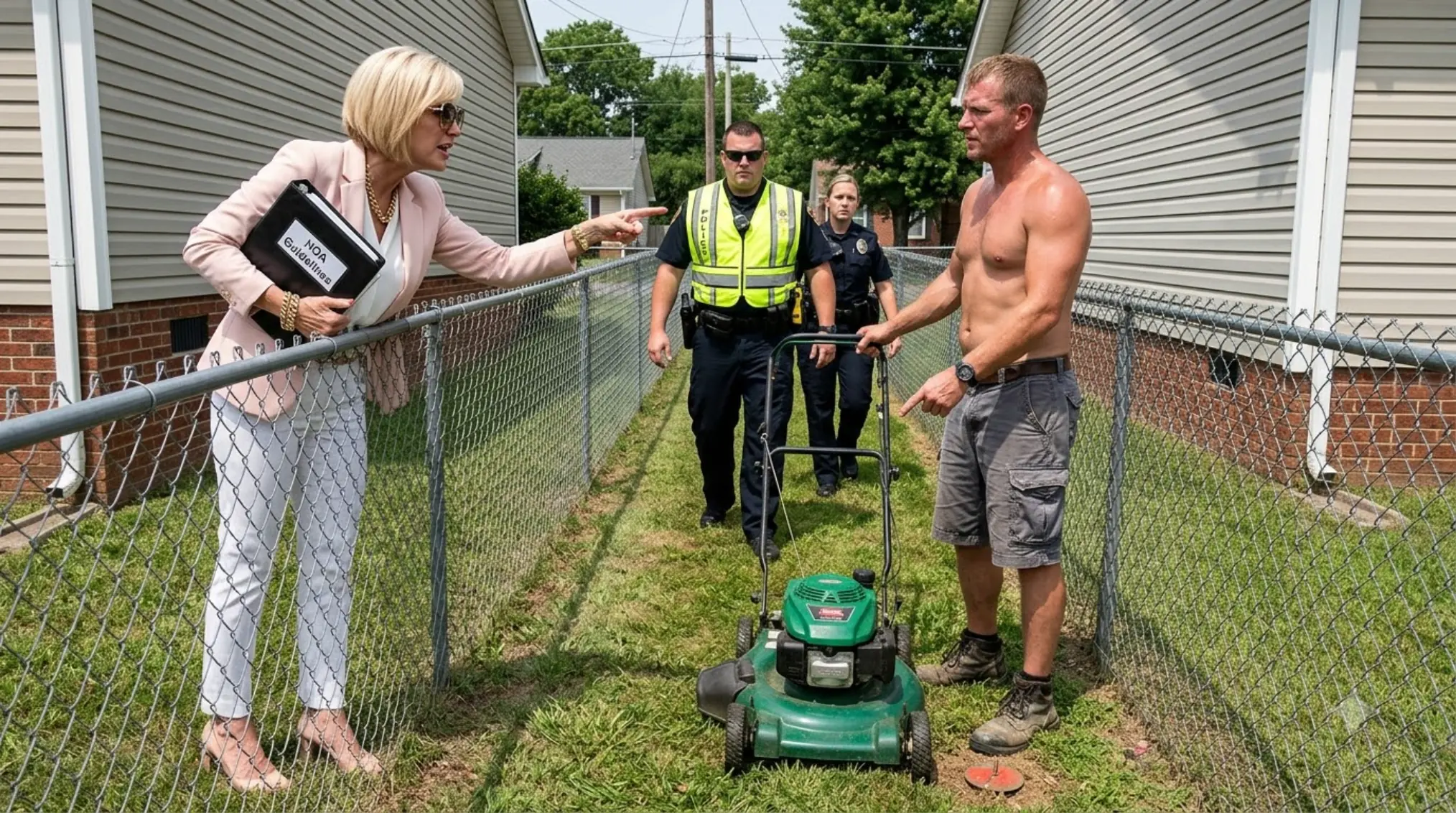
“Shut that thing off! You’re trespassing on HOA property again!”
Luke turned.
Linda was leaning over the fence from the adjoining common walkway, one arm stretched toward him like a prosecutor pointing at a defendant.
She was fifty-five, blonde hair cut into a sharp bob, oversized sunglasses covering half her face, pale-pink blazer over a white blouse, tailored white pants, nude heels, gold bracelets, and a thick black HOA binder trapped beneath her left arm.
She looked absurdly overdressed for a ninety-degree afternoon.
Behind Luke, two police officers were walking into the narrow corridor.
The first was Officer Daniel Cooper, a large man wearing a neon-yellow reflective vest over his black patrol uniform. Behind him came Officer Sarah Reed, younger, watchful, her hand resting near her radio.
Luke looked from them to Linda.
“You actually called the police?”
Linda straightened.
“I warned you twice.”
“You sent me two letters claiming I wasn’t allowed to mow my own grass.”
“It isn’t your grass.”
Luke glanced down.
The strip beneath his boots had been part of his property since he bought the house six years earlier.
Or at least that was what every document he owned said.
Officer Cooper stepped closer.
“Sir, move away from the mower.”
Luke did not release the handle.
“Why?”
“Because we have a property dispute and I don’t need a lawn mower running while people are arguing.”
“The mower is off.”
“Then move away from it.”
Luke slowly released the handle and stepped aside.
Linda smiled.
It was the expression of someone who believed the first important battle had already been won.
Cooper looked toward her.
“You’re the caller?”
“Yes. Linda Caldwell, president of Cedar Grove Residential Association.”
She opened the binder.
“This homeowner has repeatedly entered association property after being instructed not to.”
Luke pointed at the grass.
“I walked through my side yard.”
Linda snapped, “That is not your side yard.”
Officer Reed looked around.
The corridor was unusual.
Luke’s gray house sat on the right.
Another home stood on the left.
A wooden fence ran down both sides, creating a thin grassy passage leading toward the street.
The mower was sitting approximately halfway through.
Nothing about the place looked like public property.
Cooper asked Linda, “Where exactly is the HOA boundary?”
She pointed down the center of the corridor.
“From the rear corner to the utility box.”
Luke laughed once.
“That changed again.”
Linda turned.
“Excuse me?”
“Last month you said the boundary was the fence.”
“It follows the fence.”
“Then why are you pointing three feet inside it?”
Her mouth tightened.
Officer Cooper looked toward Luke.
“Sir, do you have documentation?”
“Yes.”
Linda immediately interrupted.
“He has old paperwork.”
Luke stared at her.
“It’s a recorded deed.”
“It predates the neighborhood landscape revision.”
Cooper raised one hand.
“One at a time.”
Luke pointed toward the ground beside his mower.
“You don’t even need the deed yet.”
Everyone looked.
Partially hidden beneath grass sat a small round brass disk set into concrete.
Most people would have mistaken it for some old utility marker.
Luke knew exactly what it was.
“County survey monument,” he said.
Linda’s face changed slightly.
Officer Reed crouched.
She brushed away grass.
Stamped into the metal were numbers and the abbreviation for Hamilton County survey control.
Luke continued.
“That marker is the corner reference used in my closing survey.”
Linda folded her arms.
“That means nothing.”
Luke looked at her.
“It means your fence is three feet inside my property.”
Silence.
Officer Cooper stared at the wooden fence.
Then the marker.
Then Linda.
“What?”
Luke pointed.
“The actual boundary runs from that pin to the rear monument behind my shed. The HOA moved this fence before I bought the house.”
Linda shook her head.
“No.”
“You’ve known for four months.”
“That is a lie.”
Luke’s expression hardened.
“That’s why you suddenly started sending violations after I ordered a new survey.”
Officer Reed stood.
“You ordered another survey?”
“Last month.”
“Do you have it?”
“In my kitchen.”
Linda stepped forward.
“Officers, this is exactly what he does. He changes the subject, argues everything, refuses board authority—”
Luke looked at her.
“Board authority doesn’t move property lines.”
Linda slammed the binder against the fence.
“You signed HOA documents when you bought this house.”
“Yes.”
“Then you agreed to association boundaries.”
“I agreed to the recorded covenants.”
Luke pointed at the marker.
“I did not donate three feet of my land because you wanted a wider maintenance lane.”
Cooper sighed.
“Sir, go get the survey.”
Luke started toward the house.
Cooper stepped into his path.
“Wait.”
Luke stopped.
“You’ll stay here. Officer Reed can go with you.”
Linda smiled again.
That expression irritated Luke more than he wanted to admit.
He looked at Reed.
“Fine.”
They walked through the side gate into Luke’s backyard.
His house had once belonged to his uncle, Michael Harrison, who had purchased the property when Cedar Grove was still a half-finished subdivision.
Luke bought it after Michael moved to assisted living.
The narrow strip had never mattered much.
Until Linda decided the HOA needed it.
The conflict began four months earlier when Cedar Grove announced a “community improvement corridor” connecting the rear walking path to the street.
The plan looked simple.
New fencing.
Low landscaping.
A drainage channel.
Decorative lights.
The board presentation claimed the project would improve property values.
Luke barely paid attention.
Then contractors appeared beside his house.
One morning, he walked outside and found two men marking a line through his grass with orange paint.
“What are you doing?”
One contractor handed him a work order.
“HOA corridor expansion.”
Luke studied the line.
It ran three feet inside what he believed was his property.
“Stop.”
The contractor shrugged.
“You’ll need to talk to the board.”
Luke did.
Linda told him the land belonged to the association.
Luke produced his closing survey.
Linda said it was outdated.
Luke produced his deed.
She claimed the HOA’s maintenance map superseded it.
That sentence bothered him.
Luke worked as a civil construction estimator.
He was not a surveyor or attorney, but he knew enough to understand that a maintenance map did not magically change title.
He ordered a professional boundary survey.
The next week, Cedar Grove fined him $500 for “interference with authorized maintenance.”
Then $750 for “unauthorized landscaping activity.”
The landscaping activity was mowing.
Then came a cease-and-desist letter telling him not to enter the disputed strip.
Luke ignored it.
He continued cutting the grass because if he did not, nobody else did.
Linda watched.
Photographed him.
Sent more letters.
Finally, that morning, she called police.
Luke entered his kitchen with Officer Reed.
A thick folder sat on the counter.
He handed it over.
Inside were his deed, closing survey, property tax map, photographs, emails, and the new boundary survey completed eleven days earlier.
Reed opened it.
A red line marked Luke’s parcel.
The wooden fence was clearly inside it.
“How far?”
“Thirty-six to forty-one inches depending on the point.”
“You’re sure the fence is the HOA’s?”
Luke nodded.
“They installed it eight years ago.”
“Before you bought?”
“Yes.”
“Why didn’t your uncle object?”
“He was recovering from a stroke around then.”
Luke pulled out another page.
“And according to this email from the contractor, the HOA was told the fence line didn’t match the recorded boundary.”
Reed looked up.
“When?”
“Eight years ago.”
She read the email.
The contractor had written to Cedar Grove’s former management company.