“My son needs that truck more than you do, so either hand over the keys or let the officer hear why you’re causing trouble in this neighborhood.” Vanessa Pike jabbed her finger toward Darius Cole’s chest while standing beside his blue pickup in the driveway of his Sacramento-area home. Officer Ryan Keller stood a few feet behind her with a notepad, looking increasingly uncomfortable as Vanessa waved a stack of HOA papers like they gave her authority over everything within sight. Darius remained perfectly calm. “You called the cops because I said no—now make sure you repeat that slow.”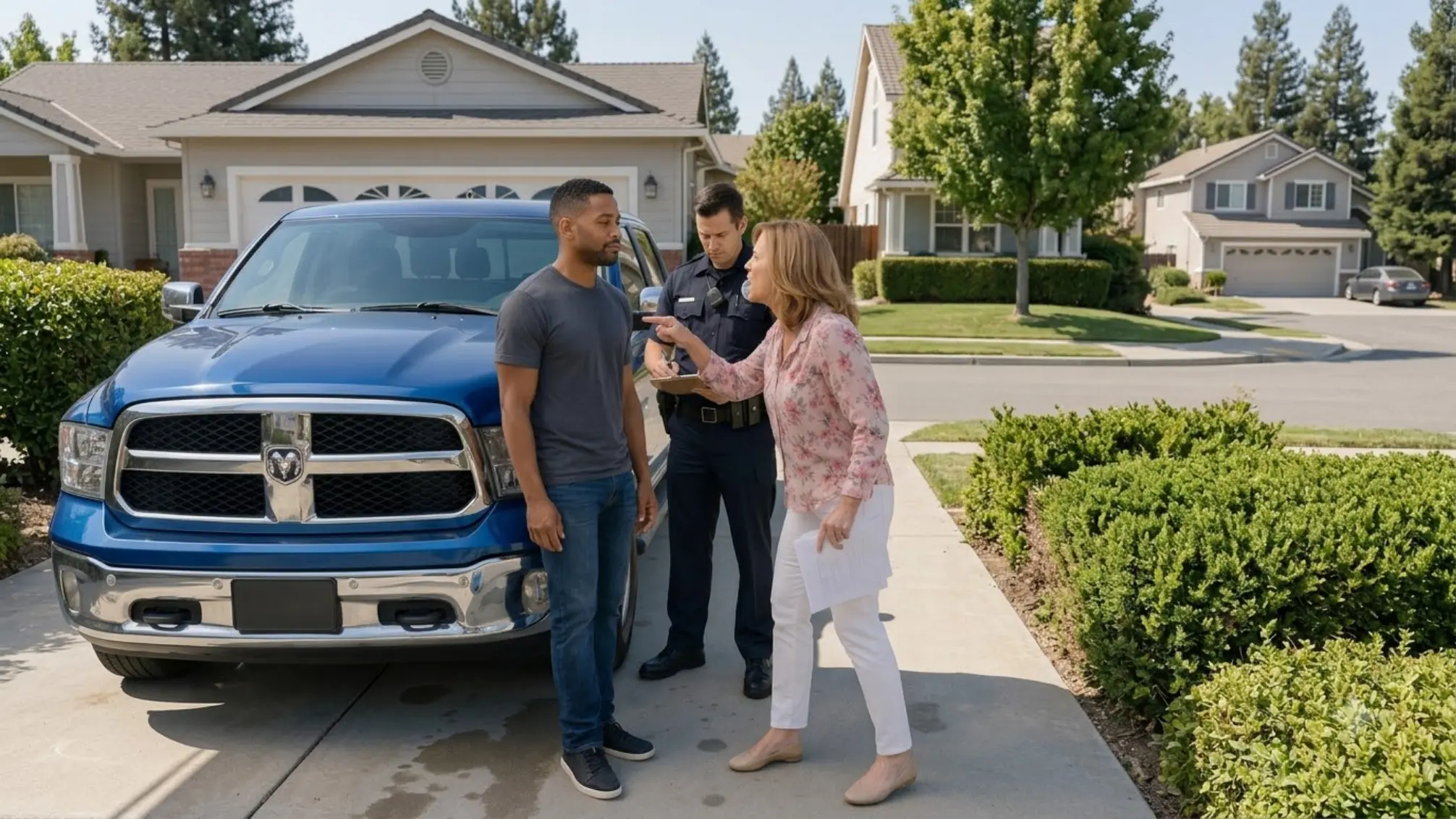
Vanessa stepped closer, her pink floral blouse bright beneath the California sun and her face red with anger. “This community doesn’t bend around people like you, and I can make your life miserable before sunset.” Darius pulled his phone from his pocket and looked at the screen. “Good—because the State Attorney’s on this line, and she just heard every word.” Vanessa’s pointing hand stopped in midair.
Officer Keller looked sharply at Darius. Vanessa laughed, but the sound came out thinner than before. “The State Attorney? Please. You expect us to believe you called some government lawyer because I asked you to cooperate with your homeowners association?” Darius turned the phone slightly so both of them could see the active call.
A woman’s voice came clearly through the speaker. “Mr. Cole, do not end this call.” Vanessa’s face tightened. The voice continued, “Officer, my name is Evelyn Hart. I’m with the California Attorney General’s office, Consumer Law Section, and I need you to document exactly what is happening at that address.” Keller immediately stopped writing and looked from the phone to Vanessa.
The confrontation had begun forty minutes earlier, but the trouble had started nearly six months before that. Darius Cole was thirty-five, a project estimator for a commercial construction company, and the blue pickup belonged to him outright. He had saved for years before buying it used from a contractor in Fresno, then spent weekends rebuilding the suspension, repairing the interior, and replacing enough worn parts that his younger sister joked he loved the truck more than most people loved their houses.
There was nothing unusual about parking it in his own driveway. The HOA rules allowed passenger vehicles and personal pickup trucks as long as they were registered, operational, and did not block the sidewalk. Darius had checked those rules before closing on the house because he knew some associations could be aggressive about vehicles. His truck complied with every written requirement.
Vanessa Pike became HOA president three months after Darius moved into Willow Creek Estates. She had lived there twelve years, chaired landscaping committees, controlled architectural approvals, and possessed the kind of confidence that made new residents assume she had legal powers she did not actually have. Most neighbors described her as “difficult but effective.” Darius quickly learned that usually meant she made rules until somebody challenged her.
Their first disagreement involved the truck’s color. Vanessa claimed the deep metallic blue was “commercial in appearance” and therefore inconsistent with neighborhood aesthetics. Darius asked her to show him the rule. She sent three pages from the community standards, none of which mentioned vehicle color.
He responded politely and considered the issue finished. Vanessa did not. Two weeks later he received a violation notice saying the truck was parked too close to the sidewalk, even though photographs showed more than four feet of clearance. Then came a warning about “excessive mechanical activity” because Darius had changed a windshield wiper in his driveway on a Saturday morning.
He began keeping records. Every notice went into a folder. Every response was saved. Every envelope was dated, photographed, and scanned.
Then Vanessa’s twenty-two-year-old son Cody came home from college. Cody liked trucks, particularly Darius’s. Twice he stopped while Darius was washing it and asked whether he would sell.
The first time, Darius laughed. “No, man. I put too much into it.” Cody offered several thousand dollars below market value anyway. Darius declined.
The second time, Cody returned with Vanessa. She walked around the pickup as though inspecting furniture at an estate sale and asked how much Darius “really needed” for it. He told her it was not for sale. Vanessa smiled in a way he did not like and said, “Everything has a price.”
Darius answered, “Not this.”
Three days later, the HOA violation notices changed. The truck suddenly became an alleged “commercial utility vehicle,” even though it carried no company markings, racks, tools, or commercial registration. Vanessa demanded that Darius either remove it from the neighborhood or park it permanently inside his garage.
Darius appealed. The HOA board denied him after a meeting lasting less than ten minutes. Vanessa chaired the meeting.
That was when Darius started looking more carefully at the association’s documents. What he found disturbed him. The rule Vanessa cited had been adopted years earlier to prevent large branded work trucks from occupying residential streets overnight. Personal pickups were explicitly exempt.
He sent Vanessa the exemption. She responded with a new violation based on “community discretion.” Darius searched the governing documents and found no clause granting such discretion.
Then the fines started. Fifty dollars. One hundred. Two hundred fifty.
Within five weeks, Vanessa claimed Darius owed the HOA $1,850.
He requested an itemized accounting and copies of board votes authorizing the charges. The association management company sent incomplete documents and told him the president was “handling the matter directly.” Darius replied that he would communicate only in writing.
Vanessa began appearing at his house instead.
One afternoon she told him the simplest solution would be selling the truck to Cody. Darius stared at her for several seconds before asking whether she had just tied HOA enforcement to a private sale. Vanessa smiled. “I’m offering you a way to make the problem disappear.”
Darius closed the door.
That sentence changed everything.
He contacted an attorney, not because he wanted a lawsuit but because he wanted somebody to explain exactly where HOA authority ended. The attorney reviewed the documents and told him the fines appeared unsupported. More importantly, tying enforcement pressure to a demand that Darius sell personal property could create serious legal problems if the evidence was strong enough.
Darius had evidence.
His porch camera had recorded Vanessa’s visit.
The attorney sent a preservation letter to the HOA and management company. Vanessa responded by increasing the fines again.
Then three other homeowners contacted Darius.
An elderly widow named Ruth Mercer said Vanessa had threatened architectural penalties until Ruth sold a utility trailer to Vanessa’s brother at a discount. A Latino family said they had received repeated landscaping fines after refusing to hire a contractor recommended by Vanessa. Another homeowner claimed Vanessa pressured him to sell two parking spaces to a board member’s daughter, then began issuing questionable violations when he refused.
Darius stopped thinking of his truck as a personal dispute.
He began thinking about a pattern.
His attorney referred the information to the state consumer-protection office. That was how Darius first spoke with Evelyn Hart.
Evelyn did not promise anything dramatic. She asked for records.
Emails.
HOA notices.
Board minutes.
Video.
Financial statements.
Management contracts.
Anything showing whether enforcement authority had been used for personal benefit.
Darius sent what he had. Evelyn told him not to provoke Vanessa and not to interfere with ordinary HOA procedures. If she contacted him again, he was to document it.
Then came Sunday afternoon.
Darius had just returned from helping his sister move furniture when he found Vanessa standing near the curb with Cody. Cody stared at the blue truck while Vanessa held a folder.
“I’m giving you one last opportunity,” she said.
Darius set his keys on the hood.
“To do what?”
“Resolve this without further penalties.”
“You mean sell Cody my truck.”
Vanessa’s expression tightened.
“I mean cooperate.”
Darius pulled out his phone and quietly dialed Evelyn’s number. They had scheduled a call that afternoon anyway to discuss another document. When Evelyn answered, Darius told her Vanessa was in his driveway.
“Put me on mute,” she said.
Darius did.
Vanessa continued.
“Cody has already arranged financing. He can give you twenty-two thousand.”
Darius almost laughed.
The truck was worth significantly more.
“It isn’t for sale.”
Vanessa looked toward Cody.
Then back at Darius.
“You currently owe the association nearly four thousand dollars.”
“No, you claim I owe it.”
“If you sell the truck, I can recommend the board waive everything.”
Darius stared at her.
There it was again.
Cleaner this time.
Direct.
He unmuted the phone without announcing it.
“Say that again.”
Vanessa frowned.
“What?”
“The part where selling your son my truck makes the fines disappear.”
Her eyes narrowed.
“You know exactly what I mean.”
“I want you to say it.”
Vanessa stepped closer.
“If you cooperate with this association, the association can cooperate with you.”
Darius looked at the active phone.
Evelyn remained silent.
Then Vanessa noticed it.
“Are you recording me?”
“I’m on a call.”
“With who?”
Before Darius could answer, a police cruiser turned onto the street.
Vanessa smiled.
“I called them before I came.”
Darius slowly looked toward her.
“For what?”
She lifted the HOA folder.
“Possible vehicle registration fraud, harassment, and threatening behavior.”
Darius stared at her.
He had done none of those things.
Officer Ryan Keller parked behind Vanessa’s SUV and approached cautiously. Vanessa immediately intercepted him, talking rapidly about an “aggressive homeowner” who refused to comply with community regulations and possessed a truck she believed might be improperly registered. Keller listened, then asked Darius for identification.
Darius provided it.
His vehicle registration matched.
The truck was insured.
There were no warrants, stolen-vehicle alerts, or registration problems.
Keller handed everything back.
“This looks valid.”
Vanessa interrupted.
“That’s not the point.”
Keller looked confused.
“What is the point?”
“He has repeatedly violated HOA rules and intimidated me.”
Darius said, “Ask her what she wants me to do with the truck.”
Vanessa snapped, “Don't twist this.”
Keller turned toward her.
“Ma’am, what are you asking him to do?”
Vanessa made the mistake of answering honestly.
“My son needs that truck more than he does.”
Keller paused.
Darius said nothing.
Vanessa continued, becoming more agitated as she tried to justify herself. She said Cody needed reliable transportation for a new business, that Darius was being unreasonable, and that the HOA dispute could easily disappear if he stopped “creating unnecessary conflict.”
Keller slowly lowered his notepad.
“Are you saying the HOA violations are connected to whether he sells your son the vehicle?”
“No.”
Darius said, “She offered to waive the fines.”
Vanessa pointed at him.
“You keep your mouth shut.”
That was the moment Darius told her the State Attorney was listening.
Now, standing in the driveway with the speakerphone active, Keller heard Evelyn Hart identify herself. He requested her office information and badge number for his report. She provided both and told him there was already an open review involving alleged misuse of HOA enforcement authority.
Vanessa went pale.
“Open review?”
Evelyn’s voice remained controlled.
“Yes, Ms. Pike.”
Vanessa stared at the phone.
“You know my name?”
“We have correspondence containing it.”
Cody stepped backward.
For the first time all afternoon, he seemed less interested in the truck.
Vanessa tried to recover.
“This is a private HOA matter.”
Evelyn replied, “Then I suggest you stop using police resources to pressure a homeowner over a private sale.”
Keller looked directly at Vanessa.
That sentence changed his posture.
“Ma’am, did you tell dispatch this was connected to a vehicle-sale dispute?”
Vanessa looked away.
“I reported suspicious activity.”
“What suspicious activity?”
“He’s hostile.”
Keller looked at Darius, who had remained calm throughout the encounter.
“How?”
Vanessa opened her mouth.
No answer came.
Darius pointed toward his doorbell camera.
“Everything since she arrived is recorded.”
Keller sighed.
“Okay.”
He asked both parties to remain separated while he reviewed what could be established at the scene. He contacted dispatch, confirmed Vanessa had described Darius as “possibly dangerous” and claimed the truck’s ownership was questionable. None of that matched what Keller found.
Vanessa became increasingly angry.
“You're taking his side.”
“No,” Keller said. “I’m documenting what happened.”
“I pay taxes in this community.”
“So does he.”
“He’s violating association rules.”
“That is civil.”
Vanessa stepped toward Keller.
“I am the HOA president.”
Keller’s expression did not change.
“That does not make you law enforcement.”
Darius almost smiled.
He stopped himself.
Evelyn remained on speaker only long enough to provide Keller with contact instructions and request preservation of the dispatch recording if relevant. Then she told Darius to call his attorney and end the conversation with Vanessa.
Vanessa heard that too.
“You're making a huge mistake,” she said.
Darius looked at her.
“No. I think I finally stopped letting you make them for me.”
Keller instructed Vanessa and Cody to leave the property.
Cody went without argument.
Vanessa did not.
She pointed toward Darius’s truck one final time.
“This neighborhood will never let you get away with this.”
Keller interrupted.
“Ma’am, leave.”
She finally did.
Two days later, things became much worse for her.
The HOA management company received formal demands to preserve financial records, enforcement logs, board communications, vendor contracts, and homeowner complaint files. Darius’s private attorney simultaneously filed for an injunction preventing collection activity on the disputed fines.
The judge granted temporary relief pending review.
Then the board began turning on Vanessa.
Two directors claimed they had never voted to approve several of Darius’s penalties. Another admitted Vanessa routinely directed the management company to issue notices before the board reviewed them. Meeting minutes had been written afterward to make some actions appear formally approved.
The irregularities were broader than Darius expected.
One landscaping company receiving unusually frequent HOA work belonged to Vanessa’s cousin.
A towing contractor used for neighborhood enforcement had paid consulting fees to a company registered to her husband.
Several homeowners targeted for violations had refused purchases, vendor recommendations, or private favors involving Vanessa’s family.
Investigators reconstructed years of emails.
One message from Vanessa to the management company said:
Keep pressure on Cole. He’ll eventually get tired of paying and sell the truck.
Another said:
Cody wants it before the end of summer.
Darius read that email twice when his attorney showed it to him.
There was no longer any plausible misunderstanding.
The truck had become leverage.
The board called an emergency meeting.
More than eighty homeowners attended.
Vanessa arrived carrying folders and insisted the investigation was a personal attack orchestrated by “disgruntled residents.” Then Ruth Mercer stood.
The elderly widow walked slowly toward the microphone.
“You threatened to fine me every week until I sold that trailer to your brother.”
Vanessa shook her head.
“That is not what happened.”
Ruth held up printed emails.
“I saved everything.”
The room changed.
Then the Ramirez family spoke.
Then another homeowner.
Then another.
By the time Darius approached the microphone, Vanessa was no longer staring at him.
He placed a copy of the truck-related email on the table.
“I don't want revenge.”
Several people looked surprised.
Darius continued.
“I want rules that apply because they are written rules, not because somebody wants your property.”
He looked toward the board.
“If I violate something, fine me.”
Then he pointed toward Vanessa.
“But nobody should be allowed to manufacture violations until a homeowner gives them what they want.”
The homeowners voted overwhelmingly to remove Vanessa from the presidency pending the investigation.
Two board members resigned.
An outside management firm was temporarily appointed.
All fines personally directed by Vanessa during the previous eighteen months were frozen for review.
Darius’s charges disappeared first.
Every one was unsupported.
But the matter did not end with the HOA vote.
The state investigation found enough evidence of deceptive practices, undisclosed conflicts of interest, and improper financial relationships to pursue civil enforcement. The attorney general’s office did not announce some dramatic raid.
It issued documents.
Subpoenas.
Interviews.
Financial demands.
Slow, methodical pressure.
The kind that could not be shouted away.
Vanessa’s attorney eventually advised her to stop contacting homeowners directly.
The management company terminated its relationship with the old board.
The landscaping and towing contracts were independently audited.
Several homeowners received refunds for improperly assessed charges.
Ruth recovered money associated with penalties used during the trailer dispute.
The Ramirez family received a settlement related to selective enforcement.
Darius received cancellation of every truck-related fine, reimbursement of legal expenses under the association’s settlement, and written confirmation that his pickup complied with neighborhood rules.
He declined additional money offered in exchange for confidentiality.
“I don't need people wondering what happened,” he told his lawyer.
The new HOA board adopted reforms.
No single officer could order fines without documented review.
Conflict disclosures became mandatory.
Board members could not direct homeowners toward businesses owned by relatives without full disclosure and competitive bidding.
Homeowners received access to hearing records.
Violation photographs required timestamps.
Appeals were reviewed by people who had not issued the original notice.
And police calls involving HOA disputes required documentation explaining the alleged criminal issue rather than simply describing a resident as “difficult.”
Officer Keller later testified about the driveway encounter.
He was careful.
He did not claim Vanessa had committed crimes he was not qualified to determine.
He simply described what she said.
The valid registration.
The request involving the truck.
The relationship between waived fines and the proposed sale.
The difference between her dispatch report and what he observed.
Darius appreciated that.
Evidence did not need exaggeration.
Several months later, he was washing the truck when a familiar sedan stopped near the curb.
Cody Pike got out.
Darius turned off the hose.
Cody approached alone.
“I’m not here about buying it.”
“Good start.”
Cody looked embarrassed.
“I owe you an apology.”
Darius waited.
“My mom made it sound like you were trying to cheat the HOA.”
“She knew that wasn’t true.”
“I know now.”
Cody looked at the truck.
“I should’ve stopped asking after you said no the first time.”
Darius nodded.
“Yes.”
Cody rubbed the back of his neck.
“I thought she was just helping me negotiate.”
Darius stared at him.
“Fines aren't negotiation.”
“I know.”
Darius let the silence sit for a moment.
Then he said, “You still looking for a truck?”
Cody looked surprised.
“Yeah.”
“There’s a dealer near Roseville with a blue 2500 coming in next week.”
Cody blinked.
“You'd tell me that?”
“I don't dislike you enough to make you walk.”
Cody laughed despite himself.
“Thanks.”
“Don't ask for mine again.”
“Never.”
He left.
The neighborhood slowly returned to normal.
That was what Darius wanted most.
No reporters outside his house.
No weekly arguments.
No violation envelopes appearing in his mailbox.
Just work, weekends, his truck, and neighbors who occasionally waved while walking dogs.
A year after Vanessa was removed, Darius attended another HOA meeting.
The new president was a retired school principal named Helen Grant.
She opened the meeting by reviewing landscaping expenses, reserve funds, and three proposed rule changes.
Boring.
Very boring.
Darius loved every minute.
Near the end, someone asked whether the association planned to regulate oversized pickup trucks.
Helen looked toward Darius.
He raised one eyebrow.
The room laughed.
Helen smiled.
“Only through rules adopted properly and applied equally.”
“Sounds dangerous,” Darius said.
More laughter.
Afterward, Evelyn Hart called him.
The state matter had reached its final resolution.
Vanessa and associated parties agreed to financial penalties, restitution provisions, governance restrictions, and compliance requirements without admitting every allegation. The HOA itself agreed to independent oversight for a period of time.
Darius listened.
“That’s it?”
“That’s it.”
“No dramatic courtroom?”
Evelyn laughed.
“Sorry to disappoint you.”
“I’ll survive.”
She became serious.
“You did the right thing documenting everything before reacting.”
Darius looked through his window toward the blue truck.
“I almost sold it just to make her stop.”
“That was probably what she expected.”
“Yeah.”
He remembered those first violation notices.
Each one had seemed irritating but manageable.
That was how pressure worked.
Small enough to tolerate.
Then another.
Then another.
Eventually the easiest solution became surrender.
Darius understood now that the truck itself had never been the important part.
It could have been a trailer.
A parking space.
A landscaping contract.
Anything valuable enough for someone with authority to want.
Vanessa’s mistake was believing HOA power belonged to her personally.
It never had.
The homeowners had granted limited authority to an association to manage shared rules and property.
They had not given one president the right to convert enforcement into leverage for her family.
That distinction eventually ended her control.
One Saturday afternoon, Darius parked the blue truck in exactly the same driveway where the confrontation had occurred.
He opened the hood and replaced an air filter.
Nothing more.
Across the street, a new neighbor waved.
“HOA allow that?”
Darius looked toward the wrench in his hand.
“Routine maintenance.”
The neighbor laughed.
“I heard stories.”
“Half of them are probably wrong.”
“Which half?”
Darius closed the hood.
“The ones where the State Attorney showed up in a helicopter.”
The neighbor stared.
“People actually say that?”
“Apparently.”
They both laughed.
The real story had been less spectacular.
No helicopter arrived.
No dramatic arrest happened in the driveway.
A woman pointed her finger.
A homeowner stayed calm.
An officer checked the facts.
A lawyer listened.
Records were preserved.
Emails surfaced.
Homeowners spoke.
The system moved slowly.
And eventually, the truth became much harder to bully than Darius had ever been.
He ran one hand across the truck’s blue fender.
Vanessa had once insisted her son needed it more than he did.
That sentence seemed absurd now.
Ownership was never determined by who wanted something most.
Neither was justice.
Darius climbed into the driver’s seat and started the engine.
The truck rumbled to life.
No fines appeared.
No angry HOA president rushed across the street.
No police cruiser turned the corner.
Just another quiet Saturday in Willow Creek Estates.
And that ordinary silence was exactly what Darius had fought to get back.