The first thing Daniel Mercer noticed was the hand on his motorcycle.
Not the folder.
Not the shouting.
Not even the pink Mercedes parked crookedly across the edge of his driveway.
The hand.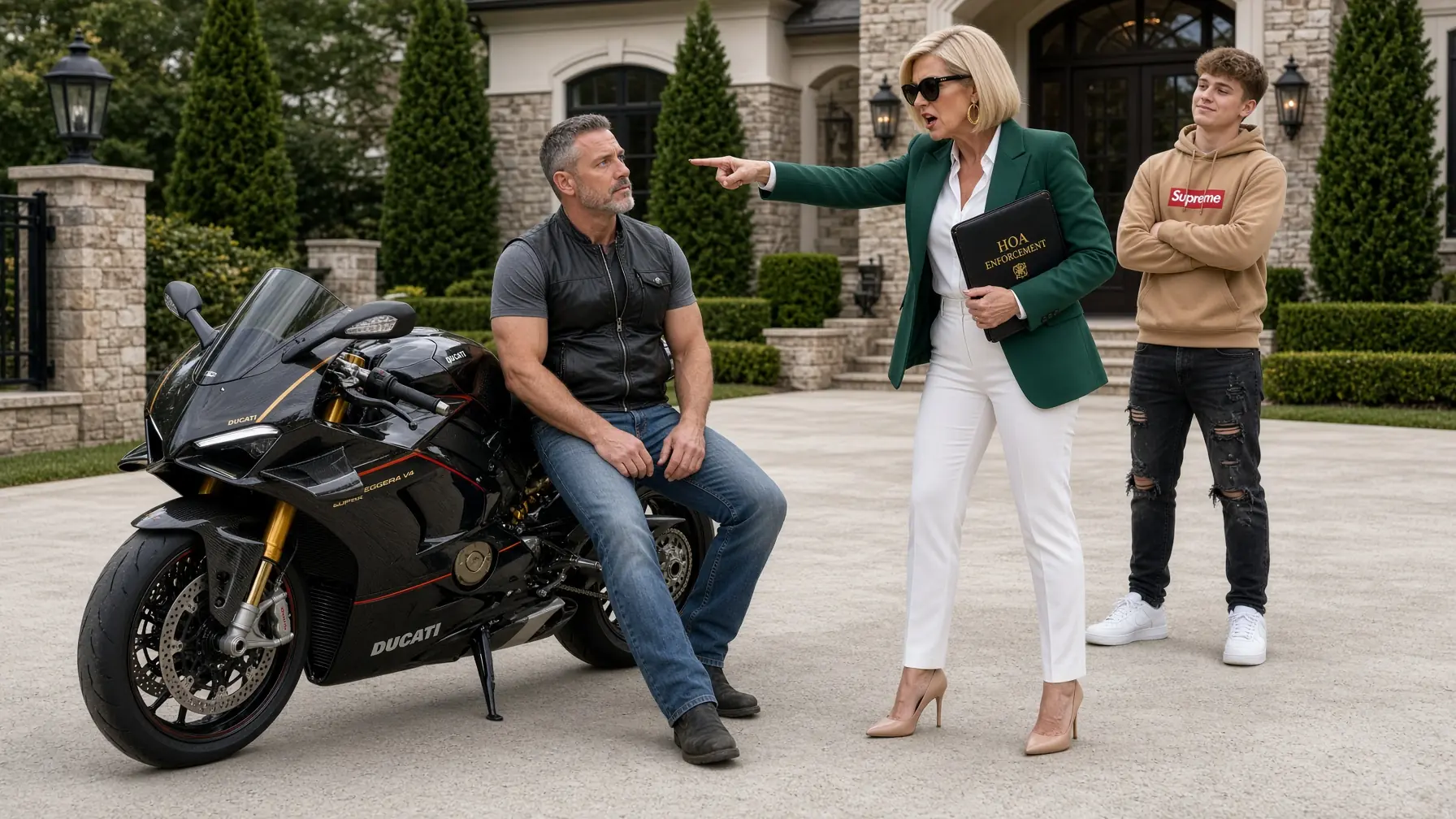
Twenty-year-old Travis Whitmore stood beside Daniel’s black-and-red Ducati Superleggera V4, fingers wrapped casually around the left handlebar as though the motorcycle had already become his.
Daniel slowly lifted his eyes.
“Take your hand off the bike.”
Travis smirked.
Behind him, his mother, Vanessa Whitmore, president of the Brookstone Heights Homeowners Association, marched up the driveway carrying a thick beige enforcement folder beneath one arm.
She was fifty-five years old, blonde, polished, and dressed as though she had arrived for a television interview rather than a confrontation. A tailored pink blazer rested over a white blouse, fitted white trousers reached her nude heels, and oversized black sunglasses covered half her face.
Daniel remained seated on a low stool beside the Ducati.
At forty-eight, he had the broad shoulders of someone who still spent weekends rebuilding engines by hand. His salt-and-pepper hair was short, his beard neatly trimmed, and his black sleeveless riding vest hung open over a fitted T-shirt.
His phone rested on the motorcycle stand beside him.
The screen looked dark.
It was not.
A call had been connected for almost four minutes.
Vanessa stopped three feet away.
“Hand over the keys.”
Daniel stared at her.
“For what?”
“You know exactly why.”
“No. I really don’t.”
Vanessa pulled a document from her folder.
“You owe Brookstone Heights twenty-six thousand four hundred dollars in unpaid penalties, enforcement assessments, administrative fees, and legal costs.”
Daniel almost smiled.
“According to you.”
“According to the association.”
“Same thing lately.”
Her face tightened.
Travis laughed.
Daniel looked at him.
The young man wore a tan Supreme hoodie with a large red logo across the chest, ripped black jeans, and expensive white sneakers. He had the relaxed arrogance of someone who had never needed to wonder who would solve his next problem.
His fingers were still on the Ducati.
Daniel repeated himself.
“Take your hand off my motorcycle.”
Travis looked toward his mother.
Vanessa nodded.
“Don’t.”
Daniel’s expression changed.
“Excuse me?”
“The motorcycle is being surrendered to the association.”
Daniel stood.
Slowly.
That removed the smile from Travis’s face.
Daniel was several inches taller than him.
“You walked onto my property to take a registered vehicle.”
Vanessa lifted the paperwork.
“Not take. Recover.”
“For HOA fines.”
“Yes.”
Daniel looked at the Ducati.
Then at Vanessa.
“And your son just happens to be here.”
“He will be maintaining the motorcycle until disposition.”
Travis finally spoke.
“Mom, quit arguing. Just give me the keys and let him fight us in court.”
Daniel went completely still.
Vanessa shot her son a warning look.
Too late.
Daniel reached toward his phone.
Vanessa pointed sharply.
“Don’t start recording me.”
Daniel picked it up.
“I’m not starting anything.”
He turned the screen toward her.
The call timer read 04:17.
Vanessa stared.
Daniel tapped the speaker icon.
A woman’s calm voice filled the driveway.
“Mr. Mercer, I’m still here.”
Travis immediately released the handlebar.
Vanessa’s face changed.
Daniel looked directly at her.
“Threaten my house again.”
Silence.
He raised the phone slightly.
“I want the State Attorney to hear it clearly.”
The dispute had started ten months earlier over something almost embarrassingly small.
Daniel’s Ducati.
He had owned motorcycles most of his adult life.
Some riders collected watches.
Some collected cars.
Daniel collected machines that frightened sensible accountants.
His garage held three motorcycles, but the Superleggera was different.
Rare.
Carbon-fiber frame.
Limited production.
A machine he had wanted for years before finally buying one from a collector in Florida.
He did not race it through Brookstone Heights.
He did not rev it outside neighbors’ houses.
He rarely even started it before nine in the morning.
But Vanessa Whitmore hated it immediately.
Her first letter arrived six days after the motorcycle came home.
UNAPPROVED HIGH-PERFORMANCE VEHICLE STORED IN VISIBLE RESIDENTIAL AREA.
Daniel read the letter twice.
Then walked outside.
The Ducati was inside his garage.
Not the driveway.
Not the sidewalk.
Inside.
He emailed the association.
Please identify the covenant prohibiting a legally registered motorcycle from being stored inside a private garage.
Vanessa personally responded.
The board retains broad discretion regarding vehicles that may negatively affect neighborhood character.
Daniel replied with one sentence.
Please provide the section number.
No section number arrived.
Instead, another notice appeared.
This one claimed the motorcycle had created “excessive mechanical noise.”
Daniel checked his driveway cameras.
The Ducati had not left the garage on the date listed.
He sent the footage.
The violation disappeared.
Three weeks later, another appeared.
Then another.
Improper garage activity.
Unapproved vehicle maintenance.
Oil contamination risk.
Commercial mechanical work.
Daniel challenged each one.
Vanessa escalated.
By the fourth month, the HOA claimed he owed $3,200.
Daniel hired an attorney.
The attorney sent a demand requiring the association to identify the specific governing provisions supporting the fines.
The HOA withdrew three.
Then immediately created two more.
Daniel did what he had always done in business disputes.
He started building a file.
Not emotionally.
Methodically.
Every letter.
Every email.
Every photograph.
Every board notice.
Every contradictory rule citation.
Daniel worked as the owner of a small industrial equipment company outside Atlanta, and fifteen years of negotiating contracts had taught him that aggressive people often became much less impressive when their words were placed in chronological order.
Vanessa looked terrifying in person.
On paper, she looked sloppy.
That mattered.
The motorcycle dispute would probably have remained an expensive annoyance if Travis had not noticed the Ducati.
The first time happened near the community clubhouse.
Daniel had ridden there to sign documents related to a landscaping vote.
He parked outside.
Travis walked around the motorcycle twice.
“Superleggera?”
Daniel nodded.
“V4?”
“Yes.”
“How much?”
Daniel smiled.
“Enough.”
Travis ran his eyes over the carbon bodywork.
“My mom could get me one of these.”
Daniel laughed.
“Then tell her to start shopping.”
Travis looked toward him.
“You ever selling?”
“No.”
“Everything’s for sale.”
“Not everything.”
The conversation lasted less than a minute.
Daniel forgot about it.
Vanessa did not.
Two weeks later, she approached him after an HOA meeting.
“My son mentioned your motorcycle.”
Daniel looked at her.
“He likes it.”
“He does.”
“He asked whether you’d consider selling.”
“I won’t.”
“What if the price was fair?”
“It isn’t about price.”
Vanessa smiled.
“Men always say that until somebody gives them a number.”
Daniel gathered his paperwork.
“Then Travis is going to be disappointed.”
She stepped closer.
“You’re already carrying substantial HOA fines.”
Daniel stopped.
“What does that have to do with my motorcycle?”
“Just pointing out that liquidity can solve problems.”
He stared at her.
Then smiled.
“Goodnight, Vanessa.”
From that point forward, the notices accelerated.
His disputed balance jumped from $3,200 to $8,700 in less than two months.
Then $13,500.
Administrative review fees appeared.
Attorney consultation fees.
Compliance monitoring.
Vehicle enforcement assessments.
Daniel’s lawyer challenged the numbers.
Vanessa responded with a threat.
If the account exceeded $20,000, the association would begin “enhanced collection procedures against property associated with the delinquent homeowner.”
Daniel’s lawyer called immediately.
“That language is weird.”
“How weird?”
“HOAs can have collection rights depending on state law and governing documents, but ‘property associated with the homeowner’ is not a magic phrase that lets them walk into your garage.”
Daniel looked toward the Ducati.
“You think she’s aiming at the bike?”
“I think she wants you nervous.”