“Hand over the Harley,” Denise Caldwell ordered, pointing directly at the polished black motorcycle. “My son deserves it more than you do.”
Jack Mercer remained seated beside the bike in the driveway of his Florida home, one hand resting on the leather saddle. His short silver hair, trimmed gray beard, and broad frame made him look calm rather than intimidated, even as Denise leaned close enough for him to smell her expensive perfume. “Touch my motorcycle,” he said, “and you’ll lose more than that fake authority badge.”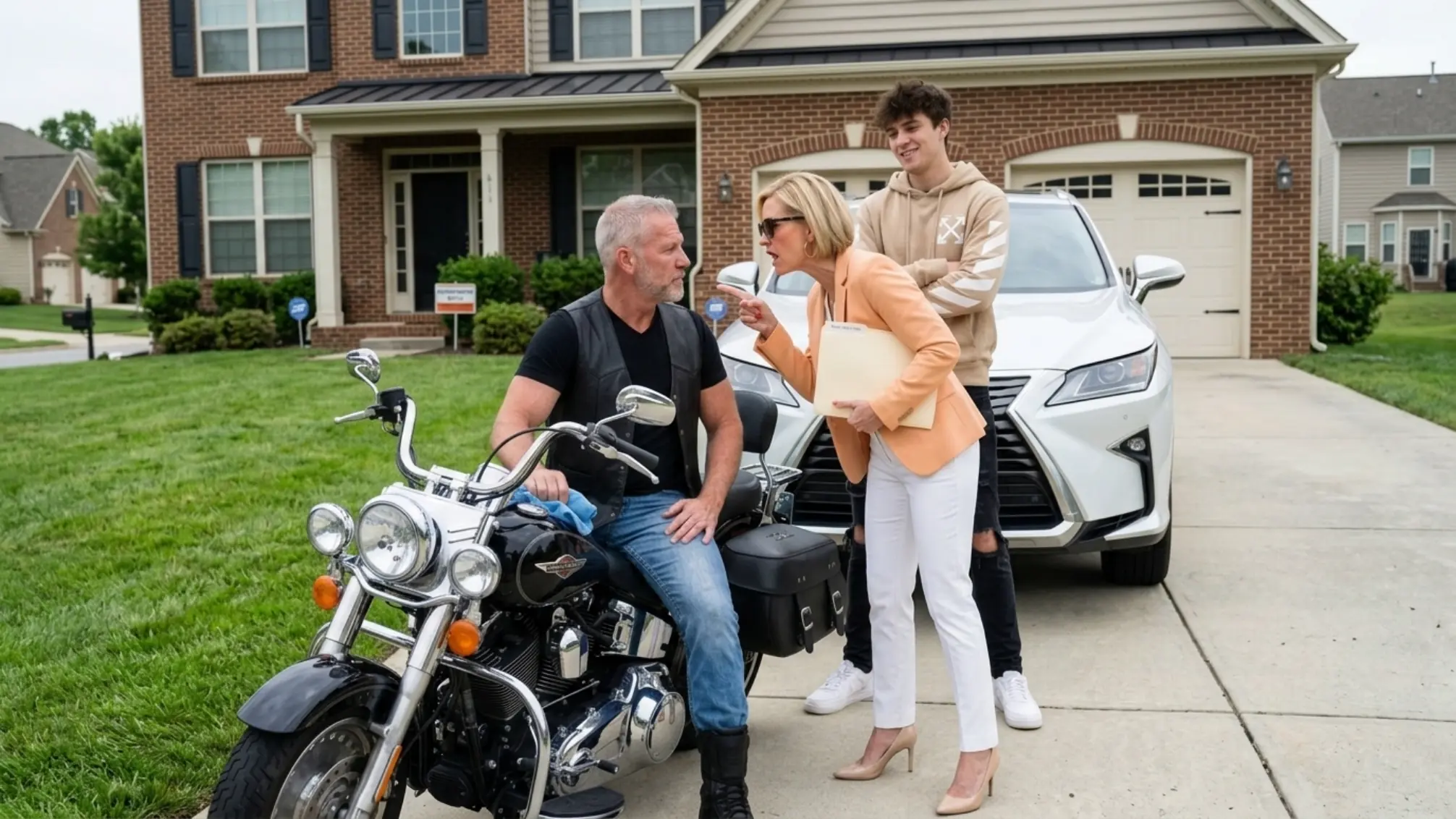
Denise’s twenty-two-year-old son, Tyler, unfolded his arms and stepped forward. He wore a beige designer hoodie, ripped black jeans, and a smug expression that had likely survived because no one had ever challenged it. “Threaten my mother again,” he said, “and I’ll put you on the ground.”
Jack raised the phone lying beside his blue cleaning cloth. “Go ahead. The state attorney heard every word.”
Denise stopped breathing for half a second.
Then she laughed.
It was not a genuine laugh. It was the sharp, dismissive sound of a woman trying to convince herself that the situation had not just shifted beneath her feet.
“You expect me to believe the state attorney is listening to you polish a motorcycle?” she asked.
Jack glanced at the phone screen. The call had been active for eleven minutes.
Assistant State Attorney Rachel Monroe remained silent on the other end, exactly as Jack had asked when Denise entered his driveway. Rachel had called to discuss financial records connected to the Magnolia Ridge Homeowners Association. Jack had barely begun explaining a suspicious vehicle invoice when Denise and Tyler appeared carrying an HOA violation folder.
Now Rachel had heard an entirely different kind of evidence.
Jack looked back at Denise. “You should keep talking. You were finally becoming honest.”
Magnolia Ridge was a gated community outside Tampa, built around artificial lakes, walking trails, and rows of expensive homes designed to appear individual while following nearly identical plans. The neighborhood advertised itself as peaceful, secure, and family-oriented.
For its first decade, it had been exactly that.
Then Denise Caldwell became HOA president.
She had moved into Magnolia Ridge six years earlier with her husband, an insurance executive who spent most weeks traveling, and Tyler, who was sixteen at the time. Denise joined the architectural committee within months and became board president two years later after promising stricter enforcement and higher property standards.
The community initially welcomed her energy.
She organized landscaping contracts, repaired the clubhouse roof, and persuaded the county to improve drainage near the northern gate. Residents believed they had elected a demanding but effective leader.
By her second year, effectiveness became control.
Denise began issuing fines for lawn ornaments, delivery trucks, basketball hoops, driveway stains, and curtains visible from the street. Families who questioned her received repeated inspections. Board members who disagreed with her discovered anonymous complaints filed against their properties.
Tyler learned quickly.
He drove too fast through the neighborhood, parked across sidewalks, held loud parties, and treated common areas as his private property. Complaints disappeared before reaching the official board minutes.
When residents produced photographs, Denise accused them of harassing her son.
Jack Mercer entered Magnolia Ridge after his wife, Ellen, died.
They had been married for twenty-seven years. Ellen taught high-school history, while Jack spent most of his career as an investigator with the Florida Department of Financial Services. He specialized in insurance fraud, contractor schemes, forged property records, and organized theft.
After retiring, he opened a small consulting practice and restored motorcycles in his spare time.
The 1974 Harley-Davidson beside him had belonged to Ellen’s older brother, Mark, who died during Jack’s first year of marriage. Mark left the motorcycle to Ellen, but it sat inside a storage shed for decades because neither of them had the time or money to restore it properly.
Jack began rebuilding it after Ellen’s funeral.
He stripped the frame, repaired the engine, replaced ruined wiring, restored the fuel tank, and carefully preserved every part that could be saved. The work gave structure to evenings that otherwise felt painfully empty.
When the motorcycle finally started, Jack cried inside the garage where no one could see him.
The Harley was not worth an extraordinary amount of money compared with modern luxury vehicles. Its value came from history. Ellen had once sat on the back while Mark rode through the Florida Keys. A faded photograph of the two siblings remained taped inside Jack’s workshop cabinet.
Denise saw only a beautiful motorcycle.
Tyler saw something he wanted.
Their interest began three weeks before the driveway confrontation.
Jack was washing the Harley when Tyler stopped his imported coupe in the middle of the street. He stared at the bike for several minutes before walking onto the driveway without invitation.
“What year?” Tyler asked.
“Seventy-four.”
“How much?”
“Not for sale.”
“I didn’t ask whether it was for sale.”
“You asked the wrong question, then.”
Tyler walked around the motorcycle, reaching toward the handlebar.
Jack caught his wrist before he touched it.
“Ask permission.”
Tyler looked down at Jack’s hand. “You serious?”
“Yes.”
“My mother runs this neighborhood.”
“Then she should have taught you not to touch other people’s property.”
Tyler pulled free and returned to his car.
The following day, Jack received an HOA notice claiming the motorcycle violated Magnolia Ridge’s restrictions on commercial and recreational vehicles. The letter ordered him to remove it from visible areas within forty-eight hours or face a five-hundred-dollar fine.
Jack read the bylaws.
Motorcycles were permitted inside driveways during maintenance, cleaning, loading, and active use. Several residents owned them. Denise’s husband kept two touring bikes inside their garage and occasionally parked them outside without receiving violations.
Jack submitted a written appeal.
Denise rejected it without a hearing.
A second notice increased the fine to one thousand dollars and claimed the motorcycle created a noise nuisance, though Jack had not started it that week.
He requested the complaint records.
Denise refused.
Then Tyler appeared again.
“My mother can make the fines disappear,” he said.
Jack continued tightening a mirror bracket. “How generous.”
“She said you could transfer the bike to me as a community settlement.”
Jack slowly lowered the wrench. “She said what?”
“You give me the Harley, she cancels the violations.”
“That’s extortion.”
“It’s negotiation.”
“You should leave.”
Tyler smirked. “You’re old. What are you even going to do with it?”
Jack stood.
Tyler was taller than average but lean, with the false confidence of someone who mistook expensive clothes for protection. Jack remained stronger despite his age, and the difference became obvious when he rose to his full height.
“I’m going to tell you one time,” Jack said. “That motorcycle belonged to my wife’s family. You will never own it. You will never ride it. You will not touch it.”
Tyler’s smile faded.
Then he shrugged. “We’ll see.”
Jack documented the conversation immediately.
His career had taught him that memory became unreliable once conflict escalated. He wrote the date, time, exact words, and location. He preserved the violation notices and downloaded copies of the bylaws.
That evening, he searched Magnolia Ridge’s public records.
The investigation began almost accidentally.
The HOA’s annual financial report showed twenty-eight thousand dollars paid to Caldwell Community Transport for “resident mobility and event logistics.” Jack had never heard of the company.
Its registered address matched a mailbox rental office.
The company owner was Tyler Caldwell.
Jack searched earlier reports. Payments had begun two years before, increasing every quarter. Other vendors appeared equally questionable: Caldwell Property Review, Prestige Neighborhood Compliance, and Gulf Community Media.
Each company traced back to Denise, Tyler, or Denise’s sister.
The HOA had paid them more than one hundred eighty thousand dollars.
Jack contacted two former board members.
One admitted Denise had pushed through vendor contracts without competitive bids. Another said signatures had been added to approval forms after meetings ended.
Residents paid special assessments believing the money funded landscaping, security, and storm preparation. Some of it appeared to be financing the Caldwell family.
Jack prepared a summary and sent it to the State Attorney’s Office.
Rachel Monroe contacted him the next morning.
She listened carefully as he explained the suspicious payments, false vendor addresses, altered meeting records, and coercive fines. Because Jack had investigated financial crimes professionally, his documentation was organized and cautious.
He did not accuse Denise of crimes he could not prove.
He showed patterns.
Rachel opened a preliminary review and requested official records through lawful channels. She warned Jack not to confront Denise about the finances or obtain material through unauthorized access.
He agreed.
For two weeks, investigators quietly collected bank transfers, vendor registrations, board minutes, and tax filings. The evidence suggested that Denise had redirected HOA funds into family-controlled companies, then used selective enforcement to silence residents who questioned expenses.
Rachel called Jack on the afternoon Denise came to claim the Harley.
He sat in the driveway cleaning fingerprints from the fuel tank while they discussed a seventy-four-thousand-dollar payment labeled “emergency transportation reserve.”
“There was no transportation emergency,” Jack said.
“We know,” Rachel replied. “The money reached Tyler’s company, then moved into an account used to purchase his car.”
Jack looked toward the street.
Denise and Tyler were approaching.
She wore a light-orange blazer over a white blouse, white trousers, gold jewelry, oversized sunglasses, and bright lipstick. Tyler followed in the beige designer hoodie Jack suspected HOA money had helped purchase.
“Rachel,” Jack said quietly, “they’re here.”
“End the call if you feel unsafe.”
“No. Stay silent and listen.”
He placed the phone faceup beside the cleaning cloth.
Denise entered the driveway without greeting him. She carried a thick folder labeled FINAL ENFORCEMENT ACTION.
Tyler stared at the motorcycle.
Denise stopped inches from Jack and opened the folder dramatically.
“You now owe Magnolia Ridge seven thousand five hundred dollars in penalties,” she announced. “The board has also authorized vehicle removal.”
“There was no hearing.”
“I am the board president.”
“You’re not the entire board.”
“I have emergency enforcement authority.”
“No, you don’t.”
Her smile disappeared. “You’ve been difficult from the moment you moved here.”
“I asked you to follow your own bylaws.”
“You challenged me publicly.”
“I sent a private appeal.”
“You embarrassed my son.”
“He tried to take my motorcycle.”
Tyler stepped forward. “You grabbed me.”
“You reached for the bike.”
Denise raised one hand. “This argument ends today. Transfer the Harley to Tyler, and I will eliminate the fines.”
Jack looked directly at her.
“Say that again.”
She mistook the request for uncertainty.
“The motorcycle becomes my son’s property. In exchange, the HOA withdraws the penalties and closes the matter.”
“How does the HOA benefit?”
“We benefit by resolving an ongoing violation.”
“You mean your son benefits.”
“My family has devoted years to this community. Tyler deserves something in return.”
Jack glanced toward the phone.
Rachel remained silent.
“What happens if I refuse?” he asked.
Denise leaned closer. “We record a lien against your house, authorize towing, and begin foreclosure proceedings. I can also make certain every insurer in this county receives photographs showing illegal mechanical work on residential property.”
Jack almost admired the completeness of the threat.
“You would falsify reports?”
“I would enforce community standards.”
“There is no violation.”
“There is whatever I document.”
Tyler laughed behind her.
Denise continued. “You live alone. You have no family here, no influence, and no idea how much power I hold. Sign the motorcycle over, or I make your life expensive enough that you leave.”
That was when Jack told her the state attorney had heard everything.
Denise laughed, but Tyler did not.
He looked at the phone.
A small green symbol indicated the call remained active.
“Mom,” he said quietly.
She ignored him. “Whoever is on that phone cannot change HOA authority.”
Rachel’s voice finally emerged from the speaker.
“Mrs. Caldwell, this is Assistant State Attorney Rachel Monroe.”
Denise’s expression emptied.
Rachel continued calmly. “Do not touch Mr. Mercer’s phone, motorcycle, documents, or person. Investigators are already traveling to the property.”
Tyler stepped backward.
Denise reached for the phone anyway.
Jack caught her wrist before she could grab it.
She jerked free. “You’re assaulting me!”
“No,” Rachel said through the speaker. “Mr. Mercer prevented you from interfering with a recorded state investigation.”
Denise stared at the device as though it had betrayed her personally.
“This was entrapment.”
“You approached him,” Rachel replied. “You brought the transfer papers. You made the threats.”
Tyler moved toward the Harley.
Jack stepped between them.
“Don’t,” he warned.
Tyler’s fear transformed into anger. “This is my bike now.”
“You heard your mother. I haven’t signed anything.”
“She said the board approved it.”
“The board cannot give away my property.”
Tyler shoved Jack’s shoulder.
Jack barely moved.
“Do it again,” he said, “and the next person touching you will be wearing handcuffs.”
Tyler raised both hands. “You think you’re tough because you set us up?”
“No. I think you’re stupid because you heard a state prosecutor and still put your hands on me.”
Denise turned toward the street.
Two unmarked state vehicles entered Magnolia Ridge, followed by a marked sheriff’s cruiser. Several neighbors stepped outside as the vehicles stopped in front of Jack’s home.
Investigator Carla Ruiz approached first. She displayed her credentials and instructed Denise and Tyler to remain separated.
A sheriff’s deputy stood beside Tyler.
Denise attempted to recover her authority.
“This is HOA business,” she said. “You have no jurisdiction over private association enforcement.”
Carla looked at the Harley, the unsigned transfer form, and the open folder.
“Threatening a lien to obtain personal property is not ordinary HOA enforcement.”
“I never threatened him.”
Rachel’s voice remained audible from the phone.
Carla gestured toward it. “The state attorney disagrees.”
Denise removed her sunglasses.
Without them, her fear became more visible.
“You cannot arrest me based on a conversation.”
“We are not here only because of today.”
Carla handed her a warrant authorizing the seizure of HOA financial records, electronic devices, contracts, banking documents, and communications involving family-owned vendors.
Denise stopped reading halfway down the first page.
Tyler looked toward his mother. “What financial records?”
She did not answer.
The deputy asked whether he owned Caldwell Community Transport.
Tyler’s face changed.
“Why?”
“Because it received seventy-four thousand dollars from Magnolia Ridge.”
“That was for services.”
“What services?”
Tyler looked at Denise.
Carla instructed the deputy to secure his phone.
He pulled it away. “You need a warrant.”
Carla raised the document. “We have one.”
Tyler attempted to delete something before surrendering the device. The deputy stopped him and placed him in handcuffs for interfering with the warrant.
Denise shouted that her son was being attacked.
Neighbors began gathering at the edge of Jack’s driveway.
Some recognized the investigation as the first real challenge to Denise’s authority in years. Others watched silently, still afraid that the HOA president might somehow survive and punish anyone appearing pleased.
Jack did not celebrate.
He covered the Harley with a soft cloth and stepped aside while investigators photographed the documents Denise had brought. The transfer form listed Tyler as recipient and described the motorcycle as “property surrendered in satisfaction of association penalties.”
Denise had already signed as HOA president.
The board had never authorized it.
Within hours, state investigators entered the Magnolia Ridge administrative office. They seized computers, ledgers, invoices, emails, and security footage.
The evidence revealed a wider scheme than Jack expected.
Denise created violations against selected homeowners, then offered unofficial settlements directing money toward private vendors. Residents paid inspection fees to companies owned by her relatives. The HOA purchased “security monitoring” from Tyler’s company, though no cameras or guards were provided.
Storm-preparation funds purchased Tyler’s car.
Landscaping payments helped renovate Denise’s kitchen.
Emergency reserve money covered vacations described in financial reports as vendor conferences.
The family had diverted nearly four hundred thousand dollars over three years.
Board minutes were altered to show approvals that never occurred. Electronic signatures were copied from unrelated documents. Residents who questioned the spending received escalating violations and threats of liens.
Jack’s motorcycle was not the first property Denise tried to obtain.
An elderly homeowner had surrendered a golf cart after Denise threatened to fine him for improper storage. Tyler began using it at parties. Another family transferred expensive patio furniture to the clubhouse rather than face a manufactured assessment.
The items later appeared at the Caldwell home.
Rachel’s office identified twenty-three victims.
The state suspended Denise’s authority over HOA financial accounts. A court-appointed manager took temporary control of Magnolia Ridge while residents organized an emergency election.
Denise and Tyler were charged with conspiracy, organized fraud, grand theft, extortion, falsification of records, and obstruction. Additional charges arose from Tyler’s attempt to delete evidence during the search.
Denise’s attorney claimed she believed the HOA bylaws allowed property transfers.
The bylaws contained no such power.
He argued that her driveway statements were negotiation rather than threats.
The recording captured her saying, “There is whatever I document,” followed by the promise to make Jack’s life too expensive to remain in his home.
The words became central evidence.
During a pretrial hearing, Denise saw Jack outside the courtroom. She wore a conservative navy suit instead of orange and no HOA identification badge.
“You destroyed my family,” she said.
Jack stopped.
“No. I refused to give your son my wife’s motorcycle.”
“You could have settled this quietly.”
“That is what people told themselves every time you threatened them.”
“You were waiting for me to make a mistake.”
“I was waiting for evidence.”
Her face hardened. “You enjoyed humiliating me.”
Jack shook his head. “I enjoyed protecting something you had no right to take.”
Denise accepted a plea agreement after Tyler agreed to cooperate. She pleaded guilty to fraud, extortion, and records falsification. The court ordered restitution, prohibited her from managing any homeowners association, and sentenced her to confinement followed by supervised release.
Tyler pleaded guilty to theft-related charges, obstruction, and participation in the false vendor scheme. He lost the car purchased through HOA money, performed hundreds of hours of community service, and received probation after repaying part of the stolen funds.
Magnolia Ridge elected a new board.
The first meeting lasted four hours because residents insisted on reviewing every procedure Denise had controlled. They adopted transparent bidding rules, independent financial audits, public access to meeting records, and an appeal process preventing one board officer from issuing penalties alone.
Improper fines were canceled.
Property taken through coerced settlements was returned.
The golf cart went back to its elderly owner. The patio furniture returned to the family who had purchased it. Money recovered from the Caldwell accounts restored most of the emergency reserve.
Jack attended only the first two meetings.
He had never wanted influence over the HOA. He wanted predictable rules, honest records, and the ability to clean his motorcycle without someone demanding ownership.
Months later, Rachel visited Magnolia Ridge after the final restitution hearing.
Jack was in the driveway beside the Harley.
She walked around the motorcycle slowly. “So this is the famous evidence.”
“It was never evidence.”
“It was the object of the threat.”
“To me, it was Ellen’s.”
Rachel noticed the faded photograph resting on Jack’s workbench inside the garage. Ellen sat behind her brother on the motorcycle, smiling toward a camera somewhere along the Florida coast.
“You restored it for her?”
“After she died.”
Rachel looked back at the Harley. “Denise never understood what she was demanding.”
“She wouldn’t have cared.”
Jack started the engine.
The restored machine settled into a deep, steady rhythm that filled the driveway without becoming painfully loud. Neighbors looked toward the sound, then waved when they saw him.
No violation letter arrived.
Jack rode through the open gates of Magnolia Ridge and followed the highway south toward the coast. The motorcycle moved smoothly beneath him, carrying Ellen’s history, Mark’s memory, and years of patient work.
Denise had believed power allowed her to decide what other people deserved.
Tyler believed wanting something made it negotiable.
They saw an old man beside an expensive motorcycle and assumed he could be pressured, fined, threatened, and isolated until surrender seemed easier than resistance.
Instead, Denise made her demand while the state attorney listened.
She threatened his home.
She offered to erase false fines in exchange for his Harley.
Her son stepped forward as though violence could complete the negotiation.
Then the state vehicles entered the street, the warrant opened, and the authority Denise had spent years manufacturing disappeared beneath the weight of real evidence.
Jack kept the motorcycle.
Magnolia Ridge recovered its money.
And the woman who demanded another family’s history as a gift for her spoiled son finally learned that some property could not be taken with a signature, a threat, or an orange blazer carrying a meaningless HOA badge.