Nine dump trucks were already lined up on my road when I got to the bank at 9:04 and the first bucket of rock came down before I could get my boots wet.
The sound my creek had made for 88 years stopped midnote. I ran down waving both arms.
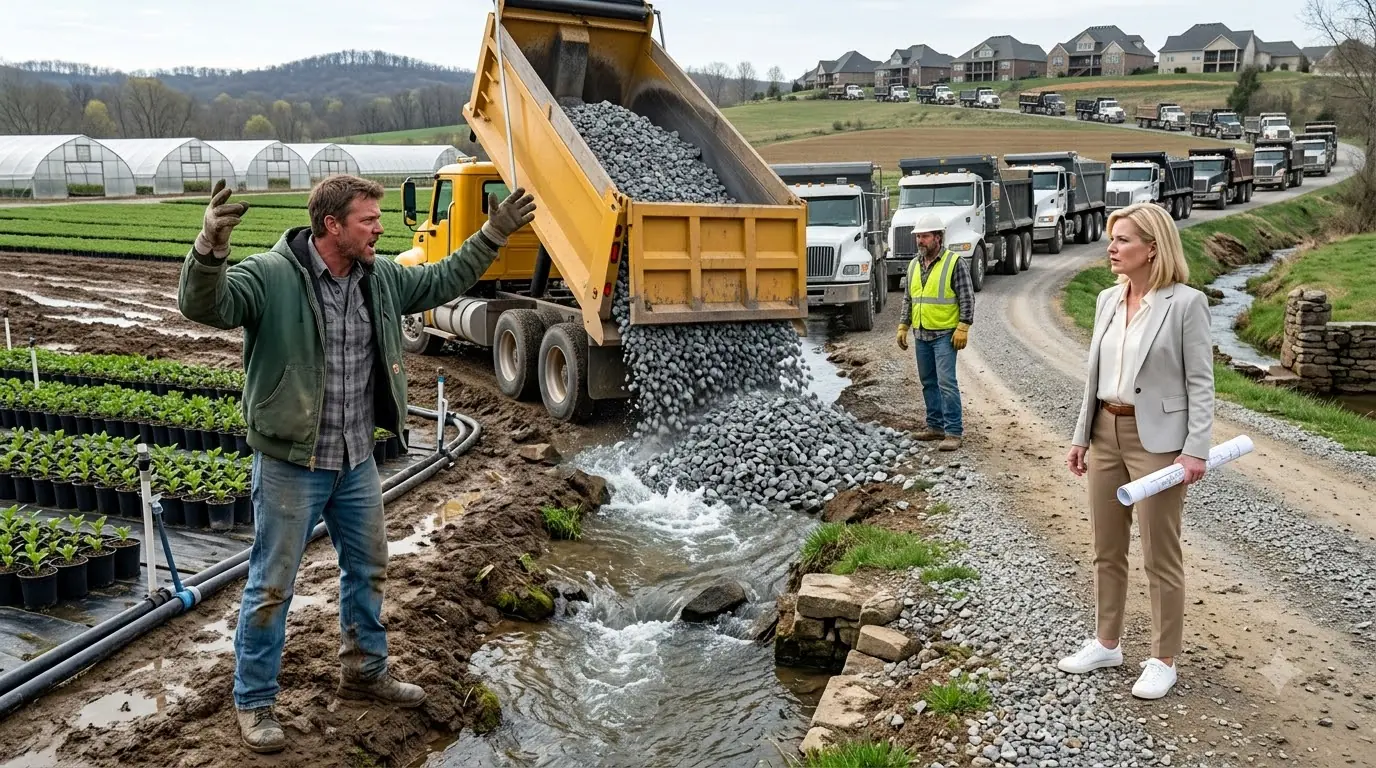
Ned Bramhal parked the bucket and looked past me at Karen Vossberg standing on my gravel in white sneakers with a rolled map under her arm.
"Keep going," Karen said. Ned hesitated. "He's not on the work order." I told her she was standing on parcel 22-064, my deed, my creek, my water right, filed and paid.
She snapped her fingers at the driver like she was calling a dog off a couch. "It's not a creek."
"It's a drainage ditch. Ditches get filled." "You never asked me." "I don't ask a man who sells shrubs out of a barn." She said it loudly enough for all nine drivers to hear.
"Stand there and I'll have you cited, towed, and removed from association property. Then we'll fill it anyway." I stood there. She had my road blocked with her own trucks.
2,400 yards of rock. 640 ft of running water gone under a flat gray pad by noon. She walked the pad afterward, heel to toe, testing it like a new driveway. Uphill of that pad sat 196 roofs, a retention pond, and every drop of rain that would ever fall on them.
Water doesn't argue. It just waits. My name is Palmer Chadwick. I'm 44 and I grow things for a living on 78 acres my family has held since before the road out front had a name.
Chadwick Creek Nursery and Sod, six greenhouses, four sod fields, and 40,000 seedlings in one-gallon pots that need water every single day from April to September or they die in a week. Not wilt die. That's the whole business. A year of work standing in plastic pots drinking.
All of it drank from that creek. It's spring-fed. It comes up out of the ground at the top of my property cold enough to ache your hand in July and it runs the length of the place before it leaves at the south fence. My grandfather Ellsworth stacked a stone ford across it in 1938 so a wagon could get over without cutting the bank.
Those stones are still there. Were still there. I have a water right on that creek number WR11-0842 filed with the state renewed on time every year of my adult life. I mentioned the paperwork because paperwork is the only reason any of this matters and because on April 2 none of it meant a thing to a woman in white sneakers.
Now here's the part everybody in the story got wrong, including me for longer than I'd like to admit. Stonebrier Landing Estates went in above me in 2003. 196 houses on the high ground north of my line roofs, driveways, cul-de-sacs, a clubhouse with a parking lot. When you pave that much of a hillside, the rain doesn't soak in anymore.
It runs. So, the developer built a retention pond at the bottom of the subdivision to catch it all and gave that pond one pipe out. One pipe. It discharged into my creek at the property line.
That's it. That's the whole drainage system for 196 homes. Everything that fell on Stonebrier Landing went into that pond, then out that pipe, then into my water, then downstream, and gone. For 20 years, it worked so quietly that nobody up there ever thought about it, including the woman who ran the place.
I was never a member of that HOA. My land isn't in their plat. Never was. Wasn't annexed, wasn't dedicated, wasn't anything.
I paid no dues, and got no newsletter. What I did get about 4 years ago was a look at one of their internal maps at a county open house, the glossy kind they print for community meetings. My creek was on it, shaded green, labeled common greenway ditch A. I remember standing there thinking somebody in a design office had gotten sloppy with a highlighter.
I did not think there was a piece of paper somewhere that made this a habit. That was my first mistake and it cost me about 6 weeks later on. Karen Vossberg was in her third year as president when she came for it. She was good at the job in the way that scares you.
Agendas on time, violations logged, two board members she'd personally recruited and a treasurer, Neville Ashcraft, who read whatever she handed him out loud like it was scripture. Her project that year was phase two of the Stonebrier Greenway, a paved walking loop and two pickleball courts, the kind of thing that photographs well and gets a president reelected without a race. Phase 2 needed four flat acres. There is exactly one flat, undeveloped stretch anywhere near that subdivision, and it's the bottomland my creek runs through.
You could see the appeal from her side of the fence. Fill the channel grade, pave it, cut a ribbon. She came to me three times over January and February. The first time was pleasant.
The second time she brought Ashcraft and a rendering. The third time she brought the tone. I told her no every time. And I offered her something anyway because I'm not built to just say no and hang up.
I offered a walking easement along the east bank, a defined path 16 ft wide. No motorized anything. Renewable with the channel left alone. I'd have signed it that afternoon.
She looked at the offer like I'd asked her to pay for her own driveway. "The association doesn't buy what the association already owns." That's a direct quote. I wrote it on the back of a feed receipt in my truck because something about the certainty of it bothered me more than the rudeness did.
People don't say already owns about land they hope to get. They say it about land somebody has told them is theirs. On March 20, I found a paper zip tied to my front gate. Common area improvement notice, drainage ditch, a channel fill and grade commencement date, April 2.