The black Chevrolet Silverado hung several inches above the asphalt, suspended by thick chains from the hydraulic arm of a white tow truck. Its front tires were off the ground while the rear wheels rested near the edge of the driveway belonging to Marcus Bennett, a forty-three-year-old Black American homeowner who had lived in Cypress Ridge for nearly six years. Across from him stood Karen Whitmore, the forty-seven-year-old white American HOA president, dressed in a fitted pink athletic jacket, black leggings, and spotless running shoes. She held a printed violation notice like a court order and smiled as though the truck had already disappeared.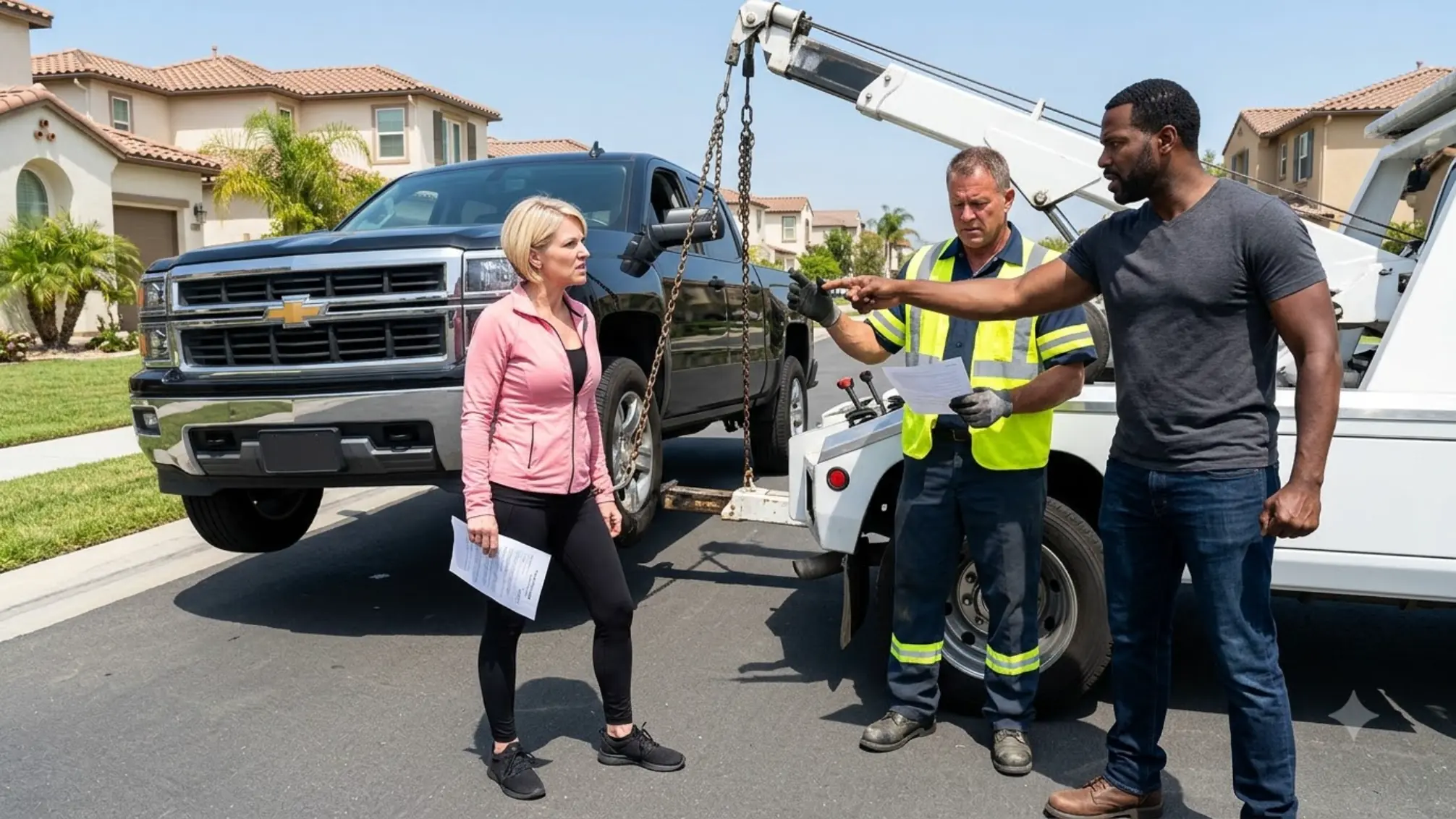
“Tow it,” Karen ordered. “He ignored my warning.”
Marcus stepped toward her, his broad shoulders rigid beneath a charcoal T-shirt. “Touch my truck and see what happens.”
Karen turned sharply toward the tow operator. “I said take it now.”
Ray Collins, the fifty-year-old white American driver standing beside the hydraulic controls, looked down at the paperwork Karen had handed him. He examined the empty signature line, the missing board authorization number, and the address printed beneath a faded HOA logo. Then he removed his gloved hand from the lever.
“Not with this fake order,” Ray said.
Karen’s smile vanished.
The hydraulic pump stopped whining, leaving only the soft clink of chains beneath the raised truck. Marcus remained between Karen and his vehicle, fists tight at his sides but his voice controlled. Behind them, the stucco homes of Cypress Ridge stood beneath a clear California sky, their neat lawns and matching tiled roofs forming the orderly background Karen had always claimed to protect.
“You were hired to tow an unauthorized commercial vehicle,” she snapped at Ray. “The association approved this removal.”
Ray held the page toward her. “Then show me the approval.”
“It is right there.”
“No, ma’am. This is a violation notice printed from a home computer. It is not a tow authorization.”
Karen reached for the paper, but Ray pulled it back. His company required a verified board representative, a legal parking violation, and proof that the vehicle was on common property before removing it. Marcus’s truck was parked inside the boundaries of his private driveway, directly beside the home identified on his deed.
Marcus pointed toward the curb. “She told you it was parked in the street, didn’t she?”
Ray looked at him. “She said it had been abandoned in an HOA-controlled fire lane.”
Karen’s face reddened. “The driveway affects the appearance of the entire street. The truck is oversized, unsightly, and clearly being used for business.”
Marcus stared at her. “It is my personal vehicle.”
The Silverado was clean, fully registered, and newer than Karen’s own SUV. It had no company lettering, equipment racks, commercial plates, or visible tools. Its only distinguishing feature was a small American flag sticker near the rear window and a university parking decal belonging to Marcus’s daughter, who occasionally borrowed it when visiting from college.
Karen had called it an eyesore because it did not fit her preferred image of Cypress Ridge. She wanted luxury sedans, polished crossovers, and vehicles that looked appropriate beside the model homes featured in her real estate advertisements. Marcus’s truck had become her latest excuse to remind him who controlled the neighborhood.
Ray lowered the front of the Silverado until all four tires rested on the driveway again. The chains relaxed with a metallic rattle, and Marcus exhaled for the first time since rushing outside. Karen stepped toward the tow truck controls as though she might operate them herself.
“You cannot leave it,” she told Ray. “I called your dispatcher personally.”
“And my dispatcher told me to confirm the order before moving anything,” Ray replied. “There is nothing here I can legally tow.”
Karen pointed at Marcus. “He has received three notices.”
“I received one,” Marcus said. “It arrived yesterday, and it gave me ten days to respond.”
Karen’s eyes shifted briefly toward the truck. That movement told Marcus everything he needed to know.
The notice had not been intended as the beginning of a lawful enforcement process. It had been created to provide just enough paper for Karen to convince a towing company that the HOA had already completed one. She expected Marcus to return from work and find his truck gone, along with a storage bill, towing charges, and perhaps enough humiliation to stop him from challenging her.
Ray folded the false authorization and placed it inside his work jacket. “My company will retain this.”
“You have no right to keep HOA documents,” Karen said.
“I have every right to keep the paperwork connected to a tow request I was asked to perform.”
Marcus pulled out his phone. “And my security cameras recorded the entire thing.”
Karen’s expression hardened. “You think cameras make you untouchable?”
“No,” Marcus said. “But they make lying harder.”
The conflict had begun three months earlier, after Marcus attended an HOA meeting concerning a proposed special assessment. Karen wanted each household to pay an additional $3,800 for pavement repairs, security upgrades, and landscaping improvements. She described the assessment as urgent and insisted the neighborhood’s property values would collapse without immediate approval.
Marcus had asked to see the contractor bids.
Karen told him they were confidential.
That answer troubled him. Marcus worked as a civil engineer for an American infrastructure consulting firm and had spent nearly two decades reviewing construction estimates, drainage systems, pavement failures, and municipal contracts. The projected price for resurfacing two short private streets appeared far above market value.
He requested the financial documents in writing.
Karen ignored the first request. She responded to the second by accusing him of attempting to interfere with volunteer board members. When he submitted a third request citing the HOA bylaws, she sent him a warning about hostile communication.
Marcus was not hostile. His letters were short, professional, and specific. He asked for three bids, a breakdown of expected costs, and the meeting minutes showing how the preferred contractor had been selected.
Two days later, Karen began sending vehicle notices.
The first claimed Marcus’s truck extended over the sidewalk. A photograph attached to the notice showed it parked nearly three feet behind the pedestrian path. The second accused him of operating a commercial business from his home because a colleague had visited with rolled engineering plans visible through his car window.
The third declared the Silverado an oversized vehicle prohibited from overnight parking.
Marcus checked the bylaws. They prohibited recreational vehicles, trailers, buses, and commercial trucks heavier than ten thousand pounds. His Silverado was a standard personal pickup well below the limit.
He replied with the registration, weight classification, and a photograph showing the truck completely inside his driveway. Karen sent no response. Instead, she called the towing company.
Ray finished removing the chains while Karen stood on the sidewalk making angry phone calls. Marcus photographed the truck’s suspension points to document any damage, then asked Ray for his company information. Ray gave him a card and quietly advised him to check whether Karen had contacted other towing operators.
“She seemed surprised that I asked for proof,” Ray said. “That usually means somebody else did not.”
Marcus looked across the neighborhood. Several driveways were empty during the workday. He wondered how many residents had returned home to discover that their cars had been removed under similar circumstances.
Karen ended her call and marched toward them. “This is not over.”
Marcus met her halfway. “You are right.”
She stopped.
“You sent a tow truck onto my property using false information,” he continued. “You tried to seize my vehicle before the response period on your own notice had expired. And you represented a piece of paper without board approval as a legal tow order.”
Karen lowered her voice. “Be careful, Marcus.”
“No. You should have been careful before the truck arrived.”
That afternoon, Marcus reviewed the footage from his exterior cameras. The recording showed Karen arriving before the tow truck and walking around the Silverado while photographing it from several angles. At one point, she stepped onto his driveway, lifted one of the windshield wipers, and placed a second violation notice beneath it.
The notice was timestamped nine minutes before the tow truck entered the street.
The camera also recorded Karen speaking to Ray after his arrival. She pointed toward the driveway and claimed the board had authorized immediate removal because the truck presented an emergency obstruction. She never mentioned the ten-day response period.
Marcus saved copies of every video to an external drive and cloud storage. Then he compared the two violation notices.
They were not identical.
The notice emailed to him the previous day allowed ten days to request a hearing. The paper Karen placed beneath his windshield had been altered to say “immediate removal authorized after repeated noncompliance.” The lower section included a board approval date from two weeks earlier.
Marcus had attended the meeting listed on the form.
No vehicle matter had been discussed.
He contacted three board members individually. Two said they knew nothing about the tow. The third, HOA treasurer Linda Hayes, asked him to send her a copy of the order.
She called back less than an hour later.
“Marcus, that document did not come from our official system,” she said. “The reference number belongs to a landscaping invoice.”
“Did the board vote to tow my truck?”
“No.”
“Did Karen have authority to order an emergency tow from my private driveway?”
“Not without a safety violation or court order.”
Marcus looked through his office window at the Silverado. “Then we need an emergency board meeting.”
Karen tried to prevent it.
She emailed the board claiming Marcus had threatened her and the tow driver. She described him as physically aggressive, emotionally unstable, and dangerous to community volunteers. She recommended suspending his access to meetings until the HOA attorney could evaluate the risk.
Ray’s written statement contradicted every claim.
He documented that Marcus never touched Karen, never interfered with the tow equipment, and never threatened physical violence. Ray also confirmed that Karen had misrepresented the location of the truck and supplied an unsigned document as official authorization.
The board scheduled the meeting for Friday evening inside the Cypress Ridge clubhouse.
By then, word of the failed tow had spread. Residents filled every chair and stood along the back wall. Some arrived carrying their own towing receipts, vehicle notices, and photographs of driveways Karen had declared noncompliant.
Karen sat at the front table wearing a white blouse and pearl earrings. Her usual pink jacket was gone, replaced by clothing designed to make her appear calm and professional. She placed a thick binder beside the microphone and opened the meeting by accusing Marcus of creating unnecessary conflict.
“This board has a duty to preserve the appearance and safety of Cypress Ridge,” she said. “Certain homeowners have chosen confrontation over cooperation.”
Marcus waited until she finished.
Then he placed the two violation notices on the projector.
The first was the version emailed to him. The second was the altered copy Karen placed beneath his windshield. Residents immediately noticed the changed language, false approval date, and reused reference number.
Karen leaned toward the microphone. “That could have been modified by anyone.”
Marcus played the security footage.
The room watched Karen remove the paper from her own clipboard and place it on the truck. The timestamp appeared clearly in the corner.
Treasurer Linda Hayes opened the financial system on her laptop and confirmed that the order number belonged to a payment made to Green Horizon Landscaping. The supposed board vote had never occurred.
Karen attempted to interrupt. “This is a technical disagreement.”
“No,” Linda said. “This is a fabricated board document.”
A low murmur moved through the room.
Marcus then played the audio from Ray’s body microphone, which his towing company used during disputed removals. Karen’s voice could be heard claiming the truck was abandoned in a fire lane and that immediate towing had been unanimously approved.
The final recording showed the Silverado parked inside Marcus’s private driveway.
Board vice president Steven Cole looked at Karen. “Why did you lie about the location?”
“I used language the driver would understand.”
“You told him it was abandoned.”
“It was an enforcement matter.”
“You told him we voted.”
Karen closed her binder. “We would have voted if Marcus had not interfered.”
That answer destroyed the last of her support.
Residents began raising their own complaints. A white American single mother named Emily Rogers said Karen had ordered her son’s car towed during his first weekend home from college. An Asian American homeowner named Kevin Park produced a storage receipt showing he had paid $640 after his registered vehicle disappeared from his driveway.
A Black American retired teacher named Gloria Fields said Karen threatened to tow her daughter’s car while Gloria was recovering from surgery. Karen had claimed overnight guests required written approval, though no such rule existed.
The pattern was no longer about one truck.
Marcus asked Linda to display the HOA’s towing expenditures. Over eighteen months, Cypress Ridge had paid more than $22,000 in vehicle-removal fees, administrative charges, and “parking compliance services.” Many payments had gone to West Valley Recovery, a towing company owned by Karen’s brother-in-law.
Ray’s company had only been contacted that morning because West Valley’s truck was unavailable.
That explained Karen’s confidence. Her usual towing operator did not ask for board votes or verify whether a vehicle was located on private property. West Valley removed the car, charged the owner, and sent the HOA a referral credit disguised as a compliance rebate.
Linda opened several bank records.
Each month with a high number of tows corresponded to reimbursements deposited into an HOA discretionary account controlled by Karen. Portions of the money were later paid to a consulting company registered at Karen’s home address.
The room became silent.
Karen stood. “Those were legitimate administrative services.”
“What services?” Linda asked.
“Compliance management.”
“You paid your own company with towing rebates.”
Karen looked toward the clubhouse exit.
Marcus stepped away from the aisle, leaving it unobstructed. “No one is stopping you from leaving.”
She stared at him.
“But the records are not leaving with you,” he added.
The board voted five to one to suspend Karen immediately. Karen cast the only opposing vote. Her access to financial accounts, enforcement software, and association email was disabled before she reached the parking lot.
The following morning, the HOA’s attorney contacted local authorities and recommended an independent forensic audit. Investigators seized copies of towing records, banking documents, board emails, and contracts with West Valley Recovery.
Marcus’s altered tow order became the simplest evidence in a much larger case.
The audit identified thirty-seven questionable vehicle removals. Eleven vehicles had been parked on private driveways. Nine owners received no prior notice. Several tow authorizations used meeting dates on which the board had discussed unrelated matters.
The consulting company connected to Karen had received more than $68,000 from towing rebates, enforcement fees, and vendor commissions. Investigators also found that she had supported the $3,800 special assessment because the preferred paving contractor had agreed to pay her a project-consulting fee.
The three bids Marcus originally requested had never existed.
Karen had submitted one inflated proposal and created two false comparison estimates using names of inactive businesses. The contract price exceeded the auditor’s estimate by nearly $240,000.
The board canceled the assessment.
Cypress Ridge hired an independent engineering firm through an open bidding process. The firm determined that only minor pavement repairs were necessary, costing less than one-quarter of Karen’s proposal.
West Valley Recovery lost its HOA contract and faced civil claims from residents whose vehicles had been improperly removed. The state towing regulator opened an investigation into the company’s authorization practices.
Karen resigned before the board could hold a permanent-removal vote. Her attorney later negotiated a settlement requiring repayment of the money transferred to her consulting company. She was also prohibited from serving on any HOA board or accessing association funds as part of the civil agreement.
Criminal investigators continued reviewing the forged documents and false financial records.
Marcus’s truck had suffered minor scratches where the chains contacted the front suspension. Ray’s company paid for an inspection even though its driver had stopped the tow before causing significant damage. Ray personally returned several days later to confirm the repairs had been completed.
“You saved me a long afternoon,” Marcus told him.
Ray shook his head. “You saved yourself by keeping documents.”
“You still could have pulled the lever.”
“I could have,” Ray said. “That does not mean I should have.”
The new HOA board adopted strict towing rules. No vehicle could be removed from private property without documented owner consent, a court order, or an immediate safety emergency verified by authorities. Every tow required two board signatures, photographic evidence, and written notice allowing the homeowner time to respond.
The board also created an online record system so residents could review meeting minutes, contracts, votes, and enforcement decisions. Vendor relationships had to be disclosed, and board members could not participate in decisions involving relatives or personal businesses.
Linda was elected HOA president.
Marcus declined a permanent board position but agreed to serve on a temporary financial-review committee. He helped residents compare past enforcement notices and submit reimbursement claims for improper towing.
Gloria Fields recovered the money her daughter had paid. Kevin Park received compensation for storage charges and damage to his car. Emily Rogers’s son received an apology from the board, though he joked that the refund meant more to a college student.
Several weeks later, Marcus parked the Silverado in the same place where Karen had tried to remove it. The truck remained clean, registered, and completely within the property line. No violation notice appeared beneath the windshield.
His daughter visited that weekend and noticed the repaired scratches near the front suspension.
“Someone tried to tow it from your driveway?” she asked.
“The former HOA president.”
“And the driver refused?”
“He read the paperwork.”
She laughed. “That is all it took?”
Marcus looked across the quiet street. “Sometimes the most powerful thing anyone can do is stop and verify what they have been told.”
At the next community gathering, Ray was invited to the clubhouse as a guest. Residents thanked him for refusing the order, but he insisted he had only followed the law and his company’s procedure.
Marcus understood that was precisely why his decision mattered.
Karen had built her authority on urgency. She shouted instructions, produced official-looking papers, and expected people to act before asking whether she possessed the power she claimed. Her system worked as long as drivers towed, board members signed, and homeowners paid without examining the details.
Ray had interrupted that system by taking his hand off one lever.
Marcus had dismantled the rest by preserving one notice, checking one reference number, and asking for the vote Karen said had already happened.
The black Silverado remained in the driveway for years afterward. To anyone passing through Cypress Ridge, it looked like an ordinary American pickup parked outside an ordinary suburban home.
To the residents who remembered the chains tightening beneath its frame, it represented something else.
It was proof that authority could look convincing and still be fraudulent, that a printed order could carry an HOA logo and still be worthless, and that one calm refusal could expose an entire system built on fear.
Karen had expected the truck to disappear before Marcus could object.
Instead, the tow driver lowered it back onto his property—and brought her control of the neighborhood crashing down with it.