The first scream came from eight-year-old Nia Reed.
Her father, Marcus, heard it through the open kitchen doors just as he set a tray of lemonade on the counter. One second, his daughter was laughing with her older brother in the backyard pool. The next, she was clawing at her arms and crying that her skin was burning.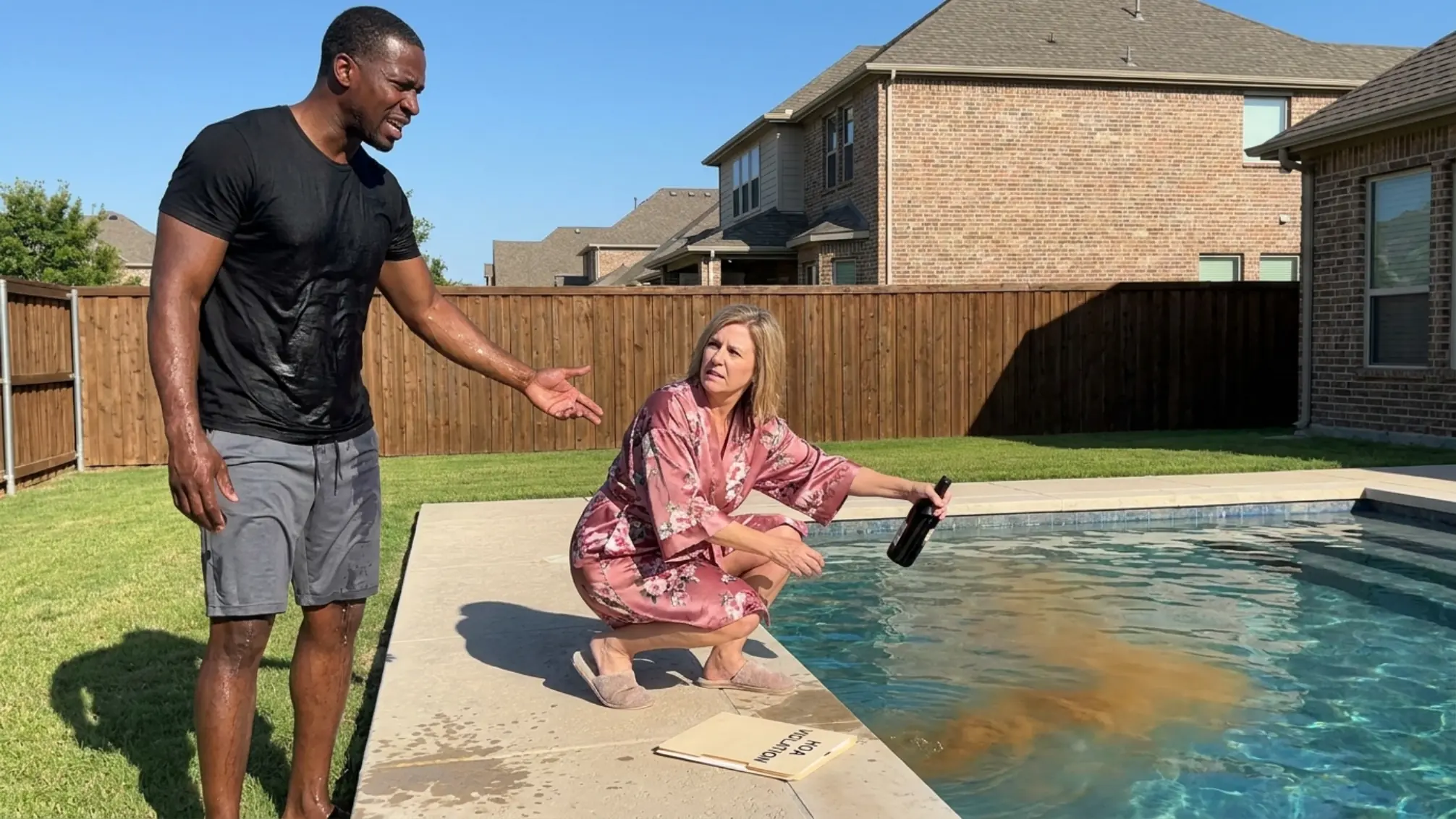
Marcus ran outside.
Nia stood waist-deep in the water, rubbing both forearms until red streaks appeared beneath her fingers. Twelve-year-old Caleb had already climbed onto the concrete deck. His eyes were watering, and angry patches were spreading across his shoulders.
“Dad, something’s wrong,” he said. “It’s everywhere.”
Marcus stepped into the shallow end without removing his shirt. The water felt normal at first, cool against his legs, but within seconds a prickling sensation traveled across his skin.
“Out,” he ordered. “Both of you, now.”
He lifted Nia against his chest and carried her toward the house while Caleb followed, coughing and wiping his eyes. Marcus’s wife, Alana, rushed into the kitchen when she heard them.
“What happened?”
“I don’t know. Get them into the shower.”
Alana took one look at the redness spreading across Nia’s neck and stopped asking questions. She guided both children upstairs, telling them not to scratch while Marcus grabbed his phone and called their pediatrician.
The doctor instructed them to rinse with clean water, change clothes, and seek emergency care if the irritation worsened or affected their breathing.
Marcus ended the call and stared through the kitchen doors.
The pool water looked clear.
Nothing floated on the surface. The pump ran normally, and the filter control panel showed no warning. Marcus had checked the chlorine and pH that morning before allowing the children to swim.
Everything had been within the safe range.
Then he noticed movement near the rear corner of the yard.
A woman was crouched beside the far edge of the pool, partly hidden behind the raised flower bed. She wore a shiny rose-pink satin robe decorated with pale blossoms. Her short silver-brown hair was carefully styled despite the heat, and one bedroom slipper rested dangerously close to the water.
In her right hand was an uncapped dark bottle.
A brown stream poured from it into the pool.
For one stunned second, Marcus could not make sense of what he was seeing.
Then he recognized her.
Marlene Whitaker.
President of the Stonebridge Estates Homeowners Association.
Marcus pushed through the kitchen doors and crossed the backyard so quickly that Marlene barely had time to look up.
“What are you doing?”
She jerked the bottle upright.
Brown liquid ran down its side and dripped onto the concrete.
Marlene did not apologize. She did not appear frightened or ashamed. Instead, she lifted her chin as though Marcus had interrupted official business.
“Your family turned this yard into a public nuisance,” she said. “So I handled your little pool problem myself.”
Marcus stared at the bottle, then at the water.
“You poured that into my pool while my kids were in it?”
Marlene reached for a beige folder lying beside her knees. The top page carried the Stonebridge Estates logo and several typed violation notices.
“Maybe now you’ll learn this neighborhood has rules,” she said. “Even for people who think money buys them freedom.”
Marcus stepped closer.
Every muscle in his body wanted him to rip the bottle from her hand, but years of discipline held him still. His children were upstairs crying. This woman had entered his private yard and poured an unknown substance into water surrounding them.
“Put the bottle down,” he said.
“You don’t give me orders.”
“Drop it and pray my children are fine, because if one rash came from you, this backyard is where your power dies tonight.”
For the first time, uncertainty flickered across Marlene’s face.
It disappeared almost immediately.
She stood, smoothed the satin robe around her waist, and tucked the folder beneath one arm.
“You should be careful how you speak to an HOA officer.”
“You should be careful what you pour into a child’s pool.”
“It was an authorized treatment.”
“Authorized by whom?”
“The board.”
“Show me the vote.”
Marlene’s mouth tightened.
Marcus pointed toward the side gate. “You entered private property without permission.”
“The HOA has authority to inspect conditions that affect neighboring homes.”
“Not through a locked gate.”
“It wasn’t locked.”
“Yes, it was.”
Marlene glanced toward it.
That small movement told Marcus everything.
The gate’s lower latch had been loose for several weeks, but the top lock required a key from inside the yard. Someone entering from the alley would have needed to reach over the fence with a tool or climb through a neighboring property.
Marcus extended his hand.
“Give me the bottle.”
“No.”
“I need to know what touched my children.”
“It’s standard pool treatment.”
“Then hand it over.”
Marlene stepped backward.
Marcus noticed that the original label had been partly covered with blue painter’s tape. A handwritten word—corrective—appeared across the front.
“You don’t even know what that is,” he said.
“I know exactly what it is.”
“Then why cover the label?”
Her eyes moved toward the house.
Nia’s crying could still be heard faintly through the open doors.
Marlene’s expression changed, but not with compassion. She looked irritated that the children’s distress might complicate the story she intended to tell.
“You’ve been warned repeatedly about excessive use of this pool,” she said. “Late-night noise. Unauthorized guests. Water splashing over the fence.”
“My children swam at four in the afternoon.”
“Your parties disrupt the entire street.”
“We had my mother’s birthday dinner.”
“There were twenty-three cars.”
“There were eleven.”
“Your music could be heard from the sidewalk.”
“At six-thirty on a Saturday.”
Marlene lifted the folder.
“These are documented violations.”
Marcus recognized the papers. Over the previous six months, she had sent seventeen notices.
A basketball hoop placed two inches too close to the curb.
A trash container visible for forty minutes after collection.
A child’s bicycle left beside the garage.
Music supposedly audible from the sidewalk, though Marcus’s security recording captured only conversation.
The Reed family had lived in Stonebridge Estates for three years. Marcus was a commercial architect, Alana was a pharmacist, and they had purchased their home without debt after Marcus sold his partnership stake in a design firm.
During the first year, the neighborhood welcomed them.
Then Marlene became HOA president.
The violations began almost immediately.
Marcus initially assumed she treated everyone with the same rigid obsession. But he gradually noticed that his white neighbors received friendly reminders while his family received formal fines.
When children from three houses played basketball in the street, only Caleb’s parents were cited.
When several homeowners placed holiday decorations outside the approved dates, only the Reeds received an enforcement letter.
When Marcus questioned the pattern at a board meeting, Marlene accused him of attempting to intimidate volunteers.
He requested copies of enforcement records.
The HOA refused.
He then contacted an attorney.
Two weeks later, the pool complaints began.
Marlene stared at him now as though every disputed fine had led naturally to this moment.
“You challenged my authority,” she said. “You embarrassed the board.”
“I asked you to follow your own rules.”
“You implied discrimination.”
“I showed fourteen examples of unequal enforcement.”
“You twisted routine decisions into something ugly.”
Marcus looked at the dark bottle.
“No, Marlene. You made them ugly.”
Her hand tightened around it.
The side gate opened behind them.
Alana stepped into the yard holding her phone. Her face was composed, but fear burned beneath it.
“The doctor wants us at urgent care,” she said. “Caleb’s eyes are swelling.”
Marlene’s confidence faltered.
Alana looked at the bottle.
“What is that?”
“Mrs. Whitaker says it’s an authorized pool treatment.”
Alana turned toward her. “You added chemicals while my children were swimming?”
“They should not have been using the pool.”
“It’s our pool.”
“Your husband ignored repeated compliance demands.”
Alana took one step forward. “My children are not enforcement tools.”
Marlene backed toward the gate.
“I have nothing more to discuss.”
“You’re not leaving with that bottle,” Marcus said.
She pulled out her phone. “Are you threatening to detain me?”
“I’m preserving evidence.”
“You have no right to touch my property.”
“You brought it into mine.”
Marlene’s thumb moved across the screen.
Marcus knew exactly what she was doing.
“You’re calling the police?”
“Yes.”
“Good.”
That answer surprised her.
Marcus continued, “Tell them you entered a locked backyard and poured an unknown chemical into a pool occupied by two children.”
Marlene lowered the phone.
For the first time, she seemed to understand that her title could not transform what happened into HOA business.
Alana took the children to urgent care while Marcus remained at the house. He called emergency services himself, explaining the suspected chemical exposure and unauthorized entry.
Within minutes, firefighters and paramedics arrived.
They closed access to the backyard, photographed the bottle, and collected water samples. A police officer placed the container inside an evidence bag after recording the partly obscured label.
Marlene attempted to leave through the side gate.
An officer stopped her.
“Ma’am, we need your statement.”
“I’m president of the homeowners association.”
“That isn’t what I asked.”
“I had authority to inspect.”
“Did you have authority to pour that substance into the water?”
Marlene looked toward Marcus.
“It was necessary corrective treatment.”
“Were children in the pool?”
“I did not see them.”
Marcus pointed toward the security camera mounted beneath the patio roof.
“The camera saw everything.”
Marlene’s face lost its color.
The officer followed Marcus inside to review the footage.
The recording began twenty-two minutes before Nia screamed. It showed Marlene entering through the side gate after using a metal garden hook to pull the upper latch from outside.
She carried the beige folder and two bottles inside a canvas shopping bag.
For several minutes, she remained behind the flower bed, watching the children swim. Then, while Marcus went inside and Alana answered a call upstairs, Marlene approached the pool.
She looked directly at Nia and Caleb.
There was no possibility she had failed to see them.
The footage showed her walking beside the pool and pouring liquid near the return jets, where the circulation system would distribute it rapidly through the water.
Nia swam less than twelve feet away.
Marlene then moved behind the flower bed and emptied part of a second container.
The officer paused the video.
“She watched them before she poured it.”
Marcus said nothing.
If he spoke, anger would take control of his voice.
The officer replayed the footage, then requested a digital copy. When they returned outside, Marlene was speaking rapidly to another officer.
“The camera angle is misleading,” she said. “I believed the children had exited the water.”
“You looked directly at them,” Marcus replied.
“Do not speak to me.”
“You entered my yard.”
“You created a health hazard by neglecting your pool.”
“The morning test results are timestamped.”
“You could have falsified them.”
“And you could have called the health department.”
Marlene folded her arms. “I acted to protect the neighborhood.”
The firefighter supervising the water samples looked up.
“From what?”
She hesitated.
“Mosquitoes. Odor. Contamination.”
The firefighter examined the clear water.
“Did you test it?”
“I relied on visual observation.”
“From outside a six-foot fence?”
Marlene stopped answering.
The officers did not arrest her immediately. The substance had to be identified, the children’s condition documented, and investigators needed to determine whether her actions met the legal standard for criminal charges.
But they confiscated the bottles and warned her not to contact the Reed family or return to their property.
Marlene left in her satin robe, walking past three neighbors who had gathered near the driveway.
By nightfall, rumors spread through Stonebridge Estates.
Marlene posted a message on the community website claiming that the HOA had attempted an emergency intervention after receiving reports of unsafe pool conditions. She accused an unnamed homeowner of obstructing volunteers and creating a hostile environment.
She did not mention the children.
She did not mention the locked gate.
She did not mention the security footage.
Marcus’s attorney, Dana Cole, advised him not to respond publicly.
“Let evidence speak first,” she said.
At urgent care, the physician diagnosed Caleb and Nia with chemical irritation affecting their skin and eyes. Neither child had suffered permanent injury, but Caleb required medicated eye drops, while Nia received treatment for a painful rash across her arms and neck.
Alana also developed irritation after helping them shower.
Marcus’s symptoms were milder because he had entered the pool only briefly.
The children returned home exhausted and frightened.
Nia refused to walk near the backyard windows.
“Is the water going to hurt us again?” she asked.
“No,” Marcus promised. “Nobody will touch that pool until professionals say it’s safe.”
“Why did that lady do it?”
He struggled to answer.
“Because she made a terrible choice.”
“Does she hate us?”
Alana sat beside their daughter.
“What she feels is her responsibility. What happens next is ours.”
The laboratory report arrived two days later.
The bottle contained a concentrated pool algaecide combined with an acidic tile-cleaning solution not intended to be poured directly into occupied water. The mixture caused the irritation documented by the doctors.
Investigators could not determine whether Marlene understood the full medical risk, but the covered label, secret entry, and decision to act while children were present made her explanation increasingly difficult to believe.
Then Marcus’s attorney obtained the HOA’s internal emails.
One message from Marlene to the property manager was sent three days before the incident.
If the Reeds continue using the pool after the next warning, I’ll create a condition the county cannot ignore.
Another read:
Once their backyard becomes a documented hazard, we can begin emergency lien proceedings.
The property manager replied that the HOA lacked authority to enter private property or alter a homeowner’s pool.
Marlene responded:
Authority belongs to whoever is willing to use it.
Dana placed printed copies across Marcus’s dining table.
“She wasn’t trying to correct the water,” the attorney said. “She was trying to manufacture a violation.”
Alana stared at the emails.
“She wanted the pool declared unsafe.”
“And possibly the property,” Dana replied. “The HOA’s attorney warned her against this. She acted anyway.”
“Why our house?” Marcus asked.
Dana turned to another page.
Marlene had been negotiating privately with a developer interested in purchasing several Stonebridge properties along the eastern boundary. The Reed home occupied the largest lot and blocked the most profitable access route.
Marcus had rejected two purchase offers.
The second came from a company partly owned by Marlene’s brother.
The HOA fines, pool complaints, and manufactured hazard were not merely personal prejudice or obsession with control.
They were pressure.
If the Reeds accumulated unpaid penalties, the board could attempt to place a lien on their property. Even an unsuccessful action might frighten them into selling.
Marcus leaned back slowly.
“She poisoned my children’s pool to force us out.”
Dana’s expression hardened. “That is what the evidence suggests.”
The emergency HOA meeting was held the following evening in the Stonebridge clubhouse.
More than one hundred residents attended.
Marlene arrived wearing a pale-pink business suit, carrying the same confident posture she had used for years. She sat at the front table between two board members and announced that the meeting concerned misinformation damaging the community’s reputation.
Marcus and Alana entered with Dana.
The room became silent.
Marlene tapped her microphone.
“Mr. Reed, this is a board session. Homeowner comments will occur later.”
Dana placed a folder on the table.
“This is also formal notice of pending civil action.”
Marlene’s smile stiffened.
“You cannot hijack an association meeting.”
Dana looked toward the remaining directors. “Your insurer has already been notified. I recommend that every board member avoid making statements before reviewing the evidence.”
One director leaned toward Marlene.
“What evidence?”
She attempted to continue the agenda.
Residents refused.
A neighbor named Thomas Keller stood from the second row.
“Did you enter their yard?”
Marlene adjusted her microphone. “I conducted an emergency inspection.”
“Did the board authorize it?”
“The president may act when immediate conditions threaten public welfare.”
A board member shook his head.
“We never voted on that.”
Another woman rose.
“Did you pour something into the pool while those children were swimming?”
Marlene’s voice sharpened.
“The video has been manipulated.”
Marcus connected his laptop to the clubhouse screen.
He played the recording.
Nobody spoke while Marlene entered through the gate, watched the children, and emptied the bottles near the circulating jets.
When the footage ended, the room erupted.
Parents shouted.
Board members moved away from Marlene.
The property manager stood and announced that she had warned the president not to enter the property.
Marlene struck the table with her palm.
“They were violating health standards.”
Marcus stepped toward the front.
“Show them the test.”
“What?”
“The test proving the water was unsafe before you entered.”
She had none.
“Show them the emergency report.”
Silence.
“Show them the board authorization.”
Marlene looked around at the faces that once accepted her authority without question.
Marcus continued, “You didn’t discover a violation. You created one.”
The treasurer opened a binder.
“I move to remove Marlene Whitaker as president immediately.”
A second board member supported the motion.
The vote was unanimous.
Marlene stood.
“You cannot do this.”
“We just did,” the treasurer said.
“You’ll destroy this neighborhood.”
“No,” Marcus replied. “We’re stopping you from destroying another family.”
Police officers waited outside the clubhouse.
The laboratory findings, medical records, security footage, emails, and evidence of unlawful entry had given prosecutors enough to act. Marlene was arrested on charges connected to trespass, evidence tampering, child endangerment, and deliberate contamination of private property.
Her expression remained defiant until an officer placed the handcuffs around her wrists.
Then she saw dozens of residents watching.
Not one defended her.
The investigation continued for months.
It uncovered years of selective enforcement, undisclosed conflicts, altered meeting records, and improper fines. Several families received refunds. The HOA dismissed its management company and adopted rules requiring recorded votes, transparent enforcement data, and independent review of discrimination complaints.
Marlene eventually accepted a plea agreement rather than face trial. She received a custodial sentence, probation afterward, and a permanent prohibition against serving on community boards or managing residential property.
Her brother’s development company abandoned its attempt to purchase the eastern lots.
The Reed family’s civil case resulted in compensation covering medical treatment, pool replacement, security upgrades, legal fees, and damages for the emotional harm caused to the children.
Marcus refused to keep the settlement confidential.
“Silence protected her,” he told the board. “Transparency protects everyone else.”
The pool had to be drained, professionally cleaned, inspected, and refilled.
Even after experts declared it safe, Nia would not enter.
Marcus did not force her.
One warm Saturday, nearly four months after the incident, he sat beside the shallow end with his feet in the water. Alana joined him. Caleb floated nearby, pretending not to watch his sister standing beneath the patio.
Marcus held out one hand.
“You don’t have to swim.”
Nia approached cautiously.
“Can I just sit?”
“For as long as you need.”
She sat between her parents and lowered one foot into the water.
Nothing happened.
Then the other.
After several minutes, Caleb splashed himself accidentally and apologized so dramatically that Nia laughed.
It was the first time the backyard sounded normal again.
A year later, Marcus was elected to the HOA board—not as president, but as chair of a new homeowner-rights committee.
He accepted only after securing one condition.
Every enforcement action had to be documented, reviewable, and applied equally.
No private entry.
No secret fines.
No authority without accountability.
The rose-pink woman who once treated the neighborhood like her personal kingdom had believed a title allowed her to cross a locked gate, punish children, and manufacture fear.
She was wrong.
The Reeds did not leave Stonebridge Estates.
They stayed.
They repaired the yard, reopened the pool, and held another birthday dinner for Marcus’s mother. This time, nearly half the neighborhood attended.
Music played softly beneath the patio lights. Children swam until sunset. Cars lined the street, and nobody counted them.
Near the pool gate, Marcus installed a small brass plaque.
It carried no mention of Marlene.
Only six words:
A HOME IS NOT A THREAT.
His children deserved to remember the backyard not as the place where someone tried to drive them out, but as the place their family refused to surrender.
The night of the party, Nia climbed onto Marcus’s back and ordered him to jump into the pool.
He pretended to resist.
She laughed and tightened her arms around his shoulders.
Marcus leaped.
They struck the water together, sending a bright wave across the deck.
For one instant, everything disappeared beneath the surface—the fines, the threats, the chemical bottles, and the woman who believed she could decide who belonged.
Then Marcus rose with his daughter still holding on.
She was laughing.
And this time, the water was safe.