The first thing Ethan Mercer heard that Saturday morning was the crunch of heavy boots outside his locked gate. He had been sitting on the porch of his mountain cabin with a metal mug of coffee, watching fog lift from the pine-covered ridge, when three battered pickup trucks rolled across the narrow road and stopped in front of his driveway. Six thickset men climbed out wearing black polo shirts, dark cargo pants, mirrored sunglasses, and cheap plastic badges stamped with the words HOA SECURITY. Then the woman responsible for the entire performance stepped from a white luxury SUV.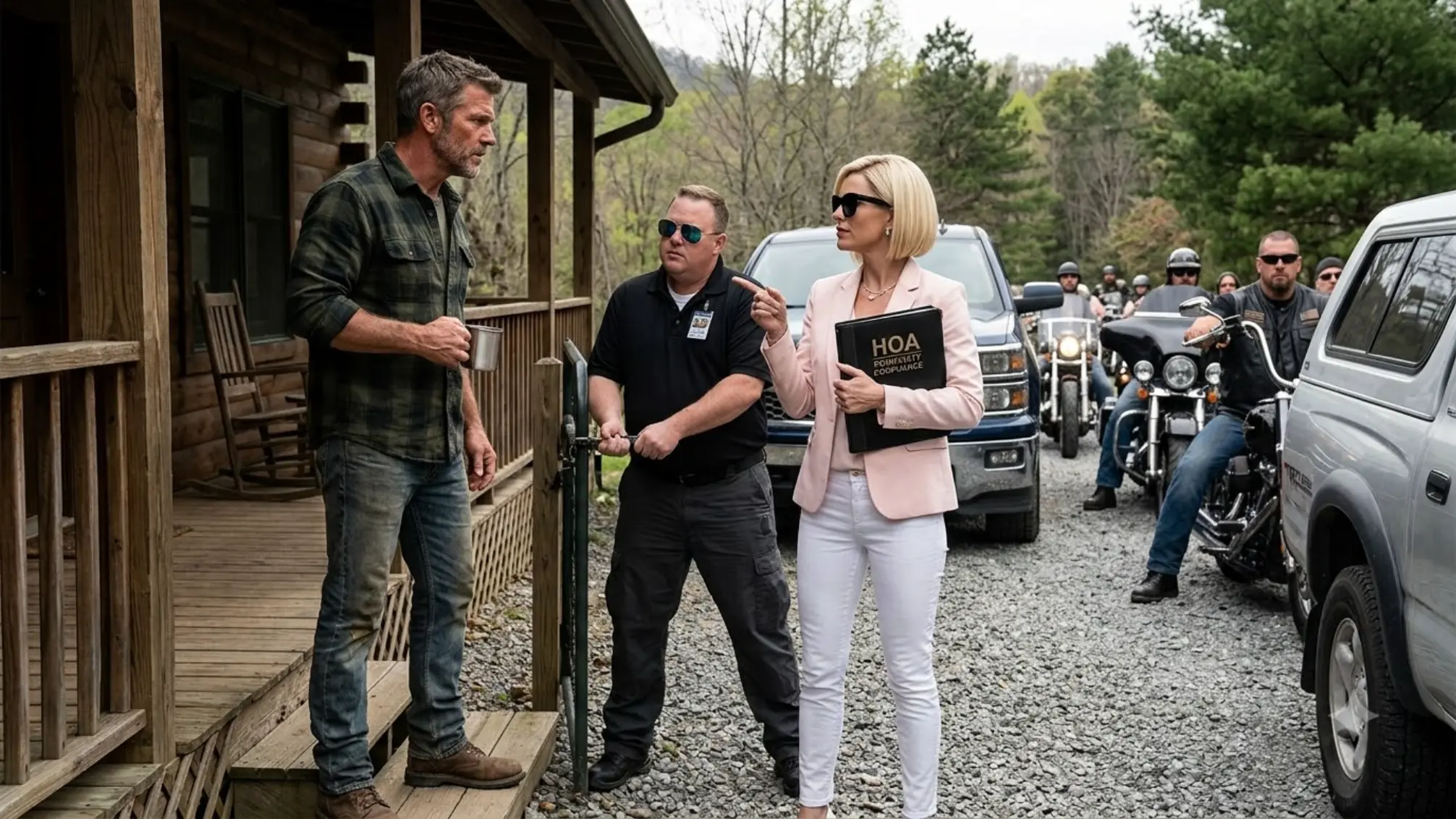
Karen Whitmore crossed the gravel in slim white pants, a white top, and a fitted pale-pink blazer. Her blonde bob rested perfectly above the collar, oversized black sunglasses covered half her face, and a large black binder marked HOA COMMUNITY COMPLIANCE was clutched against her chest. She walked with the stiff confidence of someone who believed carrying paperwork made every lie inside it official. One of the men reached Ethan’s iron gate, wrapped both hands around the bars, and shook them violently.
“Open it,” Karen ordered. “My security team is taking this cabin.”
Ethan slowly placed his coffee mug on the porch railing. “Break that lock. I dare you.”
The largest man leaned toward the gate. He was in his mid-forties, heavy through the shoulders, with a shaved head and a crooked badge clipped beneath the embroidered HOA logo. “We don’t need your permission, old man.”
Ethan stepped down from the porch. “Too late. My Army cousins just arrived.”
The men glanced toward the empty mountain road and laughed. Karen did too, although hers sounded sharper and less confident.
There were no motorcycles yet.
Not close enough for them to hear.
But Ethan knew they were coming.
His cousins Jake and Daniel had texted fifteen minutes earlier to say they were bringing breakfast supplies from town. What Karen and her hired men did not know was that the cousins rarely traveled alone. Both were American Army veterans, both belonged to a riding group made up of former service members, firefighters, mechanics, and ranchers, and both had spent the previous evening at a gathering less than ten miles from Ethan’s cabin.
Karen believed she had arrived with overwhelming force.
Ethan only needed to keep her talking.
The cabin stood on forty-two acres of private mountain land outside Asheville, North Carolina. Ethan had purchased the property four years earlier after leaving a stressful construction-management career in Charlotte. The place had been nearly abandoned when he found it—a collapsing porch, leaking roof, stone chimney clogged with years of soot, and a barn so unstable that even raccoons seemed nervous inside it.
He repaired it himself.
He replaced the roof with cedar shingles, reinforced the foundation, rebuilt the barn, cleared fallen trees, and restored the narrow bridge crossing the creek. The work took three years, countless weekends, and most of his savings, but the result belonged entirely to him. His deed described every boundary clearly, including the gravel approach, the creek bank, the southern pine grove, and the ridge overlooking the valley.
The nearest planned community began almost a mile away.
Pinecrest Heights consisted of oversized homes built around an artificial lake, a clubhouse, tennis courts, and decorative stone entrances. Karen had become president of its homeowners association two years earlier. Within months, she expanded the board’s rules from ordinary maintenance standards into an instrument for controlling nearly every visible detail of residents’ lives.
Trash bins could remain outside for no more than twenty minutes after collection.
Porch furniture required approval.
Vehicles older than ten years could not remain visible from the street.
Children’s bicycles had to be stored behind closed garage doors.
Karen fined one retired teacher because her autumn wreath stayed on the door three days after Thanksgiving. She threatened another family because their visiting daughter parked a camper in the driveway overnight. Residents complained privately but rarely challenged her publicly.
Then Karen noticed Ethan’s cabin.
The property was outside Pinecrest Heights and had never belonged to its HOA. That fact should have ended the matter. Instead, it became an insult Karen could not tolerate.
His gravel road connected to the same county route used by Pinecrest residents. His pine trees were visible from three homes near the edge of the community. His old green pickup occasionally passed the clubhouse. To Karen, proximity became permission.
Her first letter accused Ethan of keeping unapproved firewood beside the cabin.
He mailed back a copy of his deed.
The second demanded six months of HOA dues.
He returned it unopened.
The third warned that his unpainted fence reduced property values.
Ethan used it to start the wood stove.
Karen then began appearing in person. She photographed his truck from the county road, measured the distance between his mailbox and the shoulder, and claimed the smoke from his chimney violated Pinecrest’s clean-air standards. Ethan remained calm through every encounter because he assumed boredom would eventually defeat her.
Instead, his refusal became personal.
“You’ve ignored twelve written notices,” Karen shouted from outside the gate that morning. “This is your final opportunity to cooperate.”
Ethan stopped several feet from the bars. “Your notices have no authority here.”
“The HOA expanded its community zone last year.”
“An HOA cannot vote my land into its boundaries.”
“Our attorney disagrees.”
“Then your attorney should read property law before charging you.”
One of the fake security men chuckled.
Karen spun toward him. “Is something funny?”
The man immediately straightened.
She opened the black binder and removed several pages. “This cabin violates exterior-design standards, occupancy restrictions, noise regulations, firewood-storage rules, parking requirements, and community safety provisions.”
“I’m not in your community.”
“You benefit from our roads.”
“The county maintains the road.”
“You benefit from our property values.”
“I was here before half those houses were built.”
Karen thrust a page through the bars. “This is an official boundary map.”
Ethan accepted it.
The map showed Pinecrest Heights outlined in blue ink. Someone had extended the boundary across the county road, up the mountain, and around his cabin. The altered section was visibly different from the original document. Lot numbers stopped at the community entrance, scale markings did not match, and Ethan’s forty-two acres were labeled FUTURE RECREATIONAL RESERVE.
He folded the page once.
Then again.
Karen’s mouth tightened. “Be careful with that.”
Ethan pushed the folded paper between the gate bars. “You made this on a computer.”
“It was prepared by a licensed consultant.”
“Name him.”
“That information is confidential.”
“License number?”
“You’re being deliberately difficult.”
“No. I’m giving you chances to stop lying.”
The heavyset security leader rattled the gate again. “Watch how you speak to her.”
Ethan looked at the plastic badge. “What company employs you?”
“Pinecrest Community Security.”
“State license?”
The man said nothing.
“Insurance?”
His jaw flexed.
“Authority to detain, search, enter property, or enforce civil bylaws?”
Karen stepped between them. “They answer to me.”
“That is the problem.”
She slammed the binder against the bars. “Open the gate now, or they will remove it.”
Ethan moved closer until only the iron separated them. His voice dropped.
“If any man cuts that lock or crosses this boundary, I will pursue criminal trespass, property damage, intimidation, and impersonation charges against every person here.”
The leader smiled. “You think saying legal words makes you dangerous?”
“No. Cameras make you accountable.”
He pointed toward the cabin.
A security camera was mounted beneath the roofline. Another watched the gate from a pine tree, and a third sat inside a weatherproof box near the barn. Small red lights showed that each was recording.
The fake officers began looking at one another.
Karen did not.
“Turn them off,” she demanded.
Ethan almost laughed. “You came onto my road with six men and now you’re worried about privacy?”
“This is an official enforcement action.”
“Then you should want a complete record.”
She turned toward the security leader. “Cut the chain.”
The man reached into his truck bed and pulled out a long pair of bolt cutters.
The mood shifted immediately.
Until then, Ethan had treated the confrontation as ridiculous theater. The cheap badges, fabricated map, and Karen’s designer clothes made the scene seem almost comedic. But the moment steel jaws opened around his lock, the performance became a real attempt to force entry.
Ethan’s cousins were still not visible.
He reached into his pocket and touched his phone.
Recording.
Emergency call ready.
Karen saw the movement. “Don’t threaten us.”
“I haven’t threatened anyone.”
“You’re reaching for something.”
“My phone.”
“Hand it over.”
Ethan stared at her. “You truly believe you can order me to surrender my phone on my property?”
“I believe you’re creating a hostile environment.”
“You brought six men.”
“They are security professionals.”
“One of them has bolt cutters on my gate.”
Karen lifted her chin. “Because you refused lawful access.”
Ethan addressed the man holding the tool. “What is your name?”
The man paused.
“Don’t answer him,” Karen said.
“You should answer,” Ethan replied. “It will save investigators time.”
The man removed the cutters from the chain but did not step away.
Karen’s anger sharpened. “You think your little cameras frighten me? We’ll have this cabin condemned, seize the land through unpaid assessments, and recover every legal expense from you.”
“You cannot assess property outside the association.”
“We already have.”
Ethan’s face became still. “What did you say?”
Karen pulled another paper from the binder. “Your balance is now thirty-eight thousand, four hundred dollars, including late fees, enforcement expenses, and emergency security costs.”
“Security costs for the men standing here?”
“Yes.”
“You hired people to trespass, then billed me for it.”
“You forced us to act.”
That sentence mattered.
Ethan had received threatening notices, but none previously confirmed that Karen knowingly hired the men to pressure him. Now her statement existed on three cameras and his phone.
He nodded slowly. “Say the amount again.”
Karen smiled, believing he had finally become concerned. “Thirty-eight thousand, four hundred dollars. If you fail to pay within ten days, we’ll initiate foreclosure.”
The men behind her began looking less comfortable.
One scratched his neck.
Another drifted toward his truck.
The leader lowered the bolt cutters.
Karen noticed. “Why did you stop?”
“He said cameras.”
“We knew about cameras.”
“You said this was HOA land.”
“It is.”
“He has a locked private gate and deed signs.”
“He’s bluffing.”
Ethan pointed to a weathered wooden sign attached to the post:
PRIVATE PROPERTY
NO TRESPASSING
MERCER RIDGE
The security leader read it twice.
“You said he was an illegal squatter,” he told Karen.
“He is.”
“This place has his name on it.”
“He made the sign.”
“The county parcel website has his name too,” another man said quietly.
Karen whirled. “Why were you checking county records?”
“Because you told us to remove someone from a cabin.”
“You’re being paid to follow orders.”
The first faint rumble passed over the ridge.
Ethan heard it before anyone else.
The sound was low, distant, and steady, almost like thunder trapped beneath the ground. He glanced toward the road and smiled.
Karen caught the expression. “What?”
“Nothing.”
The rumble grew.
One of the men turned toward the trees. “Storm coming?”
The sky was clear.
Ethan folded his arms. “Not a storm.”
Jake and Daniel appeared first.
Their black Harley-Davidson motorcycles rolled over the crest side by side, chrome flashing beneath the morning sun. Jake was six feet four, broad across the shoulders, with a dark beard and black leather vest over a gray shirt. Daniel was shorter but heavier, his shaved head visible beneath an open-face helmet and his arms covered with old tattoos.
Behind them came ten more riders.
They descended the mountain in disciplined formation, engines rolling through the valley like controlled thunder. Some wore veteran patches, others fire-department emblems, union insignia, or simple riding-club colors. They were not a gang, militia, or enforcement unit.
They were family and friends arriving for breakfast.
But to Karen’s fake security team, they looked like consequence riding downhill.
The man with the bolt cutters dropped them into the truck bed.
Karen stepped into the middle of the road and raised both hands. “Stop those motorcycles! This is a restricted HOA enforcement area!”
No one heard her over the engines.
The riders slowed before the blocked driveway. Jake removed his sunglasses and looked at the pickup trucks positioned across the road. Daniel turned off his engine, planted one boot on the gravel, and stared at Karen’s security group.
The other motorcycles stopped behind them.
Silence returned so suddenly that the ticking engines sounded loud.
Jake looked toward Ethan. “Morning, cousin.”
“You’re late.”
“We brought eggs.”
Daniel nodded at Karen. “Did she bring breakfast too?”
Karen pushed forward. “These men are interfering with an authorized HOA operation.”
Jake looked at her pale-pink blazer, black binder, and oversized sunglasses. Then he examined the fake badges.
“What operation?”
“We are removing an illegal occupant.”
Jake looked at Ethan’s cabin. “That illegal occupant rebuilt this place with his own hands.”
“Ownership is under dispute.”
Daniel dismounted. “By whom?”
“The Pinecrest HOA.”
“You mean the neighborhood down the mountain?”
Karen’s voice sharpened. “Yes.”
Daniel pointed toward the distant rooftops barely visible through the trees. “The neighborhood that starts over there?”
“The community zone has expanded.”
“Did the land move?”
Several riders laughed.
Karen’s face flushed. “This is not a joke.”
Jake crossed toward the gate but remained on the public side. His calmness carried more weight than shouting would have.
“Ethan, are these people invited?”
“No.”
“Do they have a warrant?”
“No.”
“Court order?”
“No.”
“Law-enforcement authority?”
The security leader looked down.
“No,” Ethan said.
Jake faced the men. “Then why are you blocking his driveway?”
The leader attempted to recover his confidence. “Private security business.”
“For which licensed company?”
Silence.
Daniel picked up the discarded bolt cutters and examined them. “And this?”
The man reached for them.
Daniel placed the tool on the ground between them. “Don’t.”
No threat.
No raised voice.
Just one word delivered with enough certainty that the man stopped moving.
Karen stepped closer to Jake. “Your size does not intimidate me.”
Jake looked down at her. “Good. Then you can listen without being distracted.”
“I’ll have all of you fined for noise violations.”
Daniel laughed. “By an HOA none of us joined?”
“You’re disturbing community peace.”
“You arrived with trucks and men carrying tools to break a private gate.”
“That is enforcement.”
“That is trespassing with matching shirts.”
The riders laughed again.
Karen turned desperately toward the security leader. “Open the gate now.”
He shook his head.
Her mouth fell open. “Excuse me?”
“We weren’t told the property was outside the HOA.”
“I told you it was under disputed jurisdiction.”
“You said the county approved removal.”
“It did.”
“Show me.”
Karen gripped the binder.
The man waited.
She produced nothing.
“Show me the court order,” he repeated.
“You work for me.”
“Not anymore.”
Karen’s confidence cracked.
She pointed toward Ethan. “He owes thirty-eight thousand dollars.”
The leader stared at her. “You said he broke into an HOA cabin.”
“He occupies land the association intends to control.”
“That is not the same thing.”
The man climbed into his truck.
Karen grabbed the door handle. “Get out.”
He pulled it shut.
Another fake officer was already moving toward the second pickup. Two others hurried after him. Karen shouted that they were fired, sued, and permanently blacklisted from Pinecrest, but her threats only accelerated their retreat.
Jake stepped away from the road.
The first truck reversed, turned sharply, and rolled downhill.
Then the second followed.
The third driver hesitated until Daniel looked toward the bolt cutters. He threw the vehicle into gear and left so quickly that gravel struck Karen’s white SUV.
Within less than a minute, her entire security force had fled.
Karen stood alone outside Ethan’s gate.
Her blonde hair had come loose around her face. Dust marked the knees of her white pants, and the black binder no longer resembled a weapon. The riders remained beside their motorcycles without surrounding her or blocking her vehicle.
No one touched her.
No one needed to.
Ethan walked to the gate and unlocked it from inside. He opened it just far enough to retrieve the bolt cutters, then closed it again.
Karen pointed a shaking finger at him. “This is intimidation.”
“You brought the men.”
“You called armed bikers.”
“They were already coming for breakfast.”
“They are threatening me.”
Jake spread his hands. “I haven’t said one threatening word.”
Daniel added, “We asked why your hired men had tools on private property.”
Karen looked toward the cameras and seemed to remember them again.
Her tone changed.
“I came here peacefully to discuss compliance.”
Ethan almost admired the speed of the transformation.
“You arrived with three trucks blocking my driveway.”
“That was a parking misunderstanding.”
“You ordered men to break my lock.”
“I requested lawful entry.”
“You threatened foreclosure over invented debt.”
“The financial matter remains under review.”
“You called me an illegal occupant.”
“I may have received inaccurate information.”
“You fabricated a boundary map.”
Her mouth tightened.
Ethan removed the folded map from his pocket and held it up.
“County property records will show who created this.”
Karen reached for it through the gate.
He pulled it back.
“That belongs to the HOA.”
“It was handed to me.”
“You cannot keep confidential documents.”
“It is evidence.”
Her face changed.
“For what?”
“Attempted trespass, coercion, fraud, impersonation, unlawful debt collection, and whatever else the county attorney identifies after watching the footage.”
Karen laughed, but no confidence remained in it. “You think the sheriff cares about neighborhood disagreements?”
Ethan lifted his phone.
“The sheriff’s deputy I called twenty minutes ago seemed interested.”
A siren sounded faintly below the ridge.
Karen turned toward her SUV.
Daniel stepped aside immediately, leaving the road open.
“No one is stopping you,” he said. “But the cameras already know where you were.”
She hurried toward the vehicle, heels slipping in the gravel. Before climbing inside, she looked back at Ethan.
“This is not over.”
Ethan leaned against the gate.
“For you, I think it’s starting.”
Karen drove away moments before the sheriff’s vehicle arrived, but she did not escape the consequences. Deputies collected the fake map, video recordings, threatening letters, and information identifying the hired security men. The men cooperated quickly, admitting Karen told them the county had approved removal of a dangerous squatter from HOA-owned property.
No such approval existed.
The investigation found that Karen had created false assessments against Ethan’s cabin and recorded them internally as receivables. She planned to use the invented debt to support a fraudulent lien, hoping the legal pressure would force him to sell the land cheaply to a developer connected to the HOA treasurer.
Ethan’s acreage controlled the easiest access to a proposed luxury overlook.
That was why Karen refused to accept that the cabin stood outside her authority.
The HOA board removed her within two weeks.
State regulators opened a financial audit, while residents came forward with additional complaints about fabricated fines, hidden vendor payments, and coercive collection practices. The security company dissolved after investigators discovered it was not licensed to perform enforcement work.
Karen eventually faced criminal fraud and attempted property-theft charges, along with civil lawsuits from Ethan and several Pinecrest homeowners.
Months later, Ethan framed one document above his fireplace.
It was not the fabricated property map.
It was Karen’s four-thousand-dollar noise citation issued after the motorcycles arrived. She claimed the Harleys had disturbed the “approved mountain atmosphere.”
Jake read it during another visit and laughed until he nearly spilled his coffee.
Daniel looked around the cabin. “Worth it.”
Outside, twelve motorcycles waited beside the barn.
Not as weapons.
Not as an army.
Just machines belonging to people who refused to let family stand alone.
Ethan stepped onto the porch and looked across the quiet ridge. The pines moved gently in the wind, the creek continued beneath the bridge, and no black trucks blocked the road.
Karen believed power came from arriving with more people, louder threats, official-looking paperwork, and men willing to shake a gate.
She learned that morning that borrowed intimidation collapsed the moment anyone asked for proof.
Her security team fled when Ethan’s Army cousins arrived on Harleys.
But the motorcycles were not what defeated her.
The deed, the cameras, the witnesses, and her own recorded words did that.
The thunder over the mountain only made sure she finally stood still long enough to hear it.