When eighteen-year-old Leo noticed a black SUV circling the local playground for the fifth time, he knew something was wrong.
Not wrong in the ordinary way city things were wrong.
Not a driver lost near the park.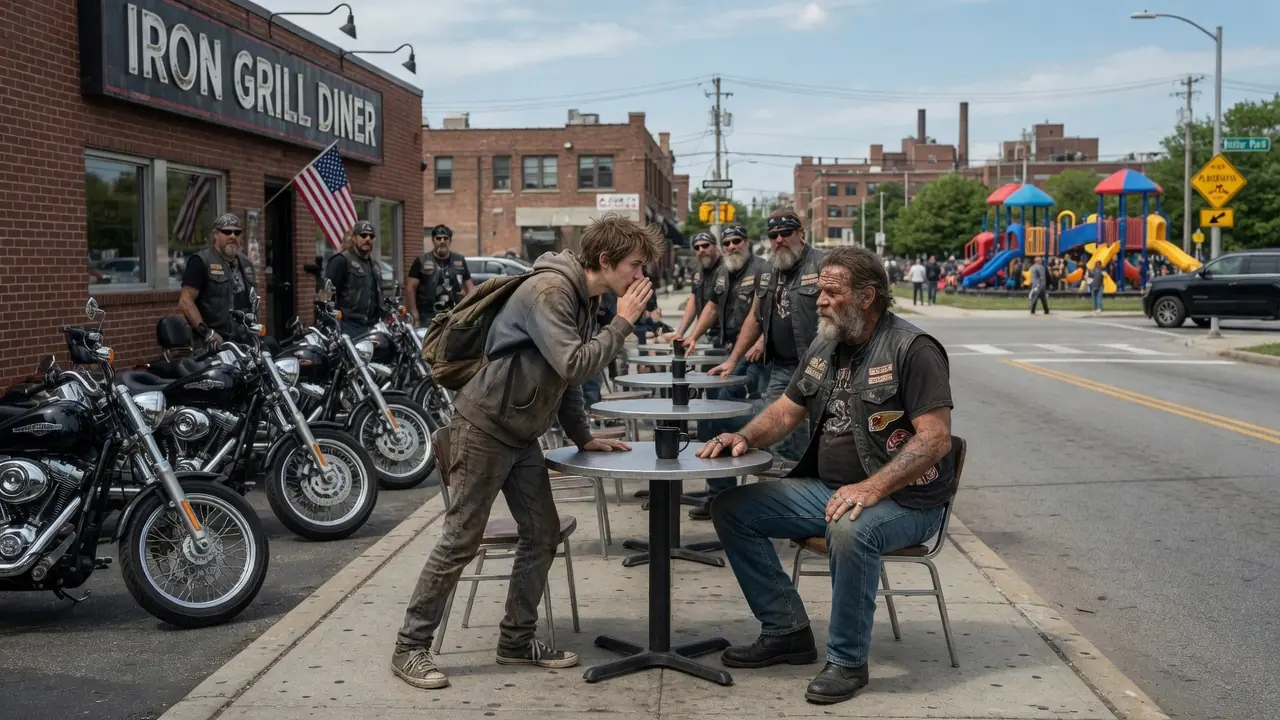
Not a parent waiting too long at the curb.
Not some delivery guy looking for an address.
This was different.
The SUV moved too slowly.
It never parked.
It never honked.
It never seemed to belong to anyone.
It circled Miller Park with the same patient hunger Leo had seen before in men who waited for a weak moment, for a distracted adult, for a child to drift a few steps too far from safety.
The black Suburban rolled past the swings again, its windows so dark they reflected the hot afternoon light like polished stone. It had no real license plates, only a dealership tag that looked fake even from across the street. The front bumper was dented. The left brake light flickered. A pale shape moved behind the steering wheel, but Leo could not see the driver’s face.
He sat up on the weathered park bench where he spent most afternoons and tightened his grip on the strap of his backpack.
Across the playground, a five-year-old boy in a yellow shirt chased a red ball near the fence.
His mother sat on another bench, one hand holding a stroller, the other scrolling on her phone.
The SUV slowed.
Leo’s stomach turned cold.
He knew that feeling.
He had spent the last two years living on the edges of the city, sleeping behind laundromats, under church awnings, in bus stations when security looked the other way. Before that, he had spent years in foster homes that ranged from kind but temporary to cold and dangerous. He had learned to read rooms, cars, voices, and footsteps. He had learned that safety often depended on noticing a thing before anyone else did.
And the black SUV was not there by accident.
Leo stood.
He looked toward the street.
An hour earlier, a patrol car had rolled past the park. Leo had stepped into view, waving both arms, trying to get the officer’s attention. The officer had slowed only long enough to crack the window.
“Not today, kid,” the officer had said. “Move your gear off the bench, or I’m writing you up for loitering.”
“There’s a car circling the playground,” Leo had tried to explain.
The officer had looked past him, not at him.
“Everybody sees things when they’ve been sleeping outside too long. Move along.”
Then the cruiser had rolled away.
Leo had stood there in the heat with his mouth still open, watching the black SUV turn the corner for the fourth time.
That was the thing about being invisible.
People didn’t just fail to see you.
They failed to believe what you saw.
Now the SUV was back.
For the fifth time.
Leo looked across the street.
Parked in a perfect gleaming row outside the Iron Grill Diner were twenty Harley-Davidsons.
Their chrome flashed under the sun. Their black paint carried dust from long roads. Their engines were quiet for the moment, but even still they seemed to hold thunder inside them.
At the outdoor tables, a group of men in leather vests ate burgers, drank coffee, laughed too loudly, and leaned back in their chairs like they had no intention of apologizing for taking up space.
The local Hells Angels chapter.
Most people crossed the street when they saw them.
Parents lowered their voices.
Shop owners watched their windows.
Police cruisers slowed.
The bikers wore the kind of reputations that entered rooms before they did.
But Leo had been watching them for months.
He had seen what other people missed.
He had seen Big Mike, a man the size of a refrigerator, carry grocery bags for Mrs. Alvarez after she slipped on the curb.
He had seen T-Bone, whose shaved head and scarred knuckles scared grown men, kneel beside a crying boy and fix the chain on his bicycle without asking for a dime.
He had seen Jax, the chapter president, leave folded cash under the flower basket of an old woman who sold roses at the corner.
He had also seen them break up a mugging behind the diner one rainy night without calling the police, without making speeches, without asking to be thanked.
They were not saints.
Leo knew that.
But they had a code.
And Miller Park was part of their territory.
Leo looked back at the playground.
The black SUV had nearly stopped by the entrance now.
The little boy in the yellow shirt had wandered toward the ball.
His mother still had not looked up.
Leo moved before fear could talk him out of it.
He grabbed his backpack, crossed the street, and walked straight toward the outdoor tables of the Iron Grill Diner.
The bikers went quiet as he approached.
Twenty pairs of eyes turned on him.
Hard eyes.
Road eyes.
Eyes that had seen weakness and violence and lies and could separate all three from ten feet away.
Leo felt his throat tighten.
He was used to being ignored, chased away, laughed at, stepped around.
He was not used to being examined.
The man at the center table looked up.
Jax.
He had a gray-streaked beard, thick forearms, and eyes that looked as if they had been carved from flint. His leather vest was worn but cared for. A silver ring shaped like an eagle’s head sat heavy on one hand.
“You lost, son?” Jax asked.
His voice was a low rumble, like an idling engine.
Leo did not ask for change.
He did not ask for food.
He leaned toward the table, his voice sharp and urgent.
“That car is watching the kids.”
The sentence cut through the air.
Jax did not move.
Leo swallowed and forced himself to keep talking.
“Black Suburban. No plates. This is the fifth time it circled the playground. It slows down every time it passes the little kids. I tried telling the cops, but they won’t listen to me.”
One of the bikers turned in his chair.
Another looked toward the park.
Jax kept his eyes on Leo.
“You sure?”
Leo pointed without looking away.
“I know every car that parks around Miller. I know which parents drive what. I know delivery vans, maintenance trucks, rideshare cars, patrol routes. That one doesn’t belong. It’s hunting.”
The word changed everything.
Jax turned toward the park.
At that exact moment, the black Suburban appeared at the far corner again, tires moving slowly over the gravel near the entrance. It rolled past the swings and slowed near the boy in the yellow shirt, who had wandered several feet away from his mother to chase the red ball.
Jax stood.
He did not push back his chair.
He did not finish his coffee.
He did not ask for a second opinion.
He simply stood, and as if moved by one collective soul, the other nineteen men stood with him.
The scraping of chairs on pavement sounded like a declaration.
“Big Mike,” Jax said, not taking his eyes off the SUV. “North exit.”
Big Mike was already moving.
“T-Bone. South side.”
T-Bone nodded once.
“The rest of you, perimeter. No panic. No kids scared if we can help it. Nobody touches the driver unless we have to. We see what’s behind that tint.”
Leo stood frozen for half a second.
Then twenty engines came to life.
The roar rolled through the street and shook the windows of the diner. Birds scattered from the trees. Parents looked up. Children paused on the swings.
The peaceful Saturday afternoon changed shape in less than thirty seconds.
The bikers did not rush wildly.
They moved with frightening order.
Big Mike’s massive touring bike swung across the north exit, blocking the narrow road. T-Bone and three others cut off the south end. Six bikers rode slowly along the curb, creating a wall between the playground and the street. The rest moved into positions that left the black SUV boxed in by chrome, leather, and steel.
The driver realized too late that he had been spotted.
The Suburban accelerated toward the exit, then braked hard when Big Mike’s motorcycle blocked the way.
T-Bone pulled in behind it.
The vehicle was trapped.
The engine idled roughly.
For one long moment, no one moved.
Then Jax walked toward the driver’s side window.
He did not pull a weapon.
He did not need one.
The sheer weight of twenty bikers surrounding the SUV was enough to make the air feel heavy.
Jax knocked on the glass with a silver-ringed fist.
“Roll it down.”
The window lowered two inches.
A man’s voice, high and nervous, came from inside.
“I haven’t done anything. You’re harassing me. I’ll call the police.”
“The police didn’t want to talk to our friend Leo,” Jax said, gesturing toward the young man standing on the curb with his backpack hanging from one shoulder. “But we’re real good listeners.”
Jax leaned closer.
“Why are you circling the kids?”
“I’m looking for an address.”
“Five times around the same playground isn’t an address,” Big Mike growled from the front of the SUV. “That’s a pattern.”
“I said I’m lost.”
Jax’s face did not change.
“Then you won’t mind waiting here while someone helps you get found.”
By now, parents had begun gathering their children. A woman scooped up the boy in the yellow shirt and pulled him tight against her chest. The boy clutched the red ball, confused and frightened by the sudden wall of motorcycles.
Jax turned his head slightly.
“Mike, call Sergeant Ramos at the Fourth.”
Big Mike pulled out his phone.
“Tell him we’ve got a vehicle matching a concern at Miller Park,” Jax said. “Tell him to send units now. And tell him if he takes his sweet time, he can explain to every parent here why a homeless kid did his job before he did.”
The man inside the SUV swore under his breath.
Leo heard it.
He also saw something shift in the back seat.
A shadow.
A shape.
He stepped closer before anyone could stop him.
“There’s something in the back,” he said.
Jax’s eyes sharpened.
“Driver,” Jax said, voice calm in a way that made it more dangerous, “hands where I can see them.”
“I told you, I haven’t done anything.”
“Then you should have no problem waiting.”
The sirens came three minutes later.
Three minutes can feel like nothing on an ordinary day.
At Miller Park, those three minutes felt like a whole lifetime.
Parents stood with children pulled close.
Bikers held their positions.
Leo watched the SUV without blinking.
The driver kept one hand on the wheel and one hand near his lap until Jax told him twice, more sharply the second time, to put both hands on the dash.
When the first patrol car turned onto the block, Leo felt a strange twist of fear.
Not relief.
Fear.
Police lights did not usually mean help to him. They meant move along, empty your pockets, where did you get that backpack, stop sleeping here, stop standing there, stop existing where people with homes might see you.
Two officers stepped out.
Then Sergeant Ramos arrived in a second car.
He was a stocky man in his fifties with tired eyes and a mustache going gray at the edges. Leo recognized him as the same officer who had dismissed him earlier.
Ramos looked at the bikers, then the SUV, then Jax.
“What is this?”
Jax pointed to Leo.
“Ask him.”
Ramos glanced at Leo with the reflexive impatience of a man who thought he already knew the category.
Then he saw the parents.
The motorcycles.
The blocked exits.
The driver sweating behind the wheel.
Something in his face changed.
Leo forced himself to speak.
“That SUV circled the park five times. No real plates. It slowed down near the kids every time. I tried telling you earlier.”
Ramos looked at him.
Recognition flickered.
Then shame.
“Open the vehicle,” Ramos ordered.
The driver began protesting immediately.
His voice rose.
He claimed harassment.
He claimed discrimination.
He claimed he had rights.
Ramos listened for ten seconds, then turned to his officers.
“Check the vehicle.”
What they found turned the afternoon silent.
Binoculars on the passenger seat.
A handwritten map of three playgrounds.
Several children’s toys still in packaging.
A roll of duct tape.
Zip ties.
A second set of fake dealership tags.
No one spoke.
Not the parents.
Not the bikers.
Not the police.
The driver’s face crumpled.
“I didn’t do anything,” he repeated, but now the words sounded less like innocence and more like panic.
Ramos cuffed him himself.
As the man was led toward the patrol car, Leo stepped back, suddenly dizzy.
He looked at the playground.
The boy in the yellow shirt was crying against his mother’s shoulder.
A little girl on the swings stared at the bikers with wide eyes.
The red ball rolled slowly across the grass until it came to rest near Leo’s shoe.
If he had ignored the SUV, if he had accepted being dismissed, if he had sat back down on his bench and told himself nobody would listen anyway, one of those children might have disappeared.
The thought made his stomach twist.
Jax came to stand beside him.
“You did good,” he said.
Leo looked down.
“I almost didn’t.”
“But you did.”
Sergeant Ramos approached.
For a moment, Leo expected trouble. Some accusation. Some warning. Some reminder that he still had no right to sleep on public benches.
Instead, Ramos stopped a few feet away and removed his sunglasses.
“You were right,” he said.
Leo said nothing.
Ramos looked toward the patrol car.
“We’ve had alerts about a vehicle matching this description in three neighboring counties. I should have listened when you tried to tell me.”
“Yes,” Leo said quietly. “You should have.”
The honesty landed harder than anger.
Ramos nodded once.
“You did good, kid.”
Jax stepped beside Leo, one heavy hand resting on the young man’s shoulder.
“He did more than good. He saved children because he was watching when everyone else was looking through him.”
Ramos did not argue.
The parents began coming over one by one.
The mother of the boy in the yellow shirt cried as she thanked Leo. Another father shook his hand with both of his. Someone tried to give him money, but Leo shook his head, overwhelmed and suddenly unable to meet anyone’s eyes.
He had spent years wanting people to see him.
Now that they did, it felt almost too bright.
When the SUV was towed and the crowd began to thin, Leo looked toward his bench.
His backpack still sat beneath it.
His blanket was rolled under the seat.
The cardboard sign he used only on the worst days was tucked behind the trash can.
That bench had been his address, his bedroom, his lookout post, his place of waiting.
Jax followed his gaze.
“No,” Jax said.
Leo looked at him.
“No what?”
“That bench is retired.”
Leo frowned.
“I don’t—”
“You’re coming with us.”
Leo almost laughed because it sounded impossible.
“With you?”
Jax nodded toward the motorcycles.
“We’ve got a clubhouse with a spare room above the garage. It smells like oil, old leather, and bad decisions, but it has a bed. You’ve got eyes this neighborhood needs. And if someone wants to come looking for the kid who spotted that SUV, they can find him behind a locked gate with twenty brothers around him.”
Leo stared at him.
“I’m not one of you.”
Jax’s expression softened, though his voice stayed rough.
“Not yet. Maybe not ever. That’s not the point.”
“What is the point?”
Jax looked toward the playground.
“You watched over kids who weren’t yours because somebody needed to. That makes you family enough for tonight.”
Leo did not know what to do with that.
Family had always been a word other people had.
A word on school forms.
A word social workers used while moving him from one placement to another.
A word foster parents said before reminding him not to get too comfortable.
He looked at the bikers.
Then at the playground.
Then at the bench.
For the first time in years, the bench looked less like shelter and more like surrender.
He picked up his backpack and followed Jax.
The Hells Angels clubhouse sat behind a fenced lot near the river, not far from a strip of auto shops, storage buildings, and old brick warehouses. From the outside, it looked like exactly the kind of place parents warned children not to approach. Black gate. Security lights. Motorcycles lined in rows. A weathered sign with no welcome on it.
Inside, it was warmer than Leo expected.
There was a main room with scarred wooden tables, old couches, a pool table with one torn corner, and walls covered in photos of rides, memorials, charity events, and men who looked terrifying until you noticed half of them were holding babies, dogs, or plates of barbecue.
A woman named Grace ran the kitchen with the authority of a general. She took one look at Leo, clicked her tongue, and made him sit down.
“You eat?” she asked.
Leo hesitated.
“Today?”
“That answers it.”
She placed a plate in front of him fifteen minutes later. Meatloaf, mashed potatoes, green beans, and a slice of bread thick enough to count as a structural object.
He ate slowly at first, out of habit.
Then hunger took over.
No one commented.
That night, Leo slept in a real bed.
The room was small, above the garage, with a slanted ceiling, one window, and a dresser missing two handles. It smelled faintly of motor oil, cedar wood, and clean sheets. A fan turned slowly in the corner.
For the first time in three years, Leo did not sleep with one eye open.
He woke once around 2:00 a.m., startled by the silence.
No footsteps under bridges.
No rats in trash.
No drunk men arguing near his blanket.
No police flashlight in his face.
Only the distant murmur of voices downstairs and the steady knowledge that there were people between him and the street.
By Monday morning, the peace had cracked.
Leo came downstairs and found the clubhouse atmosphere changed.
The laughter was gone.
Jax sat at a long table with Big Mike, T-Bone, Grace, and a thin biker everyone called Static because he handled cameras, radios, and anything with wires. Several printed photos were spread across the table. Grainy images from security cameras. A dark sedan passing the clubhouse twice. A blue van parked too long down the block. A man near the gate pretending to check his phone while taking pictures.
Jax looked up when Leo entered.
“Come here, kid.”
Leo approached slowly, coffee mug in hand.
His body knew danger before anyone explained it.
Jax tapped one of the photos.
“You recognize any of these?”
Leo looked.
The blue van.
His throat tightened.
“I’ve seen that van.”
Every eye at the table turned to him.
“Where?” Jax asked.
“Industrial district. Near Pier 19. Sometimes under the viaduct by the old cold storage building. They switch plates there.”
Big Mike swore under his breath.
Leo pointed at another photo.
“That sedan too. It was parked near Miller Park two weeks ago. Not on the playground side. By the bus shelter.”
Static leaned forward.
“You sure?”
Leo gave him a look.
“I remember cars. It’s how I stayed alive.”
No one questioned him again.
Jax sat back.
“The man from the SUV had connections. Sergeant Ramos called me this morning. They searched his phone. He wasn’t acting alone.”
Leo’s fingers tightened around the mug.
“A ring?”
Jax did not answer immediately.
That was answer enough.
Grace pulled out a chair.
“Sit down before your knees give out.”
Leo sat.
Jax’s voice softened, but it carried the weight of leadership.
“You did a brave thing. But brave things have consequences. The people behind that SUV know someone spotted their man before he could do what he came to do. They know your face is in the news, even if they haven’t printed your name. They may come looking.”
Leo looked toward the window.
“Then I should leave.”
“No,” Big Mike said immediately.
“If I stay, I put you all in danger.”
T-Bone gave him a look of disbelief.
“Kid, danger has been sending us Christmas cards for thirty years.”
Jax leaned forward.
“You don’t run because bad people noticed you. That teaches them noticing works. We protect our own.”
Leo looked down.
“I’m not your own.”
Grace spoke from the kitchen doorway.
“You slept upstairs. You ate my meatloaf. Don’t argue technicalities in my kitchen.”
For some reason, that nearly broke him.
He looked away fast.
Jax pretended not to notice.
“We’re not handling this alone,” Jax said. “Ramos is bringing in county investigators. Maybe federal people if the evidence goes where he thinks it goes. What we can do is help them see what you saw. Routes. Vehicles. Patterns. Places other people ignore.”
Leo looked at the photos again.
He had spent years being invisible in alleys, parking lots, bus shelters, loading docks, and abandoned buildings. He knew where vans idled at night. He knew which warehouses had fake security and which had real guards. He knew where men waited and where children should not walk alone.
For years, that knowledge had only kept him alive.
Now it might save someone else.
“I can map it,” Leo said quietly.
Static slid a notebook toward him.
“Then map it.”
For the next several hours, Leo built the city from memory.
Not the city of tourist brochures, skyline photos, and lakefront trails.
His city.
The underpass behind the freight yard.
The broken fence near Pier 19.
The loading dock where trucks arrived before dawn.
The alley where license plates were swapped.
The corner where a white van had parked three Fridays in a row.
Static entered everything into a digital map, but Leo’s memory was faster than the screen.
He remembered dents.
Brake lights.
Bumper stickers.
Times of day.
Weather.
Patterns.
By midafternoon, Sergeant Ramos arrived with two detectives.
He did not come in with attitude.
He came in holding a folder, his face serious.
Jax met him near the door.
“No grandstanding in my house,” Jax said.
“No arrests in mine without warrants,” Ramos replied automatically.
Then he looked at Leo.
“Can we talk?”
Leo sat across from him at the table.
For once, the officer spoke to him like a witness, not a nuisance.
Ramos opened the folder and showed him photos carefully, one by one. Leo identified two vehicles, one intersection, and a warehouse gate he had passed dozens of times while looking for places to sleep out of the wind.
The detectives exchanged looks.
One of them said, “That matches the tip we got from the neighboring county.”
Ramos exhaled slowly.
“Leo, this may be bigger than the SUV.”
“I know,” Leo said.
“You understand that if you help us, we have to protect your identity as much as possible.”
Jax snorted.
“Now he gets protection.”
Ramos accepted the jab without defending himself.
“Yes,” he said. “Now he does.”
That night, Jax put two men on the roof, two at the gate, and one in the alley. Not because he wanted a fight, but because he wanted to avoid one. The club had contacts, history, and plenty of enemies, but even the wildest among them understood the difference between pride and protection.
Leo slept badly.
The bed was warm.
The door locked.
Still, his mind would not stop returning to the black SUV, to the toys in the back seat, to the little boy in the yellow shirt.
Around 3:00 a.m., he went downstairs.
Jax was awake at the table, cleaning his glasses with a cloth.
“You sleep?” Jax asked.
“Some.”
“That means no.”
Leo sat across from him.
“How many kids do you think they took?”
Jax’s face hardened with sadness.
“Too many.”
Leo swallowed.
“What if I had noticed sooner?”
“Don’t do that.”
“I saw the blue van before. Weeks ago.”
“You didn’t know what you were seeing.”
“I should have.”
Jax leaned forward.
“Listen to me. Predators depend on everyone blaming themselves except the people doing the harm. You saw what you saw when you understood it. Then you acted. That is the part that belongs to you.”
Leo looked down at his hands.
They were shaking.
“I keep thinking about the kid with the red ball.”
“So do I.”
“What if next time I don’t see it?”
Jax was quiet for a moment.
“Then we build a world where one eighteen-year-old kid doesn’t have to be the only eyes open.”
The investigation moved quietly for the next week.
Police increased patrols around parks, but this time the officers were instructed to speak with unhoused residents instead of pushing them away. Ramos himself came to Miller Park and apologized publicly to Leo, though Leo hated the attention and stood half behind Jax the entire time.
The apology mattered.
Not because it fixed everything.
Because other people heard it.
A city official might have ignored a homeless teenager.
A police sergeant admitting that teenager had been right changed the way people listened.
Parents began talking to Leo.
At first awkwardly.
Then sincerely.
Some brought food.
Some brought blankets.
Grace intercepted most of it and said, “He has a bed now, but the shelters still need supplies. Don’t make charity lazy.”
Leo began spending afternoons at Miller Park again, but no longer alone.
The Hells Angels started parking a few bikes near the diner every Saturday, not as a threat, but as a presence. Parents who once crossed the street now nodded to them. Children waved. Big Mike became a favorite among toddlers because he pretended every high five injured him.
Ramos and the detectives used Leo’s map to secure warrants. The details were not shared widely, and Leo was grateful. He had no desire to be turned into a headline again. What he knew was that several locations were searched, vehicles were seized, and men who had moved through the city like ghosts were suddenly dragged into light.
One cold morning, Ramos came to the clubhouse.
He asked for Leo privately, but Jax stayed nearby because Leo wanted him there.
“We found children,” Ramos said.
Leo stopped breathing for a second.
“Alive?”
“Yes.”
The word broke something open in the room.
Grace sat down hard in the nearest chair.
Big Mike turned away.
Jax closed his eyes.
Ramos’s voice thickened, but he kept it steady.
“Multiple children from open missing-person cases. Not all local. Some from neighboring states. Your vehicle identifications helped connect the movement pattern. We were able to act before they were moved again.”
Leo stared at the table.
Alive.
It was one word.
It weighed more than anything anyone had ever handed him.
Ramos continued.
“There will be more arrests. This will take time. But the ring is breaking.”
Leo nodded, though his mind seemed far away.
Ramos placed something on the table.
A small red ball.
“The mother from Miller Park asked me to give you this. Her son wanted you to have it. He said you stopped the bad car.”
Leo touched the ball with one finger.
Then pulled his hand away as if it hurt.
“I didn’t do it alone.”
“No,” Ramos said. “But you started it.”
The city eventually learned part of the story.
Not all of it.
Never all of it.
The news called Leo “the homeless teen whose sharp eye saved children.”
Leo hated that phrase.
Jax hated it too.
“He has a name,” Jax growled every time a reporter said it near him.
The city council wanted a ceremony.
Leo refused.
The mayor’s office offered a medal.
Leo refused that too.
“I don’t want a medal from people who step over kids like me on the way to work,” he told Jax.
Jax nodded.
“What do you want?”
Leo looked out the clubhouse window toward Miller Park.
“I don’t know.”
That was the most honest answer he had.
A month after the first arrest, the Hells Angels held their own ceremony in the private courtyard of the clubhouse.
No cameras.
No speeches from politicians.
No reporters looking for a clean quote.
Just the club, Grace, Carolyn from the diner, Sergeant Ramos, several parents from Miller Park, and a few kids who had been rescued before the ring could move them farther away.
Leo stood near the center of the courtyard, uncomfortable in a clean black hoodie Grace had insisted he wear.
Jax stepped forward holding a small envelope and a key ring.
“You’re not getting a patch,” Jax said.
A few bikers laughed.
Leo blinked.
“I didn’t ask for one.”
“Good, because you’re going to college, not prison.”
More laughter.
Leo’s face warmed.
Jax held up the key ring.
“These are for the apartment above the Iron Grill. It’s small. The radiator bangs like a drum. The hot water has opinions. But it’s yours. Rent covered for one year while you figure out the next thing.”
Leo stared at the keys.
He did not take them.
Jax continued, holding up the envelope.
“This is from the club and the parents. Full scholarship fund. Community college first if you want. University after if you want. Sociology, law, criminal justice, social work, whatever path you choose. The world needs eyes like yours, kid. It also needs your voice.”
Leo looked around the courtyard.
Big Mike was pretending not to cry.
T-Bone was failing to pretend.
Grace had already given up and was wiping both eyes with a dish towel.
Ramos stood quietly at the back, hat in his hands.
Leo’s throat closed.
“I don’t know how to be someone people invest in,” he said.
Grace stepped forward immediately.
“You learn.”
Jax placed the keys in Leo’s palm and closed his fingers around them.
“You saved those kids because you knew what it felt like to be invisible,” he said. “You turned pain into a shield. Don’t waste that. And don’t let anyone tell you that because you came from nowhere, you belong nowhere.”
Leo looked at the keys in his hand.
For most of his life, keys belonged to other people.
Case workers.
Foster parents.
Shelter staff.
Landlords who never knew his name.
Keys meant doors that could be locked against him.
Now, for the first time, a key meant a door that would open.
That night, Leo slept in the apartment above the Iron Grill.
The room was small, but it had a bed, a dresser, a table by the window, and a view of Miller Park across the street. The radiator did bang like a drum. The hot water did have opinions. The floor slanted slightly near the kitchen.
Leo loved every inch of it.
He placed the red ball from the little boy on the windowsill.
Beside it, he placed the keys.
Then he sat on the edge of the bed and listened to the sounds below.
The diner closing.
A truck passing.
Someone laughing on the sidewalk.
A motorcycle starting in the alley.
Life.
Not survival.
Life.
Months passed.
The trafficking ring case moved through courts slowly, as such things do. Arrests reached farther than anyone expected. A logistics manager. A private security contractor. A corrupt records clerk. Two men who had looked perfectly respectable in suits and photographs. The city was horrified in the way cities are horrified when forced to see what had been happening in their blind spots.
Ramos changed too.
Not overnight.
Not perfectly.
But visibly.
He created a neighborhood watch partnership that included shelter workers, food pantry volunteers, bus drivers, street vendors, and unhoused residents willing to share information without fear of being punished for existing. He pushed his officers to stop treating poverty like suspicious behavior.
Some resisted.
Ramos did not let them.
At the first training meeting, he held up Leo’s map.
“This,” he told the room, “was built by a young man most of us would have ignored. If that makes you uncomfortable, good. Sit with it.”
Leo did not attend that meeting.
He had homework.
He enrolled in community college in January.
His first semester nearly destroyed him.
Not because he was not smart.
Because no one had ever taught him how to be a student with a permanent address, a quiet room, a schedule, and a future. He missed deadlines at first. He panicked during tests. He wrote essays like police reports because feelings still felt unsafe on paper.
But he kept going.
Grace helped him fill out forms.
Static found him a used laptop.
Big Mike taught him how to change the oil in the ancient Honda Civic donated by a retired teacher from the neighborhood.
T-Bone showed up every Tuesday night to sit in the diner while Leo studied, claiming he liked the pie, though everyone knew he was making sure Leo did not quit.
Jax never hovered.
He simply asked one question every Sunday morning over coffee.
“You still moving forward?”
Some weeks, Leo said yes.
Some weeks, he said barely.
Jax accepted both.
“Barely still counts if you’re moving.”
A year after the day at Miller Park, the playground held a community picnic.
The city had installed better lighting, new cameras, and a redesigned entrance that made blind spots harder to exploit. Parents had formed a real volunteer rotation. The Iron Grill donated burgers. The Hells Angels parked their bikes along the curb, no longer as a warning, but as part of the neighborhood’s strange new normal.
Leo stood near the fence, watching children run across the grass.
The boy in the yellow shirt was there again, taller now, chasing the same red ball’s replacement because the original sat on Leo’s windowsill.
His mother came over with two paper plates.
“You should eat,” she said.
Leo smiled.
“Grace already fed me twice.”
“She told me to feed you a third time.”
“Sounds like her.”
The woman looked toward her son.
“He still talks about you.”
Leo shifted uncomfortably.
“I didn’t do much.”
She looked at him then, really looked.
“You noticed.”
The word landed softly.
You noticed.
For years, Leo’s entire life had been shaped by the pain of not being noticed.
Now that same ability, the one born from being ignored, had become the thing that saved people.
Jax came to stand beside him a few minutes later.
“You okay?” he asked.
Leo nodded.
“Yeah.”
“Too many people?”
“Always.”
Jax grinned faintly.
“You get used to it.”
“No, you don’t.”
“No,” Jax admitted. “You don’t.”
They stood together in comfortable silence.
Twenty Harleys gleamed along the curb.
Children laughed.
Parents talked.
Sergeant Ramos stood near the entrance speaking with a group of teenagers about a summer safety program.
The black SUV was gone.
The fear was not gone completely. Fear never disappears just because one danger is removed. But it no longer owned the park.
Leo looked at the playground and understood something he could not have understood from the bench.
He had not been a ghost.
He had been a witness waiting for someone to believe him.
And once someone did, everything changed.
Years later, people in the neighborhood still told the story.
They told it at the Iron Grill over coffee.
They told it on benches at Miller Park.
Parents told it to children when explaining why they should speak up if something felt wrong.
Some versions became exaggerated.
Twenty bikers became fifty.
The SUV became a convoy.
Leo became braver than he felt.
Jax always corrected that part.
“He was scared,” Jax would say. “Courage means he walked across the street anyway.”
Every Saturday morning, a row of Harleys still parked outside the Iron Grill.
And at the center table, with coffee in front of him and textbooks beside his elbow, sat Leo.
Not a ghost.
Not a problem to be moved along.
Not a kid with a backpack nobody wanted to hear.
A student.
A neighbor.
A guardian.
A young man with a name, an apartment key, a future, and a family that looked nothing like the ones he had once wished for but held him steady all the same.
Children waved to him from across the street.
Parents nodded.
Bikers saved him a seat.
And sometimes, when the afternoon light hit the park just right, Leo would remember the exact moment everything changed.
The black SUV circling.
The playground full of children.
The police car driving away.
The twenty motorcycles outside the diner.
His own feet crossing the street.
His voice, shaking but clear, whispering the five words that made dangerous men stand up and become protectors.
“That car is watching the kids.”
Those words saved lives.
But they also saved Leo.
Because from that day forward, the city could no longer pretend it did not see him.
And Leo, who had spent years surviving by watching from the edges, finally stepped into the world not as someone waiting to be rescued, but as someone who had become the reason others were safe.
He had found his pack.
The city had found its eyes.
And Miller Park, once watched by predators from the shadows, was now watched by people who had learned the most important lesson of all.
The forgotten are not blind.
Sometimes, they are the only ones truly seeing.