Could life get any better than this?
That was the foolish question floating through my mind as I stretched across the king-size bed of a five-star hotel suite in the state capital, one arm resting lazily above my head, one foot brushing against the cool cotton sheet.
The room smelled of expensive soap, room service, perfume, and the faint scent of rain outside the tall windows. The city lights glittered below me. Somewhere far beneath, cars moved like little sparks through the wet streets, carrying ordinary people home to ordinary lives.
I was not thinking about ordinary lives.
I was thinking about power.
About attention.
About the way people looked at me now when I walked into Parliament House.
I glanced at the clock on the bedside table.
8:56 p.m.
Almost time.
I yawned and turned onto my side. It had been a long day, though not the kind of long day that earns sympathy. A limousine had collected me before dawn for a seven o’clock flight to the capital. Another car had taken me from the airport to Parliament House. I had attended a Shadow Cabinet meeting where I was not important enough to speak freely, but important enough to sit in the room. I had smiled at journalists in the hallway, accepted compliments from men who used to ignore me, and watched younger staffers step aside when I passed.
After that, I had been whisked back to the hotel for a quick meal with Mike Harding.
Mike.
Deputy Opposition Leader.
Chief Whip.
Former Australian Rules football hero.
Television commentator.
Used car king.
Political survivor.
My mentor.
My sponsor.
My lover.
He was lying across the foot of the bed now, naked under the sheet, half asleep and pleased with himself in that heavy, satisfied way he had after he believed he had been impressive. A half-empty glass of whisky sat near his side of the bed. His tie was looped over a chair. His shirt lay crumpled on the carpet.
The sight should have embarrassed me.
It did not.
Not then.
At that point in my life, shame had become something I postponed.
I had learned to do that over the past four years. Put shame in a box. Close the lid. Open the laptop. Smile at my husband. Ask about the children. Pretend to be the woman I had once been.
The clock ticked to 8:57.
It was nearly time for my nightly call home.
The loving wife act.
That was what I privately called it, and even now, remembering those words makes me feel sick.
Every night when I traveled for politics, I called Dave. Sometimes by Zoom, sometimes by phone. In the beginning, the children joined in because my trips still felt new then. Dennis would wander into view pretending not to care, and Jenny would wave from behind her father’s shoulder while asking if the hotel had a pool.
But time changes routines.
Two years into the travel schedule, the kids were older and less interested. Dennis was seventeen, all long limbs, sarcasm, and silent judgment. Jenny was sixteen, clever, aloof, and already developing that teenage ability to make a mother feel unnecessary with one raised eyebrow.
Most nights now, it was just Dave.
My husband.
David Brown.
Successful businessman.
Loyal father.
Patient man.
The person I had underestimated more completely than anyone else in my life.
I should introduce myself properly.
My name is Camille Brown.
At the time of the story I am about to tell, I was forty-two years old, married to David Brown for almost twenty-two years, and the mother of two children who, until that night, still had some reason to believe their mother was merely ambitious, busy, and distracted rather than selfish, careless, and cruel.
I married young.
Too young, some people said at the time, though they said it with smiles because Dave was handsome, steady, and already building the kind of future that made parents relax. I was nineteen when I married him. He was twenty-four, working in construction supply and already talking about starting his own company.
He did.
And he succeeded.
Dave was not flashy. He was not the kind of man who needed applause. He built quietly. First a small equipment hire business. Then commercial contracts. Then property. Then a chain of logistics and building supply companies that made more money than I truly understood in those early years.
We had Dennis first.
Then Jenny.
I became a stay-at-home mother. Not because Dave demanded it. He never did. It was a choice we made together because he traveled for work and the children needed stability. I told myself I was happy. And for many years, maybe I was.
I packed lunches.
Organized school uniforms.
Hosted birthday parties.
Volunteered at fundraisers.
Learned which teacher preferred email and which preferred a face-to-face chat.
I knew every detail of our children’s lives, every allergy form, every sports fixture, every friend’s parent, every dentist appointment.
But somewhere around the time Jenny started high school, I began to feel invisible.
Invisible.
As if invisibility justifies betrayal.
Dave never treated me badly. That is the part that makes my excuses worse. He supported me when I said I wanted to study. He paid for my Certificate IV in public relations. He encouraged me when I was nervous about returning to work after years at home. When I got a job in the public relations department of the local hospital, he bought me a leather briefcase and left a card on the kitchen bench.
Proud of you. Go show them who you are.
At the time, I cried when I read it.
Later, I betrayed him with the man who helped me climb.
That man was Mike Harding.
I first met him after he was shot.
That sounds dramatic, and it was.
Mike had been leaving a bar one night when someone fired at him in the car park. He survived, though only just. No one was ever arrested. The police claimed to be investigating leads, but everyone knew the truth. Mike had collected enemies the way other men collected ties.
He had been a national football star in his younger days, a commentator after retirement, then a used car dealer who became rich enough to buy influence and charming enough to turn influence into votes. Twelve years earlier, he had won a seat in Parliament. His party formed government, and he became Minister for Sport, which surprised no one because it was the most obvious appointment in the country.
From there, he climbed.
He knew how to flatter, threaten, promise, and survive scandal. By the time I met him, he was already a force inside the party, famous enough for cameras and dangerous enough for enemies.
When he was brought into my hospital, I was the PR officer assigned to handle press updates.
I stood in front of cameras and said he was stable, recovering, grateful for public support, and eager to return to service.
Mike noticed me.
At first, that felt like luck.
He asked for me by name after a press briefing. Told me I had poise. Said I understood timing. Said I had “the kind of face voters trust and the kind of voice reporters listen to.”
I laughed because I thought he was being generous.
He was not generous.
He was recruiting.
First, he hired me into his campaign team.
Then he got me a senior communications position.
Then he encouraged me to stand for a local seat, and when I hesitated, he found donors, consultants, photographers, volunteers, and party insiders to make sure I could not easily fail.
Dave funded everything I needed at home.
Mike funded my rise in public.
That was the split I refused to see.
Dave made my life possible.
Mike made me feel powerful.
I won the seat.
My party did not win government, so I became a backbencher. But because Mike was Deputy Opposition Leader and Chief Whip, and because I was useful to him in more ways than one, I became his special assistant. That qualified me to attend Shadow Cabinet meetings, though I sat at the back, just close enough to feel included and just far enough to remember I still needed Mike.
Camille Brown, MP.
Special Assistant to the Deputy Opposition Leader.
Rising star.
Mother.
Wife.
Liar.
The affair began gradually, or so I told myself.
A late meeting.
A private drink.
A hand on my back.
A joke that stayed too long in the air.
A hotel room after a regional conference.
The first time, I told myself it was a mistake.
The second time, I told myself it was complicated.
By the tenth time, I had stopped naming it.
Four years.
That was how long we managed to hide it.
Four years of monthly trips.
Four years of adjoining rooms when possible.
Four years of careful hallway timing.
Four years of coded messages, deleted photos, private jokes, and lies spoken so often they began to sound like scheduling.
Four years of calling Dave from hotel rooms with Mike sitting silently out of camera range.
If that sounds impossible, it is not.
Affairs survive on arrogance more than cleverness.
We believed we were covering every base. We kept separate travel confirmations. We avoided public displays. We never appeared alone in restaurants unless others were nearby. Mike entered my room only late, left before dawn, and if anyone saw us in hallways, we had a political excuse ready.
We were not brilliant.
We were lucky.
And like most lucky fools, we mistook luck for skill.
At 8:59 p.m., I sat up and reached for my nightclothes.
Mike opened one eye.
“Time to call the husband?”
“Don’t start.”
He grinned.
He liked the risk. That was part of what excited him. He liked being powerful enough to take what was not his and arrogant enough to believe no one could stop him. He called Dave “the businessman” or worse things when he was drunk. I told him not to, but not strongly enough.
Because deep down, the insults fed something ugly in me too.
They made me feel chosen by a man other women wanted, a man with public status, a man who could move careers with a phone call. They made ordinary domestic loyalty look small, at least for a while.
That is the poison of vanity.
It teaches you to laugh at the people holding your life together.
I put on my nightclothes, adjusted the neckline slightly so I looked relaxed but still attractive, then pointed toward the chair near the desk.
“Sit there and be quiet.”
Mike sighed.
“Yes, Minister.”
“I am not a minister.”
“Not yet.”
That was another poison.
Not yet.
He knew exactly how to keep me close.
He got off the bed and moved to the chair, still far too casual for a man who had just spent the afternoon with another man’s wife. He made no effort to dress. I glared at him.
“Mike.”
“What?”
“Cover yourself.”
He grabbed a towel from the floor and draped it lazily over his lap.
“Happy?”
“No. Quiet.”
I opened my laptop and connected to Zoom.
For a moment, the screen showed my own face. Flushed, but composed. Hair brushed. Lips slightly pink. Nothing that looked like a woman standing in the ruins of her own decency.
Then Dave appeared.
He was sitting on the leather lounge in our rumpus room, laptop resting on his knees. Behind him, I could see the huge television mounted on the wall, the framed football jerseys Dennis loved, and the bookshelf where Jenny kept a few childhood trophies she pretended not to care about.
Home.
The sight gave me a strange little ache.
I mistook it for tenderness.
Now I know it was warning.
“Hey,” Dave said.
“Hi, darling.”
My voice slipped automatically into warmth.
That is one of the most unsettling things about deceit. The body learns the performance. The smile arrives on time. The eyes soften. The tone becomes intimate. You can lie so smoothly that you start to wonder whether some part of you believes it.
“You look tired,” Dave said.
“Long day.”
“Shadow Cabinet?”
“Yes. Hours of speeches by people who think speaking longer means thinking deeper.”
He smiled faintly.
“That sounds about right.”
We chatted comfortably for several minutes. He asked about the meetings. I asked about the kids. Dennis had gone out to a friend’s house, Dave said. Jenny was in her room, probably pretending homework required headphones and three devices.
“Are they eating properly?” I asked.
“You mean did I remember vegetables?”
“Did you?”
“I placed a green object near their plates.”
“Dave.”
“It was broccoli.”
I laughed.
For one strange second, the call felt normal.
Then Mike got bored.
He always got bored when attention was not on him.
At first, he simply made faces from the chair. Rolled his eyes. Pretended to snore. I ignored him. Then he stood and began moving exaggeratedly in my peripheral vision, mocking my loving-wife voice, pressing his hands together like he was praying.
I shot him a warning look while Dave was talking about a supplier issue at work.
Mike smirked.
That was the problem with men like him. A warning only made him more determined.
He began miming crude gestures, pointing at me, then at himself, then toward the floor. It was childish, obscene, and dangerous. I longed to snap at him to stop, but I kept my face composed because Dave was still on screen, talking, watching.
I thought I was managing it.
I thought the laptop camera showed only me.
I thought the room was ours.
Then Dave stopped mid-sentence.
His face changed.
Not confusion.
Not surprise.
Decision.
“Camille,” he said.
“Yes?”
“Camille, can you please ask Mike to stop that?”
The world disappeared for half a second.
Mike froze behind the laptop, caught in the middle of one of his stupid gestures.
My mind went numb.
Dave remained perfectly still.
“What are you talking about?” I asked.
My voice came out too high.
Then relief arrived, sudden and ridiculous.
Dave had always had a dry, mischievous sense of humor. He said things like “put that man down and come to lunch with me” whenever he called me at the office and heard a male voice nearby. Maybe this was one of those jokes. A lucky shot in the dark.
I tried to smile.
“No, dear. I’ve sent Mike and all the other men back to their rooms. The orgy is over for the night.”
Mike silently laughed behind the screen, delighted by the danger.
Dave did not smile.
That was the moment my blood turned cold.
He took a breath.
A slow one.
The kind a man takes when grief is trying to become anger.
“I wish I could say that was funny,” he said.
I swallowed.
“Dave, really?”
He did not answer me directly.
Instead, his arms moved toward the laptop, and the image on my screen tilted. The view swung away from his face and toward the enormous television on the wall behind him.
The television screen was split into two live views.
One showed the bed in my hotel room.
The other showed the area near the dressing table.
Both camera angles were high, looking down from near the ceiling.
I saw myself on one side of the screen, sitting on the hotel bed with my laptop open.
I saw Mike on the other side, standing exposed in the middle of the room, caught like an animal under a floodlight.
I gasped.
I could not stop myself.
My eyes shot upward toward the smoke detector in the ceiling.
That was my undoing.
The cameras were there.
Hidden in plain sight.
Watching everything.
Recording everything.
The screen seemed to pulse.
My heart was beating so hard I thought I might faint.
Mike moved toward me, still trying to stay out of the laptop camera’s view, then leaned around enough to see what was on my screen.
He saw himself.
He stopped breathing.
For once in his life, Mike Harding had nothing to say.
Dave, unfortunately for us, had plenty.
“Hi, Mike,” he said. “I must say, television is kinder to you than real life.”
Mike’s face went red.
Whether from being exposed, insulted, or finally understanding the scale of the trap, I did not know. His mouth opened, then closed.
Mine did the same.
Dave watched us both like a man who had already passed through the worst of the pain and arrived somewhere colder.
“Now do you believe me?” he said.
The question made no sense until he moved the laptop again.
The view swung back across the room at home.
This time, the screen showed more of the lounge.
Sitting beside Dave were my parents.
My father, Graham, sat rigidly upright, face dark with fury. His hands were clasped so tightly his knuckles had gone white. My mother, Patricia, had one hand pressed to her mouth. Her eyes were already full of tears.
Two words escaped me before I could stop them.
“Mum? Dad?”
My father shook his head slowly, not in anger at first, but disbelief. As if his mind refused to accept that the woman on the screen was his daughter.
My mother spoke in a voice I barely recognized.
“Oh, Camille. I thought we raised you better than this.”
Then she burst into tears and moved out of view.
Dad followed her, but before he disappeared, he looked directly at the screen.
“Your husband deserved better.”
The door closed somewhere in the background.
I sat frozen.
My parents’ marriage had been a second marriage for both of them. Family lore had always treated it as romantic. Two people who had survived betrayal, divorced unfaithful spouses, then found each other later in life and built something honest. My mother had once told me, “There is no loneliness worse than lying beside someone who is lying to you.”
And now she had watched me become exactly the kind of person she had escaped.
I could not look at the screen.
So I looked at Mike.
That was when I saw his mind begin working again.
His shock turned into calculation.
I knew him well enough to read the thoughts crossing his face.
Dave had known before tonight.
Dave had arranged cameras.
There might be recordings.
Recordings could destroy reputations.
Careers.
Marriages.
Power.
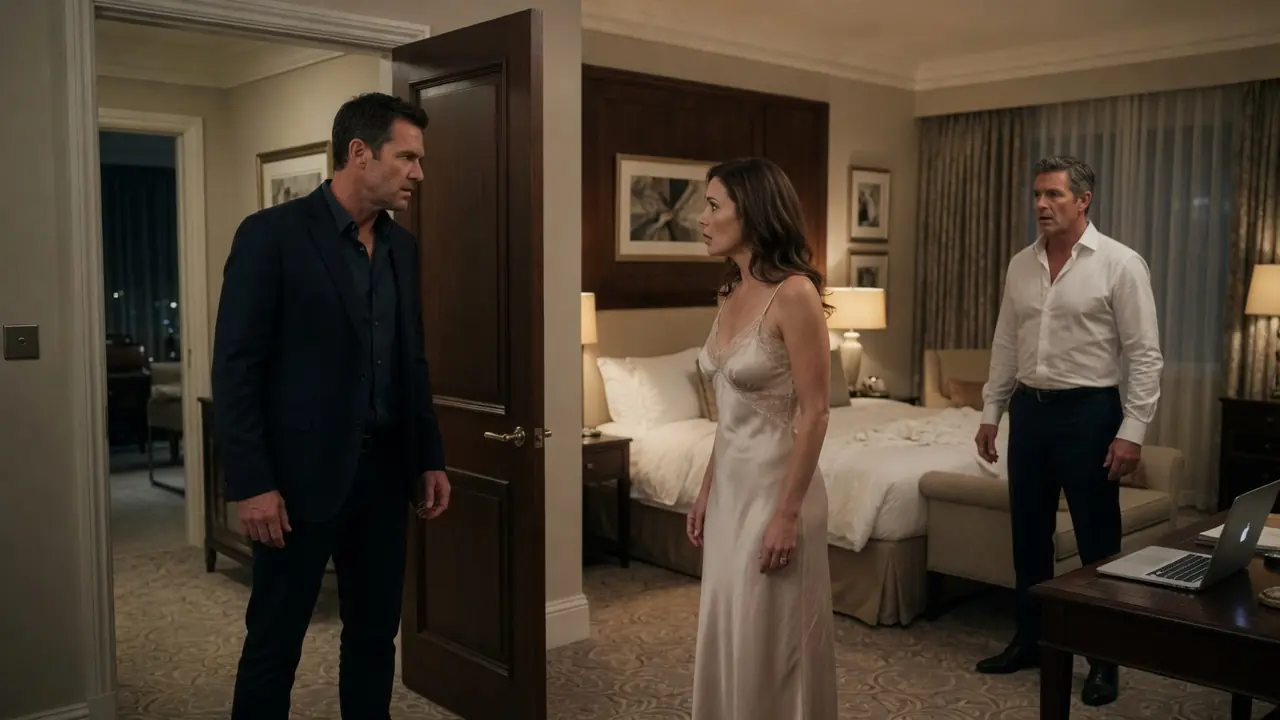
Mike grabbed a pillow from the bed, held it in front of himself, and sat beside me so he was finally visible on the laptop camera.
His voice came out low and hard.
“Now listen, Dave.”
Dave’s face appeared again on the screen.
Mike leaned closer.
“I’m sure you think you’ve been clever, but you need to be very careful with what you do next. One sniff of this reaching the party, the media, or my wife, and your business life becomes very difficult. You understand? Contracts disappear. Approvals slow down. People stop taking calls. You might feel righteous tonight, but righteousness won’t protect your little company.”
It was a mistake.
A terrible one.
The kind only an arrogant man makes when he mistakes exposure for negotiation.
Dave’s expression did not change.
Then someone stepped into view behind the couch.
At first, only a torso appeared.
A woman’s torso.
Elegant cream blouse.
Pearl necklace.
Then Dave tilted the laptop slightly upward.
Mary Harding stood behind him.
Mike’s wife.
She did not look furious.
That was somehow more frightening.
She wore a soft smile, her silver-blonde hair swept neatly back, her posture relaxed, almost graceful. She looked like a woman standing exactly where she had planned to stand.
“Hello, Michael,” she said.
Mike went pale.
“Mary.”
She looked around the room through the screen, as if confirming who was present and who had already seen enough.
Then she placed one hand gently on Dave’s shoulder.
“Thank you, David. You were right. Seeing it for myself does make the decision easier.”
Mike began stammering.
“Mary, listen, this is not the way it looks.”
She laughed softly.
“It is exactly the way it looks. That is the problem with cameras. They lack imagination.”
I wanted to disappear.
Mary’s eyes moved to me.
“Camille.”
I could not answer.
“I wish I could say I’m surprised,” she said. “But the truth is, I have been married to Mike long enough to know that a man who needs admiration the way other men need oxygen will eventually suffocate everyone around him.”
Mike found his voice.
“Mary, don’t do this publicly.”
“Publicly?” she said. “Oh, darling. You made it public before I entered the room.”
The way she said darling had no affection left in it.
Then her expression hardened.
“Your key no longer works at my house. The locks were changed this afternoon. If you need reminding what was in our prenuptial agreement, call my lawyer. Though I assume he will call you first.”
Mike’s hand tightened around the pillow.
“You can’t lock me out of my own house.”
“My house,” Mary corrected. “Read the agreement you were so proud of making me sign.”
Dave said nothing.
He did not need to.
The trap was complete.
Or so I thought.
Then I heard a door open in the room at home.
Jenny’s voice came from off-screen.
“Dad, it’s on next.”
My stomach dropped.
The laptop view turned toward the television again.
Jenny entered the frame first, stopping in front of the screen. My daughter. My beautiful, guarded, clever sixteen-year-old daughter. Her face was swollen from crying, but her eyes were sharp with hurt.
Dennis stood beside her holding the remote.
My son looked older than seventeen.
Harder.
The television switched to a news broadcast.
A serious anchor faced the camera.
“Tonight’s top political story continues to develop. In a joint statement released this evening, David Brown, husband of Member of Parliament Camille Brown, and Mary Harding, wife of Deputy Opposition Leader and Chief Whip Mike Harding, have filed for divorce on the grounds of adultery. The allegations concern an affair reportedly conducted during monthly Shadow Cabinet trips to the state capital.”
A clip appeared of our party leader standing at a podium.
“The conduct alleged is unacceptable and inconsistent with the values our party claims to uphold,” he said. “Pending internal review, both memberships will be suspended immediately.”
The broadcast returned to the anchor.
“Sources close to the matter suggest video evidence may exist, though legal representatives for Mr. Brown and Mrs. Harding declined to release details at this stage.”
Dennis clicked the television off.
The screen went black.
Then he turned toward the laptop camera.
“You wanted to be famous, Mum,” he said.
His voice did not shake.
That made it worse.
“In case you’re wondering, Dad asked us before he told the media. We told him to do whatever he needed. You deserved all of it.”
Jenny began crying harder.
Dennis put his arm around her and led her out of view.
I made a sound then.
Not a word.
Not even a sob.
Just the sound of a life collapsing.
Dave turned the laptop back toward himself and Mary.
A tear had slipped down one side of his face.
Seeing that tear hurt more than the anger.
Anger I could defend against. Anger I could call cruelty. Anger I could use to make myself the victim.
But that tear was grief.
Real grief.
The kind I had caused.
“If for no other reason than the tears in our children’s eyes,” he said, “I will never forgive you for this, Camille.”
My lips moved.
“Dave.”
“No.”
The word was quiet.
Final.
“You have no right to use my name like it still belongs in your mouth.”
I flinched.
He continued.
“I have had months to prepare. Every account, every property structure, every trust, every document, every business connection you assumed would remain available to you has been reviewed. Do not expect generosity in the divorce. Do not expect access to my protection. Do not expect me to hide your shame to preserve your future.”
Mary spoke then, still standing behind him.
“And Mike, since you enjoy threats, here is one in legal language. If you interfere with David’s business, I will release everything my investigators gathered before David ever contacted me. Dates, rooms, messages, travel records, campaign funds, staff intimidation, and the young interns you thought nobody noticed.”
Mike looked like he might be sick.
Mary smiled faintly.
“Power is only useful when people are afraid of you. Tonight, they will start laughing instead.”
Dave reached toward the laptop.
“Goodbye, Camille.”
The screen went black.
For several seconds, neither Mike nor I moved.
The silence in the hotel room was absolute.
Then the room phone rang.
I screamed.
Mike jumped up and began dressing in frantic, furious movements. His hands fumbled with buttons. He cursed under his breath, not at himself, not at what he had done, but at Dave, at Mary, at cameras, at betrayal, as if he were somehow the betrayed one.
“We need to think,” he said.
I stared at him.
Think?
Ten minutes earlier, I had thought my life was standing on pillars.
Marriage.
Children.
Parents.
Career.
Party.
Church.
Reputation.
Money.
Future.
Now I could not see a single pillar still standing.
Mike grabbed his jacket.
“I’m going to my room.”
“Are you mad?”
“I need my phone. I need to call Stuart. I need to get ahead of this.”
“Mike, there are cameras in here.”
He looked up at the smoke detector.
Then at the door.
Then, stupidly, he opened it.
Flashbulbs exploded.
A dozen voices shouted at once.
“Mr. Harding, is it true?”
“Were you having an affair with Camille Brown?”
“Did you threaten David Brown?”
“Has your wife filed for divorce?”
“Will you resign?”
Mike froze in the doorway, half-dressed, hair wild, pillow still clutched absurdly under one arm. For one beautiful and terrible second, the great Mike Harding had no script.
Then he pushed through the reporters and slammed the door behind him.
Leaving me alone.
In my nightclothes.
In a room I now knew had cameras.
With journalists in the hall.
And no life to return to.
I sank onto the bed.
My laptop screen came alive again.
An incoming Zoom call.
For one wild moment, I thought it was Dave calling back. Some desperate part of me still believed there might be one more conversation, one crack in the wall, one chance to beg.
It was not Dave.
The caller was an elderly man sitting at a dark wooden desk in a dim room lit by a single lamp. He wore a red skullcap and sash. His face was grave, lined, and unmistakable.
Cardinal Brennan.
I had met him three times. He was close to the Bishop in my electorate and had been important to my political rise. I had been elected with strong support from Catholic voters, and the Cardinal’s quiet approval had helped me enormously.
The Catholic vote had helped give me power.
Now it was about to take it away.
“Camille,” he said.
My mouth opened, but nothing came out.
“My child,” he continued, though the phrase carried no softness now, “your husband has been telling me some very disturbing things.”
I wanted to say it was complicated.
I wanted to say I had been lonely.
I wanted to say Dave had not understood me.
But after watching my parents leave the screen, after hearing Dennis, after seeing Jenny cry, every excuse sounded obscene before it reached my tongue.
The Cardinal looked off to the side.
“There is someone here who wants to speak with you.”
He stood with surprising speed for a man of his years, moving out of the camera view.
I heard murmured voices.
A second man entered the frame.
Older.
More severe.
Wearing the unmistakable scarlet of a higher office.
I knew his face from Rome.
I remember thinking, absurdly, that I had no idea how Dave had reached so many people so quickly.
Then I realized the truth.
He had not done it quickly.
He had planned this for months.
While I was lying.
While I was laughing.
While I was performing nightly calls.
My husband had been building a case, gathering allies, and preparing the precise moment when every secret door in my life would open at once.
The man on the screen said only one sentence before the room tilted.
“Mrs. Brown, a public life requires private discipline.”
That was the last thing I heard before I slid sideways off the bed and onto the carpet.
When I woke, hotel security was in the room with a female staff member and a paramedic. Someone had put a blanket over me. My phone was ringing on the bedside table, buzzing with calls from staffers, journalists, party officials, friends, enemies, and numbers I did not recognize.
My marriage had ended.
My affair had ended.
My career had ended.
My children had seen enough to hate me.
My parents had seen enough to grieve me while I was still alive.
And the night was not even over.
By morning, my face was on every major news site in the country.
Not the polished campaign photograph.
Not the image of Camille Brown MP smiling beside schoolchildren, opening community centers, attending church services, or speaking about family values.
No.
The headlines used words like scandal, hypocrisy, affair, betrayal, downfall.
Mike attempted damage control before breakfast. He denied, then minimized, then blamed political enemies, then claimed the footage had been illegally obtained. His statements contradicted each other within hours. Mary’s lawyer released one short statement saying Mrs. Harding would respond in court, not through media theater.
Dave released nothing else.
That was worse.
His silence had weight.
The party suspended both Mike and me by noon. By afternoon, the leader made it clear neither of us would be endorsed at the next election. Donors disappeared. Colleagues who had once begged to be photographed with me stopped answering calls. Staffers resigned. Volunteers deleted campaign posts.
By evening, I sat alone in a different hotel room arranged under a false name by the one aide who still felt sorry for me.
I called Dave.
No answer.
I called Dennis.
Straight to voicemail.
I called Jenny.
Blocked.
I called Mum.
Dad answered.
His voice was flat.
“Do not call your mother tonight.”
“Dad, please.”
“No, Camille. You do not get comfort from the people you humiliated after we watched what you did.”
“I’m still your daughter.”
“Yes,” he said, and his voice cracked for the first time. “That is why this hurts.”
Then he hung up.
The divorce was brutal.
Dave had not been lying. He had prepared. Financially, legally, emotionally. I had always known he was smart, but I had mistaken his quietness for softness. He had moved with patience and precision, disentangling what he could, protecting the children, securing assets, documenting my travel, my lies, my use of political allowances, my hotel records, my messages with Mike.
By the time I sat across from my lawyer, there was very little room for fantasy.
“You will not walk away with what you expect,” she told me.
“I’m his wife.”
“You were,” she said. “And he has evidence of long-term adultery, misuse of shared resources, reputational harm, and potential political misconduct. Also, your children are almost adults and appear to support him.”
My children.
Dennis refused to see me for eight months.
Jenny for longer.
When I finally saw Dennis, he did not shout. I would have preferred shouting.
He met me in a cafe near his school, sat across from me, and looked at me like I was someone he used to know.
“I don’t want details,” he said.
I nodded.
“I’m sorry.”
“I know.”
“I love you.”
“I know.”
His calm was unbearable.
“Can you forgive me?” I asked.
He looked down at his coffee.
“I don’t know. Maybe one day. But I don’t respect you right now, and I don’t know how to talk to someone I don’t respect.”
That sentence stayed with me longer than any headline.
Jenny took nearly two years.
When she finally agreed to meet, she brought Dave with her. Not because she needed protection physically, but because emotionally, she still did not trust me alone with her pain.
She had grown taller. Sharper. More beautiful. She looked at me with eyes that had lost something.
“You made me watch Dad cry,” she said.
I began crying immediately.
She did not.
“You made me watch my brother pretend to be strong. You made Grandma think she failed as a mother. You made every kid at school whisper about me.”
“I never wanted to hurt you.”
“That’s worse,” she said. “Because it means you didn’t think about us at all.”
She was right.
That is the part I could not escape.
Not that I wanted to destroy my family.
I simply wanted what I wanted more than I cared about what it would do to them.
That is selfishness stripped of all its elegant excuses.
Mike fell harder than I expected.
Mary destroyed him in court. The prenuptial agreement held. The party abandoned him. Former allies leaked stories. Younger staffers spoke quietly to journalists. Old rumors returned with new names. His used car business suffered when lenders stepped away. Within a year, Mike Harding was no longer a political force. He was a cautionary tale with expensive lawyers and fewer friends than he imagined.
He called me once.
Six months after the scandal.
Drunk.
Bitter.
He blamed me for distracting him, Dave for trapping him, Mary for betraying him, the party for cowardice, the media for hypocrisy, and voters for stupidity.
I listened for three minutes.
Then I hung up.
That was the last time we spoke.
Years later, people still ask me if Dave planned too much, if he went too far, if exposing me so publicly was cruel.
Here is the truth.
Yes, it was cruel.
Truth often feels cruel when it arrives after years of lies.
But I had made our marriage a stage.
I had turned my nightly calls into theater.
I had made my husband unknowingly perform beside my lover.
I had allowed Mike to mock him while he smiled at me from our family room.
Dave did not create the humiliation.
He revealed it.
There is a difference.
I lost the election, of course.
Technically I served out part of my term as an independent after the party suspended me, but I was a ghost. Every speech I gave was filtered through scandal. Every committee appearance was a joke waiting to happen. Every photograph made people whisper.
Eventually I resigned.
The official statement mentioned family healing, personal reflection, and the need to step away from public life.
It was written beautifully.
I know because I wrote it myself.
By then, writing polished versions of ugly truths was the only political skill I had left.
Dave remarried seven years later.
A widow named Helen.
Kind, according to Jenny.
Steady, according to Dennis.
I have met her twice. She is gracious in the way women are when they know they won. Not smug. Not cruel. Simply secure.
My children slowly returned to me, but never fully.
Dennis calls on birthdays.
Jenny sends photos of her little boy now, my grandson, though she does not leave him alone with me for long. I accept that. Trust is not restored because the guilty person has suffered enough. Trust returns only when the wounded decide the risk is worth it.
My parents forgave me before they died, but forgiveness is not the same as forgetting.
My mother once held my hand near the end and said, “I love you, Camille. But I hope you finally understand that wanting more is not wrong. Taking it by destroying others is.”
I did understand.
Too late.
Now I live quietly.
No Parliament.
No cameras.
No hotel suites.
No nightly performances.
I work for a small nonprofit that helps women leaving public scandal, divorce, or career collapse rebuild practical lives. I do not lead it. I do not speak publicly. I answer emails, organize schedules, write grant proposals, and make coffee before meetings. It is humble work.
Humility suits me better than ambition ever did.
Sometimes, when I close my laptop at night, I still remember that hotel room.
The clock at 9:00 p.m.
The cold glow of the screen.
Dave’s voice saying, “Ask Mike to stop that.”
The television showing everything.
My mother’s tears.
Dennis’s words.
Jenny’s sobbing.
Mary’s calm smile.
The Cardinal’s warning.
The flashbulbs in the hallway.
The feeling of every pillar falling at once.
People like to say rock bottom is the moment you lose everything.
They are wrong.
Rock bottom is the moment you finally understand that you were not pushed.
You walked there.
Step by step.
Lie by lie.
Choice by choice.
And every person you hurt had to watch you arrive.
Here endeth the lesson.
Not because I became wise in time.
But because I became foolish in public.
And public foolishness, I discovered, is still foolishness.
Only louder.