I saw my wife’s pregnancy test lying on the kitchen counter at 6:12 on a Monday evening, and for one bright, stupid second, I thought God had finally remembered us.
We lived at 1427 Maple Ridge Drive in Westfield, New Jersey, in a white two-story house with blue shutters, trimmed hedges, and a small American flag beside the mailbox that my wife used to straighten every morning before work.
The neighborhood was quiet in the way comfortable neighborhoods pretend to be innocent. Every lawn looked cared for. Every porch had a wreath. Every window glowed warmly by dinner time.
My wife, Claire Donovan, had always said the house looked like the kind of place where children should leave bicycles in the driveway.
For five years, that sentence had hurt us both.
Five years of appointments.
Five years of vitamins lined up beside the bathroom sink.
Five years of blood tests, calendar apps, temperature charts, quiet disappointments, and doctors who spoke gently because they knew hope had become fragile in our hands. Five years of smiling through baby showers, clapping for friends, holding other people’s newborns, then driving home in silence because joy could be beautiful and cruel at the same time.
Five years of Claire crying in my arms and whispering, “Maybe my body just does not know how to give you a family.”
My name is Martin Donovan.
I was thirty-seven years old, an accounting manager for a logistics company in Newark, and by most outside measurements, my life was stable. I had a good job, a good house, a reliable car, health insurance, retirement savings, and a wife I had loved since college.
But behind the trimmed hedges and polite Christmas cards, Claire and I had been living with a grief that had no funeral.
Every month began with cautious optimism and ended with a bathroom door closed too long.
Every negative test seemed to take something from us, not enough to destroy us all at once, just enough to make the next month heavier.
So when I walked into the kitchen that Monday evening and saw the pregnancy test on the counter, two lines showing clearly and undeniably, my first instinct was not suspicion.
It was gratitude.
I put my briefcase down so slowly it almost looked ceremonial.
The kitchen smelled like lemon cleaner and the chicken soup Claire had left warming on the stove. Rain tapped against the back windows, and somewhere down the street, a dog barked like the world had not just changed.
The test sat beside the fruit bowl, white plastic against the gray marble counter.
Two lines.
I stared at them until my eyes blurred.
For years, I had imagined this moment. Claire laughing through tears. Me lifting her off the floor. Both of us standing in that kitchen, terrified and amazed, finally allowed to believe the empty bedroom upstairs might become a nursery.
“Claire?” I called.
She came in from the hallway wearing one of my old Rutgers sweatshirts, her hair tied up, her face pale.
For a second, she looked at the test.
Then she looked at me.
She did not smile.
That was the first thing my heart noticed before my mind was brave enough to follow.
I picked up the test.
My hand was shaking.
“Is this real?”
Claire swallowed.
“Yes.”
I laughed once, barely a sound.
After everything, after all the waiting, after all the nights we lay in the dark pretending hope had not become dangerous, there it was.
Two lines.
A future.
A miracle small enough to fit in my hand.
Then I saw her face more clearly.
Not joy.
Not fear of happiness.
Something else.
Something closed.
Something already grieving what I had not yet understood.
My smile faded.
“Claire?”
She looked down.
I held the test between us.
“How far along?”
“I don’t know.”
“When did you take it?”
“This afternoon.”
“At home?”
She nodded.
“Why didn’t you call me?”
The question should have been simple.
For five years, we had promised each other that if the day ever came, if the test ever showed two lines, we would tell each other immediately. Not by text. Not casually. Face to face, if possible. Because after everything, we wanted to meet that moment together.
Claire’s lips parted, but no answer came.
Rain kept tapping against the windows.
The soup bubbled softly on the stove.
Somewhere upstairs, the empty bedroom remained empty, waiting for a future that had suddenly become dangerous.
“Claire,” I said carefully, “why didn’t you call me?”
She wrapped her arms around herself.
“I panicked.”
“That is not an answer.”
“It is the only one I have.”
I set the test back on the counter.
My body felt strange, divided between joy and dread, as if one half of me had stepped into sunlight while the other stood at the edge of a cliff.
“Tell me the truth,” I said. “Is this my child?”
Claire turned her face away.
Not dramatically.
Not with anger.
Just away.
As if the answer was already too obvious and she did not have the courage to speak it into the room.
That small movement did more damage than a confession would have.
I did not raise my voice.
I did not slam my hand on the counter.
I did not throw the test or demand explanations or break apart the kitchen that still smelled like dinner.
I simply reached into my coat pocket, took out her phone, and placed it beside the pregnancy test.
“Good,” I said. “Now let’s talk about the man you texted before you told your husband.”
Claire stared at the phone.
Her face went white.
That was when I knew the worst part had not been my imagination.
The phone had not been hidden.
It had been sitting on the hall table when I came in. I picked it up without thinking because I thought she had left it there by accident. The screen had lit up in my hand.
One message preview.
Evan: Did you tell him yet?
I had stared at those five words in the hallway while my briefcase slid from my shoulder and hit the floor.
Did you tell him yet?
Not congratulations.
Not are you okay?
Not what did the doctor say?
Did you tell him yet?
A sentence with history inside it.
A sentence that knew me.
A sentence that placed another man between my wife and the pregnancy test on our kitchen counter.
The phone had locked before I could see more. I did not know the passcode anymore. Claire had changed it two months earlier, saying it was because her bank app suggested better security. At the time, I had believed her because believing your wife should not feel like foolishness.
Now the phone sat on the counter beside the test.
One object representing the dream.
The other representing the lie.
Claire reached for the phone.
I put my hand over it first.
“No.”
Her eyes flicked up to mine.
“Martin.”
“Who is Evan?”
She closed her eyes.
That was answer number two.
“Who is he?” I asked again.
“No one.”
I almost laughed.
“No one knew about the test before I did.”
She shook her head.
“I was scared.”
“So you told no one?”
“That is not what I meant.”
“I know what you meant. I am asking what you did.”
Her hands trembled.
“Please, can we sit down?”
“No. I have been sitting down for five years. In waiting rooms. In doctors’ offices. In baby showers. In this kitchen after every disappointment. I am done sitting down while you decide how much truth I can handle.”
Her eyes filled.
“I didn’t mean for this to happen.”
The words entered the room and confirmed what her silence had already confessed.
Something inside me collapsed without making a sound.
I looked at the test.
Two lines.
For a moment, I hated them.
Not the child.
Never the child.
But the way those lines had arrived carrying someone else’s shadow.
“Is Evan the father?” I asked.
Claire covered her mouth.
“Martin, I don’t know.”
That was the first honest answer she gave me.
And it nearly broke me.
I stepped back from the counter because suddenly the kitchen felt too small. The walls, the cabinets, the framed wedding photo near the breakfast nook, the magnet from our honeymoon in Maine, all of it seemed to lean inward.
I remembered Claire on that honeymoon, barefoot on a cold beach, laughing because the wind kept stealing her scarf. I remembered her telling me she wanted three children, maybe four if we could afford chaos. I remembered saying I would build bunk beds myself if I had to.
I remembered the first fertility appointment.
The first negative test after treatment.
The first time she stopped crying and just sat on the bathroom floor staring at nothing.
I had loved her through every version of pain.
But I had not known she was becoming someone who could carry that pain into another man’s arms.
“Unlock the phone,” I said.
She looked startled.
“What?”
“Unlock it.”
“No.”
I nodded slowly.
“Then I have my answer.”
“That’s not fair.”
“Fair died when you texted him first.”
Her tears spilled.
“Martin, please.”
“Unlock it.”
For a few seconds, she stood there frozen.
Then she picked up the phone with shaking hands and entered the passcode.
I did not snatch it from her.
I held out my hand.
She placed the phone in it like she was handing me a weapon already fired.
The messages were there.
Not hidden.
Not deleted.
Evan Mercer.
I recognized the last name before I recognized the man.
Evan Mercer was a contractor who had renovated Claire’s firm’s office the previous year. I had met him once at a holiday party. Tall, charming, divorced, too comfortable touching people’s elbows when he spoke. Claire had told me he was “harmless,” which I now understood meant she had already begun defending him in her mind.
I opened the thread.
The most recent message sat at the top.
Evan: Did you tell him yet?
Below it, Claire’s reply from earlier that afternoon.
Claire: I can’t. He will know the timing is wrong.
Evan: You said there’s still a chance it’s his.
Claire: There is. But I don’t know.
Evan: If it’s mine, I want to be involved.
Claire: Don’t say that right now.
Evan: You can’t keep pretending your life with him is enough.
I stopped reading.
My throat felt like it was closing.
Enough.
That word.
Enough had haunted our marriage for years.
Enough money for treatments. Enough strength to try again. Enough patience for disappointment. Enough love to survive the absence of a child.
And now another man had used that word to carve himself a place inside my wife’s doubt.
I scrolled back.
Months.
Not weeks.
Months.
At first, the messages were light.
Office jokes.
Pictures of renovations.
Complaints about clients.
Then private.
Then intimate.
Then cruel.
Claire: Martin is so careful with me it makes me feel like glass.
Evan: Maybe you don’t need careful. Maybe you need alive.
Claire: Don’t.
Evan: You thought it though.
Claire: I hate that you see me.
Evan: He sees your pain. I see you.
I felt sick.
That was how it happened, I realized.
Not all at once.
Not with one reckless night.
With sentences.
With attention disguised as understanding.
With another man teaching my wife to interpret my patience as weakness, my gentleness as distance, my grief as failure.
I kept scrolling.
Hotel names appeared.
Dates.
Apologies.
Promises to stop.
Failures to stop.
Then one message from Claire that made my vision blur.
Claire: He would be such a good father. That’s the part that makes me feel evil.
I looked up at her.
She had read the same line over my shoulder.
Her face broke.
“Martin,” she whispered.
I handed the phone back because if I held it any longer, I feared I might crush it in my hand.
“How many times?”
She shook her head.
“Don’t make me count.”
The answer was more than once.
More than grief.
More than weakness.
More than any single mistake could explain.
I walked to the stove and turned off the soup.
It was absurd, that small practical action in the middle of betrayal.
But the soup was boiling too hard, and habit is sometimes the only thing holding a man upright.
Claire watched me.
“What are you doing?”
“Stopping dinner from burning.”
She gave a broken sob.
I looked at her.
“What did you expect me to do?”
“I don’t know.”
“Did you expect me to scream? Throw something? Make it easier for you to feel like the victim?”
“No.”
“Did you expect me to comfort you?”
She said nothing.
There it was.
Some part of her had.
Because for five years, I had comforted her first.
When treatments failed, I held her.
When doctors spoke carefully, I translated hope back into the room.
When she blamed herself, I told her we were a team.
When she said she was broken, I kissed her forehead and told her she was not.
She had come to expect my love to arrive before my pain.
Even now.
Even with another man’s name beside our miracle.
I took off my coat and hung it on the chair.
Then I said, “I am going upstairs to pack a bag.”
Claire stepped toward me.
“No.”
I looked at her hand reaching for me.
She stopped before touching my sleeve.
“Please don’t leave.”
I almost laughed again, but there was no humor left in me.
“You already left. I am just making the geography honest.”
I went upstairs.
The empty bedroom stood at the end of the hall, the one Claire called “the future room” when we first bought the house. For years, we kept the door closed. Not because it was unused, but because hope had become too bright to look at directly. Inside were boxes of old books, holiday decorations, and a rocking chair Claire bought at an estate sale three years earlier because she said someday we would need it.
I paused outside the door.
Then I kept walking.
In our bedroom, I packed slowly.
Three shirts.
Two pairs of pants.
Toothbrush.
Charger.
Work laptop.
Passport.
The ordinary objects of a life suddenly divided.
Claire appeared in the doorway.
“I ended it,” she said.
I folded a sweater.
“When?”
She looked down.
“Two weeks ago.”
I turned.
“The messages from today suggest otherwise.”
“I mean the physical part.”
The words landed like dirt thrown on a grave.
I stared at her.
She seemed to realize what she had said too late.
“I’m sorry. I didn’t mean to say it like that.”
“There was no good way to say it.”
She pressed both hands over her face.
“I was lonely.”
That old line.
The one people use when they want pain to become permission.
I zipped the bag.
“So was I.”
She looked up.
“I know.”
“No. You don’t. You were lonely and found Evan. I was lonely and kept choosing you.”
Her knees seemed to weaken.
She sat on the edge of the bed.
“I thought you hated me.”
“When?”
“After every failed cycle. After every appointment. After every time I cried. You were so calm, Martin. You never got angry. You never broke down. I thought maybe you blamed me quietly.”
I stared at her.
“I was trying not to add my grief to yours.”
“I know that now.”
“No, Claire. You knew it then. You just found someone who gave you permission to call my restraint distance.”
She cried harder.
I wanted to comfort her.
That was the sickness of loving someone who had hurt you. The body remembers the old job before the soul can resign.
I gripped the handle of my bag.
“I need to know something before I go.”
She nodded quickly.
“Anything.”
“Did you ever plan to tell me if the test was negative?”
Her face crumpled in a new way.
That answer was worse than yes or no.
She had not thought that far.
The affair could have remained a secret if the pregnancy test had shown one line.
My entire life could have continued inside a lie because biology had not forced a confession.
I nodded once.
“All right.”
“Martin.”
“I am going to my brother’s.”
“Can we talk tomorrow?”
“No.”
Her eyes widened.
“No?”
“No. Tomorrow you will call your doctor. You will schedule an appointment. You will ask about paternity testing options when the time is medically appropriate. You will also contact an attorney.”
“An attorney?”
“Yes.”
“Martin, please don’t do this.”
“I am not filing for divorce tonight. But I am no longer making decisions inside the version of this marriage where you tell me what I am allowed to know.”
She wrapped both arms around herself.
“What about the baby?”
The word baby entered the room and changed the air again.
For one moment, anger dissolved into something more complicated.
Because whatever Claire had done, there was a life beginning inside her.
Possibly mine.
Possibly not.
Innocent either way.
I looked at her stomach, still flat beneath my old sweatshirt.
“I will not punish a child for adult betrayal,” I said. “If the baby is mine, I will be that child’s father. Fully. Legally. Emotionally. Financially. But I will not pretend that being a father requires me to stay married to someone who broke me.”
Claire sobbed.
“And if the baby is Evan’s?”
I swallowed.
The answer hurt before I spoke it.
“Then he can learn what responsibility feels like when it is not hidden in another man’s house.”
I walked past her.
Downstairs, the kitchen light was still on.
The pregnancy test and the phone remained on the counter side by side.
I looked at them one last time before leaving.
Two lines.
Two lives.
Two possible fathers.
One destroyed marriage.
My brother Patrick lived twenty minutes away in Cranford with his wife, Megan, and their two kids. I called from the driveway because showing up unannounced with a bag and a dead voice seemed unfair even to family.
Patrick answered on the second ring.
“What’s up?”
“I need a place tonight.”
His tone changed immediately.
“What happened?”
I looked back at the house.
The rain had grown heavier.
“Claire is pregnant.”
For half a second, joy entered his voice.
“Wait, what? Marty, that’s—”
“I don’t know if it’s mine.”
Silence.
Then Patrick said, “Come over.”
No questions.
No hesitation.
Just come over.
That is how family is supposed to sound in a crisis.
When I arrived, Megan opened the door before I knocked. She hugged me without saying anything, then took my bag and placed it by the stairs. Patrick stood in the kitchen wearing sweatpants and a sweatshirt, his face hard with anger he was trying to control for my sake.
The kids were asleep upstairs.
Megan made tea.
Patrick poured whiskey.
I drank neither at first.
I sat at their kitchen table and told them everything.
When I reached the part about the messages, Patrick stood and walked out to the back deck. Through the glass door, I saw him put both hands on the railing and lower his head.
Megan sat beside me.
“I am so sorry,” she whispered.
I stared at the table.
“I was happy for about ten seconds.”
She covered her mouth.
That was when I broke.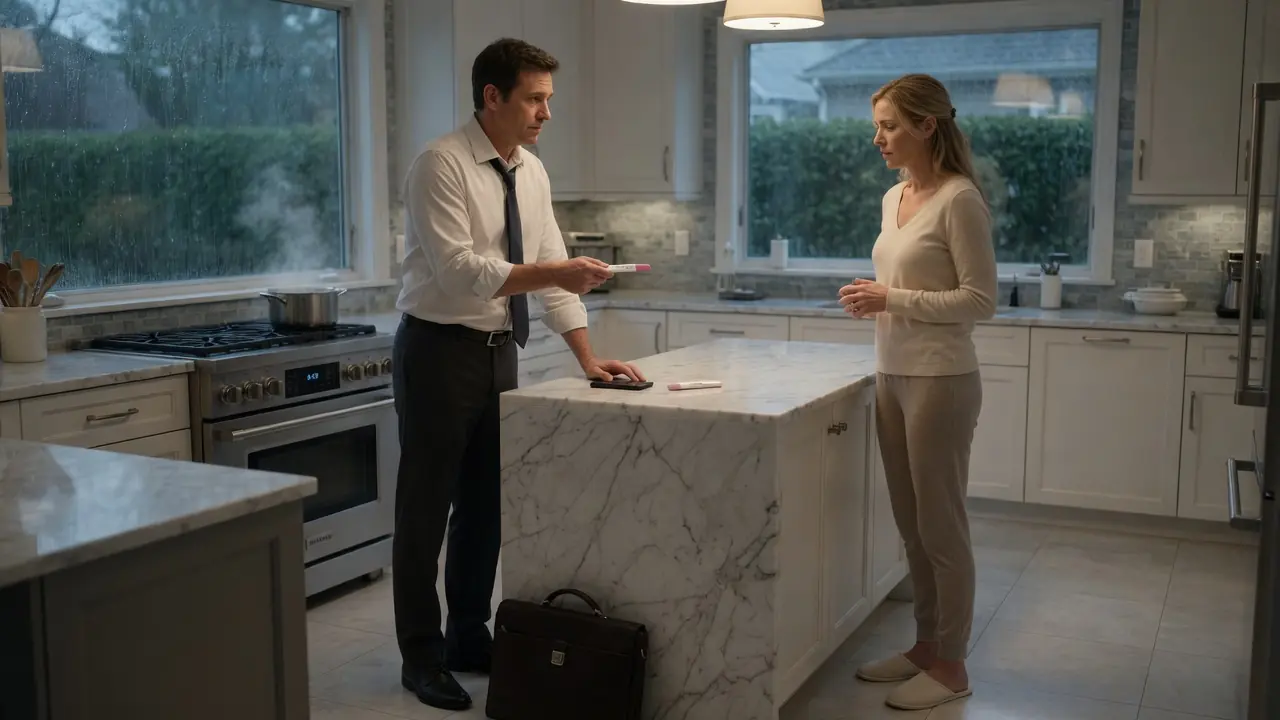
Not when I saw the phone.
Not when Claire turned away.
Not when I read Evan’s messages.
But sitting in my brother’s kitchen, saying out loud that I had been happy.
For ten seconds, I had been the father I wanted to be.
Then I became a betrayed husband holding a pregnancy test that might belong to another man.
Patrick came back inside after a few minutes.
His eyes were red, but his voice was steady.
“You stay as long as you need.”
“I don’t want the kids asking questions.”
“They’ll ask why Uncle Martin is here. We’ll tell them you needed family. That’s true.”
Megan reached for my hand.
“It is not your job to protect everyone from what Claire did.”
I nodded, though I did not fully believe it yet.
The next morning, Claire called seventeen times before 9 a.m.
I did not answer.
At 9:14, she texted.
I have an appointment this afternoon.
At 9:26:
I told Evan.
At 9:31:
He wants to talk to you.
That one made me laugh so sharply Patrick looked up from his coffee.
I typed back:
He does not get direct access to me. He can speak through an attorney.
Claire replied almost immediately.
Please don’t make this uglier.
I stared at the words.
Uglier.
As if I were the one adding dirt to clean water.
I wrote:
The ugliness already exists. I am only refusing to hide it.
Then I put the phone down.
By noon, Evan Mercer had found my work email.
Martin,
I know you probably hate me. I understand. But Claire and I did not plan for this to happen. We both care about her and want what is best for the baby. I would like us to handle this like adults.
Evan
I read the email twice, not because it deserved two readings, but because the arrogance was so smooth it almost looked reasonable.
Handle this like adults.
A phrase men use after behaving like boys with expensive watches.
I forwarded it to a divorce attorney Patrick recommended.
Her name was Elise Grant.
She called me within an hour.
“Mr. Donovan,” she said, “I am sorry you are dealing with this. First, do not respond to him. Second, preserve everything. Screenshots, messages, timelines. Third, do not move money around emotionally. Fourth, if there is any possibility the child is yours, we will discuss legal responsibilities and rights carefully.”
Her voice was calm, direct, and practical.
I needed that.
“What do I do about Claire?” I asked.
“You communicate in writing only for now, unless it concerns immediate medical safety.”
Medical safety.
That phrase made my chest tighten.
Because beneath the betrayal, there was still a pregnancy.
And pregnancy meant appointments, risks, nausea, fear, sonograms, blood pressure, vitamins, heartbeat.
It meant the thing we had prayed for had come wrapped in a nightmare.
Over the next few weeks, my life split into compartments.
Work.
Lawyer.
Brother’s house.
Messages from Claire.
Medical updates.
Pain.
I went to the office because numbers still needed balancing even when marriages did not. I answered emails, attended meetings, and reviewed budgets while my phone sat face down beside my keyboard like a loaded weapon.
At night, I slept in Patrick’s guest room under a blue quilt my mother had made years earlier. Sometimes my niece, Hannah, would knock softly before school and ask if I wanted a picture she had drawn. I said yes every time. Soon the dresser was covered in crayon rainbows, crooked houses, and stick figures labeled Uncle Marty.
One morning, she gave me a drawing of a baby.
I stood in the guest room holding it long after she left.
Patrick found me there.
“She doesn’t know,” he said gently. “She just likes babies.”
I nodded.
But I kept the drawing.
Claire’s first doctor appointment confirmed she was about six weeks pregnant.
The timing was bad.
Not impossible for me.
Not impossible for Evan.
Bad enough that truth would require science.
Claire sent me a photo of the first ultrasound.
A tiny shape.
A grain of rice in darkness.
I stared at it for a long time.
My first reaction was love.
My second was fear.
My third was rage at Claire for making those two feelings fight.
She texted:
I heard the heartbeat today.
Then:
I cried because you weren’t there.
I wrote back:
You made sure I could not stand there without wondering whose place I was taking.
She did not reply.
Two days later, I went back to Maple Ridge Drive while Claire was at work. Patrick came with me. We packed more clothes, documents, and personal items. The house looked almost unchanged. That offended me somehow.
The lemon cleaner.
The framed wedding photos.
The small American flag by the mailbox.
The empty future room upstairs.
In the kitchen, the pregnancy test was gone.
But I could still see it.
Patrick found me standing at the counter.
“You okay?”
“No.”
“Good. I was worried you’d lie.”
I looked at him.
He shrugged.
“Therapy taught me one useful sentence.”
I almost smiled.
In the bedroom, Claire had left a note on my pillow.
Martin,
I know I have no right to ask for anything, but please do not disappear completely. I am scared. I know I caused this. I know. But I am scared.
Claire
I folded the note and put it in my pocket.
Patrick watched me.
“You don’t have to carry that.”
“I know.”
But I did.
Not because I forgave her.
Because I was scared too.
At eight weeks, Claire had heavy bleeding.
She called me from urgent care crying so hard I could barely understand her.
“Martin, they said I need to go to the hospital. I don’t know what to do.”
Every boundary I had built disappeared under one fact.
The baby might be in danger.
I drove there.
Not because Claire deserved my presence.
Because the child, mine or not, deserved someone steady in the room.
When I arrived, Claire was lying in an exam bed, pale, one hand over her stomach. She looked smaller than I had ever seen her. Evan was not there.
That told me something.
She saw me and started crying harder.
“You came.”
“I came for the baby.”
“I know.”
But we both knew it was not that simple.
A nurse took her vitals. A doctor ordered tests. We waited for an ultrasound in a curtained room where every sound seemed too loud.
Claire reached for my hand, then stopped herself.
“May I?” she asked.
I looked at her hand.
Then I let her take mine.
It hurt.
The familiarity hurt.
The fact that her fingers still fit between mine hurt.
The memory of all the appointments before this one hurt.
The ultrasound showed a heartbeat.
Strong.
Alive.
The bleeding was frightening but not uncommon, the doctor said. Rest, monitoring, follow-up. Claire cried with relief. I closed my eyes and thanked God before remembering I was not sure what I was thanking Him for yet.
In the parking lot afterward, Claire stood beside my car.
“Thank you for coming.”
I nodded.
“Evan said he had a meeting,” she whispered.
I looked at her.
She seemed ashamed even saying it.
“He wants to be involved if it’s his,” she added, though her voice held less belief than before.
“Wanting involvement in theory is easy.”
“I know.”
“No,” I said. “You are starting to.”
She flinched, but accepted it.
That night, I dreamed of a baby crying in the future room upstairs while three adults stood outside the door arguing over who had the right to enter.
I woke up shaking.
Months passed.
Claire’s pregnancy continued.
So did the legal process.
We separated formally. I continued paying my share of household expenses until property agreements could be sorted because I refused to let the mortgage become another battlefield. Claire moved into the guest room. Then eventually, after pressure from her mother and my attorney, she moved in with her sister in Summit.
Evan attended one doctor appointment at twelve weeks and posted a vague quote about “responsibility” online afterward.
He missed the next three.
Claire stopped mentioning him unless necessary.
At sixteen weeks, she texted:
I found out it’s a girl.
I sat in my car outside the office and stared at the words.
A girl.
For years, Claire and I had talked about names.
Emma.
June.
Caroline.
Sophie.
We had once argued playfully over whether our daughter would play soccer or piano. Claire said both. I said our hypothetical child might prefer dinosaurs and mud. Claire said then we would buy rain boots.
Now there was a daughter coming.
Maybe mine.
Maybe his.
I typed:
Is she healthy?
Claire replied:
Yes. Everything looks good.
I wrote:
Good.
Then I cried in the parking garage where no one could see me.
At twenty weeks, noninvasive prenatal testing confirmed the baby had no major chromosomal concerns, but paternity would still require specific testing. Claire asked if I wanted prenatal paternity testing. The attorney explained the options. It was possible, but given medical considerations and emotional strain, I chose to wait until birth for legal testing unless there was an urgent reason.
People judged that decision differently.
Patrick thought I should know as soon as possible.
Megan understood why I could not put the pregnancy through anything unnecessary.
My mother said, “The truth will still be there when the baby arrives.”
My mother had been quiet through most of this.
She loved Claire once. That made her anger complicated. She brought food to Patrick’s house but never asked for details unless I offered them. One Sunday, she sat beside me on the porch and said, “If that baby is yours, you will love her. If she is not, you will grieve her. Either way, you will survive.”
“How do you know?”
“Because you are my son.”
That was not evidence.
But it helped.
Claire changed during pregnancy.
Not enough to undo what she had done.
But enough that I noticed.
She stopped defending herself. She gave my attorney full access to requested records. She forwarded Evan’s messages without being asked. She began therapy. She sent medical updates clearly, without emotional hooks. Sometimes she apologized, but less often, which strangely made the apologies matter more. She was learning that apology repeated too often can become another way of asking the wounded person for comfort.
At seven months, she sent me a letter.
Martin,
I used to think the worst thing I did was sleep with Evan. It was not. The worst thing I did was teach you that your instincts were untrustworthy. I let you comfort me while I was betraying you. I turned your patience into evidence against you. I let another man call you less than enough when you were the one showing up for every hard thing.
I am not writing this so you will forgive me. I am writing it because I need one honest record in a life I made dishonest.
If this baby is yours, she will know you are good. If she is not, I will still tell her you were good.
I am sorry.
Claire
I read the letter once.
Then I put it in a drawer.
Some apologies are not keys.
They do not unlock the door.
They simply prove the person finally understands there is a door, and it is closed for a reason.
The baby came early.
Thirty-seven weeks.
A cold February morning.
Claire called at 5:48 a.m.
“My water broke.”
Her voice was steady until I answered.
Then it cracked.
I was at Patrick’s house, already awake. I had been sleeping badly for weeks, the way people sleep when life is waiting for a verdict.
“Which hospital?”
“Overlook.”
“I’m coming.”
The drive felt unreal.
Snow lined the road in dirty ridges. Morning traffic had not yet thickened. The sky was gray and low. I kept both hands on the wheel and repeated one sentence silently.
Whatever happens, do not make the child pay.
When I reached the hospital, Claire was in labor triage, gripping the bed rail through a contraction. Her sister was there, looking relieved when I walked in. Evan was not.
Again.
I did not ask.
Claire looked at me.
“You came.”
“Yes.”
The labor lasted thirteen hours.
I stayed.
I held one leg when the nurse asked. I counted through contractions. I fed Claire ice chips. I stepped out when I needed to breathe. I came back. I did not pretend we were a married couple in love. I did not kiss her forehead. I did not call her sweetheart.
But I stayed.
Because the child was coming into the world surrounded by enough brokenness already.
At 6:31 p.m., a baby girl was born.
Small.
Red.
Furious.
Alive.
The nurse placed her on Claire’s chest, and Claire began sobbing so hard the nurse had to remind her to breathe. I stood beside the bed, one hand over my mouth, unable to move.
The baby cried with her whole body.
Claire looked at me through tears.
“She’s here.”
I nodded.
The nurse asked if I wanted to cut the cord.
I froze.
Claire whispered, “Martin should.”
No one mentioned Evan.
So I cut the cord.
The baby’s name, after a long and painful discussion weeks earlier, was Nora.
Not one of the names Claire and I had chosen years ago.
Not one connected to our old dreams.
A new name for a life that deserved not to be trapped inside our wreckage.
The paternity test was done before discharge.
Then came waiting.
Three days.
The longest three days of my life.
I visited the hospital each day. I held Nora each day. I told myself not to attach too deeply until I knew. It was a useless instruction. The first time she wrapped her tiny fingers around mine, my heart ignored every legal caution and stepped forward anyway.
On the third day, my attorney called.
I was sitting in my car outside the hospital.
“Mr. Donovan,” Elise said gently, “the results are back.”
I closed my eyes.
“Tell me.”
“Nora is your biological daughter.”
For a moment, everything stopped.
The cars in the lot.
The wind.
My breath.
Then I bent forward over the steering wheel and cried like a man whose body had been holding back an ocean.
Mine.
My daughter.
My child.
A miracle and a wound at the same time.
I walked into Claire’s hospital room twenty minutes later.
She knew from my face.
Her hand went to her mouth.
“She’s yours?”
I nodded.
Claire broke down.
Not with relief only.
With shame.
With gratitude.
With the unbearable knowledge that the man she betrayed was the father of the child she carried.
I went to the bassinet.
Nora slept with one tiny fist near her cheek.
I touched her blanket.
“My daughter,” I whispered.
The words changed me.
They did not fix the marriage.
They did not erase Evan.
They did not make Claire innocent.
But they gave the future a center.
And that center was not betrayal.
It was Nora.
In the months that followed, people expected a simple ending.
Some thought I should go back to Claire because the baby was mine. They said children need a family. They said maybe this was God’s way of healing us. They said forgiveness is powerful, which is true, though people often say it when they mean reconciliation.
Others thought I should hate Claire forever. They said take the baby, fight hard, punish her, make her regret everything.
I did neither.
The divorce continued.
Claire and I created a custody agreement that put Nora first. It was not easy. Nothing about it was easy. There were tense meetings, painful discussions, schedules, child support calculations, and moments where old grief rose like floodwater.
But I refused to let Nora become a weapon.
Claire, to her credit, did too.
Evan disappeared before Nora was born and stayed gone after the paternity test. He sent one message to Claire saying he wished her well. She showed it to me without comment. Then she blocked him.
That was the last time his name mattered in our daily lives.
The first night Nora slept at my apartment, I sat beside her crib until sunrise.
She made tiny sounds in her sleep. Her hands opened and closed. Her face shifted through expressions too old and too new for someone who had only been alive for weeks.
I thought about the kitchen counter.
The test.
The phone.
The question.
Is this my child?
I had asked it because betrayal had made love unsafe.
Now the answer slept in front of me, wrapped in a yellow blanket.
Yes.
This was my child.
Not because biology solved everything, though biology mattered.
She was my child because I would wake for her. Work for her. Protect her. Read to her. Learn her cries. Remember her medicine. Keep extra diapers in my car. Show up to daycare meetings. Sit through fevers. Teach her how to ride a bike. Tell her the truth when she was old enough, carefully, without making her carry adult shame.
She was my child because love, when it is real, becomes a verb.
Years later, Nora would ask why her mother and I did not live together.
Not at first.
At first, she only knew two homes.
Two bedrooms.
Two sets of bedtime books.
Two parents who spoke politely at drop-offs, even when sadness moved under the surface.
When she was six, she asked, “Did you and Mommy used to be married?”
I looked at her across the kitchen table in my apartment. She was eating cereal for dinner because it was Friday and we had rules loose enough for joy.
“Yes,” I said.
“Did you stop being friends?”
I thought carefully.
“We had some grown-up hurts we could not fix by staying married.”
“Was it my fault?”
The question broke my heart in the cleanest way.
I got down on one knee beside her chair.
“No. Never. Not for one second. You were wanted before you were born, and you are loved more than any grown-up mistake.”
She studied me.
“Mommy says I was a miracle.”
“She is right.”
“Do you think so too?”
I smiled.
“Nora, I thought so before I even knew your name.”
That answer satisfied her.
For then.
When she was older, there would be harder conversations. Honest ones. Age-appropriate ones. Conversations that did not make Claire a monster or me a martyr. I had learned that children do not need perfect parents. They need truthful ones who do not ask them to carry what adults should have handled.
Claire and I never remarried each other.
We did not become a grand story of betrayal healed into romance.
Life is not always that kind.
But we became better co-parents than I once believed possible. Claire stayed in therapy. She rebuilt herself slowly. She never asked me to forget. I forgave her eventually, though not in the way people imagine. Forgiveness did not mean opening the door again. It meant putting down the weight of wanting her to hurt as badly as I had.
Some wounds become part of the body.
You learn to move with them.
On Nora’s eighth birthday, Claire and I stood together in a park in Westfield while Nora ran across the grass with frosting on her chin and a pink balloon tied to her wrist. Patrick’s kids chased her. My mother sat under a tree, laughing. Claire’s mother arranged paper plates on a picnic table.
Claire stood beside me, watching our daughter.
“She has your eyes,” she said.
I smiled.
“She has your stubbornness.”
Claire laughed softly.
Then after a moment, she said, “I know I don’t get to say this often, but thank you.”
“For what?”
“For not letting what I did decide who you became.”
I looked at Nora.
She was spinning in circles, dizzy and delighted.
“I almost did,” I admitted.
Claire nodded.
“I know.”
“But she deserved better than that.”
“Yes,” Claire whispered. “She did.”
Rain began falling lightly, the kind of summer rain that makes children scream and adults gather plates. Nora ran toward us, laughing.
“Dad! It’s raining!”
“I see that.”
“Can we stay?”
I looked at Claire.
She shrugged.
“It’s her birthday.”
So we stayed.
The cake got damp. The napkins stuck to the table. The adults complained. The children danced in the rain like weather had been invented for them.
Nora grabbed my hand with one hand and Claire’s with the other, pulling us into the wet grass.
For a moment, the three of us stood together.
Not as the family Claire and I had once imagined.
Not as the marriage I had tried to save.
But as something else.
Broken.
Rebuilt.
Imperfect.
Real.
I looked at Nora laughing between us and thought back to that Monday evening in the kitchen, when I saw two lines and believed God had finally remembered us.
Maybe He had.
Not in the way I wanted.
Not in the clean, joyful, uncomplicated way I had prayed for.
But life had come anyway.
Truth had come too.
And though truth nearly destroyed everything, it also cleared away the lie that would have poisoned whatever came next.
I learned that night that miracles do not always arrive untouched by human failure.
Sometimes they appear on a kitchen counter beside a phone full of betrayal.
Sometimes they force questions no husband should have to ask.
Sometimes they break your heart before teaching it how to love differently.
But love that survives truth becomes something stronger than the love that only survives because no one has turned on the light.
When I found that pregnancy test, I thought the two lines meant one thing.
A baby.
A family.
A future.
They did mean that.
But they also meant an ending.
The end of the marriage I thought I had.
The end of the lies Claire had hidden behind grief.
The end of my willingness to confuse patience with blindness.
I did not raise my voice that night.
I did not need to.
I placed her phone beside the test and asked about the man she told first.
That was the moment my old life ended.
And months later, when Nora wrapped her tiny hand around my finger for the first time, my new one began.