My name is Donald, and for a long time I refused to believe what was happening in my own marriage.
Genevieve and I had been married for 15 years, and although we were not perfect, I always thought we had a solid foundation.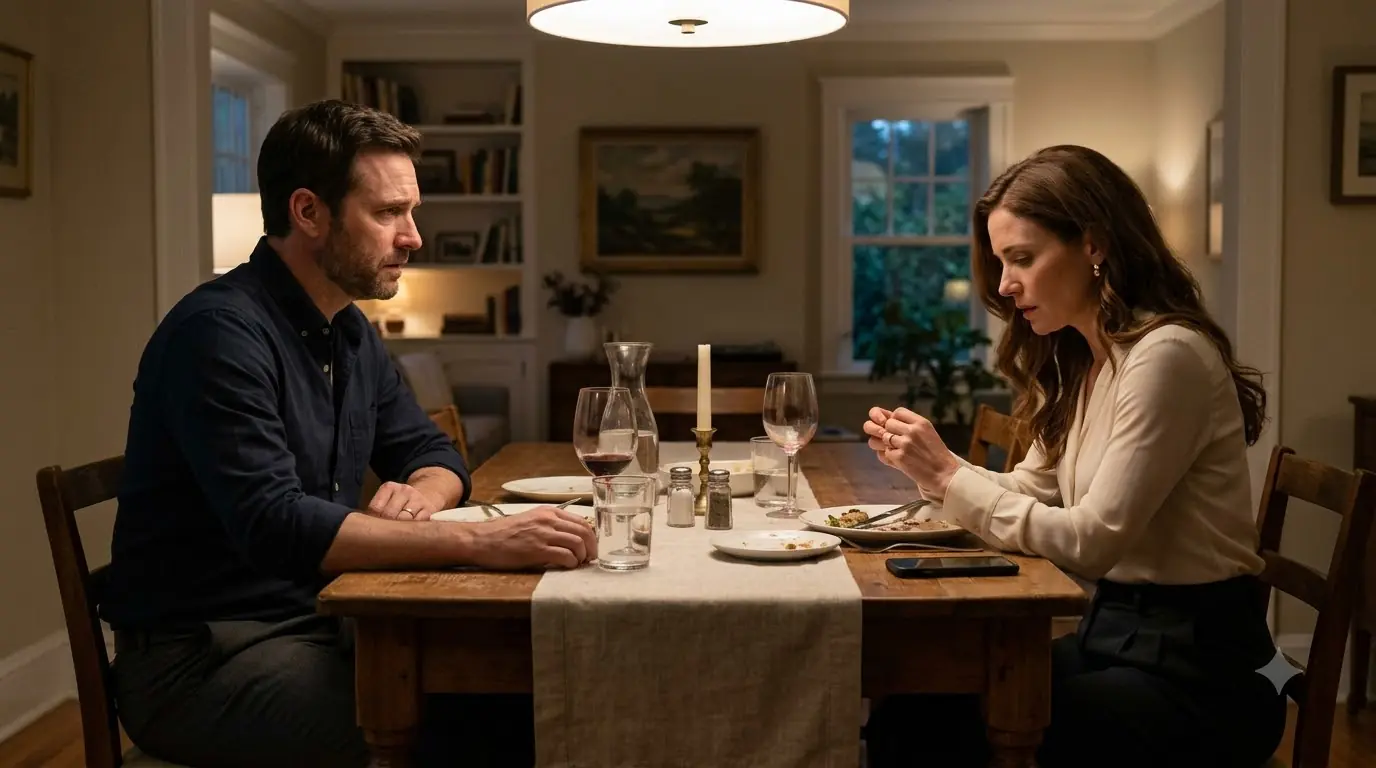
We had been through struggles, arguments, highs, and lows, but at the end of the day, I believed we were a team. At least, that was what I believed until something changed.
Our conversations got shorter. Genevieve started staying up later than usual with her phone in her hand, the screen lighting up her face in the dark.
When I asked what she was doing, she would shrug and say she was just scrolling or texting a friend. At first, I ignored it because everyone deserves privacy.
But the more I watched, the more I noticed. She started laughing at messages she would not share with me, guarding her phone, tilting the screen away, and setting it face down on the table.
There were nights when she would get a text and, instead of answering in front of me, pick up her phone and leave the room. That was when the uneasiness started creeping in.
If you have been with someone long enough, you know when they are acting differently. I kept telling myself I was overthinking it, that maybe I was turning nothing into something, but deep down I knew better.
One evening, after we had finished dinner, Genevieve put her fork down, took a deep breath, and looked me straight in the eyes. "Donald, I need space to find myself."
I nodded slowly, leaned back in my chair, and said, "Space, huh?" I kept my voice neutral, almost amused, because I did not want to sound angry or hurt.
She hesitated, like she had expected me to panic, argue, or start bargaining. That reaction told me more than the words themselves.
I asked what she meant exactly. Did she need time alone in the house, did she want to go somewhere, or was she feeling overwhelmed?
She gave me vague, empty answers. "I just need to figure things out."
"Figure what out?" I asked.
She avoided eye contact and fidgeted with her fingers. Right then, I decided I was not going to ask a hundred questions she had already chosen not to answer.
My gut was telling me this was not simply about needing time alone to think. Something else was going on, and I needed to know what it was.
So in the days that followed, I started paying closer attention. Sometimes the truth is not buried deep; it is simply sitting there waiting for someone to notice it.
First, I checked the phone records and looked for a recurring number. One stood out over and over.
Then I went through her social media, paying attention to who was liking her posts, who was commenting, and, more importantly, who she had suddenly started following again. That was when I saw a familiar name I had not heard in years.
It was her high school boyfriend, the man she had dated before me. She used to talk about him like he belonged to some unfinished teenage love story that never got a real ending.
Now he was back in her life. At first, I told myself it could be innocent and that maybe they had simply reconnected after all these years.
Then I saw the messages. Long conversations, emojis, and texts about "thinking about old times" were sitting in a married woman's inbox.
They were the kind of messages that crossed a line even before anyone admitted a line had been crossed. I could have woken her that second and demanded an explanation.
I did not. I said nothing about what I found because, by then, I believed she had already taken the space she was asking me to approve.
Whatever decision she was wrestling with had started long before she said the words out loud. She was asking me to accept a reality she had already begun creating.
So I gave her the distance she said she wanted. If she did not talk to me, I did not chase her for conversation, and when she did speak to me, I kept my responses short, polite, and distant.
I was not cold or passive-aggressive. I simply stopped making her attention the center of my day.
Since I was no longer spending my energy trying to drag answers out of her, I focused on myself. The first place I went was the gym.
I started training harder than I had in years. I was not doing it to impress her; it just felt good to put my frustration into something that actually benefited me.
Then I upgraded my wardrobe. I bought well-fitted clothes, got rid of worn-out things I had stopped caring about, and paid attention to how I presented myself again.
I got a fresh haircut and cleaned myself up. Every morning, I started seeing a man in the mirror who was no longer waiting around to be chosen.
The biggest change was my social life. I began seeing friends I had barely made time for because so much of my life had revolved around the marriage.
I started accepting invitations instead of making excuses. Friday night came, and I was out with people rather than sitting at home wondering where Genevieve was or who she was talking to.
Genevieve had her own support system, the friends she vented to and the people who told her she deserved to be happy. Some of those same women noticed the change in me quickly.
When I ran into them, I was not the bitter, heartbroken husband they seemed to expect. I was confident, relaxed, smiling more, making jokes, and enjoying myself.
At first, their reactions were subtle. A quick glance, a lingering smile, or a casual, "Wow, Donald, you're looking good these days."
Then the compliments became curiosity. Conversations lasted longer, and I could see Genevieve noticing every second of it.
At first, she seemed to enjoy her freedom. She had convinced herself she had made the right choice and simply needed time to breathe, explore, and figure things out.
But the change in our dynamic did not go unnoticed. She had expected me to be waiting for her, sad and desperate to prove my worth.
Instead, I was moving forward with my own life. That seemed to bother her more than anything I could have said.
The first signs of her jealousy were small, fleeting expressions she tried to hide. I saw the way she tensed when one of her friends laughed at something I said or touched my arm during a conversation.
Her best friend suddenly became especially friendly to me, throwing compliments my way whenever she had the chance. I was not trying to provoke anyone; I was simply no longer shrinking myself around the situation.
Genevieve noticed, and I think that was when it finally hit her that she could actually lose me. The distance she had asked for was no longer entirely under her control.
One evening, I was sitting in the living room when she walked in and asked, "How was your day?" She said it casually, almost as though nothing had happened between us.
"It was good," I said.
That was all. No details, no enthusiasm, and no effort to keep the conversation going.
I kept my tone light but distant, polite but uninterested. I was not rude, but I did not behave as though hearing her voice was the highlight of my evening.
I saw the disappointment on her face because she had expected more. She thought I would light up and eagerly engage the second she reached toward me again.
A few days later, she made another attempt. This time, she put real effort into it.
She started talking to me more, not just casual small talk but actual conversations. She asked about my plans, commented on my appearance, and dropped little hints that she had noticed the changes in me.
Then came the date-night suggestion.
"We should go out sometime, just us. Dinner, maybe?"
I knew what she was doing. She was trying to ease back into the relationship as if the last few weeks had not happened, expecting that I would jump at the opportunity.
I nodded and said, "Maybe. Let me check my schedule."
That answer hit her harder than I expected. She had clearly thought I would agree immediately and feel relieved that she was finally turning back toward me.
Instead, she had to sit with uncertainty. It was the same uncertainty she had handed me the night she asked for space.
After that, she started dressing differently around the house. She wore outfits she knew I liked, fixed her hair more often, and wore the perfume she had once saved for evenings out.
The effort was obvious. She wanted my attention, and she was waiting for me to react.
I noticed all of it, but I did not rush to give her the reassurance she seemed to want. By then, I had learned that my life could keep moving even if she was uncertain about hers.
Eventually, she cracked. One night, she sat down across from me, looked directly into my eyes, and said the words I had known were coming.
"I think I made a mistake," she said. Her voice was softer now, uncertain in a way I had not heard before.
"I don't need space. I need us."
I leaned back and watched her for a moment, letting the words settle. Part of me had once imagined hearing that sentence and feeling relief.
But the version of me sitting there that night was not the same man who had been stunned at the dinner table weeks earlier. I had already learned something about myself in the silence she created.
"I gave you space because you asked for it," I told her, "but now I'm not sure I want to go back to how things were."
Her face fell. For the first time, she seemed to understand that the decision was no longer hers alone.
I could see regret in her expression, but by then something in me had already changed. I was no longer waiting for her to decide whether I was worth keeping.
"I'm done," I told her, keeping my voice steady. "You wanted space, and somewhere inside that space I realized I deserve a relationship where I don't have to wonder whether I'm being replaced."
She sat there stunned, unable to process how the man she had expected to remain available was now choosing to leave. I felt sad, but I did not feel uncertain.
The high school boyfriend turned out to be exactly what I had begun to suspect. He enjoyed the attention and the nostalgia, but he was never serious about building a future with her.
He was an old flame reliving the past, and when reality caught up with the fantasy, he returned to his own life. Genevieve was left facing the fact that she had risked a 15-year marriage for something that had never truly existed outside memory and fantasy.
The separation between us took months to finalize. There were documents, uncomfortable conversations, divided belongings, and the slow dismantling of a life we had spent 15 years building together.
Before everything was finished, she confessed one last thing to me.
"I regret it. I regret all of it."
I believed she meant it. But regret did not erase the secrecy, the messages, or the trust that had been broken long before she finally admitted what she wanted.
By then, I had already moved forward. I was in a better place emotionally and had rebuilt parts of my life I had neglected for years.
Eventually, I met someone who valued what I brought to a relationship without needing to lose it first. For the first time in a long time, I did not feel like I was competing with a memory, a phone screen, or someone else's uncertainty.
Genevieve was left alone with the consequences of the choice she had made. I did not hate her, and I did not need revenge; I simply no longer wanted the marriage we had once shared.
For a while, I wondered whether I should have fought harder for us. Fifteen years is a long time, and walking away from that much history is not something anyone does without asking themselves difficult questions afterward.
But every time I thought about going back, I remembered the moment she said she needed space while already giving emotional energy to someone else. I remembered how quickly I became optional when she believed another possibility might be waiting.
What hurt was not simply that she had reconnected with an old boyfriend. It was that she only seemed to recognize my value again once she saw that my life could continue without her.
That distinction mattered to me. I did not want to be wanted only because losing me had suddenly become real.
The months after the separation taught me that self-respect is not the same thing as pride. Pride would have required revenge, humiliation, or proving that I had won.
Self-respect was quieter. It meant accepting that I could care about Genevieve, remember 15 years of our life together, and still decide that what happened had changed the relationship beyond what I was willing to rebuild.
I stopped measuring my future against whether she regretted her decision. Her regret belonged to her, just as my decision to move forward belonged to me.
In the end, the space she asked for did help someone find himself. It just was not the person either of us expected.