Texas, 1886.
Will Harding had knocked on many doors during his twenty-eight years.
He had knocked on ranch doors and farmhouse doors at hours when decent people were not answering. 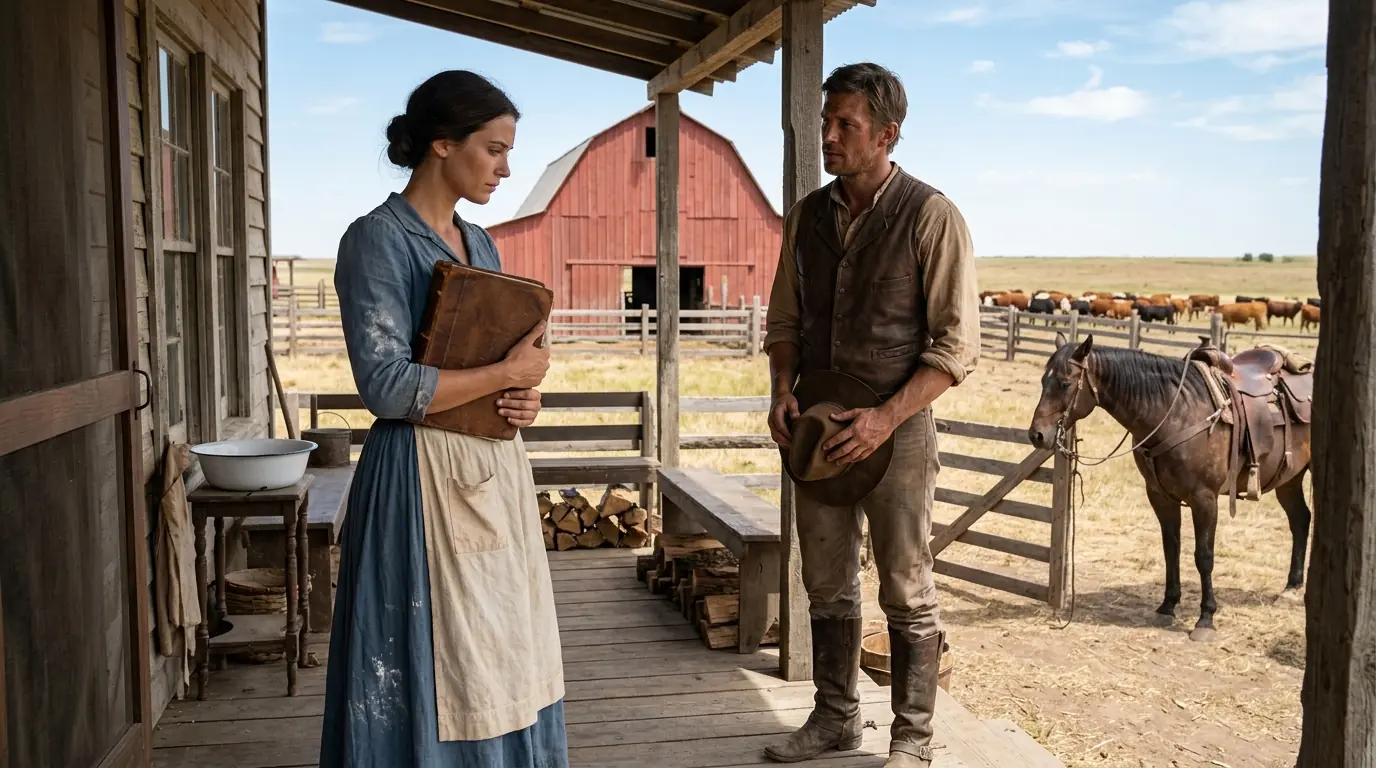
He had been turned away more times than he could count and hired just often enough to keep moving.
Will had spent his entire life working other men’s land, repairing other men’s fences, and sleeping inside other men’s barns.
He was always useful.
He never belonged.
He had ridden for three days from Abilene after hearing about a cattle operation outside Mill Haven that was short-handed.
The directions had been vague.
Follow the creek north.
Look for the red barn.
The barn stood exactly where it was supposed to be. The farmhouse beside it was solid and well maintained, and the entire property had the appearance of a place that had once been deeply loved and was now being held together by someone who refused to let it fall.
Will tied his horse at the gate, walked to the porch, and knocked.
The woman who opened the door was not what he expected.
She was twenty-six years old, with dark hair and direct brown eyes that appeared to assess an entire situation before she committed herself to a response. She wore a blue work dress with flour on one sleeve and held a ledger book that she did not put down when she opened the door.
She examined Will the way a person might examine a fence before deciding whether to repair it or replace it completely.
Will removed his hat.
“Ma’am, I heard you might need a ranch hand. I am a good worker. I have experience with cattle, and I can…”
“I need a husband more than I need a cowboy,” she said.
There was no cruelty in her tone.
She spoke directly, the way someone states a fact established through arithmetic rather than sentiment.
She continued studying him while he stood on her porch and felt his prepared speech disappear.
“Come inside,” she said. “I will explain.”
The woman turned and walked into the house, still holding the ledger.
Will remained on the porch for a moment.
Then he followed her.
There was not much else a man could do when a woman like that opened a door and invited him inside.
Her name was May Callaway.
Her husband, Daniel, had died eight months earlier. The fever had come quickly and ended his life before either of them understood how serious it had become.
His death left May with three hundred acres of productive Texas land, sixty head of cattle, two horses, and a debt of four hundred and twenty dollars owed to Mill Haven Savings Bank.
Daniel had borrowed the money the previous spring to expand the herd.
He believed cattle prices would rise.
They had not risen quickly enough.
Under the property laws that still shaped a widow’s rights in Texas in 1886, May existed in a dangerous legal uncertainty during the months after her husband’s death.
Daniel’s estate remained in probate.
The bank had the authority to call the note instead of offering new terms to a woman managing the property alone.
Harlan Briggs at Mill Haven Savings had made it clear that the bank intended to do exactly that.
May did not believe Briggs was acting out of personal cruelty. The law gave him the option, and he answered to depositors who expected the bank to protect their money.
The law did not require him to protect May Callaway.
She explained everything at the kitchen table.
The ledger lay open between them, and May spoke with the practical precision of a woman who had repeated the calculations many times and always arrived at the same answer.
Without refinancing, the note would become due in sixty days.
“I have considered every other possibility,” May said. “If I sell cattle, I will need to move forty head at current prices to satisfy the note. That would leave too few animals to carry the operation through winter.”
She turned one of the ledger pages.
“I have no family from whom I can borrow. The lawyer in town says I would lose if I fought the bank in court.”
May closed the book.
“I need a husband’s signature on the refinancing papers. That is all the law requires. A husband’s signature.”
Will looked at the ledger.
Then he looked at her.
“You are proposing a business arrangement.”
“I am proposing a marriage that begins as one.”
May placed both hands on the closed ledger.
“You would have a home, forty dollars a month after the debt is refinanced, and a share in the operation. In return, I need your name on the bank papers and your actual labor on this property.”
“You do not know me.”
“No.”
May did not hesitate.
“But I know three things. You arrived looking for honest work. You removed your hat when I opened the door. And you did not laugh when I explained what I needed.”
She looked steadily at him.
“That is more than I can say for the last two men I asked.”
Will’s fingers stopped moving against the hat brim.
“There were two others?”
“Two.”
May’s expression remained controlled.
“One laughed. The other attempted to renegotiate the arrangement in a direction I found unacceptable.”
She picked up the ledger.
“You have until tomorrow morning to decide. The barn is clean, and there is food in the kitchen.”
May left the room and returned to her work.
Will remained at the table for a long time.
Through the window, beyond the eastern pasture, he noticed a man sitting motionless on horseback along the ridge.
The rider appeared to be watching the farmhouse.
Before Will could examine him properly, the man turned his horse and rode east.
Will stored the detail in his mind.
Then he went to the barn.
It was a good barn.
Dry.
Well maintained.
The animals were calm and healthy.
Neglect appeared in livestock before it appeared anywhere else on a property.
These animals had not been neglected.
Will lay on his back in the hay and thought about May Callaway’s ledger, her direct dark eyes, and the rider on the ridge.
He had spent his life moving because nothing had ever given him a sufficient reason to stop.
Not the right reason.
Will had worked for men who owned land and returned each evening to bunkhouses. In the particular silence of someone else’s property, he often wondered what it would feel like to drive a nail into something that belonged to him.
He had always believed the echo would sound different.
In the morning, Will entered the kitchen at six o’clock.
May was already awake.
Coffee was ready.
Bacon cooked in the pan.
The ledger was open again.
She looked up at him.
“Yes,” Will said.
May watched him for a moment.
Something in her face shifted.
It was not quite relief.
It was the controlled exhale of someone who had been carrying something very heavy and had suddenly found another pair of hands.
“Sit down,” she said. “We will go into town this afternoon.”
They were married at three o’clock on a Wednesday.
The reverend performed the ceremony before two witnesses.
May wore her best dress.
Will wore his cleanest shirt.
The entire ceremony required eleven minutes.
As they walked toward the wagon afterward, May spoke quietly.
“Thank you.”
“We should examine the cattle records tonight,” Will said. “I want to understand exactly what we are working with before the week is over.”
May looked sideways at him.
“All right.”
For the first time since Will knocked on her door, the possibility of a smile crossed her face.
It did not fully arrive.
Still, it was there.
Something else was present on the road through Mill Haven.
Garrett Holland stood outside the feed store and watched their wagon pass.
He remained completely still, like a man who had just learned something important and was deciding how to respond.
Will kept his eyes on the road.
He had repaired enough broken things to recognize the kind of damage that began with a man observing from a distance.
The first weeks of the marriage were entirely practical.
Will worked from before sunrise until after dark.
He managed cattle, repaired fences, and replaced softened boards along the eastern side of the barn roof.
He asked questions the way a man asks when he wants to understand a system, not impress the person explaining it.
May answered efficiently.
For eight months, she had explained the land to herself every day simply to keep the operation alive.
Will had spent his entire life working for others.
Every task had always felt borrowed.
Someone else’s fence repaired.
Someone else’s problem solved.
Someone else’s profit earned.
When Will drove the first new nail into the barn roof, he paused and listened to the echo.
It sounded different.
He returned to work.
The bank meeting took place on Thursday.
Harlan Briggs was a small, precise man with the expression of someone who considered himself reasonable and frequently was not.
He examined the refinancing documents and asked Will three questions about the property.
Briggs never looked at May.
Will answered every question from memory.
He did not turn toward her for help.
Briggs signed the refinancing agreement.
After they left the bank, May looked at Will.
“He looked at you as though you had accomplished something remarkable.”
“What did I do?”
“You answered every question about my land without looking toward me for confirmation.”
“I read the ledger,” Will said. “I understand the property.”
May stopped walking.
“You read the entire ledger?”
“Before agreeing, I needed to know what I was entering.”
She regarded him with the expression of a woman recalculating something.
Then she resumed walking.
“The cattle records are in the second drawer,” May said. “I will explain the pasture rotation after supper.”
Will did not tell her what else he had found while reading the ledger.
The proper moment had not yet come.
Among the entries was a note written in Daniel’s hand the previous April.
“Holland offered again. Land office showing boundary discrepancy from 1874 survey. Check with Pratt in Abilene before winter.”
Daniel had never checked.
Will folded the information into his thoughts and continued walking.
Mill Haven had opinions about the marriage.
Of course it did.
Martha Greer at the general store had been one of the witnesses. She reported that May Callaway married a stranger she had known for only one day.
According to Martha, the stranger understood cattle.
The arrangement was either an act of practical genius or the beginning of a disaster.
Martha had not yet decided which.
Garrett Holland owned five hundred acres east of May’s property.
He had watched the Callaway land since before Daniel’s death.
Holland made two offers to purchase it.
May refused both.
In June, he had helpfully informed her that a woman alone with debt occupied a difficult position.
When May remarried, Holland became quiet.
It was the particular kind of quiet belonging to a man who had changed strategies rather than abandoned his objective.
He approached the eastern fence on a Monday.
“You are the new husband.”
“Will Harding.”
Will continued working.
“I heard May finally found someone to sign the papers.”
“She found a husband,” Will replied. “The papers were a consequence.”
Holland looked at the repaired posts and tightened wire.
The methodical work suggested a man intending to remain for a long time.
Holland lit a cigar.
“That land has been under question longer than May knows.”
He spoke carefully, like someone dropping a stone into water to measure the depth.
“The old survey from 1874 contains irregularities. The bank knows about them too. You might want to investigate before putting too much work into the eastern pasture.”
Holland rode away without waiting for an answer.
Will drove the next post into the earth.
Three clean strikes.
Then he straightened and looked along the eastern boundary.
He thought about Daniel’s note inside the ledger.
He thought about Holland mentioning the bank.
He thought about a man who had waited years for the property and had just told a stranger exactly what he wanted that stranger to fear.
Will returned to work.
That evening, he wrote a letter to John Pratt in Abilene.
May’s position had always involved more than the loss of a husband.
The laws of the time left a widow exposed to men she had never met making decisions about property her family had worked for years.
May had discovered one door the law left open.
She walked through it.
The courage required to ask a stranger for marriage was not romantic courage.
It was the courage of a person who had examined every alternative, expected humiliation, and asked anyway because the land depended upon it.
By October, the arrangement had developed complications not included among its original terms.
Will had grown up moving between ranches and seasons.
He had always described that movement as freedom.
He was beginning to understand it had been something else.
One evening, Will sat inside the barn repairing a trace harness.
May entered carrying a supper plate.
Bringing food into the barn was not one of the agreed terms.
It had simply begun happening.
She placed the plate on the workbench and examined the harness.
“That is the old trace harness. Daniel repeatedly said he would replace it.”
“It can be repaired,” Will said. “The leather remains sound. Only the stitching has failed.”
May watched him work.
“He was a good man.”
Will continued guiding the needle through the leather.
“He simply was not careful with money.”
A pause followed.
“Or with ledgers,” she added. “Or land-office filings.”
Will looked at the harness.
“The note in the ledger,” he said. “The one about the 1874 survey.”
May became completely still.
“You found that?”
“In October.”
“I have been examining it.”
She sat on the edge of the workbench.
“Why did you not tell me?”
“Because I did not know what it meant yet.”
Will set the harness across his knees.
“I did not want to hand you another problem before I understood its shape.”
May regarded him with the same dark eyes that had been making decisions since August.
This man was different from the useful stranger she expected to sign papers, manage cattle, and occupy one side of a business agreement.
Will had found a problem in her dead husband’s ledger.
He then spent three weeks learning its dimensions before speaking because he did not want to give her fear without also giving her the beginning of a solution.
“What shape does it have?” May asked.
“Holland has known about the survey error for years.”
Will placed the harness on the bench.
“He has known long enough to use it when the right moment appeared. The right moment was always going to be when you were vulnerable.”
May listened without interrupting.
“I wrote to Pratt in Abilene. He is a surveyor. If the discrepancy is real, we will have the corrected boundary filed before Holland can act on it.”
“You have planned this since October?”
“Since he visited the eastern fence.”
May looked at the harness inside his hands.
Something changed in her face.
It was the specific shift of someone who had managed alone for so long that having another person quietly manage one problem felt unexpectedly powerful.
She placed her supper plate beside Will’s on the workbench.
They ate inside the barn without speaking.
It was the most comfortable either of them had felt since August.
John Pratt arrived from Abilene during the second week of November.
He spent two days in the eastern pasture with his theodolite.
Will worked beside him.
He did not direct Pratt.
He remained present, learned the method, and asked the questions of a man intending to understand what he was paying for.
The results confirmed the concern.
The 1874 survey contained a compass-variation error.
The eastern boundary had been marked ninety feet west of its correct position.
The forty acres Holland appeared prepared to dispute were, by accurate measurement, unquestionably Callaway land.
The corrected survey was filed with the land office on Thursday.
On Friday night, someone cut the eastern fence.
Not one section.
Three sections.
Nearly a quarter mile of wire was dropped, and several posts were pulled from the ground.
The sixty cattle were driven through the openings into the unsettled space between the Callaway property and Holland’s eastern boundary.
The land was unclear enough in darkness to create legal confusion.
Will discovered the damage at five in the morning when he went to inspect the herd.
He returned to the farmhouse and began saddling his horse without waking May.
Will stood at the barn door for thirty seconds in the November darkness.
His breath formed clouds.
The temperature had already begun falling in the way that warned of severe weather.
Then he returned to the house and woke her.
“The eastern fence is down,” he said. “Three sections. The cattle are out.”
May was standing before he finished the sentence.
She dressed, pulled on her boots, collected the rifle from above the kitchen door, and entered the barn without wasting a word.
Will watched her saddle her horse.
“You do not have to come.”
“They are my cattle.”
She tightened the saddle.
They rode together into the November darkness.
Will looked at May and thought that this was what it looked like when someone refused to let a thing fall.
He had never seen anything like it.
He hoped he never stopped seeing it.
They found the cattle scattered across nearly a mile of open ground.
The animals had not wandered naturally.
They had been pushed by men who understood exactly what they were doing.
Will found tracks from three horses.
The riders had moved the herd east toward Holland’s boundary, where the property confusion could create a dispute over which cattle belonged to which operation.
By morning, the legal situation would become difficult to untangle.
Will read the tracks in the moonlight and understood the plan.
It was not simple theft.
It was confusion.
The cattle would be mixed with Holland’s herd in darkness.
The corrected survey had been filed less than forty-eight hours earlier.
By the time lawyers sorted ownership and boundaries, Holland could file enough counterclaims to keep May and Will trapped through winter.
The temperature continued falling.
The norther that had been gathering throughout the week had arrived.
May was already moving cattle alone in the darkness, cutting off strays before they reached Holland’s fence.
She rode like someone who had handled livestock since before she could read.
She probably had.
Will pushed farther east.
At the edge of the open ground, he found two of Holland’s men.
They were not cowhands performing ordinary work.
They sat quietly on their horses and watched the herd drift.
They were waiting.
Will rode directly toward them.
He did not raise a rifle.
He made no threat.
He simply approached two mounted men at four in the morning while the wind of a Texas norther rose around them.
His composure belonged to someone who had already decided exactly how far he was prepared to go.
One of the men spoke.
“This is not your land, friend.”
“It is,” Will replied. “The corrected survey was filed Thursday. You are welcome to verify it.”
He held the man’s gaze in the moonlight.
“I am going to move my cattle home. You may help, or you may return to Holland and tell him the survey has been filed and the herd is back where it belongs.”
Will allowed the wind to fill the silence.
“The next time someone pulls my fence posts after dark, I will not come alone.”
Neither man answered immediately.
The wind grew stronger.
The second rider leaned toward the first and said something Will could not hear.
Then both turned and rode east.
Will remained on his horse until they disappeared.
Afterward, he returned to help May.
By the time they moved the cattle through the damaged sections and temporarily braced the fence, the temperature had fallen fifteen degrees.
The first snow began falling.
May looked toward the sky.
“The Big Die-Up is coming.”
“I know.”
“Then we have work to do.”
She was already riding toward the barn.
The winter of 1886 struck the Texas plains like a judgment.
Old ranchers later called it the Big Die-Up.
It was the severe season that killed enormous numbers of cattle across western ranges, weakened major operations, and helped end the open-range era.
In Mill Haven County, the temperature fell to twenty degrees below zero during January.
The creek froze solid.
The windmill in the northern pasture seized and had to be freed by hand in weather that injured exposed skin within minutes.
Will and May worked as though sleep had become optional.
They lost seven cattle during the first week.
The losses were unavoidable.
Those animals had entered the storm already weakened by the season.
They saved eleven others that would otherwise have died.
Several were brought into the barn and fed by hand throughout the worst nights.
Three calves spent forty-eight hours beside the kitchen stove, wrapped in blankets while Will and May took turns keeping them alive.
The kitchen smelled of cattle, wood smoke, and coffee that remained constantly on the stove.
They did not discuss the original terms of the marriage.
There was no time to discuss anything beyond the next problem and the one after it.
On the worst night, the temperature fell to twenty-two below.
Wind drove snow sideways across the property.
The barn door required both of them to force it open against the pressure.
Will returned from the northern pasture near midnight with frost injury beginning in three fingers.
May placed him at the kitchen table.
For twenty minutes, she worked to restore warmth to his hands.
She did not offer comfort through unnecessary words.
She gave practical instructions.
Her hands remained steady.
Her face carried the controlled concentration she used whenever something serious needed managing and she refused to perform fear.
When the danger had passed and color returned to Will’s fingers, he looked at May bent over his hands in the kitchen light.
For years, he had searched for something that would make him stop moving.
He never expected it to look like this.
A woman with flour on her dress.
A rifle above the kitchen door.
A ledger carried like a weapon.
Three calves wrapped in blankets beside the stove.
“May.”
She looked up.
“Thank you.”
May studied him for a moment.
“They are your hands too,” she said. “This is your land too.”
She returned her attention to his fingers.
Will looked around the kitchen.
The stove.
The calves.
The ledger resting on the table.
The coffee always waiting.
He finally understood that the echo he had searched for his entire life was here.
He had driven the nail.
He had heard it.
Will was not leaving.
Garrett Holland visited in February after the worst of the winter had passed.
He found Will repairing the eastern fence.
It was the same fence cut in November.
Now the posts were set deeper, and the wire was stretched tighter.
Holland sat on his horse and examined the work for a long time.
“I lost nearly thirty head during the die-up,” he finally said.
“Twenty-two on our side.”
Will continued working.
“I heard you lost fewer than most.”
“We worked harder than most.”
Holland looked at the corrected boundary stakes.
John Pratt’s markers remained frozen into the ground.
He looked at the fence.
Then at Will.
“My men that night…”
“Were doing what you instructed,” Will said. “Or what you allowed them to do.”
Holland’s expression tightened.
“There is no difference.”
“The survey stands,” Holland said.
“It does.”
“Then there is nothing more to discuss about the eastern pasture.”
Will set down the fencing tool.
“There is one thing.”
He faced Holland directly.
“May Callaway has lived on this property throughout her adult life. She buried her husband here. She kept the operation through a bank that might have taken it, through a winter that attempted to destroy it, and through neighbors who believed a woman alone represented an opportunity.”
Will picked up the tool again.
“She is not alone anymore. I would like us to understand each other on that point.”
Holland watched him for a long moment.
It was the look of a man taking another person’s full measure and considering the result.
Then he nodded once.
It was the nod of someone choosing to become a neighbor instead of continuing as a problem.
He had made the decision because Will gave him a genuine reason.
Holland rode east.
Will watched him leave.
Then he returned to the fence.
It needed another three hours of labor.
Will intended to remain long enough to finish it.
He would be there the following day as well.
For the first time in twenty-eight years, remaining was not a compromise.
It was exactly what he wanted.
The debt remained on schedule.
Will had been entitled to forty dollars each month under the original agreement.
Instead of keeping it, he quietly returned the money to the operation.
May discovered the entries while reviewing the February accounts.
She did not address them immediately.
On a March evening, the fire was burning, the accounts were complete, and the first genuine warmth of the new season rested in the air.
Will sat across from May at the kitchen table.
“The terms,” he said.
May raised her head.
“They expired in November,” Will continued. “We have operated without a contract since before the die-up.”
“I know.”
“I would like to discuss new terms.”
May placed the ledger aside.
Will looked toward the fire.
Then toward her.
“I want the arrangement to become permanent.”
May did not move.
“Not because of the land,” he said. “Not because of the bank, the legal situation, or the forty dollars a month I have not actually taken.”
Will met her eyes directly.
“Because of you.”
He gestured toward the kitchen.
The stove.
The ledger.
The corner where the calves had once slept.
The coffee that always remained warm.
The life built in eight months from necessity and continued because of something else.
“I want this to be a marriage,” Will said. “A real one.”
May watched him for a long time.
“Will,” she said, “it became real somewhere around the calves in the kitchen.”
He stared at her.
May looked back with the same dark eyes that had assessed him at the door in August.
Those eyes had continued deciding through the bank meeting, the eastern fence, Holland’s men in the darkness, the temperature falling twenty-two degrees below zero, and the three calves wrapped beside the stove.
May rose from the table.
She crossed the two feet separating them and kissed him.
There was nothing tentative in it.
It did not feel like part of a business arrangement.
May kissed him with the complete conviction of a woman who made decisions carefully and kept them completely.
Will kissed her with the certainty of a man who had spent twenty-eight years working other people’s land and had finally driven a nail into something that belonged to him.
Outside, the Texas spring began arriving across the property they had chosen to keep together.
The eastern fence remained standing.
The herd was beginning to rebuild.
The corrected survey was filed.
The debt was on schedule.
Garrett Holland had become a tolerable neighbor.
Inside, the kitchen was warm.
The coffee remained on the stove.
Everything was unquestionably right.
The spring pasture returned strong.
Good grass often follows a hard winter.
The soil had been broken, turned, and forced to renew itself.
In May, Will walked along the eastern fence with May beside him.
They inspected the wire after the thaw.
Will looked over the land the way he had since August.
Something that belonged to him to understand.
Something that belonged to both of them to protect.
In April, he wrote to his father.
It was the first letter Will sent home in three years.
For three years, he had not known what to say.
In April, he did.
“I found a place. I am staying.”
May found the letter on the table before he mailed it.
Will was certain she read it because May read everything.
She said nothing about it.
That was her way of saying everything.
The herd continued recovering.
Fifty-three cattle became fifty-eight by May after the spring calves arrived.
The operation produced a modest profit.
It was not the rapid expansion Daniel had imagined when he borrowed money.
It was something more stable.
Real.
Sustainable.
The kind of operation built on land that had been tested and remained standing.
Harlan Briggs stopped Will on the street in April.
The banker had proven to be what Will suspected, a man attempting to perform his job within a legal system that made May’s situation difficult, rather than a man personally determined to steal her land.
Briggs told him the Callaway-Harding account was the most current note in the bank’s portfolio.
He spoke with the mild surprise of someone revising an expectation.
On a May morning, May sat at the kitchen table with the ledger.
Always the ledger.
Will entered after inspecting the eastern fence and sat across from her.
Without raising her eyes, May pushed the open book toward him.
Will examined the figures.
She had marked the salary column.
Forty dollars a month.
Five months.
Two hundred dollars.
Beside every entry, she had written in her careful hand, “Returned to operation.”
Will looked up.
May was watching him.
“You have been paying your salary back into the ranch.”
“The operation needed it.”
“The operation did need it.”
May closed one hand over the edge of the ledger.
“So did I.”
Will met her eyes.
She was no longer looking at the numbers.
“You could have left,” May said. “After Holland. After the die-up. You had every reason.”
Will looked at the careful accounting of everything they had built and everything it had cost.
“No,” he said. “I did not.”
May studied him for a long moment.
Then she closed the ledger.
Outside, the Texas spring held the land that belonged completely to both of them.
The eastern fence stood.
The herd grew.
By every measure May Callaway had ever used, it was exactly right.
May had opened a door in August with a ledger in her hand and told a stranger she needed a husband more than a cowboy.
Two men had already refused her in different ways.
One laughed.
The other attempted to turn her desperation into an opportunity.
May asked again.
Will Harding had spent his life moving between borrowed pieces of land.
He drove nails into other men’s barns, repaired other men’s fences, and listened to echoes that always sounded the same.
Then he followed a woman he had known for one day into a Texas kitchen and accepted the strangest proposition he had ever heard.
In September, Will drove a nail into the Callaway barn roof.
He paused to listen.
The echo was different.
That was the heart of their story.
A woman asked for what she needed despite having every reason to expect another refusal.
A man who spent his life searching for a reason to remain found one before he understood he had been searching.
Two people wrote four practical terms on paper in August.
They remained at the same kitchen table in March, not because of those terms, but because of everything that grew between them while a Texas winter tried to break the land and failed.
The greatest adventure in the West was not always the open road.
Sometimes it was the moment someone decided to stop moving and build something.
May asked.
Will followed her inside.
Everything that came afterward was work.
The work, it turned out, was the entire point.