Clara Whitmore had been raised to believe that some doors opened because of blood, some gates opened because of money, and some men were meant to stand outside both. Her father, Augustus Whitmore, owned the largest spread in Black River County, a wide white-fenced ranch that carried his name on the front arch like a warning. Everyone in town knew the Whitmores had land, cattle, influence, and enough lawyers to turn a handshake into a prison sentence. What almost nobody remembered was that twenty years earlier, part of that land had belonged to the Dawson family.
Caleb Dawson remembered. He remembered it in the way his father went quiet whenever riders crossed the west pasture. He remembered it in the way his mother had folded old papers into a flour sack and hidden them beneath a loose board before fever took her. He remembered it in the shape of the barn, the bend of the creek, the ridge where Dawson cattle once grazed before a judge signed them away. And because he remembered too much, he had learned to speak too little.
By the time Clara first noticed him, Caleb was already working for her father. He was twenty-nine, broad-shouldered, white American, sun-browned from labor, with dark blond hair that fell over his forehead whenever he removed his hat. He rarely laughed, rarely wasted words, and moved around the ranch as if every board, nail, and fence post held a private history. The hired men called him stone-faced, but Clara saw something else in him, a quiet pain that stood upright instead of begging.
Clara was twenty-four, white American, pale-skinned from too many afternoons indoors with books and ledgers, though she rode better than most men who mocked her soft hands. She had honey-brown hair, clear gray eyes, and a stubbornness her father called unbecoming whenever it crossed his plans. Augustus wanted her married to Preston Vale, a banker’s son with polished boots, clean fingernails, and a smile that never reached his eyes. Clara wanted air, truth, and one honest conversation that did not end with someone telling her what her duty was.
That summer, heat lay heavy over the ranch before noon. Dust clung to the windows, cattle gathered near the water troughs, and the whole valley seemed to breathe slower under the white sun. Clara began spending her mornings in the old horse barn because it was cooler there, and because Caleb often came through before riding fence. She told herself she liked the quiet, the smell of hay and leather, the soft shifting of horses in their stalls.
The truth was simpler. She liked watching Caleb Dawson enter a room without trying to own it. Men like Preston Vale made noise before they sat down, as if the world needed warning. Caleb only removed his hat, checked what needed fixing, and put his hands to work. There was something steady about him, something that made Clara feel seen without being inspected.
One morning, she found him repairing a cracked saddle strap near the open barn door. He sat on a low wooden stool, sleeves rolled to his elbows, his large hands careful with the leather. Clara stopped near a stall gate, holding a folded riding glove in one hand. For a moment, neither spoke.
“You always look like you’re listening to the ground,” she said.
Caleb did not lift his head. “Ground talks more honest than most people.”
She smiled faintly. “And what does it say?”
His fingers paused on the strap. “Depends who’s standing on it.”
It was not flirtation, not exactly. Caleb Dawson did not flirt like town men did, with compliments polished smooth and tossed around cheaply. But Clara felt the words settle under her skin. She stepped closer, watching the scar across his knuckles tighten as he pulled the leather through the buckle. “You don’t like my father much, do you?”
Caleb’s jaw moved once. “I work for him.”
“That wasn’t my question.”
“No, ma’am,” he said quietly. “It wasn’t.”
The answer should have warned her away. Instead, it pulled her deeper. Over the next weeks, Clara found reasons to be near the west pasture, the barn, the creek crossing, anywhere Caleb worked. Sometimes they spoke only a few sentences. Sometimes he said nothing at all, but he would hold her horse steady while she mounted, or lift a fallen rail before she reached it, or leave a canteen near the fence when the day grew too hot.
Preston noticed before her father did. He noticed everything that threatened his future comfort. One evening after supper, he found Clara on the veranda and stood too close, smelling of tobacco and expensive soap. “You have been spending a great deal of time around the Dawson man,” he said.
Clara looked toward the darkening pasture. “Caleb works here.”
“So do many men. You don’t follow them around like a lost hymn.”
Preston smiled, but his mouth tightened. “I’m only protecting your reputation.”
“My reputation has survived worse than your concern.”
The next morning, Caleb was gone from the barn. Clara found him near the far ridge, mending fence alone under a cruel sun. When he saw her riding toward him, his body stiffened. He did not remove his hat, and that told her something had changed.
“You shouldn’t be out here,” he said.
“I know where I am.”
“That ain’t what I meant.”
Clara dismounted, boots landing in dry grass. “Then say what you mean.”
Caleb looked away toward the Whitmore pastures stretching behind her. “Men like me don’t get to stand too close to women like you.”
Her face flushed, but not from heat. “Women like me?”
“Rich daughters with clean names.”
“And men like you?”
He gave a humorless breath. “Men whose names were dragged through court mud before you were old enough to read.”
Clara stepped closer. Caleb backed away, just one pace, but she saw it. He was not afraid of her. He was afraid of wanting something her world could punish him for wanting. That realization struck her harder than any insult Preston had ever offered.
“My father said your family sold the land,” Clara said.
Caleb’s eyes returned to hers, sharp and wounded. “Did he?”
“Yes.”
“Then I suppose that makes it true.”
“You don’t believe it?”
He looked at the fence wire in his hand. “Believing don’t change records in a courthouse.”
“Maybe records can be wrong.”
“Records can be bought.”
The words hung between them. Clara felt the ranch shift around her, the white fences, the proud arch, the brand burned into every gate. She had grown up inside a story written by her father. For the first time, she wondered whose ink he had used.
That night, Clara searched the house. Not openly, not foolishly, but with the quiet skill of a daughter who knew which floorboards creaked and which keys her father kept in his desk. She found old tax papers, cattle contracts, water rights, and letters tied in red string. None mentioned Dawson land. None explained why Caleb carried grief like a family Bible.
The hidden book found her three days later.
A storm rolled in from the west, sending horses restless in their stalls and dust spinning across the yard. Clara had gone to the old barn to fasten the lower doors before rain hit. Caleb was there already, lifting sacks away from a leaking corner. Thunder cracked overhead, and one frightened mare kicked hard against the stall wall.
Clara moved too fast. The mare reared, the latch snapped, and suddenly twelve hundred pounds of panic crashed into the center aisle. Caleb lunged, caught Clara around the waist, and turned his body between her and the mare. They hit the hay hard, his arms locked around her, his breath rough against her hair as the horse thundered past them.
For several seconds, Clara could not move. Her hands were pressed against Caleb’s chest, feeling the violent beat of his heart beneath his dusty shirt. He was enormous around her, all heat, muscle, and restraint, but his hold was careful. Protective. Terrified.
“Are you hurt?” he asked.
She looked up at him. “No.”
His eyes dropped to her mouth, then pulled away like the sight burned. He released her quickly and stood, turning his back as though distance might save them both. “You need to go back to the house.”
Clara sat up slowly, cheeks flushed. “Caleb.”
“No.”
“I didn’t say anything.”
“You don’t have to.”
The storm broke then, rain hammering the roof so hard it swallowed the world outside. Clara rose from the hay, pieces clinging to her skirt, and saw something beneath the broken boards where they had fallen. A leather corner. Old. Dark. Hidden under dust and loose straw.
“What is that?” she asked.
Caleb turned too late.
Clara pulled the object free before he could stop her. It was an old leather book, cracked at the spine, wrapped in a faded cloth. Caleb’s face changed completely. The man who had faced storms, horses, and insults without flinching suddenly looked as if she had placed a knife against his throat.
“Give it to me,” he said.
His voice was low, but not angry. Afraid.
Clara held the book tighter. “What is it?”
“Something that should’ve stayed buried.”
“Caleb, tell me.”
He stared at the book, then at her. Rain drummed above them, horses shifted in the stalls, and the whole barn smelled of wet wood and old secrets. Finally, he said, “My mother’s ledger.”
Clara looked down. “Your mother’s?”
“She kept records. Land payments. Letters. Witness names. Everything my father was too broken to keep after the court took the ranch.”
Clara’s fingers trembled against the leather. “This is about my father.”
Caleb did not answer.
She opened the book.
The first pages held neat handwriting, faded but readable. Mary Dawson had written dates, payments, cattle counts, names of county officials, and promises made under signatures. Clara turned page after page as the storm beat harder. Then she found the letter.
It was signed by Augustus Whitmore.
Her father’s handwriting was unmistakable. Strong strokes. Slanted letters. A proud, elegant cruelty. The letter promised to “resolve the Dawson claim by pressure before the next court sitting” and mentioned a judge, a banker, and “the widow’s silence.”
Clara felt the blood leave her face.
“Caleb,” she whispered.
He stood near the door, rainlight cutting across his broad shoulders. “Now you know.”
“My father stole your land.”
“Yes.”
The word was quiet, but it landed like a gunshot.
Clara kept reading, tears gathering before she could stop them. The book revealed everything. Her father had forced the Dawsons into debt by blocking access to water, then bought the note from a bank friend, then used a crooked judge to seize the property. When Caleb’s father fought back, he was branded unstable. When Caleb’s mother gathered proof, she hid it in the barn because she knew men with money could erase people faster than fire.
“You knew this was here?” Clara asked.
“I knew my mother hid something. I found it last winter when I repaired the floor.”
“And you said nothing?”
Caleb’s jaw tightened. “To who? The sheriff eats at your father’s table. The judge drinks his whiskey. Half the town owes him money.”
“To me.”
He looked at her then, and the pain in his eyes nearly broke her. “You were his daughter.”
“I’m also standing right here.”
“You don’t understand what this would cost you.”
Clara closed the book slowly, her hands shaking. “You let them call you poor, bitter, dangerous, and unworthy. You let Preston laugh at you. You let my father look at you like dirt under his boots.”
Caleb’s voice roughened. “I can survive their words.”
“And me?” she asked. “Could you survive me believing them?”
That silenced him.
For one breath, the storm seemed to vanish. Clara stepped closer with the book against her chest. Caleb did not move away this time, but his whole body was tense, fighting itself. She could see the wall he had built from grief, pride, and fear.
“Why did you stay?” she asked.
His answer came after a long, painful pause. “Because this was my home before it was yours.”
“And because of me?”
His eyes closed briefly. “Don’t ask me that.”
“I am asking.”
He looked at her with an expression so raw she forgot how to breathe. “Because every time I decided to leave, you walked into that barn with your books and your questions and looked at me like I was still a man. Not hired muscle. Not Dawson trash. A man.”
Clara’s tears slipped down her cheeks. She reached for him, but he caught her wrist gently before her hand touched his chest. His thumb rested against her pulse. His restraint was harder than anger would have been.
“I’m too big for you,” he warned.
Clara froze.
Caleb swallowed, eyes dark with fear and longing. “Too rough. Too ruined. Too much history hanging off my back. Your father built a whole kingdom on breaking mine, and if you stand with me, that kingdom turns on you too.”
Her heart shook under every word.
He released her wrist and stepped back. “You were born in white rooms, Clara. I was raised under leaking roofs. You have a name people bow to. Mine makes them spit. I’m too big for your life, and this truth is too heavy for your hands.”
Clara stared at him through her tears, then looked down at the book. Her father’s lies lay open between them. Her future with Preston waited somewhere in the house, polished and dead. Her whole life had been arranged like furniture in rooms she had never chosen.
Then she moved.
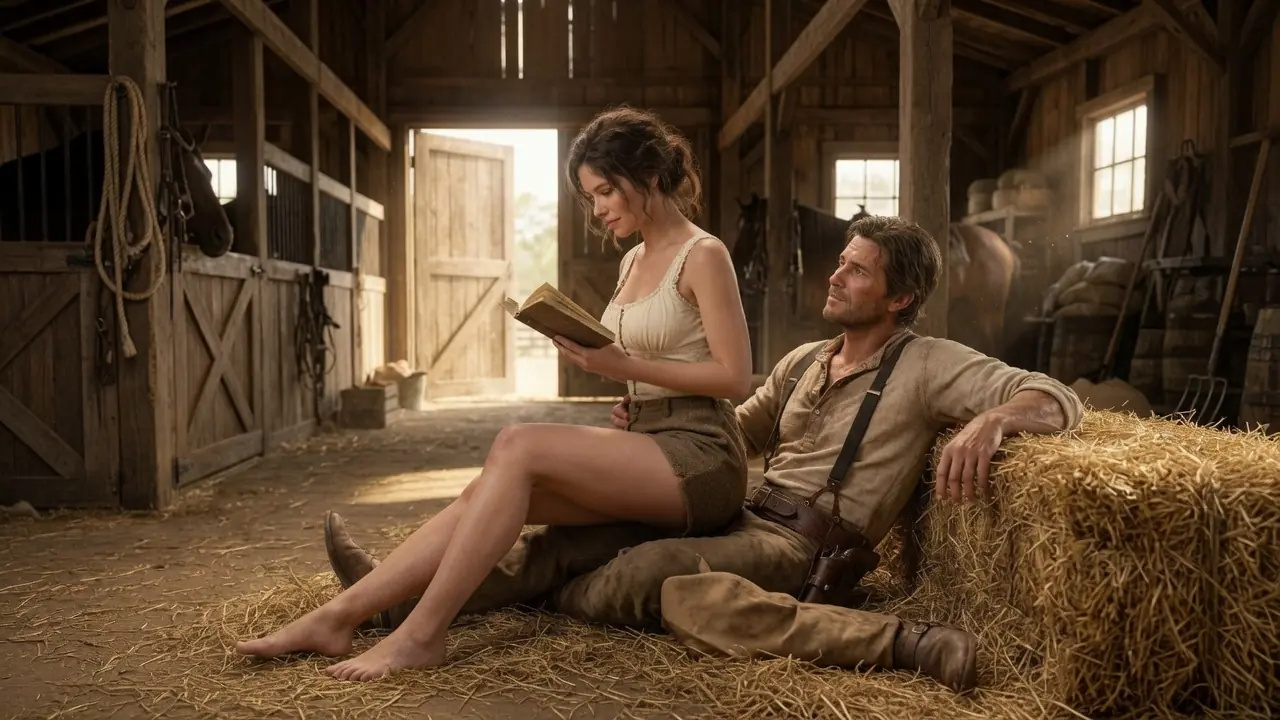
Caleb’s eyes widened as Clara climbed onto the stacked hay bale beside him, then lowered herself carefully onto his lap where he sat against the old support beam, not with shame, not with seduction, but with a desperate need to make him stop running from her. His hands lifted instinctively, hovering as if touching her might ruin them both. She placed one hand against his jaw, feeling the roughness of his stubble beneath her palm.
“Try me anyway,” she whispered.
Caleb’s breath broke.
“Clara.”
“No,” she said, trembling but steady. “Do not decide my courage for me. Do not hand me back to their lies because you think I am too fragile to choose the truth.”
His hands finally settled at her waist, careful and shaking. “If you choose this, you lose them.”
She leaned closer, forehead nearly touching his. “If loving you means losing their approval, Caleb, then let me lose it tonight.”
The words changed him. Not softly. Not easily. Something in his face cracked open, and behind it was a man who had been alone too long. He pulled her into his arms like a starving man accepting bread, holding her with fierce restraint while rain roared above them and the old barn guarded their secret.
For the first time, Clara understood that love could feel less like falling and more like standing in front of a loaded rifle without stepping aside. She held Caleb until his breathing slowed. Then she took the ledger and stood. Her legs shook, but her voice did not.
“We show this to the town,” she said.
Caleb rose slowly. “Your father will destroy you.”
“He can try.”
“He will say I turned you against him.”
“Then I will tell them he did that himself.”
They did not wait until morning. Clara knew waiting gave powerful men time to bury truth. The storm had softened to hard rain by the time they saddled two horses and rode toward town with the ledger wrapped beneath Clara’s coat. Caleb rode beside her, silent, watchful, every muscle ready for the fight ahead.
Black River’s town hall still glowed when they arrived. Augustus Whitmore was there with Preston Vale and half the county board, attending a land auction meeting that Clara had forgotten was scheduled. Perfect, she thought bitterly. Her father loved audiences when he controlled the stage.
They entered soaked with rain. Conversations stopped. Preston rose first, eyes narrowing at Clara’s wet dress and Caleb’s presence behind her. Augustus Whitmore turned from the front table, silver hair neat, vest buttoned, face calm in the way dangerous men looked calm before ordering someone else to bleed.
“Clara,” he said. “What disgrace is this?”
She walked forward and placed the leather ledger on the table.
His eyes flickered.
Only once.
But she saw it.
“This belonged to Mary Dawson,” Clara said clearly. “And it proves you stole the Dawson ranch.”
The room erupted. Preston laughed too loudly. Several board members shifted in their chairs. Augustus looked not at the book, but at Caleb.
“You,” he said coldly. “I should have known.”
Caleb stepped forward, rain dripping from his hat brim. “You did know. That’s why you kept me close enough to watch.”
Augustus’s face hardened. “You filled my daughter’s head with lies.”
Clara opened the ledger to the signed letter and turned it toward the room. “That is your handwriting.”
The sheriff, standing near the back, frowned and stepped closer despite himself. Men who had spent years nodding at Whitmore money leaned in because old ink has a way of making lies nervous. Preston tried to grab the book, but Clara slapped his hand away.
“Touch it,” she said, voice shaking with fury, “and I will make sure everyone in this county sees you helped bury it.”
Preston went pale.
Augustus stood slowly. “You foolish girl. You have no idea what you are doing.”
Clara looked at her father, really looked at him. Not as the man who bought her dresses, arranged her future, and kissed her forehead before guests arrived. As the man who had ruined a family, hidden the proof, and smiled over stolen land for twenty years.
“Yes, I do,” she said. “For the first time in my life.”
He walked around the table toward her. Caleb moved instantly, placing himself between them. The room tightened. Augustus stopped, his mouth twisting with disgust.
“Step aside, Dawson.”
“No.”
“That is my daughter.”
Caleb’s voice dropped low. “Then you should’ve treated her like she had a soul of her own.”
Augustus raised his hand.
Clara caught his wrist before Caleb could move. The room gasped. Her father stared at her in disbelief, as if her fingers around his arm were more shocking than any crime he had committed.
“You do not get to command me tonight,” she said.
His eyes burned. “You will regret this.”
“Maybe,” she answered. “But I will not kneel to a thief and call him father.”
That broke the room open. The sheriff took the ledger. The county clerk, old and nervous, admitted the handwriting matched records in the courthouse. One board member remembered Mary Dawson coming to town with papers before being turned away. Another remembered the judge receiving a new horse the same week the Dawson claim failed.
Truth did not arrive all at once. It came like rain through a weak roof, first one drop, then another, then enough to ruin everything hidden beneath. By midnight, Augustus Whitmore was no longer speaking. Preston had slipped out the side door. Clara stood beside Caleb with her hands cold, her heart pounding, and her old life collapsing behind her.
The legal battle lasted months. Augustus fought with every dollar and every connection he had left, but the ledger did what grief alone could not. It gave shape to the crime. It gave names to the betrayal. It gave the Dawson family back a voice.
Caleb did not ask Clara to stay with him during those months. That hurt her until she understood why. He wanted her choice to remain hers even after the storm, even after the romance of defiance faded into consequences. He gave her distance, and she hated him for it a little, loved him for it more.
Clara left the Whitmore house and moved into a small room above the town dressmaker’s shop. People stared. Some pitied her. Some called her ungrateful. Some women quietly squeezed her hand when no one important was watching. She learned that losing status did not kill a person, but living without truth nearly could.
When the court finally ruled that the Dawson land had been illegally seized, Caleb stood outside the courthouse without smiling. The western pastures, creek rights, and old barn were returned to his name. Augustus was forced to pay damages that emptied much of the Whitmore estate. Preston Vale announced his engagement to another woman within two weeks, proving Clara had lost nothing worth grieving.
That evening, Clara rode alone to the old barn. The sun was setting over the hills, turning the grass copper and the creek silver. Caleb stood near the doorway, hat in hand, staring at the land as if afraid it might disappear again if he breathed too hard. He turned when he heard her horse.
“You came,” he said.
Clara dismounted. “Did you think I wouldn’t?”
“I didn’t want to assume.”
She smiled faintly. “Still trying to choose for me?”
His mouth softened. “Trying not to trap you.”
She walked to him, boots brushing through dust and new grass. “Caleb Dawson, you are the most stubborn man in Black River County.”
“I’ve been told worse.”
She stopped close enough to touch him. “I meant what I said in this barn.”
His eyes searched hers. “A lot happened that night.”
“Yes,” Clara whispered. “You warned me you were too big for me.”
He looked down, almost embarrassed by the memory. “I was scared.”
“I know.”
“I still am.”
She reached up and placed her palm against his cheek, just as she had during the storm. “Try me anyway.”
This time, he did not hold back. He gathered her into his arms, not as a man taking what he had won, but as a man receiving what he had never believed life would allow him to keep. Clara held him just as tightly, her cheek against his chest, hearing the steady heartbeat she had once felt beneath torn hay and thunder.
A year later, the old Dawson barn was rebuilt, not polished, not made grand, but strengthened board by board. Clara worked beside Caleb until her hands blistered and healed harder. Town gossip faded into newer scandals. The land, patient as ever, accepted whoever cared for it honestly.
Augustus Whitmore never apologized. Clara stopped waiting for him to become a man he had chosen not to be. Sometimes grief came anyway, not for the father he was, but for the father she wished he had been. Caleb understood that kind of grief without needing it explained.
They married in the west pasture at sunset, under an arch made from old barn wood and wildflowers Clara gathered herself. No banker’s son stood near her. No stolen name gave her away. Caleb waited in a clean shirt, nervous as a boy, his large hands clasped before him like he still could not believe she was walking toward him.
When Clara reached him, he leaned close and whispered so only she could hear.
“Still too big for you?”
She smiled through tears, gripping his hands.
“Always,” she whispered back. “But I told you to try me anyway.”
And this time, with the Dawson land beneath their feet and the truth no longer buried under boards, Caleb Dawson laughed. Not loudly. Not for the whole town. Just enough for Clara to hear the sound of a man finally coming home.