“Take it or keep your old tractor.” Trent Morley tapped the laminated worksheet with one finger, wearing the relaxed grin of a salesman convinced the conversation was already over. Across the small desk inside Heartland Deere in Champaign, Illinois, fifty-eight-year-old farmer Earl Braddock stared at the number printed beneath the trade-in box: $12,000. His 2014 John Deere 7230R had only 3,840 hours, complete service records, and a private buyer had offered him $58,500 three weeks earlier.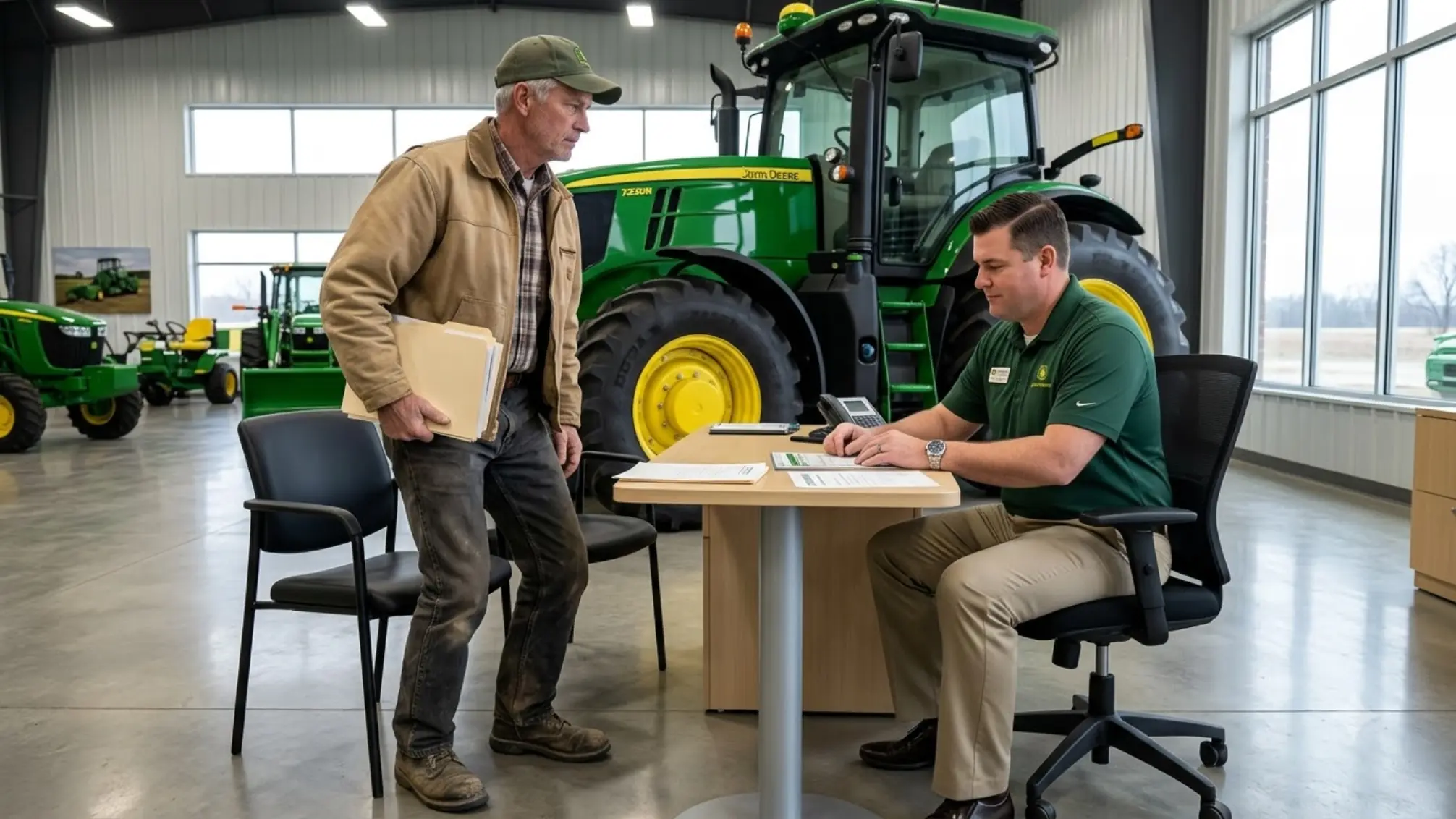
Earl slowly opened the manila folder on his lap and placed that private offer beside Trent’s worksheet. “Funny,” he said. “Someone offered me fifty-eight five.” Trent leaned back in his chair, his deep-green dealership polo perfectly tucked into pressed khakis, and gave Earl the kind of smile reserved for men he assumed needed him more than he needed them. “Then go sell it to him.”
Earl studied him for another moment. Behind Trent, a spotless green 7R tractor stood beneath the showroom lights like a monument to machinery, financing, and the belief that farmers would always return when planting season came around. Earl closed his folder and stood. “Remember that sentence when farmers stop walking through this door.”
He did not shout. He did not threaten Trent, ask for another manager, or demand that someone explain how a tractor worth somewhere around sixty thousand dollars had become worth twelve thousand the instant it crossed Heartland Deere’s property line. Earl simply walked outside, climbed into his 2017 Chevrolet Silverado 2500, and drove the forty-one miles back toward Gibson City without turning on the radio.
He had gone to Heartland Deere because he wanted a new 2023 John Deere 7R 230 listed at $289,500 before incentives. Farming had been good enough over the previous seasons that Earl believed he could justify replacing the 7230R, and trading it seemed easier than dealing with a private sale. He had checked online dealers, auction listings, and valuation guides before leaving home. Nothing he found prepared him for twelve thousand dollars.
Trent claimed the number came from a standard valuation algorithm. He said demand for pre-2015 row crop tractors had softened and that emissions changes made older machines harder to move. When Earl asked to see the data behind the figure, Trent called the information proprietary. Earl had spent too many years calculating seed costs, fertilizer rates, equipment depreciation, rent, fuel, and grain prices to mistake a bad number for complicated mathematics.
Eleven days later, Earl’s telephone rang at 6:52 in the evening. Gregory Hennessy was seventy-four years old and represented the family trust that owned 320 acres of prime corn ground east of Gibson City. Earl had rented those acres for eighteen consecutive years at $305 per acre, and his father had farmed Hennessy ground before him. Gregory had attended Earl’s father Walter’s funeral in 2018 and had shared coffee with the Braddock family more times than either man could count.
Gregory sounded uncomfortable. The Hennessy Trust would not renew Earl’s lease for 2023 because another operator had offered $355 per acre. Earl asked who the new tenant was, and after a long pause Gregory answered: DeWitt Farms. Earl thanked him quietly, hung up the telephone, and sat at the kitchen table while his wife Ruth came in from the living room and immediately understood from his face that something important had disappeared.
Eighteen years of farming ended in less than five minutes. The north ninety acres were where Earl’s son Nathan had ridden beside him in a tractor cab when he was seven, eating a ham sandwich before falling asleep against the cab post. The low ground near the creek was where Ruth had brought Earl supper during the brutal drought of 2012. Losing leased acreage was not the same as losing family-owned land, but eighteen years of sweat had given every field a memory.
At that moment Earl did not know the connection. His friend Tom Lindquist learned about the lost lease the following morning and began making calls because Tom possessed the dangerous combination of curiosity, patience, and decades of relationships in Central Illinois agriculture. By Sunday night he had filled three pages of a spiral notebook. What he placed before Earl on Monday morning changed the way the dealership conversation looked.
DeWitt Farms was a 2,800-acre operation controlled by Brett DeWitt. Brett’s daughter was married to Trent Morley, the Heartland Deere sales manager who had offered Earl twelve thousand dollars for the tractor. Even more significant, DeWitt Farms had purchased approximately $1.4 million worth of John Deere equipment from Heartland Deere during the previous eighteen months. The salesman receiving commissions on those purchases was Trent Morley.
Tom also obtained information from the Hennessy Trust’s land-management discussions. None of it proved that Trent had arranged the loss of Earl’s lease, and Earl refused to pretend it did. The Hennessy Trust had accepted a higher cash-rent offer, which was something landowners were legally free to do. Yet the connections were close enough to make Earl look again at that twelve-thousand-dollar worksheet.
“That’s why the trade was twelve,” Earl finally said. Tom did not answer immediately. Earl’s tractor deal could have been structured with a reasonable trade value, allowing him to purchase the new 7R and remain stronger financially, or it could be made so insulting that he walked away while Trent’s father-in-law continued expanding his acreage. Earl could not prove anyone had coordinated those events, so he made a decision that would define everything that followed.
He stopped doing business with Heartland Deere. No angry confrontation occurred inside the showroom. No social-media post carried Trent’s photograph, and no complaint was mailed to corporate headquarters in Moline. Earl simply decided that every dollar he controlled would go somewhere else.
He called the Peoria buyer who had previously offered $58,500 for the 7230R. The man was still interested, and Earl sold the tractor privately for the amount Trent had treated like a joke. Instead of buying Heartland Deere’s nearly $290,000 new machine, Earl purchased a used 2018 John Deere 6145R from a retiring farmer near Monticello for $74,000. It had fewer hours than expected, enough power for his reduced operation, and no financial relationship with Trent Morley.
Earl also moved his operating line away from Deere Financial to a regional lender. Parts orders shifted to other suppliers, warranty work disappeared from Heartland’s service department, and any purchase Earl could reasonably make outside Trent’s dealership went somewhere else. He told almost nobody why. To Earl, silence was not surrender when it came with a closed wallet.
The financial damage from losing the Hennessy lease was real. Earl still owned 320 acres and held two smaller leases totaling another ninety-six, leaving him with 416 acres to farm. His gross revenue dropped approximately thirty-one percent in 2023, and net income dropped around twenty-two percent. Ruth increased her hours at the clinic where she worked as a medical biller, while Nathan delayed an equipment purchase and put money back into the family operation instead.
Earl never told himself the loss was secretly a blessing. He wanted the Hennessy ground back, and seeing another operation plant fields his family had worked since 1978 hurt every time he passed them. When DeWitt Farms began working those 320 acres in spring 2023, Earl sometimes saw equipment moving across the soil from his own north fence line. He never stopped to watch, but he never looked away either.
Tom Lindquist noticed something else during 2023. Earl was not the only farmer who had walked into Heartland Deere expecting a reasonable trade value and come away staring at a number that seemed detached from the market. Tom started asking quiet questions at elevators, Farm Bureau meetings, repair shops, coffee counters, and equipment auctions. Farmers who had never compared stories suddenly discovered similarities.
One farmer had been offered dramatically below prevailing auction value for a well-maintained tractor. Another received a low offer and then lost a parts arrangement shortly afterward. A third watched a custom-harvesting relationship shift toward another operation connected to Heartland Deere’s business network. Individually, the stories could be explained as negotiations, market changes, coincidence, or ordinary rural business competition.
Together, Tom thought they deserved examination. By March 2024, his file contained information on twelve farmers whose combined trade-in offers were approximately $487,000 below what Tom believed fair market comparisons supported. He also documented secondary business disruptions that occurred within months of those attempted transactions. Tom still did not accuse anyone publicly because correlation was not proof, but he had collected enough numbers to make ignoring the pattern difficult.
Tom made copies. Plain manila envelopes began appearing in rural mailboxes between Gibson City and Monticello. There were no dramatic headlines, accusations, or demands, just documents arranged so farmers could read the numbers and reach their own conclusions.
One copy traveled farther than the others. Somehow it reached Derek Plankinton, John Deere’s regional field manager responsible for auditing dealer practices across a twelve-county Central Illinois territory. Tom never told Earl how he found Derek’s mailing information. Earl never asked.
Derek entered Heartland Deere on a Tuesday morning in late April 2024. He did not accuse Trent Morley of anything when he arrived and did not explain the file in his possession. Instead, he requested trade-in worksheets covering the previous two calendar years and began comparing them against corporate valuation records. For six hours, the dealership watched a man whose job depended on numbers ask increasingly specific questions about numbers.
The variance was significant. According to the later review described in the records Tom collected, twenty-three percent of Trent’s trade valuations fell more than thirty percent below corporate standard algorithm figures. One low trade could be negotiation. Several could be aggressive sales practice. A repeated statistical pattern demanded a more serious answer.
On May 12, 2024, Trent Morley was removed as Heartland Deere’s sales manager. He was not immediately fired; instead, he was demoted to sales associate, transferred to a smaller dealership in southern Illinois, and required to complete forty hours of corporate ethics and valuation training. By July, Trent resigned.
Earl learned about the demotion from Tom. He was greasing equipment when his friend drove onto the farm and handed him a photocopy of the information. Earl read it once, folded the paper, and returned it.
“That it?” Tom asked. Earl wiped grease from his fingers. “What else am I supposed to do?”
“You could enjoy it a little.” Earl looked across the yard at the used 6145R. “I lost 320 acres, Tom. Him losing a desk doesn’t put corn back on my ground.”
That answer stayed with Tom. Earl had never been trying to destroy Trent. He had wanted a fair tractor deal and to keep farming ground his family had cared for for decades. Accountability could expose wrongdoing, but it could not rewind a lease termination.
Heartland Deere owner Ron Becksted eventually sent personalized letters to twelve farmers acknowledging concerns about valuations. Each letter offered a $10,000 credit toward a future equipment purchase or service work. Earl kept his letter in a drawer with other farm records. He never used the credit and never returned to the dealership.
Gregory Hennessy called Earl again in August 2024. He apologized and explained that members of the family trust had pushed for the higher $355-per-acre offer because they wanted more income from the property. Earl told Gregory he understood. He did not ask for the lease back because the contract with DeWitt Farms remained in place.
Some people expected Earl’s refusal to return to Heartland Deere to disappear once Trent was gone. Instead, neighboring farmers had already begun making their own decisions. Nineteen shifted parts purchases either to an online supplier in Moline or to a smaller dealership willing to compete aggressively for independent farmers’ business. Filters, hydraulic fluid, belts, bearings, wear parts, service calls, and seasonal emergency purchases moved one order at a time.
Hank Oberlin and Dave Kessler organized an informal Farm Bureau buying pool. Fourteen farmers combined orders so smaller operators could qualify for commercial pricing usually available only to larger customers. During its first twelve months, the group handled more than $200,000 in purchases. Heartland Deere was no longer the automatic destination simply because its green sign stood closest to their farms.
Between spring 2024 and spring 2025, Heartland Deere’s parts revenue from Ford and McLean County dropped by roughly $300,000. Nobody organized a formal boycott, and Earl never asked another farmer to stop buying there. Farmers simply shared information, compared numbers, and began treating loyalty as something a business had to earn instead of inherit.
That change mattered more than Trent’s resignation. Rural businesses often survive on relationships built across generations. A farmer may buy parts from the same counter his father used and finance equipment through people who attended family funerals, weddings, auctions, and county fairs. Once trust breaks in that kind of community, rebuilding it requires more than a rebate printed on dealership letterhead.
The Hennessy acres never returned to Earl. DeWitt Farms continued operating them, and Brett DeWitt sometimes drove a new John Deere 8R 410 across fields Earl knew as well as his own kitchen. Earl encountered Brett several times at the cooperative and county elevator afterward. Neither man ever discussed Trent Morley.
Earl understood that silence could say different things. Sometimes silence was fear, sometimes restraint, and sometimes simply recognition that words could not restore what had already been lost. He had no evidence proving Brett personally arranged anything against him, so he refused to accuse him. Earl believed a man could be angry without becoming careless with the truth.
His farm remained smaller. At 416 acres, it could support Earl and Ruth but not comfortably support another full household, which meant Nathan postponed returning to farm full-time. Ruth continued working at the clinic. Those were not satisfying consequences for a story that might otherwise be told as a clean victory.
Earl did not win his land back. The truth did not produce a dramatic courtroom order returning the 320 acres. Gregory’s apology did not erase the spring morning when Earl first saw another operator’s equipment crossing soil he had managed for eighteen years.
But Earl kept something else. He kept the $58,500 the Peoria buyer paid for the 7230R instead of handing a roughly $46,000 valuation advantage to Heartland Deere. He kept control over where his financing, parts, and service dollars went. Most importantly, he kept the refusal he made when Trent expected him to accept whatever number appeared on the laminated sheet.
The used 2018 John Deere 6145R eventually passed 4,800 hours. It still started reliably and handled Earl’s planter in spring, grain cart in fall, and whatever other work he asked of it. It lacked the showroom shine of the nearly $290,000 tractor Trent had hoped to sell him, but Earl had stopped confusing newer machinery with a better deal.
Every October 3, Earl noticed the date. He never circled it on a calendar, celebrated it, or told Ruth that another anniversary had arrived. He simply remembered walking into Heartland Deere carrying complete service records and sitting across from a salesman who believed twelve thousand dollars was a number Earl would swallow because buying the new tractor mattered more to him than being treated fairly.
Trent had laughed when Earl placed the $58,500 private offer beside his worksheet. “Then go sell it to him.” Earl had done exactly that.
The sentence Trent probably expected Earl to forget ended up defining what happened next. Earl sold privately, financed elsewhere, serviced elsewhere, and kept farming. Other farmers eventually looked at their own numbers and made similar decisions.
Heartland Deere lost hundreds of thousands of dollars in annual parts business. Trent stopped selling tractors in Central Illinois. Earl still lost the lease he loved, and he never pretended otherwise.
Yet each morning the 6145R started, Earl climbed into the cab and went back to work. From the north edge of his property he could sometimes see green machinery moving across the Hennessy ground, and there were days when that sight still tightened his jaw. Then he turned his tractor toward the 416 acres that were still his responsibility and kept moving.
Because the number on Trent’s worksheet had never really been about a tractor. It was about whether Earl would allow someone else to decide the value of something he knew better than they did.
He refused.
And in a farming county where news traveled slowly but completely, nineteen other farmers eventually decided that refusal was worth more than any dealership discount.