On a freezing January morning in 1979, Eldon Carver pushed open the glass door of Pruitt’s John Deere dealership in Plattsmouth, Nebraska, carrying seventeen dollars in his pocket and a question he had rehearsed since sunrise. The showroom floor shone beneath rows of fluorescent lights, and a brand-new green tractor sat in the center like a monument to a world that men such as Eldon were permitted to admire but not touch. His faded winter coat was held closed with a safety pin because the zipper had broken months earlier, and the brown work cap in his hands was stained by years of grease and dust. He stood quietly near the service counter until the owner finally acknowledged him.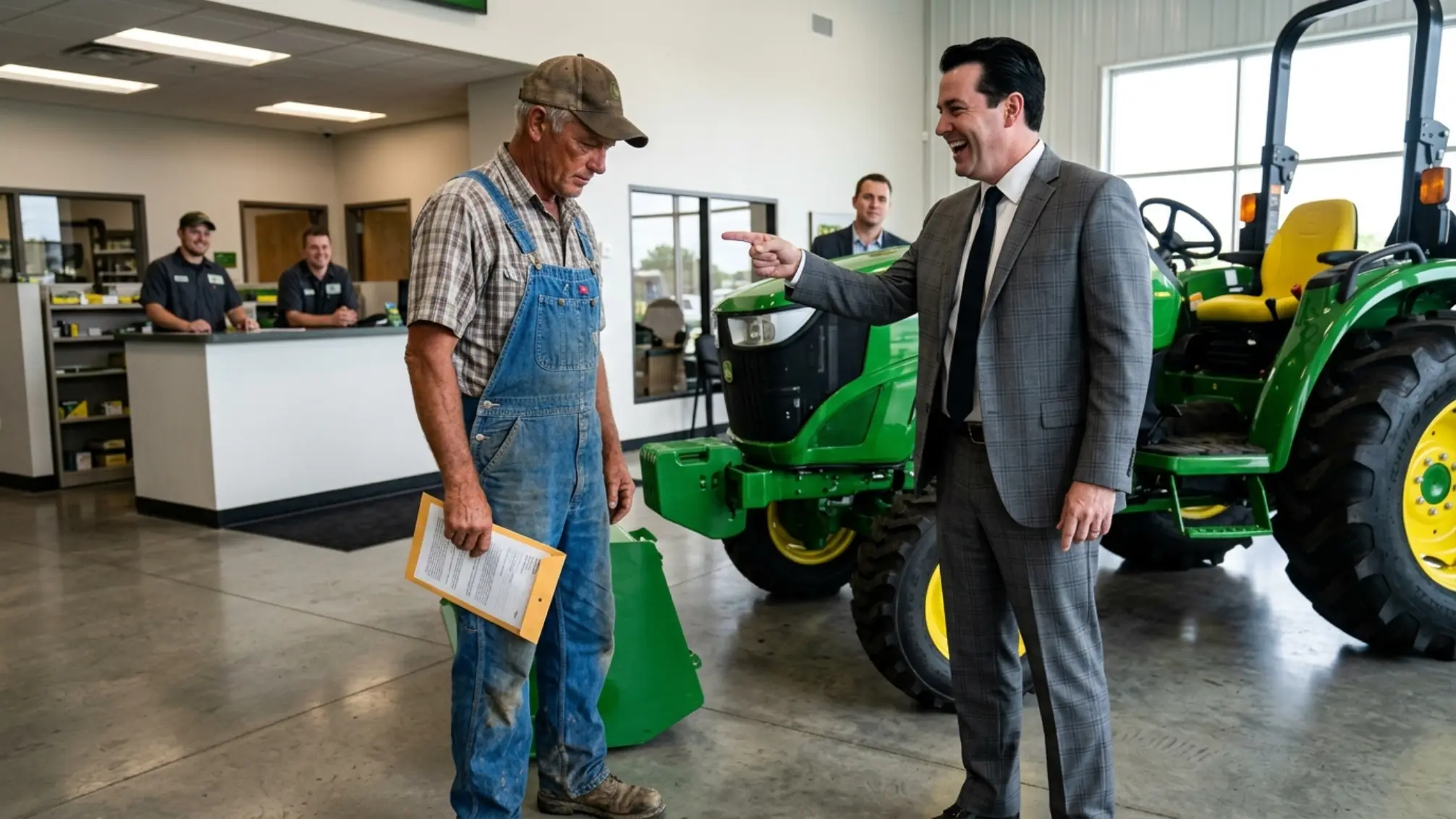
Dale Pruitt wore a tailored gray suit, polished shoes, and the comfortable smile of a man who had inherited both a successful business and the belief that it would always belong to him. Two mechanics leaned against the counter behind him while another salesman completed paperwork nearby. Dale looked at Eldon’s worn boots, patched coat, and rough hands before asking what he wanted. Eldon explained that he needed a dependable tractor before spring planting and wanted to know whether the dealership offered financing.
Dale did not reach for an application.
He pointed at Eldon and laughed.
“Poor men don’t buy John Deere,” he said loudly enough for everyone in the service department to hear. “You’re wasting my time.”
The mechanics smiled. One looked down to conceal his amusement, but the damage had already been done. Eldon put his cap back on, thanked Dale for the answer, and walked out without defending himself.
Cold wind struck his face as he crossed the parking lot. Behind him, the laughter continued for several seconds before the glass door closed and silenced it. Eldon climbed into his aging Chevrolet pickup, but he did not start the engine immediately. He sat with both hands on the steering wheel, looking through the windshield at the new tractors lined up beneath the dealership sign.
He had not asked for charity. He had not demanded special treatment. He had asked for the opportunity to work, pay his debt, and save the farm his family had held for nearly half a century.
Dale had seen only the coat.
He had not seen the land, the skill, or the patience inside the man wearing it.
Eldon was twenty-six years old when he returned home to Cass County after his father suffered a severe stroke. Raymond Carver had farmed the same two hundred eighty acres for more than thirty years, growing corn and soybeans on ground first broken by Eldon’s grandfather during the Great Depression. Raymond had resisted the expansion fever that swept across Nebraska during the early 1970s. While neighbors purchased more acreage with borrowed money, he kept the farm small, maintained his equipment, and warned Eldon that good years often convinced men bad years would never return.
Even Raymond’s caution had not protected them completely. Hospital expenses, operating loans, and several poor harvests left the farm carrying forty-one thousand dollars in debt. Their only reliable tractor was a 1966 John Deere 4020 with a cracked engine block that Raymond had patched repeatedly. It coughed smoke each morning and leaked enough oil to stain the machine-shed floor black.
Eldon had worked in an equipment-repair shop in Kearney before coming home. He understood engines, hydraulics, and electrical systems in a way that felt instinctive. He could often identify a mechanical problem from sound alone, and local farmers had brought broken machines to the Carver farm since he was a teenager.
But skill did not replace capital.
The 4020 needed work, planting season was approaching, and no bank wanted to extend another loan to a young farmer already responsible for his father’s debt. That was why Eldon entered Pruitt’s dealership.
After Dale turned him away, Eldon drove forty miles south to a dealership in Nebraska City. He purchased the engine parts he needed with most of his savings and hauled them home in the bed of his pickup.
For six nights, he worked inside the unheated machine shed. Temperatures fell into the teens, and his breath formed white clouds above the open engine. A trouble light hung from a beam while a small space heater warmed little more than his boots.
Eldon removed the damaged block, rebuilt the engine, replaced worn seals, and repaired the cooling system. By the end of February, the old tractor started on its second attempt. It smoked and rattled, but it ran.
He used it to plant every acre that spring.
During those long days in the field, Eldon noticed something happening across the county. Farmers who had borrowed heavily during the export boom were beginning to struggle. Interest rates rose, crop prices softened, and banks that once encouraged expansion started demanding payments.
Farm auctions appeared in newspapers almost every week.
The advertisements were tragic for the families selling, but Eldon saw an opportunity no dealership seemed interested in pursuing. Expensive machines were being sold cheaply because they needed repairs or because buyers had become afraid to spend money.
In May, Eldon attended an auction south of Weeping Water. A John Deere 4430 sat near the machine shed with faded paint and a hydraulic failure that had left it in a field throughout winter. The auctioneer described it as partially operational. Most serious buyers had already left after the land and livestock were sold.
Eldon purchased the tractor for forty-two hundred dollars.
He borrowed a flatbed trailer, hauled it home, and diagnosed the problem before dinner. A damaged fitting had allowed air into the hydraulic system. The repair cost less than three hundred dollars.
Three weeks later, Eldon sold the tractor to a farmer in Otoe County for seventy-eight hundred dollars.
The profit was more money than he had earned during an entire season at the repair shop.
He did not celebrate. He placed most of it against the farm debt and used the remainder to attend another auction.
By 1981, Eldon had bought, repaired, and sold seventeen tractors. Some were John Deere, others International Harvester or Allis-Chalmers, but every machine received the same treatment. He examined it carefully, calculated the repair costs, and refused to purchase anything he did not understand.
He also made himself one promise.
He would never exploit a farmer simply because the man was desperate.
If a tractor was worth twenty thousand dollars to him after accounting for repairs, transportation, and risk, he offered twenty thousand. He did not offer twelve merely because a bank deadline forced the seller to accept it.
The rule cost him money on some deals.
It earned him something more valuable on all the others.
Word spread that Eldon Carver dealt honestly.
Farmers facing liquidation called him before advertising their equipment. Men looking for dependable used tractors asked what he had in the shop. Eldon still operated from the family farm, answered the telephone in his kitchen, and repaired equipment inside the same building where he had rebuilt the old 4020.
Yet his reputation traveled farther each season.
The transaction that changed his business began with Howard Greer, a sixty-one-year-old farmer east of Louisville. Howard’s bank had called his operating loan, and unless he raised money within sixty days, he would lose everything.
Inside Howard’s machine shed sat a John Deere 4840 with a failed turbocharger, a combine requiring major feeder-house repairs, and a nearly perfect planter. The bank expected the three machines to bring no more than thirty-five thousand dollars at auction.
Eldon inspected them for nearly three hours.
Then he sat in his truck, completed his calculations, and returned with an offer of forty-four thousand dollars. He could provide ten thousand immediately and the remainder within sixty days.
Howard stared at him.
“You know I’d take less,” he said.
“I know.”
“Then why offer that much?”
“Because that’s what they’re worth to me.”
Howard accepted.
Eldon repaired the 4840 for less than a thousand dollars and sold it to a wheat farmer who urgently needed a heavy tractor. He rebuilt the combine, sold the planter separately, and cleared enough profit to complete Howard’s payment before the deadline.
Howard lost his farm, but he did not leave empty-handed.
Throughout that winter, he told everyone at the Plattsmouth diner what Eldon had done. He explained that the younger man could have taken advantage of him but chose fairness instead.
Calls to the Carver farm doubled.
By 1984, Eldon no longer searched only for individual tractors. Farmers hired him to assemble entire lines of equipment. He traveled through Nebraska, Iowa, Kansas, and South Dakota, buying machines others overlooked and rebuilding them until they were ready for years of work.
One Cass County farmer asked Eldon to replace every major machine on a twelve-hundred-acre operation. Eldon delivered a complete set of dependable late-1970s equipment for almost forty percent less than the cost of buying new.
That farmer told two friends.
Those friends told others.
In 1985, Eldon constructed a forty-by-sixty-foot repair shop behind the farmhouse. He hired Roy Diedrich, a fifty-two-year-old diesel mechanic whom Pruitt’s dealership had dismissed during budget cuts.
“What would I be doing?” Roy asked.
“Fixing machines other people gave up on.”
“What’s the pay?”
“Better than Pruitt’s.”
Roy began Monday morning.
Eldon continued buying his parts in Nebraska City. He still refused to enter the dealership in Plattsmouth.
While Eldon’s business expanded quietly, Dale Pruitt’s dealership moved in the opposite direction.
Dale inherited the company from his father in 1971, when new-equipment sales were strong and farmers believed land values would rise forever. He enlarged the showroom, ordered expensive inventory, purchased a lake house, and replaced his pickup every two years.
He believed the dealership’s name guaranteed loyalty.
Then the agricultural crisis arrived.
Interest rates rose above fifteen percent, land values collapsed, and farmers stopped buying new machines. Tractors remained on Dale’s lot while financing charges accumulated. The dealership carried too many parts, too much new inventory, and a service department weakened by repeated layoffs.
Dale dismissed experienced mechanics to reduce costs. Repairs took longer, customers waited weeks for parts, and farmers who once visited Pruitt’s automatically began calling Eldon instead.
Dale heard the name Carver occasionally.
He never connected it to the young man with the safety-pinned coat.
Why would he remember someone he had considered unimportant?
In 1986, Pruitt’s bank was acquired by a regional institution from Omaha. New executives reviewed the dealership’s debt and ordered Dale to reduce his inventory exposure within twelve months.
The demand was painful but survivable.
Dale made it disastrous.
He sold new machines below sustainable margins, cut the service department again, and replaced knowledgeable parts employees with inexperienced workers willing to accept lower wages. Customers encountered empty shelves, delayed repairs, and staff members who could not distinguish between components for different tractor models.
Eldon’s shop had the opposite reputation.
His mechanics answered questions immediately. Machines arrived when promised. Farmers received honest explanations about what could be repaired and what should be replaced.
By 1988, Carver Equipment had four employees, two workshop buildings, and customers across seven counties. Eldon offered fully rebuilt tractors with written warranties. At a time when new machines cost nearly sixty thousand dollars, he sold dependable rebuilt equipment for almost half that amount.
Orders exceeded his capacity.
He still worked beside his mechanics.
He still drove a used pickup.
He still remembered Dale’s laughter.
That memory did not make Eldon angry anymore. Anger burned quickly and demanded immediate satisfaction. Eldon’s memory had become something colder and more useful.
It reminded him how customers should never be treated.
He established an unwritten rule that a farmer facing planting or harvest problems received same-day attention whenever possible. He provided payment plans without humiliation and taught every employee to judge the machine before judging the person standing beside it.
Then Roy brought him unexpected news.
“Pruitt’s is worse than people realize,” the mechanic said one evening. “The bank may not renew the full credit line.”
Eldon said nothing at first.
He had already begun studying the dealership’s position. Through public filings, industry contacts, and conversations with an Omaha attorney, he learned the value of the real estate, inventory, franchise rights, and outstanding debt.
The business was worth far less than Dale believed.
It was also worth more to Eldon than it would be to most buyers.
The dealership had a large service building, established territory, and authorization to sell new equipment. Combined with Eldon’s used-machine network and reputation, it could become the strongest agricultural-equipment business in the region.
In March 1989, Dale’s attorney received a formal inquiry from an unnamed buyer.
The proposal included purchasing the property, assuming the remaining floor-plan debt, acquiring the parts inventory at appraised value, and applying for transfer of the dealership franchise.
Dale demanded the buyer’s identity.
The attorney refused to disclose it until a letter of intent was signed.
Dale waited one week before agreeing.
He believed the purchaser would be a corporation from Omaha or a wealthy dealership group expanding from another state. He never imagined the buyer lived only a few miles away.
The transaction required fourteen months of reviews and negotiations. The manufacturer examined the buyer’s finances, operational history, business plan, and regional reputation.
The report described a debt-free company with eleven years of profitable growth, skilled employees, and exceptional customer loyalty. Several industry contacts praised Eldon before anyone asked them directly.
Approval arrived in the spring of 1990.
On the morning of the closing, Eldon drove into Plattsmouth in a clean but ordinary Chevrolet pickup. He wore dark trousers, a white shirt, a brown jacket, and the same work cap he used around the shop.
Inside the dealership, the fluorescent lights still reflected across the polished floor. A green tractor stood in nearly the same location as the machine Eldon had admired eleven years earlier.
Dale waited beside the service counter in an expensive gray suit.
When Eldon entered, Dale smiled automatically.
Then the smile disappeared.
Recognition came slowly.
The worn coat.
The cap held in rough hands.
The young farmer asking about financing.
The laughter.
“Carver,” Dale said.
Eldon placed a thick document envelope on the counter.
Dale looked at it, then at him. “What are you doing here?”
“I remember you saying poor men don’t buy John Deere.”
Dale stepped closer, his face reddening. “Then you should have learned not to come back.”
Several employees stopped working.
Eldon met his stare.
“I didn’t come for a tractor,” he said. “I came for your dealership.”
The room became silent.
Dale’s attorney entered from the conference office, followed by Eldon’s lawyer, a title representative, and the regional dealership official. The final ownership documents were placed on the table.
Dale looked from one face to another.
“You’re the buyer?”
Eldon removed his cap. “Yes.”
“This is some kind of revenge?”
“No.”
“You expect me to believe that?”
“I expect you to sign what you already agreed to sell.”
Dale’s hands tightened. “You’ve been waiting eleven years for this.”
“I’ve been working eleven years.”
The difference left Dale with no answer.
They entered the conference room.
Eldon reviewed every page before signing. He assumed the remaining debt, purchased the building and inventory, and received control of the franchise effective immediately.
He shook hands with the title representative, the regional official, and both attorneys.
Then he extended his hand toward Dale.
Dale hesitated before taking it.
“You remembered me,” he said.
“I never forgot.”
Eldon released his hand and walked through the showroom. Employees watched the new owner cross the same polished floor where he had once been dismissed as too poor to belong.
Outside, he climbed into his pickup and drove toward the farm.
When his wife asked how the closing went, Eldon said only, “It went fine.”
The new sign appeared two months later.
CARVER FARM EQUIPMENT — SALES AND SERVICE
Roy Diedrich became the first service manager. Eldon rehired experienced mechanics Dale had dismissed and expanded the repair department to six bays. He stocked new equipment carefully, refusing to repeat the debt-driven mistakes that destroyed the previous business.
Used machines remained central to the operation.
Eldon believed farmers deserved choices rather than pressure.
Within eighteen months, Carver Farm Equipment became one of the highest-volume dealerships in the regional territory. Five years later, it ranked first.
Eldon offered health insurance and a retirement plan to mechanics when most rural shops provided neither. He trained parts employees to answer questions instead of simply reading numbers from catalogs. When struggling farmers arrived wearing worn coats or muddy boots, nobody laughed.
A few weeks after the new sign appeared, Dale returned for personal belongings left in the back office. He collected two boxes and paused near the showroom entrance.
Eldon stood behind the parts counter.
“I don’t expect you to believe me,” Dale said, “but I didn’t mean it the way it sounded.”
Eldon looked at him.
“I know.”
Dale waited, perhaps expecting forgiveness, accusation, or a speech about justice.
Eldon offered none.
Dale left.
The dealership remained in the Carver family for decades. Eldon eventually allowed the showroom floor to be refinished, though employees said he resisted the change longer than necessary. He wanted to remember how the original tiles looked beneath his worn boots on that January morning.
The memory kept him honest.
It reminded him that the poorest-looking customer might possess the skill to build an empire, the patience to outlast humiliation, or the character to hold open a door that had once been slammed in his face.
Dale had believed wealth determined who belonged inside the dealership.
Eldon proved something different.
He entered the first time with seventeen dollars, a broken zipper, and a desperate question.
He returned eleven years later carrying the papers that gave him the whole building.