“You wasted your savings on the worst tractor here because you’re a child pretending to be a mechanic.”
Travis Coker stood between fourteen-year-old Cole Hardigan and the faded 1959 Massey Ferguson 65, holding a paper coffee cup as if he owned both the auction yard and every machine inside it. The tractor’s red paint had faded almost brown, its steering wheel was cracked, and a hand-painted sign tied across the seat read PARTS ONLY — DOES NOT RUN. Behind Travis, several experienced dealers watched with amused expressions, waiting to see whether the boy would cry, argue, or finally admit he had made a foolish mistake.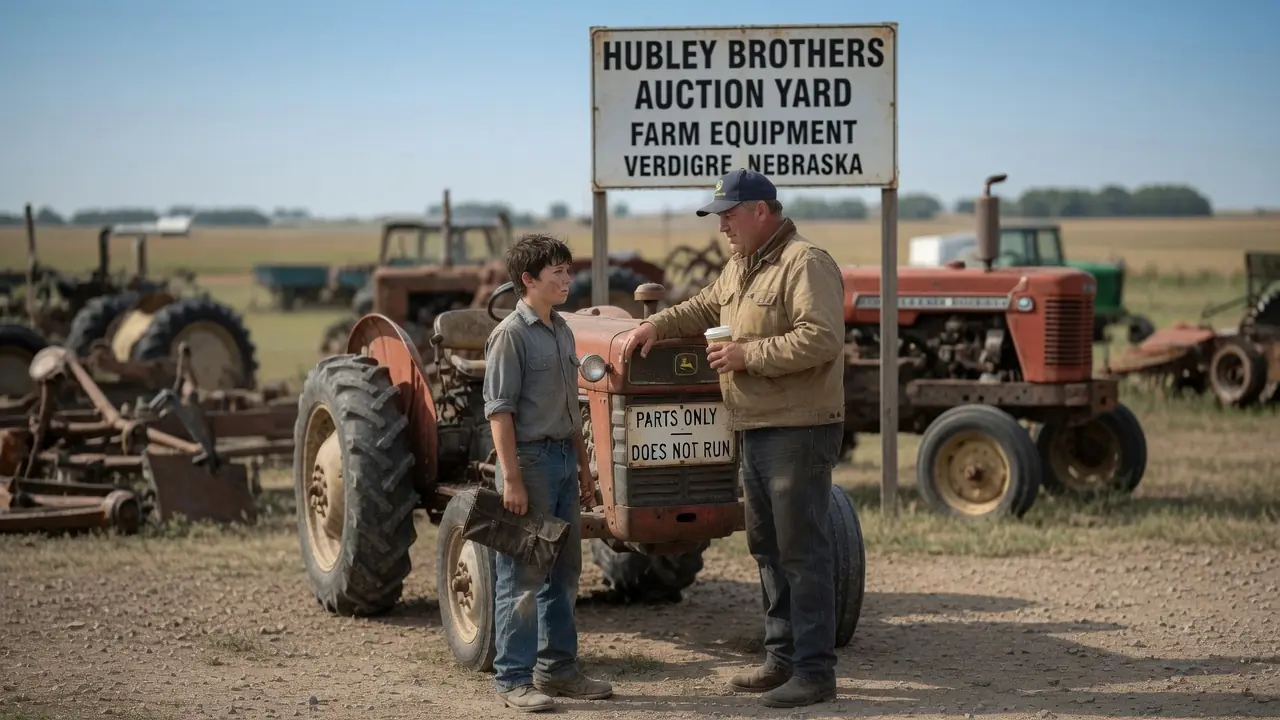
Cole removed the dark leather tool roll from his shoulder. “You called it worthless because you were too lazy to open the hood.”
The laughter around them became louder.
Travis’s smile hardened. He was fifty-two years old and had been buying tractors since before Cole’s parents met. “When it stays dead, I’ll buy it from you for scrap and send you home crying.”
Cole knelt beside the tractor and untied the leather strap around his uncle’s tools. “Keep your money. When this engine starts, everyone here will know which one of us is the amateur.”
The laughter stopped for only a second before returning even louder.
That morning in September 1987 had begun before sunrise. Cole had left his family’s small Nebraska farm at six o’clock, riding a borrowed ten-speed bicycle nine miles down a dark county road. A flashlight was tied to the handlebars, a thermos of coffee rested inside a canvas bag, and his late uncle Russell’s tool roll was secured across the rear rack with two bungee cords.
Cole had one hundred twelve dollars in the front pocket of his father’s old jeans.
He had earned every dollar himself by repairing lawnmowers, sharpening blades, stacking hay, and cleaning machinery for neighboring farmers. His mother believed he was riding to the auction only to watch. His father knew Cole intended to bid on something, but assumed the boy would spend ten or fifteen dollars on a box of hand tools.
Neither of them expected him to purchase a tractor.
Cole had studied the printed auction catalog for almost two weeks. Most of the machines were far beyond his budget, including a clean John Deere 4020 expected to sell for more than nine thousand dollars. The only lot within his reach was Lot Fourteen, the non-running Massey Ferguson described as suitable for parts.
The catalog contained no photograph of the engine.
That was why Cole arrived before anyone else.
At seven fifteen, he walked along the auction line while frost still covered the grass beside the gravel yard. He passed combines, corn headers, plows, and tractors waiting beneath the pale morning sky. When he reached Lot Fourteen, he inspected the tires, checked the oil, climbed onto the seat, and then opened the hood.
He saw the aftermarket fuel-filter housing immediately.
It was an old Fram unit with a false bleed screw cast into the top. To most mechanics, it looked like the proper place to remove trapped air from the fuel system. But the screw was decorative on that particular housing; it connected to no internal fuel passage.
Cole knew because Russell Hardigan had shown him.
Russell had been a diesel mechanic for more than forty years. He could identify a damaged bearing from its sound and diagnose a fuel problem by watching exhaust leave the stack. Farmers drove machinery from three counties away because Russell repaired only what needed repairing and never charged for work he had not performed.
Cole had spent nearly every Saturday in Russell’s garage from the age of six.
At first, he swept floors and cleaned tools. Later, he learned to adjust valves, rebuild carburetors, trace electrical faults, and recognize when someone had already tried to repair a machine incorrectly. Russell rarely delivered formal lessons; he simply explained what he was doing while Cole watched.
Two years earlier, a farmer had brought Russell another Massey Ferguson 65 that refused to start. Several mechanics had replaced the lift pump, cleaned the tank, and blamed the injection system. Russell loosened the fuel line directly at the injection pump, waited for the trapped air to escape, tightened it again, and started the tractor in less than fifteen minutes.
He placed the brass-handled wrench into Cole’s hand afterward.
“Most men look where the part tells them to look,” Russell said. “A mechanic looks where the problem actually is.”
Seven months later, Russell died from pancreatic cancer.
He left Cole the leather tool roll and everything inside it.
The morning of the auction was the first time Cole had seen the same filter housing since his uncle’s death. He did not know whether the tractor had additional mechanical problems, but several clues supported his suspicion. The engine oil contained no water, the fuel tank smelled fresh, and the starter had enough battery power to turn the engine.
Someone had likely run the tractor out of diesel, refilled it, and failed to bleed the system correctly.
Cole registered for bidder number thirty-eight.
By eight o’clock, the yard filled with farmers, dealers, collectors, and curious families. Pickup trucks lined the gravel road, many towing empty trailers for whatever their owners hoped to purchase. Men walked through the equipment rows with clipboards and coffee, judging machines in seconds before moving to the next lot.
Travis Coker arrived with two employees and a long gooseneck trailer.
He had owned Coker Farm Equipment for twenty-three years and built a reputation for buying undervalued tractors, cleaning them, and reselling them at impressive profits. He knew engines well enough, but his greatest skill was reading people. He recognized desperation, impatience, and pride, then used all three during negotiations.
Travis noticed Cole sitting alone on a fence rail.
He saw a short boy wearing oversized jeans, worn work boots, and a faded blue-gray shirt with sleeves rolled above the elbows. Engine grease marked Cole’s cheek, and his uneven dark hair appeared to have been cut at home.
Travis dismissed him instantly.
When auctioneer Bert Hubley reached Lot Fourteen, he asked for an opening bid of three hundred dollars. No one raised a paddle. He lowered the request to two hundred, then one hundred, and finally fifty.
Still, no one responded.
A few men laughed when Bert asked for fifty dollars a second time. The Massey Ferguson appeared too heavy to transport for the value of its salvageable parts. Even if the engine block was sound, dismantling and selling it would require time most dealers did not want to spend.
Cole raised his paddle. “Twenty-five.”
Heads turned toward him.
The first laugh came from somewhere beside the registration table. It spread through the crowd until even men who had not heard the bid began laughing because everyone else was doing it. Travis shook his head and smiled into his coffee.
Bert Hubley did not laugh.
He had called auctions for thirty-one years and learned that unusual bidders sometimes understood unusual equipment. He accepted Cole’s offer, asked for twenty-eight dollars, received no response, and brought down the gavel.
“Sold to bidder thirty-eight for twenty-five dollars.”
Cole walked directly to the tractor.
That was when Travis stepped in front of him and began humiliating him.
Cole did not answer the surrounding laughter again. He unrolled Russell’s tools across the tractor’s front wheel, selected the brass fuel-line wrench, and climbed beneath the engine. Gravel pressed into his shoulder blades while he reached toward the injection pump.
Several men followed.
At first, they expected entertainment. Then they noticed the confidence of his movements. Cole did not search blindly or turn random fittings. He placed the wrench on one specific line and loosened it a quarter turn.
Air hissed from the connection.
Diesel appeared in irregular drops against his wrist.
Cole waited.
The crowd drew closer as the drops became a steady stream. After thirty seconds, he tightened the fitting, wiped his hand, and slid out from beneath the tractor.
Travis looked at the filter housing. “The bleed screw is on top.”
Cole climbed into the seat. “That screw doesn’t lead anywhere.”
“You don’t know what you’re talking about.”
Cole pulled the decompression lever. “Then the tractor won’t start.”
He opened the throttle, checked that the transmission was in neutral, and turned the key.
The starter groaned.
The engine rotated once, then twice.
Someone laughed again, but this time the sound was nervous.
On the third turn, a burst of black exhaust shot from the vertical pipe. The Perkins diesel engine coughed violently, caught, and settled into a rough idle. Cole released the decompression lever and adjusted the throttle.
The idle smoothed.
A deep, steady mechanical rhythm filled the yard.
The auctioneer stopped speaking in the middle of Lot Seventeen. Buyers turned away from the machine currently being sold and stared toward the Massey Ferguson. Travis stood motionless with his coffee cup halfway to his mouth.
Cole watched the gauges for oil pressure and temperature. When both readings stabilized, he let the tractor run for another minute, then shut it off.
The sudden quiet felt heavier than the laughter had.
Cole climbed down and rolled up his tools.
Travis approached slowly. His expression no longer carried amusement. “What did you do?”
“I bled the fuel line at the injection pump.”
“The housing has a bleed screw.”
“Not a working one. It’s a Fram replacement housing. The screw is left from another casting, but there’s no passage behind it.”
Travis inspected the component and then looked back at Cole. “How did you know?”
“My uncle showed me.”
“Who was your uncle?”
“Russell Hardigan.”
Recognition moved across Travis’s face.
He removed his John Deere cap. “The mechanic from Norfolk?”
“Yes, sir.”
Travis stared at the tool roll in Cole’s hands. “Russell worked on a tractor for me years ago. Charged me less than everyone else and fixed a problem two dealerships missed.”
Cole nodded.
“I heard he died.”
“Last year.”
Travis lowered his eyes. “I’m sorry, son.”
“Thank you.”
For the first time that morning, Travis looked at Cole not as a child wandering through an adult world, but as someone carrying knowledge he had failed to recognize.
“What are you going to do with the tractor?”
“Take it home, repair it properly, and sell it.”
Travis glanced at the now-silent engine. A running Massey Ferguson 65, even in poor cosmetic condition, was worth far more than twenty-five dollars.
“I’ll give you fifteen hundred for it right now.”
A murmur passed through the nearby crowd.
Cole had one hundred twelve dollars that morning. Accepting Travis’s offer would multiply his savings immediately and eliminate the work of transporting or restoring the tractor. For a moment, the number fifteen hundred seemed impossibly large.
Then Cole looked at the rusted hood, cracked seat, and faded paint.
He saw not what the tractor was worth that morning, but what it might become after patient work.
“No, thank you.”
Travis studied him. “You sure?”
“Yes, sir.”
A small smile appeared beneath Travis’s gray beard. “That’s the right answer.”
The auction continued, but Cole no longer sat unnoticed on the fence rail. Dealers who had laughed now asked questions about the engine. One farmer offered him a ride home, while another gave him the name of a shop that could recore the damaged radiator.
Cole accepted the information but refused all offers for the tractor.
That afternoon, he rode home with the auction receipt folded in his pocket.
His father, Daniel Hardigan, was repairing a gate when Cole entered the yard. He looked at the empty bicycle trailer rack, then at the receipt his son held out.
“You bought something.”
“Yes, sir.”
“How much?”
“Twenty-five dollars.”
Daniel relaxed slightly. “What did you buy?”
“A Massey Ferguson 65.”
His father stared at him.
Cole explained everything while Daniel listened without interrupting. When Cole reached the part about starting the engine, Daniel put down the fencing pliers.
“You are telling me there is now a tractor sitting at Hubley Brothers with your name on it?”
“Yes, sir.”
“And you rode home on a bicycle because you have no way to bring it here?”
“Yes, sir.”
Daniel rubbed his face. “Your mother is going to find this very interesting.”
They hauled the tractor home the following morning.
Cole drove it carefully from the trailer into the equipment shed. In full daylight, the machine looked worse than it had at the auction. Rust had spread beneath the paint, several gauges were broken, the radiator leaked, and years of grime coated the engine.
His mother stood in the doorway with her arms crossed. “You spent your savings on that?”
“Only twenty-five dollars.”
“That sentence does not make it look better.”
Daniel opened the hood. “The engine sounds healthy.”
“The lift pump needs rebuilding,” Cole said. “And the radiator must be recored.”
His mother looked between father and son. “How long will this project live in my equipment shed?”
Cole hesitated. “Maybe a year.”
It remained there for fourteen months.
Cole worked after school, on weekends, and during winter evenings when the wind pushed snow against the barn doors. He began by cleaning decades of grease from the engine and frame. He replaced worn hoses, rebuilt the lift pump, repaired wiring, and removed the radiator for professional recoring.
Every decision required money.
Because Cole refused to ask his parents to finance the restoration, he accepted additional work from neighbors. He repaired snowblowers, mended fences, stacked feed, and serviced small engines. Every few weeks, he used part of his earnings to order another component.
His classmates mocked the project after hearing about it.
One boy asked whether Cole planned to drive the “twenty-five-dollar corpse” to school. Another said the tractor would fall apart before it reached the road.
Cole did not argue.
Russell had taught him that machines answered insults better than mechanics could.
By spring, the engine started reliably. By summer, the hydraulic system operated smoothly and the transmission shifted through every gear. Cole repaired the seat, replaced the steering-wheel grip, and restored the electrical system.
The paint remained the final challenge.
He removed every damaged panel, sanded the metal, treated the rust, and applied primer. His cousin owned a small body shop and allowed Cole to rent the spray equipment on Sundays. Slowly, faded brown-red steel became the original Massey Ferguson red and gray.
When Cole reassembled the tractor in March 1989, his parents stood outside the shed in silence.
The machine no longer resembled auction scrap.
It looked almost new.
His mother touched the polished hood. “I owe you an apology.”
“For what?”
“I thought you bought a problem.”
“I did.”
She smiled. “You turned it into something else.”
Cole advertised the tractor in a regional equipment paper. Within two weeks, a collector named Hans Roth drove from Wayne County to inspect it. Hans spent nearly an hour examining the engine, paint, hydraulic system, and restoration records.
“You did this work?”
“Yes, sir.”
“How old are you?”
“Sixteen.”
Hans started the engine and listened. “What are you asking?”
“Sixty-five hundred.”
Hans offered five thousand.
Cole declined.
They negotiated for twenty minutes and agreed on sixty-two hundred dollars.
When the collector’s trailer disappeared down the road carrying the Massey Ferguson, Cole felt an unexpected emptiness. He had spent more than a year learning every sound and imperfection of the machine. Selling it felt like watching proof of his uncle’s final lesson leave the yard.
Then his father handed him the bank deposit receipt.
After parts and expenses, Cole had earned more than five thousand dollars.
“What will you do with it?” Daniel asked.
“Buy another tractor.”
At the next auction, Cole purchased a non-running John Deere 3010 for one hundred forty-five dollars. The injection pump needed rebuilding, but the engine was sound. He restored and sold it for thirty-four hundred.
Then he bought another.
By the time Cole graduated from high school in 1991, he had restored seven tractors and one small combine. His savings exceeded thirty thousand dollars. While many classmates prepared for college, Cole purchased a small commercial garage in Norfolk.
The building stood only three blocks from the closed Massey Ferguson dealership where Russell once worked.
Cole named the business C. R. Hardigan Diesel Repair and Restoration.
The R stood for Russell.
Above his workbench, he placed the dark leather tool roll inside a handmade wooden display case. Beneath it, a brass plaque carried two lines:
RUSSELL HARDIGAN, 1922–1986
HE SHOWED ME THE TRICK.
Cole’s reputation grew quickly.
Farmers trusted him because he repaired causes instead of replacing parts blindly. He kept detailed notes, charged fair prices, and explained every problem before presenting the bill. Within three years, the garage expanded from one service bay to four.
One afternoon in 1994, Travis Coker entered the shop.
Age had softened his shoulders, but he still wore a navy John Deere cap. He brought a 1966 John Deere 4020 that refused to start and admitted two mechanics had already failed to diagnose it.
Cole found a cracked fuel-return line within twenty minutes.
The repair cost one hundred forty dollars.
Afterward, Travis remained beside the workbench drinking coffee. His attention settled on Russell’s tool roll hanging behind glass.
“I almost bid on that Massey Ferguson,” he said.
Cole wiped his hands. “No, you didn’t.”
Travis laughed quietly. “You’re right. I never even opened the hood.”
“No, sir.”
“I looked at the sign and thought I knew everything I needed to know.”
Cole glanced at the brass-handled wrench visible inside the display case. “Most people did.”
Travis removed his cap. “I was cruel to you that morning.”
“You laughed.”
“I did more than laugh. I wanted you to fail because it would prove my judgment was better than yours.”
Cole said nothing.
Travis continued, “Then you started that tractor, and for the first time in years, I realized experience can make a man careless. He stops inspecting because he thinks he already knows.”
“My uncle used to say knowledge is useful only until pride makes you stop learning.”
“That sounds like Russell.”
Travis looked around the busy shop. “You built all this from that twenty-five-dollar tractor?”
“Not from the tractor.”
“Then from what?”
Cole looked toward his uncle’s tools. “From what someone took the time to teach me.”
Travis nodded slowly.
Before leaving, he placed two hundred dollars on the counter despite the smaller bill. Cole tried to return the difference, but Travis refused.
“Consider it payment for the lesson I received at the auction.”
Cole accepted only the original amount.
“The lesson was free,” he said.
Years later, C. R. Hardigan Diesel Repair became one of the most respected restoration shops in the Midwest. Cole employed younger mechanics, including teenagers whom other shops considered too inexperienced to matter.
He taught them the way Russell had taught him.
He placed tools in their hands.
He showed them strange failures not described clearly in manuals. He explained why a machine behaved as it did, then made them repeat the repair until they understood.
Whenever a young mechanic rushed to replace an expensive part, Cole pointed toward the leather tool roll.
“Open the hood before you price the scrap,” he said.
The original Massey Ferguson occasionally returned to regional tractor shows. Hans Roth preserved it carefully and displayed a small card describing its restoration. The card never mentioned the men who laughed or the dealer who tried to purchase it.
It simply stated that a fourteen-year-old mechanic had bought the non-running tractor for twenty-five dollars and started it eleven minutes later.
At one show, Cole stood beside the tractor with his own twelve-year-old daughter, Grace. She ran her fingers along the polished hood and asked whether he had truly known it would start.
“I knew one reason it might not be starting.”
“But you could have been wrong.”
“Yes.”
“Were you scared?”
“Terrified.”
“You didn’t look scared in the story Grandpa tells.”
“People often look confident when they are concentrating too hard to show fear.”
Grace studied the engine. “Will you show me the trick?”
Cole opened the hood.
He pointed toward the replacement filter housing and explained the false bleed screw, the trapped air, and the fuel line at the injection pump. Then he placed the brass-handled wrench into her hand, just as Russell had once placed it into his.
The explanation lasted less than two minutes.
Its value could not be measured.
On a cool September morning many years earlier, an auction yard filled with experienced men had looked at a boy and a dead tractor and decided neither deserved serious attention. They possessed more money, more equipment, and more years in the trade.
Cole possessed one precise lesson given by a dying mechanic who loved him enough to explain what others had overlooked.
The men saw twenty-five dollars of scrap.
Cole saw a fuel line that needed bleeding.
And before their laughter had finished echoing across the gravel yard, the engine answered for him.