The little girl looked up at Jack Webb with eyes too tired for a child so small. Her face was streaked with mud, her brown dress was torn near the hem, and both of her tiny hands clutched the handle of an old broom as if it were the only thing keeping her standing. Behind her, tied carefully against her back in a faded cloth sling, a baby slept with his cheek pressed to her shoulder. The girl swallowed hard and whispered, “Thank you.”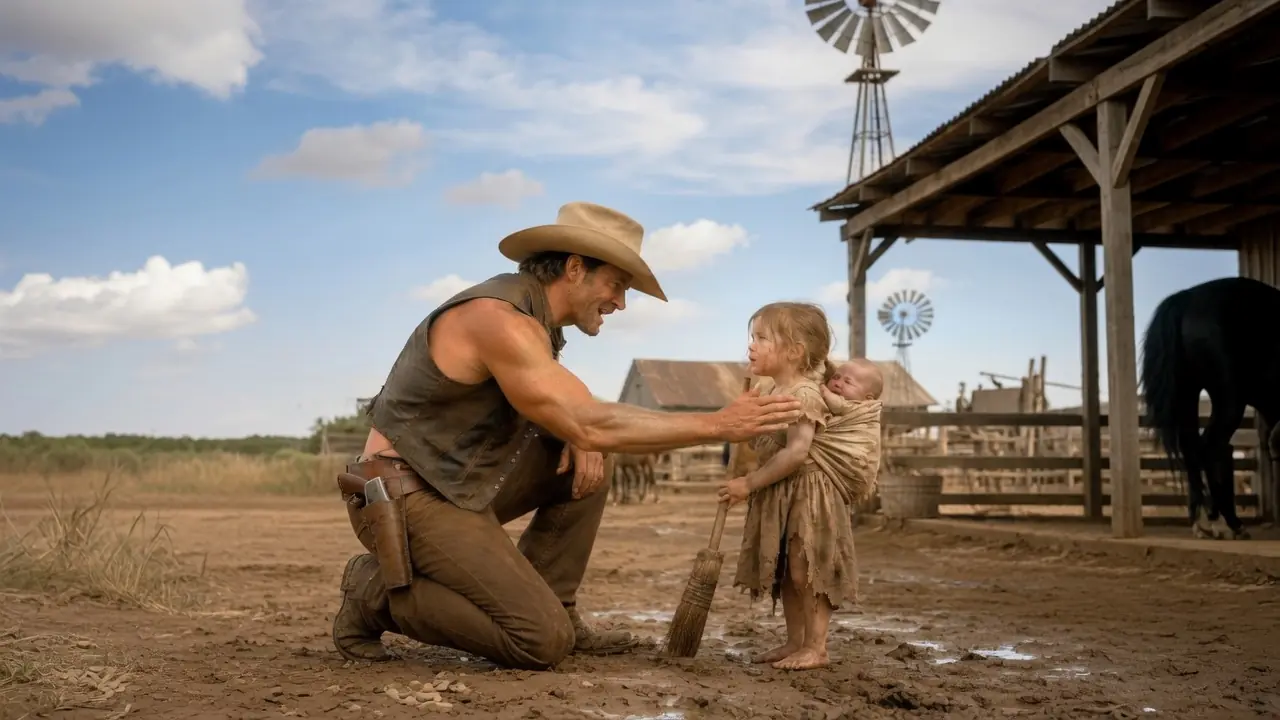
Jack crouched lower in the muddy yard so he would not tower over her. He was a tall man, broad from years of lifting hay bales, mending fence posts, and hauling water through winters that made even strong men quiet. The farm behind him sat alone outside Denver County, with a weathered barn, a leaning windmill, and a porch that had not heard a woman’s laugh since his wife passed three years earlier. He had seen hunger, grief, and fear before, but he had never seen all three standing in front of him wearing the face of a four-year-old girl.
“What’s your name, sweetheart?” he asked gently.
The little girl glanced toward the empty road before answering. “Emily.”
“And him?” Jack asked, nodding toward the baby.
She turned her head slightly, careful not to wake him. “Noah.”
Jack’s chest tightened at the way she said the baby’s name, not like a sister, but like a guard standing between danger and the only thing she had left. He looked at her bare ankles, her muddy shoes, and the red marks left by cold and walking. The storm from the night before had covered the plains in snow, though the afternoon sun had already begun melting it into dirty streams across the yard. No child should have crossed even one mile in that weather, much less with a baby tied to her back.
“Where did you come from, Emily?” Jack asked.
Her small mouth trembled. “From Aunt Clara’s.”
Jack had heard that name before. Clara Briggs lived closer to town, in a tall narrow house behind the mercantile, where people said children sometimes came and went without anyone asking enough questions. Jack did not like rumors, but he liked Clara Briggs even less. She smiled too quickly, spoke too sweetly, and looked at poor children the way traders looked at livestock before bidding low.
Emily shifted under the baby’s weight. “She said she was gonna take Noah away.”
Jack kept his face calm, though something inside him went cold. “Take him where?”
Emily shook her head. “I don’t know. She said he was little enough to forget me.” Her eyes filled with tears, but she did not let them fall. “She said nobody wants two children, but someone would pay for a baby.”
For a moment, the wind seemed to stop moving.
Jack reached out slowly, palm open, making sure Emily could see every movement. “You’re safe here,” he said. “No one is taking him from you today.”
Emily stared at his hand, then at his face. “Promise?”
Jack had made many promises in his life and broken some without meaning to. Weather broke promises. Banks broke promises. Death broke promises. But this one he could choose to keep with everything he had.
“I promise,” he said.
Only then did Emily let go of the broom.
Jack carried Noah first, gently loosening the sling from Emily’s shoulders while she watched with sharp fear. The baby stirred once, made a soft sound, then settled against Jack’s chest. He was lighter than he should have been. Emily swayed the moment the weight left her back, and Jack caught her before her knees touched the ground.
Inside the farmhouse, the stove still held a little heat from the morning fire. Jack set Noah in a padded wooden crate lined with blankets, the same crate he once used for kindling before his wife made him admit it looked more like a cradle. Then he sat Emily near the stove and wrapped one of his old wool coats around her shoulders. She looked swallowed by it, a tiny, solemn child in a farmer’s coat big enough to hide her whole body.
He warmed milk slowly so it would not upset the children’s stomachs. Emily watched every movement, never blinking for long. When he handed her a cup, she looked down into it as if milk were something rare. “For me?” she asked.
“For you,” Jack said.
She took a careful sip, then looked toward Noah. “He needs some too.”
“He’ll get some,” Jack promised. “You first.”
Emily drank because he told her to, but her eyes stayed on her brother. Jack had seen mothers look that way. He had seen wives, nurses, and widows look that way. He had never seen it in a child too young to tie her own bonnet properly.
By the time Noah woke, Jack had found an old feeding bottle in a box his wife had kept after helping a neighbor’s baby years earlier. He cleaned it, warmed the milk, and sat near the stove while Noah drank with small hungry pulls. Emily watched like a judge making sure Jack did it right. When Noah finished and gave a weak burp, she finally leaned back against the chair.
“You got any folks besides Clara?” Jack asked.
Emily’s eyelids fluttered. “Mama went to heaven. Papa too.”
Jack lowered his eyes. “I’m sorry.”
“Aunt Clara said crying wastes food.” Emily’s voice had gone soft from exhaustion. “So I don’t cry much.”
Jack looked toward the window, where the last strips of snow clung to the fence rails. His jaw tightened, but when he spoke, his voice stayed gentle. “In this house, you can cry if you need to.”
Emily did not cry then. She was too tired. Instead, she curled up on the chair under his coat and fell asleep with one hand stretched toward Noah’s crate.
Jack stood there for a long while, looking at the two children by his stove. The farmhouse had been quiet for years, filled only with the sounds of wind, wood, animals, and his own boots crossing the floor. Now a little girl and a baby breathed inside it, and the place felt changed so quickly it frightened him.
He knew Clara Briggs would come.
Women like Clara did not lose what they considered valuable and shrug it off. If what Emily said was true, Noah was not just a child to Clara. He was money. And money made people bold, especially when they believed no one would stand between them and the helpless.
Jack crossed to the wall and took down his coat. He needed help, and he needed it before dark. He wrote a quick note for his nearest neighbor, Harlan Webb, no relation by blood though people often mistook them for brothers. Harlan was older, sharper, and knew half the sheriff’s office by first name because he had once worn a badge before his knees gave out. Jack saddled his horse and rode hard across the thawing road.
Harlan listened without interrupting. He sat at his kitchen table with a pipe unlit between his fingers while Jack described Emily, Noah, Clara, and the girl’s words. When Jack finished, Harlan’s face looked carved from old wood. “Clara Briggs,” he said. “I knew trouble would finally crawl out from under that woman’s door.”
“You know something?” Jack asked.
“I know enough to send a telegram.” Harlan stood with effort and reached for his coat. “There’s been talk in Denver County. Private adoptions, cash arrangements, widows pressured, children moved before papers get checked. Folks whisper because they’re ashamed, scared, or paid to keep quiet.”
Jack felt anger rise hot in his chest. “They’re children.”
“Aye,” Harlan said. “That’s why wicked people like her choose them.”
They sent the telegram from a small relay office near the stage road. Harlan addressed it to Inspector Franklin in Denver County, a man he trusted from older days. The message was brief but urgent: two children found, Clara Briggs involved, possible illegal adoption activity, immediate assistance needed. Then Jack rode back through gathering dusk with the feeling that every shadow on the prairie had started watching him.
Emily was awake when he returned, sitting on the floor beside Noah’s crate. She had found a needle and was sewing a tear in the baby’s blanket with crooked concentration. Her tongue pressed lightly against the corner of her mouth. Noah lay beside her, kicking weakly and staring at the firelight.
“You were gone longer,” Emily said.
“Road was rough,” Jack answered, hanging up his coat.
She looked at him carefully. “You got that look again.”
“What look?”
“The one where your eyes go hard but your voice gets softer.”
Jack almost smiled despite everything. Sharp kid. Too sharp. He crossed the room and crouched beside her. “Harlan is helping us. He knows a man who can look into your aunt.”
Emily’s fingers stopped moving. “She in trouble?”
“I think so.”
“Real trouble?”
Jack nodded. “Real trouble.”
For the first time since arriving at the farm, Emily’s face changed in a way Jack did not expect. Not joy. Not safety. Relief. Tiny and fragile, like the first green shoot after a fire.
“She won’t like that,” Emily whispered.
“No,” Jack said. “I expect she won’t.”
The storm returned after midnight.
At first it was wind, screaming across the plains hard enough to rattle the shutters and make the old house groan. Jack woke instantly. Years on the farm had trained him to wake at wrong sounds, and this sound was wrong in a way that sat low in his gut. Then came a thud from the front porch.
Jack sat upright.
Another thud.
He pulled on his boots, crossed the room, and took the lantern from the hook. Emily appeared in the hallway wrapped in his coat, eyes wide, Noah bundled against her chest. “Is it her?” she whispered.
Jack placed a finger to his lips. “Stay behind me.”
He opened the door only a crack.
A shape stood beyond the porch posts, half-hidden by blowing snow. At first, Jack saw only a shawl, a gloved hand, and a face pale beneath a bonnet. Then the woman stepped into the lantern light.
Clara Briggs smiled.
“Mr. Webb,” she called sweetly over the wind. “I believe you have something that belongs to me.”
Jack opened the door wider but did not step aside. “Children don’t belong to people.”
Her smile tightened. “My niece is confused. She ran off in the night with an infant under my care. You can imagine how worried I’ve been.”
Behind Jack, Emily made a small sound and pressed Noah closer. Clara’s eyes flicked past Jack toward the children, and for one second her polite mask slipped. Jack saw impatience there, not worry.
“You’ll need to leave,” Jack said.
Clara laughed softly. “This is a serious matter. I have documents.”
“Bring them to the sheriff.”
“I intend to.” Her voice sharpened. “But until then, you are harboring runaway children.”
Jack stepped onto the porch and pulled the door mostly closed behind him, blocking her view. Snow blew across his shoulders. “A four-year-old girl walked through a blizzard carrying her baby brother because she was afraid of you. That’s the only document I need tonight.”
Clara’s face hardened. “You simple farm men think kindness makes you righteous. It doesn’t. It makes you easy.”
Jack did not answer.
She leaned closer, lowering her voice. “You have no wife, no children, no standing in court. I have witnesses who will say Emily is unstable, that she steals, lies, and panics. By morning, those children will be in my custody again, and you will be sorry you interfered.”
Jack looked at her for a long, cold moment. “By morning, the inspector from Denver County may be on his way.”
For the first time, Clara went still.
The wind moved between them.
Then her smile returned, but weaker. “You don’t know what you’re talking about.”
“I know enough.”
Clara stepped backward into the snow. “This territory has a way of forgetting children nobody claims.”
Jack’s voice dropped. “Not these two.”
She turned and disappeared into the storm.
Jack barred the door, then stood with one hand against the wood until his breathing steadied. When he turned around, Emily was staring at him with tears streaming silently down her cheeks. Noah was awake now, fussing against her shoulder.
“She came,” Emily whispered.
“And she left,” Jack said.
“She’ll come back.”
Jack crossed the room and knelt before her. “Then we’ll be ready.”
Emily looked at him like she wanted to believe but had forgotten how. “Why are you helping us?”
Jack reached for the edge of Noah’s blanket and tucked it more securely around the baby. “Because someone should have helped you before you had to walk through a storm.”
The next morning, the telegram arrived.
Harlan brought it himself, riding through melting snow with a red face and hard eyes. Jack was splitting wood when Harlan dismounted and handed him the damp folded paper. Jack read it once, then again.
Inspector Franklin, Denver County. Investigation open against Clara Briggs. Multiple reports involving private adoptions and cash exchanges. Witness prepared to testify. Hold children safely. Sheriff notified.
Jack folded the telegram carefully and slipped it into his coat pocket like something dangerous. Inside the house, Noah laughed at something Emily had done with a wooden spoon. The sound was small, bright, and alive.
Harlan looked toward the farmhouse window. “She came last night?”
Jack nodded.
“Then she’s cornered.”
“And cornered people are dangerous.”
“Aye,” Harlan said. “But now she’s not the only one moving.”
By noon, the sheriff arrived with two deputies and Inspector Franklin beside him in a dark travel coat. Franklin was not a large man, but he had the careful eyes of someone who listened for lies in the spaces between words. He removed his hat before stepping inside and crouched low when Emily hid behind Jack’s chair.
“Miss Emily,” he said gently, “my name is Franklin. I’m here to make sure nobody takes you or Noah unless the law says it’s safe.”
Emily looked at Jack.
Jack nodded once.
The inspector did not rush her. That mattered. He asked simple questions, then waited through long silences. He asked where Clara kept papers, who visited at night, whether Emily remembered names, wagons, coins, or conversations. Emily answered in fragments, clutching Noah’s blanket with both hands.
“Mr. Bell came once,” she whispered. “He said the baby was fine-looking.”
The sheriff’s mouth tightened.
“Did Clara say where Noah was going?” Franklin asked.
Emily shook her head. “She said far enough that I’d stop asking.”
Jack turned away for a moment, his hands closing into fists at his sides.
By midafternoon, the sheriff had sent deputies toward Clara’s house. Harlan stayed at the farm with Jack, while Franklin continued taking statements. Nora from a nearby homestead came to help feed the children and sit with Emily while the men spoke outside.
The whole territory seemed to hold its breath until sundown.
Then the riders appeared on the road.
First came a deputy. Then another. Then the sheriff. Behind them rode a wagon carrying boxes, ledgers, and Clara Briggs seated stiffly between two officers. Her face was pale with fury, but she held her chin high as if pride could still save her. Jack stood in the yard with Emily behind him and Noah in Nora’s arms.
Clara’s eyes found Emily.
“You ungrateful little thing,” she called. “After everything I did for you.”
Emily flinched, but Jack placed a steady hand on her shoulder.
Inspector Franklin stepped forward. “Clara Briggs, you’ll speak only when spoken to.”
Clara laughed sharply. “This is absurd. That child lies.”
Franklin lifted one ledger from the wagon. “Children don’t keep payment records in your handwriting.”
For the first time, the people gathered in the yard saw Clara’s confidence crack.
The sheriff turned to Jack. “We found names, amounts, and letters. Enough for Denver County to take over. Enough to find other children too.”
Emily looked up at Jack. “Other children?”
Franklin’s expression softened. “Yes, sweetheart. You may have helped more than Noah.”
Emily did not understand the full meaning, but Jack did. That tiny girl, who had walked through snow with a baby on her back, had cracked open a door many frightened people had been unable to open. By running, she had carried more than Noah. She had carried the truth.
Clara was taken away before dark.
She shouted once that the children would never be wanted, that no farmer could raise someone else’s burdens, and that Jack would regret making promises to mouths he could not feed. Jack did not answer her. He only looked down at Emily and said, “Don’t listen.”
Emily whispered, “Are we burdens?”
Jack knelt in the mud, the same way he had the day she arrived. “No. You’re children.”
That was all he could say for a moment.
The days after Clara’s arrest were not simple. Nothing in frontier life ever was. There were hearings, questions, officials, and papers. Inspector Franklin worked to identify anyone Clara had hurt, while the sheriff made sure Emily and Noah stayed under Jack’s protection until proper guardianship could be arranged.
People from town began arriving with food, clothes, blankets, and opinions. Some came because their hearts had been moved. Others came because a story was easier to care about once everyone else was caring too. Jack accepted the supplies but kept the curious ones away from Emily, who still startled at sudden footsteps and hid Noah whenever strangers knocked too loudly.
Nora stayed often. Harlan came daily. The farmhouse changed slowly. A small cradle appeared near the stove. A child-sized chair was repaired and placed at the table. Jack bought a slate board from town so Emily could learn letters, though she first used it to draw a crooked picture of a tall man, a baby, and a little girl standing beside a windmill.
“Is that me?” Jack asked.
Emily nodded.
“Why are my arms that long?”
“So you can reach us if we fall.”
Jack had to step outside after that.
Winter softened into spring. Emily learned to feed chickens, gather eggs, and hum to Noah when he fussed. She still had nightmares, and some nights she woke crying, begging Jack not to let anyone take him. Each time, Jack lit the lamp, carried Noah to her, and waited until she could see they were both still there.
One morning, Inspector Franklin returned with final papers and a tired smile. Clara’s case had grown larger than anyone expected. Several families had come forward. Two children had already been located in neighboring counties. The investigation would continue, but Emily and Noah were no longer considered missing, runaway, or unclaimed.
“They need a legal guardian,” Franklin said.
Jack looked toward the yard, where Emily was showing Noah how to pet a barn cat with one careful finger. “I know.”
“You willing?”
Jack did not answer quickly. He knew love was not enough on its own. Children needed food, schooling, warmth, patience, and a man willing to stay when grief made them difficult. He also knew that since Emily arrived, the farmhouse no longer felt empty enough to echo.
“Yes,” he said. “If they’ll have me.”
Franklin smiled faintly. “I think they already do.”
When Jack told Emily, she stood very still. “Does that mean we stay?”
“If you want to.”
“With Noah?”
“With Noah.”
“And Clara can’t take him?”
“No.”
Emily stared at him for several seconds, as if testing every word for weakness. Then she stepped forward and wrapped her arms around his leg because she was still too small to reach his waist. Jack placed one hand gently on her hair and looked up at the sky so she would not see his eyes fill.
Noah, seeing the embrace, crawled over and patted Jack’s boot.
That was the closest thing to a ceremony the farm had that day.
Years later, people in Denver County still told the story of the little girl who walked through a blizzard carrying her baby brother alone. Some told it as a tale of bravery. Some told it as a warning about Clara Briggs and the evil that can hide behind polite smiles. Some told it as the day a lonely farmer’s empty house became a family again.
Jack told it differently.
He said the story began in the yard, under a wide sky, when a tiny girl in a torn dress stood with a broom in her hands and a baby on her back, trying to look brave though she was almost too tired to stand. He said it began when he crouched down and told her the truth she deserved to hear.
“You’re doing a good job.”
And she, small as a sparrow but strong as any soul he had ever known, looked back at him and whispered, “Thank you.”
That was the moment Jack understood something he had forgotten after losing his wife. Sometimes life did not return gently. Sometimes it came through mud, snow, fear, and a child at your door carrying someone smaller than herself.
And if you were wise, you opened that door and let your heart be changed.