The summer of 1977 began with rain that never came.
By the second week of June, the soil outside Haven Creek, Kansas, had hardened into pale brown plates beneath the sun. Corn leaves curled inward before noon, pasture grass lost its color, and dust followed every truck down the county road like smoke.
For the Warren family, drought was not an inconvenience.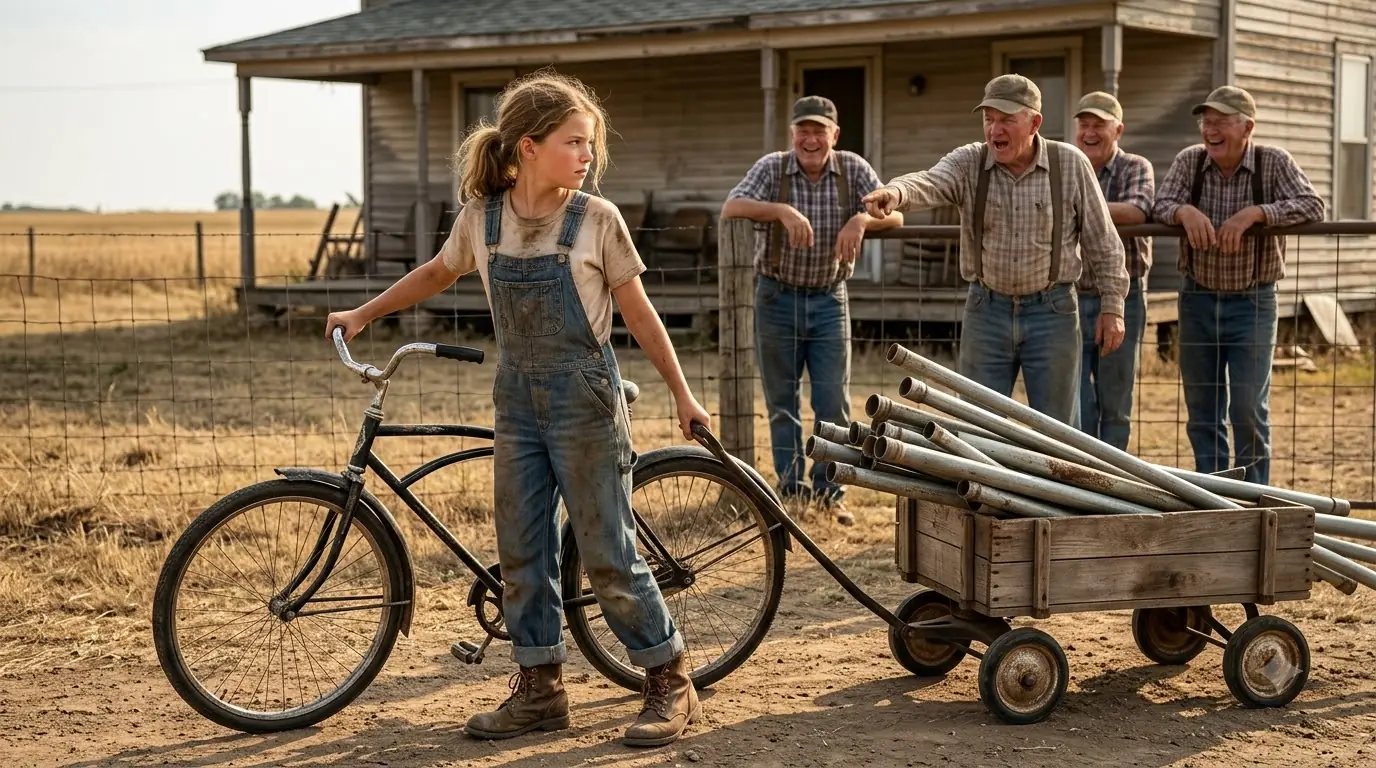
It was a countdown.
Twelve-year-old Ellie Warren understood that even when adults tried to hide it from her.
She heard the conversations through the kitchen wall after bedtime.
Her father, Daniel, speaking quietly.
Her mother, Ruth, asking the same question in different forms.
“How much time?”
“Before what?”
“Before the bank.”
Silence always followed.
That silence frightened Ellie more than numbers.
The Warrens owned one hundred twenty acres their family had farmed for nearly sixty years. It was not the most productive land in the county, but Ellie’s grandfather had raised cattle, sorghum, wheat, and feed corn there through enough difficult years that everyone assumed the farm would simply continue existing.
Her grandfather died four years earlier.
Then costs rose.
Cattle prices weakened.
A tractor engine failed.
Two medical bills arrived after Ruth needed surgery.
Daniel borrowed money against the farm.
Then the drought came.
By July, the Warrens had sold twenty-three cows.
Another twelve went a week later.
Ellie watched the stock trailer disappear down the road carrying animals she had named when they were calves.
Her father stood beside the empty pen for a long time afterward.
Ellie walked toward him.
“Are we selling all of them?”
Daniel kept staring down the road.
“No.”
“How many are staying?”
“Enough.”
“That isn’t a number.”
He looked at her.
Ellie had inherited his own habit of demanding precise answers.
He regretted teaching it frequently.
“Fourteen.”
Ellie swallowed.
They once had fifty-nine.
“What happens if it doesn’t rain?”
Daniel rubbed one hand across his face.
“It will.”
That answer told her everything.
He did not know.
The Warren farm had a shallow irrigation well near the eastern field.
Years earlier it produced enough water to flood several acres during dry periods.
Now the flow had weakened.
Daniel had cleaned the pump.
Checked the screen.
Called a well man.
The answer was simple.
The water table had dropped.
A deeper well would cost money they did not have.
Their neighbors faced the same drought, but some had better equipment.
Larger farms had center pivots.
High-capacity wells.
Diesel pumps.
Storage tanks.
The Warrens had one aging pump, several hundred feet of cracked hose, and desperation.
Ellie began paying attention to water.
Not emotionally.
Mathematically.
Her grandfather Nathan Warren had been the kind of man who wrote numbers on everything.
Rainfall on calendars.
Calf weights inside feed-shed doors.
Fuel consumption on scraps of cardboard.
He left behind boxes of agricultural pamphlets from extension offices, machinery dealers, irrigation companies, and universities.
Most adults considered them outdated.
Ellie read them.
That was partly because she loved farming.
Partly because summer was boring when there was nothing growing.
And partly because she wanted to understand why water disappeared so quickly when her father tried irrigating.
Daniel would open the ditch.
Water spread.
The first twenty feet became mud.
Another section stayed damp.
Farther rows remained almost dry.
Half the water seemed to vanish before plants received anything useful.
One evening, Ellie found a twenty-year-old agricultural bulletin folded inside her grandfather’s toolbox.
The cover showed vegetables growing beside thin pipes.
The title described low-volume irrigation methods for small plots.
Ellie read it three times.
The system in the booklet was not exactly what she needed.
Some parts required equipment she could not buy.
But the principle was obvious.
Do not water everything.
Water where roots are.
Ellie looked toward the dead field outside.
Then toward a pile of old aluminum irrigation pipe beside their machine shed.
Most sections were damaged.
Several couplings missing.
Her father had stopped using them years ago.
Ellie measured one.
Then another.
That night she drew a crude map on school notebook paper.
Pump.
Main line.
Branches.
Rows.
Small openings.
She calculated badly.
Erased.
Started again.
The next morning she dragged one section across the yard.
Daniel saw her.
“What are you doing?”
“Experiment.”
“That sounds expensive.”
“It’s free.”
“That sounds worse.”
Ellie ignored him.
She connected two old pieces.
Water sprayed from the joint immediately.
Daniel laughed.
“Engineering going well?”
Ellie tightened the clamp.
Water sprayed harder.
“Go away.”
Daniel smiled.
For the first time in days.
Then he walked over and helped.
The experiment lasted twelve minutes before one corroded section split.
Ellie stared at the water pouring onto dry ground.
Daniel closed the valve.
“That pipe’s done.”
She crouched.
“Not all of it.”
“Ellie.”
She pointed.
“Only three feet is bad.”
“The section is twenty.”
“So cut three.”
He looked at her.
Then toward the scrap pile.
“You know how many repairs that would take?”
“Less than buying new pipe.”
Daniel almost answered.
Then stopped.
New pipe was impossible anyway.
Ellie looked toward him.
“What do farmers do with old irrigation pipe?”
“Scrap it.”
“Where?”
“Depends.”
That afternoon she rode her bicycle to Mason Farm, one mile north.
A wooden wagon bounced behind her.
It had once carried garden tools.
Now it was empty.
Farmer Harold Mason stood beside his porch with two hired men.
He was sixty-seven, gray-haired, deeply tanned, and wore denim overalls over a striped work shirt.
Harold knew Ellie.
Everyone did.
“Nathan’s granddaughter.”
He called her that more often than her actual name.
Ellie stopped.
“Mr. Mason.”
“What are you hauling?”
“Nothing yet.”
One worker laughed.
“Strong business model.”
Ellie ignored him.
“You have old irrigation pipe?”
Harold pointed toward a field edge.
“Pile behind the machinery shed.”
“Can I have it?”
All three men stared.
Harold laughed.
“For what?”
“I need pipe.”
“That stuff leaks.”
“I know.”
“Couplings are gone.”
“I know.”
“Some’s crushed.”
“I’ll leave those.”
Harold looked amused.
“You planning to irrigate the county with garbage?”
“No.”
“What then?”
Ellie folded her arms.
“My field.”
The hired men laughed.
One slapped the porch railing.
Harold shook his head.
“Girl, haul your little scrap wagon home before that junk buries you with it.”
Ellie looked directly at him.
“You using it?”
“No.”
“Then can I take it?”
Harold laughed again.
“Take every piece you can pull.”
Ellie nodded.
“Thanks.”
She rode around the shed.
The pile was bigger than expected.
Thirty or forty sections.
Most too long for her wagon.
She dragged one out.
Then realized transporting it would be ridiculous.
Ellie found a hacksaw inside the farm shed after asking permission.
She cut usable portions.
Loaded shorter lengths.
Tied them with rope.
By the time she finished the first load, four men stood watching.
Another farmer had arrived.
Cliff Barker.
Behind him came Jim Wallace.
Both older.
Both bored enough to enjoy entertainment.
Cliff pointed toward Ellie.
“What is this?”
Harold laughed.
“Future irrigation tycoon.”
Jim looked into the wagon.
“That’s scrap.”
Ellie gripped the bicycle handles.
“I know what it is.”
Cliff laughed.
“Does she?”
Harold called:
“Tell them your plan.”
Ellie stared at him.
“No.”
That made them laugh harder.
Cliff stepped forward.
“Girl, those pipes are dead metal, and your field’s dead right behind them.”
Ellie turned toward him.
She had dirt across her face, grease on her overalls, and both arms ached from cutting metal.
She was tired of being entertainment.
“Then don’t blink when my crops come up and your sorry mouths go quiet.”
Nobody laughed for one second.
Then Harold exploded.
Jim nearly dropped his coffee.
Cliff pointed.
“Nathan’s granddaughter, all right.”
Ellie pushed the bicycle away.
Behind her, the wagon rattled violently.
She could hear the men laughing another fifty yards.
She did not turn around.
Over the next four days, Ellie visited six farms.
Some gave her pipe.
One charged five dollars.
Another farmer insisted she remove an entire pile if she wanted anything useful.
She agreed.
By Saturday, the Warren yard looked like a scrapyard.
Daniel returned from town.
Stopped the truck.
Stared.
“What happened?”
Ellie stood beside nearly two hundred feet of mismatched aluminum tubing.
“Resources.”
Daniel closed his eyes.
“Your mother is going to kill both of us.”
“She doesn’t know yet.”
“That makes one of us more afraid than the other.”
Ruth came outside five minutes later.
She stared.
Then looked at Daniel.
Daniel immediately pointed at Ellie.
“I had nothing to do with this.”
“Coward.”
Ruth approached the pipe.
“Explain.”
Ellie showed them the booklet.
Then the drawing.
Her idea was crude.
The weak well could not supply enough water to flood acres efficiently.
But perhaps it did not need to.
Instead of opening irrigation across entire fields, they could create smaller zones.
Use repaired pipe as a main delivery line.
Then distribute lower volumes directly along selected rows.