“Do you want me here as a wife—or just for my inheritance?”
Isabella Hart’s question entered the little ranch cabin more quietly than the afternoon wind, yet it struck Sam Whitaker harder than any fist. She stood only a few steps from him in her cream traveling dress, one hand pressed against her heart and the other resting near the unsigned marriage papers on the table. Sunlight from the single window touched her chestnut hair and revealed the tears she refused to let fall.
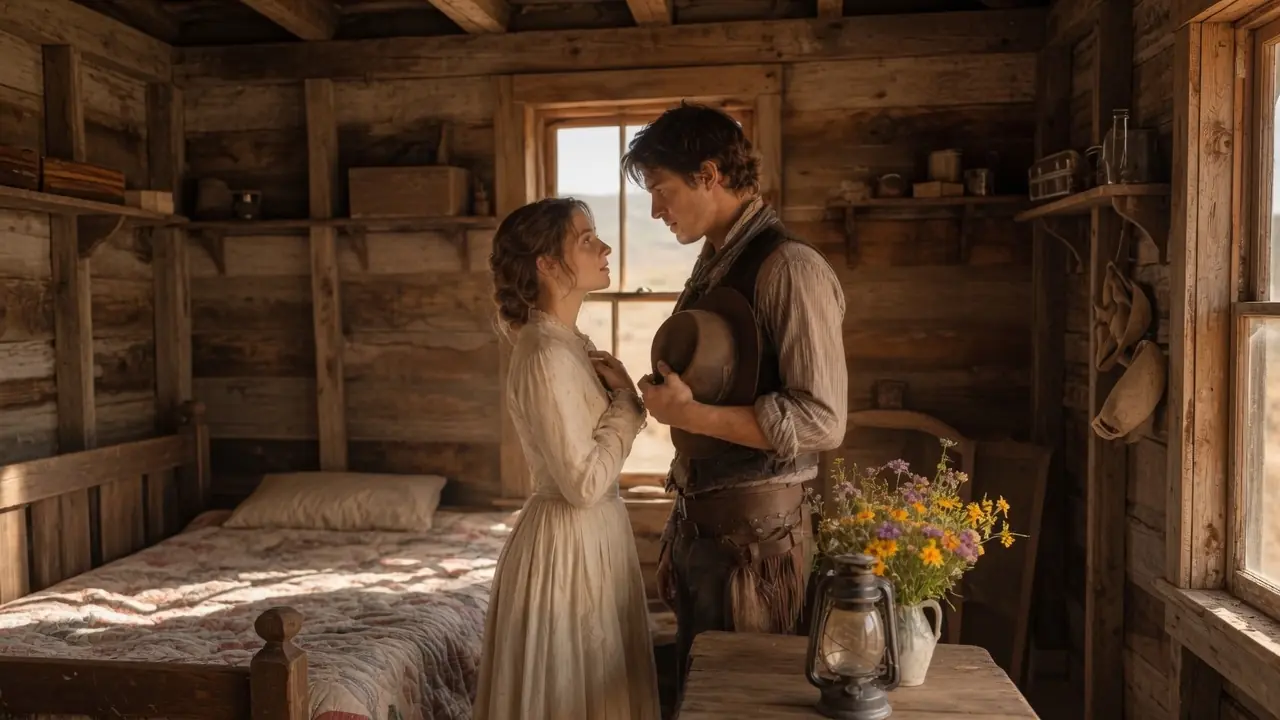
Sam held his battered hat against his chest.
“I wanted you before I knew you had a dollar,” he said.
Isabella searched his face, looking for hesitation, calculation, or any trace of the scheme she had uncovered. What she found instead was fear—the honest fear of a lonely man who had finally received something precious and had no idea how to keep it. She stepped closer, though the space between them still felt wider than the three hundred miles she had traveled.
“Then ask me to stay with nothing promised,” she whispered.
Sam’s fingers tightened around the brim of his hat.
“Stay,” he said tenderly, “and let me spend my life proving I chose you.”
The ranch house fell silent afterward. Outside, cattle moved through the dry pasture, and somewhere near the barn, a loose hinge knocked steadily against wood. Isabella wanted to believe him, but belief had already carried her across half a territory and nearly placed her inheritance in the hands of men who considered her a solution rather than a person.
She looked toward the cream-colored envelope resting on the table.
Inside were copies of the bank notices, notes about the forged correspondence, and a written account of the conversation she had overheard behind the general store. Sam’s father, Amos Whitaker, had spoken openly about using Isabella’s inheritance to save the ranch. Mr. Pike, the town banker, had laughed as though arranging a marriage under false pretenses were merely another transaction.
Sam followed her gaze.
“I read everything,” he said.
“And?”
“And I believe you.”
“That is not the same as understanding.”
“No,” Sam admitted. “But I am trying.”
Isabella moved toward the window. Beyond it, the Wind River country opened in long stretches of gold and brown beneath an enormous Wyoming sky. She had imagined this view while reading Sam’s letters in her mother’s narrow parlor back East. In those letters, he had described the quiet mornings, the hard winters, and the way stars covered the land so completely that a person felt small without feeling unimportant.
Those letters had made her fall in love with a man she had never met.
Now she did not know whether he had written them at all.
“Did you write to me?” she asked.
Sam’s jaw tightened.
“Most of the letters.”
“Most?”
“My father wrote the first one.”
The admission cut deeper than Isabella expected.
Sam continued quickly. “He placed the advertisement without telling me. When your reply arrived, he gave it to me and said I should answer because the ranch needed a woman.”
“A woman?”
“A wife,” he corrected, ashamed. “Someone who could help build a home here.”
“And someone with an inheritance.”
“I did not know about that.”
Isabella turned toward him. “When did you learn?”
“Last night, after you left the supper table.”
His father had finally confessed everything after discovering Isabella’s envelope. Amos admitted that Mr. Pike had investigated the Hart family before recommending Isabella’s letter. Her late grandfather had established a trust that would transfer to her once she married or reached twenty-six, whichever came first.
Isabella’s twenty-sixth birthday was six months away.
A marriage would have released the money immediately.
Amos believed the Whitaker ranch would fail before winter unless the bank received full payment. Three years of drought, sick cattle, and rising interest had reduced the proud property to a collection of debts disguised by weathered fences. He had convinced himself that arranging Sam’s marriage to a wealthy woman was not fraud but survival.
“He said you would benefit too,” Sam explained bitterly. “A husband, land, a respected name.”
“A respected name built on deception.”
“I told him the ranch could burn before I touched your money.”
Isabella studied him.
“What did he say?”
“That I was choosing a stranger over my blood.”
“And are you?”
Sam placed his hat on the table.
“You stopped being a stranger somewhere around your fourth letter.”
Isabella remembered that letter. She had written about her mother’s illness, the months spent caring for her, and the emptiness that followed her death. She confessed that relatives treated her inheritance as the only interesting thing about her and that every unmarried man introduced by her aunt seemed more curious about the trust than the woman who would receive it.
Sam’s reply had arrived two weeks later.
He wrote that loneliness made people think they wanted rescue when what they truly wanted was recognition. He told her she did not need to impress him with wealth, beauty, or refinement. If she came west, he wanted only honesty and the willingness to build something slowly.
“Did your father write that reply?” Isabella asked.
“No.”
“Mr. Pike?”
“No.”
“How can I know?”
Sam swallowed. “You cannot. Not yet.”
The answer was painful but honest.
He did not ask her to trust him immediately. He did not claim love should erase doubt or that his father’s desperation excused the scheme. He merely stood before her without defense, offering the truth in pieces she could inspect.
A door slammed outside.
Amos Whitaker entered the cabin carrying anger with him like a storm. He was sixty-three, broad despite age, with a gray beard and hands permanently shaped by ranch work. His eyes moved from Isabella to Sam and then to the unsigned marriage papers.
“You have embarrassed this family enough,” he told Isabella.
Sam stepped between them.
“Careful, Father.”
Amos stared at his son. “You think she cares about you? She came here searching for a husband because no respectable man back East wanted her.”
Isabella’s face went still.
Sam crossed the room so quickly that Amos took one step back.
“You will not speak to her that way.”
“I am trying to save what your grandfather built.”
“By selling me?”
“By securing your future!”
“You lied to both of us.”
Amos’s expression hardened. “A man sometimes does ugly things to protect his family.”
“No,” Sam said. “A coward calls greed protection because the word sounds cleaner.”
The older man’s hand curled into a fist.
For one moment, Isabella thought he might strike his son. Sam did not move, though he had never openly challenged his father before. His entire life had been shaped by Amos’s commands: rise before dawn, work until dark, do not complain, and never place personal wants above the ranch.
Then Amos looked at Isabella.
“You think he can offer you something better than money? My son has never courted a woman. He barely knows how to speak unless cattle are involved. You will grow tired of him within a year.”
Color rose in Sam’s face, but Isabella spoke first.
“Perhaps he has little experience because you taught him duty before affection.”
Amos laughed. “And you believe you can change him?”
“I do not want to change him.”
“Then what do you want?”
Isabella glanced at Sam.
“A choice made freely.”
She picked up the unsigned papers and tore them down the middle. The sound was small, but Amos reacted as though she had fired a gun. She tore them again, let the pieces fall onto the table, and retrieved her gloves.
“The wedding arrangement is finished,” she said.
Sam’s face paled.
“Isabella—”
“I said the arrangement is finished. I did not say what comes after.”
She left the cabin before either man could answer.
For the next five days, Isabella remained at Mrs. Bennett’s boardinghouse in Wind River. The town’s curiosity followed her everywhere. Women lowered their voices when she entered the general store, men watched from beneath hat brims, and children whispered that the eastern bride had rejected the Whitaker cowboy before the wedding.
Isabella ignored them.
She wrote to her mother’s attorney, Mr. Charles Bell, explaining that no marriage would occur and instructing him to freeze any attempt to access the trust. She also requested an investigation into Mr. Pike, who had used private banking information to identify her as a financial target.
Mr. Bell’s reply arrived by telegraph.
DO NOT SIGN ANYTHING. REPRESENTATIVE DEPARTS TOMORROW.
The message offered protection but not clarity.
Isabella still had to decide whether Sam’s affection belonged to him or to the future his father had designed. She reread his letters each night, studying changes in handwriting and tone. The first letter was stiff and formal, while those that followed became warmer, clumsier, and unexpectedly observant.
Sam remembered small things.
He remembered that she hated lilies because their scent filled the room where her mother died. He remembered she preferred coffee without sugar and that she wanted a garden with herbs rather than decorative roses. He once sent pressed wildflowers from the ranch, apologizing because he did not know their names.
Those details could not have come from Amos.
On the sixth morning, someone knocked on the boardinghouse door before sunrise.
Mrs. Bennett answered and called upstairs.
“Miss Hart, the cowboy is here.”
Isabella descended wearing a simple blue dress and found Sam waiting in the front parlor. He had shaved, washed the dust from his boots, and carried no flowers or gifts. In his hands was a wooden box.
“I will leave if you ask,” he said.
“What is in the box?”
“The truth I can prove.”
He placed it on the table.
Inside were copies of every letter Isabella had sent, tied in careful bundles. Beside them rested pages of Sam’s unfinished replies, covered in crossed-out sentences and repeated attempts to express thoughts he had never spoken aloud.
There was also a bank document.
Sam had transferred his legal share of the ranch to a trust that Amos could not control. The property could no longer be pledged against Isabella’s inheritance or used as leverage in any marriage negotiation. If the bank foreclosed, Sam would lose everything with no claim against her.
“You did this yesterday?” Isabella asked.
“Yes.”
“Why?”
“Because asking you to believe me while I still benefited from the lie would make me another liar.”
She lifted the document. “Your father will never forgive you.”
“He may.”
“And if he does not?”
Sam looked toward the pale morning beyond the window.
“I spent thirty-one years obeying him because I thought obedience made me a good son. It only made me useful.”
The words echoed her own fear of being valued for money rather than self.
“What will you do if the bank takes the ranch?”
“Work.”
“Where?”
“Anywhere that hires me. Another spread. The railroad. Freight wagons.”
“You would abandon your home?”
“I would abandon every acre before I made you pay for being deceived.”
Isabella’s throat tightened.
Sam continued, “I am not asking you to marry me. I am asking for permission to court you honestly, without papers, deadlines, or promises about your money.”
“And if I return East?”
“Then I will write, if you allow it.”
“And if I never come back?”
He looked directly into her eyes.
“Then knowing you will still have been the finest thing that happened to me.”
Isabella had expected persuasion.
Instead, he gave her freedom.
She touched the rough pages of his unfinished letters and imagined the lonely cowboy sitting beneath an oil lamp, searching for words while believing the woman who received them might never cross his path. No skilled deceiver would leave so many failed sentences behind.
“Walk with me,” she said.
They left the boardinghouse and followed the edge of town toward the open plain. Morning light spread across the grass, turning every blade pale gold. Sam kept a respectful distance, though Isabella could feel his attention beside her.
“Your father said you had never courted anyone,” she said.
“That is true.”
“Never?”
“No.”
“Why?”
Sam’s ears turned red. “Women make me nervous.”
“Cattle do not?”
“Cattle usually announce when they intend to injure me.”
Isabella laughed before she could stop herself.
Sam looked startled, then smiled.
It was the first time she had seen his entire face soften. He was handsome when serious, but his smile transformed him into the man she recognized from his letters—quiet, thoughtful, and slightly surprised whenever life offered kindness.
They walked until the roofs of Wind River disappeared behind them.
“I am afraid,” Isabella admitted.
“So am I.”
“I crossed three hundred miles expecting marriage. Now I do not know whether staying makes me brave or foolish.”
“Stay until you know.”
“At the boardinghouse?”
“At the ranch, if you prefer. You may have the cabin. I will sleep in the bunkhouse.”
“And your father?”
“He left yesterday.”
“Where?”
“To my uncle’s spread near Casper.”
Isabella stopped. “You forced him out?”
“I gave him a choice. Remain and treat you with respect, or leave.”
“And he left.”
“Yes.”
The sadness in Sam’s voice revealed that choosing Isabella had not erased his love for his father. It had merely forced him to stop confusing love with submission. Isabella understood that kind of grief.
She returned to the ranch that afternoon.
Sam moved his belongings into the bunkhouse and gave her the cabin key without entering behind her. He worked during the day, while Isabella restored order inside the neglected house. She did not behave as his wife, and he never asked her to.
They began again as two people rather than a transaction.
Sam taught her to saddle the gentlest mare. Isabella showed him how to prepare tea properly and laughed when he insisted boiled leaves tasted like wet grass. They cooked supper together, often producing meals neither wanted to claim.
At night, they sat on the porch and talked.
Sam spoke of his mother, who died when he was fourteen. Amos responded to grief by becoming harder, teaching his son that tenderness created weakness. Sam learned to hide emotion so completely that he eventually struggled to recognize it even in himself.
Isabella spoke of men who courted her after learning about the inheritance. One proposed marriage during their third meeting and became angry when she asked whether he knew her favorite book. Another told her that wealthy women should be grateful when men overlooked their independence.
“Then my letter arrived,” Sam said.
“Yes.”
“And you thought a silent cowboy in debt was safer?”
“I thought a man who admitted loneliness might at least understand mine.”
He looked toward her beneath the stars.
“Do I?”
“More each day.”
Two weeks later, Mr. Bell’s representative arrived from the East with evidence against Mr. Pike. The banker had accessed confidential records through a cousin employed at Isabella’s family bank. He had then encouraged Amos to advertise for a bride while presenting Isabella’s reply as a fortunate coincidence.
Mr. Pike was arrested for fraud and misuse of banking information.
His records revealed another surprise.
The Whitaker debt was smaller than Amos claimed. Mr. Pike had inflated interest, added illegal fees, and prepared to seize the ranch regardless of whether Isabella married Sam. Her inheritance would have delayed the theft but not prevented it.
With the fraudulent charges removed, the ranch still faced hardship, but survival became possible.
Sam did not celebrate.
He stood outside the courthouse and watched Amos approach from across the street. The older man looked diminished without the ranch behind him. His shoulders remained broad, but shame had bent them.
“I was wrong,” Amos said.
Sam waited.
“I believed Pike because he offered an answer when I had none. Then I kept believing because admitting the truth meant admitting I had risked my son’s honor.”
“You risked Isabella’s life too.”
“I know.”
Amos looked toward her.
“I cannot ask forgiveness.”
“No,” Isabella agreed. “You cannot ask for what you have not earned.”
He accepted the words.
Amos returned to his brother’s ranch and began repaying money he had borrowed under false claims. He wrote to Sam occasionally, never demanding a reply. Months passed before Sam answered the first letter.
Trust, Isabella learned, returned as slowly as grass after drought.
Summer settled over Wind River.
The orchards Isabella planted behind the cabin were only young saplings, unlikely to produce fruit for years. Sam teased her for creating work without immediate reward. She told him that some things were worth planting precisely because someone else might enjoy them later.
Their courtship unfolded without urgency.
Sam brought her wildflowers but finally learned their names. Isabella repaired his shirts and made it clear that sewing did not mean accepting a wife’s role. They attended church socials, town dances, and one disastrous picnic where wind carried their tablecloth into the river.
During the autumn harvest dance, Sam stood at the edge of the hall for nearly an hour before gathering enough courage to approach her.
“Would you dance with me?”
“Have you danced before?”
“No.”
“Then this may be dangerous.”
“I warned you cattle were easier.”
She took his hand.
Sam stepped on her shoe twice, turned in the wrong direction, and nearly collided with the pastor. Isabella laughed until tears filled her eyes. By the final song, however, his movements became steadier.
He held her as though she were precious without treating her as fragile.
That winter, the ranch survived.
Sam sold a portion of the cattle, repaired fences himself, and accepted freight work in town during the coldest months. Isabella used none of her inheritance, though she contributed money earned by teaching reading and arithmetic to local children.
They built something together without allowing wealth to become its foundation.
On the first anniversary of her arrival, Sam led Isabella to the hill overlooking the ranch. The sunset spread red and gold across the plains, and the cabin windows glowed below them.
He removed his hat.
Isabella smiled. “You only hold it like that when terrified.”
“I am.”
“Should I fetch a cow so you feel safer?”
“Please do not make this harder.”
She waited.
Sam took a small silver ring from his pocket. It had belonged to his mother, but the stone was new—a modest blue sapphire purchased with wages from his freight work.
“I have no great speech,” he said.
“I would distrust you if you did.”
He breathed slowly.
“I cannot promise an easy life. The ranch may fail someday despite everything we do. I will say the wrong thing, forget important things, and probably never learn to dance properly.”
“All convincing reasons so far.”
“But I can promise you will never be payment for my debts. You will never be required to become smaller so I can feel bigger. And if you choose me, I will choose you every morning without asking what you own.”
Isabella’s vision blurred.
Sam continued, “Do you want me here as a husband, Isabella—not because of land, loneliness, or the letters, but because I am the man you want beside you?”
She recognized her own question returned with all deception removed.
“Yes,” she whispered. “I do.”
They married beneath the cottonwood trees the following spring.
The ceremony was small. Mrs. Bennett brought flowers from her garden, the schoolchildren scattered petals, and Amos stood at the back without expecting inclusion. After the vows, Isabella walked to him and offered her hand.
“This is not forgiveness,” she said.
“I understand.”
“It is the beginning of an opportunity to earn it.”
Amos’s eyes filled.
“That is more than I deserve.”
Years later, the ranch became profitable again. Not because Isabella surrendered her inheritance, but because she and Sam diversified the property, planted orchards, raised horses, and opened a boardinghouse for travelers passing through Wind River.
Isabella eventually received her trust.
She used part of it to establish a school and legal fund for women traveling west under marriage arrangements. Every woman received independent counsel before signing papers, private transportation if she wished to leave, and control over her own money.
Sam supported the work without controlling it.
Their marriage was not perfect. They argued about cattle, money, weather, and Sam’s habit of leaving boots in the doorway. But no disagreement ever made Isabella question whether she was loved for herself.
On quiet evenings, they stood together in the same cabin where she had once demanded the truth.
Sometimes Sam held his hat against his chest and repeated his first honest proposal.
“Stay, and let me spend my life proving I chose you.”
Isabella would place her hand over his.
“You already have.”
The inheritance eventually helped their family, but it never rescued the ranch.
Love did not erase the deception that brought Isabella west, nor did it excuse the men who tried to use her. Instead, love began only after the scheme was exposed, the papers were torn, and both people were free to walk away.
She stayed because Sam gave her that freedom.
He won her heart not by claiming her, purchasing her, or needing her money.
He won it by choosing her when choosing her meant losing everything else.